
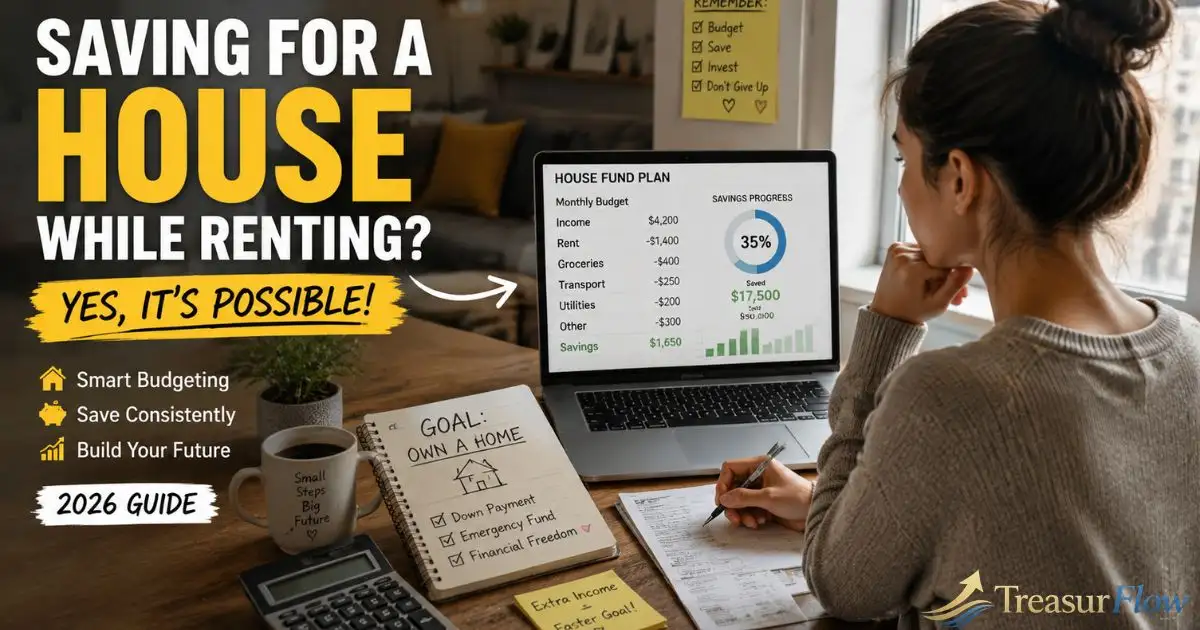
There is no single number, but most first-time buyers need:
- Down payment: 3% to 20% of home price
- Closing costs: 2% to 5%
- Emergency buffer: 3–6 months of expenses
Example:
For a $300,000 home:
- Minimum down payment: ~$9,000 (FHA loan)
- Typical comfortable down payment: $20,000–$60,000
- Closing costs: $6,000–$15,000
👉 Realistically, most buyers aim to save $25,000–$70,000 total
Can You Afford a House Based on Your Salary?
Let’s break it down realistically.
If you earn $50,000/year:
- Affordable home range: $150K–$220K
- Tight budget, requires low debt
If you earn $70,000/year:
- Affordable home range: $200K–$320K
- Comfortable if debt is controlled
If you earn $100,000/year:
- Affordable home range: $300K–$450K+
- Strong approval chances
👉 Lenders typically use a 28/36 rule:
- 28% of income for housing
- 36% total debt limit
Rent vs Buy in 2026 — What Actually Makes Sense?
Renting is not “wasted money” — it is flexibility.
Buying is not always better — it is commitment.
Renting is better if:
- You move frequently
- Income is unstable
- You have low savings
Buying is better if:
- You plan to stay 5+ years
- You have stable income
- You are building long-term wealth
👉 The real decision is not emotional — it is financial timing.
Step-by-Step Strategy to Save Money for a House While Renting
Step 1: Fix your savings baseline
Start with 10–20% of your income, even if small.
Step 2: Separate your house fund
Open a high-yield savings account specifically for down payment savings.
Step 3: Control rent ratio
Try to keep rent under 30–35% of income.
Step 4: Cut invisible expenses
Subscriptions, food delivery, and unused services often drain $200–$600/month.
Step 5: Automate savings
Set automatic transfers right after payday.
How to Save $10,000 Faster While Renting
To save $10,000 quickly, you need structure, not motivation.
Example plan:
- Save $833/month → 12 months
- Save $1,250/month → 8 months
- Save $2,500/month → 4 months
Ways to speed it up:
- Freelance or side income
- Reduce fixed expenses
- Temporarily downsize lifestyle spending
Best Place to Store Your House Savings
The safest option is a:
High-Yield Savings Account
Benefits:
- Low risk
- Easy access
- Earns interest (better than normal savings)
Other options:
- Money market accounts
- Short-term CDs (if timeline is fixed)
Mistakes That Stop People From Buying a House
Most people fail not because of income, but because of behavior:
- Waiting for “perfect timing”
- Lifestyle inflation
- No separate savings account
- High-interest debt
- Emotional spending
Real Mindset Shift: How People Actually Become Homeowners
Homeownership is not a one-time decision — it is a system of habits.
People who succeed:
- Save automatically
- Think in years, not months
- Avoid emotional spending
- Treat housing as a financial plan, not a dream
Your Monthly Savings Plan: Example Numbers That Actually Work
Advice like “just save more” is useless without real numbers. Here is what a practical monthly plan looks like for a renter earning $70,000 a year — roughly $4,600 a month after taxes, depending on your state:
- Rent: $1,600
- Essential bills and groceries: $1,200
- Debt payments: $300
- Personal spending: $300
- House savings: $1,200
That is $1,200 a month going straight into the house fund — $14,400 in one year — without changing your job or cutting your lifestyle to the bone.
What if you earn less?
On a $50,000 salary (about $3,400 a month take-home), the same structure works at a smaller scale. If your rent is $1,200 and you keep other spending tight, saving $700 a month adds up to $8,400 a year. The amount matters less than the habit — consistency is what turns renters into homeowners.
The 50/30/20 tweak for future homeowners
Try a modified budget: 50% for needs, 20% for wants, and 30% straight into the house fund. On a $4,600 take-home pay, that is $1,380 a month toward the down payment — enough to cross $40,000 in under three years once interest is included.
High-Yield Savings Accounts: The Best Home for Your Down Payment
A regular checking account pays almost nothing, and cash sitting idle loses value to inflation every year. A high-yield savings account (HYSA) is the middle ground most first-time buyers use: your money stays safe and instantly accessible, but it actually grows while you save.
👉 Example: $20,000 in an HYSA earning 4.50% APY grows by about $900 in a year — free money toward your closing costs, with zero market risk.
What to look for in a down payment account
- APY of 4% or higher
- No monthly fees or minimum-balance traps
- FDIC insurance up to $250,000
- Fast transfers so you can move money when you find the right house
Before you open an account, compare current high-yield rates on Bankrate — rates change often, and the best account today may not be the best one next quarter.
Keep this account completely separate from your emergency fund and daily spending. When the money is out of sight at a different bank, you stop treating it as spendable.
First-Time Homebuyer Assistance Programs Worth Knowing
Here is something most renters do not realize: you probably do not need a 20% down payment. Federal, state, and local programs exist specifically to help first-time buyers get in with far less saved — yet most renters never look into them.
FHA loans: buying with 3.5% down
Loans backed by the Federal Housing Administration let qualified buyers put down as little as 3.5%. On a $300,000 home, that is about $10,500 instead of $60,000. You can read the official program details on the HUD website.
FHA loans do require mortgage insurance premiums, so always compare the total monthly cost — but for renters with limited savings, they are often the fastest realistic path to ownership.
State and local first-time buyer programs
Almost every state runs a housing finance agency offering down payment assistance, below-market mortgage rates, or tax credits for first-time buyers. Many of these programs provide grants you never repay or forgivable second loans, and income limits are often higher than people expect. Search for “[your state] housing finance agency first-time homebuyer” to see what you qualify for.
Grants and free homebuying education
Some employers, unions, and nonprofits offer homebuyer grants or matched savings programs. The Consumer Financial Protection Bureau also publishes free, unbiased homebuying guides at consumerfinance.gov that explain loans, closing costs, and assistance options in plain language.
👉 Check assistance programs before assuming you need $50,000+ saved. Many buyers close with far less out of pocket than they expected.
Cutting Rent Costs: House Hacking and Negotiating Rent
Rent is usually a renter’s biggest expense — which also makes it the biggest savings opportunity. Two strategies work especially well while you are saving for a house. While renting, also protect your belongings with the best renters insurance 2026.
House hacking: let someone else pay part of your rent
House hacking simply means offsetting your housing cost. Rent out a spare bedroom, take on a roommate for a year or two, or — when you are ready — buy a small multi-unit property, live in one unit, and let tenants cover most of the mortgage.
👉 Example: your rent is $1,600 and a roommate pays $700. Your effective housing cost drops to $900, freeing $700 a month — that is $8,400 a year straight into the house fund.
How to negotiate rent (yes, it works)
Most renters never try, but landlords negotiate more often than you would think — especially at renewal time:
- Research comparable rents in your area before renewal
- Offer to sign a longer lease in exchange for a lower rate
- Ask for upgrades or waived fees if the landlord will not budge on price
- Time your ask: leverage is highest when a unit might otherwise sit empty
Even a $100 monthly reduction saves $1,200 a year — nearly a full extra month of house savings, for free.
Automate Your Savings So You Never Miss a Month
Willpower is unreliable; systems are not. The renters who actually reach their down payment goal treat savings like a bill that gets paid first — automatically, every single month.
- Set an automatic transfer to your house fund for the day after payday
- Keep the house fund at a different bank so raiding it takes real effort
- Increase the transfer by half of every raise or bonus you receive
- Use round-up features that sweep spare change into savings
Start with whatever you can — even $200 a month — and raise the amount over time. An automated $500 monthly transfer quietly becomes $6,000 a year without a single decision.
A Realistic Timeline: From Renter to Homeowner in 3 Years
Big goals feel impossible until you break them into years. Here is what the journey can look like for a renter saving about $1,000 a month toward a $300,000 home:
Year 1 — Build the foundation ($12,000 saved)
- Open a separate high-yield savings account for the house fund
- Build a small $2,000–$3,000 emergency buffer first
- Automate a $1,000 monthly transfer and cut one major expense
Year 2 — Accelerate ($24,000+ saved)
- Add side income or a roommate to push savings to $1,200–$1,500 a month
- Check your credit reports and fix errors hurting your score
- Research FHA and state first-time buyer programs you may use
Year 3 — Get ready to buy ($36,000–$45,000 saved)
- Get pre-approved to learn exactly what lenders will offer you
- Keep saving while you tour homes and compare neighborhoods
- Avoid new debt — no car loans or credit card splurges before closing
👉 Three years feels long on day one, but most homeowners look back and say the time passed faster than expected. The key is starting the system now instead of waiting for the “right time.”
FAQs
Can I save for a house while renting in the USA?
Yes, by separating savings, controlling expenses, and using structured budgeting.
Is it better to rent or buy in 2026?
It depends on income stability, savings rate, and long-term plans.
How much money do I need for a house?
Most buyers need $20,000–$70,000 including down payment and costs.
How long does it take to save for a house?
Typically 1–5 years depending on income and savings rate.
Can I afford a $300K house on $70K salary?
Yes, if debt is low and monthly payments stay within lender guidelines.
What is the fastest way to save for a down payment while renting?
Combine the big levers at once: house hack or get a roommate to cut housing costs, automate a fixed monthly transfer into a high-yield savings account, and add temporary side income. A renter saving $2,000 a month can build a $24,000 down payment fund in a single year.
Can I get a mortgage in the USA with a low down payment?
Yes. FHA loans allow as little as 3.5% down, and some conventional first-time buyer programs allow 3–5%. State assistance programs can cover part of the down payment or closing costs on top of that.
Should I invest my down payment savings in stocks?
For a goal less than five years away, no. The stock market can drop 20% or more in a bad year — right when you need the money. Keep down payment savings in a high-yield savings account or money market account where the principal is safe.
How much should I keep in my emergency fund while saving for a house?
Aim for 3–6 months of essential expenses, kept completely separate from your down payment fund. Buying a house with zero cash cushion is risky — one broken furnace or medical bill right after closing can force you into high-interest debt.
Conclusion
Saving for a house while renting is not about earning more instantly — it’s about building a system that steadily moves you toward ownership.
If you:
- Control expenses
- Automate savings
- Use the right savings tools
- Understand affordability early
Then homeownership becomes a timeline, not a dream.

Muhammad Zakir is the founder of Treasurflow and the author of its personal finance guides. He researches consumer banking, credit, and personal loans, and every guide cites primary sources such as the CFPB, FDIC, FTC, and IRS. His content is educational and is not personalized financial advice.
2 thoughts on “Renting But Want a House? Here’s How People in the USA Actually Save for One”