
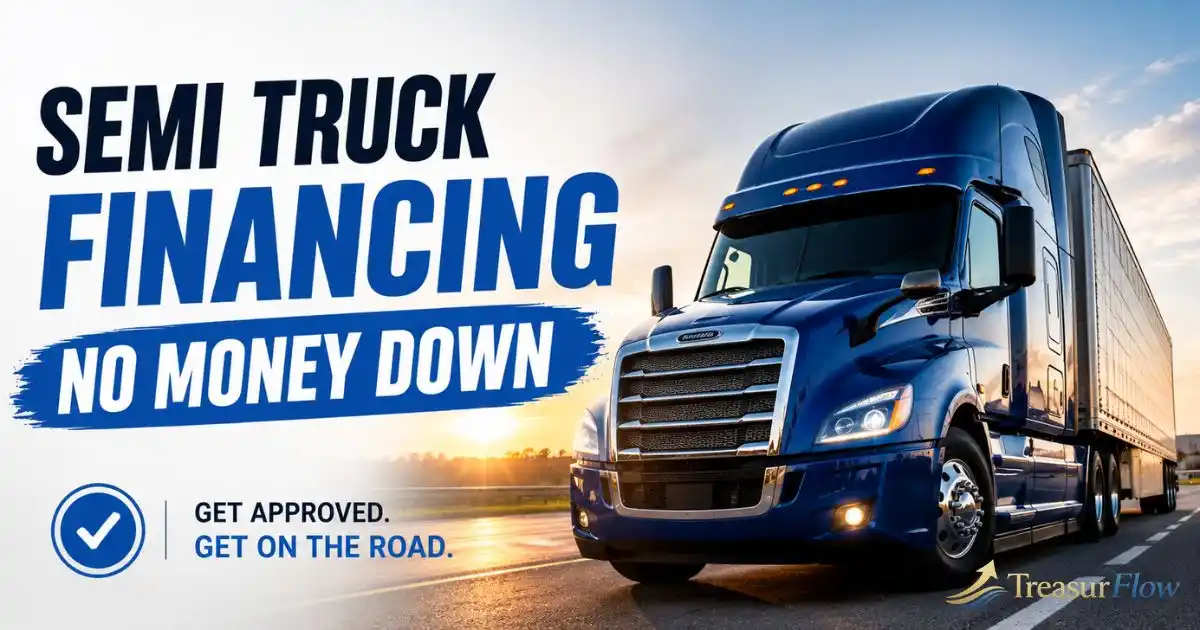
If you need a used semi truck but don’t have enough cash for a large down payment, you may be wondering whether used semi truck financing with no money down is possible. Depending on the lender, truck, and your financial profile, financing options may be available with little or no money required upfront.
Your credit history is only one part of the picture. Lenders may also consider your income or business finances, the truck you’re purchasing, its age and value, your existing financial obligations, and other eligibility requirements.
This guide explains how no-money-down semi truck financing works, what lenders may look at, how credit can affect your options, what your monthly payment could look like, and how to compare financing offers before you apply.
Can You Finance a Used Semi Truck With No Money Down?
Yes, some financing programs may allow you to finance a used semi truck with little or no down payment, but approval and terms depend on the lender and your individual circumstances.
A $0-down arrangement can reduce the amount of cash you need to put toward the truck initially. That can be important for owner-operators who need to preserve working capital for expenses such as insurance, fuel, maintenance, registration, and other operating costs.
However, no money down does not necessarily mean no upfront costs. Depending on the transaction, you may still have expenses related to taxes, registration, insurance, documentation, or other requirements.
Before accepting any financing offer, look beyond the down payment and consider the:
- Amount financed
- Interest rate or APR
- Loan term
- Monthly payment
- Financing fees
- Total repayment amount
- Other upfront expenses
The goal isn’t simply to find a $0-down offer. It’s to find financing that fits your budget and business situation.
How Does No-Money-Down Semi Truck Financing Work?
With traditional financing, a buyer contributes part of the purchase price as a down payment and finances the remaining balance.
With a zero-down structure, the lender may finance a larger portion of the truck’s purchase price.
For example, if a truck costs $70,000, a traditional transaction might require the buyer to contribute part of that amount upfront. A qualifying $0-down arrangement could potentially finance the full purchase price, subject to the lender’s requirements and the overall transaction.
What Does “$0 Down” Actually Mean?
“$0 down” generally refers to the amount applied toward the purchase price at closing. It doesn’t automatically mean that you will have no other expenses.
Ask the lender or financing provider to clearly explain:
- What amount is being financed
- Whether fees are included
- Whether taxes or registration are included
- Whether insurance is required before funding
- Whether there are other cash requirements
- What the total repayment will be
Zero Down vs. Low Down Payment
Zero down can preserve more of your cash, but a larger down payment may reduce the amount you need to finance.
A larger down payment can potentially result in a lower monthly payment and less interest paid over time. On the other hand, keeping cash available may be valuable for an owner-operator who needs working capital.
The right choice depends on your finances, business needs, and the actual financing terms available to you.
What Credit Score Do You Need to Finance a Semi Truck?
There isn’t one universal credit score that guarantees approval for every semi truck financing program.
Different lenders can have different underwriting requirements. Your credit score may be important, but lenders can also consider your broader financial profile and the truck being financed.
Factors that may be considered include:
- Credit history
- Income or business revenue
- Cash flow
- Existing debt obligations
- Time in business
- Truck age and value
- Requested loan amount
- Down payment
- Financing terms
Soft-Pull Pre-Qualification vs. Hard Credit Checks: What You Should Know
If you’re looking for semi truck financing with no money down, you may hesitate to apply because you’re worried that every financing application will result in a hard credit inquiry.
That concern is understandable. When you’re comparing financing options—especially with less-than-perfect credit—you don’t want to submit multiple applications without knowing whether each one could affect your credit profile.
The good news is that some lenders offer pre-qualification using a soft credit inquiry, which generally does not affect your credit score. However, you should always confirm the type of credit inquiry being used before submitting your information.
What Is a Soft Credit Inquiry?
A soft credit inquiry, sometimes called a soft pull, is a credit check that does not generally affect your credit score.
A lender may use a soft inquiry during an initial pre-qualification process to help determine whether you may fit certain financing criteria.
For example, you might provide basic information about your:
- Credit profile
- Business
- Income or revenue
- Desired truck
- Financing amount
The lender may then provide an initial indication of potential eligibility or financing options.
Importantly, pre-qualification is not the same as final approval.
The lender may need additional information and a hard credit inquiry before completing the final underwriting process.
What Is a Hard Credit Inquiry?
A hard credit inquiry can occur when you formally apply for credit and authorize a lender to review your credit as part of the lending decision.
Unlike a soft inquiry, a hard inquiry may affect your credit score.
This is why it can be helpful to understand a lender’s application process before submitting multiple full applications.
Ask:
“Will this application require a hard credit inquiry?”
Also ask:
“Can I pre-qualify using a soft credit inquiry first?”
Getting those answers before applying can help you make more informed decisions.
Does Pre-Qualification Hurt Your Credit?
If a lender specifically states that its pre-qualification process uses a soft inquiry, that inquiry generally does not affect your credit score.
However, don’t assume that every pre-qualification process works this way.
Some lenders may use different processes, and the credit inquiry used during final underwriting may be different from the inquiry used during pre-qualification.
Before submitting an application, verify:
- Whether the initial inquiry is soft or hard
- Whether a hard inquiry occurs later
- When the hard inquiry occurs
- Whether pre-qualification is an actual financing offer or only an initial estimate
- What information is required for final approval
Does a Soft Pull Guarantee Semi Truck Financing Approval?
No.
A soft-pull pre-qualification can help you understand whether you may fit a financing program, but it does not guarantee approval.
Final approval may depend on a more complete review of factors such as:
- Credit history
- Income or business revenue
- Cash flow
- Existing obligations
- Truck value and condition
- Loan amount
- Business experience
- Documentation
- Lender-specific requirements
Think of pre-qualification as an initial screening, not a promise that financing will be finalized.
Why Pre-Qualification Can Be Useful for $0-Down Financing
If your goal is semi truck financing with no money down, pre-qualification may help you understand your potential options before committing to a full application.
This can be especially useful when you are:
- Comparing financing providers
- Shopping for a used semi truck
- Concerned about your credit
- A first-time owner-operator
- Trying to preserve cash
- Unsure how much you may qualify to finance
Instead of immediately asking, “Will I get approved?”, a better first question can be:
“Can I find out what financing options I may qualify for without starting a full credit application?”
How to Approach Pre-Qualification
Before submitting your information, follow these steps:
1. Ask about the credit inquiry
Confirm whether the initial pre-qualification uses a soft or hard inquiry.
2. Provide accurate information
Income, business details, requested financing amount, and truck information should be accurate. Incorrect information can produce misleading results.
3. Understand that terms may change
An initial estimate may not reflect the final financing terms.
4. Compare the complete offer
Don’t compare lenders based only on whether they offer $0 down. Look at the APR, amount financed, payment, term, fees, and total repayment.
5. Confirm before accepting
Before moving from pre-qualification to a formal application, understand when a hard inquiry may occur and what additional documentation will be required.
Soft Pull vs. Hard Pull
| Feature | Soft Inquiry | Hard Inquiry |
|---|---|---|
| Typically affects credit score? | Generally no | May affect your score |
| Commonly used for initial pre-qualification? | Sometimes | Less commonly for initial screening |
| Used for final underwriting? | Not necessarily | Commonly possible |
| Guarantees approval? | No | No |
| Should you verify with lender? | Yes | Yes |
Can You Compare Semi Truck Financing Without Applying Everywhere?
In some cases, yes. If a financing provider offers a genuine soft-pull pre-qualification process, you may be able to get an initial indication of potential eligibility without immediately proceeding to a full credit application.
But the exact process varies by lender.
Never assume “pre-qualification” automatically means “no hard credit check.” Confirm the inquiry type before submitting an application.
What to Ask a Financing Provider
If you’re concerned about your credit, these questions can save you unnecessary uncertainty:
- Do you offer pre-qualification?
- Does pre-qualification use a soft credit inquiry?
- Will checking my options affect my credit score?
- When would a hard inquiry occur?
- Is pre-qualification a financing offer or only an estimate?
- What information do you need initially?
- What additional requirements apply to final approval?
- Are $0-down options available for my situation?
Key Takeaway
If you’re searching for semi truck financing with no money down, you don’t necessarily have to jump straight into a full application without understanding the process.
A soft-pull pre-qualification, when offered, can provide an initial look at potential financing eligibility without the same credit-score impact generally associated with a hard inquiry.
However, pre-qualification is not guaranteed approval, and policies differ between financing providers. Always ask whether the inquiry is soft or hard and when a hard credit check may occur.
Understanding that distinction can help you compare financing options more confidently while minimizing unnecessary applications.
Can You Finance a Semi Truck With Bad Credit?
Bad credit can make financing more difficult, but it doesn’t necessarily mean every financing option is unavailable.
If your credit profile is less than ideal, you may want to focus on understanding the factors that lenders consider and preparing your application carefully.
Depending on the financing program, other parts of your financial profile may help demonstrate your ability to repay the financing.
If traditional lenders decline your application due to past credit challenges,
Exploring dedicated in-house financing programs or alternative no-credit-check engine-replacement financing can keep your commercial operations moving without significant upfront capital…
Section 179 Tax Deductions for Semi Truck Financing No Money Down
For many owner-operators and small trucking businesses, tax savings can be just as important as financing terms. One of the most commonly discussed benefits is the Section 179 deduction, which may allow you to deduct a large portion—or in some cases the full cost—of a qualifying semi truck in the year it’s placed into service.
What Is Section 179 for Semi Trucks?
Section 179 is a part of the U.S. tax code that allows businesses to deduct the cost of qualifying equipment, including certain commercial vehicles, instead of depreciating that cost over several years.
For a semi truck, this means:
- You may be able to deduct a significant portion of the purchase price in the same tax year
- The deduction is based on the truck being used for business purposes
- The truck must be placed into service within the tax year
- The deduction is subject to IRS limits and eligibility rules
This is one reason many buyers consider financing before year-end.
Can You Use Section 179 With No-Money-Down Financing?
Yes—financing a semi truck with no money down, IRS Section 179 equipment deduction guidelines may still allow you to claim Section 179, because the deduction is based on the purchase and use of the asset, not how much you paid upfront.
In simple terms:
- You don’t need to pay cash for the full truck
- You may still be able to deduct the cost of the truck (if eligible)
- Your monthly payments continue, but you may benefit from a tax deduction in the same year
This creates a powerful combination for some buyers:
Put the truck to work + keep your cash reserves intact + potentially lower your tax burden
However, eligibility depends on your specific financial and tax situation.
Why Section 179 Matters for Owner-Operators
For trucking businesses, cash flow is critical. Section 179 can potentially help:
- Reduce taxable income for the current year
- Offset business profits
- Improve short-term cash flow
- Make it easier to justify a truck purchase within the current tax cycle
This is especially relevant if:
- You had a strong revenue year
- You’re expanding your fleet
- You need equipment quickly but want to manage tax exposure
Section 179 vs. Depreciation Over Time
Without Section 179, a semi truck is typically depreciated over several years.
With Section 179:
- A larger portion of the cost may be deducted immediately
- Instead of spreading deductions across years, you may realize them upfront
This difference can significantly affect how quickly you recover the cost of the asset for tax purposes.
Important Considerations Before Claiming Section 179
While Section 179 can be beneficial, it’s not automatic or universal.
Before relying on it, consider:
- Whether your business has enough taxable income to benefit
- Whether the truck qualifies under IRS rules
- Annual deduction limits
- Business-use percentage requirements
- How financing terms affect your overall cash flow
Key Takeaway
Semi truck financing no money down combined with Section 179 can be a powerful strategy for some buyers—but it should be evaluated carefully.
The right approach depends on:
- Your business income
- Your tax situation
- Your financing terms
- Your long-term goals
Before making a decision, it’s wise to review your situation with a qualified tax professional who understands commercial trucking and equipment financing.
Do You Need a CDL or Driving Experience to Finance a Semi Truck?
If you’re a first-time owner-operator looking for semi truck financing with no money down, you may wonder whether you need a CDL or previous trucking experience before you can qualify for financing.
The important distinction is this: a CDL requirement and a financing requirement are two different things. Federal and state regulations determine whether you are legally permitted to operate a particular commercial motor vehicle, while a lender determines whether your financial and business profile meets its underwriting requirements.
FMCSA Commercial Driver’s License regulations, a Class A CDL generally applies to combination vehicles with a GCWR of 26,001 pounds or more…
Is a CDL Required Before You Finance a Semi Truck?
Not necessarily.
A person may be able to purchase or finance a commercial truck without personally operating it. For example, a fleet owner may finance a truck that will be driven by an employee who holds the appropriate license.
However, if you intend to personally operate a vehicle that requires a CDL, you must meet the applicable licensing requirements before legally driving it.
Under federal standards, a Class A CDL generally applies to combination vehicles with a gross combination weight rating or gross combination weight of at least 26,001 pounds, when the towed unit exceeds 10,000 pounds. Other vehicle configurations can fall under different CDL classifications.
State requirements and specific operating circumstances can also affect licensing requirements, so buyers should verify the rules that apply to their operation.
Commercial Truck Age & Mileage Limits: What Lenders May Require
When you’re looking for semi truck financing with no money down, your credit score and down payment aren’t the only factors that can affect your options.
The age, mileage, condition, and value of the semi truck itself can also matter.
A lender may be more comfortable financing a newer truck with lower mileage because the vehicle generally provides stronger collateral value. Older or high-mileage trucks may have different eligibility requirements, shorter financing terms, or fewer available programs.
How Old Can a Semi Truck Be to Finance?
There is no universal maximum age for every commercial truck financing program.
Some lenders may prefer trucks below a certain age—for example, under 10 years old—while others may have different limits or evaluate older equipment on a case-by-case basis.
The important question isn’t simply:
“How old is the truck?”
It’s:
“Does this lender’s financing program accept a truck of this age and condition?”
Before applying, ask the financing provider whether there is a maximum vehicle age at:
- The time of purchase
- The beginning of the financing term
- The end of the financing term
That last point matters because a lender may consider not only how old the truck is today, but how old it will be when the financing is paid off.
Does Mileage Affect Semi Truck Financing?
Yes, mileage can be another consideration.
Mileage can affect both future maintenance costs and market value, with higher-mileage trucks often requiring more upkeep than comparable lower-mileage models
Because the truck can serve as collateral for the financing, lenders may evaluate its:
- Current mileage
- Age
- Condition
- Market value
- Make and model
- Maintenance history
- Equipment specifications
- Expected useful life
There isn’t one mileage threshold that applies to every lender.
For that reason, don’t assume that a high-mileage truck automatically qualifies—or automatically gets rejected.
What If the Semi Truck Is More Than 10 Years Old?
An older truck may still have financing possibilities, but the available options can be more limited depending on the lender.
An older vehicle may result in considerations such as:
- Different financing programs
- Shorter repayment terms
- Additional documentation
- Higher pricing
- Larger down-payment requirements
- Additional inspection or valuation requirements
These aren’t universal outcomes. They’re examples of factors that may vary when financing older commercial equipment.
If you’ve found an older truck you want to purchase, ask the lender specifically whether it finances that truck based on its year, mileage, value, and condition.
Why Truck Value Matters for $0-Down Financing
The phrase “no money down” can make a financing offer sound simple, but lenders still need to evaluate the transaction.
Suppose you’re purchasing a used semi truck for $70,000.
If the lender determines that the truck’s acceptable collateral value is lower than the purchase price, the financing structure may be different from what you expected.
This is one reason the purchase price alone doesn’t tell you whether a truck will qualify for a particular financing program.
The lender may consider the relationship between:
Truck price → truck value → amount financed → collateral risk
This can become particularly important when you’re trying to finance a high percentage of the purchase price.
Why Older Trucks Can Be More Complicated to Finance
A truck’s age can influence how a lender evaluates its condition, value, and financing suitability.
A lender may consider whether the truck is likely to retain enough value throughout the financing term and whether its condition supports the requested financing amount.
For buyers, this means you should evaluate more than the monthly payment.
Consider:
- Purchase price
- Truck age
- Mileage
- Maintenance records
- Engine condition
- Transmission condition
- Tire condition
- Repair history
- Expected maintenance expenses
- Estimated resale value
A lower purchase price doesn’t necessarily mean a lower overall cost of ownership.
Questions to Ask Before Financing a Used Semi Truck
Before you submit an application, ask the financing provider:
- What is the maximum truck age you finance?
- Is there a maximum mileage limit?
- Are older or high-mileage trucks reviewed individually?
- Does truck condition affect eligibility?
- Do you require an inspection or valuation?
- Does the truck’s market value affect the amount you can finance?
- Can older trucks qualify for $0-down financing?
- Does the truck’s age affect the maximum loan term?
- Are there different requirements for used vs. newer trucks?
Getting these answers before choosing a truck can prevent an unpleasant surprise during the financing process.
Truck Age and Mileage Checklist
| Factor | Why It May Matter |
|---|---|
| Truck year | May affect lender eligibility |
| Mileage | Can influence condition and expected useful life |
| Purchase price | Determines the requested financing amount |
| Market value | May affect collateral evaluation |
| Maintenance history | Helps demonstrate vehicle condition |
| Mechanical condition | May influence lender risk assessment |
| Loan term | Determines how old the truck will be at payoff |
| Down payment | Can affect the amount being financed |
| Truck usage | Helps determine expected operating demands |
Don’t Choose a Truck Before Checking Financing Eligibility
One of the most common mistakes is finding the perfect truck first and asking about financing afterward.
If you’re specifically looking for semi truck financing with no money down, it can be smarter to understand the lender’s truck requirements before committing to a purchase.
A truck that looks affordable may not fit a particular financing program because of its age, mileage, condition, or value.
Before leaving a deposit or signing a purchase agreement, confirm that the truck meets the financing provider’s requirements.
Key Takeaway
Truck age and mileage can play an important role in semi truck financing with no money down, particularly when you’re purchasing used equipment.
There is no single industry-wide rule saying that every lender will only finance trucks under 10 years old or below a particular mileage threshold. Requirements vary.
The safest approach is to verify the lender’s current requirements for truck age, mileage, condition, value, and maximum financing term before you commit to a specific semi truck.
That small step can help you avoid choosing a truck that doesn’t fit the financing program you need.
Does Driving Experience Affect Semi Truck Financing?
It can.
A lender may evaluate more than your credit score when reviewing a semi truck financing application. Depending on the financing program, the lender may consider your business history, income or cash flow, credit profile, the truck being financed, and other factors.
Driving experience can also be relevant when evaluating a first-time owner-operator because operating a truck successfully involves more than making the monthly payment. Experience may demonstrate familiarity with equipment, operating costs, safety requirements, freight operations, and the realities of running a trucking business.
That doesn’t mean every lender requires the same amount of experience.
If you’re new to trucking, ask the financing provider specifically:
- Is previous commercial driving experience required?
- Is a current CDL required?
- Do you finance first-time owner-operators?
- Does the truck have to be operated by the applicant?
- Can a qualified driver operate the truck?
- Are additional documents or conditions required for new operators?
Getting these questions answered early can help you avoid applying for a financing program that isn’t designed for your situation.
First-Time Owner-Operator vs. Fleet Owner
A first-time owner-operator and an established fleet owner can present very different financing profiles.
First-time owner-operator
A new owner-operator may have:
- Limited business history
- Limited commercial trucking experience
- A newer business
- Less historical cash-flow information
- A personal credit profile that carries more weight in the application
Because there may be less business history available, the lender may need to evaluate other aspects of the application carefully.
Established fleet owner
An established trucking company may have:
- Existing commercial vehicles
- Operating history
- Business revenue records
- Established customer or freight relationships
- Business credit history
- Multiple drivers or employees
The availability and terms of financing can differ based on the overall applicant profile and lender criteria.
Can You Get Semi Truck Financing as a New Owner-Operator?
Potentially.
Being a first-time owner-operator does not automatically mean you cannot seek financing. However, you should expect the lender to evaluate your overall ability to support the financing obligation.
Before applying, prepare information that demonstrates how you plan to operate the truck and manage the associated expenses.
Consider preparing:
- Your CDL information, if applicable
- Driving history
- Business formation information
- Income or revenue documentation
- Bank statements or financial records
- Insurance information
- Details about the truck
- Your expected operating budget
- Information about your existing financial obligations
The stronger and more organized your application, the easier it can be for a lender to understand your situation.
What If You Don’t Have a CDL Yet?
If you plan to personally operate a commercial vehicle that requires a CDL, you should determine the applicable licensing requirements before driving it.
FMCSA explains that commercial motor vehicle drivers may need a CDL based on the vehicle’s classification and operation, and states administer the licensing process under federal standards.
There are also specific exemptions and exceptions for certain operations, so the rules aren’t identical for every vehicle or use case. For example, FMCSA guidance identifies circumstances where a CDL may not be required for vehicles or combinations below certain weight thresholds, while specific exemptions can apply to particular operations.
For that reason, don’t assume that a truck automatically requires—or doesn’t require—a CDL based only on its appearance or size. Check the applicable federal and state requirements for your intended operation.
CDL vs. Financing: What Should You Check?
Before applying for semi truck financing with no money down, separate the two questions:
| Question | What It Determines |
|---|---|
| Do I need a CDL? | Whether you’re legally licensed to operate the vehicle |
| Do I have enough driving experience? | Whether you meet a lender’s or program’s experience criteria |
| Can I qualify for financing? | Whether your financial profile meets underwriting requirements |
| Can I afford the truck? | Whether the payment and operating costs fit your budget |
| Can I legally operate the truck? | Whether your license and operation comply with applicable rules |
This distinction is especially important for first-time buyers. Being eligible to finance a truck does not automatically mean you’re legally qualified to drive it, and having a CDL does not automatically guarantee financing approval.
Key Takeaway for First-Time Buyers
If you’re searching for semi truck financing with no money down and you’re a first-time owner-operator, don’t focus only on your credit score or down payment.
Look at the complete picture:
CDL → driving experience → business profile → credit → income/cash flow → truck → financing terms → operating costs
Understanding both the licensing requirements and the lender’s financing criteria can help you approach the purchase with realistic expectations.
Before operating the truck, verify the CDL and commercial driving requirements that apply to your specific vehicle and operation. Before accepting financing, ask the lender about its requirements for first-time owner-operators, driving experience, credit, documentation, and down payment.
Looking to finance a semi truck this year?
Explore your financing options and understand how timing, cost, and tax considerations may affect your decision.
Can You Get Semi Truck Financing With a 500 Credit Score?
A 500 credit score can make traditional financing more challenging, but a credit score by itself doesn’t determine the outcome of every application.
If your score is low, consider preparing information about your income, business finances, existing obligations, and the truck you want to purchase before applying.
It’s also important to avoid assuming that “bad credit financing” means guaranteed approval. Financing terms can vary significantly based on the applicant and lender.
What Are the Requirements for Semi Truck Financing?
Requirements vary by lender, but financing providers may request information such as:
- Identification
- Credit information
- Proof of income or business revenue
- Business information
- Details about the semi truck
- Insurance information
- Bank or financial statements
- Other documents needed for underwriting
Having your information organized before applying can make the process easier and help you understand what you can realistically afford.
What Documents Do You Need?
Depending on the lender and your situation, you may be asked for documentation relating to your identity, income, business, credit, and the truck.
Ask about the complete documentation requirements before submitting an application so you can avoid unnecessary delays.
How Much Does Semi Truck Financing Cost?
Your monthly payment depends on several variables, including the truck price, amount financed, interest rate, loan term, down payment, and applicable fees.
A simple way to think about it is:
Truck price − down payment + financed fees = amount financed
The interest rate and loan term then help determine the monthly payment and total cost of financing.
Estimated Monthly Payments ($40k, $70k, and $100k Examples)
There is no single monthly payment for a $40,000 truck because the payment depends on the financing terms.
For an accurate estimate, you need to know:
- APR
- Loan term
- Down payment
- Amount financed
- Applicable fees
A payment calculator can help you compare different scenarios rather than relying on a generic payment figure.
The same principle applies to a $70,000 semi truck.
A $70,000 truck financed over one term at one interest rate can have a very different payment from the same truck financed over a different term or at a different rate.
When comparing offers, look at both the monthly payment and total repayment cost.
A $100,000 semi truck generally requires more financing than a less expensive truck if the down payment and other terms are the same.
Before choosing a higher-priced truck based only on what you can technically finance, consider whether the expected monthly obligation fits comfortably within your business cash flow.
Is Zero-Down Semi Truck Financing Worth It?
It can be, but it isn’t automatically the cheapest financing option.
The biggest advantage is that you can potentially preserve cash that might otherwise be used for the down payment.
Potential Benefits of Zero Down
- Lower initial cash requirement
- More working capital available
- Ability to preserve funds for operating expenses
- Potentially faster access to a truck
Potential Drawbacks of Zero Down
- Larger amount financed
- Potentially higher monthly payments
- Potentially more interest over the life of the financing
- Other upfront expenses may still apply
The best option depends on your financial position. A $0-down arrangement can be useful when preserving cash is important, but you should compare the total cost against financing options that require a down payment.
Should You Lease or Buy a Semi Truck?
Leasing and financing serve different purposes, so the better option depends on your business goals.
Financing a Semi Truck
With financing, you’re purchasing the truck and making payments toward the financed amount according to the agreement.
Potential advantages can include:
- Ownership
- Greater control over the asset
- Potential long-term value
- No need to return the truck at the end of a standard loan term
Leasing a Semi Truck
Leasing can provide another way to access a commercial truck without structuring the transaction exactly like a traditional purchase.
Depending on the lease, there may be different requirements, payment structures, mileage considerations, ownership provisions, and end-of-term conditions.
Which Is Better?
Don’t choose between leasing and financing based only on the monthly payment.
Compare:
- Total cost
- Ownership
- Contract terms
- Upfront costs
- Monthly obligations
- Expected truck usage
- Business cash flow
- Long-term goals
How Do You Get Approved for Semi Truck Financing?
While every lender has its own requirements, preparing before you apply can help you approach the process more effectively.
1. Determine How Much Truck You Can Afford
Start with your realistic business budget rather than the maximum amount a lender might approve.
Consider the truck payment alongside:
- Fuel
- Insurance
- Maintenance
- Repairs
- Registration
- Permits
- Taxes
- Other business expenses
2. Review Your Credit
Know your credit position before applying.
Understanding your credit history can help you identify potential issues and set realistic expectations about available financing.
3. Gather Your Financial Information
Prepare relevant business and personal financial information that a lender may request.
The more organized your documentation is, the easier it can be to respond to underwriting questions.
4. Choose the Right Truck
The truck itself can be an important part of the financing decision.
Consider:
- Purchase price
- Age
- Mileage
- Condition
- Market value
- Expected operating costs
5. Compare Financing Options
Don’t evaluate financing based only on whether the down payment is $0.
Compare:
- APR
- Loan term
- Monthly payment
- Amount financed
- Fees
- Total repayment
- Other contractual requirements
6. Review the Agreement Carefully
Before accepting financing, make sure you understand the complete payment structure and obligations.
If something isn’t clear, ask the financing provider to explain it before signing.
How Can You Improve Your Chances of Getting Approved?
There is no guaranteed formula for approval, but preparation can put you in a stronger position.
Consider:
- Reviewing your credit profile
- Preparing complete financial documentation
- Choosing a truck that fits your budget
- Understanding your existing debt obligations
- Knowing how much you can comfortably pay each month
- Comparing appropriate financing options
- Keep clear, up-to-date documentation of your business revenue and financial position.
If you have bad credit, don’t assume that the credit score is the only thing a lender will consider. Ask what other information is relevant to the financing decision.
What Can Disqualify You From Semi Truck Financing?
The exact reasons for a denial depend on the lender and financing program.
Potential concerns can include:
- Serious credit problems
- Insufficient income or cash flow
- Excessive existing obligations
- Incomplete documentation
- Issues with the truck being financed
- Failure to meet lender-specific requirements
If you’re denied, don’t immediately assume that you can never obtain financing. Find out whether the issue can be addressed and whether other financing options may be appropriate.
How Should You Compare Semi Truck Financing Offers?
A financing offer should be evaluated as a complete financial package.
Compare these factors side by side:
| Factor | What to Consider |
|---|---|
| Down payment | How much cash is required upfront? |
| Amount financed | How much are you actually borrowing? |
| APR | What is the financing cost? |
| Loan term | How long will you make payments? |
| Monthly payment | Does it fit your business budget? |
| Fees | Are there additional financing or transaction costs? |
| Total repayment | How much will you pay over the full term? |
| Other terms | Are there additional conditions or restrictions? |
A lower monthly payment isn’t necessarily a better deal if it comes with a significantly longer term or higher overall cost.
Common Semi Truck Financing Mistakes to Avoid
Focusing Only on the Down Payment
A $0-down offer may look attractive, but the total financing cost matters more than the initial payment alone.
Don’t Let Your Approval Limit Decide Which Truck You Buy
Your financing approval sets a limit—not a recommendation for how much you should spend.
Ignoring Operating Costs
Your truck payment is only one part of the cost of running a trucking business.
Failing to Compare Offers
Terms can vary between financing providers. Comparing the complete financing structure can help you make a more informed decision.
Assuming Bad Credit Means Guaranteed Rejection
A low credit score can create challenges, but eligibility depends on the overall financing profile and lender requirements.
Assuming $0 Down Means $0 Out of Pocket
Always ask about taxes, registration, insurance, fees, and other potential upfront expenses.
Frequently Asked Questions About Semi Truck Financing
Can I finance a used semi truck with no money down?
Some financing programs may offer little or no down payment, but availability and terms depend on the lender, truck, and your financial profile. $0 down does not necessarily mean there are no other upfront costs.
What credit score is needed to finance a semi truck?
There is no single credit score that guarantees approval across all lenders. Credit history is one factor that may be considered along with income, business finances, existing obligations, the truck, and other requirements.
Can I finance a semi truck with bad credit?
Potentially. Bad credit can limit financing options or affect terms, but some financing programs may consider applicants with less-than-perfect credit depending on their overall financial profile.
How Much Cash Should You Have Ready to Buy a Semi?
The required down payment varies by lender, financing program, truck, and applicant. Some options may require a down payment while others may offer low- or zero-down structures to qualifying applicants.
How much is a $70,000 semi truck payment?
There isn’t one standard payment. The monthly amount depends on factors such as APR, loan term, down payment, amount financed, and applicable fees.
Is zero-down semi truck financing worth it?
It can be useful when preserving working capital is important, but it may result in a larger financed balance and potentially higher total financing costs. Compare the complete terms before deciding.
How hard is it to finance a semi truck?
The difficulty varies depending on your credit, finances, business situation, the truck, and lender requirements. Preparing your documents and understanding your budget can make the process easier.
What documents are needed for semi truck financing?
Requirements vary, but lenders may request identification, credit information, income or business documentation, truck details, insurance information, and other financial records.
Should I lease or finance a semi truck?
The right choice depends on your ownership goals, cash flow, truck usage, financing terms, and long-term business plans. Compare total costs and contractual obligations rather than looking only at the monthly payment.
How can I improve my chances of getting approved?
Review your credit, prepare complete financial information, choose a truck that fits your budget, understand your existing obligations, and compare financing options that match your financial situation.
Final Thoughts
Used semi truck financing with no money down can be an attractive option for buyers who need to preserve cash, but the right financing decision involves more than finding a $0-down offer. If you already own equipment and want better terms, consider equipment refinancing.
Before applying, understand your credit position, determine how much truck you can realistically afford, prepare your documentation, and compare the complete financing terms. Pay attention to the amount financed, APR, monthly payment, fees, and total repayment—not just the initial down payment.
If you’re ready to explore your options, the next step is to review your financing situation and determine what programs and terms may be available for your specific circumstances.
Ready to explore semi truck financing? Start by reviewing your financing options and preparing the information needed for an application.

Muhammad Zakir is the founder of Treasurflow and the author of its personal finance guides. He researches consumer banking, credit, and personal loans, and every guide cites primary sources such as the CFPB, FDIC, FTC, and IRS. His content is educational and is not personalized financial advice.
1 thought on “Semi Truck Financing No Money Down: What You Need to Qualify”