
Let’s be honest first: if your credit score is bruised, or you don’t have one at all, and you type “no credit check personal loans” into Google, half of what you find is either misleading or an outright trap. Some sites promise “guaranteed approval” (a phrase no legitimate lender can honestly use), others bury triple-digit APRs in the fine print, and a few are just advance-fee scams wearing a nice website.
This guide does the opposite. Below you’ll find what “no credit check” actually means in 2026, the 7 legitimate paths real borrowers use, what each one really costs with honest math, and a scam-spotting checklist that can save you hundreds or even thousands of dollars. Everything is written for US borrowers and updated for 2026.
This guide is for general borrowing: it compares lenders, terms, and total cost for planned personal loans, not only urgent emergencies, so you can choose on terms as well as speed.
Related Guides: If you’re rebuilding your financial life from scratch, these go hand-in-hand with this guide: No Credit Check Credit Cards: 7 Honest Options for 2026 (borrow without a hard inquiry), No Credit Check Bank Accounts: 8 Real Options for 2026 (get a safe place to receive loan funds), and Car Insurance for Unlicensed Drivers (2026) (another “hard to insure” problem, solved).
Helpful Official Resources: Consumer Financial Protection Bureau — Payday Loans (how high-cost loans work and your rights) · Federal Trade Commission — Personal Loans (how to shop for loans and spot scams). These are free, unbiased US government resources — bookmark them.
What “No Credit Check” Actually Means in 2026
Here’s the thing most articles won’t tell you plainly: almost every legitimate lender checks something. What “no credit check” really means in practice is no hard inquiry on your traditional credit report (the kind that dings your FICO or VantageScore).
Instead of pulling your credit file, these lenders typically verify:
- Income and employment: pay stubs, bank deposits, or gig-work earnings
- Bank account history: 2–3 months of regular deposits shows you can repay
- Identity: a government ID and Social Security number (required by federal law)
- Debt-to-income signals: some use bank-statement analysis instead of a credit score
That’s the honest definition. Any lender that asks for none of these — no income proof, no ID, no bank verification — is not a lender at all. It’s a scam. The Federal Trade Commission is blunt about this: legitimate lenders must verify your ability to repay before extending credit.
The Truth About “Guaranteed Approval”
You’ll see the phrase “guaranteed approval” on thousands of loan sites. Let’s be direct: no legitimate lender in the United States can guarantee approval before reviewing your application. Federal lending rules require lenders to assess your ability to repay. A company promising otherwise is doing one of three things:
- Using it as marketing language while still checking income and identity behind the scenes (misleading, but common)
- Running a predatory operation: triple-digit APRs, rollover traps, aggressive collections
- Running an advance-fee scam: they’ll “guarantee” your loan, then ask for an upfront “insurance fee” or “processing fee” before disbursing funds that never arrive
The Consumer Financial Protection Bureau and the FTC both flag “guaranteed approval” language as a hallmark of predatory lending. Treat the phrase as a yellow flag: slow down, read the terms, and verify the lender independently before sharing your bank details.
What does exist are lenders with very lenient standards: no minimum credit score, approval based on income and banking history. That’s meaningfully different from a guarantee, and it’s where the legitimate options below live.
7 Legitimate No-Credit-Check Loan Options for 2026
1. Payday Alternative Loans (PALs) From Federal Credit Unions
PALs are the closest thing to a genuinely borrower-friendly small loan in America, and most people have never heard of them. Offered by federal credit unions under rules set by the National Credit Union Administration, PALs cap out at $2,000 (PALs I) with strict limits on fees and interest.
Why they work: The application looks at your membership standing and income, not your credit score. Interest rates are capped far below payday-loan levels, and the credit union reports your payments — so a PAL can actually build your credit while solving the emergency.
The catch: You must be a member of a federal credit union offering PALs, and some require a short membership period first. Loan amounts are small by design. But if you need $500–$2,000 fast, start here before anywhere else.
2. Secured Personal Loans
With a secured loan, you pledge an asset — usually a car title or a savings account — as collateral. Because the lender has security against default, they’re willing to skip the credit check and offer better rates than unsecured bad-credit products.
Why they work: Approval odds are high, rates are meaningfully lower than payday or no-credit-check installment loans, and amounts can be larger.
The catch: The obvious one — miss payments and you lose the asset. Never secure a loan with something you can’t afford to lose, like your only vehicle. Read the repossession terms before signing anything.
3. Credit-Builder Loans
Credit-builder loans flip the normal loan upside down. Instead of receiving money upfront, your payments go into a locked savings account, and you get the funds when the term ends. Companies like Self structure these specifically for people with thin or damaged credit.
Why they work: No credit check to start, payments are reported to all three major credit bureaus, and you end the term with both a better score and a small savings cushion. It’s the rare product that solves two problems at once.
The catch: It doesn’t help if you need cash today — the money is locked until you’ve paid in. Think of it as a 12-month credit repair program with a savings account attached, not emergency funding.
4. Earned Wage Access (EWA) Apps
Apps like Earnin let you access money you’ve already earned before payday — typically $100–$750 per pay period — with no credit check, no interest and no mandatory fees (most run on optional tips or small subscription fees).
Why they work: You’re borrowing against wages you’ve already earned, so there’s no debt trap by design. Approval is based on your pay schedule and direct deposits, not your credit file.
The catch: Amounts are small, tied to your paycheck, and the “optional” tips can add up if you’re not careful. It’s a bridge to payday, not a loan for a $3,000 emergency. Also verify your employer is supported before counting on it.
5. Lending Marketplaces (MoneyMutual, CashUSA, ZippyLoan)
Lending marketplaces aren’t lenders. They’re matchmakers. You fill out one application, and the network shows it to dozens of direct lenders who decide whether to make you an offer. Names you’ll see include MoneyMutual, CashUSA, and ZippyLoan, with typical loan ranges from $100 to $10,000 or more.
Why they work: One application reaches many lenders, increasing your odds without multiple hard inquiries. Many partner lenders use soft pulls or alternative underwriting, so bad credit isn’t an automatic rejection.
The catch: You’re handing your data to a network, so expect follow-up calls and emails. APRs vary wildly (roughly 6% to 36%+, depending on which lender picks up your application). Compare every offer side-by-side and never accept the first one out of desperation — that’s exactly when the expensive offers win.
6. Bad-Credit Installment Lenders (OppLoans, CreditNinja, RISE)
A newer breed of online installment lenders — OppLoans, CreditNinja, and RISE Credit are the established names — specializes in borrowers with low scores. They offer fixed monthly payments over 6-24 months with same-day or next-day funding. Most don’t require a minimum credit score.
Why they work: The application is fully online, funding is fast, and fixed installments are far easier to plan around than payday rollover cycles. Some report payments to credit bureaus, which helps rebuilding.
The catch: APRs are high — often 60% to 160% depending on your state and profile. That is expensive, though still dramatically cheaper than a 400% payday loan. These are state-licensed lenders, so availability and terms vary by where you live; always check your state’s specific terms.
7. Upstart (AI Underwriting for Thin Files)
Upstart takes a different approach: instead of leaning on your credit score, its underwriting model weighs education, employment history, and other factors. That makes it one of the few mainstream lenders genuinely accessible to borrowers with thin credit files.
Why it works: If your problem is no credit history rather than bad history — recent graduates, new immigrants, young workers — Upstart’s model can approve you where traditional banks won’t. Loan amounts run $1,000 to $75,000.
The catch: It’s still a real underwriting process, not “no questions asked.” Rates depend heavily on the profile the model builds, and origination fees apply. But for thin-file borrowers, it is often the best-priced legitimate option.
What These Loans Really Cost: Honest Math
Numbers beat adjectives. Here’s what borrowing actually costs at different tiers, using a $3,000 loan over 24 months:
| Loan type | Typical APR | Monthly payment | Total interest | Total cost |
|---|---|---|---|---|
| Payday Alternative Loan (PAL) | ~18–28% | ~$145–$160 | ~$480–$840 | ~$3,480–$3,840 |
| Bad-credit installment loan | ~36% | ~$166 | ~$984 | ~$3,984 |
| High-cost installment (60–99%) | ~80% | ~$220 | ~$2,280 | ~$5,280 |
| Payday loan (rolled over 4x) | ~400% | fees only | ~$4,800+ in fees | $4,800+ before principal |
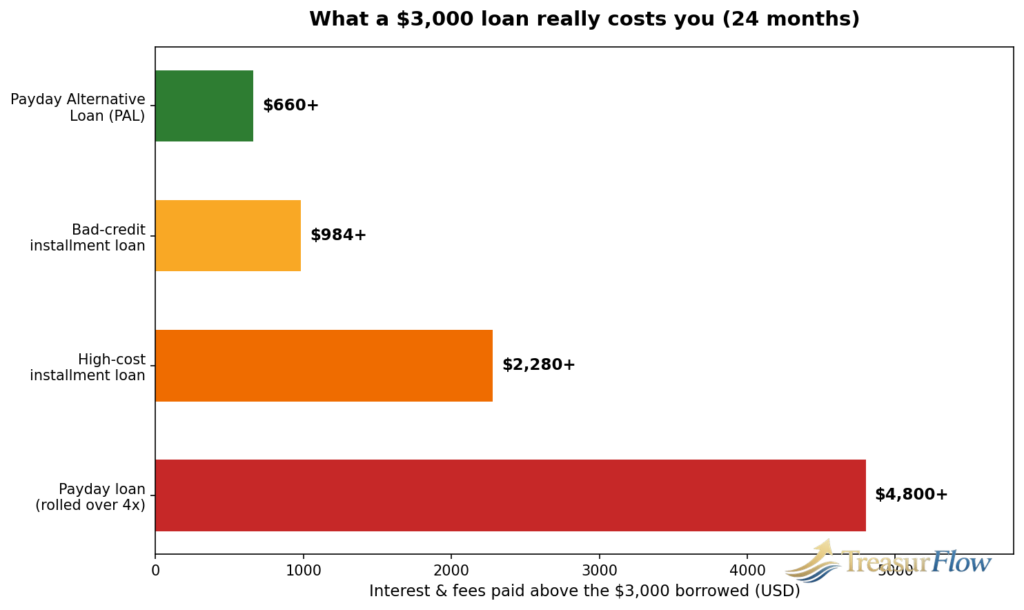
Two takeaways. First, the gap between a 36% installment loan and a 400% payday loan is thousands of dollars on the same $3,000 — which is why the “cheapest legitimate option first” order in this guide matters. Second, always calculate the total cost, not just the monthly payment. A low monthly payment stretched over years can cost more than a higher payment on a shorter term.
How to Apply Without Getting Scammed: The 6-Point Checklist
Before you share your Social Security number or bank login with any lender, run through this list. It takes five minutes and filters out nearly every scam:
- No upfront fees. Ever. It’s illegal for telemarketers to charge fees for a loan they’ve “guaranteed.” Any request for an “insurance fee,” “processing fee,” or gift-card payment before disbursement = walk away.
- Verify state licensing. Legitimate lenders are licensed in the states where they operate. Search “[lender name] + state license” or check your state attorney general’s site.
- Search “[lender name] + scam / complaint / BBB.” Five minutes of reading beats months of regret.
- Read the APR and total cost, not the ad. The Truth in Lending Act requires lenders to disclose the APR — if you can’t find it easily, that’s the answer.
- Never share bank login credentials with a lender you haven’t fully vetted. Real lenders use secure, read-only verification — and even then, only after you’ve chosen them.
- Check the physical address and phone number. PO boxes only, no working phone, or a site registered last month are all red flags.
Safer Alternatives Worth Considering First
Before borrowing at high rates, check whether one of these fits — they’re cheaper or free.
- Negotiate the bill directly. Medical providers, utilities, and landlords often have hardship programs or payment plans they’ll offer if you ask — at 0% interest.
- Local assistance programs. 211.org connects you with local nonprofits offering emergency aid for rent, utilities, and food.
- Credit union hardship loan. Even without a formal PAL program, many credit unions offer small emergency loans to members at reasonable rates.
- Payment plan with the creditor. A $0-interest plan from the company you owe beats any loan product on this page.
Frequently Asked Questions
Are there really personal loans with no credit check?
Yes — but “no credit check” means no hard inquiry on your traditional credit report. Legitimate lenders still verify your identity, income, and bank activity. Anyone offering money with zero verification of any kind is running a scam — not a lending business.
Can I get a personal loan with a 500 credit score?
Yes. Options like PALs from credit unions, secured loans, credit-builder products, and bad-credit installment lenders (OppLoans, CreditNinja, RISE) all work with scores around 500 or with no score at all. Expect higher rates than prime borrowers get, and compare total cost — not just the monthly payment.
Will a no-credit-check loan hurt my credit score?
The application itself usually won’t (soft pull or no pull). What matters is repayment: lenders that report to the bureaus help your score when you pay on time and hurt it when you don’t. Ask before signing whether the lender reports to all three bureaus — some don’t, which means on-time payments build nothing.
How fast can I get the money?
PALs and EWA apps can fund same-day. Online installment lenders and marketplaces typically fund within 1–2 business days. Anyone promising “instant cash in minutes” with no verification deserves extra scrutiny — speed is the scammer’s favorite selling point.
What’s the difference between a payday loan and a bad-credit installment loan?
Structure and cost. Payday loans are single-payment, typically due in two weeks, with ~400% APRs and rollover traps. Bad-credit installment loans spread repayment over months with fixed payments, still expensive at often 36-160% APR, but dramatically cheaper and easier to escape than the payday cycle.
Should I use a lending marketplace or go direct?
Marketplaces (one application, many lenders) maximize your approval odds and let you compare offers. Going direct gives you more control over who holds your data. If you use a marketplace, compare at least three offers and ignore the pressure to accept the first one.
What if I’ve already been scammed by a fake lender?
Stop all payments, contact your bank about the unauthorized debits, file a complaint with the FTC at ReportFraud.ftc.gov, and file with your state attorney general. Then pull your free credit reports at AnnualCreditReport.com to check for anything opened in your name.
The Bottom Line
No-credit-check personal loans are real, and for the right emergency they’re better than the alternatives — but the space is full of traps precisely because borrowers are stressed and in a hurry. The hierarchy is simple: try the cheapest legitimate option first (PALs, negotiation, EWA), then secured or credit-builder products, then bad-credit installment lenders, and treat anything screaming “guaranteed approval” with the skepticism it deserves.
If this guide saved you from one bad decision, it did its job. And if you’re rebuilding more broadly, start with a no-credit-check bank account to receive funds safely — then work on the credit itself.
This article is for informational purposes only and is not financial advice. Loan terms, rates, and availability change frequently and vary by state — always verify current terms directly with the lender before applying. Last updated: October 7, 2026.
Some links on this page go to product or issuer pages. Treasurflow’s rankings are based on the criteria stated in each guide. See the About page for how the site is funded.

Muhammad Zakir is the founder of Treasurflow and the author of its personal finance guides. He researches consumer banking, credit, and personal loans, and every guide cites primary sources such as the CFPB, FDIC, FTC, and IRS. His content is educational and is not personalized financial advice.
1 thought on “No Credit Check Personal Loans: 7 Legit Options for 2026”