
Best Business Credit Cards 2026: 9 Picks Matched to How Your Business Actually Spends
Most “best business credit card” lists rank cards by whoever’s bonus is biggest this month. That is backwards. The right card is the one whose rewards map onto the bills your business already pays — office supplies and phone contracts, fuel and client dinners, shipping and software ads — and whose fees and rules fit your stage of business. A card earning 5% on your biggest category will quietly out-earn a flashier card earning 1.5% on everything, every single year.
This guide matches nine of the best business credit cards of 2026 to spending profiles, shows the rewards math on a realistic $36,000-a-year business before the profiles (so you can check our work), and explains the rules that surprise first-time applicants — personal guarantees, business credit reporting and who can actually qualify. Card terms, bonuses and intro offers are as reported by issuers and major comparison sites as of October 2026; they change often, so confirm the current offer before you apply.
Related Guides
- Best Cash Back Credit Cards 2026 — the personal-card counterparts, if your spending is mostly personal
- Best Balance Transfer Credit Cards 2026 — for moving existing card debt to a 0% intro APR
- How Long Does It Take to Build Credit From Scratch? — the personal credit foundation every business card application leans on
Helpful Official Resources
- Consumer Financial Protection Bureau — Credit Card Consumer Tools
- U.S. Small Business Administration — Fund Your Business
- IRS — Apply for an Employer Identification Number (EIN) Online
Quick Picks by Business Type
| If your business looks like… | Start with | Why |
|---|---|---|
| An office with heavy supply, internet and phone bills | Ink Business Cash® | 5% on those categories, no annual fee |
| “Just give me one simple rate” | Wells Fargo Signify Business Cash® | Unlimited 2% cash back, no annual fee |
| Points you can transfer to airlines and hotels | Ink Business Preferred® | 3x on travel, shipping, telecom and ads |
| A freelancer inside the Amex ecosystem | Blue Business® Plus (Amex) | 2x Membership Rewards points, no annual fee |
| Spending over $100,000 a year | Amex Business Gold or Spark Cash Plus | Category multipliers / 2% at serious scale |
| A funded startup avoiding a personal guarantee | Brex | Underwritten on company finances, not your credit |
The Math First: What $36,000 of Typical Spending Earns
Take a representative small business spending $36,000 a year on cards: $12,000 on office supplies plus internet and phone service (of which $7,000 is internet/phone), $6,000 on gas and dining, $6,000 on advertising, travel and shipping, and $12,000 on everything else. Paying in full every month, here is what the main contenders return in a year, excluding welcome bonuses:
- Ink Business Cash: $600 (5% on the $12,000 office/telecom spend) + $120 (2% on gas/dining) + $180 (1% on the remaining $18,000) = $900, no annual fee
- Wells Fargo Signify / Amex Blue Business Cash (flat 2%): $720, no annual fee
- Ink Business Unlimited (flat 1.5%): $540, no annual fee
- Ink Business Preferred: 3x points on the $13,000 that falls in its bonus categories (internet/phone, ads, travel, shipping) and 1x on the other $23,000 = 62,000 points, worth about $620 at a baseline 1¢ per point, minus the $95 annual fee = ~$525 in cash terms — with upside if you transfer points to travel partners instead of cashing out
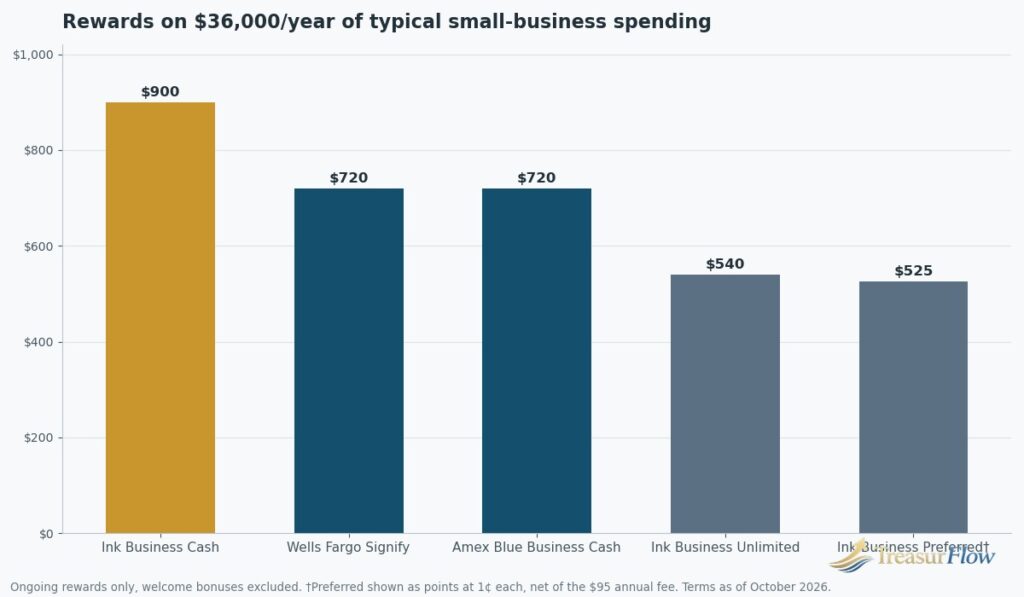
Two lessons. First, category fit beat the flat rate here — but shift this same spending toward untracked categories and the flat 2% cards win instead, which is why there is no universal “best.” Second, welcome bonuses scramble year one entirely: recent offers (as of October 2026) included $750 after $6,000 of spending in 3 months on both Ink no-fee cards, $500 after $5,000 on Signify, and 100,000 points after $8,000 on Ink Preferred. Bonuses are marketing, though — judge a card you will hold for five years on its ongoing math.
The Cards, Profiled
Ink Business Cash® — best for office, telecom and supply spending
Rewards: 5% cash back on the first $25,000 spent each account anniversary year at office supply stores and on internet, cable and phone services; 2% on the first $25,000 at gas stations and restaurants; 1% on everything else. Annual fee: $0. Intro APR: 0% for 12 months on purchases. Recent welcome offer: $750 after $6,000 in the first 3 months.
If your business runs on toner, laptops, broadband and mobile contracts, no no-fee card pays you more for it. The 5% categories map precisely onto what a small office actually buys, and Ultimate Rewards points earned here can be combined with a premium Chase card for travel transfers.
Wells Fargo Signify Business Cash® — the highest simple flat rate
Rewards: unlimited 2% cash back on all purchases. Annual fee: $0. Intro APR: 0% for 12 months. Recent welcome offer: $500 after $5,000 in the first 3 months.
Signify is the answer to category fatigue: no caps to track on the 2% rate (unlike the Amex flat-rate card’s $50,000 ceiling), no rotating anything, no annual fee. For businesses whose spending is spread evenly across suppliers, inventory and services, this is frequently the best single-card solution in the market right now.
American Express Blue Business Cash™ — flat 2% inside Amex
Rewards: 2% cash back on all eligible purchases up to $50,000 per year, then 1%. Annual fee: $0. Intro APR: 0% for 12 months.
Functionally a sibling of Signify with a spending cap where the 2% steps down — irrelevant unless you spend more than $50,000 a year. Choose this over Signify if you value Amex’s service, app and Offers program, or already bank in the Amex ecosystem.
The Blue Business® Plus Credit Card from American Express — flat-rate points
Rewards: 2x Membership Rewards points on everyday business purchases up to $50,000 per year, then 1x. Annual fee: $0.
Identical shape to Blue Business Cash, except you earn transferable points instead of cash. Points moved to Amex’s airline and hotel partners can be worth well above 1¢ each in premium-cabin redemptions, which makes Blue Business Plus the quiet favourite of points-savvy freelancers and consultants.
Ink Business Unlimited® — Chase’s flat-rate workhorse
Rewards: unlimited 1.5% cash back. Annual fee: $0. Intro APR: 0% for 12 months. Recent welcome offer: $750 after $6,000 in the first 3 months.
On pure rate it loses to the 2% cards. It wins on ecosystem: pair it with Ink Preferred or a Sapphire card and its “cash back” becomes Ultimate Rewards points you can transfer. As a standalone, choose Signify; as part of a Chase two-card setup, Unlimited earns its slot.
Ink Business Preferred® — best for travel and advertising spend
Rewards: 3x points on the first $150,000 spent each account anniversary year across travel, shipping, internet/cable/phone services and advertising on social media and search engines; 1x thereafter and on everything else. Annual fee: $95. Recent welcome offer: 100,000 points after $8,000 in the first 3 months. No foreign transaction fees, and points transfer to Chase’s airline and hotel partners.
Digital advertisers, agencies, e-commerce sellers who ship daily, and consultants who live in airports: this card was designed for you. At $60,000+ a year of bonus-category spend, the 3x rate buries every flat-rate alternative.
American Express Business Gold — best flexible multiplier for high spenders
Rewards: 4x Membership Rewards points on the two categories where your business spends the most each billing cycle (from a list of six: U.S. airfare booked directly, advertising, computer hardware/software/cloud services, restaurants, gas stations and shipping), on up to $150,000 per year combined. Annual fee: $375.
The fee is steep, and the card only makes sense at serious volume — but for a business spending six figures across shifting categories, the automatic “top two” mechanic means you never have to think about which card to swipe. Recent welcome offers have run around 100,000 points after $15,000 of spending; verify the live offer before applying.
Capital One Spark Cash Plus — best for very high spend, no preset limit
Rewards: 2% cash back on all purchases (with an enhanced rate on very large single purchases in recent terms). Annual fee: $150. Structure: a charge card — the balance is due in full each month, and there is no preset spending limit.
Built for established businesses pushing heavy volume through cards — wholesalers, contractors buying materials, media buyers. Tiered welcome bonuses for very high spend have run into four figures. If your monthly card spend is measured in tens of thousands, the no-preset-limit structure and flat 2% are the combination to beat.
Brex — best for startups that refuse the personal guarantee
Almost every card above underwrites you: a personal credit check and a personal guarantee that makes you liable for the debt. Brex’s corporate card is the notable exception, underwriting the company’s cash position and funding instead. There is no personal guarantee and no personal credit pull, and the card pairs with spend controls and accounting integrations aimed at startups. The trade-offs: Brex targets funded or revenue-generating companies (it is not a starter card for a brand-new sole proprietor), rewards are points-based rather than cash, and balances are paid on short cycles. For venture-backed teams, it removes a real risk the traditional cards all carry.
Business Card vs Personal Card: What Actually Changes
Separation. A business card keeps business spending off your personal statements, which pays off at tax time and when a lender reviews your personal debt-to-income ratio — though see the guarantee point below.
The personal guarantee. With the exception of corporate products like Brex, mainstream small business cards require the owner to personally guarantee the debt. Default and the issuer can pursue you personally. There is no corporate veil on a guaranteed card.
Credit reporting. Applications trigger a hard inquiry on your personal credit with most issuers. After that, practices vary: many issuers report business card activity only to business credit bureaus (Dun & Bradstreet, Experian Business, Equifax Business) and report to personal bureaus only if the account goes delinquent; some report everything to both. Ask before you rely on a card staying invisible to your personal file.
Employee cards and controls. Business accounts typically offer free employee cards with individual spending limits and consolidated statements — a mundane feature that becomes invaluable the first time a team member needs to buy fuel, flights or software without your card number.
Weaker legal protections. Federal CARD Act protections (billing dispute rules, limits on rate increases) apply to consumer cards, not business cards. Issuers extend many similar policies voluntarily, but read the business cardmember agreement rather than assuming.
Who Can Qualify (It’s Probably You)
You do not need an LLC, employees or revenue history to get a business credit card. Sole proprietors qualify — gig drivers, freelancers, Etsy and eBay sellers, landlords and consultants all count as businesses. Practical points:
- Apply as a sole proprietor using your own name as the business name and your SSN as the tax ID; an EIN is optional for most major issuers (the IRS issues EINs free online if you want one).
- Expect a personal credit check. The best rewards cards generally go to applicants with good-to-excellent personal credit; thinner files should look at starter and secured business options first, or build with personal cards meanwhile.
- Revenue can be $0 for a brand-new business on many applications — you report expected or other household income where the application allows — but never invent figures; applications are legal documents.
- Chase applicants: the widely reported (unofficial) “5/24 rule” means Chase generally declines applicants who have opened five or more personal cards in the past 24 months. It is not published policy, but it is consistent enough to plan around: apply for Chase business cards earlier in your card strategy.
The Interest Trap: Where Rewards Go to Die
Four cards in this guide — Ink Cash, Ink Unlimited, Signify and Blue Business Cash — have recently offered 0% intro APRs for 12 months on purchases, genuinely useful for a planned equipment buy you can clear within the year. Outside an intro window, however, business card APRs commonly sit in the 20s. Carry an $8,000 balance for a year at a 25% APR and the interest runs to roughly $2,000 — erasing the rewards on tens of thousands of dollars of spending. The entire strategy in this article depends on one habit: pay in full, every month. If a balance is unavoidable, a business line of credit or loan will almost always be cheaper than revolving card debt.
How to Apply, Step by Step
- Match the card to your last 3 months of spending — use the profile table, not the bonus headlines.
- Check your personal credit score and, for Chase, your 5/24 status.
- Gather the basics: legal business name (your own name if a sole proprietor), business address, tax ID (SSN or EIN), industry, years in business, annual revenue.
- Apply once, then wait a few days before any second application — clustered hard inquiries hurt.
- Set autopay-in-full on day one, add employee limits if relevant, and calendar the intro-APR end date if you use one.
Two-Card Setups Worth Considering
Serious optimizers rarely stop at one card. Two pairings cover most businesses well:
Ink Business Cash + Ink Business Preferred (the Chase ladder). Put office supplies and telecom on Ink Cash at 5%, travel/shipping/ads on Preferred at 3x, and everything else on whichever you are working toward a bonus with. Cash back earned on the no-fee card can be moved into the Preferred account and converted to transferable Ultimate Rewards points, lifting its value above the 1¢ baseline used in our worked example. Total annual fees: $95. This is the strongest mainstream setup for an office-based business spending $40,000+ a year.
One flat card, deliberately (the anti-setup). For every business under roughly $25,000 of annual card spend, a single 2% card — Signify, or Blue Business Cash/Plus if you prefer Amex — captures nearly all available value with zero category management. The realistic gain from a two-card system at that volume is often under $150 a year, bought with real complexity. Complexity is a cost; spend it only when the dollars justify it.
Whichever route you take, automate the discipline: statement-balance autopay on every card, one shared expense policy for the team, and a quarterly ten-minute review of which categories your spending actually fell into. Cards should be re-matched to spending about once a year — businesses change faster than card line-ups do.
Business Card Questions Owners Ask Before Applying
Can I get a business credit card as a sole proprietor or freelancer?
Yes. Sole proprietors, freelancers, gig workers and online sellers all qualify as businesses for the major issuers. You apply with your own name as the business name and your Social Security number as the tax ID (an EIN is optional for most issuers). You do not need an LLC, employees or existing revenue, though the application will ask for revenue figures and you must answer honestly. Your personal credit history is what the issuer primarily underwrites.
Do business credit cards affect my personal credit?
Usually, in two ways. The application itself triggers a hard inquiry on your personal credit with most issuers. After approval, reporting varies: many issuers report the account only to business credit bureaus and touch your personal report only if you default, while others report all activity to both. Because nearly all mainstream small business cards carry a personal guarantee, a default can reach your personal credit and your personal wallet — ask the issuer about its reporting policy before applying if this matters to you.
What credit score do I need for the best business credit cards?
The premium rewards cards in this guide — Ink Business Preferred, Amex Business Gold, Spark Cash Plus — generally go to applicants with good-to-excellent personal credit, which in practice means scores in the high 600s at minimum and more comfortably the 700s. If your score is still building, starter business cards, secured options and corporate cards underwritten on business finances (like Brex, for funded companies) are the usual on-ramps.
Do I need an EIN to apply for a business credit card?
Not for most major issuers. Sole proprietors can apply with a Social Security number alone. You will need an EIN if your business is structured as a corporation or partnership, or if you simply prefer not to use your SSN on applications — the IRS issues EINs free online in about 15 minutes. Either way, never pay a third-party site for an EIN; the IRS never charges for one.
What is a personal guarantee on a business credit card?
It is your signed promise that if the business does not pay, you personally will. Nearly every mainstream small business card requires one, which means the debt survives the business — closing the company does not close the obligation. Corporate cards underwritten on company finances, such as Brex, are the main exception. A personal guarantee is the single most important difference between business and personal card risk, and it is worth reading that section of any cardmember agreement closely.
Is a business credit card worth it for a side hustle?
If the side hustle has real spending — materials, software, fuel, ads — and you pay in full monthly, yes: you get clean expense separation for taxes, rewards on money you were spending anyway, and the start of a business credit profile. A no-annual-fee card like Ink Business Cash, Wells Fargo Signify or Amex Blue Business Cash keeps the experiment free. If you expect to carry balances, skip the rewards card entirely; interest will cost more than any cash back returns.
The Bottom Line
Pick the card your spending already deserves. Office-and-telecom-heavy businesses should start with Ink Business Cash; even-spend businesses with Signify or Blue Business Cash; travellers and advertisers with Ink Business Preferred; high-volume operations with Business Gold or Spark Cash Plus; and funded startups wary of personal liability with Brex. Then protect the whole strategy with the only rule that makes rewards real: pay every statement in full.
Disclaimer: This article is educational information, not financial advice. Card terms, rewards, fees, intro APRs and welcome offers change frequently and are shown as reported by issuers and major comparison sites as of October 2026; always confirm the current offer and cardmember agreement on the issuer’s site before applying.

Muhammad Zakir is the founder of Treasurflow and the author of its personal finance guides. He researches consumer banking, credit, and personal loans, and every guide cites primary sources such as the CFPB, FDIC, FTC, and IRS. His content is educational and is not personalized financial advice.