

Why In-House Financing Is Gaining Momentum Across North America
The rise of What Is In House Financing across the United States shows a clear shift in how businesses sell and how customers buy. Many buyers now prefer Customer financing that feels simple and fast. Traditional banks often slow things down, while Direct financing gives faster decisions. This change is reshaping the modern buying journey.

At the same time, stricter Credit score evaluation and rising rejection rates push customers toward flexible Financing options. Businesses respond by offering Point of sale financing that increases approvals. As a result, What Is In House Financing USA is growing quickly because it removes friction and improves the overall customer experience.
Understanding the Core Concept of In-House Financing
The what is in house financing meaning is simple. A business provides Internal lending instead of sending customers to banks. In this model, the company becomes the lender. This approach is also called Seller financing or Builder financing in real estate markets.
A lighter-touch version of seller financing is offering a price credit to a buyer — see how to give credit on price to a client.
For example, when buying a home, In-house financing for homes allows buyers to work directly with builders. The Financing approval process becomes faster and more flexible. Businesses also adjust Loan terms based on customer needs, which improves access for people with limited credit history.
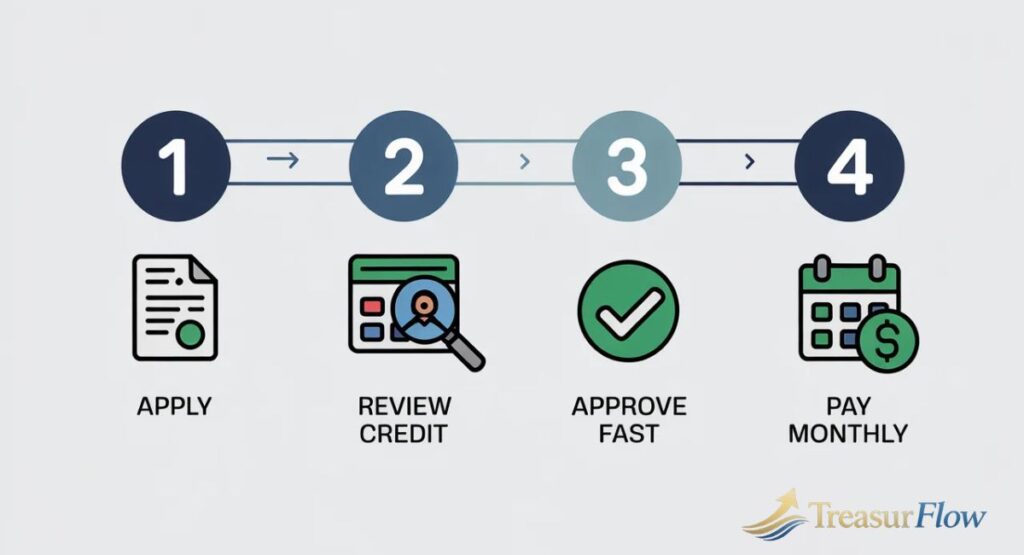
A Clear Breakdown of How In-House Financing Works
The In-house financing process starts when a customer applies directly with the business. Instead of a bank, the company handles Loan underwriting, reviews Debt-to-income ratio, and checks financial history. This allows faster Credit approval decisions compared to traditional systems.
Once approved, customers follow structured Monthly payment plans with a clear Repayment schedule. Businesses manage payments internally, which strengthens relationships. This system of Direct financing keeps everything simple and controlled under one roof.
| Step | Description |
|---|---|
| Application | Customer applies directly with business |
| Review | Business checks credit and income |
| Approval | Fast Credit approval decision |
| Payment | Fixed Monthly payment plans begin |
Key Reasons Businesses Are Adopting what is in House Financing
Businesses adopt In-house financing because it increases sales and builds trust. Customers feel more confident when flexible Financing options are available. Instead of losing buyers due to strict bank rules, companies close more deals using Point of sale financing.
Another reason is control. With Internal lending, businesses decide pricing, Loan terms, and approvals. This improves Credit risk management while also boosting customer loyalty. Over time, this strategy creates repeat customers and stronger revenue growth.
Identifying the Ideal Customers for In-House Financing
Not every buyer fits this model, but many benefit from In-house financing for homes and other purchases. Customers with limited credit history often struggle with banks. However, flexible Loan eligibility criteria in In-house financing USA opens new opportunities.
Young buyers, small business owners, and first-time home buyers often prefer Customer financing. These groups value faster approvals and simple processes. With fewer barriers, Direct financing becomes a practical solution for modern consumers.
Common Mistakes That Cause In-House Financing Programs to Fail
Even thoughWhat Is In House Financing offers benefits, poor planning can lead to failure. Weak Loan underwriting and unclear Repayment schedule create confusion. Businesses must define clear rules before offering Financing options.
Another mistake is ignoring Credit risk management. Without proper checks like Debt-to-income ratio, businesses face losses. A strong system ensures stable cash flow and reduces financial risk over time.
How Digital Tools Are Transforming Customer Credit Decisions
Technology is changing how In-house financing process works. Businesses now use smart tools for faster Credit score evaluation and automated approvals. These systems reduce manual work and improve accuracy.
Digital platforms also enhance the Financing approval process. Customers get instant decisions through online applications. This modern approach makes Point of sale financing faster, smoother, and more accessible.Helpful Resources on In-House Financing
To better understand what is in house financing, it helps to explore trusted financial sources. These websites provide deeper insights into in-house financing, credit systems, and loan processes:
Compare mortgage and financing options at Bankrate
https://www.bankrate.com/mortgages/
Learn about financing basics from the Consumer Financial Protection Bureau (CFPB)
https://www.consumerfinance.gov/
Explore home financing guidance on USA.gov Housing Help
https://www.usa.gov/housing-help
Understand loans and credit from Federal Trade Commission (FTC)
https://www.consumer.ftc.gov/

Practical Models for Implementing what is in House Financing
Different industries use different models of what is in house financing. Some offer short-term Monthly payment plans, while others provide long-term Loan terms. Each model depends on business goals and customer needs.
For example, Builder financing works well in real estate, while retail businesses prefer Direct financing at checkout. Choosing the right structure improves both customer satisfaction and business performance.
| Model | Best Use Case |
|---|---|
| Installments | Retail and services |
| Builder plans | Real estate |
| Short-term loans | Small purchases |
When is in house Financing Becomes a Smart Business Move
Businesses should adopt In-house financing USA when they want growth and flexibility. If customers frequently face rejection from banks, offering Customer financing can solve this problem.
It also works well when businesses can manage Loan underwriting and payments internally. A strong financial base ensures the company can handle delayed revenue while maintaining steady operations.
Technology Essentials for Managing Financing Programs
To run In-house financing smoothly, businesses need the right tools. Systems for tracking Repayment schedule and managing Loan terms are essential. These tools reduce errors and improve efficiency.
Modern platforms also support Credit risk management and automate approvals. This allows businesses to scale their Internal lending programs without increasing complexity.
Step-by-Step Approach to Launching In-House Financing
Launching In-house financing process requires planning and structure. Businesses must define clear Loan eligibility criteria and create transparent Financing options.
They should also build systems for Credit approval and payment tracking. A strong foundation ensures long-term success and reduces operational risks.
Final Insights on the Future of In-House Financing
The future of In-house financing USA looks strong as businesses continue to adopt flexible models. Customers now expect easy Financing options and fast approvals. This trend will only grow in the coming years.
As technology improves, Direct financing will become even more efficient. Businesses that invest in smart systems and strong Credit risk management will lead the market and build
lasting customer relationships.
What to Check Before You Accept an In-House Financing Offer
An in-house financing offer can look simple on the surface: no bank, a quick decision, and a monthly payment that fits your budget. The real test is in the details. Before you sign anything, ask for the full written agreement and read every section, including the parts about fees, late payments, early payoff, and what happens if you miss a payment. A trustworthy seller will explain each term in plain language and give you time to review the paperwork at home. If you feel rushed, or if the seller will not put a promise in writing, treat that as a warning sign and slow down.
Start by comparing the total cost, not just the monthly payment. Ask for the purchase price, the interest rate or finance charge, every fee, the length of the agreement, and the total amount you will pay if you make every payment on schedule. A lower monthly payment can still be expensive if the term is long or the fees are high. Write the numbers down side by side with any bank or credit union offer you have, and look at the total cost and the payoff date rather than the payment alone.
Next, check who holds ownership and what happens if you fall behind. Ask whether you receive the title straight away, whether the seller keeps a lien until the balance is paid, and how repossession works under the agreement. Read the sections on missed payments, grace periods, and cure rights carefully. A fair agreement spells out the notice you will receive, the time you have to catch up, and any fees that apply, rather than leaving those points vague.
Also ask how payments are recorded and reported. Some sellers report on-time payments to the credit bureaus, which can help you build a payment history, while others do not report at all. Ask directly, and do not assume reporting happens automatically. Keep copies of the agreement, every receipt, and any written change to the terms. If a verbal promise matters to you, ask for it in writing before you sign, and keep your own records in one place for the life of the agreement.
How In-House Financing Fits Your Budget and Credit
Treat the payment as part of your full monthly budget, not as an isolated number. Add it to your housing, transport, food, insurance, and debt payments, and check that you still have room for savings and for an occasional unexpected expense. If the payment leaves no margin, the agreement is too tight, even when the seller says you qualify. A comfortable payment is one you can still make in a slower month, not only in a good month.
On the credit side, keep your expectations realistic. Paying on time can only help your credit when the seller reports those payments, so confirm reporting before you count on it. A missed payment can still cause real harm even when it is not reported, because the seller may charge late fees, demand the remaining balance, or repossess the item. The safest approach is to set up reminders or automatic payments and to contact the seller early if you think a payment will be late.
Frequently Asked Questions
Q: Is in-house financing the same as a bank loan?
A: No. With a bank loan, a bank or credit union lends the money and sets the terms. With in-house financing, the seller itself acts as the lender, handles approval, and collects the payments.
Q: Do you need good credit for in-house financing?
A: Not usually. Many sellers approve buyers with limited or weak credit history, which is one of the main attractions. Expect stricter terms, a larger deposit, or a shorter agreement in return.
Q: Is in-house financing more expensive than a bank loan?
A: It can be. Because the seller sets the terms and takes on more risk, the total cost is often higher than a bank loan. Compare the purchase price, the interest rate, the fees, and the length of the agreement — not just the monthly payment — before you accept.

Muhammad Zakir is the founder of Treasurflow and the author of its personal finance guides. He researches consumer banking, credit, and personal loans, and every guide cites primary sources such as the CFPB, FDIC, FTC, and IRS. His content is educational and is not personalized financial advice.