
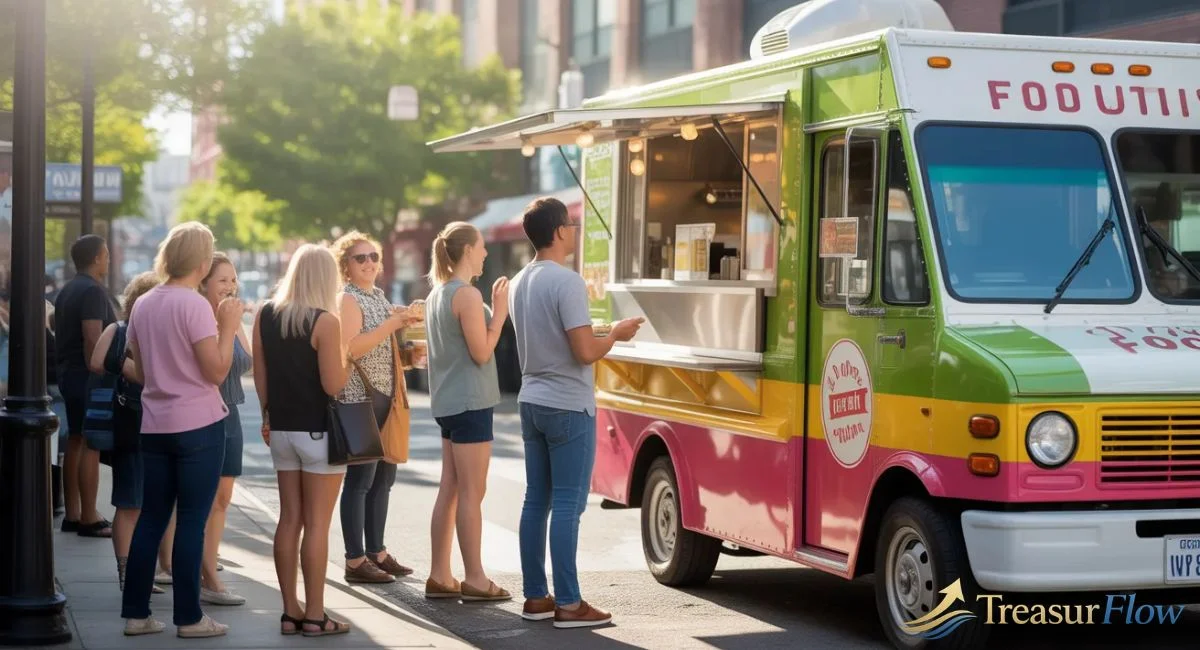
Most people think starting a food truck is simple. Buy a truck, cook great food, park somewhere busy, and the money follows. Honestly, that’s not how it works. The gap between a great food idea and an actual running business is almost always money — and knowing how to get it.
The US food truck industry crossed $1.2 billion in annual revenue, according to IBISWorld. That number keeps climbing every year. There’s real money in this space, but only for people who set themselves up properly from the start. Food truck finance isn’t just a backup plan — it’s often the whole reason a truck gets on the road at all.
Statista projects continued growth in the US food truck market through 2027. Changing consumer habits, the rise of food truck finance events and markets, and far lower overhead than a restaurant are all driving that growth. The opportunity is real.
The operators who turn one truck into a business think past the first loan. They borrow smart, pay on time, build their credit history, hit their revenue targets — and then use that track record to access capital for a second truck. That’s how it actually works. One decision to start is the only thing separating the dream from the reality.
Case Study: Austin-based “Smoke & Roll BBQ” launched in 2019 with a $65,000 equipment loan. By 2022, they were running three trucks and a catering arm. The founder credited disciplined cash flow management and smart early financing as the two things that made scaling possible.
What It Actually Costs to Launch a Food Truck
The number that catches most first-timers off guard: launching a food truck finance in the US typically costs between $75,000 and $200,000 total, according to Entrepreneur.com. A used truck might run $20,000 to $50,000. A custom-built new one can hit $150,000 before you’ve bought a single ingredient.
And that’s just the truck. Food truck startup costs include health permits ($100 to $1,000 depending on city), a business license ($50 to $500), liability insurance ($2,000 to $4,000 annually), commissary kitchen fees ($400 to $1,500 per month in many states), plus fuel, wages, and branding. Financing a food truck business the smart way means borrowing enough to cover the real picture — not just the vehicle.
| Cost Category | Estimated Range |
|---|---|
| Used Truck | $20,000 – $70,000 |
| New Custom Truck | $75,000 – $175,000 |
| Equipment (if separate) | $10,000 – $50,000 |
| Permits and Licenses | $500 – $3,000 |
| Insurance (annual) | $2,000 – $4,000 |
| Commissary Kitchen (monthly) | $400 – $1,500 |
| Branding and Wrap | $2,000 – $5,000 |
| Opening Inventory | $1,000 – $3,000 |
Food Truck vs. Food Trailer Financing
Although the terms are often used interchangeably, food trucks and food trailers are financed differently. Understanding the distinction can help you choose the right financing program and avoid surprises during the approval process.
Food Truck Financing
A food truck is a self-powered commercial vehicle with a built-in kitchen. Because it is both a vehicle and a business asset, lenders typically evaluate:
- The vehicle’s title and VIN (Vehicle Identification Number).
- The truck’s year, make, model, mileage, and overall condition.
- Whether the vehicle complies with local health and commercial vehicle regulations.
- The borrower’s credit profile, business revenue, and ability to repay.
Some lenders also impose age and mileage restrictions, meaning older trucks or heavily used vehicles may qualify for fewer financing options or require a larger down payment.
Food Trailer Financing
A food trailer is a towable unit that does not have its own engine. Financing is often structured more like equipment financing than traditional vehicle financing.
Lenders commonly review:
- The trailer’s title or manufacturer’s certificate of origin (for new units).
- Purchase price and equipment specifications.
- Business revenue or projected cash flow.
- The borrower’s creditworthiness.
Because trailers are not self-propelled, some financing programs have different underwriting guidelines and may be more flexible regarding age and depreciation than food truck loans.
Why the Difference Matters
Whether you’re buying a truck or a trailer can affect:
- Loan eligibility.
- Down payment requirements.
- Maximum financing amounts.
- Vehicle or equipment age restrictions.
- Interest rates and repayment terms.
- Documentation required during underwriting.
Before applying, confirm that the lender finances the specific type of mobile food business you’re purchasing, as not every financing program covers both trucks and trailers under the same terms.
Lease-to-Own & Equipment Leasing ($1 Buyout Options)
If traditional financing isn’t the best fit, many food business owners consider equipment leasing or lease-to-own programs.
Common lease structures include:
- $1 Buyout Lease: You make scheduled lease payments and can purchase the equipment for $1 at the end of the lease term. This option is popular for businesses that intend to own the equipment long-term.
- Fair Market Value (FMV) Lease: At the end of the lease, you may purchase the equipment at its then-current market value, renew the lease, or return the equipment.
- Equipment Finance Agreement (EFA): Functions similarly to a loan, with ownership typically transferring after all payments are completed.
Lease-to-own financing may offer benefits such as:
- Lower upfront costs than paying cash.
- Flexible repayment terms.
- Financing for kitchen equipment, generators, refrigeration units, point-of-sale systems, and complete food trucks or trailers.
- Potential approval opportunities for newer businesses or borrowers with less-than-perfect credit, depending on the lender’s underwriting criteria.
Before signing any lease agreement, review the total cost of financing, early payoff options, maintenance responsibilities, insurance requirements, and whether the agreement includes a $1 buyout, FMV purchase option, or another end-of-term ownership structure.
Smart Ways to Actually Fund Your Food Truck (including Lease-to-Own)
There’s no single best answer here. It depends on your credit, your history, and how much you need. That said, the options are genuinely good right now for American Food Truck Finance owners.
An equipment loan is probably the cleanest starting point for most people. The gear itself acts as collateral, which means lenders take on less risk — and that usually means better rates for you. A food truck business loan covers the bigger picture: truck, equipment, permits, working capital. A business line of credit works well for ongoing costs once you’re already running. And if you’ve been in business a while with decent credit, an SBA loan for food truck finance purchases offers some of the lowest rates available anywhere.
| Financing Type | Best Situation | Typical Range | Approval Time |
|---|---|---|---|
| Equipment Loan | Buying specific gear | $10K – $150K | 1–5 days |
| Food Truck Business Loan | Full setup including truck | $20K – $200K | 1–4 weeks |
| SBA Loan for Food Truck | Established owners, good credit | $50K – $500K | 2–3 months |
| Business Line of Credit | Ongoing cash needs | $5K – $100K | 1–7 days |
| Alternative Online Lender | Startups or lower credit scores | $5K – $75K | Same day – 3 days |
Honestly, this surprised me when I first looked into it. Most new business owners assume they need years of history to get a decent loan. Equipment financing doesn’t always work that way. Because the lender can repossess the equipment if you default, they’re taking on less risk. That gives newer operators a real shot at approval even without a long track record.
According to the Equipment Leasing and Finance Association, about 79% of US businesses use some form of equipment financing. It’s not a last resort. It’s just how smart operators fund growth without draining their savings.
Your Equipment Is Either Making You Money or Costing You Customers
Nobody lines up twice at a truck that runs slow. Cold food, long waits, a generator that cuts out during the lunch rush — these aren’t just annoying. They kill repeat business before it even starts. The equipment inside your truck determines your speed, your consistency, and honestly your reputation.
Here’s what most people miss: cheap equipment costs more over time. A cut-rate grill breaks down faster. A weak refrigeration unit risks your entire inventory on a hot July afternoon. Buying quality gear through food truck equipment financing protects you from those disasters without wiping out your cash on day one.
What Equipment Does a Food Truck Actually Need?
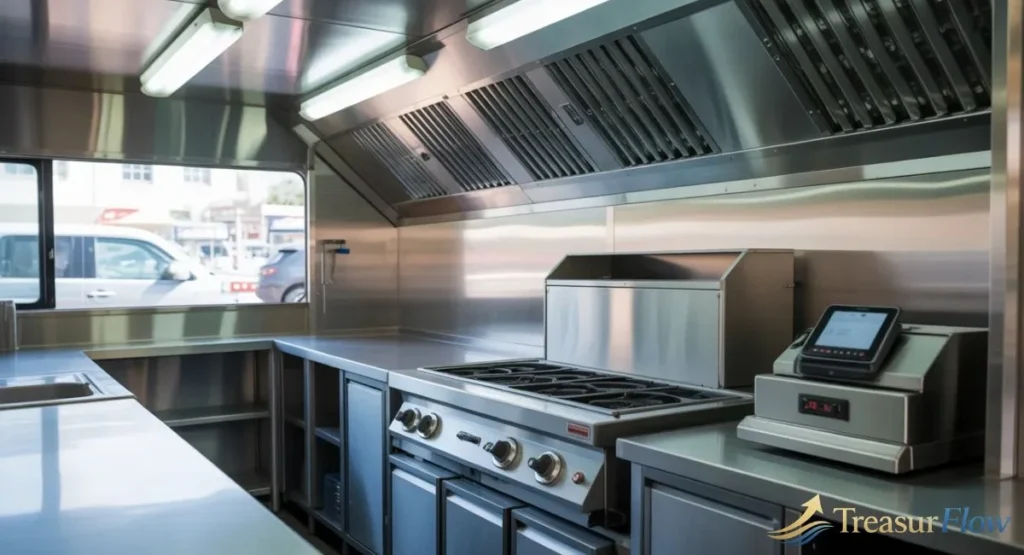
Every truck needs a core set of gear regardless of what you’re cooking. Commercial grill or range, refrigeration unit, freezer, generator, ventilation hood, fire suppression system, water tanks, and a POS system. That’s the non-negotiable baseline. Everything beyond that depends on your menu.
A taco truck needs a flat-top griddle and a steam table. A BBQ setup needs a serious smoker. A dessert truck needs a soft-serve machine or a specialty oven. Equipment leasing for food trucks is worth considering if you’re still testing your concept — lower monthly costs, more flexibility to switch things up. But if you know what you’re building, buying through a loan usually makes more financial senselong-termm.
| Equipment | Estimated Cost (New) |
|---|---|
| Commercial Grill / Range | $1,500 – $10,000 |
| Refrigeration Unit | $1,000 – $5,000 |
| Generator | $2,000 – $15,000 |
| Ventilation Hood | $1,000 – $5,000 |
| Fire Suppression System | $1,500 – $4,000 |
| POS System | $500 – $2,500 |
| Water Tank System | $500 – $2,000 |
How to Pick a Lender You Can Actually Trust
Not every lender deserves your business. Some online platforms look friendly but bury brutal APRs in the fine print. Others tack on prepayment penalties that punish you for paying early. Choosing the wrong lender isn’t just annoying — it can cost you thousands of dollars over the life of a loan.
Compare at least three lenders before you decide. Look at the APR, not just the monthly payment. Those two numbers tell very different stories. The SBA Lender Match Tool is free and genuinely useful — it connects you with approved lenders based on your situation. Check food truck lender reviews on Trustpilot or the Better Business Bureau. Nobody talks about this enough, but a lender’s reviews often tell you more than their marketing ever will.
“The best loan isn’t always the biggest one. It’s the one with terms you can actually live with.” — SCORE.org small business advisors
The Real Benefits of Going With a Term Loan
Predictability. That’s the main thing a term loan gives you. Fixed payments, fixed schedule, no surprises. When you’re managing a small food truck finance operation, knowing exactly what leaves your account each month makes everything easier to plan around.
There’s also a tax angle most new owners completely overlook. Under IRS Section 179, you may be able to deduct the full purchase cost of financed equipment in the year you buy it — instead of slowly depreciating it over years. On a $30,000 equipment package, that deduction genuinely matters. Talk to your accountant about it. Full details are at IRS.gov.
What Lenders Are Actually Evaluating
Commercial lenders aren’t evaluating your application the same way a consumer bank looks at a personal loan or mortgage. When you apply for food truck financing, underwriting revolves around risk management—specifically, your business’s ability to service monthly debt while keeping the vehicle operational.
Traditional banks, online alternative lenders, and equipment finance companies primarily evaluate four key commercial metrics before issuing an approval:
1. Credit Score & Business Credit History
While personal credit (FICO) matters—especially for startups—lenders also evaluate your business credit profile (such as your Paydex score or Experian Commercial report).
- 650+ FICO: Qualifies you for competitive APRs, traditional bank financing, and SBA 7(a) microloans.
- 550–640 FICO: Shifts the approval toward direct equipment lenders or lease-to-own programs, which often require higher interest rates or larger down payments.
2. Debt Service Coverage Ratio (DSCR) & Cash Flow
Lenders want proof that your mobile food business generates enough monthly cash flow to cover debt obligations. Underwriters frequently calculate your Debt Service Coverage Ratio (DSCR):$$\text{DSCR} = \frac{\text{Net Operating Income}}{\text{Total Debt Service}}$$
Most commercial food truck lenders prefer a DSCR of 1.25x or higher, meaning your business earns 25% more than what is required to cover your monthly loan payments and operational overhead.
3. Time in Business & Revenue Thresholds
Operating history directly impacts your loan options:
- Established Businesses (2+ Years): Qualify for working capital lines of credit, low-rate SBA loans, and unsecured business loans based on 3 to 6 months of commercial bank statements showing $10,000+ in average monthly revenue.
- Startups (< 1 Year): Require stronger personal credit, a detailed business plan, projections, or industry experience to offset the lack of historical revenue.
4. Down Payment Needs & Commercial Collateral
Because a food truck or trailer is a physical asset, the vehicle and kitchen gear themselves serve as collateral.
- Standard Down Payment: Expect to put down 10% to 20% of the total purchase price. A larger down payment reduces the lender’s Loan-to-Value (LTV) risk and lowers your monthly installment.
- Vehicle Condition & Age: For self-propelled food trucks, lenders inspect vehicle age, engine mileage, and title status. Older chassis (typically over 10–12 years) may require higher down payments due to faster depreciation and maintenance risks.
Step-by-Step: How to Apply Without the Headache
Start with clarity. Know exactly what equipment you need and what it costs. Don’t walk into a lender application saying “I need some money for a food truck.” Lenders respond to specifics. Get vendor quotes. Know your numbers.
Then check your credit. Free reports are available at AnnualCreditReport.com. Most traditional lenders want a score above 650. Online lenders often work with scores down to 550 for startup food truck loan products. After that, pull your documents together — two years of tax returns, three to six months of bank statements, a simple business plan. Submit to two or three lenders at the same time and compare what comes back.
| Step | What to Do | Time Needed |
|---|---|---|
| Define needs | Equipment list and vendor quotes | 1–2 days |
| Check credit | Pull your free credit report | 30 minutes |
| Gather documents | Tax returns, bank statements, business plan | 2–5 days |
| Apply | Submit to 2–3 lenders at once | 1 day |
| Compare offers | Review APR, terms, fees carefully | 1–2 days |

Approaching Lenders with Poor Credit or Limited History
Having a score below 600 or zero business history doesn’t automatically mean a rejection. If your commercial credit profile is thin, you can strengthen your application by:
Providing 6 months of consistent business bank statements proving strong daily cash flow.
Pledging additional commercial or personal collateral to lower lender risk.
Applying with a strong co-signer who holds solid personal credit.
Opting for a $1 Buyout Equipment Lease where approval is anchored strictly to the value of the machinery rather than your financial history.
Cash Flow Will Make or Break You Faster Than Anything Else
A great food truck finance project doesn’t save a truck with broken cash flow. Plenty of trucks with loyal customers have closed because the owner couldn’t time their expenses properly. It’s more common than people admit.
One habit that actually helps: align your loan repayment date with your strongest revenue days. If Thursday through Sunday is when you earn, a mid-week payment clears before the weekend money lands. Build a cash reserve before you open — three months of fixed costs, sitting separately. That buffer covers your payment during a slow stretch, a rainy week, or an unexpected repair. Tools like QuickBooks or Wave Accounting are affordable and genuinely simple for solo operators. And if your credit improves after 12 to 18 months of on-time payments, refinancing into a better rate is always an option worth exploring.

Real Questions People Ask About Food Truck Equipment Financing
What credit score do I need?
Most traditional lenders want 650 or above. Online platforms often work with scores as low as 550. Food truck finance with bad credit programs exist for operators under 600 — but expect higher rates in return.
Can I get financing with no business history?
Yes, but your options get narrower. Personal credit, a solid business plan, and alternative lenders become your path. Some platforms offer startup food truck finance and loan products built specifically for new operators.
Is leasing better than buying?
Depends on your situation. Leasing keeps monthly costs lower and gives you flexibility. Buying through a loan builds equity and ownership. If you’re testing a concept, lease. If you’re committed, buy.
How long does approval take?
Online lenders can move in one business day. Traditional banks take one to four weeks. SBA loans take two to three months but often offer the best rates for qualified applicants.
What documents will I need?
Plan on two years of tax returns, three to six months of bank statements, a business plan or revenue projections, proof of licenses, and a specific equipment list with vendor quotes.
Can equipment loans help me scale to more trucks?
Absolutely. A clean repayment history on your first loan is often the fastest path to qualifying for a larger one. That’s exactly how single-truck operators grow into fleets.
Sources
IBISWorld — Food Truck Industry Report SBA Lender Match Tool IRS Section 179 Deduction Statista — US Food Truck Market Entrepreneur — Food Truck Startup Costs, Equipment Leasing and Finance Association SCORE.org AnnualCreditReport.com

Muhammad Zakir is the founder of Treasurflow and the author of its personal finance guides. He researches consumer banking, credit, and personal loans, and every guide cites primary sources such as the CFPB, FDIC, FTC, and IRS. His content is educational and is not personalized financial advice.
1 thought on “Food Truck Finance Made Simple — Get Funded and Hit the Road Fast in 2026”