

Introduction: Why “Slow Wealth” Is the Smartest Strategy
Everyone wants fast money.
You’ve probably searched things like:
- “How to turn $1,000 into $10,000 quickly”
- “How to become a millionaire in 2 years”
But here’s the truth:
👉 Most real wealth in the USA is built slowly — not quickly.
In fact, studies show that the majority of millionaires didn’t get rich overnight. They built wealth through consistent investing, patience, and smart decisions.
In this guide, you’ll learn:
- A step-by-step system to build wealth slowly
- The safest investments in the US
- How to grow even small amounts of money
- Mistakes that destroy wealth
What Does “Building Wealth Slowly” Really Mean?
Building wealth slowly means growing your money over time using consistent saving, investing, and compounding — instead of risky, fast-money strategies.
It focuses on:
- Long-term growth
- Low risk
- Consistency
- Compound interest
👉 Think of it like planting a tree:
You don’t see results immediately… but over time, it becomes powerful.
Why Slow Wealth Building Works Better Than Fast Money
1. Compounding Multiplies Your Money
Your money earns returns… then those returns earn more returns.
2. Lower Risk
You avoid scams, hype, and emotional decisions.
3. Proven Track Record
The stock market has historically grown over time.
4. Works for Normal People
You don’t need:
- High income
- Special skills
- Huge starting capital
The Psychology Behind Wealth (Why Most People Fail)
Most people fail because they:
- Chase quick money
- Panic during market drops
- Stop investing too early
- Compare themselves to others
👉 Wealth is more about behavior than intelligence.
Successful people:
- Stay consistent
- Think long-term
- Ignore noise
Step-by-Step Plan to Build Wealth Slowly
Step 1: Build a Financial Foundation
- Create an emergency fund (3–6 months)
- Pay off high-interest debt
Step 2: Start Investing Early (Even Small Amounts)
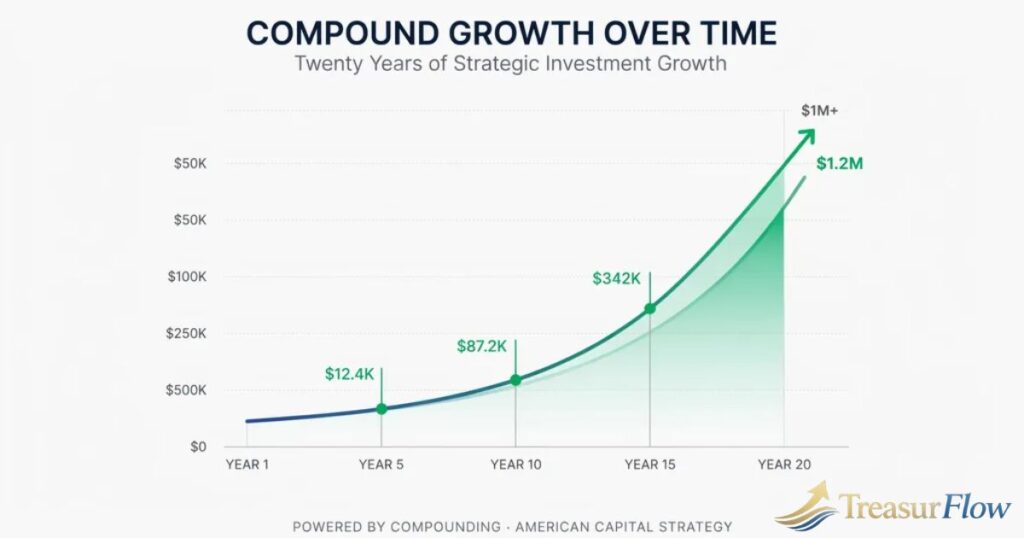
Even $100/month can grow massively over time.
👉 Example:
- $100/month for 20 years ≈ $50,000+ (with growth)
Step 3: Use Compound Interest
The earlier you start, the more powerful compounding becomes.
👉 Time matters more than money.
Step 4: Invest in the Right Assets (USA)
Best long-term options:
- Index funds (S&P 500)
- ETFs
- Retirement accounts (401k, Roth IRA)
- Real estate
Step 5: Stay Consistent (This Is Everything)
The secret is simple:
👉 Invest regularly, ignore noise, and stay patient.
Best Investment Options in the USA for Long-Term Wealth
Index Funds & ETFs
- Beginner-friendly
- Low fees
- Diversified
Real Estate
- Long-term appreciation
- Rental income
Retirement Accounts
- 401(k) → employer match
- Roth IRA → tax-free growth
Dividend Stocks
- Passive income
- Long-term growth
How Much Should You Invest Monthly?
A simple rule:
👉 Invest 15–25% of your income
But start small if needed:
- $50/month is better than $0
Consistency > Amount
Real Example of Wealth Growth
If you invest:
- $500/month
- for 20 years
- at ~8% return
👉 You could have $300,000+
That’s the power of slow wealth.
Common Mistakes That Destroy Wealth
- Trying to get rich quickly
- Not starting early
- Panic selling
- Ignoring diversification
- Not investing at all
How to Stay Consistent (Even When It Feels Slow)
- Automate your investments
- Track progress yearly (not daily)
- Focus on long-term goals
- Ignore market noise
👉 Remember:
Slow progress is still progress.
Compound Interest Explained With Real Numbers
Compound interest is the engine of slow wealth. It means you earn returns not only on your original contributions, but also on the returns those contributions already earned. Over long periods, this creates a powerful snowball effect — small amounts turn into large sums simply because time does the work.
Here is a concrete example. Assume you invest $200 per month and earn an average annual return of 8%:
- After 10 years: about $36,500 (you contributed $24,000)
- After 20 years: about $118,000 (you contributed $48,000)
- After 30 years: about $298,000 (you contributed $72,000)
Notice what happens: in the first 10 years, you put in $24,000 and gained roughly $12,500. Between years 20 and 30, you put in the same $24,000 — but your balance grew by about $180,000. The money you invested early did most of the work. You can test your own numbers with a free compound interest calculator, such as the one on Bankrate.
The key takeaway: starting ten years earlier matters more than investing twice as much later. A 25-year-old who invests $200 per month until age 65 will end up far wealthier than a 45-year-old who invests $500 per month over the same finish line. Time in the market beats timing the market — every time.
Index Fund Basics for Beginners
An index fund is a single investment that holds hundreds or even thousands of stocks at once and simply tracks a market index, such as the S&P 500. Instead of trying to pick individual winners, you own a small slice of the entire market.
Why index funds fit the slow-wealth strategy:
- Low fees: index funds typically charge 0.03%–0.20% per year, compared to 1% or more for many actively managed funds. Over decades, fees are one of the biggest drags on returns.
- Instant diversification: one fund spreads your money across hundreds of companies, so a single company’s failure barely matters.
- Proven long-term record: broad market index funds have historically delivered roughly 8–10% average annual returns over long periods, though returns are never guaranteed.
Before investing, it is worth understanding the basics. The U.S. Securities and Exchange Commission explains investing concepts in plain language at investor.gov, a free and trustworthy resource every new investor should bookmark.
How to Automate Your Investments
Willpower is unreliable; systems are not. Automating your investments removes emotion and forgetfulness from the process. Most banks and brokerages let you set up automatic transfers in a few minutes, and many employers offer automatic 401(k) deductions from every paycheck.
- Automatic bank transfers: schedule a transfer to your brokerage or IRA on payday, so the money is invested before you can spend it.
- 401(k) payroll deductions: contributions come out of your paycheck automatically — and always capture the full employer match if one is offered, because that is an instant 100% return on your money.
- Auto-increase contributions: raise your savings rate by 1% each year or with every raise, so you never feel the pinch.
- Annual checkup: once a year, review your accounts to make sure your mix of stocks and bonds still matches your plan.
Treat investing like a bill that gets paid automatically every month — pay yourself first. If you need help finding money in your budget to automate, the Consumer Financial Protection Bureau offers practical, free guidance at consumerfinance.gov.
Avoiding Lifestyle Inflation: The Silent Wealth Killer
Lifestyle inflation is what happens when your spending rises every time your income rises. You get a raise, then a nicer car, a bigger apartment, and more subscriptions — and your savings rate stays at zero. It is one of the most common reasons high earners never build real wealth.
Consider the math: you earn $50,000 and save 10% ($5,000 per year). A few years later you earn $80,000. If you keep living on roughly $45,000 and save the rest, you now save $35,000 per year — seven times more — without feeling any real sacrifice, because your lifestyle never changed. Every raise becomes a wealth-building event instead of a spending event.
Simple rules to fight lifestyle inflation:
- Save at least half of every raise or bonus before you touch it.
- Set a fixed monthly “fun budget” and send everything else to savings and investments.
- Upgrade your lifestyle only after hitting a savings milestone — not after every paycheck increase.
Wealth is not what you earn; it is what you keep. The gap between your income and your spending is where all slow wealth is built.
One lever for widening that gap is your career choice — see how many jobs are available in finance.
How to Choose Between a 401(k) and a Roth IRA
Retirement accounts are the backbone of slow wealth in the USA, and the two most popular options are the 401(k) and the Roth IRA. Understanding the difference between them helps you use both effectively instead of guessing.
- 401(k): contributions are usually pre-tax, which lowers your taxable income today. Your money grows tax-deferred, and you pay taxes when you withdraw in retirement. Many employers match contributions — that is free money you should never leave on the table.
- Roth IRA: contributions are made with after-tax dollars, but your money grows tax-free and you pay no taxes when you withdraw in retirement. This is ideal if you expect to be in a higher tax bracket later in life.
A common strategy is to contribute enough to your 401(k) to get the full employer match first, then fund a Roth IRA, then return to the 401(k) with any extra savings. The IRS sets annual contribution limits for both accounts, so it is smart to check the current limits on investor.gov before making your plan.
Whichever account you choose, the rule stays the same: start early, contribute automatically, and leave the money invested for decades. Retirement accounts reward patience more than any other investment.
FAQs About Building Wealth
What is the quickest way to build wealth?
There is no guaranteed “quick” way. The safest and most reliable method is consistent investing over time.
Can I turn $10,000 into $100,000?
Yes, but it takes time. With long-term investing and compounding, this is realistic over years — not weeks.
What creates most millionaires?
👉 Consistent investing + long-term discipline
Not luck, not hype.
What is the smartest thing to do with $10,000?
- Invest in index funds
- Keep emergency savings
- Avoid risky speculation
How much do I need to invest to make $3,000/month?
It depends on returns, but typically:
👉 $500,000–$1M invested (long-term)
Is it possible to become a millionaire in 2 years?
Extremely rare and risky. Slow wealth building is far more realistic and sustainable.
What are 7 streams of income?
- Salary
- Investments
- Rental income
- Business income
- Dividends
- Royalties
- Side hustles
Conclusion: Slow Wealth Is Real Wealth
Building wealth slowly may not be exciting…
But it works.
👉 It’s how real people in the USA:
- Achieve financial freedom
- Retire comfortably
- Build generational wealth
Start Today (Simple Action Plan)
- Open an investment account
- Start with any amount
- Invest consistently
- Stay patient
💡 Final Truth:
👉 You don’t need to be lucky to get rich.
You just need to be consistent.
Some links on this page go to product or issuer pages. Treasurflow’s rankings are based on the criteria stated in each guide. See the About page for how the site is funded.

Muhammad Zakir is the founder of Treasurflow and the author of its personal finance guides. He researches consumer banking, credit, and personal loans, and every guide cites primary sources such as the CFPB, FDIC, FTC, and IRS. His content is educational and is not personalized financial advice.
5 thoughts on “How to Build Wealth Slowly (The Proven Path to Financial Freedom in the USA)”