

Imagine this. You’re comparing the best CD rates 2026 and put $10,000 into a 12-month CD paying 4.50% APY. Six months later, a roof repair forces you to pull the money out. The bank charges a penalty equal to three months of interest. How much do you actually keep?
Work it out with simple-interest math, which is close enough for a decision (your bank’s exact compounding method may shift the final dollars slightly):
- Interest earned in 6 months: $10,000 × 4.50% × (6 ÷ 12) = $225
- Penalty (3 months of interest): $10,000 × 4.50% × (3 ÷ 12) = $112.50
- Interest you keep: $225 − $112.50 = $112.50
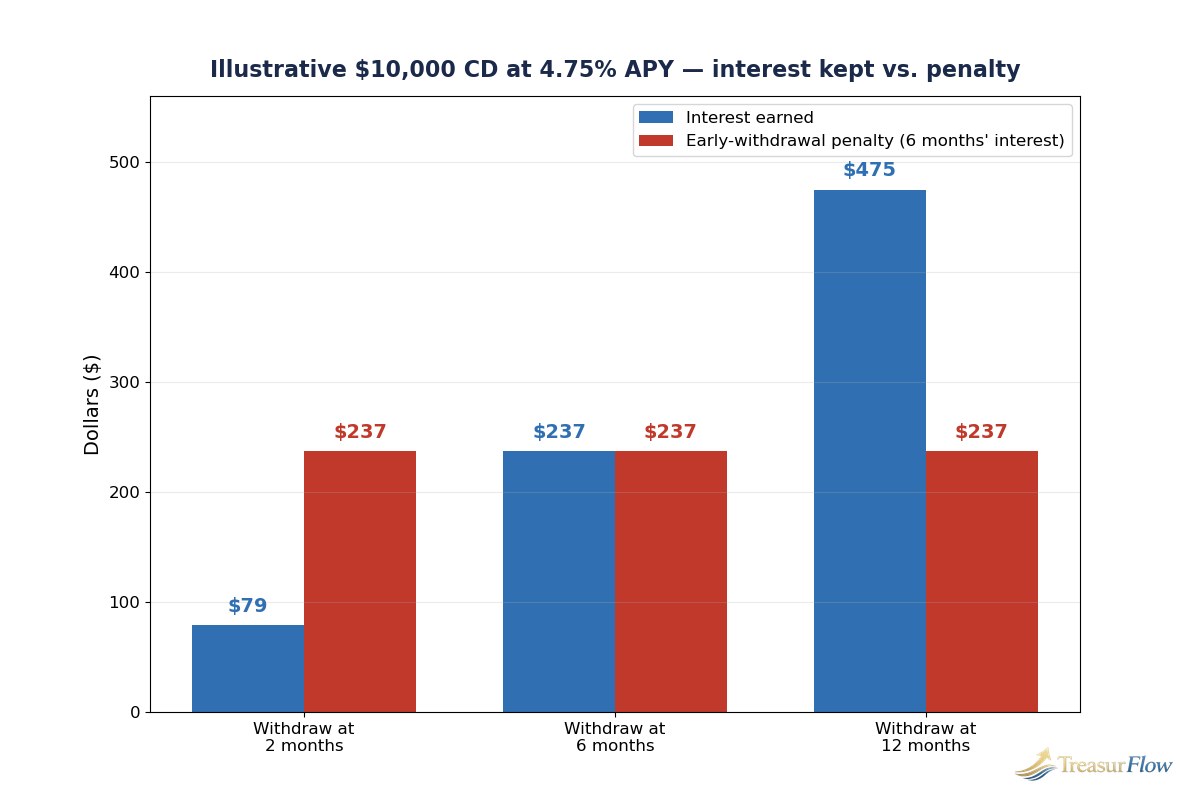
You still come out ahead — but only because you waited six months. Pull the same CD out after two months with a six-month penalty and the math turns ugly: about $67 earned against a $200 penalty, so you walk away with roughly $9,867 of your original $10,000. The headline APY never told you that. The penalty schedule did.
That is the test every CD in this guide has to pass. A great CD is not just the highest APY on a comparison page. It is the highest APY on a term you can actually hold, with a penalty you can survive if life intervenes, from an institution whose insurance covers your full deposit. Keep that test in mind and the rest of this guide gets simple.
Related Guides
Best High-Yield Savings Accounts 2026 — if you need the money on short notice, a top savings account may beat a CD you will break early.
How to Build Wealth Slowly — where guaranteed products like CDs fit inside a long-term plan.
How to Save Money in 2026 — the emergency-fund-first rule that decides how much belongs in a CD at all.
Rate Snapshot: October 2026 (Read This First — Rates Move)
Every APY in this article is a snapshot from mid-October 2026, drawn from Bankrate, Experian/Curinos, and MonitorBankRates listings. CD rates change — sometimes weekly. Bankrate notes that the Fed kept the federal funds rate steady through 2026 after three cuts in late 2025, and competitive CD rates have still inched down slowly since then. Treat every number below as “what the market looked like on the snapshot date,” then verify the live rate at the bank before you open anything. The comparison logic in this guide — penalty math, term matching, ladder structure — stays useful long after the numbers move.
Where the market stood in the snapshot:
| Term | National average APY (Bankrate, Oct 8, 2026) | Best verified APY in this guide |
|---|---|---|
| 3-month | Not published in Bankrate’s table | 4.58% (Austin Capital Bank, $1,000 min) |
| 1-year | 2.13% | 4.75% (E*TRADE, $0 min) |
| 2-year | 1.89% | 4.40% (Happen Bank, $500 min) |
| 3-year | 1.75% | 4.85% (Popular Direct, $10,000 min) |
| 5-year | 1.80% | 4.60% (Bread Savings, $1,500 min) |
Two things jump out. First, the gap between the national average and the best available CD is enormous — more than two full percentage points on a 1-year term. The average saver earns roughly half what a rate-shopper earns. Second, longer does not always mean higher: in this snapshot, the best 3-year CD paid more than the best 5-year CD. Never assume the longest term wins. Compare each term on its own merits.
APY vs. Interest Rate: The Only Definition That Matters
A CD’s interest rate is the simple rate the bank quotes. Its APY — annual percentage yield — is what you actually earn in a year after compounding is included. When a bank compounds interest and leaves it in the account, you earn interest on your interest, and the APY captures that effect.
In practice: $10,000 in a 1-year CD at 4.75% APY grows to about $10,475 at maturity, because the APY already accounts for compounding. Over multiple years the effect compounds further. A 5-year CD at 4.60% APY, with annual compounding, turns $10,000 into roughly $10,000 × (1.046)^5 ≈ $12,522 — about $2,522 of interest. That is the number to compare, not the rate printed in the ad. Two CDs can advertise the same “rate” and pay different APYs if one compounds daily and the other pays interest out to you instead of letting it compound — a common difference between bank CDs and brokered CDs, covered later in this guide.
One more definition before the picks: the penalty. Most banks charge 3 to 12 months of interest for early withdrawal, scaled to the term. The common pattern is about 3 months of interest for terms of 12 months or less, about 6 months for 1–5 year terms, and up to 12 months for terms over 5 years. Some banks charge flat fees or a percentage of principal instead. Always read the penalty line in the disclosure — it is the second-most important number on the page after the APY.
The Best CD Rates 2026 Picks, Term by Term
Each pick below is the strongest verified offer for its term in the October 2026 snapshot, chosen on the penalty test: a rate worth holding, at a bank where the penalty and minimums fit real savers.
3-Month CDs
Austin Capital Bank — 4.58% APY, $1,000 minimum. Short-term CDs rarely beat 4.50%, which makes this one the standout for money you will need soon — a quarterly tax payment, a known bill. Three-month penalties are typically light (often 1–3 months of interest), so the exit cost stays small if your timing slips.
The 9-Month Gap
No bank in the snapshot listings offered a standout 9-month CD. If your horizon is roughly three quarters, compare the best 6-month and 12-month offers instead: a 12-month CD at 4.75% APY broken after nine months (with a typical 3-month penalty) still nets about 3.56% annualized — usually better than settling for a mediocre 9-month rate. Do the penalty math on your specific CD before you assume the middle term is the middle return.
18-Month CDs
The snapshot’s competitive 18-month offers clustered near 4.30–4.40% APY. If you are parking money for a goal about a year and a half out — a wedding, a home down payment in 2027 — an 18-month term beats rolling two 9-month CDs only if the rate is locked and the penalty for the full term is acceptable. Otherwise, the 12-month pick below plus a rollover gives you more flexibility for nearly the same yield.
5-Year CDs
Bread Savings — 4.60% APY, $1,500 minimum. The longest term is the purest penalty-test case: five years is a long time to be wrong about needing the money. Bread’s offer passes because the rate leads its term and the bank’s early-withdrawal terms are disclosed up front — but only take a 5-year CD for money you are confident you will not touch. The Quorum Federal Credit Union 5-year CD at 4.15% APY is the credit-union alternative for members who prefer NCUA insurance, at a lower rate.
No-Minimum CDs
E*TRADE — 4.75% APY on the 1-year CD, $0 minimum. No-minimum CDs matter because minimums are a quiet gatekeeper: Popular Direct’s 3-year leader demands $10,000, which excludes plenty of savers. E*TRADE’s 1-year offer pairs the snapshot’s best 1-year rate with no minimum at all, making it the most accessible top pick in this guide.
CDs for Seniors
Seniors often hold the largest cash balances and face the steepest cost if a CD must be broken for medical expenses. Two rules: keep every CD under the $250,000 insurance limit per bank (see the FDIC section), and favor terms with light penalties or explicit senior-friendly withdrawal exceptions — some banks waive penalties for documented hardship or death. A 5-year CD at 4.60% is only a good senior CD if the money is genuinely spare; otherwise the 1-year no-minimum pick is the safer anchor.
Four Savers, Four CD Plans
Rates are abstract. Plans are concrete. Here is how the penalty test plays out for four different savers:
1. The emergency-fund builder ($5,000 saved, adding $400/month). Do not buy a CD yet. Finish the emergency fund first in a high-yield savings account — our How to Save Money in 2026 walks through the order of operations. A CD you will break for a car repair is a savings account with extra steps and a penalty.
2. The house-down-payment saver ($40,000, buying in ~18 months). Split it: $20,000 in the 12-month pick at 4.75% APY, $20,000 in a 6-month CD near 4.30%. The 6-month rung covers you if the timeline moves up; the 12-month rung earns the top rate. Never put a hard-deadline goal entirely in a term that matures after the deadline.
3. The retiree with $150,000 in cash. Keep $30,000 in savings for the year’s expenses, then ladder the rest: five $24,000 CDs across 1–5 year terms. Every dollar stays under the $250,000 FDIC limit, and a rung matures every year. If rates fall, the long rungs keep paying; if rates rise, each maturing rung can be reinvested higher.
4. The rate chaser ($10,000, loves a deal). Take Popular Direct’s 3-year CD at 4.85% APY — the snapshot’s highest verified rate — but only with money you will not need for three full years. The $10,000 minimum means this is the entire deposit; breaking it early forfeits the rate advantage that justified the lock-up. The penalty test is strictest for the highest APY.
Build a Best CD Rates 2026 Ladder: The Walkthrough
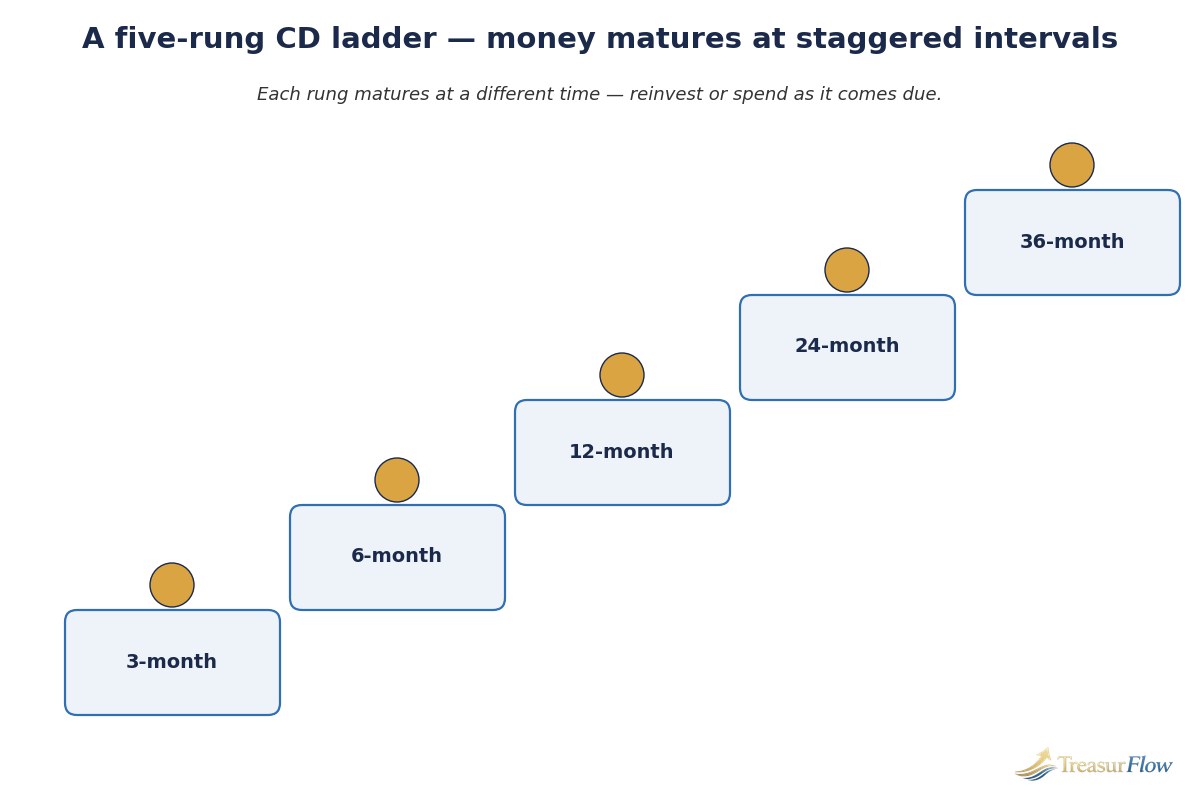
A CD ladder splits one deposit across multiple terms so money matures at staggered intervals. You earn long-term rates on part of the money while keeping regular access to the rest. Here is a $30,000 ladder built from this guide’s snapshot rates, from our How to Build Wealth Slowly framework:
| Rung | Term | Deposit | Snapshot APY | First-year interest (approx.) |
|---|---|---|---|---|
| 1 | 3-month | $6,000 | 4.58% | $68.70 (for the first 3 months) |
| 2 | 6-month | $6,000 | 4.30% | $129.00 (for the first 6 months) |
| 3 | 12-month | $6,000 | 4.75% | $285.00 |
| 4 | 24-month | $6,000 | 4.40% | $264.00 |
| 5 | 36-month | $6,000 | 4.85% | $291.00 |
| Total | $30,000 | ≈ $1,037.70 first-year |
How it runs: when the 3-month rung matures, roll it into a new 12-month CD (or the longest rung you are comfortable with). When the 6-month rung matures, do the same. Within a year, every rung is on a 12-month-or-longer cycle and something matures every few months. If rates rise, maturing rungs capture the new rates. If rates fall, the longer rungs you already locked keep paying. The ladder is the penalty test applied to a whole portfolio: no single withdrawal can trigger more than one rung’s penalty.
Brokered CDs vs. Bank CDs
You can also buy CDs through a brokerage — our Best Online Broker 2026 guide covers where. Brokered CDs work differently in three ways that matter for the penalty test:
- Price moves daily. A brokered CD is a bond-like instrument: its market price rises and falls with interest rates. Sell before maturity and you get the market price, which can be less than you paid — a different, harsher kind of “penalty” than a bank’s fixed months-of-interest.
- Interest is usually paid out, not compounded. Most brokered CDs pay interest into your brokerage sweep account instead of compounding inside the CD. A 4.60% brokered CD and a 4.60% APY bank CD are not the same return if the bank CD compounds and the brokered one does not.
- Call features are common. Many brokered CDs are callable: the issuer can redeem them early if rates fall — precisely when you would most want to keep the high rate. Bank CDs are rarely callable.
Brokered CDs suit investors who will definitely hold to maturity and want to consolidate accounts at one brokerage. For everyone else — especially anyone who might need the money — a direct bank CD with a disclosed fixed penalty is the cleaner penalty test.
CD vs. High-Yield Savings vs. T-Bills: The Decision
Three safe places for cash, three different jobs:
| CD | High-yield savings | Treasury bills | |
|---|---|---|---|
| Rate type | Fixed for the term | Variable — the bank can change it anytime | Fixed at auction (discount) |
| Access | Locked until maturity (penalty to exit) | Anytime | Sellable, or hold to maturity (4–52 weeks) |
| Insurance/backing | FDIC/NCUA up to $250,000 | FDIC/NCUA up to $250,000 | Full faith and credit of the U.S. government |
| Minimum (snapshot) | $0 at several top banks | $0–$1 at top accounts | $100 via TreasuryDirect |
| Best for | Money with a known future date | Emergency fund, money you may need soon | Short-term cash, state-tax-sensitive savers |
| Watch out for | Penalty, auto-renewal, call features | Rate cuts, teaser/promotional rates | 45-day transfer hold at TreasuryDirect for new issues |
The one-line version: savings for money you might need, CDs for money with a date, T-bills for money where state taxes bite. Our Best High-Yield Savings Accounts 2026 covers the savings side in the same depth.
FDIC and NCUA: How the $250,000 Limit Actually Works
The headline is simple: the FDIC insures bank deposits up to $250,000 per depositor, per bank, for each account ownership category; the NCUA provides identical coverage for credit union share accounts. The details are where people get hurt:
- It is per bank, not per account. Two CDs of $200,000 at the same bank total $400,000 — $150,000 uninsured. The same two CDs at two different banks are fully insured.
- Ownership categories multiply coverage. A single account and a joint account at the same bank are separate categories — each insured to $250,000. A couple can structure well over $500,000 of coverage at one bank across categories, but get this wrong and the excess is exposed.
- Accrued interest counts. Coverage includes principal plus accrued interest through the date of a bank failure, up to the limit. A $250,000 CD that has earned $3,000 is $3,000 over the limit.
- Brokered CDs: check the issuing bank. A brokered CD’s insurance comes from the issuing bank, not your brokerage. If you already hold deposits at that bank, the brokered CD aggregates with them toward the $250,000 cap.
Verify any bank at the FDIC’s BankFind and any credit union at the NCUA’s credit union locator before depositing over the limit — the links are in Helpful Official Resources below.
Before You Open: The 8-Point Checklist
Run every CD through this list before you fund it:
- Can I hold the full term? If the honest answer is no, shorten the term or keep the money in savings.
- What is the exact penalty? Months of interest, flat fee, or percentage of principal — and does it apply to principal if interest earned is smaller?
- Is the rate fixed for the whole term? Confirm there is no call feature and no “bump” clause that cuts the other way.
- What happens at maturity? Auto-renewal terms and the grace period length (Bread Savings gives 10 days; many banks give 7–10).
- Is my full deposit insured? Total at this bank, in this ownership category, under $250,000 including accrued interest.
- What is the minimum — and the next tier? Some banks pay higher APYs above a threshold; know which tier your deposit lands in.
- How does interest compound and pay out? Daily compounding left in the CD maximizes APY; interest paid out to you does not compound.
- Have I verified the live rate today? The snapshot in this guide is dated October 2026. Confirm the current APY at the bank before opening.
Helpful Official Resources
FDIC — Understanding Deposit Insurance
NCUA — How Your Savings at Credit Unions Are Insured (via Bankrate)
Frequently Asked Questions
What is the best CD rate right now?
In the October 2026 snapshot used in this guide, the strongest verified offers were about 4.75% APY on a 1-year CD (E*TRADE, no minimum), 4.85% APY on a 3-year CD (Popular Direct, $10,000 minimum), and 4.60% APY on a 5-year CD (Bread Savings, $1,500 minimum). Rates change frequently, so verify the live rate at the bank before opening. The “best” CD for you also depends on your term, minimum, and penalty tolerance — not just the APY.
Can you lose money in a CD?
Yes, in one specific way: the early-withdrawal penalty. If you withdraw before maturity and the penalty is larger than the interest you have earned, the bank deducts the difference from your principal. Example: $10,000 in a 12-month CD at 4.00% APY, withdrawn after two months with a six-month penalty — about $67 earned against a $200 penalty, so you get back roughly $9,867. Held to maturity, a CD at an insured bank cannot lose principal.
Are CDs FDIC insured?
CDs from FDIC-insured banks are insured up to $250,000 per depositor, per bank, for each account ownership category. CDs from federally insured credit unions carry the same $250,000 protection through the NCUA’s Share Insurance Fund. Coverage includes principal plus accrued interest through the date of a bank failure, up to the limit.
Is a CD better than a high-yield savings account?
It depends on what you are insuring against. A CD’s fixed rate protects you if rates fall; a savings account’s flexibility protects you if you need the money. On $10,000, a 1-year CD at 4.75% APY earns about $475 if held to maturity, versus about $425 for a savings account at 4.25% APY if its rate holds all year — but if the savings rate drops mid-year, the gap widens in the CD’s favor. Keep emergency money in savings; lock money with a known future date in a CD.
What happens when a CD matures?
Most banks auto-renew the CD into a new term at the then-current rate unless you act during the grace period — Bread Savings, for example, gives a 10-day grace period after renewal to close the account without penalty. You can usually choose to withdraw, renew, or change the term. Mark the maturity date and the grace-period deadline on your calendar; missing the window can lock your money into a new term you did not choose.
Should I put all my savings in one CD?
No. Keep 3–6 months of expenses in an accessible savings account first, keep no more than the $250,000 insurance limit at any one bank in any one ownership category, and consider a ladder so part of your money matures regularly. A single CD is a single lock-up date and a single penalty schedule — spreading across terms and institutions removes both risks.

Muhammad Zakir is the founder of Treasurflow and the author of its personal finance guides. He researches consumer banking, credit, and personal loans, and every guide cites primary sources such as the CFPB, FDIC, FTC, and IRS. His content is educational and is not personalized financial advice.