

A couple books a $9,000 Alaskan cruise a year in advance. Three weeks before sailing, one of them needs gallbladder surgery. The cruise line’s refund schedule returns almost nothing that late. Their trip cancellation benefit pays the whole non-refundable amount — because surgery is a covered reason, and they bought the policy within the waiver window.
A 68-year-old retires to Portugal for a month. On day six, he slips on wet cobblestones and fractures a hip. His U.S. health plan covers almost nothing in Portugal — Medicare does not pay for care outside the United States — and the hospital wants payment arrangements before surgery. His travel plan’s emergency medical benefit and evacuation benefit handle the bills and the flight home.
A family of four books a $4,000 beach trip. Two days before departure, their teenager’s school closes for a norovirus outbreak and they simply do not want to travel. No illness, no covered reason. Without Cancel For Any Reason coverage, they lose everything. With it, they recover up to 75%.
Same product category, three completely different jobs. That is why “best travel insurance 2026” has no single winner. The right plan depends on what kind of trip you are taking, how much of it is non-refundable, how healthy the travelers are, and how much flexibility you need. This guide ranks plans by trip type, shows the real coverage limits behind each pick, works through the Cancel For Any Reason math with stated assumptions, and explains the two deadlines — the waiver window and the look-back period — that decide whether your coverage actually works when you need it.
What a Ruined Trip Actually Costs
Travel insurance is priced against a simple fact: most of a trip’s cost becomes non-refundable long before you leave. Airlines, cruise lines, tour operators, and vacation rentals all run sliding refund schedules. Cancel early and you may recover most of your money. Cancel two weeks out and you may recover almost none of it. Insurance exists to convert that cliff into a predictable premium.
A comprehensive package plan — one that bundles cancellation, interruption, medical, evacuation, delay, and baggage — typically costs 4% to 8% of your prepaid trip cost, according to licensed-agent comparison site CoverTrip. The National Association of Insurance Commissioners puts the general range at about 5% to 10% of total trip price. On a $5,000 trip, that means roughly $200 to $400 for a mid-range plan. A basic plan with low medical limits can come in under 4%; a top plan with Cancel For Any Reason can pass 10%.
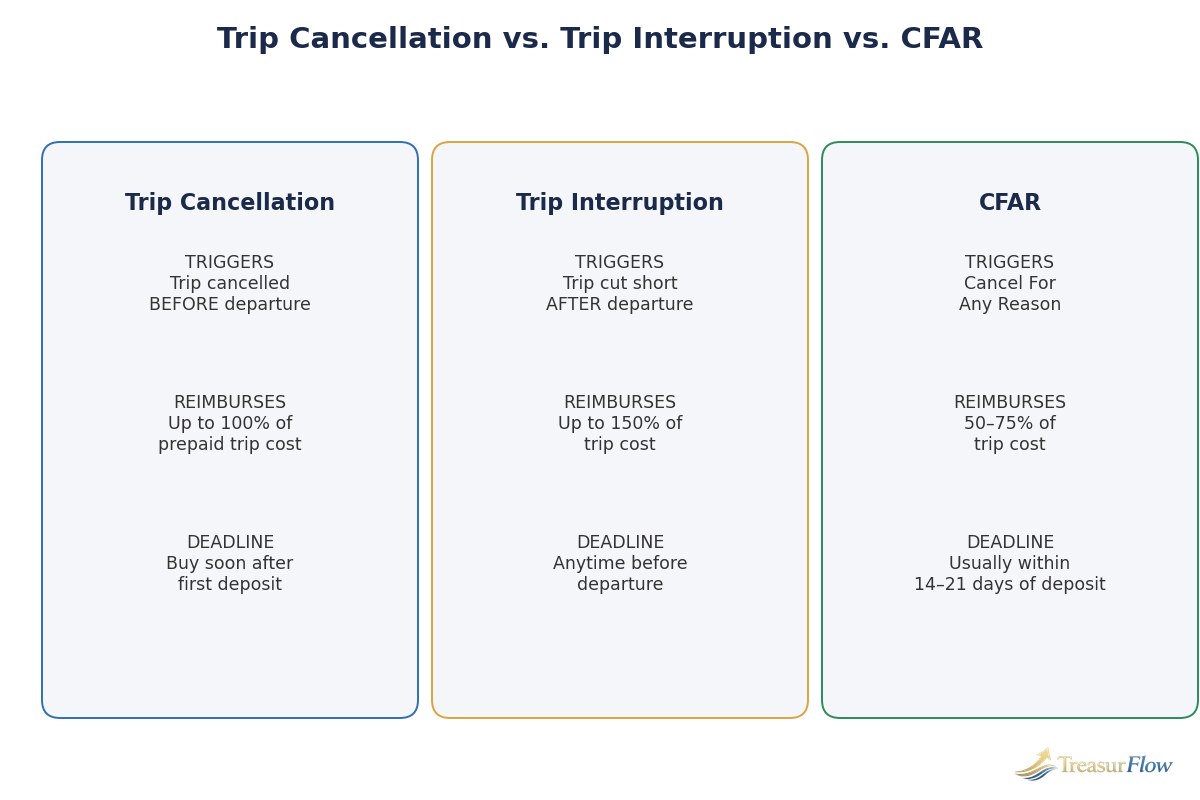
Those percentages buy three different kinds of protection, and confusing them is the most common mistake travelers make:
Trip cancellation reimburses prepaid, non-refundable expenses if you cancel before departure for a covered reason — illness, injury, death in the family, job loss, severe weather, airline bankruptcy, and similar listed events. Standard cancellation typically reimburses up to 100% of the insured trip cost.
Trip interruption reimburses the unused, non-refundable portion of your trip plus the extra transportation cost of getting home early, again for a covered reason. Many plans pay up to 150% of the trip cost here, because getting home early costs extra.
Emergency medical and evacuation pay for care and transport after an illness or injury during the trip. This is the coverage with the widest gap between cheap and good plans: basic plans may cap medical at $10,000, while strong plans offer $100,000 to $250,000, and evacuation limits range from $50,000 to $1,000,000.
The U.S. State Department’s own guidance is blunt: the U.S. government does not pay medical costs for U.S. citizens traveling abroad, and Medicare and Medicaid do not pay for medical care outside the United States. The State Department recommends buying travel health insurance before your trip and strongly recommends medical evacuation insurance when traveling to areas with higher risk or limited medical care. If your regular health plan does not cover you abroad, a short-term travel policy is the backstop — and some policies pay hospitals directly rather than making you pay first and claim later.
Related Guides: If you are paying for the trip with a card, read Best Travel Rewards Credit Cards 2026 first — some cards include built-in trip protection that changes how much standalone coverage you need. And if you are still budgeting the trip itself, see How to Save Money for Holidays.
The Five Coverages That Actually Matter
Before comparing plans, learn to read a benefits schedule. Every travel plan is a list of caps, and the caps are the product.
1. Trip cancellation
The headline number is the maximum cancellation reimbursement, per traveler. On Allianz’s OneTrip line, for example, Basic caps cancellation at $10,000, Prime at $100,000, and Premier at $200,000 (up to the amount purchased). Cancellation only pays for covered reasons listed in the certificate. “I changed my mind” is not one of them — that is what CFAR is for, covered later in this guide.
2. Trip interruption
Interruption pays when a covered reason cuts your trip short. Allianz Prime and Premier both pay up to 150% of the insured trip cost. The extra 50% exists because an interrupted trip costs more than an unused trip: you are buying last-minute flights home on top of the nights you already lost.
3. Emergency medical
This is the benefit that separates a $150 policy from a $400 policy. Allianz Prime covers up to $50,000 in emergency medical and dental ($750 sublimit for dental); Premier covers up to $75,000. Dedicated cruise and senior plans from other insurers go higher — Seven Corners’ cruise plan, for example, lists $250,000 in medical coverage. If you are traveling somewhere with expensive private hospitals or far from good care, medical limits matter more than cancellation limits.
4. Emergency medical transportation (evacuation)
Evacuation pays to move you to the nearest adequate hospital, and then home if medically necessary. Allianz Prime covers up to $500,000; Premier covers up to $1,000,000. Basic covers $50,000. Evacuation from a cruise ship — ship-to-shore transfer, local hospital, stabilization, then a medical escort home — is a multi-leg sequence, which is why cruise travelers should treat this number as a first-class requirement, not a footnote.
5. Travel delay, baggage delay, and baggage loss
These are the small, frequent claims. Allianz Prime pays up to $800 for travel delay ($200 per day, after a delay of five or more hours for a covered reason) and up to $300 for baggage delay (12+ hours, receipts required), plus up to $1,000 for baggage loss or damage. Premier doubles the delay cap to $1,600 with a shorter three-hour trigger. These benefits will not change your life, but they are the ones you are most likely to actually use — a missed connection, a bag that arrives a day late.
The Best Travel Insurance 2026 Picks, by Trip Type
Instead of one overall winner, here is the strongest plan for each of the five trips people actually book — with the limits that justify each pick.
Best for cruises: Seven Corners Cruise Insurance (or IMG iTravelInsured Choice Cruise)
Cruises break standard travel insurance in four specific ways, and a cruise-specific plan is built to fix them.
First, missed connections. Arrive late to embarkation and you have missed the ship. A cruise plan covers the cost of catching up to the ship at the next port, or reimburses the unused portion of the cruise. Second, missed ports and itinerary changes. Standard policies often do not pay anything when the captain skips a port — you still got a cruise. Cruise plans pay a fixed missed-port benefit: Travel Guard Preferred pays $250 per missed port per person, Tin Leg Cruise pays $500, and IMG’s iTravelInsured Choice Cruise pays $750. Third, medical at sea. Cruise-line-sold protection often caps medical at $20,000–$25,000, which a single night in a ship’s ICU can exceed. Third-party cruise plans run far higher: Seven Corners’ cruise plan lists $250,000 in medical coverage and $500,000 in evacuation; IMG’s lists $100,000 in primary medical coverage and $500,000 in evacuation. Fourth, financial default. Many third-party plans cover the cruise line’s financial default as a cancellation reason; cruise-line-sold protection usually cannot, because the seller is the entity that would default.
Seven Corners Cruise is the pick for travelers who want the highest medical limits plus CFAR availability (up to 75% of non-refundable trip cost) and a pre-existing condition waiver if requirements are met. IMG iTravelInsured Choice Cruise is the pick for families and value seekers: it allows one child under 18 per adult at no additional cost, caps cancellation at $10,000, and still pays 150% for interruption with a $750 missed-port benefit.
One caution: cruise-line-sold protection has one genuine advantage — most cruise lines waive the pre-existing condition exclusion if you buy at final payment, while third-party plans require purchase within 14–21 days of your very first deposit. If you booked months ago and never bought insurance, the cruise line’s own plan may be your only route to a waiver.
Best for seniors and travelers with health conditions: Allianz OneTrip Premier
Seniors face the sharpest version of the pre-existing condition problem, and Premier’s combination of a waiver path plus the highest limits in the OneTrip line makes it the strongest fit. Premier covers cancellation up to $200,000, interruption up to 150%, emergency medical up to $75,000, and evacuation up to $1,000,000, with a $1,600 travel-delay benefit that triggers after just three hours.
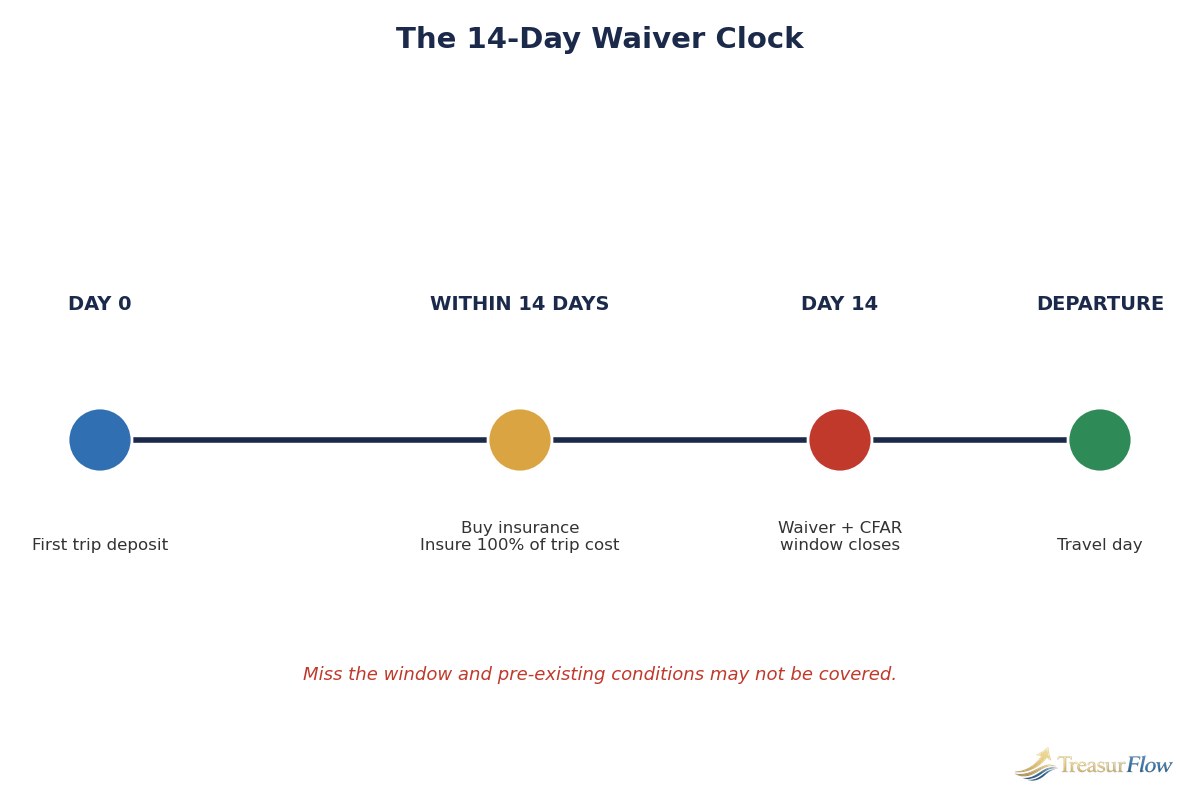
The waiver is the real reason to pick Premier over a cheaper plan: Allianz’s OneTrip plans can cover existing medical conditions at no additional cost if you insure the full cost of your trip within 14 days of paying your first trip deposit and are medically able to travel when you buy. Miss that window and the exclusion applies. Seniors booking expensive trips — a $15,000 river cruise, a three-week tour — should treat the insurance purchase as part of the booking transaction, not a follow-up task. The same logic applies to life-stage planning more broadly; if you are also reviewing coverage for the people who depend on you, see Best Life Insurance 2026.
Best for frequent travelers: an annual (multi-trip) plan
If you take three or more trips a year, pricing each trip separately gets expensive and repetitive. Annual plans, such as Allianz’s AllTrips line, cover every trip you take within 365 days under one policy. The trade-off is that per-trip limits are lower than a strong single-trip plan — annual plans are built for frequency, not for one catastrophic trip.
The break-even test is simple. Illustrative example (assumptions stated): suppose a single-trip mid-range plan costs $250 per trip. Three trips a year cost $750 in single-trip premiums. If an annual plan costs less than $750 and its per-trip limits cover your typical trip cost, the annual plan wins — and it wins again on convenience, because you never face the waiver window again: you are covered from the day the annual policy starts. If your trips are mostly cheap domestic weekends, single-trip basic plans may still be cheaper. If your trips are mostly $5,000+ international trips, buy single-trip comprehensive plans for those and let the annual plan handle the small ones — but read the certificate first, because some annual plans exclude trips above a cost or length threshold.
Best for adventure and active trips: an adventure-focused plan, verified activity by activity
Standard plans routinely exclude “high-risk” activities — scuba diving, zip-lining, ATV riding, mountaineering, backcountry skiing — even when those activities are the entire point of the trip. Comparison analyses of cruise excursion coverage reach the same conclusion: adventure activities booked independently are frequently excluded from standard plans.
The fix is not a brand name; it is a verification step. Adventure-focused plans (World Nomads’ Explorer tier is the best-known example) publish a list of covered activities. Before buying, search that list for every activity on your itinerary, including the specific variant — “scuba diving to 30 meters” is not the same as “scuba diving,” and altitude limits matter for trekking. If an activity is missing, either pick a different plan or accept that you are self-insuring that day. Also confirm that the plan’s medical and evacuation limits are high enough for remote destinations: a helicopter evacuation from a mountain trail is exactly the claim that exposes a $50,000 evacuation cap.
Best for budget trips and cancellation-only needs: Allianz OneTrip Basic
Not every trip needs a $400 policy. If your trip is a $1,200 domestic flight-and-hotel weekend, your health coverage at home already applies, and the only real risk is losing the non-refundable fare, a basic plan is rational. OneTrip Basic covers cancellation up to $10,000, medical up to $10,000, evacuation up to $50,000, baggage loss up to $500, and travel delay up to $300. That is a thin medical cushion — do not take Basic abroad to a remote destination — but for a cheap domestic trip it converts a total loss into a $60–$100 premium.
A cancellation-only alternative exists for travelers who want nothing but the cancellation benefit. It is cheaper than a package plan, but it drops medical, evacuation, delay, and baggage entirely. Buy it only when you are certain your health coverage and credit card benefits already cover the rest — and verify that claim against your card’s actual guide to benefits, not your memory of it.
Cancel For Any Reason: The Math, Worked Out
CFAR is the most misunderstood upgrade in travel insurance. It is an add-on rider to a comprehensive policy, never a standalone product. It lets you cancel for reasons your standard policy excludes — fear of travel, a schedule change at work, a falling-out with your travel companion, plain buyer’s remorse — and recover a percentage of your prepaid, non-refundable costs. The standard reimbursement is 50% to 75%, depending on the plan.
It comes with four hard rules:
- Buy within 14–21 days of your first trip payment. The clock starts at your first deposit, not your departure date. Miss the window and CFAR is gone for that trip.
- Insure 100% of your prepaid, non-refundable trip costs. You cannot insure only the flights and skip the hotel.
- Cancel at least 48–72 hours before departure (the exact cutoff varies by provider).
- Accept partial reimbursement. CFAR pays 50–75%, never 100%. If your cancellation reason is covered by your standard policy — say, a medical emergency — you still get the full 100% through the standard benefit. CFAR only kicks in for reasons the base policy does not cover.
Now the cost. Adding CFAR typically increases the premium by roughly 40% to 50%. InsureMyTrip’s published figures put the CFAR add-on at about $79 on a $2,500 trip, $191 on a $5,000 trip, and $302 on a $10,000 trip — roughly 3% to 4% of trip cost for the add-on alone, or about 9% to 14% of trip cost for the full comprehensive policy with CFAR included.
Worked example (illustrative, assumptions stated): a couple books a $6,000 trip — $2,400 in non-refundable flights, $3,600 in a non-refundable resort. Their base comprehensive policy costs $360 (6% of trip cost). Adding CFAR at 75% reimbursement costs an additional $191 (using the published $5,000-trip figure as a guide, rounded). Total premium: $551.
- Scenario A — covered reason. One traveler breaks a leg a week before departure. Standard cancellation pays 100%: $6,000 recovered. CFAR is irrelevant.
- Scenario B — uncovered reason. A work project moves and they must cancel. Without CFAR: $0 recovered. With CFAR at 75%: $4,500 recovered. The $191 add-on returned $4,500.
- Scenario C — nothing goes wrong. They travel. The $191 bought nothing but peace of mind.
The decision rule falls out of the arithmetic: CFAR is worth it when (a) a large share of your trip is non-refundable, (b) there is a realistic chance you will want to cancel for a reason no standard policy covers, and (c) you buy within the 14–21 day window. It is not worth it when your bookings are mostly refundable, when the trip is cheap enough to absorb, or when you have already missed the purchase window — which, according to Squaremouth’s 2026 trends data, is exactly what happens to roughly one in three travelers who search for CFAR. They look for coverage they already forfeited.
The 14-Day Clock: Pre-Existing Conditions, Waivers, and Look-Back Periods
If CFAR is the most misunderstood upgrade, the pre-existing condition waiver is the most expensive one to misunderstand. A standard policy excludes claims caused by a “pre-existing condition” — generally, any condition for which you had symptoms, sought treatment, or took medication during a look-back period before you bought the policy. Look-back periods typically run 60 to 180 days depending on the carrier. In CoverTrip’s comparison of 54 plans, 22 used a 60-day look-back, 21 used 180 days, 8 used 90 days, and 2 used 120 days. A shorter look-back is better for you: with a 60-day window, a condition diagnosed 90 days ago falls outside it; with a 180-day window, it is pre-existing.
The waiver removes that exclusion — if you meet three conditions:
- Buy within 14–21 days of your first trip payment. The shortest window in CoverTrip’s library is 14 days; nothing shorter exists. Allianz’s OneTrip waiver requires insuring the full trip cost within 14 days of the first deposit.
- Insure 100% of your prepaid, non-refundable trip costs, and add later payments as you go.
- Be medically able to travel on the day you buy.
Meet all three and the waiver is typically granted at no additional cost. Miss any one and the exclusion applies.
Two nuances most travelers miss. First, the waiver clock starts at your first dollar — a $500 cruise deposit on a $5,000 cruise triggers it, even if you have not booked flights yet. Second, many plans treat a condition controlled solely by unchanged medication as not pre-existing at all: 31 of the 54 plans in CoverTrip’s library say so in their definitions. If your blood pressure medication has not changed in a year, that condition may not count as pre-existing on those plans, waiver or no waiver. If the dose changed last month, it does.
If you have already missed the window, you are not uninsured — you are uninsured for that condition. Everything unrelated is still covered in full: a fall, food poisoning, a missed connection, a hurricane. And a plan with a 60-day look-back still helps, because a shorter window means fewer things count as pre-existing. But the waiver itself cannot be bought back at any price.
What Credit Card Travel Coverage Will Not Do
Many premium travel cards include trip cancellation, interruption, delay, and baggage benefits — and for some travelers, card coverage plus a medical-only policy is enough. But card coverage has four gaps that surprise people at claim time.
First, limits are lower. Card trip cancellation caps are typically a few thousand dollars per trip, far below a $10,000 cruise fare. Second, no CFAR. Cards do not offer Cancel For Any Reason. Third, no pre-existing condition waiver. Card benefits do not waive pre-existing condition exclusions the way a travel policy purchased within 14 days does. Fourth, medical is usually secondary or absent. Many cards offer no emergency medical coverage at all, and those that do may pay only after your health insurance denies the claim.
The right move is to read your card’s guide to benefits before you shop for a standalone policy, then buy only the coverage the card does not already give you. If your card covers cancellation up to $10,000 and your trip costs $6,000, you may only need a medical-and-evacuation policy. If your card covers nothing medical, a comprehensive standalone plan is the safer buy. (Card choice itself matters here — see Best Travel Rewards Credit Cards 2026 — but never assume a card’s marketing page describes its insurance; the guide to benefits is the contract.)
The Best Travel Insurance 2026 Claim Documentation Checklist
The best policy in the world pays nothing if you cannot document the claim. Insurers deny claims for missing paperwork more often than for uncovered reasons. Build this file the moment something goes wrong — not when you get home:
- Cancellation claims: proof of the covered reason (doctor’s note on letterhead with dates, employer’s termination letter, death certificate), proof of the trip cost (booking confirmations, receipts), and proof of what the supplier refunded or refused to refund (a written denial or refund statement). CFAR claims need the cancellation confirmation showing you cancelled at least 48–72 hours before departure.
- Medical claims: itemized hospital bills, diagnosis and treatment notes, proof of payment, and the name and contact of the treating physician. If you are admitted, call the insurer’s assistance line during the emergency, not after — many policies require notification for evacuation, and some pay hospitals directly if you call first.
- Delay claims: proof of the delay from the carrier (airline delay notice, a screenshot of the departure board with timestamps), plus receipts for meals and hotels. Keep every receipt; a $200-per-day benefit still requires receipts unless your plan offers a fixed inconvenience payment option.
- Baggage claims: the airline’s property irregularity report (file it at the airport, not later), a list of contents with approximate values, and receipts for emergency replacement purchases.
- For pets traveling with you: keep vet records and vaccination proof with your travel documents. If your pet needs care abroad, those records decide whether treatment can start immediately. See Best Pet Insurance 2026 for how pet coverage works at home — it does not replace travel medical coverage for your pet.
Photograph everything, keep a digital copy with someone at home, and file the claim within the deadline in your certificate — typically 20 to 90 days after the loss, depending on the insurer. Late filing is one of the few claim denials that is entirely avoidable.
The Five-Question Decision Framework
If you have read this far and still feel stuck, answer these five questions in order. They select the plan for you.
1. How much of this trip is non-refundable, and when does it become non-refundable? Under $1,500 and mostly refundable: a basic plan or card coverage may be enough. Over $3,000 non-refundable: a comprehensive plan is worth it. Over $10,000: buy the strongest cancellation and interruption limits you can afford.
2. Is anyone on the trip managing a health condition? If yes, the 14-day waiver window is your first deadline — buy within 14 days of your first deposit, insure 100% of trip cost, and confirm you are medically able to travel that day. If no, you can shop more slowly, but earlier is still cheaper in option value.
3. Where are you going, and how good is the medical care there? A city with modern hospitals and your health plan’s network: standard medical limits are fine. A remote area, a cruise, or a country with expensive private hospitals: maximize medical and evacuation limits first, cancellation second.
4. How likely are you to cancel for a reason no policy lists? High — work, family obligations, changing plans: add CFAR within the 14–21 day window. Low — your plans are firm and your health is stable: skip CFAR and save the 40–50% premium add-on.
5. How many trips will you take this year? Three or more: price an annual plan against your total single-trip premiums using the break-even test above. One big trip: buy the best single-trip plan for that trip type and stop optimizing.
Frequently Asked Questions
Do I need travel insurance for a domestic trip?
Often, yes — but for a different reason than international travel. Your U.S. health insurance generally works at home, so medical coverage is less urgent. What you are really insuring is the non-refundable cost: flights, hotels, rental cars, event tickets. If those are mostly refundable, card coverage may be enough. If a $4,000 domestic trip is largely non-refundable, a basic or mid-range plan is still worth it. The State Department’s warning about medical costs abroad does not apply domestically, but cancellation risk does.
When should I buy travel insurance?
As soon as you pay your first deposit. Two separate deadlines run from that date: the 14–21 day window for the pre-existing condition waiver and the 14–21 day window for CFAR. Both are lost permanently once they pass. Buying early also covers you against supplier bankruptcy and other events that happen between booking and departure. You can buy a policy later — up to the day before departure on many plans — but you will have forfeited the two most valuable options.
Does travel insurance cover trip cancellation if I just change my mind?
Only with Cancel For Any Reason coverage. Standard trip cancellation reimburses only listed covered reasons, such as illness, injury, death in the family, job loss, or severe weather. Changing your mind, a schedule conflict, or fear of travel are not covered reasons under a standard policy. CFAR covers them, reimburses 50–75% of prepaid non-refundable costs, and must be purchased within 14–21 days of your first trip payment with 100% of trip costs insured.
How much medical coverage do I need abroad?
It depends on destination. For a trip to a country with modern, affordable care, $50,000 in emergency medical coverage (Allianz Prime’s level) is a reasonable floor. For the United States as a destination for international visitors, for cruises, or for remote regions, $100,000 to $250,000 is safer, with evacuation of at least $500,000. The binding constraint is usually evacuation, not treatment: a single medical flight can cost more than the hospital stay. Check the evacuation limit before the medical limit.
Is cruise line insurance enough, or do I need a third-party plan?
Cruise-line protection is convenient and has one real advantage: most cruise lines waive the pre-existing condition exclusion if you buy at final payment, while third-party plans require purchase within 14–21 days of your first deposit. On everything else, third-party plans are usually stronger: higher medical limits (cruise-line plans can cap medical at $20,000–$25,000), missed-port and itinerary-change benefits, coverage for the cruise line’s own financial default, and CFAR options. If you booked months ago and missed the third-party waiver window, the cruise line’s plan may be your best remaining option. Otherwise, compare a third-party cruise plan first.
Does travel insurance cover pre-existing conditions?
Only through the waiver — or if the condition falls outside the look-back period. A standard policy excludes claims caused by conditions that were treated, symptomatic, or medicated during the look-back period (typically 60–180 days before purchase). The waiver removes that exclusion if you buy within 14–21 days of your first trip payment, insure 100% of prepaid non-refundable costs, and are medically able to travel when you buy. Some plans also do not treat a condition controlled solely by unchanged medication as pre-existing at all. Read the certificate’s definition, not the marketing summary.
What is not covered by travel insurance?
Common exclusions include: known events (a named storm that existed before you bought the policy), war and acts of war (though downstream effects like airspace-closure cancellations may be covered separately), high-risk activities not listed in your plan, traveling against a government “Do Not Travel” advisory, self-inflicted injuries, and losses caused by intoxication. Fear of travel is not covered without CFAR. Always read the exclusions section of the certificate — it is shorter than you expect and more important than the benefits list.
Helpful Official Resources: U.S. State Department — Travel Insurance · Allianz Travel — OneTrip Prime Plan · CoverTrip — How Much Does Travel Insurance Cost · InsureMyTrip — Cruise Travel Insurance

Muhammad Zakir is the founder of Treasurflow and the author of its personal finance guides. He researches consumer banking, credit, and personal loans, and every guide cites primary sources such as the CFPB, FDIC, FTC, and IRS. His content is educational and is not personalized financial advice.