

If your dog swallowed a sock last night or your cat started limping this morning, you already know the scariest part of the vet visit isn’t the diagnosis — it’s the bill. The bottom line up front: for most pet owners in 2026, Fetch is the strongest all-around pick — it was voted #1 Best Pet Insurance in the 2026 Newsweek Readers’ Choice Awards, covers every adult tooth for dental disease, and includes sick-visit exam fees and behavioral therapy in the base policy instead of hiding them behind add-ons. Trupanion is the one to beat if you want unlimited payouts with 90% reimbursement and direct payment to your vet, while Pets Best is the budget-friendly route if keeping the monthly premium low matters most.
This guide compares the best pet insurance 2026 plans for dogs and cats — what they cost, what they actually cover, what they don’t, and how to pick one without regretting it later. No fluff, no sponsored rankings.
🏛️ Helpful Official Resources
- NAIC: Pet Insurance Consumer Guide — the National Association of Insurance Commissioners explains policy types, exclusions, and waiting periods.
- AVMA: Pet Owner Care Survey — American Veterinary Medical Association research on how pet owners use veterinary care.
- California Department of Insurance — example of a state insurance department where you can verify a pet insurer’s license or file a complaint (find yours via the NAIC).
- ASPCA — pet health resources and the ASPCA’s own pet insurance program details.
What Is Pet Insurance?
Pet insurance is a reimbursement-based policy that pays you back for eligible veterinary bills after you meet your deductible. You pay the vet, file a claim, and the insurer reimburses a set percentage — typically 70%, 80%, or 90% — up to your annual limit. Most plans cover unexpected accidents and illnesses, exclude pre-existing conditions, and come with short waiting periods before coverage kicks in.
That definition hides the part that actually matters: pet insurance exists so you never have to choose between your savings account and your dog’s surgery. In an AVMA survey of 1,000 U.S. pet owners, 76% said they put their pet’s health and safety above all else as a top priority — but wanting the best care and being able to afford it at 2 a.m. in an emergency room are two different things.
Quick Comparison: The Best Pet Insurance Plans of 2026
Here’s how the top providers stack up at a glance. Detailed reviews follow below.
| Provider | Best For | Standout Feature | Sample 2026 Monthly Rate* |
|---|---|---|---|
| Fetch | Best overall | Full dental coverage, exam fees & behavioral therapy included | From ~$35 |
| ASPCA | Flexible coverage | Strong pre-existing condition approach, direct-pay option | Varies — get a quote |
| Trupanion | Unlimited payouts | 90% reimbursement, VetDirect Pay at checkout | Up to ~$139 |
| Spot | Unlimited coverage option | Accident, illness & wellness tiers | Varies — get a quote |
| Embrace | Military families | 25% military discount on USAA-issued policies | Varies — get a quote |
| Pets Best | Budget pick | Lowest starting rates in 2026 comparisons | From ~$40 avg |
| Lemonade | Fast claims | AI-driven claims process | Varies — get a quote |
| Healthy Paws | Holistic coverage | Alternative therapies, direct pay on request | Varies — get a quote |
| Pumpkin | Puppies & kittens | Puppy/kitten-focused plans | Varies — get a quote |
Sample rates are representative 2026 figures from Sniffspot’s 12-provider comparison and MoneyGeek’s national cost analysis — not guaranteed quotes. Your actual premium depends on your pet’s breed, age, location, deductible, reimbursement rate, and annual limit.
The 9 Best Pet Insurance Companies of 2026
1. Fetch — Best Overall
Verdict: the most complete base policy in 2026 — the plan I’d recommend first to most pet owners.
Fetch was voted #1 Best Pet Insurance in the 2026 Newsweek Readers’ Choice Awards, an honor decided by editorial review plus direct consumer input, and Forbes Advisor named it best for dental coverage in its 2026 analysis. The company insures more than 600,000 cats and dogs across North America and its U.S. policies are underwritten by AXIS Insurance Company.
What actually separates Fetch is how much sits in the base policy instead of behind an upgrade button. Dental coverage includes every adult tooth — not just the canines — which matters because the Cornell University College of Veterinary Medicine notes that the vast majority of dogs over age 3 show some periodontal disease. Sick-visit exam fees are covered up to your policy cap, behavioral therapy is reimbursed at 100% up to $1,000 a year, and 24/7 online vet visits through Vetster are covered at 100% up to $1,000 a year. There’s even up to $1,000 a year for covered trip-cancellation costs if your pet gets sick before or during travel.
Best for: owners who want one comprehensive policy without stacking add-ons.
Watch out for: no multi-pet discount, and routine wellness care isn’t included.
2. ASPCA Pet Health Insurance — Best for Flexible Coverage
Verdict: a strong all-rounder with one of the friendliest approaches to pre-existing conditions.
In Sniffspot’s 2026 weighted scorecard of 12 providers — built from official policy terms and real owner reviews — ASPCA ranked highest overall, largely on the strength of its pre-existing condition policy and coverage breadth. It’s also among the providers that can pay your veterinarian directly rather than making you pay upfront and wait for reimbursement.
MoneyGeek’s 2026 analysis found ASPCA the cheapest option for large dogs at around $43 a month on average — a meaningful data point if you own a breed with expensive health risks like hip dysplasia or bloat.
Best for: owners who want flexible coverage and a direct-pay option.
Watch out for: as with every provider here, confirm exactly how pre-existing conditions are handled in the sample policy before you buy.
3. Trupanion — Best for Unlimited Payouts
Verdict: the pick for worst-case-scenario protection — 90% back with no annual cap.
Trupanion’s headline features are simple and powerful: 90% reimbursement of eligible costs with no payout limit. If your dog needs a $12,000 surgery, there’s no annual ceiling cutting you off mid-treatment. Its VetDirect Pay system lets the insurer pay participating vets directly at checkout, which Sniffspot’s owner-review research found to be the most widely accepted direct-pay experience in the industry.
The tradeoff is price. In Sniffspot’s 2026 comparison, Trupanion sat at the top of the range at about $139 a month for dogs. That’s the cost of unlimited peace of mind — worth it for breeds prone to catastrophic bills, painful if your pet stays healthy.
Best for: owners who want maximum protection against a five-figure vet bill.
Watch out for: higher premiums than most competitors.
4. Spot — Best for Unlimited Coverage Option
Verdict: flexible plan tiers with an unlimited annual limit option for owners who want it.
Money.com’s October 2026 ranking named Spot its pick for unlimited coverage, and the provider offers accident-only, accident-and-illness, and preventive-care tiers so you can build the plan around your budget. Spot also covers extras many owners care about, like microchip implantation.
Best for: owners who want to customize coverage level and add preventive care.
Watch out for: pricing varies widely by choices — compare the unlimited tier against Trupanion before deciding.
5. Embrace — Best for Military Families
Verdict: a veteran-friendly pick with solid wellness perks.
Money.com named Embrace its best pet insurance for military veterans in October 2026, thanks to a 25% discount for military members, veterans, and eligible relatives on USAA-issued policies. Beyond that, Embrace policies include alternative therapies and up to $1,000 a year in dental illness coverage, plus a diminishing deductible feature that rewards claim-free years.
Best for: military families and owners who want alternative-therapy coverage.
Watch out for: the headline military discount applies to USAA-issued policies specifically.
6. Pets Best — Best Budget Pick
Verdict: the cheapest way into real coverage in 2026.
If the monthly premium is your deciding factor, Pets Best keeps coming out on top. MoneyGeek’s 2026 analysis found it the cheapest overall at about $40 a month on average — roughly a third below the national benchmark — and the cheapest for small dogs at around $29 a month. Sniffspot likewise found it had the lowest starting rates among the 12 providers it compared. Money.com also flags it as its pick for treatment of mobility issues, with a 24/7 pet helpline.
Best for: budget-conscious owners and multi-pet households watching total cost.
Watch out for: lower premiums can mean lower annual limits — check the cap before you buy.
7. Lemonade — Best for Fast Claims
Verdict: the tech-forward option when you want claims handled quickly.
Lemonade built its reputation on an AI-driven claims process, and Sniffspot’s 2026 research found it had the fastest claims experience among the providers compared. MoneyGeek named it a top pick for large-dog accident coverage. If you’ve ever waited weeks for a reimbursement check, the appeal is obvious.
Best for: owners who value a fast, app-based claims experience.
Watch out for: newer pet insurer — read recent customer reviews for your state.
8. Healthy Paws — Best for Holistic Coverage
Verdict: a longtime favorite for owners who want alternative therapies covered.
Money.com’s October 2026 list named Healthy Paws its pick for holistic coverage, and the provider can pay veterinarians directly on request rather than forcing the pay-and-wait reimbursement cycle. It’s a popular choice among owners of active dogs who end up using physical therapy, acupuncture, or chiropractic care after injuries.
Best for: owners interested in holistic and alternative treatments.
Watch out for: direct pay is on request, not automatic — confirm with your vet’s office.
9. Pumpkin — Best for Puppies and Kittens
Verdict: the puppy-and-kitten specialist worth a look for young pets.
Money.com named Pumpkin its best pick for puppies and kittens in October 2026, and MoneyGeek’s analysis ranked it the best overall for large dogs plus the best customer experience for small dogs. Enrolling a young pet is the single smartest timing move in pet insurance — premiums are lowest and there are no pre-existing conditions to exclude yet.
Best for: new puppy and kitten owners enrolling early.
Watch out for: compare its pricing against Pets Best and Fetch for your specific breed.
How Much Does Pet Insurance Cost in 2026?
Here’s the honest answer: it depends more on your dog’s breed and your zip code than on the provider’s marketing. But 2026 comparison research gives us solid benchmarks:
- National average for dogs: about $61 a month ($736 a year), based on MoneyGeek’s 2026 analysis of a 6-year-old Labrador with a $500 deductible, $5,000 annual limit, and 80% reimbursement.
- Range across providers: roughly $35 to $139 a month for dogs in Sniffspot’s 2026 12-provider comparison, with most landing between $45 and $65.
- Large dogs: about $69 a month on average (MoneyGeek) — bigger bodies, bigger bills.
- Small dogs: about $48 a month on average (MoneyGeek).
- Cats: consistently cheaper than dogs across every comparison.
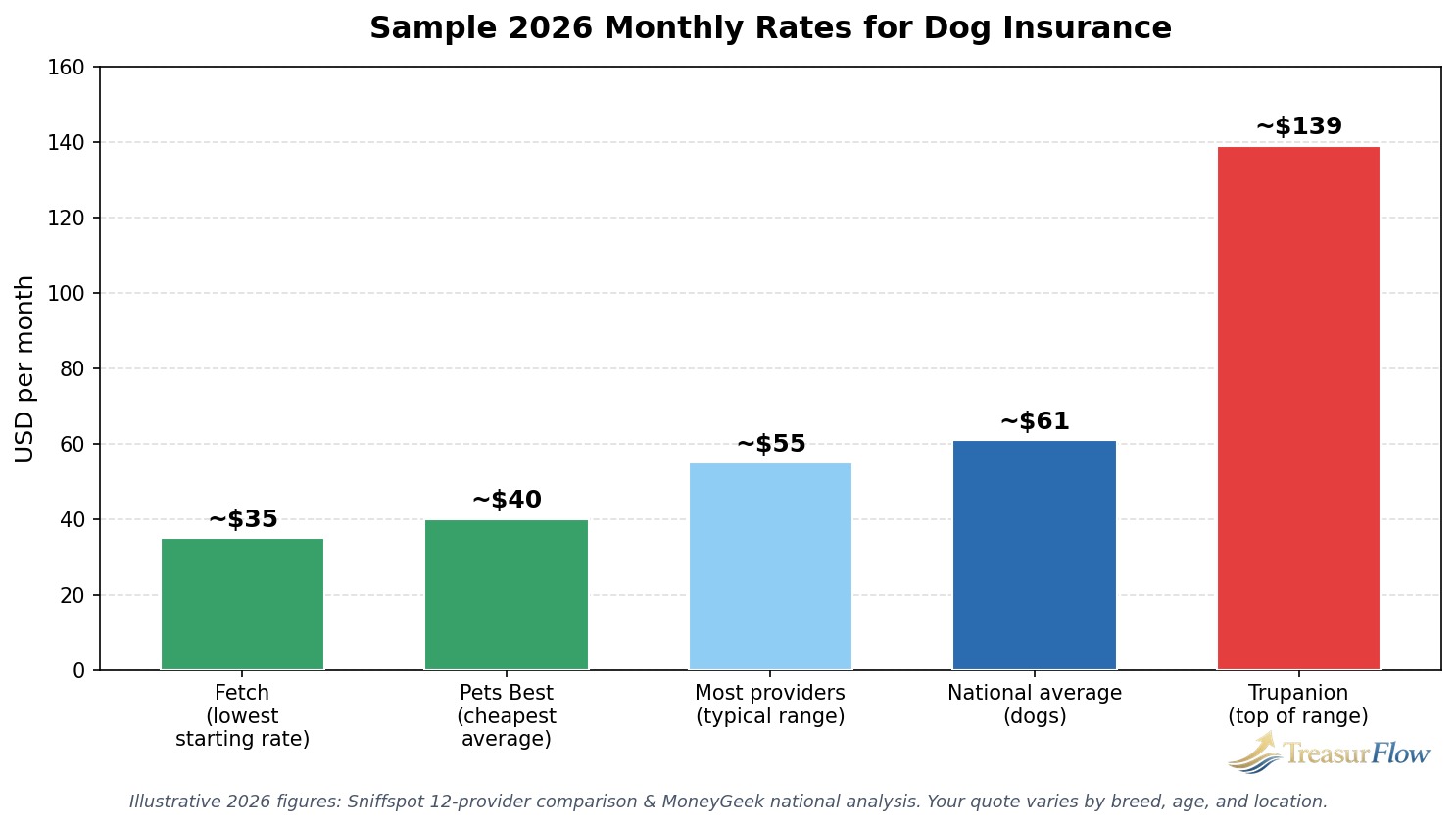
What moves your price up or down: breed (a French Bulldog costs far more to insure than a mixed-breed), age (premiums rise as pets get older), location (vet costs in Manhattan aren’t vet costs in rural Ohio), and the three dials you control — deductible, reimbursement rate (70/80/90%), and annual limit. Raising your deductible and dropping from 90% to 80% reimbursement are the two fastest ways to cut a premium.
One more number worth knowing: pet parents spent an average of $1,135 on health-related expenses per pet in 2025 — $472 on insurance and $663 on vet visits — and 22% dealt with a major unexpected health event averaging $555, according to Talker Research. A single emergency can eclipse years of premiums.
What Does Pet Insurance Cover?
A standard accident-and-illness policy — the type most owners buy — typically covers treatment for things you didn’t see coming:
- Accidents: broken bones, swallowed objects, bite wounds, car accidents, torn ligaments
- Illnesses: infections, allergies, digestive issues, urinary problems
- Hereditary and congenital conditions: hip dysplasia, heart disease (check the fine print — some providers limit these)
- Cancer treatment: surgery, chemotherapy, radiation
- Diagnostic testing: X-rays, MRIs, blood work, ultrasounds
- Surgery and hospitalization
- Prescription medications prescribed for a covered condition
- Emergency and specialist care
The NAIC — the organization of state insurance regulators — groups pet insurance into three main categories: accident-only, accident and illness, and wellness coverage, and notes that each level covers specific services at different prices. Accident-only is the cheapest entry point; accident-and-illness is the sweet spot for most owners.
What Does Pet Insurance Not Cover?
This is the section that saves people from nasty surprises. Across the industry, standard policies typically exclude:
- Pre-existing conditions — any illness, injury, or symptom documented before your policy’s effective date or during the waiting period. This is the single most common reason claims get denied.
- Routine and preventive care — annual exams, vaccinations, flea/tick prevention, and dental cleanings aren’t in standard plans (available via wellness add-ons).
- Cosmetic and elective procedures — tail docking, ear cropping, declawing.
- Breeding and pregnancy costs.
- Grooming, food, and general supplies (prescription diets may be covered when treating a specific condition).
- Claims during the waiting period — coverage doesn’t start the day you pay.
About that pre-existing condition exclusion: it’s the industry’s biggest pain point, but there’s nuance. Some providers distinguish between curable pre-existing conditions (like an ear infection that fully resolved) and incurable ones (like diabetes or arthritis) — curable ones may become eligible after a symptom-free period. AKC’s policy goes further than most: Money.com reports that after you keep the policy active for 365 days, previously excluded pre-existing issues become fully covered on renewal. And under the NAIC’s Pet Insurance Model Act, the insurer — not you — bears the burden of proving a pre-existing exclusion applies.
Is Pet Insurance Worth It?
For a lot of pet owners, yes — especially once you look at real numbers instead of gut feelings. Sniffspot’s 2026 analysis, which compared 12 providers against real owner reviews, concluded that “a handful of serious vet bills can easily exceed a decade of premiums, and coverage bought early, before anything goes wrong, tends to offer the most value.”
Consider the math from the other side: a May 2026 ConsumerAffairs survey of more than 1,000 American pet owners found that nearly 1 in 5 admitted delaying emergency vet care longer than they should have — usually over money — and 11% ended up paying more because they waited. Insurance doesn’t just cover bills; it removes the hesitation that makes bills bigger.
That said, it’s not automatic. You might reasonably skip it — or self-insure — if:
- You have a dedicated emergency fund you won’t touch for anything else (many planners suggest $5,000–$10,000 per pet; a high-yield savings account is the right home for it)
- Your pet is young, healthy, and a low-risk breed, and you’re disciplined enough to keep saving
- You’ve run real quotes and the premiums genuinely don’t fit your budget
The worst time to wish you had pet insurance is at the emergency vet’s front desk. The second-worst time is six months after a diagnosis that is now a pre-existing condition. If you’re on the fence, get actual quotes for your specific pet — a firm number beats an average every time, and quotes are free.
Which Pet Insurance Pays the Vet Directly?
One of the most practical questions owners ask — because reimbursement means floating a $4,000 bill on your credit card first. Among major providers, Trupanion, ASPCA, and Healthy Paws all offer some form of direct payment to veterinarians:
- Trupanion’s VetDirect Pay is the most established — the insurer pays participating vets at checkout, and owner reviews rate it the most widely accepted direct-pay experience.
- ASPCA can pay vets directly rather than requiring pay-and-file.
- Healthy Paws pays directly on request, though it’s not automatic.
One caveat: direct pay always depends on whether your specific vet’s office participates. Ask your vet which insurers they work with before you choose — it’s a five-minute phone call that can shape the whole decision.
How to Choose the Right Pet Insurance Plan
1. Enroll early. Premiums are lowest and exclusions fewest when your pet is young and healthy. Every month you wait is a month a new symptom can become a “pre-existing condition.”
2. Pick accident-and-illness unless you have a reason not to. Accident-only is cheaper but leaves the big-ticket illnesses — cancer, cruciate tears, chronic disease — on you.
3. Understand the three dials. Deductible (what you pay first), reimbursement rate (70/80/90%), annual limit (the cap). A $500 deductible with 80% reimbursement and a $10,000 limit is a sensible middle ground for most owners.
4. Read the waiting periods. Most plans impose short waits — commonly around 2 days for accidents and 14 days for illnesses, with longer waits for specific orthopedic conditions. Under the NAIC Model Act, waiting periods can’t exceed 30 days, and accidents during the wait can’t be used to deny coverage.
5. Check the exclusions list before the marketing page. Pre-existing conditions, hereditary limits, bilateral exclusions (one bad knee can mean the other knee isn’t covered later) — this is where claims actually get denied.
6. Verify the underwriter and your state’s protections. Pet insurers must be licensed in your state. The NAIC’s consumer guide is the best neutral starting point, and your state insurance department can confirm a company’s standing or take a complaint.
7. Get 2–3 real quotes. National averages are useful; your quote for your breed, age, and zip code is decisive. Compare identical deductibles and limits so you’re comparing the insurer, not the settings.
Frequently Asked Questions
Is pet insurance worth it for a healthy pet?
Often yes, because you buy it for the healthy years to protect the sick ones. Coverage bought while your pet is healthy locks in lower premiums and avoids pre-existing exclusions. If you’d struggle to cover a sudden $3,000–$7,000 emergency bill — the typical range for emergency surgery — insurance is worth serious consideration.
How much does pet insurance cost per month in 2026?
For dogs, expect roughly $35–$139 a month depending on provider, with most plans between $45 and $65 and a national average around $61 (MoneyGeek, 2026). Cats cost less. Your breed, your pet’s age, your location, and your deductible and reimbursement choices move the number the most.
Does pet insurance cover pre-existing conditions?
Standard policies don’t. However, some providers cover curable pre-existing conditions after a symptom-free period, and AKC’s policy covers previously excluded conditions after 365 days of continuous coverage. Enroll before conditions develop — that’s the entire game.
What does pet insurance not cover?
Pre-existing conditions, routine wellness care (exams, vaccines, dental cleanings), cosmetic procedures, breeding costs, and anything during the waiting period. Wellness add-ons can cover preventive care if you want it bundled.
Which pet insurance pays the vet directly?
Trupanion (VetDirect Pay), ASPCA, and Healthy Paws offer direct vet payment options. Availability depends on your vet’s office participating, so ask your vet which insurers they work with before choosing.
At what age should I get pet insurance?
As early as possible — ideally when your pet is a puppy or kitten. Premiums are lowest, there are no pre-existing conditions to exclude, and you’re covered before the accidents of youth (and the illnesses of age) arrive.
Is accident-only pet insurance enough?
Rarely. Accident-only plans are cheap but don’t cover illnesses — and illnesses like cancer, cruciate ligament tears, and chronic conditions generate the biggest bills. Most owners are better served by accident-and-illness coverage.
Conclusion
The best pet insurance 2026 plan is the one you’ll still be happy with at the emergency vet at midnight. For most owners, that means Fetch for its complete base policy, Trupanion if unlimited payouts matter most, or Pets Best if budget is the priority. Whatever you choose, enroll while your pet is healthy, read the exclusions before the marketing copy, and get real quotes for your specific pet before deciding.
Pet insurance isn’t about expecting the worst — it’s about making sure money never decides your pet’s medical care. And if you’re building the financial safety net to go with it, our guides to life insurance for seniors and high-yield savings accounts cover the human side of the same planning.

Muhammad Zakir is the founder of Treasurflow and the author of its personal finance guides. He researches consumer banking, credit, and personal loans, and every guide cites primary sources such as the CFPB, FDIC, FTC, and IRS. His content is educational and is not personalized financial advice.
1 thought on “Best Pet Insurance 2026: 9 Plans Compared for Dogs & Cats”