

Finding the best life insurance for seniors over 70 is harder than it should be. Most articles recycle the same company names with no real numbers — no published rates, no age limits from official sources, and no honest math on what a policy actually buys. This guide fixes that.
Every rate estimate below is attributed to its published 2026 source, every age limit comes from the insurer’s own materials, and every funeral-cost figure comes from the National Funeral Directors Association (NFDA). Where a number couldn’t be verified, we say so instead of guessing.
Bottom line up front: for most healthy seniors over 70, a simplified-issue final expense policy from Mutual of Omaha or Transamerica offers the best blend of price and day-one coverage. If health issues would cause a decline, Gerber Life’s guaranteed-issue policy (ages 50–80, no health questions) or Colonial Penn’s budget units are the safer doors. AARP/New York Life is the pick if brand trust matters most and you want up to $100,000 in permanent coverage.
Related guides: If you’re organizing your finances in your 70s, see our best checking account bonuses for 2026 to make your cash work harder, our best high-yield savings accounts for a safe place to keep premium money, and our best balance-transfer credit cards if you’re carrying debt into retirement. And if funeral costs feel urgent, our emergency loans guide explains options — though insurance is almost always cheaper than borrowing.
Helpful official resources: NAIC Life Insurance Buyer’s Guide (PDF) · Gerber Life Guaranteed Life — official FAQ · Transamerica Final Expense Solutions · Check any insurer’s license with your state’s department of insurance before you buy.
How We Evaluated These 6 Picks
Three rules drove every ranking decision:
- Verified numbers only. Age limits and coverage ranges come from the insurer’s own brochures and official pages. Premium estimates are labeled as estimates with their source — published 2026 figures compiled from Forbes Advisor, MoneyGeek, and Choice Mutual data. Actual premiums vary by state, health class, tobacco use, and underwriting, so treat every dollar figure as a starting point, not a quote.
- Financial strength matters more after 70. A policy is a decades-long promise. We weighted AM Best ratings heavily — every pick below carries an A-range rating (reported; confirm current ratings at ambest.com).
- Real-world fit for 70+ buyers. Maximum issue age, no-exam availability, waiting periods, and what the death benefit actually covers at today’s funeral prices.
The 6 Best Life Insurance Companies for Seniors Over 70
| Company | Best For | Max Issue Age | Coverage Range | Medical Exam | AM Best (reported) |
|---|---|---|---|---|---|
| Mutual of Omaha (Living Promise) | Best overall value | 85 | $2,000–$50,000 | No | A+ (Superior) |
| AARP / New York Life | Best brand trust, up to $100K | 80 (permanent) / 85 (guaranteed) | Up to $100,000 | No (health questions) | A++ (Superior) |
| Gerber Life (Guaranteed Life) | Best guaranteed acceptance | 80 (75 in NY) | $5,000–$25,000 | No — none asked | A (Excellent) |
| Transamerica (Final Expense) | Widest age window | 85 | $1,000–$50,000 | No | A (Excellent) |
| MassMutual (Whole Life) | Best for larger permanent coverage | 90 | $25,000+ | Usually yes | A++ (Superior) |
| Colonial Penn (Guaranteed Acceptance) | Budget-friendly units | 85 (most states) | Up to $50,000 | No — none asked | A- (Excellent)* |
*Colonial Penn’s rating is reported from third-party reviews; confirm current rating before buying.
1. Mutual of Omaha — Best Overall Value
Product: Living Promise whole life (final expense)
Issue ages: 45–85 (Level Benefit plan); 45–80 (Graded Benefit plan), per the company’s own product brochure
Coverage: $2,000–$50,000 (Level); $2,000–$20,000 (Graded)
Medical exam: None — simplified underwriting via health questions
Estimated cost: roughly $53/month (female) / $73/month (male) for $10,000 simplified-issue coverage at age 70, per published 2026 estimates
Mutual of Omaha earns the top spot because it combines the strongest value proposition in the final-expense space: no exam, day-one full coverage on the Level Benefit plan (no waiting period for qualifying applicants), premiums that never increase, and an A+ (Superior) AM Best rating affirmed in April 2026. J.D. Power ranked the company first for individual life insurance customer satisfaction in its 2025 study, and its NAIC complaint ratio tracks below the industry median.
The Graded Benefit version exists for applicants with moderate health issues — it pays premiums-plus-10% for natural death in the first two years, then the full benefit. Know which version you’re being offered before you sign.
2. AARP / New York Life — Best Brand Trust
Products: Permanent Life (whole life), Guaranteed Acceptance Life, Level Benefit Term
Issue ages: 50–80 (Permanent Life); 50–85 (Guaranteed Acceptance); 50–74 (Term, coverage ends at 80)
Coverage: up to $100,000 (Permanent); up to $30,000 (Guaranteed Acceptance); up to $150,000 (Term)
Medical exam: None — health questions on Permanent and Term; no questions on Guaranteed Acceptance
Estimated cost: roughly $78/month (female) / $103/month (male) for $15,000 whole life at age 70, per published 2026 estimates
AARP doesn’t underwrite insurance itself — all AARP-branded life products are underwritten by New York Life, which carries the highest possible A++ (Superior) AM Best rating. The standout here is the Permanent Life policy: up to $100,000 with no exam and level premiums for life, the highest no-exam permanent coverage among these picks. The tradeoff: AARP membership is required, and the Term product’s premiums rise in five-year age bands with coverage ending at 80. The Guaranteed Acceptance version carries the standard two-year graded period (110% of premiums paid for natural death in years one and two).
3. Gerber Life — Best Guaranteed Acceptance
Product: Guaranteed Life (whole life)
Issue ages: 50–80 (50–75 in New York), per Gerber Life’s official site
Coverage: $5,000–$25,000
Medical exam: None — acceptance is guaranteed regardless of health; no health questions asked
Estimated cost: roughly $75/month (female) / $99/month (male) for $10,000 at age 70, per published 2026 estimates
If you’ve been declined elsewhere or have serious health conditions, Gerber Life’s official Guaranteed Life page states the terms plainly: ages 50–80, guaranteed acceptance regardless of health history, premiums that never increase, and cash value that builds over time. Like all guaranteed-issue products, expect a two-year graded benefit period.
4. Transamerica — Widest Age Window
Product: Final Expense Solutions Portfolio (Immediate Solution, 10-Pay Solution, Easy Solution)
Issue ages: 0–85 (Immediate Solution and 10-Pay); 18–80 (Easy Solution), per Transamerica’s official materials
Coverage: $1,000–$50,000 (Immediate Solution; lower caps at older ages)
Medical exam: None — simplified issue via health questions
Estimated cost: roughly $65/month (female) for $10,000 simplified-issue at age 70, per published 2026 estimates
Transamerica’s official Final Expense page confirms the broadest eligibility window here — the Immediate Solution accepts applicants up to age 85 with full coverage from day one and a guaranteed level premium. For seniors 76–85, maximum face amounts step down (around $25,000), which is standard. The Easy Solution is the graded-benefit variant for tougher health profiles. Transamerica carries an A (Excellent) AM Best rating.
5. MassMutual — Best for Larger Permanent Coverage
Product: Whole Life (Whole Life 100 and related series)
Issue ages: up to 90 for whole life (term caps at 75), per NerdWallet’s 2026 policy data
Coverage: $25,000 and up (no stated maximum on some products)
Medical exam: Usually required
Estimated cost: Priced through agents only — MassMutual doesn’t publish online quotes; expect higher premiums than simplified-issue competitors
MassMutual is the pick for seniors who are relatively healthy and want more than final-expense amounts — estate liquidity, a larger legacy, or mortgage protection — with lifelong coverage available all the way to age 90, the highest maximum issue age in this roundup. As a mutual company, it has paid dividends to participating whole-life policyholders for over 150 years, and it holds A++ (Superior) from AM Best. The honest tradeoff: full underwriting (often including an exam) and agent-only pricing mean it’s not the path for anyone with significant health issues.
6. Colonial Penn — Budget-Friendly Units
Product: Guaranteed Acceptance whole life
Issue ages: 50–85 in most states (varies: 55–85 DC, 56–85 PA, 50–75 MN/MT/NY), per the company’s published materials
Coverage: up to $50,000, sold in units
Medical exam: None — no health questions
Estimated cost: from $9.95 per unit per month — but read the fine print below
Colonial Penn’s famous “$9.95 a month” is real, and it’s also widely misunderstood, so here’s the honest math: $9.95 buys one unit, and one unit’s coverage depends on your age, sex, and state. Around age 65, a single unit may provide only about $2,000–$3,000 in coverage — meaning a $6,000–$9,000 policy needs 2–3 units ($19.90–$29.85/month). The policy carries the standard two-year limited-benefit period (premiums plus 7% interest for natural death in years one and two; full benefit for accidental death from day one). It’s a legitimate last-resort option — just don’t mistake one unit for a full final-expense plan.
What $5K, $10K, and $15K Policies Actually Cover
This is the math most listicles skip. The NFDA’s 2023 General Price List Study puts the median US funeral cost at $6,280 with cremation and $9,995 with burial and a vault — and those medians exclude cemetery plots, flowers, and obituaries. Social Security’s one-time lump-sum death payment is just $255, which barely dents the bill.
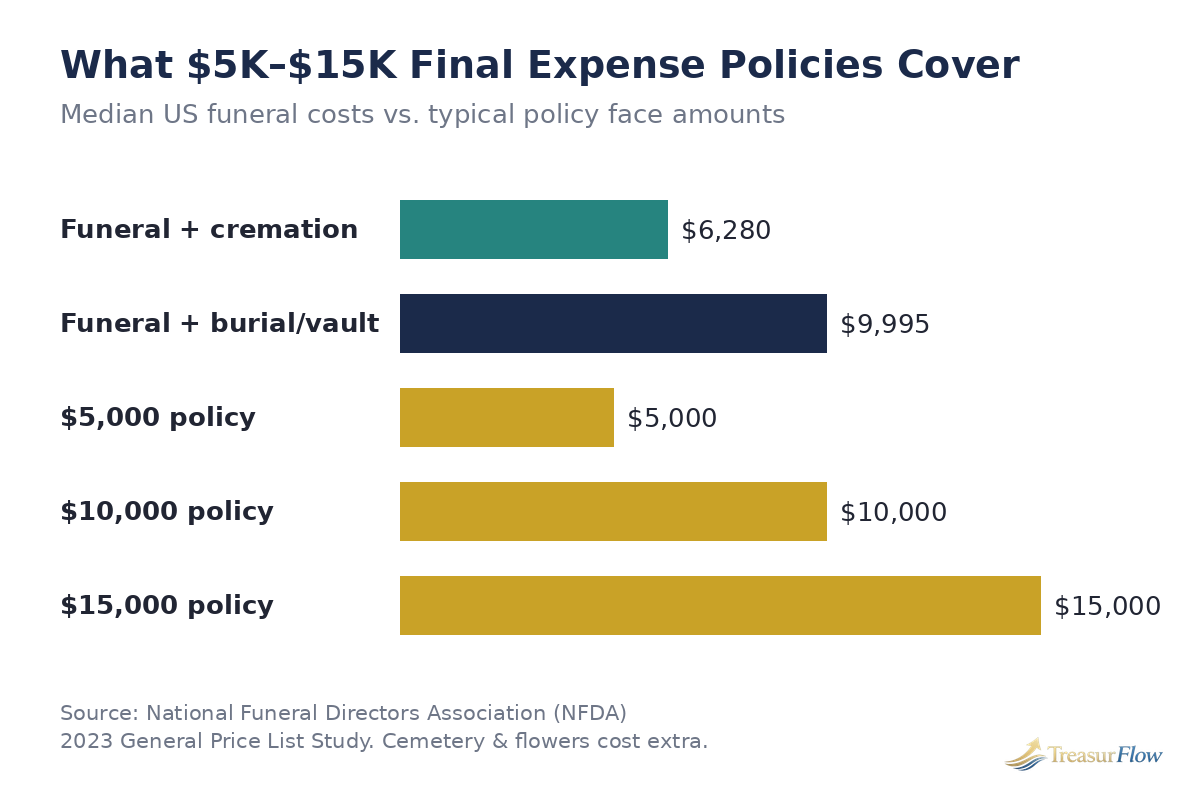
What this means in practice:
- A $5,000 policy covers most of a cremation funeral but leaves a gap of $1,000–$5,000+ for a burial — before cemetery costs.
- A $10,000 policy covers the median burial funeral in full, with a small cushion for extras. This is the sweet spot for most buyers.
- A $15,000 policy covers the median burial plus several thousand for cemetery, flowers, and a modest buffer for unpaid bills.
Anyone selling you $5,000 as “complete peace of mind” for a traditional burial isn’t showing you this chart. Match the face amount to the funeral you actually want, then add 20–30% for the extras nobody itemizes.
Term vs. Whole vs. Final Expense vs. Guaranteed Issue After 70
| Term Life | Whole Life (fully underwritten) | Final Expense (simplified issue) | Guaranteed Issue | |
|---|---|---|---|---|
| Coverage length | 10–20 yrs, then ends | Lifetime | Lifetime | Lifetime |
| Medical exam | Usually yes at 70+ | Usually yes | No — health questions only | No — no questions at all |
| Max issue age | ~75–80 (10-yr term) | Up to 90 (MassMutual) | Up to 85 | Up to 80–85 |
| Waiting period | None | None | Usually none | 2 years (graded) |
| Typical cost at 70 | $$$$ (see below) | $$$$$ | $$ | $$$ |
| Best for | Temporary need (mortgage) | Healthy + wants legacy/cash value | Most seniors: funeral costs, no exam | Declined elsewhere / serious conditions |
Why term is usually the wrong answer after 70: a 10-year term at 75 can run $216–$323/month for $250,000 (female/male, excellent health, via Term4Sale data cited by Clark.com) — and when the term ends at 85, you’re uninsurable or facing astronomical renewal rates. Term makes sense only for a defined temporary obligation, like covering the last years of a mortgage. For permanent needs — funeral costs, a spouse’s security — permanent coverage you can’t outlive is the rational choice.
Simplified issue vs. guaranteed issue is the distinction that matters most. Simplified issue asks health questions but requires no exam — answer honestly and you typically get day-one full coverage. Guaranteed issue asks nothing and accepts everyone in the age band — but you pay for that with a two-year graded benefit: die of natural causes in years one or two and your beneficiary gets premiums back plus interest (typically 7–10%), not the face amount. Accidental death is covered in full from day one under both types. Beyond the policy itself, families should also understand how long it takes to receive inheritance money.
5 Tips Before You Buy
- Get three quotes. Published estimates in this guide vary 20–40% between carriers for identical coverage. A 15-minute call to two more insurers is the highest-paid quarter-hour of your year.
- Ask “simplified or guaranteed?” in writing. If it’s guaranteed issue, get the graded-benefit terms in writing — specifically what your beneficiary receives if you die of natural causes in year one.
- Confirm the free-look period. Every state mandates one (commonly 10 days; California requires 30 for seniors, per NAIC data). Use it to re-read the policy with a family member.
- Check the license. The NAIC recommends verifying both the insurer and the agent with your state’s department of insurance before paying a premium. It takes two minutes online.
- Don’t replace existing coverage on impulse. A new policy restarts the two-year graded clock and is priced at your current (older) age. Compare old vs. new side by side before canceling anything.
How Much Does Life Insurance Cost at 70, 75, and 80?
Two honest tables. Table 1 uses published 2026 final-expense estimates (Forbes Advisor/MoneyGeek/Choice Mutual via budgetseniors.com; Gerber/Colonial Penn figures as noted). Table 2 shows why term gets punishing with age.
Table 1 — Final expense / simplified-issue estimates at age 70 (per month)
| Company | $10,000 coverage (F / M) | Notes |
|---|---|---|
| Mutual of Omaha | ~$53 / ~$73 | Simplified issue, no waiting period (Level plan) |
| Transamerica | ~$65 / — | Simplified issue; male figure not published |
| Gerber Life | ~$75 / ~$99 | Guaranteed issue — no health questions at all |
| AARP / New York Life | ~$78 / ~$103* | *$15,000 whole life; requires AARP membership |
| Colonial Penn | from $9.95/unit | One unit ≈ $2K–$3K coverage at 65; buy multiple units |
Table 2 — 10-year term, $250,000, excellent health (Term4Sale via Clark.com)
| Age | Female | Male |
|---|---|---|
| 75 | $216/month | $323/month |
Premiums roughly double every 5–7 years at these ages. A healthy 70-year-old man might pay around $150/month for a small 10-year term; by 80, the same coverage can exceed $500/month (MoneyGeek 2026 term data). This is why locking in level-premium permanent coverage in your early 70s — before the next birthday band — is the single highest-leverage move.
Questions From Seniors
Can you get life insurance after age 70?
Yes. Multiple insurers issue new policies well past 70: Mutual of Omaha to 85, Transamerica to 85, AARP/New York Life to 80–85, and MassMutual whole life to 90. Your options narrow and premiums rise with each birthday, but “too old” is a myth — guaranteed-issue policies accept everyone in their age band regardless of health.
How much does life insurance cost for a 70-year-old?
For final-expense coverage, published 2026 estimates put a $10,000 simplified-issue policy at roughly $53–$75/month for women and $73–$99/month for men, depending on carrier. Guaranteed-issue runs slightly higher for the same face amount. Fully underwritten whole life and term cost several times more — a 10-year $250,000 term at 75 runs about $216/month (female) to $323/month (male) in excellent health.
What is final expense insurance?
Final expense insurance (also called burial or funeral insurance) is a small whole-life policy — typically $5,000–$25,000 — designed to cover funeral costs, medical bills, and other end-of-life expenses. Premiums are level for life, coverage never expires, and most policies require no medical exam.
What’s the difference between simplified issue and guaranteed issue?
Simplified issue requires answering health questions but no medical exam — qualify and you get full coverage from day one. Guaranteed issue asks no health questions and accepts everyone in the age range, but imposes a two-year graded benefit: natural death in years one–two pays premiums-plus-interest instead of the full face amount.
Do I need a medical exam to get life insurance over 70?
Not necessarily. All four final-expense picks in this guide (Mutual of Omaha, AARP/NY Life, Gerber, Transamerica, Colonial Penn) require no exam. MassMutual’s fully underwritten whole life usually does require one — the tradeoff for larger coverage amounts and lower per-dollar cost if you’re healthy.
Is there a waiting period before coverage starts?
Simplified-issue policies from Mutual of Omaha (Level plan), Transamerica (Immediate Solution), and AARP Permanent Life typically have no waiting period — full coverage from day one. Guaranteed-issue policies (Gerber, Colonial Penn, AARP Guaranteed Acceptance) impose a two-year graded period for natural death; accidental death is covered in full immediately.
How much coverage do I actually need?
Start with the NFDA medians: $6,280 (cremation funeral) or $9,995 (burial with vault), then add cemetery, flowers, and any debts you want cleared. For most buyers, $10,000 covers a median burial in full; $15,000 adds a comfortable buffer. Subtract the $255 Social Security death payment and any existing coverage.
Can I get approved with diabetes, COPD, or heart disease?
Often yes. Many simplified-issue carriers accept well-managed diabetes, COPD, and heart conditions (sometimes at standard rates if stable for 1+ years). If your conditions would cause a decline, guaranteed-issue policies from Gerber Life or Colonial Penn accept you regardless — with the two-year graded benefit as the tradeoff.
Is term life worth it after 70?
Rarely. Term premiums at 70+ are steep and climb brutally — and you can outlive the term, ending up uninsured at 80+. Term only makes sense for a defined temporary need, like covering remaining mortgage years. For funeral costs or a spouse’s permanent security, level-premium permanent coverage is the better math.
Will my premiums go up as I get older?
Not on the policies in this guide. Whole life and final-expense policies lock your premium at the age you apply — it never increases. The exception is AARP’s Level Benefit Term, whose premiums rise in five-year age bands with coverage ending at 80. Always confirm “level premium for life” in writing before you buy.
Get Your Quotes This Week
The best life insurance for seniors over 70 isn’t the cheapest advertised rate — it’s the policy your family can actually collect on, from a company strong enough to pay decades from now, at a premium your fixed income can carry for life. For most buyers, that means Mutual of Omaha’s Living Promise or Transamerica’s Immediate Solution (no exam, day-one coverage, A-range ratings). If health history closes those doors, Gerber Life’s guaranteed acceptance keeps one open. And whatever you choose, match the face amount to real NFDA funeral costs — $10,000 covers the median burial; $5,000 doesn’t. For a broader comparison across life stages, see our guide to best life insurance 2026.
Get your quotes this week, not next year. Every birthday band costs you.
Some links on this page go to product or issuer pages. Treasurflow’s rankings are based on the criteria stated in each guide. See the About page for how the site is funded.

Muhammad Zakir is the founder of Treasurflow and the author of its personal finance guides. He researches consumer banking, credit, and personal loans, and every guide cites primary sources such as the CFPB, FDIC, FTC, and IRS. His content is educational and is not personalized financial advice.
3 thoughts on “Best Life Insurance for Seniors Over 70 in 2026: 6 Picks Ranked by Real Cost Data”