

The best life insurance 2026 has to offer depends less on which company is best in the abstract and more on where you are in life. A new parent needs cheap, high-coverage term insurance. A business owner needs something that protects the company. A healthy 30-year-old who wants coverage today, without a medical exam, needs a completely different company than a family building cash value for decades.
After comparing financial strength ratings, dividend history, policy options, and real 2026 costs, here is the short version: Northwestern Mutual is the best life insurance company overall for most families in 2026, thanks to its A++ financial strength rating, a $9.2 billion expected dividend payout, and strong term and whole life options.
Related Guides: If you are 70 or older, read our dedicated guide instead: Best Life Insurance for Seniors Over 70 — it covers final expense and guaranteed-issue policies built for that age group. This article focuses on working-age adults and families.
Helpful Official Resources: Before you buy, check the National Association of Insurance Commissioners (NAIC) for complaint data on any insurer, and the Insurance Information Institute (Triple-I) for plain-English explanations of policy types.
Who Wins in 2026?
If you want one answer: Northwestern Mutual wins for most families. It pairs the strongest financial ratings in the industry with the largest dividend payout of any mutual insurer, and its term policies convert to permanent coverage if your needs change. But most families is not every family. Here is how the six winners break down: Best overall: Northwestern Mutual – strongest finances, biggest dividends, term + whole life. Best for cash value growth: MassMutual – top-rated whole life cash value returns. Best for customization: New York Life – the most flexible permanent policies, 150+ years in business. Best for customer satisfaction: State Farm – top-rated service, low complaints, strong term value. Best for same-day coverage: Ethos – no medical exam for most applicants, coverage in minutes. Best for flexible term coverage: Ladder – adjust your coverage up or down online as life changes.
Quick Comparison: The 6 Best Life Insurance Companies
| Company | Best For | AM Best Rating | Policy Types | NerdWallet Rating |
|---|---|---|---|---|
| Northwestern Mutual | Overall | A++ (Superior) | Term, whole, universal | 4.9 / 5 |
| MassMutual | Cash value growth | A++ (Superior) | Term, whole, universal | 4.8 / 5 |
| New York Life | Customization | A++ (Superior) | Term, whole, universal | 4.9 / 5 |
| State Farm | Customer satisfaction | Top-tier | Term, whole, universal | Top-rated service |
| Ethos | Same-day, no-exam | Partner-issued | Term, whole | Best for speed |
| Ladder | Flexible term coverage | A (Excellent) via partners | Term only | Best for flexibility |
Ratings reflect AM Best financial strength grades and NerdWallet company ratings as published in 2026. Ladder policies are issued by partner insurers carrying A (Excellent) ratings; Ethos policies are issued by partner insurers.
How Much Life Insurance Do You Actually Need?
Most people either buy far too little or freeze up and buy nothing. Two simple methods cut through the confusion. The 10-12x rule (fast estimate). Multiply your annual income by 10 to 12. A 35-year-old earning $80,000 needs roughly $800,000 to $960,000 of coverage. It takes ten seconds and gets you in the right ballpark. The DIME method (precise estimate). Add up four numbers: D – Debt: everything except the mortgage: credit cards, car loans, student loans. I – Income replacement: your annual income times the number of years your family would need support (often 10-15 years with young kids). M – Mortgage: the remaining balance, so your family keeps the house. E – Education: what you want set aside for your children’s schooling. Example: a 35-year-old earning $80,000 with a $300,000 mortgage, two kids, and $25,000 in other debts lands around $1.0-$1.2 million using DIME. That number sounds enormous until you price it. At healthy 30-something rates, a $1 million 20-year term policy typically runs $40-$70 a month. Coverage needs fall as the mortgage shrinks, the kids launch, and retirement savings grow. That is exactly why cheap term coverage beats an expensive permanent policy for most families.
Term vs Whole Life: Which Fits Your Situation?
This is the decision that confuses everyone. Here is the honest version: Term Life vs Whole Life:
| Term Life | Whole Life | |
|---|---|---|
| What it is | Coverage for a set period (10-30 years) | Lifelong coverage + cash value |
| Typical cost | about $20-$30/month (healthy 30-year-old, $500K, 20-yr term) | about $400-$500/month (same face amount) |
| Cash value | None | Yes, grows over time, can borrow against it |
| Best for | Income replacement, mortgage, raising kids | Lifelong dependents, estate planning, tax-advantaged savings |
| Who should buy it | Most families | A small minority with specific needs |
Buy term life if: you need maximum coverage per dollar; you have a mortgage, young kids, or income to replace; you want protection for a defined period (until the kids are grown, the mortgage is paid). Consider whole life if: you have a lifelong dependent who will never be financially independent; you have estate-tax exposure; you have already maxed out your retirement accounts and want a conservative, tax-advantaged savings vehicle; or you want guaranteed lifelong coverage and can comfortably afford premiums for decades. The honest truth about whole life: for most families, buy term and invest the difference wins. Whole life costs roughly 10-15 times more than term for the same death benefit. The cash value grows slowly in the early years, and many buyers lapse their policies before the math ever works in their favor. Whole life is not a scam. It is a legitimate tool for specific situations, but it is oversold to people who would be better served by term coverage plus retirement investing. When a policy pays out, beneficiaries should also know how long it takes to receive inheritance money.
Best Life Insurance by Life Stage
Young Family (Kids Under 10): Northwestern Mutual
Your biggest risk is losing an income for 15-20 years while the kids grow up. You need high coverage at the lowest possible price, from a company that will still be here in 30 years. Northwestern Mutual’s term policies deliver that, with the option to convert to permanent coverage later if your situation changes. Its A++ rating and $9.2 billion expected 2026 dividend payout are the strongest financial signals in the industry.
New Parents: State Farm
New parents are sleep-deprived, time-starved, and often buying life insurance for the first time. State Farm wins here on service: top-rated customer satisfaction, a low complaint volume, and local agents who walk you through the paperwork. Its term rates start around $18 a month for healthy applicants, and bundling with auto or home insurance can lower the total bill.
Sole Breadwinner: MassMutual
If one income supports the whole household, you need maximum protection plus a policy that builds value over time. MassMutual’s whole life policies earn NerdWallet’s top marks for cash value return rates, and its A++ rating means the death benefit is as safe as life insurance gets. Start with a large term policy for income replacement, and consider a smaller whole life policy alongside it if the budget allows.
Business Owner: New York Life
Business owners have layered needs: family income replacement, key-person coverage (what happens to the company if you or a partner dies?), and often a buy-sell agreement funded by life insurance. New York Life’s permanent policies are the most customizable in the industry, with the widest range of riders and payment options. With more than 150 years in business and an A++ rating, it is built for obligations that span decades.
Healthy Buyer on a Budget: Ladder
If you are young, healthy, and want the most coverage per dollar with zero hassle, Ladder is hard to beat. Its term policies run $100,000 to $8 million, with up to $3 million available with no medical exam. The standout feature is adjustability: you can lower your coverage online as your mortgage shrinks or your kids leave home, and your premium drops immediately. No riders, no conversion option. Just clean, flexible term coverage.
Need Coverage Today: Ethos
If you have been putting this off and want coverage in place before the weekend, Ethos is the fastest path. Most applicants ages 20-65 can get term coverage from $20,000 to $3 million with no medical exam, and many are approved the same day. Ethos is also one of the most active life insurance advertisers on Google, with roughly 600 active ads, because its online-first model converts well. Speed is the point here: a good policy in force today beats a perfect policy you never get around to buying.
The 6 Best Life Insurance Companies in Detail
1. Northwestern Mutual – Best Overall
Northwestern Mutual’s scale shows in the numbers. The company holds an A++ (Superior) rating from AM Best, a 4.9-star NerdWallet rating, and is expected to pay $9.2 billion in dividends to policyholders in 2026, more than any other mutual insurer. Its term policies are competitively priced and convertible to permanent coverage, and its whole life policies are a benchmark for the industry. Northwestern Mutual also runs roughly 2,000 active Google ads, a sign of sustained advertiser demand in a fiercely competitive market.Pros: Strongest financial ratings; largest dividend payout; convertible term; excellent customer experience scores. Cons: No fully online purchase for all products, so expect an agent conversation; whole life premiums are premium-priced. Best for: Families who want the safest pair of hands in the industry.
2. MassMutual – Best for Cash Value Growth
MassMutual earns NerdWallet’s top marks for whole life cash value return rates, and its A++ AM Best rating puts it in the same financial tier as Northwestern Mutual and New York Life. Expected 2026 dividends of $2.9 billion reward participating policyholders. If your plan includes a permanent policy as a long-term savings vehicle, not just a death benefit, MassMutual’s whole life is the strongest starting point.Pros: Best cash value growth rates; A++ rating; strong dividend history. Cons: Whole life is expensive. Only buy it if you will hold it for decades. Best for: Buyers who specifically want a permanent policy that builds cash value.
3. New York Life – Best for Customization
New York Life has been in business for more than 150 years, holds an A++ AM Best rating, and is expected to pay $2.78 billion in dividends in 2026. Its permanent policies offer the widest range of riders and payment structures in this ranking, useful for business owners, blended families, and anyone whose situation does not fit a standard template. NerdWallet rates it 4.9 stars and names it a top pick for seniors and for whole life customization. Pros: Most customizable policies; 150+ year track record; strong whole life lineup. Cons: Premium pricing; agent-driven sales process. Best for: Business owners and buyers who need a tailored permanent policy.
4. State Farm – Best for Customer Satisfaction
State Farm is the insurer your neighbors already use, and there is a reason. It consistently earns top marks for customer satisfaction with a low complaint volume, and its term life rates start around $18 a month for healthy applicants. Policies are sold through local agents, which many first-time buyers prefer over a faceless online checkout. Its financial strength is top-tier, and bundling life with auto or home insurance can reduce your overall premium. Pros: Best-in-class service; low complaints; affordable term rates; bundling discounts. Cons: Less online self-service than digital-first rivals; whole life options are less flexible than the mutual giants. Best for: First-time buyers and families who want a local agent.
5. Ethos – Best for Same-Day Coverage
Ethos rebuilt life insurance around speed. Applicants ages 20-65 can get term coverage from $20,000 to $3 million, most without a medical exam, and many are approved the same day. The application is fully online and takes minutes. Ethos also offers guaranteed-issue whole life for ages 65-85 ($10,000-$25,000), though readers over 70 should compare with our dedicated seniors guide. The trade-off for speed is price: no-exam policies can cost more than fully underwritten ones, and coverage options are simpler than the mutual giants. Pros: Same-day approval; no medical exam for most applicants; fully online. Cons: Simpler policy options; no-exam pricing can run higher; not available in New York for some products. Best for: Anyone who needs coverage in force fast.
6. Ladder – Best for Flexible Term Coverage
Ladder does one thing, term life insurance, and does it with a flexibility no legacy insurer matches. Coverage runs $100,000 to $8 million (up to $3 million with no medical exam), with terms of 10, 15, 20, 25, or 30 years for applicants ages 20-60. The defining feature: you can reduce your coverage online at any time as your needs shrink, and your premium drops with it. There are no riders and no conversion to permanent coverage, so Ladder is a poor fit if you might want lifelong protection later. But for pure, adaptable term coverage, it is the smartest option on this list. Pros: Adjustable coverage online; up to $3M with no exam; clean, simple product. Cons: Term only: no conversion, no riders; age-plus-term must total 70 or under. Best for: Healthy buyers who want flexible term coverage that shrinks as their obligations do.
5 Mistakes That Cost Families Thousands
1. Waiting because it feels morbid. Every year you wait, the premium rises, and a health surprise can make you uninsurable. Buy when you are young and healthy, even if the coverage feels abstract. 2. Buying whole life when term fits. Whole life is right for a small minority. For most families, a large term policy plus retirement investing beats a small whole life policy on every measure. 3. Underinsuring. A $100,000 policy sounds like a lot until you compare it to a $300,000 mortgage plus 15 years of income replacement. Use the DIME method, not a round number. 4. Naming the wrong beneficiary (or none). Review beneficiaries after marriage, divorce, births, and deaths. An outdated beneficiary designation overrides your will. 5. Never comparing quotes. Rates for identical coverage can differ 20-40% between insurers. Get quotes from at least two or three companies before you commit.
What Life Insurance Costs in 2026
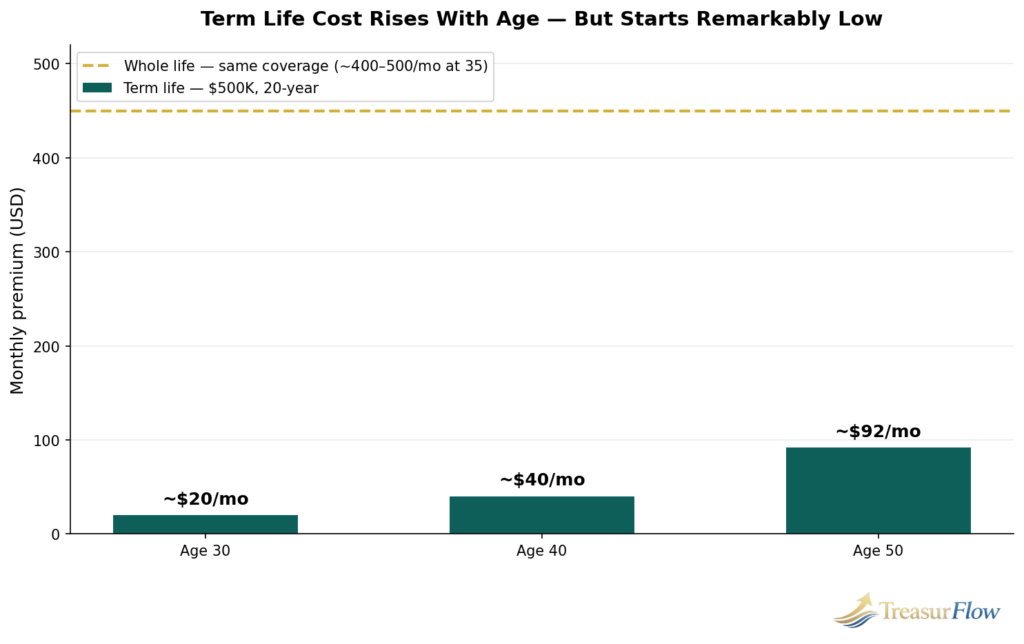
Age is the single biggest cost driver, bigger than health, gender, or coverage amount. The table below shows approximate monthly premiums for a healthy non-smoker buying a $500,000, 20-year term policy, based on published 2026 industry rate benchmarks: Costs rise sharply with age, so readers over 70 should compare best life insurance for seniors over 70.
| Age | Male (20-Year Term) | Female (20-Year Term) |
|---|---|---|
| 25 | about $17/month | about $14/month |
| 30 | about $20/month | about $16/month |
| 35 | about $27/month | about $21/month |
| 40 | about $40/month | about $31/month |
| 50 | about $85-$100/month | about $70-$85/month |
Whole life for the same $500,000 face amount runs roughly $400-$500 a month for a healthy 35-year-old, about 10-15 times the term price. Smokers pay 2-3 times more than non-smokers at every age, and women pay roughly 10-25% less than men for identical coverage because of longer life expectancy. Two numbers matter most. First, a healthy 30-year-old pays about $20-$30 a month for half a million dollars of term coverage, less than a streaming bundle. A 2025 LIMRA Insurance Barometer study found that adults 30 and younger overestimate the cost of a $250,000 20-year term policy by 10 to 12 times the actual price. Second, waiting is brutally expensive: the same policy that costs $20 a month at 30 costs $85-$100 at 50. Buying early locks in a low rate for the full term.
Questions, Answered
What is the best life insurance company in 2026?
Northwestern Mutual is the best life insurance company overall for most families in 2026, with an A++ AM Best financial strength rating, a 4.9-star NerdWallet rating, and an expected $9.2 billion dividend payout. MassMutual leads for whole life cash value growth, State Farm for customer satisfaction, and Ethos for same-day no-exam coverage.
How much life insurance do I need?
A fast estimate is 10-12 times your annual income. For a precise number, use the DIME method: add your non-mortgage Debt, Income replacement (annual income x years of support needed), Mortgage balance, and Education costs. A 35-year-old earning $80,000 with a $300,000 mortgage, two kids, and $25,000 in debts needs roughly $1.0-$1.2 million.
Is term or whole life insurance better?
Term life is better for most families because it delivers far more coverage per dollar: roughly $20-$30 a month for a healthy 30-year-old’s $500,000 20-year term policy versus $400-$500 for whole life. Whole life fits a small minority: people with lifelong dependents, estate-tax exposure, or a need for guaranteed lifelong coverage who can afford decades of premiums.
How much does life insurance cost in 2026?
A healthy 30-year-old non-smoker pays roughly $20-$30 a month for a $500,000 20-year term policy. The same coverage costs about $40 a month at 40 and $85-$100 at 50. Whole life for the same face amount runs roughly $400-$500 a month. Smokers pay 2-3 times more; women pay roughly 10-25% less than men.
Can I get life insurance without a medical exam?
Yes. Ethos offers term coverage up to $3 million with no medical exam for most applicants ages 20-65, often approved the same day. Ladder offers up to $3 million with no exam for applicants ages 20-60. No-exam policies can cost more than fully underwritten ones, and coverage options are simpler.
What is the best life insurance for new parents?
State Farm is the best pick for most new parents thanks to top-rated customer satisfaction, low complaints, local agents, and term rates starting around $18 a month. If you want the fastest path to coverage, Ethos can approve many new parents the same day with no medical exam. Either way, prioritize a 20- or 30-year term that lasts until your youngest child is financially independent.
What happens if I outlive my term life policy?
Nothing bad, the policy simply ends, and you have paid for 20 or 30 years of protection your family never needed to use. That is the point. If you still need coverage, you can renew at a much higher age-based rate, convert to a permanent policy (if your term policy includes a conversion option, as Northwestern Mutual’s does), or buy a new policy. Ladder’s term policies do not offer conversion, which is worth knowing before you buy.

Muhammad Zakir is the founder of Treasurflow and the author of its personal finance guides. He researches consumer banking, credit, and personal loans, and every guide cites primary sources such as the CFPB, FDIC, FTC, and IRS. His content is educational and is not personalized financial advice.
3 thoughts on “Best Life Insurance 2026: 6 Companies Ranked by Your Life Stage”