The best personal loans 2026 has to offer are not one-size-fits-all. The best personal loan for most borrowers is SoFi, thanks to its wide $5,000–$100,000 range, same-day funding, and no required fees. But if you have excellent credit, LightStream may beat it on rate. If you hate fees, Discover is the cleanest option. And if your credit history is thin, Upstart looks past your score entirely.
That’s why this guide ranks lenders by the borrower each one serves best — not in one generic list.
Related Guides: If your main goal is paying off card balances, see our Best Debt Consolidation Loans 2026 guide, which compares lenders specifically for that job. If you’d rather move a balance to a 0% card instead, see our Best Balance Transfer Credit Cards 2026. Need money today? Our Emergency Loans: No Credit Check guide covers a different need — this article is about mainstream personal loans for planned borrowing, not emergency or no-credit-check lending.
Helpful Official Resources: Before you apply anywhere, read the FTC’s warning on advance-fee loan scams — no legitimate lender charges you before funding your loan. If a lender mistreats you, you can file a complaint with the CFPB.
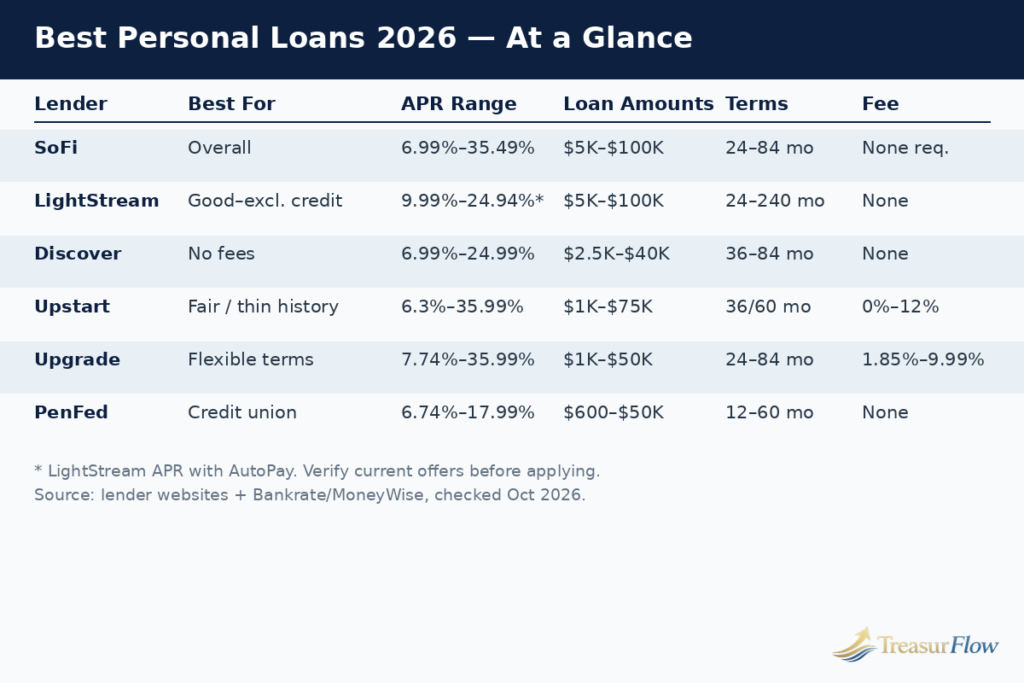
Quick Comparison: The 6 Best Personal Loans of 2026
| Lender | Best For | APR Range | Loan Amounts | Terms | Origination Fee |
|---|---|---|---|---|---|
| SoFi | Overall | 6.99%–35.49% | $5,000–$100,000 | 24–84 months | None required |
| LightStream | Good-to-excellent credit | 9.99%–24.94% (with AutoPay) | $5,000–$100,000 | 24–240 months | None |
| Discover | No fees of any kind | 6.99%–24.99% | $2,500–$40,000 | 36–84 months | None |
| Upstart | Fair credit / thin history | 6.3%–35.99% | $1,000–$75,000 | 36 or 60 months | 0%–12% |
| Upgrade | Flexible terms | 7.74%–35.99% | $1,000–$50,000 | 24–84 months | 1.85%–9.99% |
| PenFed | Credit union option | 6.74%–17.99% | $600–$50,000 | 12–60 months | None |
APR ranges are as published by each lender or by Bankrate/MoneyWise where the lender’s own page did not render its range. Your actual rate depends on your credit, income, and loan details. Rates change — verify current offers before applying.
Best Personal Loans by Borrower Profile
Best Overall: SoFi
SoFi is the most complete personal loan on this list. You can borrow $5,000 to $100,000 at fixed rates from 6.99% to 35.49% APR, with terms of 24 to 84 months. There is no required origination fee and no prepayment penalty. If your loan is approved and you sign by 5:30 PM ET on a business day, you can get same-day funding.
Two discounts are worth knowing about. Setting up autopay shaves 0.25% off your rate. SoFi Plus members (or borrowers who set up eligible direct deposit) get another 0.25% off. Those discounts stack, which can move a borderline rate into genuinely competitive territory.
SoFi’s parent company runs roughly 7,000 active Google ads across its products, per the Google Ads Transparency Center at the time of writing. That matters because advertisers only keep spending at that scale when the products convert and borrowers actually use them. It is a rough but real signal of market confidence.
Choose SoFi if: you want one lender that handles large amounts, fast funding, and no mandatory fees without needing perfect credit.
Best for Good-to-Excellent Credit: LightStream
LightStream, the online lending division of Truist, is built for borrowers with strong credit — and it rewards them for it. Its APR range of 9.99% to 24.94% with AutoPay sits lower at the top end than most online lenders, and it charges no fees and no prepayment penalties at all.
The standout feature is term flexibility. LightStream offers terms from 24 all the way to 240 months depending on loan purpose, which is far longer than the 84-month ceiling most competitors set. A longer term means a smaller monthly payment — but remember, it also means more total interest paid over the life of the loan. Use the long term only if the monthly breathing room is worth the extra interest.
LightStream only approves good-to-excellent credit profiles, and it says so plainly. It looks for several years of credit history, stable income, and a good payment record. If that describes you, LightStream is often the cheapest money among the online lenders on this list. If it doesn’t, apply elsewhere rather than collecting a denial — LightStream also offers same-day funding if you complete signing by 2:30 PM ET on a banking business day.
Choose LightStream if: your credit is good to excellent and you want the lowest ceiling rate plus the longest available terms.
Best for No Fees: Discover
Discover’s personal loan pitch is four words: no fees, period. No origination fee. No prepayment penalty. No late fees. No application fee. What you borrow is what you get, and what you repay is principal plus interest — nothing else skimmed off the top.
The numbers: borrow $2,500 to $40,000 at 6.99% to 24.99% APR, with terms of 36 to 84 months. Funds arrive as early as the next business day after acceptance. The $40,000 ceiling is lower than SoFi’s or LightStream’s $100,000, so Discover is not the pick for a very large loan. But for the common $5,000–$25,000 borrowing range, its fee-free structure makes the true cost unusually transparent.
Discover is also a useful benchmark when you compare lenders. If another lender quotes you a lower APR but charges a 5% origination fee, Discover’s no-fee quote may still cost you less overall. Always compare the total amount you will repay — not just the headline APR.
Choose Discover if: you want zero fees and a clean, predictable loan in the $2,500–$40,000 range.
Best for Fair Credit or Thin History: Upstart
Most lenders decide your fate almost entirely on your credit score. Upstart does something different: its underwriting model also weighs your income, employment history, and education. That means a borrower with a thin file or a fair score can still qualify — and sometimes at a better rate than a score-only lender would offer.
You can borrow $1,000 to $75,000 at 6.3% to 35.99% APR, with 36- or 60-month terms. There is no minimum credit score, and checking your rate takes about five minutes with a soft credit pull that does not affect your score. If approved, funds can arrive in as fast as 24 hours. There is no prepayment penalty.
The trade-off is the origination fee, which ranges from 0% to 12% depending on your profile and is deducted from your loan proceeds. If you borrow $10,000 with a 5% origination fee, you receive $9,500. That matters — always check the “amount you receive” line, not just the loan amount. Upstart runs roughly 400 active Google ads, a smaller but steady advertising footprint that reflects its niche: borrowers the big banks overlook.
Choose Upstart if: your credit history is thin, fair, or still being built, and you want a lender that looks at more than your score.
Best for Flexible Terms: Upgrade
Upgrade’s strength is choice. You can borrow $1,000 to $50,000 at 7.74% to 35.99% APR, with terms from 24 to 84 months, and you can adjust your payment date to fit your pay cycle. It accepts joint applications, which can help you qualify for a larger loan or a better rate if a co-applicant has stronger credit. Funding typically arrives within one business day of clearing verifications.
Upgrade charges an origination fee of 1.85% to 9.99%, and this is where its own example is genuinely useful for understanding how loans work. Upgrade shows a $10,000 loan at 17.98% APR with a 36-month term and a $343.33 monthly payment. The 17.98% APR includes a 5% one-time origination fee; the underlying interest rate is 14.32%. Your monthly payment is calculated on the 14.32% interest rate. The APR is higher because it folds the fee into the total cost. This is exactly why APR — not the interest rate alone — is the number to compare across lenders.
Upgrade also offers an autopay discount and a homeowner discount for borrowers who secure the loan with built-in home fixtures (without using the home itself as collateral). There are no prepayment fees.
Choose Upgrade if: you want flexible terms, joint-application options, and a lender that spells out its fee math in plain sight.
Best Credit Union Option: PenFed
Credit unions are member-owned nonprofits, and their loan pricing often reflects it. PenFed’s personal loan carries no origination fee and no early payoff fee, with APRs from 6.74% to 17.99% — the lowest ceiling on this list. You can borrow $600 to $50,000 with terms of 12 to 60 months, and funding can arrive as soon as the next day.
Setting up autopay lowers your rate by another 0.25%. Checking your rate uses a soft credit pull, so it won’t affect your score. The catch is membership: PenFed is a credit union, so you need to be a member to borrow. Anyone can apply to join, but it is one extra step compared with an online lender that takes all comers.
PenFed’s $50,000 ceiling and 60-month maximum term make it best suited to small-to-midsize borrowing rather than very large loans. For that range, its low rate ceiling and zero-fee structure are hard to beat.
Choose PenFed if: you want credit-union pricing, a low rate ceiling, and zero fees — and you don’t mind joining a credit union to get it.
How to Choose the Right Personal Loan
Comparing lenders is simpler if you check five things in the same order every time.
1. APR, not just the interest rate. The APR folds fees into the cost, so it is the only number that lets you compare lenders fairly. A 14% interest rate with a 5% origination fee can cost more than a 16% rate with no fee. Always compare APR to APR.
2. The origination fee — and what you actually receive. If a lender charges a 5% origination fee on a $10,000 loan, you receive $9,500. If you needed the full $10,000, you would have to borrow more — and pay interest on that extra amount too. Fee-free lenders (Discover, LightStream, PenFed, SoFi) avoid this trap entirely.
3. Term length and total cost. A longer term shrinks your monthly payment but grows your total interest. Before you pick a 60- or 84-month term, multiply the monthly payment by the number of months and compare that total across lenders. The cheapest monthly payment is not always the cheapest loan.
4. Funding speed. If you need money by Friday, funding speed is a real feature, not a nice-to-have. SoFi and LightStream can fund the same day if you sign early enough on a business day. Upstart can send funds in as fast as 24 hours. Discover and Upgrade typically fund within one business day. PenFed can fund as soon as the next day.
5. Prequalification with a soft pull. Every lender on this list lets you check your rate with a soft credit inquiry that does not affect your score. There is no reason to accept a hard pull before you have seen your actual offer. Prequalify with at least three lenders, then pick the best real offer — not the best advertised rate.
Using a Personal Loan to Consolidate Debt
Debt consolidation is one of the most common reasons people take out a personal loan, and it works when the math works: if your new loan’s APR is lower than the weighted average APR of the debts you are paying off, and you stop adding new card debt, you save interest and simplify your life into one monthly payment.
But consolidation is a tool, not a cure. If the underlying spending pattern doesn’t change, the loan just rearranges the debt. And if you are comparing lenders specifically for consolidation — including balance-transfer cards as an alternative — our dedicated guide goes deeper: Best Debt Consolidation Loans 2026. That article ranks lenders by total interest saved on consolidation, which is a different question from this article’s borrower-profile ranking.
Personal Loan vs. Credit Card: When Each One Wins
A personal loan and a credit card solve different problems. A personal loan gives you a lump sum with a fixed rate, a fixed monthly payment, and a fixed payoff date. A credit card gives you revolving credit you can use, repay, and reuse.
A personal loan usually wins when you need a large lump sum, you want a fixed payoff date, or you are consolidating balances at a lower rate than your cards charge. The fixed structure forces discipline: every payment moves you closer to zero.
A credit card usually wins when you need a small amount you can repay within a few months, you can use a 0% intro APR offer, or you need ongoing flexible access to credit rather than one lump sum.
One warning: taking out a personal loan and then running your credit cards back up leaves you with more debt than before, not less. If you consolidate, commit to keeping the paid-off cards at a zero balance — or cut them up.
How to Avoid Personal Loan Scams
Personal loans attract scammers because borrowers are often in a hurry. The FTC’s rule is simple: no legitimate lender charges you before funding your loan. If anyone asks you to pay a “processing,” “insurance,” or “application” fee before you receive your money, walk away — that is an advance-fee loan scam.
Other red flags:
- “Guaranteed approval” or “no credit check needed” — legitimate lenders always check your credit and income.
- Pressure to decide immediately, or a lender who contacts you out of the blue.
- A lender with no verifiable street address, phone number, or state registration.
- Requests to pay by gift card, wire transfer, or cryptocurrency.
If you are unsure about a lender, search its name plus “complaint” or “scam,” check whether it is registered in your state, and read the FTC’s guide on advance-fee loan scams. If you have been mistreated, file a complaint with the CFPB. Before trusting any provider, check our review of Global Financial Solutions.
Your Questions
What credit score do you need for a personal loan?
There is no single minimum — it depends on the lender. LightStream and Discover generally expect good-to-excellent credit. SoFi and Upgrade work across a wider range. Upstart has no minimum credit score and weighs income, employment, and education alongside your credit history. In general, a score of 670 or above gets you the best rates, while fair-credit borrowers (580–669) can still qualify but should expect higher APRs.
How much does a $10,000 personal loan cost per month?
It depends on your APR and term. As a worked example from Upgrade’s own disclosure: a $10,000 loan at 17.98% APR (which includes a 5% origination fee on a 14.32% interest rate) costs $343.33 per month over 36 months. At a lower rate — say 10% APR over 36 months — the same $10,000 would cost about $323 per month. Use each lender’s calculator with your actual offer before you commit.
Will checking my personal loan rate hurt my credit score?
No. Checking your rate with any lender on this list uses a soft credit inquiry, which does not affect your score. A hard inquiry happens only if you accept an offer and proceed with a full application, and even then the impact is usually small and temporary.
Can I pay off my personal loan early?
Yes. Every lender in this guide — SoFi, LightStream, Discover, Upstart, Upgrade, and PenFed — charges no prepayment penalty. Paying early reduces the total interest you pay, and you can make extra payments or pay the full balance at any time.
Should I get a personal loan or use a credit card?
For a large lump sum, a fixed payoff date, or consolidating high-rate balances, a personal loan is usually the better tool. For a small amount you can repay within a few months, or when a 0% intro APR card is available, a credit card may cost less. Compare the total cost of each option — not just the monthly payment.
Can I use a personal loan to consolidate debt?
Yes. A personal loan can roll multiple high-rate debts into one fixed monthly payment, and it saves money when the loan’s APR is lower than the average rate on the debts you are replacing. For a lender-by-lender comparison built specifically for consolidation, see our Best Debt Consolidation Loans 2026 guide.
Our Verdict
The best personal loans 2026 has to offer reward borrowers who match the lender to their profile instead of chasing the lowest advertised rate. Start with SoFi if you want the most complete package. Pick LightStream if your credit is excellent and you want the lowest ceiling rate. Pick Discover if you refuse to pay fees. Pick Upstart if your credit history is thin or fair. Pick Upgrade if you want flexible terms and joint applications. Pick PenFed if you want credit-union pricing with zero fees.
Whatever you choose, prequalify with at least three lenders, compare APRs (not just interest rates), check what you will actually receive after fees, and never pay anyone before your loan is funded. That is how you borrow once — and borrow right.

Muhammad Zakir is the founder of Treasurflow and the author of its personal finance guides. He researches consumer banking, credit, and personal loans, and every guide cites primary sources such as the CFPB, FDIC, FTC, and IRS. His content is educational and is not personalized financial advice.
1 thought on “Best Personal Loans 2026: 6 Lenders Ranked by Your Borrower Profile”