
If you’re carrying $15,000 or $20,000 in credit card debt at 22% APR or higher, the minimum-payment trap can cost you more in interest than the original purchases. Our best debt consolidation loans 2026 roundup replaces five high-rate balances with one fixed-rate loan — and the right pick can save you $7,646 in interest on a $20,000 balance, as the verified math below shows.
Unlike most roundups that stop at APR ranges, we ranked these nine lenders by total interest saved — because the APR (which by law includes origination fees) is the truest measure of what a loan actually costs you. Every rate, fee, and loan amount below was verified on the lender’s official site in October 2026.
Related guides: Best Balance Transfer Credit Cards 2026 · Emergency Loans With No Credit Check · No-Credit-Check Personal Loans 2026 · Best High-Yield Savings Accounts 2026
Helpful official resources: CFPB: What to know about consolidating credit card debt · FTC: Debt relief guidance
What is a debt consolidation loan, exactly?
A debt consolidation loan is a fixed-rate personal installment loan you use to pay off multiple high-interest debts — usually credit cards — leaving you with one monthly payment, one interest rate, and one payoff date. You borrow a lump sum (say $20,000), the lender either deposits it to your bank account or pays your creditors directly, and you repay it in equal monthly installments over 2 to 7 years. For a wider comparison of loan options, see our guide to the best personal loans 2026.
Why it works comes down to simple arithmetic. The average credit card APR sits above 20%, while the consolidation loans on this list start as low as 5.96% APR for qualified borrowers. Every percentage point of rate you eliminate goes straight into interest savings. Just as important is the structure: revolving credit card debt has no finish line — minimum payments are designed to keep you paying for decades. An installment loan amortizes to zero on a fixed date, which means your debt has an expiration date.
The CFPB notes there are several ways to consolidate — personal loans, balance transfer cards, home equity products — and recommends understanding why you’re in debt before borrowing. If overspending (not just high rates) is the root cause, a loan alone won’t fix it unless spending changes too.
How we compared: total interest saved, not just APR
Most “best of” lists sort by the lowest advertised rate and call it a day. That’s misleading, because a 7% loan with a 9% origination fee can cost more than an 8% loan with no fees. Our ranking uses the lowest advertised starting APR as the primary sort — since APR already bakes in origination fees — and notes fee structures so you can compare true cost. Your actual rate depends on your credit profile, income, and loan term; nobody is guaranteed the floor rate.
The math: how much can you actually save?
Before the lender list, here are three worked examples with real amortization math — balance, APR, term, monthly payment, and total interest shown for each.
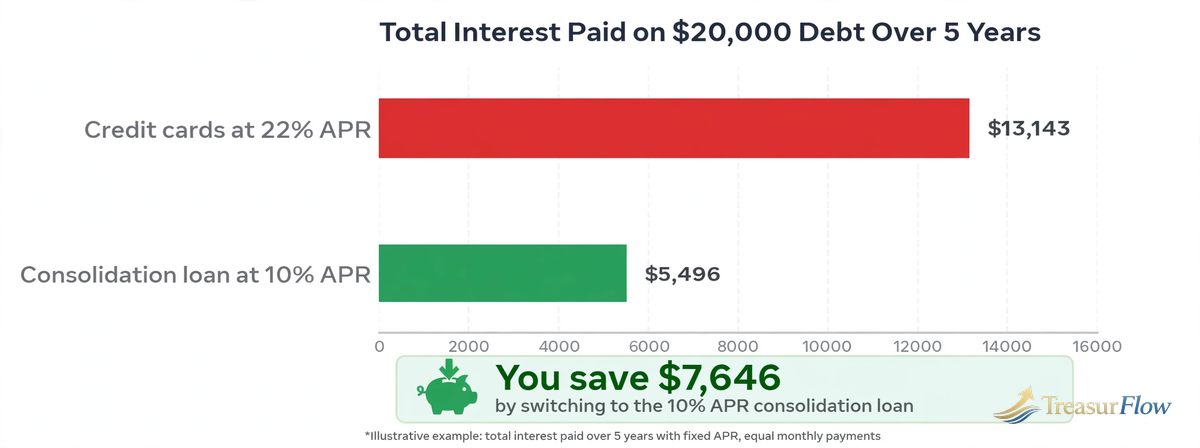
Example 1 — $20,000 in credit card debt at 22% APR, consolidated to 10% over 5 years. Staying on the cards: $552.38/month, $33,142.69 total, $13,142.69 in interest. With a 10% consolidation loan: $424.94/month, $25,496.45 total, $5,496.45 in interest. Total saved: $7,646.24 — and you’re debt-free on a fixed date instead of revolving forever.
Example 2 — $15,000 at 24% APR, consolidated to 12% over 4 years. Cards: $489.03/month, $8,473.32 in interest. Loan: $395.01/month, $3,960.36 in interest. Total saved: $4,512.96.
Example 3 — how origination fees really work (Upgrade’s own published illustration). A $10,000 loan at a 13.94% note rate with a 5% origination fee has an APR of 17.59% — you receive $9,500, pay $341.48/month for 36 months, $12,293.46 total. The APR exceeds the note rate precisely because of the fee. This is why comparing APR — not just the interest rate — matters.
Best Debt Consolidation Loans 2026: Our 9 Top Picks
1. Happen Bank (formerly LendingClub) — Best starting APR: 5.96%
Happen Bank, which rebranded from LendingClub in June 2026, advertises the lowest starting APR on this list: 5.96% to 35.99%, with origination/processing fees from 0.00% to 8.00% of the loan amount. Loans run $1,000 to $75,000 over 24 to 84 months. Its published example: a $15,262 loan at 13.99% with a 6% fee ($916) means you receive $14,346 and pay $522/month for 36 months (18.40% APR). NerdWallet rates it a top pick partly because it pays your creditors directly — removing the temptation to spend the loan funds. Best for borrowers with strong credit chasing the absolute lowest rate.
2. Upstart — Best for thin credit files: from 6.3% APR
Upstart’s AI underwriting looks beyond your credit score — factoring in education and employment — which helps borrowers with short credit histories. APRs run 6.3% to 35.99% with 3- or 5-year terms and no prepayment penalty. Watch the origination fee: Upstart’s own example shows a $10,000, 60-month loan at 19.08% with an 8.15% fee ($815), working out to 23.37% APR and $261/month. Best for borrowers whose score doesn’t reflect their real repayment ability.
3. LightStream (Truist) — Best for excellent credit, zero fees
LightStream charges no fees whatsoever — no origination, no late fee, no prepayment penalty — and knocks 0.50 percentage points off your rate with AutoPay. Published reviews cite starting APRs around 6.49% with AutoPay (rates vary by loan purpose; check their official rate widget). Borrow $5,000 to $100,000 over 24 to 240 months depending on purpose, with same-day funding possible. The catch: LightStream only approves good-to-excellent credit profiles, and there’s no soft-pull prequalification — applying triggers a hard inquiry. Its Rate Beat Program beats a qualifying competitor’s rate by 0.10%.
4. SoFi — Best for large loans with no fees: 6.99%–35.49%
SoFi offers 6.99% to 35.49% APR (with AutoPay), no origination fees or prepayment penalties, loans of $5,000 to $100,000, and terms of 2, 3, 5, or 7 years. Stackable discounts (0.25% for autopay, 0.25% for direct deposit) plus unemployment protection sweeten the deal. SoFi publishes that borrowers reduced their rate by 44% on average and gained 22 FICO points on average after consolidating $10,000+. Best for consolidating very large balances in a single loan.
5. Discover Personal Loans — Best no-fee bank option: 6.99%–24.99%
Discover’s personal loans carry 6.99% to 24.99% APR with no fees of any kind — no origination, no late, no prepayment. Borrow $2,500 to $40,000 over 36 to 84 months, with funds as early as the next business day and direct payment to creditors available. Note: published reviews cite a $25,000 minimum household income requirement, and you can’t use proceeds to pay off Capital One accounts directly. A rare 30-day return policy lets you cancel within 30 days of funding.
6. Best Egg — Best secured-loan option: 6.99%–35.99%
Best Egg’s APRs run 6.99% to 35.99% with an origination fee of up to 9.99% deducted from proceeds, on loans of $2,000 to $50,000 over 3 to 5 years. The standout: a secured loan option and a Direct Pay feature that can unlock better rates while paying creditors directly. Funding can land in as little as one business day. Best for homeowners or borrowers willing to secure the loan for a lower rate.
7. Upgrade — Best for fair credit: 7.74%–35.99%
Upgrade welcomes borrowers with less-than-perfect credit: APRs 7.74% to 35.99%, origination fee 1.85% to 9.99% (deducted from proceeds), terms 24 to 84 months, and amounts from $1,000 to $50,000 per published reviews. The lowest rates require autopay plus using part of the loan to pay off existing debt directly. As Example 3 above shows, always read the APR — not just the note rate — because the origination fee is real money.
8. Happy Money — Best for credit-card-only debt: 7.95%–35.99%
Happy Money’s Payoff Loan was built for exactly one job: killing credit card debt. APRs run 7.95% to 35.99% on $5,000 to $50,000 over 24 to 60 months, with an origination fee of 0.25% to 10% folded into the APR and no late fees or prepayment penalties. Rate checks use a soft pull. Best for borrowers who want a lender laser-focused on card consolidation — just know the funds can only be used for that purpose.
9. Alliant Credit Union — Best credit union pick: as low as 9.49%
Alliant’s unsecured personal loans start as low as 9.49% APR (12-month term), rising to 12.49% for 60 months, with no closing costs or fees and no prepayment penalties. Borrow up to $100,000 over 12 to 60 months, with same-day funding in most cases. The tradeoff: you must be a member for at least 90 days before applying, and the APR runs 0.4% higher without automatic payments. Best for existing credit union members who value fee-free simplicity.
Side-by-side comparison
| Lender | Starting APR | Origination fee | Loan amounts | Terms | Fees |
|---|---|---|---|---|---|
| Happen Bank | 5.96% | 0–8% | $1,000–$75,000 | 24–84 mo | Varies |
| Upstart | 6.3% | Applies (e.g., 8.15%) | $1,000–$75,000* | 3 or 5 yrs | None (prepay) |
| LightStream | ~6.49% (w/ AutoPay)* | None | $5,000–$100,000 | 24–240 mo | None |
| SoFi | 6.99% | None | $5,000–$100,000 | 2–7 yrs | None |
| Discover | 6.99% | None | $2,500–$40,000 | 36–84 mo | None |
| Best Egg | 6.99% | Up to 9.99% | $2,000–$50,000 | 36–60 mo | None (prepay) |
| Upgrade | 7.74% | 1.85–9.99% | $1,000–$50,000* | 24–84 mo | None (prepay) |
| Happy Money | 7.95% | 0.25–10% | $5,000–$50,000 | 24–60 mo | None (late/prepay) |
| Alliant | 9.49% (12-mo) | None | Up to $100,000 | 12–60 mo | None |
Per published reviews; confirm on the lender’s official site before applying. All APRs verified October 2026 and subject to change.
5 mistakes that wipe out your consolidation savings
- Ignoring the origination fee. A 9% fee on $25,000 is $2,250 gone before you see a dollar. Always compare APR (fee-included), never the note rate alone.
- Stretching the term for a lower payment. Dropping from a 3-year to a 7-year term can double your total interest even at a lower APR. Match the term to the shortest payoff you can afford.
- Re-spending the freed-up cards. The #1 consolidation killer. Paid-off cards with full limits are a trap — remove them from your wallet, delete saved card numbers from shopping sites, or freeze them in ice (literally; it works).
- Not comparing at least three offers. Rate quotes for the same borrower routinely differ by 3–5 percentage points between lenders. Three soft-pull checks take 15 minutes and can save thousands.
- Consolidating without a budget. The loan fixes the math, not the behavior. The CFPB recommends making a budget — for example, the envelope budgeting method — before borrowing and, if needed, talking to a nonprofit credit counselor (free) about whether a debt management plan fits better than a loan.
Debt consolidation loan requirements: what lenders actually check
Credit score. Most lenders approve scores from the high 500s upward, but the rate you get is heavily score-dependent. Around 670+ is where offers start beating typical card APRs by enough to matter; the advertised floor rates (5.96%–6.99%) generally require good-to-excellent credit. LightStream is explicit: it only approves good-to-excellent profiles.
Debt-to-income ratio (DTI). Lenders want your total monthly debt payments — including the new loan — to fit comfortably within your income, typically under 40–50%. A $20,000 consolidation that drops your monthly minimums usually improves your DTI picture, which is part of why approvals are common even for heavily indebted borrowers.
Income and documentation. Expect to provide pay stubs or tax returns, bank statements, and a government ID. Discover publishes a $25,000 minimum household income; most lenders don’t publish a number but verify stability.
The application itself. For eight of the nine lenders above, checking your rate triggers only a soft inquiry — no score impact. The hard inquiry lands only when you accept an offer and the loan funds. LightStream is the exception: there’s no prequalification step, so even checking your personalized rate means a hard pull. Plan accordingly and compare soft-pull offers first.
How to choose the right debt consolidation loan
- Compare APR, not just the interest rate. APR includes origination fees — it’s the only apples-to-apples number.
- Calculate total interest, not just the monthly payment. A longer term lowers your payment but can raise total cost. Use the worked examples above as your template.
- Prefer direct creditor payment. Lenders like Happen Bank, Discover, and Best Egg can pay your cards directly, so the money can’t leak into new spending.
- Prequalify with soft pulls only. Most lenders on this list let you check your rate without hurting your score — LightStream is the notable exception (hard pull to apply).
- Don’t stretch the term to chase a low payment. If the loan’s total interest approaches what you’d pay on the cards, consolidation isn’t saving you anything.
Debt consolidation vs. balance transfer vs. debt settlement
A balance transfer card (see our best balance transfer credit cards for 2026) can beat any loan for balances you can clear within the 0% intro window — but transfer fees run 3–5%, and the rate snaps back afterward. A debt consolidation loan wins for larger balances you need years to repay, with a fixed payoff date. Debt settlement — paying less than you owe through negotiation — is a different animal: it severely damages your credit for up to seven years and forgiven amounts can be taxable. The CFPB and FTC both warn that legitimate help never demands upfront fees.
Watch out for debt consolidation scams
The FTC is blunt: only scammers demand payment before settling your debts or entering you into a plan, and anyone guaranteeing to wipe out your debt is lying. Real help — nonprofit credit counselors, your own lenders’ hardship programs — doesn’t cold-call you or charge upfront. If you’re unsure where to start, the CFPB’s consolidation guide (linked above) walks through your options before you borrow a dollar. Before trusting any provider, check our review of Global Financial Solutions.
Debt Consolidation Questions
How much can I save with a debt consolidation loan?
It depends on your balance and the rate drop. Our verified Example 1: $20,000 at 22% consolidated to 10% over 5 years saves $7,646.24 in interest ($13,142.69 vs $5,496.45). Example 2: $15,000 at 24% to 12% over 4 years saves $4,512.96. Run your own numbers with the lender’s APR — not just the note rate — before applying.
What credit score do I need for a debt consolidation loan?
Most lenders approve scores around 580–600 and up, but scores of 670+ unlock rates low enough to produce meaningful savings over typical card APRs. LightStream and the lowest advertised rates generally require good-to-excellent credit.
Does debt consolidation hurt your credit score?
Expect a small, temporary dip of roughly 5–10 points from the hard inquiry. The net effect is usually positive within 6–12 months: paying off revolving balances slashes your utilization ratio, and on-time installment payments build history.
What’s the difference between debt consolidation and debt settlement?
Consolidation repays 100% of what you owe under better terms — minimal lasting credit impact. Settlement negotiates to pay less than owed, which can crater your score for up to seven years, and forgiven debt may count as taxable income.
Should I close my credit cards after consolidating?
No — keep them open with zero balances. Closing cards shrinks your available credit and raises your utilization ratio, hurting your score. Put the cards away (or freeze them) so you don’t reload them with new debt.
Can I get a debt consolidation loan with bad credit?
It’s harder but possible. Upgrade and Upstart work with fair-credit and thin-file borrowers; Best Egg offers a secured option. If your rate quote isn’t meaningfully below your card APRs, consolidation won’t save you money — consider a nonprofit credit counselor instead.
How fast can I get a debt consolidation loan?
Same-day funding is possible at SoFi and LightStream (complete steps by early afternoon ET); most others fund within 1–3 business days after verification. Direct payments to creditors can take a few extra days to post.
Are there fees with debt consolidation loans?
It varies: SoFi, LightStream, Discover, and Alliant charge no origination fees at all, while others charge 0.25%–12% deducted from your proceeds. Because APR legally includes these fees, comparing APRs automatically accounts for them.
Is a consolidation loan better than a balance transfer card?
For balances under ~$10,000 you can repay within a 0% intro period (usually 12–21 months), a balance transfer is often cheaper even with a 3–5% transfer fee. For larger balances needing multi-year payoff, a fixed-rate loan’s certainty usually wins. Compare both in our balance transfer guide.
What should I do if I’m denied for a consolidation loan?
Don’t shotgun applications — each hard inquiry dings your score. Instead: check your credit reports for errors, try a secured loan or credit union, or talk to a nonprofit credit counselor about a debt management plan. Our guides to emergency loans and no-credit-check personal loans cover fallback options.
Your Next Step
The best debt consolidation loan of 2026 is the one with the lowest APR you actually qualify for — and as the math shows, dropping from 22% to 10% on $20,000 saves $7,646 in interest and hands you a fixed finish line. Happen Bank leads on starting rate (5.96%), LightStream and SoFi lead on zero fees, and Discover is the cleanest bank option. Compare at least three soft-pull offers, insist on the APR (never the note rate alone), and make sure the new payment fits your budget with room to spare. Once the cards are paid off, keep them open but out of your wallet — and consider parking your monthly savings in one of the best high-yield savings accounts so the debt cycle doesn’t restart.
Who should — and shouldn’t — consolidate
Consolidation makes sense when: you can qualify for an APR meaningfully lower than your current weighted average card rate (a 3+ point drop is a good rule of thumb); you have steady income to cover the new payment; and you’re committed to not re-running the paid-off cards back up. Borrowers with scores of 670+ typically see the biggest savings.
Skip it when: the best APR you’re offered is barely below your card rates (after origination fees, you could pay more); your debt is small enough to kill with a few months of aggressive payments; or the real problem is ongoing overspending — in that case, a loan just converts credit card debt into loan debt while the cards fill up again. The CFPB specifically warns that consolidation won’t help unless you address the spending patterns behind the debt.

Muhammad Zakir is the founder of Treasurflow and the author of its personal finance guides. He researches consumer banking, credit, and personal loans, and every guide cites primary sources such as the CFPB, FDIC, FTC, and IRS. His content is educational and is not personalized financial advice.
2 thoughts on “Best Debt Consolidation Loans 2026: 9 Picks Ranked by Total Interest Saved”