

If you’re still paying the rate the dealership handed you, there’s a good chance you’re overpaying — and the best auto loan refinance 2026 options could fix that in a single afternoon. Here’s the bottom line up front: PenFed Credit Union is our top overall pick, thanks to no origination or document fees and competitive starting rates, while Caribou is the best way to compare multiple offers at once and Gravity Lending stands out for customer service and payment flexibility.
Refinancing isn’t magic, but the numbers are real. Borrowers who refinanced in the second quarter of 2026 cut their average rate from 10.40% to 7.97% and dropped their monthly payment by $83, according to Experian data shared by Caribou in October 2026. And LendingTree’s Q2 2026 marketplace data puts the average auto refinance rate at 8.05%, with refinancers saving an average of $142 a month. Your results will depend on your credit, your car, and your current rate — but if any of those have improved since you first signed, it’s worth a look.

Related guides: If your car situation is changing, you may also need non-owner auto insurance — our guide explains when it makes sense. And if you’re sorting out coverage without a license, see how car insurance works with no license.
Helpful official resources: The Consumer Financial Protection Bureau’s auto loan shopping resources include a free worksheet for comparing offers side by side. The FTC’s car-buying guidance at ftc.gov/cars reminds shoppers to arrange financing before visiting the dealer — advice that applies just as well to refinancing.
What Is Auto Loan Refinancing?
Auto loan refinancing means replacing your current car loan with a brand-new loan — usually from a different lender — that has better terms. Your new lender pays off your old loan, and you start making payments on the new one instead. Most people refinance to get a lower interest rate, a smaller monthly payment, or a different loan term, and the whole process can often be completed online in a few days.
Quick Comparison: Best Auto Loan Refinance Companies 2026
| Lender | Standout feature | Best for | Min. credit score* |
|---|---|---|---|
| PenFed Credit Union | No origination or document fees | Best overall | Not disclosed |
| Gravity Lending | Up-to-90-day first-payment delay | Customer service + flexibility | 600 |
| Caribou | Compare multiple lender offers | Shopping several offers at once | 640 |
| RefiJet | Dedicated refinance support team | Lower credit scores | 540 |
| myAutoLoan | Up to 4 competing offers, one application | Comparing banks and credit unions | Varies by partner |
| LightStream | Unsecured loans, same-day funding | Fast, fee-free funding | 600 |
| DCU | Refinances private-party purchases | Private-party car loans | Not disclosed |
| Happen (formerly LendingClub) | Soft pull to check your rate | Fee-free prequalification | Not disclosed |
*Minimums as reported by Bankrate, NerdWallet, or lender review roundups in October 2026. Lenders change criteria often — treat these as starting points and confirm on the lender’s site before applying.
Our Top Auto Refinance Picks for 2026
We looked at how the major review outlets ranked refinance lenders this fall — Money, Bankrate, NerdWallet, and LendingTree all refreshed their lists in September and October 2026 — and cross-checked the fine print so you don’t have to. Rate ranges below are as reported in October 2026 and will move with the market; your actual offer depends on your credit profile, vehicle, and loan-to-value ratio.
1. PenFed Credit Union — Best Overall
Verdict: The best combination of low advertised starting rates and zero junk fees.
Money named PenFed the best overall auto refinance lender in its October 2026 update, and it’s easy to see why: starting APRs of 4.19% for new cars and 4.79% for used vehicles (for cars with 7,500 miles or fewer), with no document fees and no origination fees. Loan amounts go up to $150,000 with terms from 36 to 84 months, and PenFed will refinance vehicles with up to 125,000 miles — more generous than many competitors — plus up to 125% of your current loan balance, which helps if you’re slightly upside down.
The trade-offs: you must join the credit union (membership is open to anyone), the starting rate climbs for higher-mileage vehicles, and unlike marketplaces, PenFed leaves the old-loan payoff and title transfer paperwork to you. If you’re organized and have decent credit, the fee savings can be substantial.
2. Gravity Lending — Best for Customer Service and Payment Flexibility
Verdict: Ideal if you want a human guiding you through the process — and breathing room before the first payment.
Gravity Lending earned Money’s “best for customer service” nod in October 2026. Estimated APRs run from 3.89% to 17.98% with a minimum credit score of 600, according to NerdWallet’s October 2026 data. Gravity charges no origination fees on its own products (though a partner lender in its network might, so read each offer carefully). Its standout perk: you can delay your first payment for up to 90 days, one of the longest grace periods in the business — genuinely useful if you’re refinancing because money is tight right now.
3. Caribou — Best for Comparing Multiple Offers at Once
Verdict: The fastest way to see several real offers side by side without applying lender by lender.
Caribou is a refinance-only marketplace, which means one application can surface offers from multiple lenders. Reported APRs range from 4.18% to 28.55% on loans of $5,000 to $125,000, with a 640 minimum credit score, according to Bankrate’s October 2026 data. Customer service runs seven days a week, and prequalification is available. Watch the fine print: a $499 processing fee may be passed through by the lender, it’s not available in every state, and vehicles are capped at 120,000 miles. Caribou’s own data is encouraging — borrowers who funded through the platform in the first half of 2026 and chose an offer to lower their payment saved an average of $162 per month.
4. RefiJet — Best for Lower Credit Scores
Verdict: The most accessible option if your credit is still a work in progress.
Most refinance lenders draw the line at a 600 credit score. RefiJet goes down to 540, per Bankrate’s October 2026 figures, with APRs from 4.49% to 21.99% and loan amounts from $10,000 to $120,000. Bankrate also flags RefiJet for dedicated customer support — each borrower gets guidance through the refinance process rather than a faceless online form. Prequalification is available, and there’s a two-month payment-free period after closing. If past credit mistakes are what’s keeping your current rate high, RefiJet deserves a look.
5. myAutoLoan — Best for Pitting Banks Against Credit Unions
Verdict: One application, up to four competing offers from its network of banks and credit unions.
myAutoLoan isn’t a direct lender — it’s a marketplace that sends your single application to multiple partner lenders and returns up to four competing offers. Some network lenders advertise rates as low as 6.24% on new-car loans for well-qualified borrowers, as reported in October 2026 roundups, and the marketplace itself charges no origination fees. Because rates reflect whichever partner lenders are active, treat any advertised number as a starting point and compare the actual offers you receive.
6. LightStream — Best for Fast, Fee-Free Funding
Verdict: Unsecured refinancing with zero fees and same-day funding for strong-credit borrowers.
LightStream is unusual: it refinances cars with unsecured personal loans, so your vehicle isn’t collateral. Bankrate’s October 2026 data shows fixed APRs starting at 4.09%, loan amounts from $5,000 to $100,000, and a 600 minimum credit score — with no fees of any kind and same-day funding available. The catch is that the best rates go to borrowers with strong credit profiles, so this one favors people whose scores have already rebounded since their original loan.
7. DCU (Digital Federal Credit Union) — Best for Private-Party Refinancing
Verdict: The rare lender that will refinance a car you bought directly from another person.
Most lenders on this list won’t touch a loan on a car you bought from a private seller. DCU will. Rates go as low as 4.99% if you enroll in automatic payments, and DCU lets you delay your first payment up to 60 days after closing, according to October 2026 roundups. Like PenFed, you’ll need to become a credit union member to finalize the loan. If your car came from Facebook Marketplace or a neighbor rather than a dealership, start here.
8. Happen (formerly LendingClub) — Best Fee-Free Way to Check Your Rate
Verdict: See your potential rate with a soft credit pull that won’t touch your score.
LendingClub rebranded to Happen Bank in 2026, and its auto refinance product kept the fee structure that made the original popular: no origination fee, the ability to choose your own payment due date, and a soft credit check to prequalify — so you can see your rate before committing to a hard inquiry. It’s a low-risk first stop if you’re refinance-curious but not ready to apply anywhere yet.
Best Auto Refinance for Fair Credit 2026
If your credit score sits in the fair range — roughly 580 to 669 — you’re in the group most likely to benefit from refinancing, because even a modest score improvement since your original loan can unlock a meaningfully better rate. Experian’s automotive insights lead has noted that much refinancing activity happens when borrowers start with lower scores, make consistent payments, and then qualify for better terms.
Your best bets in this bracket:
- RefiJet (minimum 540) and Auto Approve (minimum 480, per NerdWallet) are the most accessible if your score is still below 600.
- Gravity Lending (minimum 600) pairs fair-credit eligibility with strong customer support and that 90-day first-payment delay.
- Caribou (minimum 640) works if you’re at the top of the fair range and want to compare several offers at once.
One caution for fair-credit borrowers: advertised “starting at” rates assume excellent credit. Your offer will be higher — the question is whether it’s still lower than what you’re paying now. Always compare the full offer, including fees, against your current loan’s remaining cost.
When Should You Refinance Your Car Loan?
Refinancing makes the most sense in a few specific situations, according to Bankrate’s September 2026 guidance:
- Your credit score has improved since you took out the original loan. On-time payments on that very loan often raise your score, which can qualify you for a lower rate now.
- Market rates have dropped below what you’re currently paying. The Federal Reserve raised its benchmark rate to a 3.75%–4.00% range on September 16, 2026, with its next meeting October 27–28 — so check current offers rather than assuming.
- You took the dealership’s financing without shopping around. The CFPB notes that only about half of car buyers comparison-shop for financing — if you were the other half, refinancing is your second chance.
- Your payment no longer fits your budget. Refinancing can also remove a cosigner from your loan, per Bankrate — useful if your finances have changed.
When to wait instead: if today’s rates are higher than your current rate, if you’re close to paying the loan off (fees could wipe out the savings), or if you owe significantly more than the car is worth. Most lenders also want you to wait at least 90 days after signing before refinancing, and many advisors suggest waiting around 12 months so your credit has time to rebound. As consumer expert Clark Howard puts it: if you can qualify for a lower rate without extending your term, move forward — auto refinancing has no “payback period,” so the savings start with your very first new payment.
Does Refinancing a Car Hurt Your Credit?
Refinancing can cause a small, temporary dip in your credit score — but it usually rebounds within a few months of on-time payments, according to NerdWallet’s November 2025 analysis. Here’s what actually happens:
- A hard inquiry. Applying triggers a hard credit check, which FICO says can shave up to about 5 points off your score. The good news: if you submit multiple auto-loan applications within a 14-day window, FICO counts them as a single inquiry (VantageScore allows up to 45 days) — so rate-shopping quickly is the smart move.
- A slightly younger average account age. Your new loan resets the clock on that account. Since length of credit history is only 15% of a FICO score, the effect is usually minor.
- A new account on your report. The old loan shows as closed in good standing and stays on your report for up to a decade, per Experian.
The inquiry stays on your report for two years but only affects your score for about 12 months, per Bankrate. And checking your rate with a soft pull — offered by Happen, Caribou, and others — doesn’t affect your score at all. If you’re about to apply for a mortgage, though, consider waiting until that closes before refinancing the car.
How Much Could You Save by Refinancing?
Real-world data from 2026 suggests the savings are more than pocket change:
- $83/month — average monthly payment drop for Q2 2026 refinancers, whose average rate fell from 10.40% to 7.97% (Experian data, via Caribou, October 2026).
- $142/month — average payment reduction across LendingTree’s Q2 2026 refinance marketplace data, where the average refinance rate was 8.05%.
- $188/month — average savings for Caribou customers who funded in Q3 2026 and selected an offer specifically to lower their payment, with APRs falling 4.37 percentage points on average.
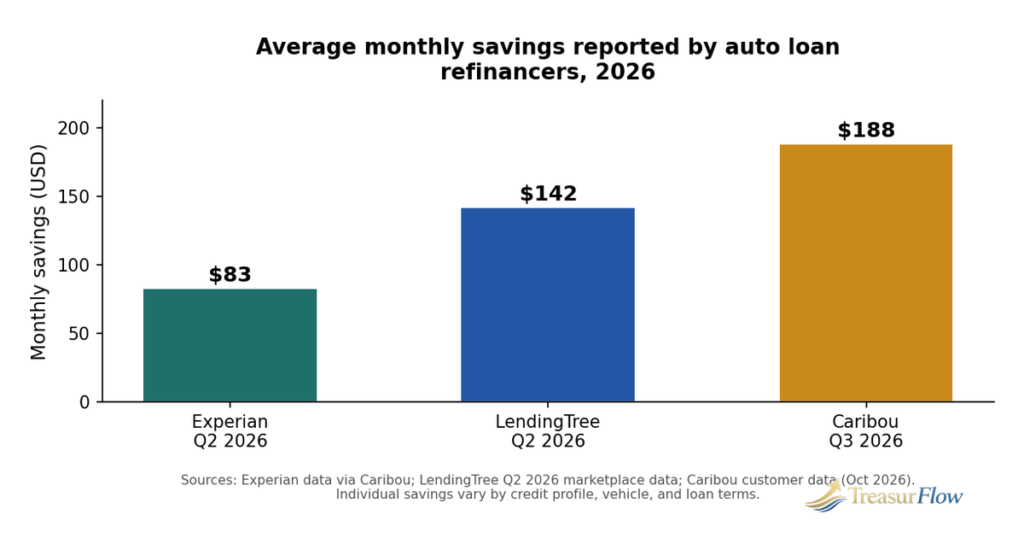
Your own savings hinge on three things: the gap between your current rate and your new one, your remaining balance, and whether you extend the term. A longer term lowers the monthly payment but raises total interest — the CFPB’s auto loan shopping worksheet is built exactly for this trade-off, and it’s free.
4 Auto Refinance Mistakes to Avoid
- Refinancing an upside-down loan. If you owe far more than the car’s worth, most lenders will decline — and rolling negative equity into a new loan digs the hole deeper. (PenFed’s willingness to finance up to 125% of the balance is a rare exception.)
- Extending the term just to chase a lower payment. Stretching a 48-month loan into 72 months can cost you thousands in extra interest. Keep the term the same or shorter whenever possible.
- Ignoring fees. A $499 processing fee or origination charge can erase months of savings. Factor every fee into the comparison.
- Applying everywhere over several months. Scattered applications mean scattered hard inquiries. Do your rate shopping inside a two-week window.
If high-interest debt beyond the car payment is the real strain on your budget, refinancing the car may only be half the fix — our debt consolidation loans guide covers the other half.
How to Refinance Your Car Loan in 5 Steps
- Check your credit and your current loan. Pull your score and note your current APR, remaining balance, monthly payment, and months left. You can’t beat a deal you haven’t measured.
- Estimate your car’s value. Most lenders require positive equity — your car should be worth more than you owe. Check a valuation site before you apply so there are no surprises.
- Gather your documents. Lenders typically ask for proof of income and residence, your vehicle details (year, make, model, mileage, VIN), and your current loan’s balance and terms.
- Compare at least three offers. Start with soft-pull prequalification (Happen, Caribou) plus one credit union (PenFed or DCU). Submit formal applications within a two-week window so the hard inquiries count as one.
- Sign, then confirm the payoff. Once approved, review the new terms against your old loan’s total remaining cost. After signing, make sure your old loan is actually paid off and the title transfers correctly — then start paying the new lender.
Auto Loan Refinance FAQs
What credit score do you need to refinance a car loan?
There’s no single minimum — it varies by lender. Among the lenders above, minimums range from 480 (Auto Approve) to 640 (Caribou), with several not disclosing a cutoff. Higher scores unlock lower rates, but fair-credit borrowers often see the biggest improvement over their original loan.
How soon after buying a car can you refinance?
Most lenders want you to wait at least 90 days after signing. Waiting around 12 months is often smarter, since it gives your credit score time to recover from the original hard inquiry and improve with on-time payments.
Can you refinance a car if you owe more than it’s worth?
It’s difficult — most lenders require positive equity. A few exceptions exist: PenFed allows refinancing up to 125% of your current loan balance, according to Money’s October 2026 review. Otherwise, paying down the balance first is usually the better move.
Does refinancing remove a cosigner from a car loan?
Yes. Refinancing replaces the original loan with a new one in your name only, which is one of the most common ways to release a cosigner. You’ll need to qualify on your own income and credit.
How many times can you refinance a car loan?
There’s no legal limit. But every refinance is a new application with a new hard inquiry, and lenders get wary of cars with high mileage and age — so refinancing repeatedly within a short period rarely pays.
Are there fees to refinance a car loan?
Sometimes. PenFed, LightStream, and Happen charge no origination or document fees, while marketplaces like Caribou note that a lender may pass through a processing fee (around $499). Always ask for the full fee picture before signing.
Final Word
The best auto loan refinance in 2026 isn’t one-size-fits-all: PenFed Credit Union wins overall on low rates and zero fees, Caribou and myAutoLoan are the easiest ways to compare multiple offers, RefiJet and Gravity Lending serve fair-credit borrowers well, and DCU is the answer for private-party purchases. With average refinancers saving $83–$188 a month this year, the potential payoff is real — as long as you refinance to a lower rate without stretching the term, shop your applications inside two weeks, and count every fee before you sign. Check your current rate against today’s offers; if the math works, your future self will thank you. If you also own business equipment, equipment refinancing may cut those costs too.

Muhammad Zakir is the founder of Treasurflow and the author of its personal finance guides. He researches consumer banking, credit, and personal loans, and every guide cites primary sources such as the CFPB, FDIC, FTC, and IRS. His content is educational and is not personalized financial advice.
3 thoughts on “Best Auto Loan Refinance 2026: 8 Lenders That Can Lower Your Car Payment”