

If you search for the best mortgage refinance 2026, every list looks the same: a row of lenders, a row of rates, and a winner picked for everybody. That is the wrong way to choose a refinance, and it is why so many homeowners leave money behind. A refinance is not a product you buy off a shelf. It is a trade — you pay closing costs today in exchange for lower payments later — and whether that trade wins depends on your balance, your current rate, your credit, how long you will stay, and what kind of loan you hold.
The stakes are large. Bankrate’s research found that 87% of 2025 borrowers paid more than the most competitive rate they could have gotten, with the typical borrower overpaying by $3,343 a year — about $278 a month. That is not a rounding error. That is the cost of picking a lender from a generic list instead of from your own numbers.
This guide works differently. Instead of ranking lenders by advertised rate, it ranks them by borrower profile and by break-even month — the month your monthly savings finally repay what the refinance cost you. You will see three fully worked borrower profiles, the real anatomy of closing costs, the rate-versus-cost tradeoff most articles hide, and a lender lineup that tells you who actually wins for each profile. Rates move daily, so every market number here is dated: the Freddie Mac weekly survey put the 30-year fixed at 7.40% for the week ending October 15, 2026, and Bankrate’s national average 30-year refinance rate was 7.63% (7.70% APR) the same day. Use those as your benchmark, then get your own quotes — because your rate will be set by your profile, not by any national average.
Related Guides: If you are weighing more than one kind of refinance, start with how the same break-even logic works on a car loan in Best Auto Loan Refinance 2026, see the tactics that lower any loan payment in How to Lower Your Car Interest Rate, and if the property is an investment rather than your home, read DSCR Loan Rates in 2026 before you assume a standard refinance applies. The savings a good refinance frees up can also be redirected into a long-term plan — see How to Build Wealth Slowly.
Helpful Official Resources: Consumer Financial Protection Bureau — Buying a House / Owning a Home · FHFA — 2026 Conforming Loan Limit Values · VA — VA-backed Home Loans · HUD — Single Family Housing · Bankrate — Current Refinance Rates
Start With Your Break-Even Month, Not the Rate
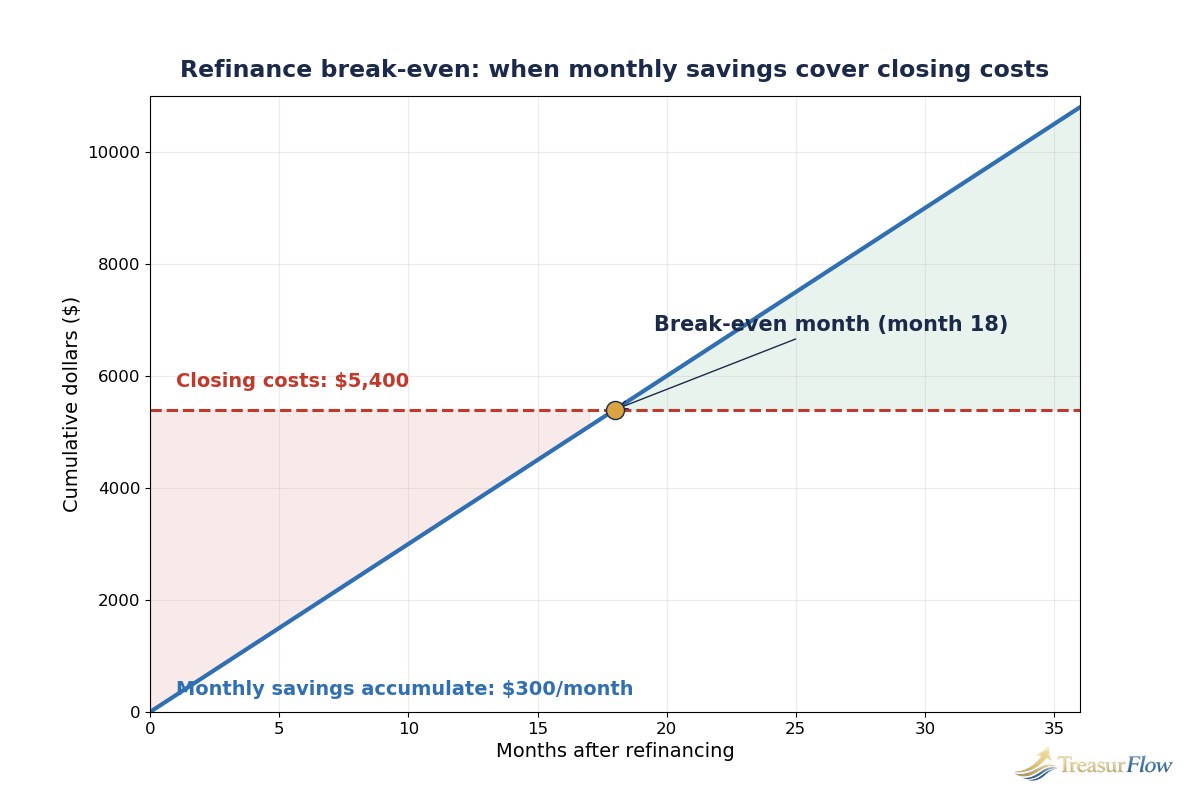
Forget the “1% rule” you have heard — the idea that you should refinance if you can cut your rate by a full percentage point. It is dangerously incomplete. A 1-point drop on a $600,000 balance saves roughly six times as much per month as the same drop on a $100,000 balance, while the same $6,000 in closing costs takes far longer to recoup on the small loan. The only test that respects your situation is the break-even month:
Break-even month = Total closing costs ÷ Monthly payment savings
If the refinance costs $8,000 and saves you $320 a month, you break even in 25 months. If you sell, move, or refinance again before month 25, you lost money — even though your payment went down. If you stay past month 25, every month after that is profit.
Worked Example — Profile A: The Big-Balance Borrower
Illustrative example with stated assumptions — not a rate quote. Assumptions: $420,000 remaining balance, 27 years left on the current loan, current rate 8.25%, new rate 7.40% (near the Freddie Mac survey level), closing costs $8,400 (2% of the balance), principal-and-interest only, taxes and insurance unchanged.
| Current loan | New 30-year refinance | New loan, 27-year term | |
|---|---|---|---|
| Rate | 8.25% | 7.40% | 7.40% |
| Monthly P&I payment | $3,239 | $2,908 | $2,999 |
| Monthly savings | — | $331 | $240 |
| Break-even | — | ~25 months | ~35 months |
| Total interest remaining | $629,555 | $626,878 | $551,746 |
Read that table twice, because it contains the most expensive misunderstanding in refinancing. The new 30-year loan saves $331 a month and breaks even in about 25 months — but because the term restarts at 30 years, its total interest is barely lower than staying put ($626,878 vs. $629,555). The monthly savings are real, but most of them are consumed by paying for three extra years. Keep the term at 27 years instead and the monthly savings shrink to $240 — yet total interest falls by roughly $77,800, because you stop paying three years sooner.
The lesson: a refinance has two levers, rate and term, and the monthly payment only shows you one of them. Before you sign, ask your lender to quote the new loan at your remaining term, not just at 30 years, and compare total interest — not just the payment — across both versions. If cash flow is tight and you genuinely need the lowest payment, the fresh 30-year term is a legitimate choice. But make it a choice, not an accident.
Three Borrowers, Three Different Right Answers
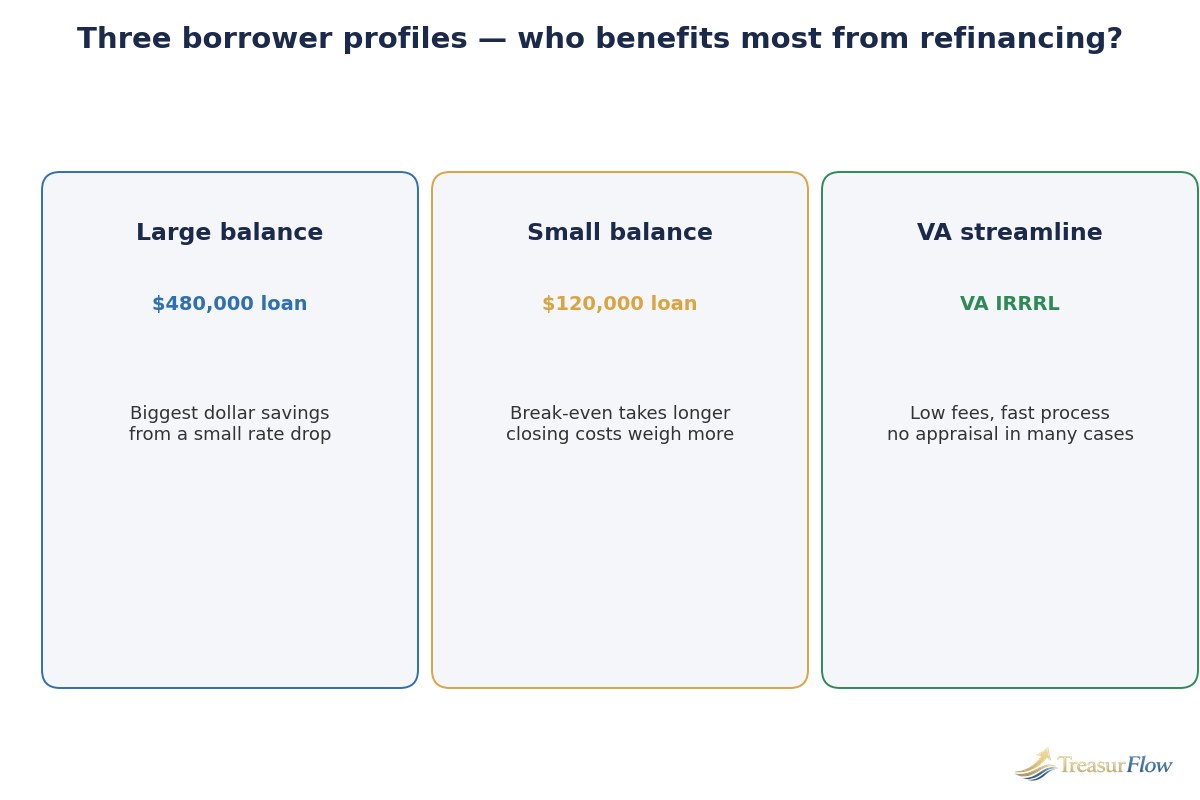
The same rate drop produces three different verdicts depending on who you are. Here are three profiles built from the situations lenders see every week. Each uses clearly stated assumptions; your numbers will differ, but the decision logic is the same.
Profile A: The Big-Balance Borrower — Refinance, but Watch the Term
Maya and Daniel owe $420,000 with 27 years left at 8.25%, after buying when rates were higher. Their credit is 760, their home has appreciated, and they plan to stay at least 10 years. At 7.40% with $8,400 in closing costs, they break even in about 25 months on a new 30-year loan — and far more profitably if they keep the 27-year term. For them, refinancing is a clear yes. Their best move is to collect Loan Estimates from a digital lender and a credit union, compare them on the same day, and ask both to quote the 27-year term. Their biggest risk is not the rate — it is sleepwalking into a term reset that quietly hands back most of the savings.
Profile B: The Small-Balance Borrower — The Rate Drop Has to Be Bigger
Illustrative example — assumptions: $185,000 balance, 24 years left, current rate 7.90%, closing costs $5,500 (about 3% of the balance, because small loans carry a higher percentage of fixed fees).
At 7.40%, this borrower’s payment falls from about $1,435 to about $1,281 — a $154 monthly saving — but the break-even stretches to roughly 36 months. That is not a bad refinance, but it is a fragile one: one move, one job change, one more refinance within three years, and the savings evaporate. If the same borrower can reach 6.90% — through a better credit score, a shorter term, or a lender credit structure — the saving rises to about $216 a month and break-even drops to roughly 25 months, which is a much safer bet.
The rule for small balances: do not refinance for a half-point drop unless your costs are unusually low. Either wait for a bigger drop, negotiate the lender’s fees down, or take a “no-closing-cost” structure (a slightly higher rate in exchange for lender credits) so there is almost nothing to recoup. A small loan can still win — but only when the cost side of the trade is treated as seriously as the rate side.
Profile C: The VA Borrower — The Streamline Changes Everything
Illustrative example — assumptions: veteran with an existing VA loan, $310,000 balance, 26 years left, current rate 7.75%, IRRRL at 7.00%, VA funding fee 0.5% ($1,550) plus $2,500 in other closing costs, total $4,050.
The VA’s Interest Rate Reduction Refinance Loan (IRRRL), often called the VA Streamline, exists for exactly this borrower. It generally requires no appraisal, no income documentation, and no credit underwriting in most cases. The funding fee is just 0.5% of the loan amount — far below the 2.15%–3.3% charged on VA purchase and cash-out loans — and it can be rolled into the loan. Here the payment falls from about $2,312 to about $2,062, a $250 monthly saving, and the break-even lands at roughly 16 months. The VA also requires the refinance to pass a recoupment test: closing costs must be recovered through savings within 36 months. At 16 months, this one passes comfortably.
Profile C’s lesson generalizes: if you already hold a government-backed loan (VA, FHA), check the streamline program before you shop a standard refinance. Streamlines cut the paperwork, the appraisal risk, and often the cost — and they exist precisely because you already proved you can make the payment.
What Refinancing Actually Costs in 2026
Closing costs are where refinances quietly go wrong, because most borrowers compare rates and ignore them. The Consumer Financial Protection Bureau (CFPB) puts typical refinance closing costs at 2%–5% of the loan amount, while Freddie Mac cites a 3%–6% range — and CFPB data showed average refinance closing costs reached $4,979 in 2022 after a sharp rise. The gap between those ranges is the point: costs vary enormously by state, lender, and loan type, which is why your Loan Estimate matters more than any national average.
Here is what you are actually paying for:
| Cost bucket | What it covers | Typical range | Can you reduce it? |
|---|---|---|---|
| Origination / underwriting | The lender’s fee for processing and underwriting the loan | 0%–1% of the loan, sometimes a flat fee | Yes — negotiate or compare lenders. |
| Appraisal | A professional estimate of your home’s current value | $300–$600 | Sometimes waived if you have strong equity and the lender’s model supports it. |
| Title search + title insurance | Verifies ownership and protects against claims | $500–$2,000+ | Shop the title company in many states. |
| Recording + government fees | Filing the new loan with local authorities | $100–$250+ (varies widely by state) | No — set by your jurisdiction. |
| Credit report | Pulling your credit | $30–$50 | No. |
| Discount points (optional) | Prepaid interest to buy the rate down | 1% of the loan per point | Your choice — see the tradeoff below. |
| Prepaid escrow items | Prepaid interest, taxes, and insurance collected at closing | Varies | These are not true costs — you would have paid them anyway, and your old escrow balance is refunded. |
Two traps hide in that table. First, “no-closing-cost” refinances are not free: the lender covers your costs in exchange for a higher rate, which means you pay them back slowly through a bigger payment. That can still be the right deal — especially if you may move soon — but compare it honestly against paying costs upfront. Second, escrow prepaids inflate the cash you bring to closing without being a real cost, because your old lender refunds your existing escrow balance. When you compute break-even, use the true closing costs (origination, appraisal, title, fees, points), not the total cash due at closing.
Your most powerful document is the Loan Estimate. Lenders must send it within three business days of your application, and it standardizes costs into sections: Section A (origination charges, set by the lender), Section B (services you cannot shop for), and Section C (services you can shop for, like title). The CFPB’s Loan Estimate explainer walks through each section. When comparing lenders, line up their Section A charges first — that is where lenders actually differ. A lender quoting a lower rate with $3,000 more in Section A fees is not cheaper; it is just hiding the price in a different place.
Rate vs. Closing Cost: The Trade You Are Really Making
Every refinance quote is a point on a tradeoff curve: pay more upfront, get a lower rate; pay less upfront, accept a higher rate. Lenders will happily show you only one point on that curve. You should ask for at least three: the zero-point rate, the one-point rate, and the lender-credit (no-closing-cost) rate. Here is why, with math.
Buying Points: A Five-Year Bet
Illustrative example — assumptions: $350,000 loan, 30-year term. Paying 1 point ($3,500) buys the rate down from 7.40% to 7.15% (a 0.25-point reduction — a common rule of thumb for one point).
The payment falls by about $59 a month. Divide $3,500 by $59 and the break-even on the point is roughly 59 months — about five years. If you stay past five years, the point pays for itself and then keeps paying. If you sell or refinance again in three years, the point was a $1,400 mistake. Points make sense for one kind of borrower: someone confident they will stay put for a long time, with cash available, buying the lowest possible lifetime cost. They are a bad deal for anyone who may move, anyone short on cash, and anyone refinancing into a falling-rate environment where they may refinance again soon.
Taking a Lender Credit: The Mirror Image
Illustrative example — assumptions: same $350,000 loan. Option 1: 7.40% with $4,000 in closing costs. Option 2: 7.65% with a $4,000 lender credit covering those costs (zero out of pocket).
Option 2 costs about $60 more per month. Over five years that is about $3,600 in extra payments — slightly less than the $4,000 credit you received. So if you move or refinance within roughly five and a half years, the lender credit wins. If you stay longer, the lower rate wins. This is the right structure for Profile B’s small-balance borrower, for anyone who may move within a few years, and for anyone who would rather keep cash in the bank than sink it into fees. It is the wrong structure for a borrower who will stay 15 years and never refinance again.
The Decision Rule
Ask yourself one question before you pick: “How long will I keep this loan?” If the honest answer is under three years, take the lender credit and the slightly higher rate. If it is three to seven years, compare the zero-point and lender-credit quotes side by side and pick the shorter break-even. If it is seven years or more, consider buying a point — but only after confirming the point’s own break-even fits inside your timeline. Notice what this rule does: it replaces “what is the lowest rate?” with “what is the lowest total cost for my timeline?” That is the entire game.
Best Mortgage Refinance 2026 Lender Lineup: Who Wins for Each Profile
No lender is best for everyone. The right question is who is best for your profile. The table below compares the major lender categories on the dimensions that actually decide a refinance: cost structure, speed, flexibility, and who they serve best. Treat it as a shortlist for gathering quotes — always confirm the details in a Loan Estimate, because pricing and programs change frequently.
| Lender | Best for | Why it can win | Watch out for |
|---|---|---|---|
| Rocket Mortgage | Large-balance borrowers who want a fast, fully digital process | One of the largest retail mortgage lenders in the US; polished online experience; can close quickly for straightforward files | Convenience can come with origination fees — compare Section A carefully. |
| Better | Tech-comfortable borrowers who want low lender fees | Markets a fully online process with no lender fees; fast pre-approval | Best for clean files; complex situations may fit a local lender better. |
| LoanDepot | Borrowers who want online speed plus human help | Large national lender with both digital and branch/loan-officer channels | Fee structures vary by channel — compare like-for-like quotes. |
| Chase / Bank of America / U.S. Bank | Existing customers of the bank | Relationship pricing and discounts for existing deposit/investment customers; one-stop servicing | Non-customers often get sharper pricing elsewhere. |
| Navy Federal / PenFed / local credit unions | Members, veterans, and fee-sensitive borrowers | Credit unions often charge lower origination fees and offer flexible underwriting for members | Membership required; digital tools may lag the big online lenders. |
| New American Funding / Freedom Mortgage | FHA and VA borrowers | Dedicated government-loan teams that handle streamline programs (FHA Streamline, VA IRRRL) every day | Conventional borrowers may find better pricing at generalist lenders. |
| Local mortgage brokers | Unusual files (self-employment, mixed income, condos) | A broker shops many wholesale lenders at once and can place files that big lenders reject | Broker compensation is baked into the quote — ask how the broker is paid and compare the full Loan Estimate. |
Per-Profile Picks
- Profile A (big balance, strong credit, long stay): Get three quotes — one digital lender (Rocket or Better), one credit union, and your current servicer. Ask each to quote the remaining term, not just 30 years. The winner is usually whoever pairs the lowest Section A fees with the rate, because on a large balance even an eighth of a point is real money.
- Profile B (small balance, short horizon): Prioritize low or zero closing costs. Credit unions and lender-credit quotes from digital lenders usually win here. A lender offering the lowest rate but $6,000 in fees is the wrong answer for this profile.
- Profile C (VA borrower): Start with a lender that runs IRRRLs in volume — a VA specialist — and ask specifically for the IRRRL with the 36-month recoupment test shown in writing. If you hold an FHA loan instead, the equivalent move is an FHA Streamline quote from an FHA-active lender. Only shop a standard conventional refinance if the streamline math fails or you want to drop mortgage insurance (see the next section).
One more point about your current lender: it will often call with a “streamline” offer when rates fall. Take the call — but do not accept the first quote. Your current lender knows you are a captive audience, and its rate is rarely the best one. Use its quote as a baseline, then beat it with two outside quotes. The CFPB’s consistent advice to shop multiple lenders exists because the savings are real: Bankrate’s research put the typical overpayment from not comparing at $3,343 a year.
When Refinancing Does NOT Pay
A refinance that lowers your payment can still be a bad deal. Say no — or at least wait — in these five situations:
- You will move or refinance again before break-even. If your break-even is 30 months and you plan to sell in two years, the refinance costs you money even though the payment drops. The lender-credit structure can rescue this case, but only if the credit truly covers the costs.
- Your current loan is almost paid off. With five years left on a 30-year loan, most of each payment is already principal. Restarting a 30-year term to save $100 a month can cost tens of thousands in extra interest. If you want a lower payment late in the loan, look at a shorter remaining term — or simply keep paying the old loan off.
- The savings come only from a term reset. If the rate barely moves and the “savings” appear only because the term stretched back to 30 years, you have not saved anything — you have re-borrowed time. Compare total interest, not just the payment.
- Your credit or income has deteriorated. A refinance re-underwrites you. If your score fell or your income dropped since the original loan, you may be quoted a worse rate than you hold now, or be denied outright. In that case, improving your profile first beats refinancing now.
- You are rolling high-interest debt into the mortgage to “save” money. A cash-out refinance that pays off credit cards can lower your monthly outgo — but it converts short-term unsecured debt into 30 years of secured debt against your home, and it restarts the interest clock. It can be the right move when the alternative is default, but it should never be the default move. Price it with total interest, not just the new payment, and have a plan that keeps the cards paid off.
Lock or Float: A Decision Rule, Not a Prediction
Nobody can reliably predict where rates go next — not the experts quoted in the press, and not your loan officer. So do not try to time the market. Use a decision rule instead.
A rate lock is the lender’s promise to hold a quoted rate for a set period, typically 30, 45, or 60 days. If rates rise during that window, you are protected. If they fall, you generally keep the locked rate unless you paid for a float-down option (which lets you take a lower rate once, for a fee). Locks cost money indirectly: longer locks usually carry slightly worse pricing, and if your loan does not close before the lock expires, you may pay an extension fee or be re-priced at the market.
The rule that works:
- If you have a signed purchase-style deadline or a refinance that must close by a date (an ARM reset coming, a divorce settlement, a balloon payment), lock as soon as the quote meets your break-even test. Certainty is worth more than a possible eighth of a point.
- If your file is straightforward and you can close in 30 days, lock when the numbers work and stop watching rates. Checking daily after you lock only buys anxiety.
- If your file is complex (self-employment, appraisal questions, condo review), get a 45- or 60-day lock, or wait to lock until conditions clear. An expired lock on a complicated file is the most common way borrowers pay twice.
- If rates have just spiked and your break-even fails today, do not force it. Set a target rate, gather your documents, and wait. The refinance will still be there when the math works.
One more lock detail that matters: ask whether the quote is a true lock or an estimate. A lock confirmation should state the rate, the lock period, the expiration date, and any float-down terms in writing. If it is not in writing, it is not locked.
Conforming, Jumbo, FHA, VA: Know Your Lane
Your loan’s “lane” decides which programs you can use and how your rate is priced. Getting the lane wrong wastes weeks.
Conforming loans. In most of the country, the 2026 conforming loan limit for a one-unit property is $832,750, up $26,250 from 2025, per the Federal Housing Finance Agency (FHFA). Loans at or below that limit can be sold to Fannie Mae and Freddie Mac, which usually means standardized underwriting and deeper investor demand. In high-cost areas the ceiling reaches $1,249,125. If your balance sits just above the conforming limit, ask your lender to price both a conforming loan (possibly with a small principal paydown to get under the limit) and a jumbo loan — the conforming side is often cheaper.
Jumbo loans. Above the conforming limit, you are in jumbo territory: stricter underwriting, more documentation, larger reserve requirements, and rates that can run above conforming. Jumbo borrowers should expect a full financial workup and should shop lenders that specialize in jumbo — not every lender prices it well.
FHA Streamline. If you already hold an FHA loan, the FHA Streamline refinance is usually the simplest path: no appraisal, no income verification on the non-credit-qualifying version, and a faster close. You must have made at least six payments and waited 210 days since closing, and the new loan must show a net tangible benefit — a combined rate-and-MIP drop of at least 0.5%. The new loan carries FHA mortgage insurance premiums (1.75% upfront, about 0.55% annually), and no cash back is allowed. If your goal is to eliminate mortgage insurance entirely, you will need a conventional refinance once you have at least 20% equity — the Streamline keeps you in FHA insurance.
VA IRRRL. If you already hold a VA loan, the IRRRL is the cheapest refinance in the business: 0.5% funding fee (waived for veterans receiving VA disability compensation), generally no appraisal, no income documentation, and no credit underwriting in most cases. Requirements: at least six monthly payments made and 210 days since the first payment date, a net tangible benefit, and — critically — a 36-month recoupment test: closing costs must be recovered through savings within 36 months. Fixed-to-fixed refinances need a rate reduction of at least 0.50 percentage points. No cash back is permitted. If you want cash out, that is a separate VA cash-out refinance with full underwriting and a higher funding fee.
Cash-out refinancing. Available on conventional, FHA, and VA loans, cash-out lets you borrow more than you owe and take the difference in cash — for renovations, debt payoff, or other uses. It requires a full appraisal and underwriting, and on conventional loans it is generally capped at 80% loan-to-value. Treat it as a separate decision from a rate-and-term refinance: the question is not just “does the payment drop?” but “is borrowing against my home the cheapest way to fund this purpose?”
How to Shop for the Best Mortgage Refinance 2026 Without Hurting Your Credit
Shopping is the highest-return hour in the entire refinance process, and fear of credit damage is the main reason people skip it. Here is how to do it safely:
- Get three Loan Estimates on the same day. Rates move daily, so quotes from different days are not comparable. Aim for: one digital lender, one credit union or local lender, and your current servicer. Same day, same loan type, same term, same lock period.
- Compare Section A first, then APR. The interest rate tells you the payment; the APR folds in fees and tells you the true yearly cost. A quote with a lower rate but a much higher APR is hiding its price in fees. Section A (origination charges) is where lenders differ most — that is your negotiation target.
- Use the shopping window. Credit scoring models generally treat multiple mortgage inquiries made within a short shopping window (often cited as 14–45 days, depending on the scoring model) as a single inquiry, precisely so borrowers can shop. You may see a small, temporary score dip from the hard inquiries, but comparison shopping itself is not punished. Do not spread your applications across three months — cluster them in one or two weeks.
- Negotiate with the Loan Estimate in hand. A competing Loan Estimate is leverage. Send the best one to your preferred lender and ask it to match or beat Section A. Lenders expect this. Many will waive an origination fee or sharpen the rate rather than lose the file.
- Never sign on the first call. A legitimate lender will put everything in a Loan Estimate and give you time. Pressure to “lock today or lose it” is a sales tactic, not a market fact. If a quote is real today, a comparable quote will exist tomorrow.
Questions Homeowners Ask Before Refinancing
How much does it cost to refinance a mortgage in 2026?
The CFPB puts typical refinance closing costs at 2%–5% of the loan amount, and Freddie Mac cites a 3%–6% range; CFPB data showed average refinance closing costs reached $4,979 in 2022. On a $350,000 loan, expect roughly $7,000–$17,500 depending on your state, lender, and whether you buy points. Your Loan Estimate gives you the exact figure — compare Section A across lenders before you decide.
How much should my rate drop before refinancing makes sense?
There is no universal number. The right test is your break-even month: total closing costs divided by monthly savings. A half-point drop can pay on a large balance with low costs, while a full-point drop can fail on a small balance with high costs. As a rough guide, a 0.75–1 point drop with normal costs and a stay of five-plus years usually works; anything smaller needs the break-even math to prove it.
Does refinancing restart my loan term?
A new loan starts a new term — usually 30 years — unless you ask for your remaining term. Restarting the term lowers the payment but can erase much of the interest savings. Ask your lender to quote both the 30-year and the remaining-term versions, and compare total interest, not just the payment.
Can I refinance with bad credit?
It depends on your loan type. Conventional refinances generally need a score around 620 or higher, and the best pricing goes to scores of 740+. FHA Streamline’s non-credit-qualifying path does not use your score for approval, and VA IRRRL generally skips credit underwriting. If your score has fallen, a streamline may be your best path — or waiting while you rebuild may beat refinancing now.
How long does a mortgage refinance take?
Most standard refinances take 30–45 days from application to closing. Streamlined VA and FHA cases can close faster, often in 15–30 days, because they skip the appraisal and much of the underwriting. Complex files — cash-out, self-employment, title issues — can run longer. A 45- or 60-day lock is safer for anything complicated.
Is it better to refinance with my current lender or a new one?
Get both quotes. Your current lender may offer a streamlined process, but its rate is rarely the best one — it knows you are a captive audience. Use its quote as a baseline and beat it with two outside quotes. The winner is the lowest total cost for your timeline, whoever offers it.
Your Next Move
Do not start by picking a lender. Start by pulling three numbers: your current rate, your remaining balance, and how long you plan to stay. Run the break-even test — closing costs divided by monthly savings — and ask for quotes at your remaining term. Then collect three same-day Loan Estimates, compare Section A and APR, and pick the lowest total cost for your timeline, not the lowest advertised rate. If you hold a VA or FHA loan, check the streamline program first; it may beat every conventional quote on cost and hassle. And if the break-even does not fit inside your stay, wait. The best refinance is sometimes the one you do not do yet.
Rates and program rules change frequently. Market figures in this guide are dated to mid-October 2026 (Freddie Mac weekly survey: 30-year fixed 7.40%, week ending October 15, 2026; Bankrate national average 30-year refinance 7.63%, APR 7.70%, October 15, 2026). Re-check current rates and confirm program rules with your lender before you lock. This article is educational and is not personalized financial advice.

Muhammad Zakir is the founder of Treasurflow and the author of its personal finance guides. He researches consumer banking, credit, and personal loans, and every guide cites primary sources such as the CFPB, FDIC, FTC, and IRS. His content is educational and is not personalized financial advice.