
Taking out an auto loan is one of the most effective ways to build a robust credit profile, but it rarely produces an immediate score increase. If you just signed loan paperwork and checked your credit score on an app, you might be surprised to see your points drop instead of climb.
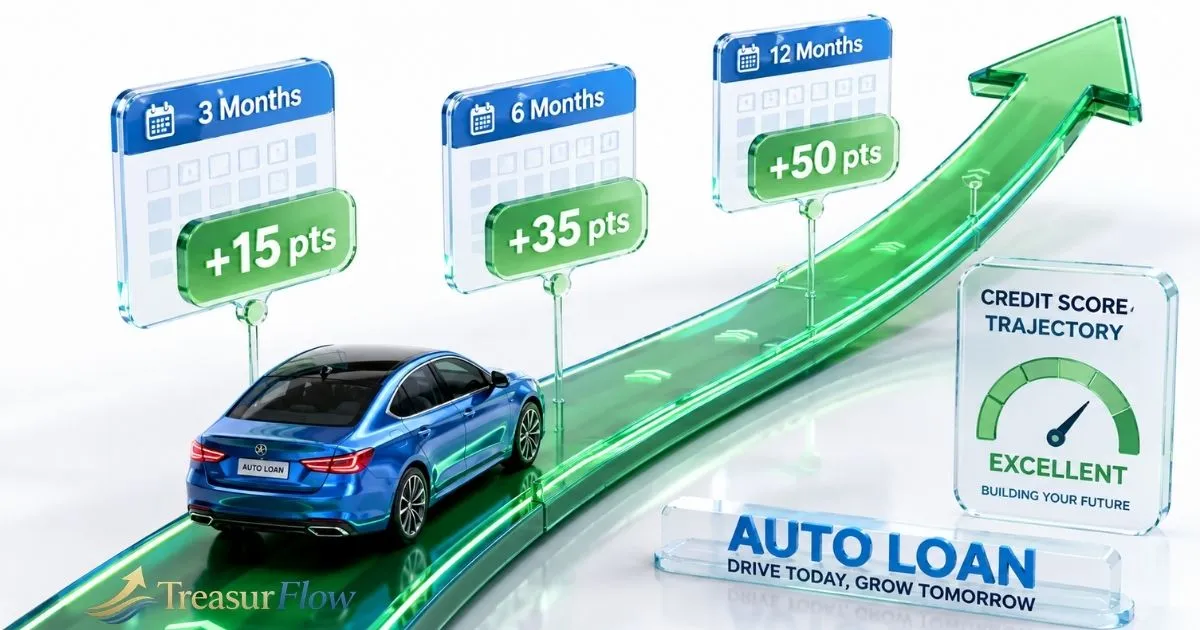
A car loan typically starts raising your credit score within 3 to 6 months of consecutive, on-time monthly payments. While your credit score initially dips by 5 to 15 points immediately after financing due to hard inquiries and a lower average account age, consistent monthly reporting to Experian, TransUnion, and Equifax offsets this temporary dip. Over a 12 to 24-month period, an auto loan can increase your overall credit score by 20 to 50+ points through payment history building and credit mix diversification.
Self credit card+ 1
Understanding the exact timeline of how consumer credit scoring algorithms process new installment debt allows you to navigate the process without panic.
The Complete Auto Loan Credit Timeline: What to Expect
Credit score movement following a vehicle purchase follows a distinct three-phase trajectory.
[Day 1: Credit Inquiry and Loan Processing]Balance reduced substantially
│
▼
Initial Dip: -5 to -15 Points
│
┌────────────────────────┴────────────────────────┐
▼ ▼
Months 1–3: Stabilization Months 6–12: Steady Growth
• 0 to +10 Points Recovery • +15 to +35 Points Boost
• On-time payments building • Credit mix fully recognized
│ │
└────────────────────────┬────────────────────────┘
▼
Months 12–24: Peak Acceleration
• +30 to +50+ Total Net Gain
•
Phase 1: The Initial Drop (Days 1 to 30)
When you finance a vehicle, your score almost always drops briefly and temporarily. This occurs due to three structural factors in credit scoring models:
Best Egg
- Hard Inquiries (-3 to -5 points each): Lenders perform a hard credit pull to review your file. Under standard FICO scoring models, all auto loan inquiries made within a 14- to 45-day rate-shopping window are de-duplicated and counted as a single inquiry to protect consumers. Best Egg+ 1
- Lower Average Age of Accounts (AAoA): Opening a brand-new trade line reduces the overall average age of your credit profile, which temporarily drags down your length of credit history score.
- High Initial Debt Ratio: When the auto loan first appears on your credit report, you owe 100% of the original principal. Scoring algorithms evaluate the ratio of your current balance against the original loan amount.
Phase 2: Credit Stabilization and Recovery (Months 1 to 6)
As you log your first 3 to 6 monthly payments, the positive attributes of the loan begin to outweigh the initial setup costs:
- Payment History Building (35% of FICO): Each month your lender reports a “Paid as Agreed” status to the credit bureaus, adding positive weight to your credit history. Self credit card
- As you log your first 3 to 6 monthly payments, the positive attributes of the loan begin to outweigh the initial setup costs. To maximize your monthly savings while building credit, learn how to lower your car interest rate through refinancing options down the road.
- Credit Mix Diversification (10% of FICO): If your credit profile previously consisted only of revolving credit cards, adding a structured installment loan improves your credit mix. This structural change frequently produces a visible point jump around months 3 to 4.
- Free consumer apps like Credit Karma utilize VantageScore models, whereas 90% of lenders look at standard FICO metrics. Understanding how scoring models differ—including specialty options like the choice credit score—helps you track real lender perception.
Phase 3: Peak Credit Growth (Months 6 to 24+)
By the end of your first year of vehicle ownership, compounding positive payment history combines with balance reduction:
- Principal Reduction Milestones: As your monthly amortized payments drop your remaining loan balance below 80%, 50%, and 30% of the original loan amount, credit scoring algorithms reward the declining debt ratio.
- Net Score Improvement: Borrowers who maintain clean payment records and keep revolving credit card utilization low typically realize a total net gain of 20 to 50+ points compared to their baseline score prior to buying the vehicle.
FICO Score 8 vs. Credit Karma (VantageScore): Why Scores Differ
A frequent source of confusion for car buyers is seeing vastly different credit score movements depending on where they check their scores. Free consumer apps like Credit Karma utilize the VantageScore 3.0 or 4.0 model, whereas 90% of top auto lenders use specific versions of the FICO Score (such as FICO Score 8 or FICO Auto Score 8/9).
┌────────────────────────────────────────────────────────────────────────┐
│                     SCORING MODEL BEHAVIOR COMPARISON                  │
├──────────────────────────────┬──────────────────┬──────────────────────┤
│ Metric / Feature             │ FICO Score 8     │ VantageScore 3.0/4.0 │
├──────────────────────────────┼──────────────────┼──────────────────────┤
│ Installment Debt Sensitivity │ Moderate         │ Very High            │
│ Initial Score Drop Drop Range│ -5 to -15 pts    │ -20 to -40+ pts      │
│ Rate-Shopping Deduplication  │ 14 to 45 Days    │ Strict 14 Days       │
│ Recovery Speed               │ Faster (Mo. 3-6) │ Lags until ~20% paid │
└──────────────────────────────┴──────────────────┴──────────────────────┘
Installment Debt Weighting
VantageScore models heavily penalize new installment debt balances upon account opening. When a $30,000 auto loan hits your profile with $30,000 still owed, VantageScore views this as maximum debt exposure, causing a temporary drop of 20 to 40+ points. FICO Score 8 differentiates installment debt from revolving credit card debt, recognizing that a car is a secured asset, resulting in a much smaller initial drop of 5 to 15 points.
Rate-Shopping Windows
If you take 30 days to shop around at various dealerships and credit unions for the best auto loan interest rates, FICO groups all hard pulls within that period into a single inquiry. VantageScore utilizes a strict 14-day deduplication window. Inquiries made on day 15 or later may be counted as additional separate inquiries on VantageScore platforms, causing extra temporary drops.
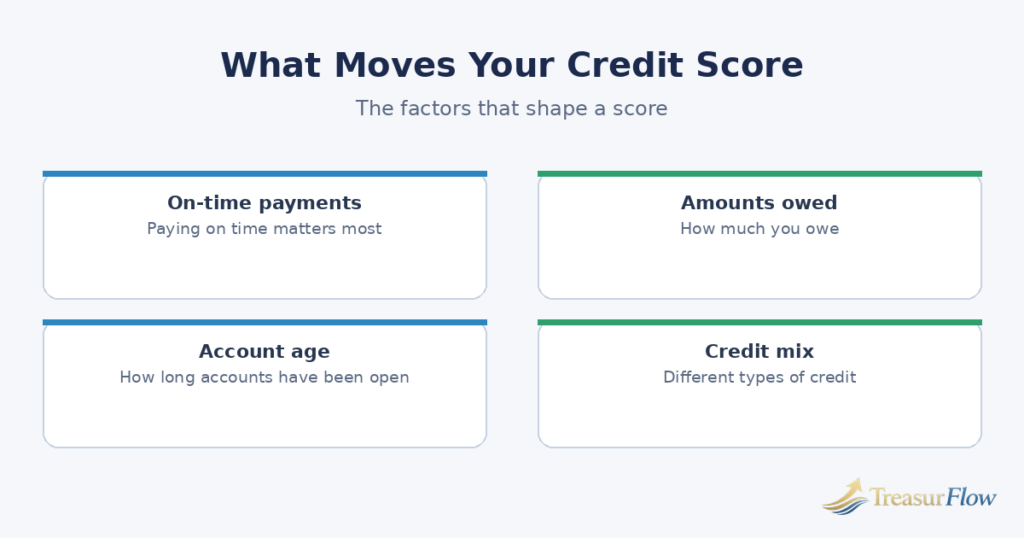
How an Auto Loan Affects the 5 FICO Scoring Factors
To understand why an auto loan impacts your score over time, it helps to break down how installment debt interacts with the five core components of the FICO scoring system.
┌─────────────────────────────────────────────────────────────────┐
│                    FICO SCORE IMPACT WEIGHTS                    │
├───────────────────────────────┬─────────┬───────────────────────┤
│ Payment History               │   35%   │   Largest Gain        │
│ Amounts Owed (Debt Ratio)     │   30%   │   Gradual Increase    │
│ Length of Credit History      │   15%   │   Initial Small Dip   │
│ Credit Mix                    │   10%   │   Immediate Gain      │
│ New Credit (Inquiries)        │   10%   │   Initial Small Dip   │
└───────────────────────────────┴─────────┴───────────────────────┘
1. Payment History (35% Weight) — High Long-Term Positive Impact
Your payment history is generally the most influential factor in determining your credit score. Over a standard 48- to 72-month auto loan term, completing every payment on time adds 48 to 72 positive payment marks to your credit report. Conversely, a single payment reported as 30+ days late can cause an immediate drop of 60 to 100 points and remain on your credit file for 7 years.
Experian
2. Amounts Owed / Debt Utilization (30% Weight) — Gradual Positive Impact
While revolving credit card utilization (balance divided by credit limit) carries primary weight in this category, installment debt balance ratios also play a role. As your monthly amortized payments steadily shrink the remaining principal balance, your overall debt ratio improves, lifting your total score.
Experian
3. Length of Credit History (15% Weight) — Initial Small Negative Impact
This metric considers the average age of all your accounts (AAoA) and the age of your newest account. Adding a new auto loan brings down the average age of your entire credit portfolio. However, as the auto loan ages past its first and second years, it shifts from a minor liability to a stabilizing asset for account longevity.
Self credit card
4. Credit Mix (10% Weight) — Immediate Moderate Positive Impact
Lenders favor consumers who demonstrate the ability to manage diverse types of credit. Credit is broadly split into two categories:
Experian
- Revolving Credit: Credit cards, personal lines of credit, HE-LOCs.
- Installment Credit: Auto loans, mortgages, student loans, personal loans. Self credit card
If your file previously lacked an active installment loan, adding a car loan fills a gap in your credit mix, generating an automatic point increase once the trade line is established.
Best Egg
5. New Credit & Inquiries (10% Weight) — Initial Small Negative Impact
Applying for financing requires lenders to pull your full credit file via a hard inquiry. Each hard pull typically deducts fewer than 5 points from your score. Hard inquiries remain visible on your credit report for 24 months, but they only impact your FICO score calculation for the first 12 months.
Best Egg+ 1
Real-World Case Studies: How Auto Loans Impact Different Profiles
The exact point change you experience after taking out a car loan depends on your starting credit profile.
Case Study A: The Credit Builder (Starting Score: 580)
- Background: Alex has a sparse credit file with only one credit card ($500 limit, 2 years old) and a history of minor late payments 3 years ago.
- Loan Terms: Takes out a $12,000 used car loan at 12% APR for 48 months.
- Initial Impact (Month 1): Alex’s score drops by 8 points to 572 due to the hard inquiry and new account creation.
- Recovery & Growth (Months 6–12): Because Alex had no prior installment debt, adding the car loan significantly boosts the credit mix score. By Month 6 of perfect payments, the score jumps to 615 (+35 net points). By Month 12, as the loan balance declines, Alex’s score reaches 645—a net gain of 65 points. Experian
Case Study B: The Prime Borrower (Starting Score: 760)
- Background: Sarah has an established credit history spanning 10 years, including three credit cards with low balances and a paid-off student loan.
- Loan Terms: Takes out a $35,000 new car loan at 5.5% APR for 60 months.
- Initial Impact (Month 1): Sarah’s score drops by 12 points to 748. Because her average age of accounts was long, adding one new trade line moderately reduces her AAoA.
- Recovery & Growth (Months 6–12): Since Sarah already has a mature credit mix and high existing scores, the additional points gained from on-time auto payments are incremental. By Month 6, her score recovers to 758. By Month 12, her score sits at 772—a modest net gain of 12 points.
4 Proactive Strategies to Maximize Your Credit Score Gain
To ensure your auto loan builds credit as quickly as possible, implement these four tactical management steps:
1. Automate Payments to Guarantee 100% On-Time Reporting
Because payment history accounts for 35% of your score, a single missed or 30-day late payment will eliminate all the point gains from your loan. Set up automatic recurring bank drafts for your monthly loan due date. Set the auto-pay date 3 to 5 days before the official due date to account for potential weekend or holiday processing delays.
Experian
2. Pay an Extra $50 to $100 Toward Principal Monthly
Standard loan payments follow an amortization schedule where early payments go primarily toward interest. By adding an extra principal-only payment each month, you accelerate the rate at which your remaining principal balance drops relative to the original loan balance. Lowering this ratio faster triggers positive movement in the “Amounts Owed” scoring category. If your rate is high, refinancing may help more than extra payments — compare the best auto loan refinance 2026.
Standard Amortization vs. Accelerated Principal Reduction:

Standard Payment ($400/mo):
Month 12 Balance: $26,400 / $30,000 (88% Balance-to-Loan Ratio)

Extra $100/mo Principal Payment ($500/mo):
Month 12 Balance: $25,200 / $30,000 (84% Balance-to-Loan Ratio)
Result: Faster score recovery due to quicker balance reduction.
3. Maintain Low Revolving Credit Card Balances
A common mistake borrowers make is accumulating credit card debt while managing a new auto loan. While an auto loan balance is installment debt, high credit card balances represent revolving debt—which drastically inflates your overall credit utilization ratio. Keep total credit card balances below 10% of your available limits to allow your auto loan’s positive payment history to shine through.
Experian
4. Monitor Your FICO Score 8 Profile Directly
Avoid reacting to daily fluctuations on VantageScore apps. Utilize services offered directly by major card issuers or bureau platforms that supply actual FICO Score 8 data. Track your score quarterly rather than daily to evaluate real long-term trends.
Borrowers navigating lower scores or limited credit histories often face higher overall vehicle ownership costs. If you have a limited file, review how long it does take to build credit from scratch, or explore alternative vehicle purchase structures such as auto in house financing and cheap car insurance for bad credit.
Frequently Asked Questions
Why Did My Credit Score Drop by 100 Points After Financing a Car?
A 100-point drop is rare from an auto loan alone. It typically indicates compounding negative factors: multiple hard inquiries falling outside the rate-shopping window, an auto lender reporting a high balance before a trade-in payoff cleared, or high credit card utilization during the same billing cycle. Additionally, free monitoring apps using VantageScore models penalize new installment balances much more severely than standard FICO models.
Would paying off my car early help or hurt my credit score?
Paying off an auto loan early can cause a temporary score drop of 10 to 30 points. When the loan is paid off, the status changes from active to closed. This closes an active trade line with a low balance ratio and can temporarily reduce your active credit mix if you have no other open installment loans. However, the closed account remains on your credit report for 10 years, continuing to contribute positively to your payment history.
The “Trade-In Lag” Temporary Score Dip (15 to 30-Day Delay)
If you traded in your previous vehicle when purchasing a new one, you may experience an artificial, temporary credit score drop during the first month. This happens because of a timing delay known as the trade-in loan clearance lag.
When a dealership accepts your trade-in, they agree to pay off your existing loan balance with your previous lender. However, processing that payoff, transferring funds, and updating bureau records usually takes 15 to 30 days. During this window:
- Dual Loan Reporting: Your credit report temporarily displays two active auto loans simultaneously—your old loan balance and your new loan balance.
- Artificial Debt Spikes: Credit scoring algorithms calculate your total installment debt as if you are responsible for paying both balances, briefly inflating your overall debt balance.
Once your previous lender receives the dealer’s payoff check and reports a $0 balance (“Paid in Full”) to Experian, TransUnion, and Equifax, your credit score will automatically recalculate and recover from this temporary dip.
Can you get a $30,000 car loan with a 600 credit score?
Yes, securing a $30,000 car loan with a 600 credit score is possible through subprime auto lenders, credit unions, or specialized finance companies. However, interest rates will be higher—typically between 11% and 18%—and lenders usually require a down payment of 10% to 20% along with proof of steady employment and income.
What Happens If You Pay an Extra $200 Each Month Toward Your Car Loan?
Paying an extra $200 per month directly toward your principal balance reduces total interest charges, shortens your overall loan term, and accelerates balance reduction. Lowering your remaining balance faster improves your debt-to-original-loan ratio, helping your credit score recover and grow more quickly.
What Happens When You Pay Off the Car Loan (Account Closure Impact)
While paying off your auto loan early or reaching the end of your loan term is a major financial milestone, many borrowers are surprised to see their credit score drop by 10 to 30 points immediately after making their final payment.
Understanding why your credit score drops after paying off a car loan helps prevent unnecessary concern:
- Loss of an Active Open Account: Credit scoring models favor active, open accounts that regularly log “Paid as Agreed” updates. Closing an active loan means you have one fewer open trade line contributing to your real-time payment history.
- Shift in Active Credit Mix: If your auto loan was your only active installment account (and you only have revolving credit cards left), your active credit mix score decreases slightly.
- Loan-to-Value Ratio Loss: An active loan with a low remaining balance (e.g., owing $500 on a $25,000 original loan) provides a very favorable balance-to-original-loan ratio. Once closed, that low-balance installment account is no longer factored into your active debt ratios.
The Long-Term Outlook: This post-payoff drop is temporary. The closed auto loan stays on your credit report for 10 years as a positive closed account, continuing to support your age of credit and overall payment history.
How Long Does It Take to Raise a Credit Score From 500 to 700?
Rebuilding a credit score from 500 to 700 generally takes 12 to 24 months of consistent, disciplined financial habits. Requirements include 100% on-time payments, keeping revolving credit card balances below 10%, resolving delinquent balances, and maintaining a well-managed installment account like an auto loan.
External Resources & Official Financial Authorities
To verify your credit reporting rights, track your official FICO metrics, or research consumer lending protections, consult these official federal and financial resources:
- Official Bureau Credit Tracking: Request your free annual credit reports directly from the three major consumer reporting agencies (Experian, TransUnion, and Equifax) via AnnualCreditReport.com.
- Consumer Auto Lending Protections: Review official federal guides on car financing, rate-shopping rules, and contract rights at the Consumer Financial Protection Bureau (CFPB).
- FICO Credit Scoring Mechanics: Understand the exact calculation breakdown for payment history and credit mix categories on the official MyFICO Credit Education Portal.
- Federal Trade Commission (FTC) Credit Rights: Learn about your rights when shopping for vehicle financing and disputing credit report inaccuracies at the FTC Consumer Information Hub.

Muhammad Zakir is the founder of Treasurflow and the author of its personal finance guides. He researches consumer banking, credit, and personal loans, and every guide cites primary sources such as the CFPB, FDIC, FTC, and IRS. His content is educational and is not personalized financial advice.
1 thought on “How Fast Will a Car Loan Raise My Credit Score? (Full Recovery & Growth Timeline)”