
Picking the best online broker 2026 has to offer is not about finding one perfect platform. It is about finding the right one for you — your budget, your experience, and what you actually plan to buy. A beginner with $100 needs something completely different from an active trader who places twenty trades a week, and both of them need something different from a retirement saver who just wants a Roth IRA that runs quietly in the background.
Here is the short answer: Fidelity is the best online broker for most people in 2026. It charges $0 commissions, has no account minimum, lets you buy fractional shares from $1, and offers the deepest research library of any US broker. If you want the simplest possible start, Robinhood is easier. If you trade actively, Interactive Brokers or Schwab’s thinkorswim will serve you better. The table and guide below will help you match yourself to the right pick in about five minutes.
Related Guides: Best Robo Advisors 2026: 5 Picks Ranked by Fees for Beginners — if you’d rather have your investments managed for you instead of picking them yourself, start there. Best High-Yield Savings Accounts 2026 — a good parking spot for cash you are not ready to invest yet.
Helpful Official Resources: SEC — Investor.gov: How to Open a Brokerage Account · FINRA BrokerCheck — Verify Any Broker · SIPC — What SIPC Protects
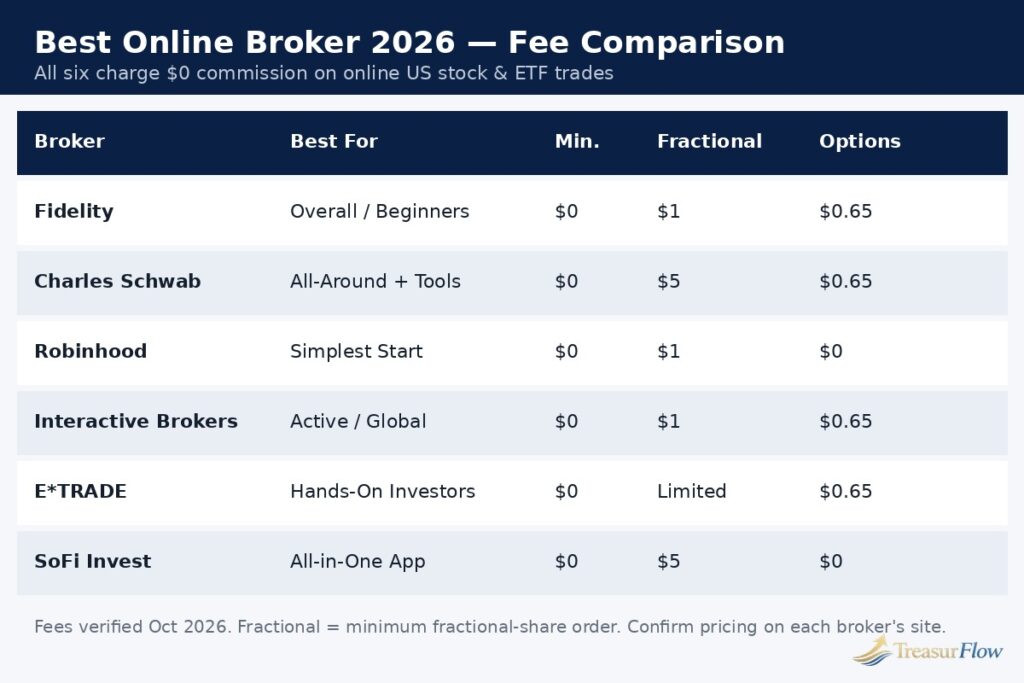
Quick Comparison: Best Online Brokers 2026
| Broker | Best For | Stock/ETF Commission | Account Minimum | Fractional Shares From | Options Per Contract |
|---|---|---|---|---|---|
| Fidelity | Best overall / beginners / retirement | $0 | $0 | $1 | $0.65 |
| Charles Schwab | Best all-around + advanced tools | $0 | $0 | $5 (S&P 500 only) | $0.65 |
| Robinhood | Easiest start / simplest app | $0 | $0 | $1 | $0 |
| Interactive Brokers | Active + global traders | $0 (IBKR Lite) | $0 | $1 | $0.65 |
| E*TRADE | Hands-on investors / Power E*TRADE | $0 | $0 | Limited (DRIP/robo only) | $0.65 |
| SoFi Invest | All-in-one money app | $0 | $0 | $5 | $0 |
Every broker in this table offers $0 commission on online US stock and ETF trades. That is the industry standard in 2026, not a special feature — so the real differences are in research, account types, fractional shares, and how the platform feels to use.
The 6 Best Online Brokers of 2026
1. Fidelity — Best Overall, Best for Beginners, Best for Retirement
Fidelity is the broker we recommend first to most people, and it is easy to see why. You can open an account with $0, trade stocks and ETFs with $0 commission, and buy fractional shares from just $1. That means a $50 deposit is enough to own small pieces of several companies or ETFs on day one.
What sets Fidelity apart is depth. It offers research from more than 20 independent providers, planning tools and retirement calculators, and four index funds with a 0% expense ratio — the famous Fidelity ZERO funds. Its fractional-share program covers NYSE and Nasdaq stocks and ETFs, and you can place both market and limit orders on fractions. Customer service is available around the clock, which matters when you are new and have a question at 9 p.m.
Fidelity also scales with you. A beginner can start with a dollar and a ZERO fund. A more experienced investor gets Trader+, screeners, and one of the deepest research libraries in retail brokerage. Investopedia named Fidelity its Best Overall online broker for a fifth consecutive year in 2026.
Fees: $0 stock/ETF commission; $0.65 per options contract; $0 account minimum; $0 to open.
Best for: Beginners, retirement savers, long-term investors, anyone who wants one broker for everything.
Skip if: You want the absolute simplest app and nothing else — Robinhood is lighter.
2. Charles Schwab — Best All-Around Broker With Pro-Level Tools
Schwab is the closest thing to a tie with Fidelity, and for many investors it is the better choice. It charges $0 for stock and ETF trades, has no account minimum, and pairs a clean, beginner-friendly platform with thinkorswim — one of the most respected trading platforms in the industry, free with any Schwab account.
Schwab’s research is a genuine standout. Its stock quote pages stack ratings from eight providers, including Schwab Equity Ratings, Morningstar, CFRA, and Argus. It also offers one of the widest investment menus: stocks, ETFs, more than 4,000 no-transaction-fee mutual funds, options, futures, bonds, CDs, and forex. StockBrokers.com named Schwab its #1 Overall Broker for 2026 for the second year in a row, also ranking it first for mobile trading apps, advanced trading, ease of use, customer service, and high-net-worth investors.
The two things to know: fractional shares work through Schwab Stock Slices, which starts at $5 and covers S&P 500 companies only — you cannot buy fractional shares of ETFs or non-S&P 500 stocks. And Schwab’s Intelligent Portfolios robo-advisor, which charges a $0 advisory fee, requires a $5,000 minimum.
Fees: $0 stock/ETF commission; $0.65 per options contract; $0 account minimum; $49.95 for non-OneSource mutual funds; $6.95 for US OTC stocks.
Best for: Investors who want great research and a platform they can grow into; active traders who want thinkorswim.
Skip if: You mainly want fractional shares of ETFs — Fidelity is more flexible there.
3. Robinhood — Easiest Start and Simplest App
Robinhood is the easiest broker on this list to start with. Account setup takes minutes, the app is clean and intuitive, and you can buy fractional shares from $1. It charges $0 commission on stocks, ETFs, and options — and unlike most brokers, it charges no per-contract fee on options either.
Robinhood’s standout feature is its IRA match: a 1% match on IRA contributions on the free tier, rising to 3% with Robinhood Gold ($5 per month or $50 per year). Matched funds must stay in the account for five years to vest, and you must stay subscribed to Gold for one year after your first Gold match. For someone maxing out an IRA, that match is real money.
The trade-offs are real too. Robinhood offers no mutual funds and no individual bonds. Its research is thinner than Fidelity’s or Schwab’s, and it has a history of outages during high-volatility market events. It is also a trading-first app: the ease that makes it great for beginners can tempt some people into trading far more often than they should.
Fees: $0 stock/ETF/options commission (no per-contract fee); $0 account minimum; Gold $5/month; $100 ACAT transfer-out fee.
Best for: First-time investors who want the simplest possible start; people who want the IRA match.
Skip if: You want mutual funds, bonds, or deep research — pick Fidelity or Schwab instead.
4. Interactive Brokers — Best for Active and Global Traders
Interactive Brokers (IBKR) is the professional’s broker, and its IBKR Lite plan makes it accessible to everyone. Lite offers unlimited commission-free trading on US-listed stocks and ETFs, with no account minimums and no inactivity fees. You also get fractional shares, a huge range of investments — stocks, ETFs, mutual funds, bonds, options, futures, crypto, and currencies — and access to global markets.
The catch is complexity. IBKR’s platforms (Trader Workstation, IBKR Desktop, Client Portal) assume you know what you are doing. Beginners often find the interface overwhelming, and the pricing structure — Lite vs Pro, fixed vs tiered — takes time to understand. IBKR Pro charges commissions (fixed $0.005 per share or tiered pricing) but offers better execution through SmartRouting, lower margin rates, and higher interest on idle cash.
Choose IBKR if you trade actively, trade internationally, or want the widest market access available to a retail investor. If you are a beginner buying your first index fund, Fidelity or Schwab will feel far more welcoming.
Fees: IBKR Lite $0 stock/ETF commission; IBKR Pro fixed $0.005/share or tiered; options $0.65/contract (Lite); $0 account minimum; $0 inactivity fee.
Best for: Active traders, global investors, people who want every market and asset class.
Skip if: You are a true beginner — start with Fidelity or Schwab and graduate to IBKR later if you need it.
5. E*TRADE from Morgan Stanley — Best for Hands-On Investors
E*TRADE is built for people who like to research before they buy. It charges $0 for stock and ETF trades with no minimum to get started, and its Power E*TRADE platform offers customizable charts, dozens of metrics, and risk/reward overlays for options. Research includes Morningstar, Argus, and others, plus educational articles and webinars.
E*TRADE also offers one of the broadest investment menus: stocks, ETFs, mutual funds (including no-load, no-transaction-fee funds and zero-expense-ratio index funds), options, futures, bonds, and Treasuries. The trade-off is fractional shares: they are limited to DRIP plans and robo-created portfolios, so you cannot freely buy fractional shares of any stock the way you can at Fidelity or Robinhood. E*TRADE also does not offer forex trading.
Fees: $0 stock/ETF commission; $0.65 per options contract ($0.50 at volume); $0 account minimum; $1/bond (min $10, max $250).
Best for: Hands-on investors who want strong research and a powerful platform without going full pro.
Skip if: Fractional shares matter to you — Fidelity, Schwab, Robinhood, or IBKR are better there.
6. SoFi Invest — Best All-in-One Money App
SoFi Invest is the simplest way to start if you already live in the SoFi ecosystem — or want to. It charges $0 commission on stocks, ETFs, and options (with $0 per-contract fees), has no account minimum, and offers fractional shares from $5. It also gives a 1% match on eligible IRA contributions, and Motley Fool named SoFi its Best Stock Broker for Beginners in 2026.
The real appeal is consolidation: banking, loans, credit cards, and investing in one app. You can open a Roth IRA, buy fractional shares, and manage your checking account without switching apps. The downside is depth — SoFi’s research tools are lighter than Fidelity’s or Schwab’s, and it is not built for active traders who want advanced charting.
Fees: $0 stock/ETF/options commission ($0 per-contract); $0 account minimum; fractional shares from $5; automated investing from ~$50.
Best for: Beginners who want investing + banking in one app; first-timers who want the smoothest setup.
Skip if: You want deep research or advanced trading tools — pick Fidelity, Schwab, or IBKR.
Our Method
We ranked by investor type, not by a single “best” score, because a broker that is perfect for a day trader can be a terrible fit for a retirement saver. Each broker was judged on:
- Cost: Commissions, options contract fees, account fees, and the fees hiding behind “$0 commission” (more on those below).
- Starting small: Account minimums and the smallest fractional-share order.
- Investment range: Stocks, ETFs, mutual funds, bonds, options, crypto, and retirement accounts.
- Research and tools: Does the platform help you learn, or does it leave you guessing?
- Safety: SEC regulation, FINRA membership, and SIPC protection.
- Real-world fit: Who is this actually best for — and who should skip it?
We verified fees and minimums against broker pricing pages and current 2026 reviews. Fees change, so always confirm on the broker’s own site before you open an account.
Brokerage vs Robo-Advisor: Which Is Right for You?
This is the question that confuses the most new investors, so let us settle it plainly.
A brokerage account is a do-it-yourself account. You choose what to buy — individual stocks, ETFs, mutual funds — and when to buy and sell. You are in charge, and you pay no management fee for that freedom. Every broker on this page offers a self-directed brokerage account.
A robo-advisor is a managed account. You answer questions about your goals and risk tolerance, and software builds and manages a diversified portfolio for you — picking the ETFs, rebalancing, and reinvesting dividends automatically. You pay a small annual fee (typically 0.25%–0.35% of your balance) for that hands-off management.
Choose a self-directed brokerage if: you want to pick your own investments, you enjoy learning about stocks and ETFs, or you want to buy specific companies.
Choose a robo-advisor if: you want to set it and forget it, you do not want to pick investments, or you know you will not rebalance on your own.
You can also use both. Many investors hold a robo-advisor for their core retirement savings and a self-directed brokerage for a smaller “learning” portfolio. If the hands-off route sounds better, read our full comparison: Best Robo Advisors 2026: 5 Picks Ranked by Fees for Beginners.
What $0 Commission Does NOT Cover
“$0 commission” is real — but it is not the whole cost story. Here is what can still cost you money at a “$0 commission” broker:
- Options contracts: Most brokers charge $0.65 per contract (Robinhood and SoFi charge $0). Ten contracts = $6.50 per trade.
- Regulatory and exchange fees: Tiny fees (fractions of a cent per share) passed through on sell orders. Every broker charges these.
- Mutual fund transaction fees: Many brokers charge ~$49.95 to buy a mutual fund outside their no-transaction-fee list. Stick to no-transaction-fee funds or ETFs to avoid this.
- Broker-assisted trades: Calling a human to place your trade can cost $25 or more.
- Transfer-out (ACAT) fees: Moving your account to another broker can cost $0–$100 depending on the broker. Robinhood charges $100; Fidelity and Schwab charge $0.
- Margin interest: Borrowing against your portfolio is expensive at every broker. Beginners should avoid margin entirely.
- Inactivity and account fees: Most top brokers have eliminated these, but always check the fee schedule before you open an account.
The lesson: $0 commission covers the trade itself. Everything around the trade — contracts, funds, transfers, margin — can still carry a price. Read the fee schedule, not just the headline.
Is Your Money Safe? SIPC, Regulation & How to Verify a Broker
Short answer: yes — if you use a regulated US broker. Here is how the protection works.
SIPC protection. Every reputable US broker is a member of the Securities Investor Protection Corporation (SIPC). If a SIPC-member broker fails and your assets go missing, SIPC helps return the cash and securities in your account up to $500,000 per customer, including up to $250,000 in cash. This is the single most important safety fact to know.
What SIPC does NOT cover. SIPC does not protect you from market losses. If your stocks drop 30%, that loss is yours — SIPC only covers broker failure, not bad investments. It also does not cover crypto in most cases.
Regulation. US brokers are regulated by the Securities and Exchange Commission (SEC) and are members of FINRA, the self-regulatory organization that oversees broker-dealers. Before you open an account, verify the firm on FINRA BrokerCheck — it is free and takes two minutes. If a broker is not on BrokerCheck, treat that as a serious red flag. You can also read the SEC’s investor guidance at Investor.gov.
Practical safety checklist: (1) Confirm SIPC membership on the broker’s site. (2) Confirm the firm on FINRA BrokerCheck. (3) Use two-factor authentication. (4) Never share your login. (5) Be skeptical of any “broker” that contacts you on social media promising guaranteed returns — that is a scam pattern, not a brokerage.
How to Choose the Right Broker in 5 Steps
- Decide what you will buy. Mostly index funds and ETFs? Any broker on this list works. Individual stocks and options? You need a broker with strong research and options tools. Retirement only? Prioritize IRA features and the IRA match.
- Decide how much you will start with. If it is under $500, fractional shares matter — pick a broker with a $1 fractional minimum (Fidelity, Robinhood, IBKR).
- Decide how much help you want. Want to pick everything yourself? Self-directed brokerage. Want it managed? A robo-advisor. Unsure? Start self-directed with a broad index ETF — you can always add a robo account later.
- Check the fees that apply to YOU. Not the headline — the fees on what you will actually do. Options trader? Check contract fees. Mutual fund buyer? Check transaction fees. Might switch later? Check transfer-out fees.
- Open one account this week. Do not spend a month comparing. Pick the best fit from this guide, open the account, deposit your first amount, and buy your first ETF. You can always open a second account later — many investors eventually hold two.
Common Questions
What is the best online broker for beginners?
Fidelity is the best online broker for beginners in 2026. It offers $0 commissions, a $0 account minimum, fractional shares from $1, deep research, and 24/7 customer service. Robinhood is a strong runner-up if you want the simplest possible app, and SoFi Invest is the smoothest choice if you want banking and investing in one place.
How much money do I need to open a brokerage account?
At most top brokers, $0. Fidelity, Schwab, Robinhood, Interactive Brokers, E*TRADE, and SoFi Invest all let you open an account with no minimum deposit. To actually buy something, you need as little as $1 if the broker offers fractional shares — Fidelity, Robinhood, and IBKR all start fractional orders at $1.
What is the difference between a brokerage account and an IRA?
A brokerage account is a standard taxable investment account: flexible, no contribution limits, and you can withdraw money anytime. An IRA (Individual Retirement Account) is a tax-advantaged retirement account with annual contribution limits and rules around withdrawals. Most people benefit from having both — a brokerage account for flexible money and an IRA for retirement. Every broker on this list offers both account types.
Are online brokerages safe?
Yes, if you use a regulated US broker. Reputable brokers are SEC-regulated, FINRA members, and SIPC members. SIPC protects your account up to $500,000 (including $250,000 in cash) if the broker fails. That protection covers broker failure — it does not cover market losses. Verify any broker free on FINRA BrokerCheck before you open an account.
Do commission-free brokers charge anything else?
Yes. “$0 commission” covers the stock or ETF trade itself. You can still pay options contract fees ($0.65 per contract at most brokers), mutual fund transaction fees (~$49.95 outside no-fee lists), broker-assisted trade fees, transfer-out fees ($0–$100), and margin interest. Read the fee schedule, not just the headline.
What is the difference between a brokerage and a robo-advisor?
A brokerage account is do-it-yourself: you pick your investments. A robo-advisor is managed: software builds and manages a diversified portfolio for you for a small annual fee (typically 0.25%–0.35%). Choose a brokerage if you want to pick investments; choose a robo-advisor if you want it handled for you. See our full robo-advisor ranking: Best Robo Advisors 2026.
What is SIPC protection?
SIPC (Securities Investor Protection Corporation) protection helps return your cash and securities — up to $500,000 per customer, including up to $250,000 in cash — if a SIPC-member broker fails and your assets go missing. It does not protect against market losses or guarantee any investment.
How do I check if a broker is legitimate?
Search the firm on FINRA BrokerCheck (brokercheck.finra.org) — it is free and shows the firm’s registration, history, and any disciplinary events. Confirm SIPC membership on the broker’s website, and confirm SEC regulation. Avoid any “broker” that contacts you on social media promising guaranteed returns.
What To Do Next: Start With One Account This Week
The best online broker 2026 has to offer depends on who you are — but for most people, the answer is Fidelity. It is free to open, free to trade, lets you start with $1, and gives you the research and tools to grow from beginner to confident investor without switching platforms. Schwab is a near-equal choice if you want thinkorswim and the deepest research. Robinhood is the simplest start. Interactive Brokers is the power tool for active and global traders. E*TRADE suits hands-on investors. SoFi Invest is the cleanest all-in-one app.
The broker you pick matters far less than the habit you build. Open one account this week, deposit what you can, and buy your first broad-market ETF. A year from now, you will be glad you started — not because you picked the perfect broker, but because you picked one and began.
This article is for educational purposes only and is not investment advice. Fees and features change — always confirm current pricing on the broker’s official site before opening an account. Investments carry risk, including loss of principal.

Muhammad Zakir is the founder of Treasurflow and the author of its personal finance guides. He researches consumer banking, credit, and personal loans, and every guide cites primary sources such as the CFPB, FDIC, FTC, and IRS. His content is educational and is not personalized financial advice.
1 thought on “Best Online Broker 2026: 6 Picks Ranked by Investor Type”