

Discover how to invest in real estate without buying property by using indirect vehicles like REITs, crowdfunding, and private syndications to generate passive cash flow. This step-by-step 2026 guide breaks down exact capital strategies from $50 to $100,000+, compares top alternative investments, and provides real return formulas without the burden of being a landlord.
Can You Really Build Real Estate Wealth Without Owning Physical Houses?
Yes, you can build wealth slowly through real estate without ever taking out a mortgage, negotiating buy-sell agreements, or handling midnight maintenance calls.
For decades, building a multi-property real estate portfolio meant putting down 20% in cash, securing bank financing, and managing physical tenants. In 2026, high interest rates and elevated residential property valuations mean many investors prefer indirect investing over learning how to save money for a house while renting.
Indirect real estate investing allows you to pool capital into professionally managed entities—such as public trusts, private funds, and debt structures—that own, develop, and operate physical properties on your behalf. You earn proportional cash distributions, rental dividends, and asset appreciation while retaining total freedom over your time.
Key Takeaway: You do not need physical deeds to capture real estate equity. Modern capital structures allow you to act as the financier or fractional partner, collecting contractual yields while letting professional operators handle daily management.
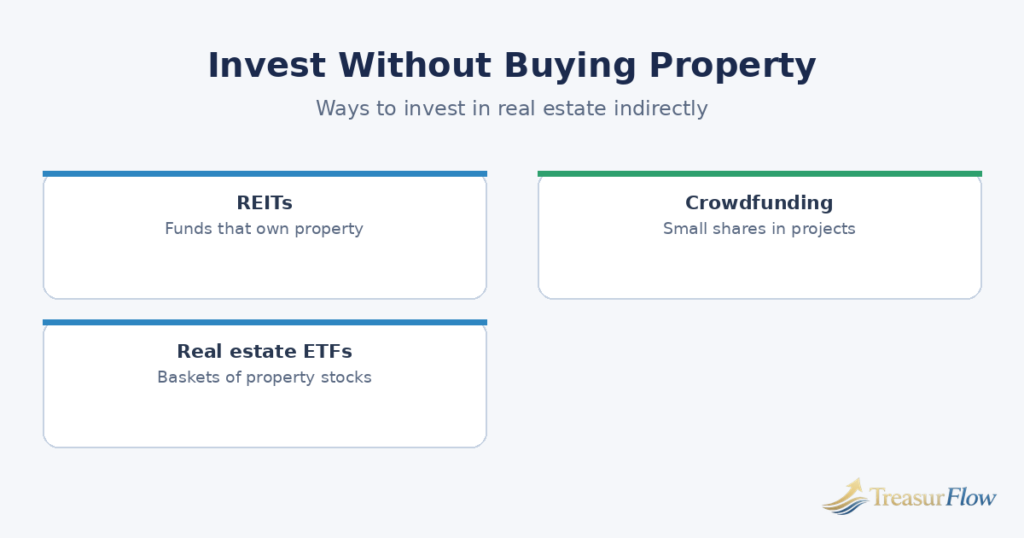
6 Proven Ways to Invest in Real Estate Without Buying Property
┌─────────────────────────────────────────────────────────────────────────────────┐
│                      INDIRECT REAL ESTATE VEHICLES                              │
├──────────────────────────┬──────────────────────────┬───────────────────────────┤
│    PUBLIC MARKETPLACES   │    PRIVATE CROWDFUNDING  │    PRIVATE EQUITY & DEBT  │
│  • Publicly Traded REITs │  • Equity Crowdfunding   │  • Real Estate Syndicates │
│  • Real Estate ETFs      │  • Debt Crowdfunding     │  • Real Estate Debt Funds │
│  • Real Estate Mutuals   │  • Fractional Platforms  │  • Tax Liens & Contracts  │
└──────────────────────────┴──────────────────────────┴───────────────────────────┘
1. Publicly Traded REITs & Real Estate ETFs (Best for Instant Liquidity)
Real Estate Investment Trusts (REITs) are publicly listed corporations that own, operate, or finance income-generating real estate. By law (Securities Exchange Act), REITs must pay out at least 90% of their taxable income to shareholders as annual cash dividends. To open an account for buying REIT shares, compare the best online broker 2026.
- How it works: You buy individual shares of REITs (e.g., Prologis for industrial logistics, Realty Income for triple-net commercial lease retail) or diversified ETFs (e.g., Vanguard Real Estate ETF – VNQ) through any regular brokerage account.
- Average Historical Return: 8% to 11% annualized total return.
- Minimum Capital: Price of 1 share (often under $50, or fractional shares starting at $1).
- Liquidity: High (buy and sell during regular stock market trading hours).
2. Real Estate Crowdfunding Platforms (Best for Micro-Budgets: $10–$500)
Crowdfunding platforms utilize SEC Regulation A+ and Regulation D structures to aggregate capital from thousands of retail investors into multi-family residential, industrial, and commercial real estate portfolios.
- How it works: Platforms like Fundrise, Arrived, and RealtyMogul pool individual contributions to purchase single-family rentals or commercial developments. You receive quarterly dividends sourced from rental yields and share in the equity upside upon property sale.
- Average Historical Return: 7% to 12% cash-on-cash return.
- Minimum Capital: $10 to $500, depending on the platform.
- Liquidity: Moderate to Low (typically requires a 3- to 7-year holding period).
3. Private Real Estate Syndications (Best for High Yields & Accredited Investors)
A real estate syndication is a legal partnership between a General Partner (GP/Sponsor who finds, manages, and executes the real estate project) and Limited Partners (LPs who supply passive investment equity).
- How it works: LPs pool money to acquire large-scale commercial assets (e.g., a 200-unit apartment complex or self-storage facility). LPs receive preferred returns (typically 6% to 8% paid quarterly) plus an equity split (e.g., 70/30 or 80/20 LP/GP split) upon final asset sale or refinancing.
- Average Historical Return: 13% to 18%+ Internal Rate of Return (IRR).
- Minimum Capital: Usually $25,000 to $100,000 (restricted primarily to accredited investors).
- Liquidity: Low (illiquid lockup periods of 5 to 7 years).
4. Real Estate Wholesaling (Best for Sweat Equity & $0 Down)
Wholesaling is an active, zero-capital strategy where you act as the deal finder rather than the investor.
- How it works: You identify distressed properties or motivated sellers selling below market value, secure the home under a purchase contract, and then assign that contract rights to a cash buyer (an investor or fix-and-flipper) for an assignment fee.
- Average Historical Yield: $5,000 to $25,000 per assigned contract deal.
- Minimum Capital: $0 to $500 (marketing and contract setup costs).
- Liquidity: Instant cash conversion upon contract assignment closing.
5. Real Estate Debt Funds & Hard Money Lending (Best for Fixed Income)
Instead of buying property equity, you take on the role of the bank by funding short-term loans for real estate developers and fix-and-flip investors.
- How it works: You place money into private mortgage funds or issue hard-money loans secured by a first-lien deed of trust on physical real estate at 60%–70% Loan-to-Value (LTV). If the borrower defaults, the asset itself acts as collateral.
- Average Historical Return: 9%-12% fixed annual interest payouts.
- Minimum Capital: $5,000 (via specialized debt platforms) to $50,000+ (direct private lending).
- Liquidity: Moderate (loan terms range from 6 to 24 months).
6. Tax Liens & Land Contracts for High-Return Investors
When physical property owners fail to pay property taxes, municipal governments issue tax liens against the title.
- How it works: Investors bid on tax lien certificates at public local auctions, paying off the delinquent taxes on behalf of the city or county. The property owner must repay you the full back taxes plus heavy state-mandated penalty interest (often 12% to 24% annually). If the owner fails to pay within the redemption period, you can foreclose and take title to the property at a fraction of its market value.
- Average Historical Return: 10% to 18% statutory penalty yield.
- Minimum Capital: $500 to $5,000 per auction parcel.
- Liquidity: Fixed multi-year statutory redemption window.
Indirect Real Estate vs. Buying Physical Rental Property
Understanding the fundamental trade-offs between indirect vehicles and direct land ownership is critical for risk management:
| Performance Metric | Indirect Investing (REITs, Crowdfunding, Debt) | Direct Rental Ownership (Turnkey & DIY) |
|---|---|---|
| Minimum Required Capital | $10 – $5,000 | $30,000 – $100,000+ (Down payment + Reserves) |
| Active Management Time | 0 hours/month (100% Passive) | 5 – 20 hours/month (Tenant & maintenance tasks) |
| Asset Liquidity | Instant (Public) to 5 Years (Private) | Very Low (30 to 90+ days to market and sell) |
| Diversification Level | High (Hold fractional stakes in hundreds of properties) | Low (Capital concentrated in 1 or 2 localized addresses) |
| Tax Advantages | 20% QBI Deduction (REITs); K-1 Depreciation (Private Funds) | Direct Cost Segregation, 1031 Exchanges, & Depreciation |
| Mortgage Leverage Access | Limited to platform fund leverage | Direct access to 30-year fixed investor mortgages |
Capital Roadmap: Where to Invest $50, $5,000, or $50,000 Today
Depending on your available liquid capital, use this roadmap to select the most appropriate indirect path:
┌─────────────────────────────────────────────────────────────────────────────────┐
│                        CAPITAL ALLOCATION ROADMAP                               │
├──────────────────────────┬──────────────────────────┬───────────────────────────┤
│    MICRO BUDGET          │    GROWTH BUDGET         │    HIGH-YIELD PASSIVE     │
│    ($50 - $1,000)        │    ($5,000 - $10,000)     │    ($50,000+)             │
├──────────────────────────┼──────────────────────────┼───────────────────────────┤
│ • Broad Market REIT ETFs │ • Balanced Crowdfunding  │ • Private Equity Funds    │
│ • Starter Crowdfunding   │ • Direct Public REITs    │ • Real Estate Syndicates  │
│ • Fractional Shares      │ • Short-Term Debt Funds  │ • Direct Hard Money      │
└──────────────────────────┴──────────────────────────┴───────────────────────────┘
What to Do With $50 to $1,000 (Micro-Investing Strategies)
- Primary Objective: “Primary Objective: Capital preservation, learning how to save money fast, habit building, and automatic dividend reinvestment.”
- Execution Plan:
- Open a low-cost brokerage account and set up automated monthly purchases into broad-market real estate funds (e.g., Vanguard Real Estate ETF – VNQ or Schwab U.S. REIT ETF – SCHH).
- Direct a small portion ($10 to $500) into a primary real estate crowdfunding platform like Fundrise to access private industrial residential funds.
- Turn on DRIP (Dividend Reinvestment Plan) to automatically compound quarterly payouts.
Growth Budget Strategy ($5,000 to $10,000)
- Primary Objective: Yield maximization balanced across income and capital growth.
- Execution Plan:
- Allocate 50% ($2,500 – $5,000) to higher-yielding public REIT sectors, such as healthcare properties or net-lease commercial retail.
- Allocate 30% ($1,500 – $3,000) across private crowdfunding eREITs specializing in residential build-for-rent communities.
- Allocate 20% ($1,000 – $2,000) to short-term private real estate debt funds offering 9%+ fixed interest payments.
High-Yield Passive Strategy ($50,000+)
- Primary Objective: Wealth preservation, tax shelter optimization, and quarterly passive income generation.
- Execution Plan:
- Place $25,000 to $50,000 into a private real estate syndication deal backed by an experienced commercial sponsor (target: 7% preferred return + 15%+ project IRR).
- Allocate remaining capital into direct private debt/hard money loans secured by first-position mortgage deeds at a maximum 65% LTV.
- Utilize Schedule K-1 tax depreciation pass-throughs to offset cash distributions against passive paper losses.
The Cash Flow Formula: How Much Money Do You Need to Earn $3,000/Month?
To calculate the exact liquid portfolio size required to achieve $3,000 a month ($36,000 per year) in passive real estate cash flow without buying property, use this core yield formula:
$$\text{Required Capital} = \frac{\text{Target Annual Cash Flow}}{\text{Net Annual Yield}}$$
$$\text{Required Capital} = \frac{\$36,000}{Y}$$
                          YIELD TO CAPITAL REQUIREMENT MAP

     Required Capital ($)
        $1,000,000 ────────┐ $900,000
          $800,000 ────────┼──────────────────┐ $514,285
          $600,000 ────────┼──────────────────┼──────────────────┐ $360,000
          $400,000 ────────┼──────────────────┼──────────────────┼
          $200,000 ────────┼──────────────────┼──────────────────┼
                $0 ────────┴──────────────────┴──────────────────┴────────
                             4.0% Yield         7.0% Yield        10.0% Yield
                             (Public REITs)    (Crowdfunding)     (Syndicates)
Yield Target Scenarios
Scenario A: Conservative Public REIT Portfolio (4.0% Net Annual Yield)
- Calculation: $\$36,000 / 0.04$
- Required Investment Capital: $900,000
- Best for: Highly conservative investors who prioritize daily liquidity and SEC safety over maximum yield.
Scenario B: Balanced Crowdfunding & Private Fund Portfolio (7.0% Net Annual Yield)
- Calculation: $\$36,000 / 0.07$
- Required Investment Capital: $514,285
- Best for: Mid-tier investors targeting steady quarterly cash flow combined with moderate growth.
Scenario C: High-Yield Syndication & Private Debt Fund (10.0% Net Annual Yield)
- Calculation: $\$36,000 / 0.10$
- Required Investment Capital: $360,000
- Best for: High-net-worth investors comfortable with multi-year capital lockups in exchange for maximum quarterly payouts.
Essential Risk Management & Tax Nuances
1. Understanding Liquidity Lockups & Illiquidity Penalties
Unlike public stock markets, private real estate platforms and syndication funds carry strict capital lockup rules. Most private funds require a 3- to 7-year holding period before capital is returned via asset sales or refinancing events. Early redemption requests may incur 1% to 5% penalties or be completely suspended during market down cycles. Never allocate money to private real estate vehicles that you will need for emergency expenses within 36 months.
2. Tax Realities: Form 1099-DIV vs. Schedule K-1
How your indirect income is taxed depends on your chosen investment vehicle:
- Public REITs (Form 1099-DIV): REIT dividends are generally taxed as ordinary income rather than qualified dividend rates. However, under Section 199A, individual investors can claim up to a 20% Qualified Business Income (QBI) deduction on eligible REIT dividends, lowering the effective tax rate.
- Private Syndications & Partnerships (Schedule K-1): Investors receive pass-through tax benefits, including their proportional share of depreciation deductions and other eligible tax advantages. Sponsors perform cost segregation studies to accelerate property depreciation, often generating paper losses that shelter your actual cash distributions from immediate income taxes.
Frequently Asked Questions About Indirect Real Estate Investing
Can I invest in real estate with $500?
Yes. You can invest in real estate with $500 by purchasing shares of publicly traded REIT ETFs (such as VNQ or SCHH) or through private real estate crowdfunding platforms. Platforms like Fundrise allow retail investors to open starter portfolios with initial minimum deposits as low as $10.
How much money do I need to invest to make $3,000 a month?
The required investment depends on your net annual yield. At a conservative 4% yield from public REITs, you need $900,000. At an average yield of 7% from private real estate crowdfunding, you need $514,285. At a 10% target yield from private syndications or debt funds, you need $360,000.
What is the safest way to invest in real estate without buying a house?
Broadly diversified, publicly traded REIT ETFs (such as Vanguard Real Estate ETF – VNQ) are widely considered the safest indirect path. They offer daily market liquidity, strict SEC compliance standards, professional management, and exposure across thousands of properties worldwide.
Is indirect real estate investing better than owning physical rentals?
Indirect real estate investing provides complete freedom from property management responsibilities, lower entry capital minimums, and instant asset diversification. However, direct physical property ownership allows investors to utilize higher mortgage leverage and apply direct 1031 tax-deferred exchanges upon property sales.
External Resources & Authoritative References
┌─────────────────────────────────────────────────────────────────────────────────┐
│ OFFICIAL REGULATORY & MARKET GUIDANCE │
├──────────────────────────┬──────────────────────────┬───────────────────────────┤
│ SECURITIES & SEC │ TAX CODE & COMPLIANCE │ MARKET RESEARCH │
│ • SEC REIT Guidelines │ • IRS Section 199A │ • Nareit Industry Data │
│ • Regulation A+ Rules │ • Schedule K-1 Guidance │ • Real Estate Indexes │
└──────────────────────────┴──────────────────────────┴───────────────────────────┘
To verify compliance rules, tax structures, and historical performance metrics discussed in this guide, refer to these primary regulatory and market databases:
- SEC Investor Bulletin: Publicly Traded REITs: Official guidance from the U.S. Securities and Exchange Commission outlining liquidity, structural dividend payout requirements (90%+ taxable income), and investor safeguards.
- Nareit Data & Performance Analytics: Industry-standard index data tracking historical returns, sector breakdowns (industrial, commercial, multi-family), and quarterly income metrics across global real estate trusts.
- IRS Section 199A Qualified Business Income Guidelines: Detailed IRS tax policy explaining how individual investors can claim up to a 20% tax deduction on eligible REIT dividend distributions.
- SEC Regulation A+ & Capital Raising Framework: Comprehensive breakdown of individual accreditation standards, crowdfunding platform compliance, and investor protection limits.

Muhammad Zakir is the founder of Treasurflow and the author of its personal finance guides. He researches consumer banking, credit, and personal loans, and every guide cites primary sources such as the CFPB, FDIC, FTC, and IRS. His content is educational and is not personalized financial advice.
2 thoughts on “How to Invest in Real Estate Without Buying Property (2026 Strategy Guide)”