
If you don’t own a car but still drive from time to time, you may be wondering: Do I need car insurance if the vehicle isn’t mine?
The answer depends on how you drive, where you live, whose vehicle you use, and what insurance already covers you. For drivers who don’t own a car, non-owner auto insurance may still offer valuable liability coverage when they’re behind the wheel.
A non-owner policy can be useful if you regularly borrow cars, rent vehicles, have recently sold your car, or need to maintain continuous insurance coverage. It can also be relevant for drivers who need an SR-22 filing but don’t own a vehicle.
This guide explains how non-owner car insurance works, what it typically covers, how much it can cost, who may offer it, and what to consider before buying a policy.
National Association of Insurance Commissioners — Auto Insurance
Use this for general explanations of liability coverage, state requirements, premiums, deductibles, and insurance shopping.
NAIC: Auto Insurance Consumer Guide
What Is Non-Owner Auto Insurance?
Non-owner auto insurance is a type of auto liability policy designed for certain drivers who don’t own a vehicle but still drive vehicles they don’t own.
Instead of insuring a specific car, the policy generally follows the insured driver and can provide qualifying liability coverage when that person drives a non-owned vehicle.
For instance, suppose you sold your vehicle about six months ago. You don’t want to buy another vehicle yet, but you occasionally borrow your sister’s car and rent a car when traveling. A non-owner policy may provide a way to maintain your own liability coverage while you don’t own a vehicle.
The important distinction is that a non-owner policy generally isn’t a replacement for insurance on a vehicle you own.
How does non-owner car insurance work?
A standard auto policy usually connects a driver and a specific insured vehicle. A non-owner policy is different: it is primarily designed around the driver’s liability exposure rather than ownership of a particular car.
Depending on the policy and state, it may provide liability protection when you’re driving an eligible vehicle you don’t own.
However, coverage details, exclusions, policy limits, and eligibility criteria can vary depending on your insurance provider and the state where you live.In some states, drivers may be required to obtain an SR-22 filing following certain driving-related violations or incidents.
What is non-owned auto coverage?
Non-owned auto coverage generally refers to coverage that may apply when an insured person drives a vehicle they don’t own.
It’s important not to assume that every non-owned vehicle is automatically covered. Policies can contain restrictions involving household members, regularly available vehicles, commercial use, vehicle ownership, and other circumstances.
Always review the actual policy terms before relying on coverage.
Who Needs Non-Owner Car Insurance?
Non-owner insurance isn’t necessary for every driver who doesn’t own a vehicle. But it may make sense in several situations.
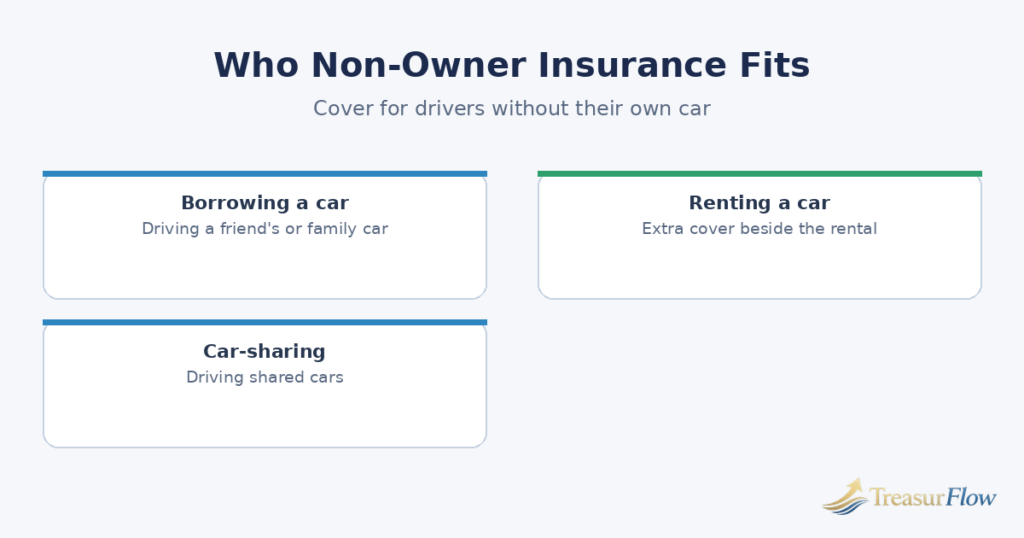
You regularly borrow someone else’s car
Imagine you don’t have a car of your own but frequently drive a vehicle borrowed from a friend or family member.
The vehicle owner’s insurance may provide coverage depending on the circumstances and policy terms. But you shouldn’t automatically assume that their policy provides all the protection you need.
A non-owner policy can give eligible drivers their own liability coverage in qualifying situations.
You frequently rent cars
If you rent a car multiple times each year, it’s worth knowing how your personal insurance, the rental company’s coverage, credit card protections, and other policies may work together.
A non-owner policy may provide liability coverage for eligible rental use, but you should verify the policy before renting because non-owner insurance generally isn’t designed to cover every type of rental-car loss.
You sold your car but still drive
Selling your car doesn’t necessarily mean you’ll stop driving altogether.
You might sell your car because you’re moving, saving money, working remotely, or waiting to purchase another vehicle. During that period, you could still rent or borrow cars.
A non-owner policy may allow you to maintain your own auto liability coverage while you’re between vehicles.
You need an SR-22 but don’t own a vehicle
Depending on state requirements, some drivers may need to file an SR-22 after specific driving-related violations or incidents.
If you don’t own a vehicle, a non-owner policy may sometimes be used to satisfy an SR-22 requirement.
Because SR-22 rules vary by state, you should confirm the exact requirement with your state’s motor vehicle authority or an insurance professional.
You want continuous insurance coverage
A gap in auto insurance history can sometimes affect future insurance costs or underwriting.
If you’ve sold your car but expect to purchase another one later, maintaining appropriate insurance coverage may be worth considering.
Whether a non-owner policy is the right solution depends on your circumstances.
What Does Non-Owner Car Insurance Cover?
Non-owner insurance generally focuses on liability coverage rather than protecting the vehicle you’re driving.
Depending on the policy and state, coverage may include some combination of:
- Bodily injury liability
- Property damage liability
- Uninsured motorist coverage
- Underinsured motorist coverage
- Medical payments or personal injury protection, where available
Coverage varies, so don’t treat this list as a guarantee of what every policy includes.
Bodily injury liability
If you’re legally responsible for injuring another person in an accident, bodily injury liability coverage may help pay covered costs up to your policy limits.
These costs can include medical expenses and, depending on the circumstances and applicable law, other damages.
Property damage liability
Property damage liability may help cover damage you cause to another person’s property while driving an eligible non-owned vehicle.
For example, if you borrow a friend’s car and cause an accident that damages another driver’s vehicle, your applicable liability coverage may help with the resulting covered property damage.
Uninsured and underinsured motorist coverage
Some policies and states provide uninsured or underinsured motorist protection.
This type of coverage can become relevant when another driver causes an accident but doesn’t have enough insurance—or any insurance—to cover the resulting damages.
Availability and requirements vary by state.
NAIC — What Auto Insurance Covers
This is particularly useful for explaining liability, comprehensive, collision, and other coverage types.
NAIC: What Does Auto Insurance Cover?
What Does Non-Owner Car Insurance Not Cover?
Understanding your policy’s limitations is just as important as knowing the protection it provides.
A non-owner policy generally isn’t intended to function like comprehensive insurance on a vehicle you own.
Depending on the policy, it may not cover:
- Damage to the vehicle you’re driving
- A vehicle you own
- Certain vehicles regularly available for your use
- Personal belongings inside the vehicle
- Certain business or commercial activities
- Certain household or family situations
- Other excluded circumstances listed in the policy
Does non-owner insurance pay to repair the car I borrowed?
Usually, you shouldn’t expect a non-owner policy to function as physical-damage coverage for the borrowed vehicle.
If you borrow a friend’s car and damage it, the vehicle owner’s policy may become relevant. The exact outcome depends on the policies involved, the circumstances of the accident, state law, and other factors.
This is one reason it’s important to understand both your coverage and the vehicle owner’s coverage before regularly borrowing a car.
How Much Does Non-Owner Car Insurance Cost?
There isn’t one universal price for non-owner auto insurance.
Your premium can depend on factors such as:Potential ways to reduce insurance costs can include:
- Comparing multiple insurers
- Maintaining a clean driving record
- Asking about applicable discounts
- Reviewing your coverage limits
- Avoiding unnecessary coverage
- Maintaining appropriate insurance history
- Comparing quotes periodically
You can also explore these ways to reduce monthly expenses when you’re looking for opportunities to lower your overall budget.
Non-owner policies can sometimes cost less than insuring a vehicle because there is no specific vehicle being insured for physical damage. But that doesn’t mean every non-owner policy will be inexpensive.
Is non-owner car insurance cheaper than regular insurance?
It can be, but there is no guaranteed price difference.
A standard policy may include coverage associated with an owned vehicle, while a non-owner policy generally focuses on liability coverage for eligible non-owned vehicles.
Your individual premium can still vary substantially based on your driving history, location, coverage requirements, and insurer.
Is $300 a month normal for car insurance?
Whether $300 per month is reasonable depends heavily on the driver’s situation and the type of policy.
For a non-owner policy, a quote that high deserves a closer look. Ask the insurer what factors are driving the premium and verify that you’re comparing the same coverage limits and policy terms.
Don’t compare two prices unless you know you’re comparing similar coverage.
If you’re trying to determine whether an insurance premium fits your finances, you can also use this guide to build a realistic insurance budget.
What brings car insurance down the most?
There isn’t one strategy that lowers everyone’s premium.
Potential ways to reduce insurance costs can include:
- Comparing multiple insurers
- Maintaining a clean driving record
- Asking about applicable discounts
- Reviewing your coverage limits
- Avoiding unnecessary coverage
- Maintaining appropriate insurance history
- Comparing quotes periodically
For non-owner insurance specifically, shopping around can be particularly important because not every insurer handles these policies in the same way.
If insurance is putting pressure on your monthly budget, these ways to save money on recurring expenses may also help.
Who Offers Non-Owner Car Insurance?
A question that many drivers commonly have is:
“Which insurance company offers non-owner car insurance?”
The answer can depend on your state and personal circumstances.
Some major insurers and insurance agencies may offer non-owner policies or related coverage options, but availability and eligibility can change.
You may encounter searches for:
- GEICO non-owner car insurance
- Progressive non-owner car insurance
- State Farm non-owner car insurance
- Travelers non-owner car insurance
- Lemonade non-owner car insurance
Don’t assume that a company offers a non-owner policy simply because information about it appears online. Product availability can vary by state, and insurers can change their underwriting rules.
How should you compare non-owner insurance companies?
Instead of looking only at the company name, compare:
| Factor | Why it matters |
|---|---|
| Liability limits | Determines the maximum protection available under the policy |
| Premium | The amount you’ll actually pay for your coverage |
| Eligibility | You may not qualify with every insurer |
| State availability | Products and requirements vary |
| Exclusions | Identify situations or circumstances that aren’t covered by the policy |
| Customer service | Helpful when you have questions or need assistance with your policy |
| Claims handling | Matters if you ever need to use your coverage |
| SR-22 availability | Important if you need a filing |
The “best” insurer isn’t necessarily the company with the lowest advertised price.
How to Get Affordable Non-Owner Car Insurance
If price is your main concern, don’t search for one magic insurer that is always cheapest.
Insurance pricing is individualized.
Instead, get multiple quotes and compare equivalent coverage.
1. Compare several insurers
A quote from one company doesn’t tell you what another company would charge.
2. Compare the same liability limits
A cheaper policy isn’t necessarily cheaper for the same protection if the coverage limits are different.
3. Ask about discounts
Depending on the insurer and your circumstances, discounts may be available.
4. Check your driving record
Tickets, accidents, claims, and other driving-related factors can affect premiums.
5. Don’t sacrifice necessary coverage for a low price
The cheapest policy can become expensive if it leaves you inadequately protected.
The better goal is often appropriate coverage at a competitive price.
NAIC — Shopping for Auto Insurance
For your comparison/quote section, the NAIC’s consumer guidance is useful because it explains shopping considerations and the information consumers may need when requesting quotes.
NAIC Auto Insurance Shopping Guide
Can You Get Non-Owner Car Insurance Online?
Sometimes, yes—but the process isn’t identical with every insurer.
Some companies may provide online tools, while others may require you to speak with an agent.
When requesting a quote, you may need information such as:
- Your driver’s license information
- Address
- Driving history
- Insurance history
- Date of birth
- Coverage requirements
- SR-22 information, if applicable
Why might an insurer require an agent?
Non-owner policies can involve specific eligibility and underwriting questions.
If the online system doesn’t offer the policy you need, speaking with an agent or independent insurance professional may help you determine whether another option is available.
Is Non-Owner Car Insurance Worth It?
For the right driver, it can be.
It may be worth considering if you:
- Regularly drive vehicles you don’t own
- Frequently rent cars
- Recently sold your vehicle
- Need an SR-22 without owning a vehicle
- Want your own liability coverage when driving eligible non-owned vehicles
It may be unnecessary if you rarely drive and already have appropriate coverage through another arrangement.
The important question isn’t simply:
“Is non-owner insurance worth it?”
It’s:
“Does this type of coverage solve an insurance gap in my specific situation?”
Can I Insure Myself on a Car I Don’t Own?
In many circumstances, you can obtain insurance designed for drivers who don’t own vehicles.
That’s essentially the purpose of a non-owner policy.
However, there is an important distinction between:
insuring yourself as a driver
and
insuring a specific vehicle for physical damage.
A non-owner policy generally focuses on your liability exposure as a driver rather than providing full coverage for a particular vehicle.
If you own or regularly have access to a vehicle, tell the insurer. That information can affect eligibility and coverage.
What Happens If My Friend’s Car Is Involved in an Accident?
Imagine this:
You borrow your friend’s car, get into an accident, and you’re determined to be responsible.
Several insurance questions can arise:
- What coverage does the vehicle owner’s policy provide?
- Does the owner’s policy apply to your use?
- Do you have a non-owner policy?
- What are the applicable liability limits?
- Are there exclusions?
- Which coverage applies first?
- Are the damages greater than the available limits?
The exact answer depends on the policies, circumstances, and applicable state law.
This is why you shouldn’t assume that borrowing someone’s car means you’re automatically fully insured.
What If No One Will Sell Me Non-Owner Car Insurance?
It can be frustrating to find out that an insurer won’t offer you the policy you want.
There are several reasons this can happen.
An insurer may have restrictions related to:
- State availability
- Driving history
- License status
- Insurance history
- Vehicle access
- SR-22 requirements
- Underwriting guidelines
If one company declines your application, that doesn’t necessarily mean every insurer will.
Consider contacting multiple insurers or an independent insurance agent who can check different markets.
If you have a license-related or SR-22 issue, make sure you’re asking specifically about the coverage and filing you need.
Non-Owner Car Insurance vs. Regular Car Insurance
The easiest way to understand the difference is to look at what is being insured.
| Feature | Non-owner insurance | Standard auto insurance |
|---|---|---|
| Designed for someone without an owned vehicle | Yes | Usually no |
| Liability coverage | Generally | Generally |
| Covers a vehicle you own | No | Yes |
| Physical damage coverage for owned vehicle | Generally no | May be available |
| Designed for people who regularly own and drive their own vehicles | No | Yes |
| Can be relevant to occasional borrowed vehicles | Yes, depending on policy | May also apply depending on circumstances |
A standard auto policy is generally built around an insured vehicle. A non-owner policy is generally built around an eligible driver who doesn’t own a vehicle.
Non-Owner Insurance vs. the Vehicle Owner’s Insurance
This distinction causes a lot of confusion.
Suppose you borrow your brother’s car.
His vehicle has an insurance policy.
You also have a non-owner policy.
Which one pays after an accident?
There isn’t a universal answer that applies to every accident.
The result can depend on:
- The owner’s policy
- Your policy
- State law
- Whether you had permission to drive
- The circumstances of the accident
- Coverage limits
- Policy exclusions
Never assume that your non-owner policy automatically replaces the vehicle owner’s insurance.
Does Non-Owner Insurance Cover Rental Cars?
It may provide liability coverage for eligible rental use, but you shouldn’t assume it covers every loss associated with a rental vehicle.
For example, there is a difference between:
liability for damage you cause to another person or vehicle
and
damage to the rental car itself.
Before renting, check what your non-owner policy actually covers and consider any additional protection offered by the rental company or other sources of coverage.
What Type of Insurance Can You Get Without a Driver’s License?
This is a more complicated situation.
If you don’t have a valid driver’s license, you should not assume that a standard non-owner policy will solve the problem.
Insurance eligibility and licensing requirements vary by state and insurer.
If your license is suspended, revoked, expired, or otherwise restricted, tell the insurer exactly what your status is rather than providing incomplete information.
Driving without the required legal authorization can create serious legal and insurance consequences.
Frequently Asked Questions About Non-Owner Auto Insurance
What is non-owner car insurance?
Non-owner car insurance is generally a liability-focused auto policy for certain drivers who don’t own a vehicle but drive eligible vehicles they don’t own.
Is non-owner car insurance worth it?
It can be worthwhile if you regularly borrow or rent vehicles, have sold your car, need an SR-22, or otherwise need your own liability coverage. It may not be necessary for someone who rarely drives and already has adequate coverage elsewhere.
How does non-owner car insurance work?
Instead of insuring a specific vehicle you own, a non-owner policy generally provides qualifying liability coverage for the insured driver when driving eligible non-owned vehicles.
Progressive — Non-Owner Car Insurance
Progressive has a dedicated explanation of non-owner insurance, including who may need it, coverage limitations, rental situations, and pricing considerations.
Progressive: What Is Non-Owner Car Insurance?
How much does non-owner car insurance cost?
The price varies by driver, state, insurer, coverage limits, driving record, insurance history, and other rating factors. There is no single national price that applies to every driver.
Who offers non-owner car insurance?
Availability varies by state and insurer. Some major insurance companies and independent agents may offer non-owner policies, but you should verify current availability and eligibility directly with the insurer.
GEICO — Non-Owner Car Insurance
GEICO has a dedicated resource explaining non-owner coverage, borrowed vehicles, rental cars, limitations, and optional coverage.
GEICO: Non-Owner Car Insurance
Can I get non-owner car insurance online?
Some insurers may allow online quoting or purchasing, while others may require an agent. If an online quote isn’t available, an agent may be able to explain whether the insurer offers the policy.
Can I insure myself on a car I don’t own?
You may be able to purchase a non-owner policy if you meet the insurer’s eligibility requirements. This generally provides liability coverage for the driver rather than physical-damage coverage for the vehicle.
Does non-owner insurance cover my friend’s car?
A non-owner policy may provide liability coverage when you drive an eligible friend’s vehicle, but it generally isn’t designed to provide physical-damage coverage for the friend’s car. The owner’s policy may also be relevant.
Is non-owner insurance cheaper than regular car insurance?
It can be less expensive because it generally doesn’t insure an owned vehicle for physical damage, but the actual premium depends on your circumstances and the insurer.
Can I get non-owner insurance without a license?
Not necessarily. Licensing requirements and insurer eligibility rules vary. If you don’t have a valid license, disclose your exact status before applying.
What happens if I crash someone else’s car?
The applicable insurance can depend on the vehicle owner’s policy, your own coverage, the circumstances of the accident, state law, and policy limits. Don’t assume either policy will automatically cover every loss.
What should I do if no company will insure me?
Ask why you were declined, contact other insurers, and consider speaking with an independent insurance agent. If you need an SR-22 or have a licensing issue, clearly explain those requirements.
How to Choose the Right Non-Owner Auto Insurance
Before buying a policy, ask yourself five questions:
1. How often do I drive vehicles I don’t own?
Someone who drives once a year has different needs from someone who borrows a car every weekend.
2. Whose vehicles do I drive?
Regular access to a household member’s vehicle can affect whether a non-owner policy is appropriate.
3. What coverage do I actually need?
Focus on the liability limits and other protections required for your situation.
4. Do I need an SR-22?
If so, tell the insurer before purchasing the policy.
5. Am I comparing equivalent quotes?
A lower premium isn’t meaningful if the coverage limits and terms are substantially different.
Final Thoughts: Is Non-Owner Auto Insurance Right for You?
Non-owner auto insurance can fill an important gap for drivers who don’t own a vehicle but still need their own auto liability coverage.
It can be relevant to people who regularly borrow cars, rent vehicles, have recently sold a car, or need an SR-22 without owning a vehicle.
But the right policy isn’t necessarily the cheapest one.
Before purchasing, compare coverage limits, exclusions, eligibility, insurer availability, and price. Most importantly, make sure the policy actually fits the way you drive.
If you’re ready to explore your options, compare non-owner insurance quotes from insurers that serve your state and ask specifically about the coverage you need.
Some links on this page go to product or issuer pages. Treasurflow’s rankings are based on the criteria stated in each guide. See the About page for how the site is funded.

Muhammad Zakir is the founder of Treasurflow and the author of its personal finance guides. He researches consumer banking, credit, and personal loans, and every guide cites primary sources such as the CFPB, FDIC, FTC, and IRS. His content is educational and is not personalized financial advice.
4 thoughts on “Non Owner Auto Insurance: How It Works, What It Covers, Costs & Where to Get It”