
If you are searching for very cheap car insurance with no deposit, you are probably not simply looking for the lowest advertised premium. You may need coverage today, have only a small amount of cash available, or want to avoid a large first payment.
The good news is that you can often find low-upfront-cost car insurance, but there is an important distinction: “no deposit” or “$0 down” does not necessarily mean you can start a policy without paying anything. In most cases, an insurer requires an initial payment before coverage begins. Some companies may offer payment arrangements that keep that first payment relatively low.
If you have only around $20 available, need full coverage, have bad credit, or need insurance immediately, the cheapest option for you can be very different from the cheapest option for another driver.
This guide explains how low-down-payment car insurance works, whether $20-down car insurance is realistic, how to compare quotes, and how to reduce your upfront and overall insurance costs.
Can You Really Get Car Insurance With No Deposit?
Usually, you should be careful with the phrase “no deposit car insurance.”
A car insurer generally requires an initial payment before putting your policy into effect. What some people call “no deposit” or “no down payment” may actually mean that the insurer allows you to pay only the first installment instead of requiring several months of premium upfront. Progressive, for example, explains that legitimate insurers require an upfront payment and that a low-down-payment arrangement may simply involve paying the first month’s premium.
So there are three different ideas worth separating:
- No deposit: A marketing term that can be misleading.
- $0 down: A claim that should be verified carefully before purchasing.
- Low down payment: A more realistic description of an arrangement requiring a relatively small initial payment.
Your first payment is generally part of the cost of your policy rather than a separate fee that you eventually get back.
What Does “No Deposit” Car Insurance Actually Mean?
When someone searches for no-deposit car insurance, they often mean:
“I need coverage, but I cannot afford a large payment today.”
That is a different question from whether an insurer will literally issue a policy for $0.
Instead of searching only for a “no deposit” offer, ask insurers:
“What is the lowest upfront payment available based on my driver profile, vehicle, coverage needs, and state?”
This question is more helpful because the amount you’ll pay upfront can vary based on your individual circumstances.
Why Do Insurers Require an Initial Payment?
Insurance companies take on financial risk as soon as your policy becomes active. An initial payment helps establish the financial side of the policy before coverage begins.
Your payment structure may depend on whether you choose:
- monthly installments,
- a six-month policy,
- a 12-month policy,
- or another payment arrangement offered by the insurer.
Monthly payments can reduce the amount you need to pay at once, although paying more frequently or using installment billing can sometimes cost more overall.
Is It Possible to Get Car Insurance With Just $20 Down?
Sometimes, but it is not realistic for every driver.
A $20 first payment may be possible for some drivers when several factors work in their favor, such as a relatively inexpensive insurance market, minimum required coverage, a clean driving record and a favorable driver profile.
Independent 2026 research has found that some qualifying drivers can reach very low initial payments, while many others pay considerably more.
That means “$20 down car insurance” should be treated as a possibility to investigate, not a guaranteed price.
What Determines Your First Car Insurance Payment?
Your initial payment can be affected by factors including:
- Your state
- Your age
- Driving history
- Accident and violation history
- Insurance history
- Vehicle type
- Annual mileage
- Coverage limits
- Deductible
- Credit-based insurance information where permitted
- Available discounts
- The insurer’s payment structure
Two drivers can enter exactly the same search—“$20 down car insurance”—and receive completely different quotes.
Is $20 Down Really the Cheapest Option?
Not necessarily.
This is one of the biggest mistakes people make when shopping for cheap insurance.
Suppose one policy requires a $25 first payment but costs substantially more over the full policy term. Another requires $60 upfront but has a much lower total premium.
The first policy has the lower initial payment.
The second policy may have the lower overall cost.
Always compare both:
Initial payment + recurring payment + total policy premium + applicable fees
rather than judging a policy by its first payment alone.
How to Find the Cheapest Car Insurance With a Low Upfront Payment
If your immediate priority is affordability, use a structured comparison process instead of choosing the first “cheap insurance” advertisement you see.
1. Compare Multiple Insurance Quotes
Insurance companies price risk differently.
The same driver can receive substantially different quotes from different carriers because each company uses its own underwriting and pricing models.
Get multiple quotes using the same:
- coverage limits,
- vehicle information,
- drivers,
- deductibles,
- and policy term.
Otherwise, you may think one company is cheaper simply because it offered less coverage.
2. Ask for the Actual First Payment
Do not ask only:
“How much is my insurance per month?”
Ask:
“How much do I have to pay today to start the policy?”
Then ask:
“What will my regular payment be after that?”
Finally ask:
“What will the total premium be for the policy term?”
Those three numbers give you a much clearer picture of affordability.
3. Check Minimum Coverage Requirements
If your primary goal is the lowest legal cost, you may compare quotes for your state’s minimum required coverage.
But be careful.
Minimum coverage generally protects you only up to the limits included in the policy. It may not provide the protection you need for your own vehicle or for a serious accident.
A lower premium can therefore come with significantly less protection.
4. Look for Available Discounts
Ask whether you qualify for discounts such as:
- safe-driver discounts,
- multi-policy discounts,
- multi-vehicle discounts,
- electronic-document discounts,
- defensive-driving discounts,
- student-related discounts,
- usage-based programs,
- or other discounts offered in your state.
Discount availability varies by insurer and state.
5. Compare the Total Cost
A low first payment can be attractive when money is tight.
But the best deal is not always the policy requiring the least money today.
Compare:
First payment → monthly payment → policy-term premium → coverage → deductible → fees
That simple checklist can prevent a cheap-looking policy from becoming an expensive choice.
Can You Get Cheap Car Insurance With Bad Credit?
Yes, you can often obtain car insurance with poor credit, but your credit history can affect your insurance price in states where insurers are permitted to use credit-based insurance information.
The National Association of Insurance Commissioners explains that insurers often use credit-based insurance scores when underwriting and pricing auto insurance, although state laws restrict or prohibit the practice in certain states.
As of the NAIC’s March 2026 information, California, Hawaii, Maryland, Massachusetts, Michigan, Nevada, Oregon and Utah prohibit insurers from using credit-based insurance scores in setting auto insurance rates or determining whether to offer or renew a policy. Rules can change, so consumers should verify the current requirements in their state.
Does Bad Credit Mean You Cannot Get Insurance?
No.
Bad credit does not automatically mean you are uninsurable.
However, where credit-based insurance scoring is allowed, it can be one factor affecting your premium.
If your credit is a concern, compare several insurers rather than assuming one company will automatically be cheapest.
How to Shop for Insurance With Bad Credit
Try this approach:
- Get quotes from multiple insurers.
- Use identical coverage levels when comparing prices.
- Ask about every available discount.
- Check your credit report for errors.
- Ask how your state regulates credit-based insurance scoring.
- Compare the total policy cost rather than only the first payment.
A company advertising “no credit check” is not automatically the cheapest choice. The absence of a credit check does not guarantee a lower premium.
How to Get Car Insurance Today With a Lower Initial Payment
If you need coverage immediately, price is only half the problem.
You also need to know when the policy becomes effective.
Many insurers allow customers to purchase coverage online or over the phone and start a policy once the required information and payment have been processed. Some insurers can provide digital proof of insurance shortly after purchase.
Have These Details Ready
Before requesting a quote, gather:
- Driver’s license information
- Vehicle identification number (VIN)
- Vehicle make and model
- Current mileage, if requested
- Address
- Driving history
- Current or previous insurance information
- Information for other drivers who need to be insured
- Desired coverage levels
- Payment method
Having this information ready can make the quoting process much faster.
Can Insurance Start Immediately?
It can, depending on the insurer, your application and payment, and the effective date you select.
Do not assume that receiving a quote means you are already insured.
Confirm:
“What exact date and time does my coverage become effective?”
Then obtain proof of insurance before driving if your policy requires it.
Is Cheap Full-Coverage Car Insurance Available With No Upfront Deposit?
You may be able to find a low initial payment for full coverage, but full coverage generally costs more than minimum liability coverage.
The reason is simple: you’re purchasing more protection.
Full coverage commonly refers to a combination of liability coverage plus physical-damage coverage such as collision and comprehensive. Exact coverage depends on the policy.
Why Full Coverage Costs More
Your premium can increase when you add protections such as:
- Collision coverage
- Comprehensive coverage
- Higher liability limits
- Lower deductibles
- Additional optional coverages
If you finance or lease a vehicle, your lender may also require certain coverage levels.
How to Make Full Coverage More Affordable
Consider comparing:
- Different insurers
- Different deductibles
- Available discounts
- Vehicle-specific rates
- Coverage limits
- Monthly versus other payment schedules
Do not remove important coverage solely to achieve a lower first payment without understanding the risk you’re accepting.
No Deposit vs. $0 Down vs. $20 Down vs. First Month Free
These terms can sound similar, but they can describe very different payment arrangements.
| Term | What it may mean |
|---|---|
| No deposit | Often used to describe a low upfront payment arrangement |
| $0 down | Suggests no initial payment, but availability should be verified carefully |
| $20 down | A specific low initial payment target that may only be available to qualifying drivers |
| First month free | A promotional concept with specific eligibility and conditions |
| Pay later | May refer to installment billing or another financing/payment arrangement |
The key question isn’t simply:
“Does this company offer no-deposit insurance?”
Ask:
“What do I pay today, what do I pay each month afterward, and what is my total cost?”
That gives you the information needed to compare policies honestly.
Is No-Deposit Car Insurance Legit?
Low-down-payment car insurance can be legitimate, but you should carefully verify what an advertisement means by “no deposit.”
A legitimate insurer should clearly tell you:
- What you pay initially
- When coverage begins
- What your recurring payment will be
- What coverage you are purchasing
- What the policy term is
- What happens if you miss a payment
- Whether fees apply
- How to obtain proof of insurance
Be cautious about any offer that promises an unrealistically low price without asking for information needed to calculate your risk.
A genuine insurance quote should reflect your actual circumstances.
What Is the Cheapest Way to Get Car Insurance?
There is no single insurer that is guaranteed to be the cheapest for every driver.
Your cheapest option can change based on:
- state,
- age,
- driving history,
- vehicle,
- coverage,
- credit-based insurance information where permitted,
- mileage,
- discounts,
- and insurer pricing.
For that reason, the most reliable strategy is to compare several quotes using the same coverage requirements.
If upfront cash is your biggest concern, compare the initial payment separately from the total premium.
If keeping your overall expenses low matters most, consider the total cost of the policy rather than just the initial payment.
If protection is your priority, compare coverage limits and deductibles rather than choosing solely on price.
What If No One Will Insure Me?
If you’re having trouble finding affordable coverage, don’t immediately assume you have no options.
Common reasons insurance can become difficult or expensive include:
- Multiple accidents
- Serious traffic violations
- A lapse in coverage
- Young-driver status
- High-risk vehicle characteristics
- Poor credit where credit-based insurance scoring is permitted
- Living in a high-cost insurance market
- Previous claims
Start by asking insurers whether they can provide a quote for your current circumstances.
You can also investigate your state’s insurance resources for drivers who have difficulty obtaining coverage through the standard market.
The objective is not simply to find any policy. The goal is to secure legally sufficient coverage at a cost you can comfortably afford over time.
How to Compare Affordable Car Insurance Without Being Misled by a Low Rate
Use this checklist before buying:
Compare the first payment
How much must you pay today?
Compare the recurring payment
What will you pay next month?
Compare the total policy cost
How much will the policy cost over the entire term?
Compare coverage limits
Are you comparing equivalent protection?
Compare deductibles
A lower premium may sometimes mean you’ll have to pay a higher deductible when you file a claim.
Check cancellation and payment rules
Understand what happens if you miss a payment or cancel early.
Confirm the effective date
Never assume you are insured until the insurer confirms your coverage has started.
Related Guides to Help You Save Money
Looking for very cheap car insurance with no deposit is often part of a bigger goal: keeping your monthly expenses under control. If you’re trying to make your budget stretch further, our guide on how to save money fast on a low income offers practical ways to reduce everyday costs.
Your credit history can also affect how much you pay for car insurance in some states. If you’re rebuilding your financial profile, learn how long it takes to build credit from scratch and what factors can help you make steady progress.
If you don’t own a vehicle but still need certain auto insurance coverage, see our guide to non-owner auto insurance to understand who may need it and how this type of policy works.
You can also explore our guide to how to save money in 2026 for additional strategies that can help lower your overall monthly expenses.
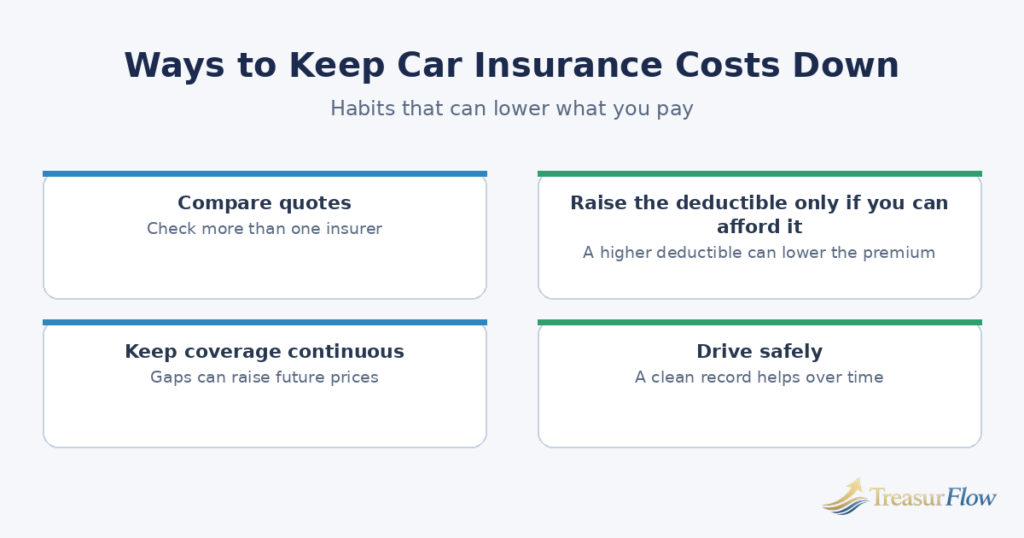
What Are the Most Effective Ways to Reduce Your Car Insurance Costs?
If your quote is higher than expected, try these strategies:
Shop around
Don’t assume your current insurer is still your cheapest option.
Ask about discounts
You might be eligible for discounts that aren’t currently included in your policy.
Review your coverage
Make sure you’re not paying for coverage you don’t need—but don’t remove protection without understanding the consequences.
Consider your deductible
A higher deductible may reduce your premium, but it means you’ll have more out-of-pocket exposure after a covered loss.
Maintain a clean driving record
Safe driving can help you qualify for better pricing over time.
Avoid unnecessary lapses
A gap in coverage can make future insurance more difficult or expensive.
Re-shop periodically
Your circumstances and insurer pricing can change, so comparing rates periodically can be worthwhile.
Cheap Car Insurance With No Deposit Near Me
If you’re searching for very cheap car insurance with no deposit near me, location matters.
Insurance rates are not simply national prices. Your state, ZIP code and local risk factors can affect what insurers charge.
Your state’s insurance requirements also determine the minimum coverage you need.
Instead of searching only for a company advertising “no deposit,” compare insurers available in your area and ask each one for:
- The lowest initial payment available
- The monthly payment afterward
- The total policy premium
- The coverage limits
- The deductible
- The effective date
That gives you a much more useful local comparison.
Very Cheap Car Insurance With No Deposit in Florida
Florida drivers should pay particular attention to coverage requirements and pricing because insurance costs can vary substantially by state and driver profile.
If you’re looking for very cheap car insurance with no deposit in Florida, don’t assume that a national “$20 down” advertisement will apply to you.
Instead, obtain quotes based on Florida requirements and compare the actual upfront payment with the policy’s total premium.
Also check that the policy provides the coverage you need—not merely the lowest possible advertised price.
For any state-specific insurance requirement, use current information from your state’s insurance regulator or other authoritative source before purchasing.
Frequently Asked Questions
Can You Get Car Insurance Without Making an Upfront Payment?
Generally, you should expect an initial payment before coverage begins. Some insurers may offer low-down-payment arrangements, but “no deposit” does not necessarily mean $0 is required to activate a policy.
Can I really get car insurance with $20 down?
A $20 first payment may be possible for some drivers, particularly when rates are low and the driver qualifies for inexpensive coverage. It is not a universal price, however. Your state, driving history, coverage and other factors affect the quote.
Is no-deposit car insurance legitimate?
Low-upfront-payment arrangements can be legitimate, but you should verify exactly what the insurer means by “no deposit.” Ask how much you must pay before coverage begins and what your recurring and total costs will be.
Can I get car insurance today?
Often, yes. Many insurers allow customers to purchase a policy online or through an agent and begin coverage after the required information and payment have been processed. Confirm your exact effective date before driving.
Can I get full coverage with no down payment?
You may find insurers offering relatively low initial payments for broader coverage, but you should not assume that full coverage will be available for $0 down. Full coverage generally costs more than minimum liability coverage.
Does bad credit prevent me from getting car insurance?
Not necessarily. In states where credit-based insurance scoring is permitted, credit information can affect the price of insurance, but it does not automatically mean you cannot obtain coverage. State rules differ.
Is Car Insurance From a Company That Doesn’t Check Credit Always Cheaper?
No. A company that doesn’t use credit information is not automatically the least expensive option. Compare actual quotes for the same coverage rather than relying on a single pricing factor.
What Is the Most Affordable Car Insurance You Can Buy Online?
There is no single cheapest insurer for everyone. The lowest price depends on your state, vehicle, driving record, coverage, and other rating factors. The best approach is to compare multiple quotes using identical coverage.
Can You Start Car Insurance Now and Pay Later?
You generally need to make the required initial payment before coverage begins. After that, some insurers offer installment plans. Ask about the exact payment schedule before purchasing.
What Can You Do If No Insurance Company Will Cover You?
Ask insurers why you’re being declined or quoted a high rate, compare additional carriers, and investigate your state’s insurance resources for high-risk or hard-to-insure drivers. Don’t drive without the coverage required by your state. If your license status is the reason for the decline, read our guide to car insurance for unlicensed drivers to understand your options.
The Bottom Line: Focus on the Lowest Real Cost, Not Just $0 Down
If you searched for very cheap car insurance with no deposit, your real goal is probably simple:
Get legally required protection without paying more upfront—or overall—than you can afford.
A $0, $20 or very low first payment can sound attractive, but it does not automatically make a policy the cheapest deal.
Before buying, compare:
Initial payment + monthly payment + total premium + coverage + deductible + fees
If you need coverage today, confirm the exact effective time. If you have bad credit, compare several insurers and understand how your state regulates credit-based insurance scoring. If you only have $20 available, ask insurers whether a first payment around that amount is actually available for your specific profile rather than assuming an advertisement applies to everyone.
The smartest cheap-car-insurance strategy isn’t finding the lowest number in an advertisement.
It’s finding the lowest realistic cost for the coverage you actually need—and understanding exactly what you’re paying for before you buy.
Trusted Insurance Resources
Insurance rules, pricing factors, and coverage requirements can vary by state, so it’s important to verify important information with authoritative sources before purchasing a policy.
The National Association of Insurance Commissioners (NAIC) provides consumer information about insurance, including topics such as auto insurance, coverage, complaints, and state-specific insurance resources.
If you’re researching how credit information can affect auto insurance pricing, the NAIC also explains credit-based insurance scores and how their use can vary by state.
For Florida drivers, current insurance regulations and consumer information can be checked through the Florida Office of Insurance Regulation.

Muhammad Zakir is the founder of Treasurflow and the author of its personal finance guides. He researches consumer banking, credit, and personal loans, and every guide cites primary sources such as the CFPB, FDIC, FTC, and IRS. His content is educational and is not personalized financial advice.
3 thoughts on “Very Cheap Car Insurance with No Deposit: $20 Down Options”