

Let’s be honest first: if your credit is bruised — or you have no credit history at all — applying for a credit card can feel like walking into a room where everyone already knows you don’t belong. You’ve probably been denied before, or you’re afraid that even applying will ding your score further.
Here’s the good news: a small group of legitimate credit cards really does skip the traditional credit check. Here’s the honest part, and I won’t bury it: no credit card on earth offers 100% guaranteed approval. Any site that promises otherwise is selling you something. What these cards do offer is approval based on something other than your credit score — your deposit, your income, or your bank account activity.
This guide walks through seven real options available in 2026, with actual deposits, fees, and the catches nobody puts in the headline. Every number below comes from the issuer’s published terms or a major independent review — and you should still verify current terms on the issuer’s site before applying, because card terms change.
What “No Credit Check” Actually Means
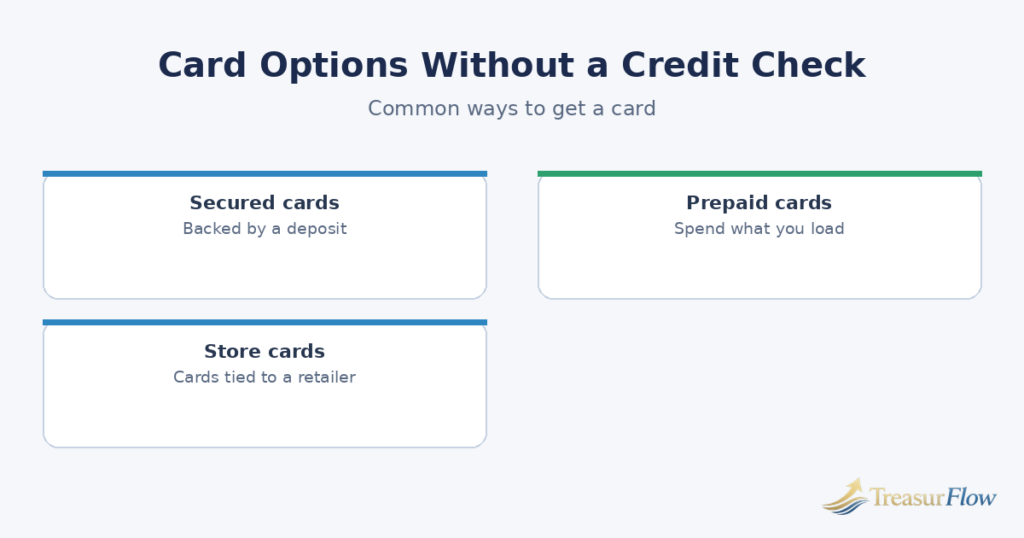
Not all “no credit check” claims are the same. There are three levels:
Hard inquiry. The traditional kind. The issuer pulls your full credit report, the inquiry appears on your file, and your score can dip a few points. Most mainstream cards do this.
Soft inquiry. The issuer peeks at your credit data — or uses alternative data like your bank account history — without leaving a mark on your score. Many “no credit check” cards actually do this behind the scenes.
No bureau check at all. A few issuers skip the credit bureaus entirely and decide based on your identity, income, and deposit. This is the strictest meaning of “no credit check,” and only a handful of cards qualify.
Why does the distinction matter? Because a card that skips the hard pull protects your score while you apply — which is exactly what someone rebuilding credit needs. But “no credit check” never means “no questions asked.” Every legitimate issuer still verifies you’re over 18, have valid ID, and can afford the payments. Anyone offering a card with literally zero verification is either lying or running a scam.
7 No-Credit-Check Credit Cards Compared (2026)
| Card | Credit Check | Deposit | Annual Fee | Best For |
|---|---|---|---|---|
| OpenSky Secured Visa | None | $200–$3,000 | $35 | Highest approval odds |
| OpenSky Plus Secured Visa | None | $200+ | $0 | No annual fee |
| Chime Credit Builder | None | No minimum | $0 | No interest, no fees |
| Tomo Card | None (bank data instead) | None | $0 | No deposit, fast approval |
| Capital One Platinum Secured | Yes (but low bar) | $49–$200 | $0 | Upgrade path |
| Discover it Secured | Yes (but low bar) | $200+ | $0 | Cashback while rebuilding |
| Self Visa | No hard pull | $100+ | $0 first yr, then $25 | Lowest deposit |
| Mission Lane Visa | Yes (lenient) | None (unsecured) | $0 | No deposit, unsecured |
Terms shown are as published in 2026 by issuers and major reviewers (Bankrate, WalletHub). Always confirm current terms with the issuer before applying.
OpenSky Secured Visa — Highest Approval Odds
OpenSky is the closest thing to a sure bet in this space. There is no credit check for new applicants — approval rests on being 18 or older, having a valid SSN or passport, a U.S. mailing address, and enough income to handle the bills. It even accepts applicants with bankruptcy on their record, which almost no other card does.
The trade-offs: a $35 annual fee and a 23.89% variable APR, with deposits from $200 to $3,000. It reports to all three major bureaus every month, so responsible use builds real history. (Source: WalletHub’s 2026 secured-card survey; OpenSky’s published terms.)
OpenSky Plus Secured Visa — The No-Fee Sibling
OpenSky’s newer Plus version keeps the no-credit-check application but drops the annual fee to $0. The APR is higher at 28.24% variable — which only matters if you carry a balance, and you shouldn’t. If the $35 fee on the standard version bothers you, this is the better pick. (Source: WalletHub, updated September 2026.)
Chime Credit Builder — No Interest, No Fees
Chime’s card works differently: there’s no minimum deposit, no annual fee, no interest, and no credit check to apply. You move money into the account and spend only what you’ve set aside — so you can’t dig a deeper hole. It reports to all three bureaus.
Two honest notes. First, you must open a Chime checking account first. Second, at least one major reviewer noted in August 2026 that the secured Chime Visa product page was no longer available — verify current availability on Chime’s official site before counting on this one. (Source: Bankrate, August 2026.)
Tomo Card — No Deposit, Approval in Minutes
Tomo is the rare no-credit-check card that also requires no security deposit. Instead of your credit score, it looks at your bank account activity. It carries a $0 annual fee, runs on the Mastercard network, and — because you pay the balance in full each month — there’s no interest trap. WalletHub’s analysts note it’s the only no-check, no-deposit card in their 1,500-card database where instant approval is genuinely plausible. (Source: WalletHub.)
The catch: because there’s no deposit backing it, Tomo is pickier about steady income than the secured options.
Capital One Platinum Secured — Best Upgrade Path
This one does run a credit check, so strictly speaking it isn’t a “no credit check” card — but the bar is low enough that it belongs on this list. Deposits start at just $49 for a $200 credit line (some applicants pay $99 or $200 depending on creditworthiness), the annual fee is $0, and Capital One automatically reviews accounts for upgrade to an unsecured card. If you can tolerate one hard inquiry, this is often the smartest long-term play. (Source: Capital One’s published card terms.)
Discover it Secured — Cashback While You Rebuild
Also not strictly no-check, but worth including because it’s the only rebuilding card that pays you back: cashback rewards on every purchase, a $0 annual fee, and automatic account reviews starting at seven months. Discover is known for graduating responsible users to unsecured cards. The deposit starts at $200. (Source: Discover’s published card terms.)
Self Visa — Lowest Deposit to Start
Self lets you start with a deposit of just $100 — lower than most secured cards — with no hard pull on your report. The annual fee is $0 the first year, then $25. APR is 27.49% variable, so pay in full. Pairing it with Self’s Credit Builder Account (a small installment loan) diversifies your credit mix, which scoring models reward. (Source: Bankrate.)
Mission Lane Visa — Unsecured, No Deposit
Mission Lane’s card is unsecured — no deposit at all — and approves applicants with fair-to-poor credit where mainstream issuers say no. It does check your credit, but leniently, and reports to all three bureaus with a $0 annual fee on most offers. Consider it a step between secured cards and mainstream cards. (Source: Bankrate.)
How to Choose the Right One
Ask yourself three questions.
Can you put down a deposit? If yes, a secured card like OpenSky or Self gives you the widest approval odds. If no, Tomo or Mission Lane are your lanes.
Do you need it fast? Tomo and most secured cards can approve within minutes to a day. Traditional reconsideration processes take longer.
What’s your endgame? A secured card is a stepping stone, not a destination. Capital One and Discover both offer clear upgrade paths to unsecured cards — that matters more than a slightly lower fee today. Have a plan: use the card 6–12 months, then graduate.
And read the Schumer box — the standardized fee table every issuer must show — before you apply. The APRs on rebuilding cards run from the low 20s to nearly 30%. That only hurts if you carry a balance. Don’t carry a balance.
How to Actually Build Credit With One of These
Getting the card is step one. Building the score is the real job, and it’s simpler than most people think:
- Use it for one small recurring bill — a streaming subscription, for example. Set it to autopay in full.
- Keep utilization under 30% — under 10% is even better. On a $200 limit, that’s $20–$60 a month.
- Never miss a payment. Payment history is the single biggest scoring factor — one 30-day late can undo months of progress.
- Leave it open. The age of your accounts matters, so don’t close your first card the moment you get a better one.
- Check your progress free. You’re entitled to free weekly credit reports, and many issuers show you a free score.
How long until you see results? It varies, but many people see meaningful movement within 6–12 months of clean use. We break down realistic timelines in our guide on how long it takes to build credit from scratch.
Watch Out for These Traps
The bad-credit corner of the card market attracts predators. Walk away from any card that:
- Charges an application fee or processing fee just to apply — legitimate issuers don’t.
- Has monthly maintenance fees stacked on top of an annual fee — the math gets ugly fast.
- Doesn’t report to all three bureaus — if it doesn’t report, it doesn’t build credit, and that’s the whole point.
- Promises “guaranteed approval” with zero requirements — that’s not a card offer, it’s bait.
Also note: some “no credit check” store cards (like certain catalog cards) don’t report to the bureaus at all. They give you spending power without building anything. Always confirm bureau reporting before applying.
Related Guides
- What Is a Good Choice for Your Credit Score? Understanding the Ranges — know where you stand before you apply.
- How Long Does It Take to Build Credit From Scratch? — realistic timelines and what moves the needle.
- How Fast Will a Car Loan Raise My Credit Score? — how installment accounts interact with new credit cards.
Helpful Official Resources
- Consumer Financial Protection Bureau (CFPB) — free, unbiased explainers on credit cards, credit reports, and your rights.
- AnnualCreditReport.com — the only federally authorized source for free weekly credit reports from all three bureaus.
- OpenSky — official card terms — verify current fees and deposits.
- Chime — official site — verify Credit Builder availability.
- TomoCredit — official site — current terms and eligibility.
- Capital One — official site — Platinum Secured terms and upgrade policy.
- Discover — official site — it Secured terms and rewards details.
Frequently Asked Questions
Can I really get a credit card with no credit check?
Yes — a handful of legitimate cards skip the traditional credit check, led by OpenSky, Chime’s Credit Builder, Tomo, and Self. But “no credit check” never means “no requirements.” You’ll still need to be 18 or older, verify your identity, and show enough income to make payments. Most no-check cards are secured, meaning your deposit sets your limit.
Do no-credit-check credit cards actually build credit?
They do — if they report to all three major bureaus (Equifax, Experian, TransUnion). Every card on this list does. What builds the score isn’t the card itself but how you use it: on-time payments every month and low balances relative to your limit. A card that doesn’t report to the bureaus builds nothing, so always confirm reporting before applying.
Will applying hurt my credit score?
With true no-credit-check cards, no — there’s no hard inquiry, so applying leaves no mark. That’s their main advantage for rebuilders. One nuance: opening any new account can slightly lower your average account age, but for someone with thin or damaged credit, the positive payment history quickly outweighs that.
Is “guaranteed approval” real?
No — and treat any card advertising it as a red flag. As WalletHub’s editors put it, no card offers 100% guaranteed approval because there’s always some requirement, even if it’s just being 18 with a valid ID and enough income. Cards like OpenSky come close because the deposit removes the issuer’s risk, but “guaranteed” in an ad usually means “we’ll take your application fee and disappear.”
Should I get a secured or unsecured card for bad credit?
If you can afford even a $100–$200 deposit, secured is usually the better bet: approval odds are higher, and cards like Discover it Secured and Capital One Platinum Secured offer upgrade paths to unsecured cards. Go unsecured (Tomo, Mission Lane) only if a deposit genuinely isn’t possible — you’ll face stricter income scrutiny instead.
How much deposit do I need?
Most secured cards start at $200. Self goes as low as $100. OpenSky lets you go up to $3,000, which can be strategic: a bigger limit makes it easier to keep your utilization ratio low. Remember the deposit is refundable — you get it back when you close the account in good standing or upgrade.
How long until my credit score improves?
There’s no fixed timeline, but 6–12 months of on-time payments and low utilization moves the needle for most people. Your starting point matters: going from no file to a first score can happen within about six months of reported activity, while recovering from serious delinquencies takes longer. For a detailed breakdown, see our guide on how long it takes to build credit from scratch.
The Bottom Line
No-credit-check credit cards are real, legitimate tools — not loopholes, not scams. The best strategy for most people in 2026: pick the cheapest reputable option you qualify for (OpenSky Plus at $0 annual fee, or Tomo if you can’t do a deposit), use it for one small bill on autopay, keep utilization low, and let 6–12 months of clean history do the work. Then graduate to a mainstream card and never look back.
And remember the honest rule that runs through this entire guide: nobody can guarantee you an approval — but with the right card and the right habits, you may not need a guarantee.
Some links on this page go to product or issuer pages. Treasurflow’s rankings are based on the criteria stated in each guide. See the About page for how the site is funded.

Muhammad Zakir is the founder of Treasurflow and the author of its personal finance guides. He researches consumer banking, credit, and personal loans, and every guide cites primary sources such as the CFPB, FDIC, FTC, and IRS. His content is educational and is not personalized financial advice.
5 thoughts on “No Credit Check Credit Cards: 7 Honest Options for 2026”