

Best Travel Rewards Credit Cards 2026: 10 Picks by Traveler Type
Picking a travel rewards credit card in 2026 feels harder than it should. Premium card annual fees have jumped to $795 and even $895, welcome bonuses keep shifting, and every “best cards” list seems to rank the same three cards no matter how you actually travel.
So this guide does it differently. Instead of one generic ranking, we matched 10 of the strongest travel rewards cards of 2026 to the type of traveler you actually are — the beginner taking two trips a year, the frequent flyer living out of a carry-on, the luxury traveler who wants lounge access, and the fee-hater who wants rewards without paying a dime for them.
Every card below was evaluated on the same five things: the real earning rate on travel spending, the size and attainability of the welcome offer, the annual fee versus the credits and perks that offset it, how flexible the points are (can you transfer them to airlines and hotels?), and whether the card still makes sense in 2026 after the latest fee hikes.
One honest note before we start: travel rewards cards reward people who pay their balance in full every month. If you carry a balance, interest charges will wipe out your rewards many times over. The Consumer Financial Protection Bureau’s credit card guide is a good primer if you want the fundamentals first. And if your credit history isn’t strong enough for these cards yet, our guide to no-credit-check credit cards covers realistic alternatives.
Travel Rewards Cards Compared (2026)
| Card | Best for | Annual fee | Rewards rate | Welcome offer |
|---|---|---|---|---|
| Chase Sapphire Preferred | Beginners | $95 | 5x travel via Chase Travel; 3x dining | 75,000 points |
| Capital One Venture Rewards | Simple flat-rate earning | $95 | 2x on everything; 5x via Capital One Travel | 75,000 miles |
| Capital One Venture X | Frequent flyers | $395 | 2x–10x on travel | 75,000 miles |
| Chase Sapphire Reserve | Premium perks | $795 | 8x via Chase Travel; 4x flights/hotels | 100,000 points |
| Amex Platinum | Luxury travelers | $895 | 5x flights & prepaid hotels | up to 175,000 points |
| Amex Gold | Foodies who travel | $325 | 4x dining & groceries; 3x flights | 60,000 points |
| Citi Strata Premier | Mid-tier value | $95 | 3x flights, hotels, dining, groceries, gas | 60,000 points |
| Wells Fargo Autograph | No annual fee | $0 | 3x travel, dining, gas, transit | 20,000 points |
| Discover it Miles | No-fee starter | $0 | 1.5x everything, matched year one | Miles matched |
| Bank of America Travel Rewards | BofA customers, no fee | $0 | 1.5x everything (up to 3x with status) | 25,000 points |
Best for Beginners: Chase Sapphire Preferred ($95)
If you’ve never had a travel rewards card, start here. The Chase Sapphire Preferred has been the default beginner recommendation for years, and in 2026 it still earns that spot: a 75,000-point welcome offer, 5x points on travel booked through Chase Travel, 3x on dining, and a $100 annual hotel credit — all for a $95 annual fee that the hotel credit alone nearly wipes out.
What makes it beginner-friendly isn’t just the math. Chase Ultimate Rewards points transfer to a long list of airline and hotel partners, which is where the real value hides: 75,000 points can be worth far more than $750 if you move them to the right airline program instead of redeeming for a flat 1 cent each. But if transferring points sounds like homework, you can also just redeem them simply through Chase Travel. The card grows with you.
Good to know: Chase’s application rules are strict — the unofficial “5/24 rule” means you may be denied if you’ve opened five or more cards in the last 24 months. If you’re new to credit cards, that’s rarely an issue.
Best Simple Flat-Rate Earner: Capital One Venture Rewards ($95)
Some people don’t want to memorize bonus categories. The Capital One Venture Rewards is for them: 2 miles on every single purchase, plus 5x on hotels and rental cars booked through Capital One Travel. No thinking, no rotating categories, no “did I use the right card at the restaurant?”
The 75,000-mile welcome offer is competitive with the Sapphire Preferred’s, and Capital One’s transfer partners include most of the same major airlines. At the same $95 fee, the choice between this and the Sapphire Preferred mostly comes down to personality: Venture if you want simplicity, Sapphire Preferred if you’ll put in a little effort to squeeze more value from transfers and dining bonuses.
Best for Frequent Flyers: Capital One Venture X ($395)
Fly monthly or more? The Capital One Venture X is arguably the best value in travel cards right now. Yes, $395 is a real annual fee — but the card hands you a $300 annual Capital One Travel credit plus 10,000 bonus miles every anniversary (worth roughly $100+). Do the subtraction and the effective fee is close to zero for anyone who books even one trip a year through the portal.
On top of that: 2x miles on everything, up to 10x on hotels and rental cars via Capital One Travel, and airport lounge access (Capital One Lounges plus Priority Pass). For a frequent flyer, lounge access alone can justify the card — one delayed layover with free food, Wi-Fi, and quiet pays for itself in sanity.
Best Premium Card: Chase Sapphire Reserve ($795)
The Sapphire Reserve’s 2026 fee hike to $795 made headlines, and honestly, it’s now a card only heavy travelers should consider. But if you are one, the math can still work: a $300 annual travel credit, 8x points on Chase Travel bookings, 4x on flights and hotels booked directly, lounge access, and a deep bench of travel protections.
The break-even question is simple: will you use at least $500+ of the credits and perks? If yes, the Reserve’s earning rates and protections beat nearly everything. If not, the Sapphire Preferred gives you 80% of the experience at one-eighth of the fee. Don’t pay $795 for prestige — pay it because your travel volume demands it.
Best for Luxury Travel: Amex Platinum ($895)
The American Express Platinum is the most expensive mainstream travel card in 2026 at $895 a year — and the most perk-loaded. 5x points on flights and prepaid hotels, the widest airport lounge network in the business (Centurion Lounges, Delta SkyClubs when flying Delta, Priority Pass), elite hotel status perks, and a stack of statement credits for travel-adjacent spending.
Here’s the catch the marketing glosses over: extracting full value from the Platinum is practically a part-time job. The credits are scattered across airlines, hotels, streaming, and shopping — miss a few and you’re paying $895 for a very pretty card. This card is for travelers who will genuinely use the lounges monthly and track their credits. Everyone else should look at the Venture X or Sapphire Reserve first.
Best for Foodies Who Travel: Amex Gold ($325)
Not all travel spending happens at 35,000 feet. If your trips revolve around restaurants — and your home life does too — the Amex Gold earns 4x points on dining and groceries, 3x on flights, plus dining credits that offset a big chunk of the $325 fee. The points are the same Membership Rewards currency as the Platinum’s, so they transfer to the same airline partners.
Think of the Gold as the everyday-spending engine that funds your trips. Pair it with a travel card for flights and hotels, and you’ve covered nearly every dollar you spend at a high earn rate.
Best Mid-Tier Value: Citi Strata Premier ($95)
The quiet overachiever of this list. For $95, the Citi Strata Premier earns 3x points on flights, hotels, restaurants, supermarkets, and gas stations — that’s five everyday categories at a rate many $400+ cards can’t match. The 60,000-point welcome offer is solid, and Citi’s ThankYou points transfer to a respectable set of airline partners.
The trade-off: Citi’s travel portal and transfer partner list aren’t quite as deep as Chase’s or Amex’s, and the card lacks lounge access. But on pure earning power per dollar of annual fee, few cards in 2026 beat it.
Best No-Annual-Fee Cards
Don’t want to pay any annual fee? You can still earn meaningful travel rewards. These three prove it:
Wells Fargo Autograph ($0) — 3x points on travel, dining, gas, transit, and streaming. That’s a genuinely strong earning rate with no fee attached, and Wells Fargo’s rewards transfer to several airline partners. The 20,000-point welcome offer is modest, but the ongoing earning is the real story.
Discover it Miles ($0) — 1.5x miles on everything, and Discover matches every mile you earn in the first year, effectively making it 3x for 12 months. No foreign transaction fees either, which matters for international trips. The catch: Discover’s acceptance abroad is spottier than Visa or Mastercard, so carry a backup.
Bank of America Travel Rewards ($0) — 1.5x points on everything with no foreign transaction fees, plus a 25,000-point welcome offer. If you bank with Bank of America, the Preferred Rewards program can boost your earning rate up to 3x — making this one of the best no-fee cards available to existing customers.
How to Choose the Right Travel Rewards Card
- Start with your travel volume. One or two trips a year? A $95 card (or no-fee card) is plenty. Monthly flyer? The mid-tier and premium cards start making sense.
- Do the fee math honestly. Subtract the credits you’ll actually use from the annual fee. A $395 card with $300 in travel credits you were going to spend anyway really costs $95. A $895 card whose credits you’ll forget to use really costs $895.
- Check the transfer partners. Points are worth the most when transferred to airline and hotel loyalty programs — but only if those programs serve the routes and hotels you actually use. A quick look at a card’s partner list before applying can save you disappointment later.
- Don’t chase the welcome bonus alone. Big bonuses are nice, but they require spending thresholds (often $4,000–$6,000 in a few months). Never spend extra just to hit a bonus — that’s the fastest way to turn “free travel” into expensive debt. Our guide on tracking expenses can help you see whether a spending requirement fits your real budget.
- Mind your credit score. The best travel cards typically require good to excellent credit (roughly 670+). Each application triggers a hard inquiry, so apply strategically rather than spraying applications. The CFPB explains how credit scores and inquiries work if you want the details.
- Watch out for scams. Legitimate card offers never ask you to pay an upfront “processing fee” to receive a card. The FTC’s guidance on credit scams is worth a read before you respond to any too-good-to-be-true offer.
Frequently Asked Questions
What is the best travel rewards credit card for beginners in 2026?
The Chase Sapphire Preferred is the best starting point for most beginners: a $95 annual fee, a 75,000-point welcome offer, 5x on travel booked through Chase Travel, and points that transfer to many airline and hotel partners. If you’d rather not think about bonus categories, the Capital One Venture Rewards ($95, 2x miles on everything) is the simplest alternative.
Are travel rewards credit cards worth the annual fee?
They can be — if the math works for your spending. Subtract the credits you’ll genuinely use from the fee: a $395 card with a $300 travel credit effectively costs $95. The fee is worth it when your rewards plus perks exceed it; for light travelers, a no-annual-fee card like the Wells Fargo Autograph usually wins.
How do travel points and miles actually work?
You earn points or miles on spending, then redeem them. The simple way is redeeming through the card issuer’s travel portal (usually about 1 cent per point). The high-value way is transferring points to airline or hotel loyalty programs, where the same points can be worth 1.5–2+ cents each toward award flights and stays.
Can I get a good travel rewards card with no annual fee?
Yes. The Wells Fargo Autograph earns 3x on travel and dining with no fee, the Discover it Miles doubles your first-year earnings through its match, and the Bank of America Travel Rewards offers 1.5x on everything (up to 3x for BofA customers). You give up lounge access and the biggest bonuses, but the ongoing rewards are real.
What’s the difference between cash back and travel rewards?
Cash back gives you a fixed return (e.g., 2% back as statement credit) with zero effort. Travel rewards have a higher ceiling — points can be worth much more when transferred to travel partners — but require more effort to maximize. If you won’t bother with transfers, a good cash-back card may actually beat a travel card for you. To compare simple rewards options, see the best cash back credit cards 2026.
Will applying for a travel credit card hurt my credit score?
Each application causes a small, temporary dip from the hard inquiry (usually a few points). What’s far more important is how you use the card afterward: paying on time and keeping balances low builds your score over time. Multiple applications in a short window have a bigger impact, so space them out.
Which travel card has the best welcome bonus in 2026?
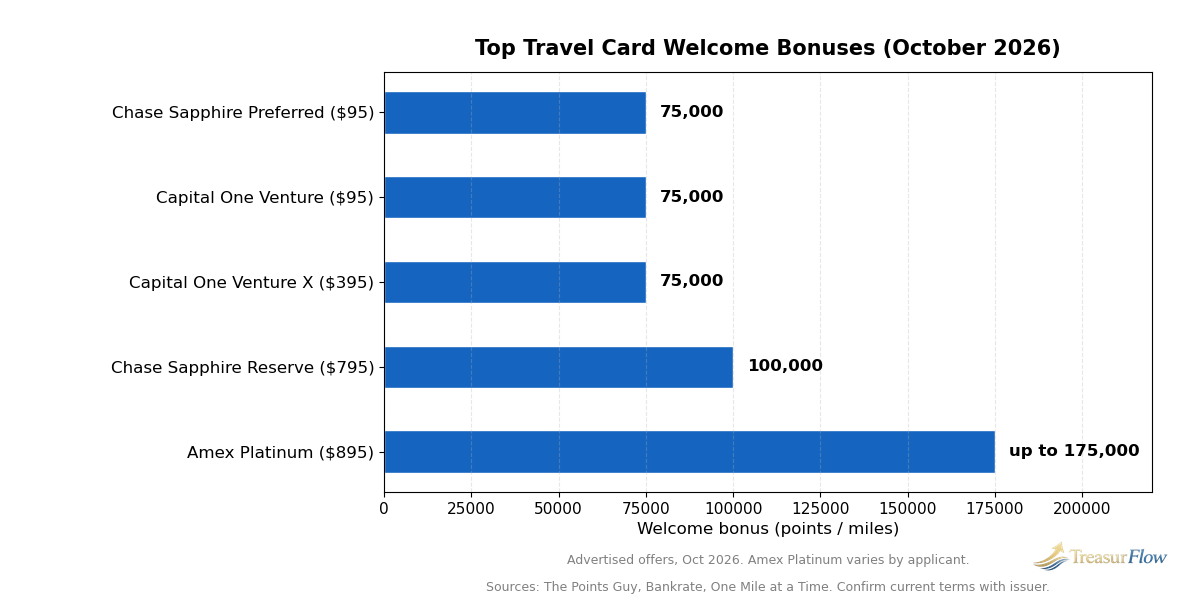
Among mainstream cards, the Amex Platinum’s welcome offer (up to 175,000 points) is the largest, followed by the Chase Sapphire Reserve’s 100,000 points and 75,000-point/mile offers from the Chase Sapphire Preferred, Capital One Venture, and Venture X. But “best” depends on attainability — a smaller bonus with a lower spending requirement you can comfortably meet beats a big one you can’t.
Final Take
The best travel rewards credit card of 2026 isn’t the one with the highest fee or the flashiest ads — it’s the one that matches how you actually travel. Beginners should start with the Chase Sapphire Preferred, frequent flyers get the most from the Venture X, luxury travelers who’ll use the perks can justify the Amex Platinum, and fee-haters do just fine with the Wells Fargo Autograph.
Whatever you choose, the unglamorous rules matter most: pay in full every month, don’t spend extra to chase a bonus, and re-check the fee math once a year. Do that, and your card will fund trips instead of funding the bank. If you’re still building toward your first big trip, our guides on saving money in 2026 and saving fast on a low income pair well with everything above.
Card details, fees, and offers change frequently. This article reflects offers advertised in 2026 — always verify current terms with the issuer before applying.

Muhammad Zakir is the founder of Treasurflow and the author of its personal finance guides. He researches consumer banking, credit, and personal loans, and every guide cites primary sources such as the CFPB, FDIC, FTC, and IRS. His content is educational and is not personalized financial advice.
2 thoughts on “Best Travel Rewards Credit Cards 2026: 10 Picks by Traveler Type”