

Best 529 Plans 2026: Top-Rated Plans Ranked by Fees, Ratings and State Tax Breaks
Ask a dozen “best 529 plan” lists which plan wins and you will get a dozen different answers. That is because a 529 is not really a national product. It is a state program with a federal tax wrapper, and the single biggest variable in how much a plan is worth to you is something no national ranking can see: whether your state hands you a tax deduction or credit for using its own plan.
So this guide works differently. Instead of crowning one winner, it starts with the decision that actually drives the outcome — your state’s tax break — then profiles the plans that independent raters put at the top of the class for 2026, explains the new rules that took effect this year (including the doubled K-12 limit and the 529-to-Roth IRA rollover), and shows the contribution math with clearly labelled hypothetical illustrations. Every rule, limit and rating cited here is current as of October 2026.
A quick note on safety: a 529 is an investment account, not a savings account. Balances can fall as well as rise, nothing here is personalized tax or investment advice, and state tax rules change. Use this guide to build a shortlist, then confirm the details for your state before you contribute.
Related Guides
- Best Roth IRA Accounts 2026 — the account unused 529 money can now roll into under the SECURE 2.0 rules
- Best Robo Advisors 2026 — another set-it-and-forget-it way families invest for long-term goals
- Best High Yield Savings Accounts 2026 — for education money needed within the next year or two, where investing is too risky
Helpful Official Resources
- IRS — Tax Topic No. 313: Qualified Tuition Programs
- IRS — 529 Plans: Questions and Answers
- IRS — Publication 970: Tax Benefits for Education
- Investor.gov (U.S. Securities and Exchange Commission) — investor.gov
The 2026 Shortlist at a Glance
Independent analyst Saving for College named seven direct-sold plans to its top “Top of the Class” tier in its 2026 ratings, and Morningstar’s analyst ratings repeatedly spotlight the same low-cost names. These are the plans that anchor this guide.
| Plan | Best for | Why it makes the list |
|---|---|---|
| Maryland College Investment Plan | Maryland residents; top ratings | Saving for College “Top of the Class” for 2026; strong age-based portfolios |
| Alaska 529 | Out-of-state shoppers; low fees | “Top of the Class” for 2026; open to residents of any state |
| Utah my529 | Lowest-cost age-based investing | Consistently top-rated by Morningstar and Saving for College; Vanguard-heavy line-up |
| Nevada Vanguard 529 | Vanguard fans | Direct access to Vanguard index portfolios inside a 529 wrapper |
| New York 529 Direct Plan | New York residents | Up to $10,000 state deduction for married couples, plus low fees |
| Illinois Bright Start | Illinois residents | Up to $20,000 state deduction for married couples; highly rated portfolios |
| Indiana CollegeChoice 529 | Indiana residents | A 20% state tax credit on contributions — the richest headline break in the country |
| West Virginia SMART529 | West Virginia residents | Two WV plans in the 2026 “Top of the Class” tier |
Notice what the table is really telling you: five of the eight entries earn their place partly through a home-state tax benefit. That is not an accident. It is how 529 math works.
Step One: Your State’s Tax Break Beats Any National Ranking
There is no federal income tax deduction for 529 contributions. What the federal government gives you is tax-free growth and tax-free withdrawals for qualified education expenses. The deduction, if there is one, comes from your state — and most states only grant it when you contribute to their own plan.
Run the arithmetic once and the ranking debate mostly settles itself. A married couple in New York who contribute $10,000 to New York’s 529 Direct Plan can deduct the full $10,000 from state taxable income. At an illustrative 6% state marginal rate, that is roughly $600 back on one year’s contributions, every year they contribute. Illinois is more generous still: up to $10,000 per individual and $20,000 per married couple. Indiana skips the deduction and offers a credit instead — 20% of contributions, subject to a state-set cap — which is why The College Investor’s 2026 net-return analysis ranked Indiana’s deal for its own residents as the best in the nation.
Three wrinkles matter:
Parity states. A handful of states — including Arizona, Kansas, Maine, Missouri, Montana and Pennsylvania — let you deduct contributions to any state’s plan. If you live in one of them, you can chase the lowest fees nationally and keep your deduction.
No-benefit states. Several states with an income tax, including California and Hawaii, offer no state tax benefit for 529 contributions at all. If you live in one, ignore state loyalty completely and shop the national low-fee leaders.
The fee gap is real but smaller than the tax gap. According to The College Investor’s 2026 analysis, 45 of 49 plans cut fees in the past year, so the cost difference between a good home-state plan and the cheapest national plan is often a few hundredths of a percent. A state tax break worth hundreds of dollars a year usually swamps that. The exception: if your home plan is both high-fee and offers you no break, leave.
The Top Plans, Profiled
Maryland College Investment Plan — the ratings leader
Maryland’s direct-sold plan took a “Top of the Class” designation in Saving for College’s 2026 ratings, the only tier that outscores more than 80% of peers. It is managed by T. Rowe Price and built around enrollment-date and age-based portfolios that de-risk automatically as college approaches. Maryland residents also get a state subtraction from income for contributions (per-beneficiary limits apply under Maryland law). If you live in Maryland, this is the rare case where the national ratings and the home-state math point to the same plan.
Alaska 529 — the open-door low-cost option
Alaska 529 also landed in the 2026 “Top of the Class” tier, and Alaska’s second plan, the T. Rowe Price 529, joined it there — an unusual double. Alaska offers no state income tax, so there is no home-state deduction distorting the comparison: these plans compete on fees and portfolio quality alone, and anyone in any state can enroll. That makes Alaska 529 one of the cleanest choices for residents of no-benefit states.
Utah my529 — the fee minimalist’s favourite
Utah’s my529 has spent years at or near the top of both Morningstar’s analyst ratings and Saving for College’s ratings, thanks to very low costs and a line-up heavy on Vanguard index funds, including age-based options that glide toward FDIC-insured accounts as the beneficiary nears college. Utah residents may also claim a state tax credit on contributions (Utah’s credit replaces a former deduction; check current Utah limits before filing). For families in no-benefit or parity states, my529 is the plan to beat.
Nevada Vanguard 529 — brand-name index investing
Nevada sponsors several 529s; the one that matters for do-it-yourself savers is the Vanguard 529 College Savings Plan, which wraps Vanguard’s index portfolios in a 529 with competitive all-in costs. Nevada has no state income tax, so again the appeal is pure product quality. If your taxable investing already lives at Vanguard, the familiarity is a genuine practical benefit.
New York 529 Direct Plan — the deduction heavyweight
New York pairs one of the largest state deductions — up to $5,000 for single filers and $10,000 for married couples filing jointly — with a low-cost, Vanguard-managed direct plan. For a New York family maxing the deduction every year from birth to age 18, the cumulative state tax savings alone can run into five figures. Out-of-staters get no benefit here, which is exactly the point of this guide’s state-first approach.
Illinois Bright Start — big deduction, strong portfolios
Bright Start lets Illinois individuals deduct up to $10,000 and married couples up to $20,000 of contributions per year, and its age-based portfolios have drawn consistently strong analyst reviews. For Illinois residents it is very hard for an out-of-state plan’s slightly lower fee to overcome a deduction of that size.
Indiana CollegeChoice 529 — the 20% credit
Indiana’s CollegeChoice plan is this guide’s tax-break champion: the state offers a tax credit of 20% of contributions (up to a state-capped maximum per year), and credits are worth more than deductions of the same size because they reduce tax owed dollar-for-dollar. The College Investor’s 2026 net-ROI study put Indiana residents’ deal at the top of the country for exactly this reason. If you pay Indiana income tax, start here.
West Virginia SMART529 — the small-state overachiever
Both of West Virginia’s direct plans — SMART529 Select and the SMART529 WV Direct plan — made Saving for College’s 2026 top tier. West Virginia residents have historically been able to deduct contributions generously under state law. It is a useful reminder that plan quality does not track state size.
What Counts as a Qualified Expense in 2026
The list of things 529 money can pay for, tax-free, is wider than most families realise — and it widened again under the One Big Beautiful Bill Act (OBBBA), signed in July 2025.
For college and other post-secondary education:
- Tuition and mandatory fees at eligible institutions (including most colleges, universities, vocational and trade schools)
- Room and board, if the student is enrolled at least half-time
- Books, supplies and equipment required for coursework
- Computers, software and internet access used for schoolwork
- Registered apprenticeship program costs
- Up to $10,000 in student loan repayments per beneficiary, over a lifetime
For K-12, the 2026 expansion: before 2018, 529s could not be used for K-12 at all. The TCJA opened K-12 tuition only, capped at $10,000 a year. OBBBA changed both halves of that rule:
- From July 5, 2025, qualified K-12 expenses expanded beyond tuition to include curriculum materials and books, tutoring by a qualified non-relative, standardized test and AP exam fees, dual-enrollment fees, and educational therapies for students with disabilities.
- From January 1, 2026, the annual tax-free K-12 withdrawal cap doubled to $20,000 per beneficiary per year — one combined cap across all of a child’s 529 accounts, not per account.
One caution: roughly a dozen states still do not treat some or all K-12 withdrawals as qualified under state law. A withdrawal that is tax-free federally can still trigger state income tax — and recapture of deductions you claimed earlier. Check your state’s conformity before using a 529 for K-12. Computers, note, remain a college-only expense; they are not qualified at the K-12 level.
Withdrawals beyond the qualified list are not forbidden, but the earnings portion is taxed as ordinary income and hit with a 10% additional tax. Your original contributions always come back tax-free, because they were made with after-tax money.
Contribution Rules: The Annual Exclusion, Superfunding and State Caps
There is no federal limit on how much you can put into a 529 each year. The constraints come from gift tax and from each state’s aggregate balance cap.
The annual gift tax exclusion. Contributions are treated as gifts to the beneficiary. For 2026, the annual exclusion is $19,000 per recipient (or $38,000 for a married couple splitting gifts), unchanged from 2025. Contribute more than that to one child’s plan in a year and the excess must be reported on a gift tax return and counts against your lifetime gift and estate exemption — $15 million per person in 2026, per the IRS figures published for the year.
Superfunding. A special rule, Internal Revenue Code §529(c)(2)(B), lets you contribute up to five years of exclusions at once and elect on Form 709 to spread the gift evenly over five years. For 2026 that means $95,000 per beneficiary from one donor, or $190,000 from a married couple, in a single year, with no gift tax and no use of your lifetime exemption. The trade-offs: you generally cannot give that beneficiary more during the five-year window without gift-tax consequences, and if the donor dies inside the window, a pro-rated share is added back to the estate.
The compounding case for superfunding, as a hypothetical illustration at a 6% annual return (not a prediction): $95,000 contributed at a child’s birth grows to about $271,162 by age 18. Spreading the same total as $19,000 a year over five years reaches about $242,154. Same money in, roughly $29,009 more out — purely because more of it was invested for longer.
State balance caps. Each state sets a maximum aggregate account balance per beneficiary, typically between $300,000 and $500,000 or more. Once the account hits the cap, new contributions stop (earnings can keep growing it). For almost every family this ceiling is theoretical, but it is the only hard federal-adjacent limit in the system.
Ownership and control. The account owner — usually a parent or grandparent — keeps control of the money indefinitely. The beneficiary has no right to it. Owners can change beneficiaries to another member of the family (siblings, step-siblings, parents, first cousins, a spouse, and more) with no tax cost, and can change investment options twice per calendar year.
How Much Should You Save? A Worked Illustration
There is no official target, but a common planning rule of thumb is to aim to save about one-third of expected college costs in the 529, cover one-third from income and other resources during college, and borrow or find aid for the rest. The table below shows what steady monthly saving builds at a hypothetical 6% annual return, compounded monthly — an illustration, not a forecast. Investment returns vary and will not be this smooth.
| Monthly saving | Start at birth (18 yrs) | Start at age 5 (13 yrs) | Start at age 10 (8 yrs) |
|---|---|---|---|
| $150 | $58,103 (you put in $32,400) | $35,317 (you put in $23,400) | $18,424 (you put in $14,400) |
| $300 | $116,206 (you put in $64,800) | $70,634 (you put in $46,800) | $36,849 (you put in $28,800) |
| $500 | $193,677 (you put in $108,000) | $117,724 (you put in $78,000) | $61,414 (you put in $48,000) |
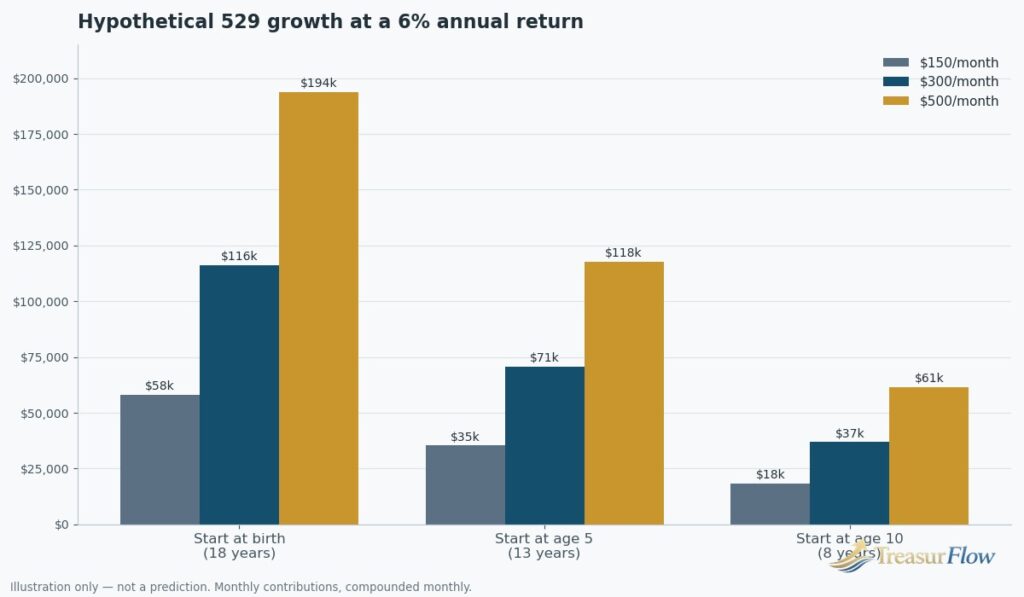
Two lessons hide in the numbers. First, starting at birth rather than age 10 roughly triples the outcome at the same monthly amount — time in the market does more than contribution size. Second, even the “late start” columns are worth having: $36,849 tax-free covers a meaningful share of an in-state public degree. The best plan is the one you actually fund, started now.
How a 529 Affects Financial Aid
On the FAFSA, a 529 owned by a parent is reported as a parental asset, assessed at a maximum rate of 5.64%. In plain terms, $10,000 in a parent-owned 529 reduces aid eligibility by at most $564 — a far gentler treatment than student-owned assets, which are assessed at up to 20%.
There is also good news for grandparents. Under the old FAFSA, money paid from a grandparent-owned 529 counted as student income and could slash aid. Since the FAFSA Simplification Act took effect with the 2024–25 form, grandparent 529 distributions are no longer reported as income at all. Grandparents can now fund a 529 without the aid penalty that used to punish the strategy. (Private colleges using the CSS Profile may still ask about outside 529s, so aid-sensitive families applying to those schools should check each college’s policy.)
If Your Child Doesn’t Go to College: The Exit Ramps
Fear of “wasting” a 529 used to be the top reason families under-saved. The exit ramps are now wide enough that it should not stop you:
- Change the beneficiary. Move the money to a sibling, a cousin, a parent going back to school — or keep it for a future grandchild. No tax, no penalty, as long as the new beneficiary is a member of the family.
- Use it for other education. Trade school, registered apprenticeships, professional credentials and up to $20,000 a year of K-12 costs all qualify in 2026.
- Scholarship exception. If the beneficiary wins a scholarship, you may withdraw an equal amount without the 10% penalty. You will owe ordinary income tax on the earnings portion only.
- Repay student loans. Up to $10,000 per beneficiary, per lifetime, can go to student loan payments.
- Roll it to a Roth IRA. Since January 1, 2024, SECURE 2.0 has allowed leftover 529 money to roll into a Roth IRA for the beneficiary, tax- and penalty-free, under strict conditions:
- The 529 account must have been open for at least 15 years.
- The lifetime rollover cap is $35,000 per beneficiary (not indexed for inflation).
- Contributions from the last five years (and their earnings) are not eligible.
- Each year’s rollover counts against the annual Roth IRA contribution limit — $7,500 in 2026 if under 50, $8,600 if 50 or older — so moving the full $35,000 takes at least five years.
- The beneficiary must have earned income at least equal to the rollover that year, and the transfer must be direct, trustee-to-trustee.
- The usual Roth IRA income limits do not apply to these rollovers.
That last ramp converts the worst case of over-saving into a head start on your child’s retirement — the single biggest improvement to 529 flexibility in decades.
How to Open a 529 (About 15 Minutes)
- Decide whose plan. Start with your home state’s plan if it offers you a deduction or credit; otherwise shortlist the national leaders above.
- Pick the investment. Most families choose an age-based or enrollment-date portfolio, which starts growth-oriented and automatically shifts conservative as college nears. It is the default for a reason.
- Open online with the plan directly (“direct-sold”). You will need the beneficiary’s Social Security number and date of birth. Skip advisor-sold share classes unless you specifically want an advisor — they add cost.
- Automate a monthly contribution, even a small one. The worked table above is an argument for autopilot.
- Revisit once a year — check the balance against your goal, and note your state’s deduction deadline (usually December 31; a few states allow contributions into the new year).
529 Questions Parents Ask Us Most
What is the best 529 plan in 2026?
For most families, the best 529 plan is their own state’s plan when it offers a tax deduction or credit — that break is usually worth more than small fee differences. Independent raters put Maryland’s College Investment Plan, Alaska 529 and West Virginia’s SMART529 plans in the top tier for 2026, while Utah’s my529, Nevada’s Vanguard 529, New York’s 529 Direct and Illinois Bright Start are perennial low-cost leaders. Indiana residents get the richest home-state deal in the country: a 20% state tax credit on contributions.
How much can I contribute to a 529 plan in 2026?
There is no federal annual contribution limit, but contributions count as gifts. In 2026 you can give up to $19,000 per beneficiary (or $38,000 as a married couple) under the annual gift tax exclusion, or “superfund” up to $95,000 per beneficiary ($190,000 per couple) using the five-year election on Form 709. Each state also caps total account balances per beneficiary, typically somewhere between $300,000 and $500,000 or more.
What can 529 money be used for in 2026?
Qualified expenses include college tuition and fees, room and board for at least half-time students, books and required supplies, computers for college coursework, registered apprenticeship costs, and up to $10,000 per beneficiary in lifetime student loan repayments. For K-12, the tax-free withdrawal cap doubled to $20,000 per beneficiary for 2026, and the list now covers books and curriculum materials, qualified tutoring, test fees, dual enrollment and educational therapies — though about a dozen states still tax some K-12 uses.
What happens if my child doesn’t go to college?
The money is not lost. You can change the beneficiary to another family member at no tax cost, spend it on trade school or apprenticeships, withdraw up to the amount of any scholarship penalty-free (tax applies to earnings only), repay up to $10,000 of student loans, or — if the account is at least 15 years old — roll up to $35,000 into a Roth IRA for the beneficiary under the SECURE 2.0 rules. Only earnings withdrawn for truly non-qualified purposes face income tax plus a 10% penalty.
Does a 529 plan hurt financial aid?
Only mildly, and less than it used to. A parent-owned 529 counts as a parental asset on the FAFSA, assessed at a maximum of 5.64% — so $10,000 saved reduces aid eligibility by at most $564. Since the 2024–25 FAFSA simplification, distributions from grandparent-owned 529s are not reported as student income at all, removing the old penalty for grandparent saving. Colleges using the CSS Profile may treat outside 529s differently, so check with target schools.
Can I open a 529 plan in another state’s plan?
Yes. Almost every direct-sold 529 accepts account owners from any state, and the money can be spent at eligible schools anywhere. The trade-off is tax: most states only give their deduction or credit for contributions to their own plan, so going out of state usually means giving that break up. Residents of tax-parity states (including Arizona, Kansas, Maine, Missouri, Montana and Pennsylvania) can deduct contributions to any state’s plan, and residents of no-benefit states lose nothing by shopping nationally.
The Bottom Line
Choosing a 529 in 2026 is a two-step decision. First, find out what your state will pay you to stay home: a deduction in New York or Illinois, or Indiana’s 20% credit, beats almost any fee advantage elsewhere. Second, if your state offers nothing — or gives you parity — buy one of the proven national plans: Maryland, Alaska, Utah, Nevada’s Vanguard plan or West Virginia’s SMART529. Then automate contributions, lean on the new flexibility (the $20,000 K-12 cap and the $35,000 Roth rollover exit), and let compounding do the heavy lifting.
Disclaimer: This article is educational information, not tax, legal or investment advice. 529 plan rules, state tax benefits and ratings change; figures and plan details are as reported by the IRS, Saving for College, Morningstar and plan sources as of October 2026. Investments in 529 plans involve risk, including possible loss of principal. Consult a qualified tax professional about your state’s rules before contributing or withdrawing.

Muhammad Zakir is the founder of Treasurflow and the author of its personal finance guides. He researches consumer banking, credit, and personal loans, and every guide cites primary sources such as the CFPB, FDIC, FTC, and IRS. His content is educational and is not personalized financial advice.