
Your income is the engine behind almost everything else in your financial life. It pays the rent or mortgage, covers food and utilities, funds your savings, and keeps debt under control. Yet most people insure their car, their home, and even their phone before they insure the one thing that pays for all of them: their ability to work.
Disability insurance exists to fix that gap. It replaces part of your income if an illness or injury stops you from doing your job. According to the National Association of Insurance Commissioners (NAIC), citing the U.S. Social Security Administration, more than one in four of today’s 20-year-olds will become disabled before reaching retirement age. That is not a remote risk. It is a risk that deserves a place in any serious financial plan for 2026.
This guide takes an income-protection approach. Instead of jumping straight to company names, it first explains what disability insurance actually replaces, why Social Security disability benefits alone leave a large gap, and how the five policy levers that set your price really work. Only then does it compare short-term and long-term cover, group and individual policies, and the providers worth shortlisting — framed honestly as “best for” categories, because no single policy is best for everyone.
Related Guides
- Best Life Insurance 2026 — protect your family’s income if you die, alongside cover that protects it while you live.
- Best Identity Theft Protection Services 2026 — another layer of financial protection worth comparing once your income cover is in place.
- Best Budgeting Apps 2026 — work out exactly how much monthly income you would need to replace before you choose a benefit amount.
Helpful Official Resources
- NAIC — Simplifying the Complications of Disability Insurance — plain-English guidance from state insurance regulators on comparing policies.
- Social Security Administration — Disability Benefits — how SSDI works, who qualifies, and how to apply.
- U.S. Department of Labor — Employee Benefits Security Administration — your rights under employer benefit plans, including disability claims procedures.
- Consumer Financial Protection Bureau — federal consumer guidance on financial products and on using disability income when applying for credit.
What Disability Insurance Actually Replaces
Disability insurance is income insurance. It does not pay hospital bills, and it does not pay out simply because you received a diagnosis. It pays a monthly benefit when a covered illness or injury prevents you from working and earning, so that your household bills can still be paid while you recover.
The NAIC puts the typical figure clearly: a typical disability policy benefit is approximately 60% of earned income before the disability. Insurers cap the percentage deliberately. If a policy replaced 100% of your pay, there would be little financial reason to return to work, so benefits are set high enough to keep a household afloat but below full salary. The exact percentage in your contract is based on your income at the time the policy was purchased, and it can be reduced by other sources of support, such as Social Security disability payments or an employer’s long-term disability plan. That coordination rule surprises many people: holding two policies does not always mean receiving two full benefits.
What counts as a disability also matters more than most buyers expect. The NAIC notes that the most common causes of long-term disability are heart disease, back injury, and cancer, followed by anxiety and depression. In other words, the typical claim is not a dramatic workplace accident. It is an illness or a musculoskeletal problem that builds over time. A policy that only covers accidents, and not illness, leaves out the most likely reasons you would claim — so always check whether a policy covers both accident and sickness.
Disability insurance is also different from workers’ compensation. Workers’ compensation only responds when the injury or illness is connected to your job. Disability insurance does not require that link. A back injury from weekend sport, a cancer diagnosis, or a serious infection can all qualify under a disability policy, provided the contract’s definition of disability is met.
Finally, understand the difference between total and partial disability. Some policies require you to be totally disabled before they pay anything. Others pay a partial amount if an injury restricts you from performing only part of your job. Many real disabilities are partial, especially during recovery, when you might return to work part-time on reduced earnings. A residual benefit — sometimes built in, sometimes added as a rider — fills that income gap. For many workers, residual cover is the difference between a policy that helps in the real world and one that only helps in the worst case.
The SSDI Gap: Why Social Security Alone Is Not Enough
Many workers assume the government will step in if they cannot work. Social Security Disability Insurance (SSDI) does exist, and it is a genuine safety net for people with a sufficient work history. But relying on it as your only plan leaves three serious gaps: a strict test, a long wait, and a benefit based on your earnings record rather than on what your household actually needs.
First, the test is strict. The Social Security Administration (SSA) pays disability benefits only to people who cannot work because of a medical condition that is expected to last at least one year or is terminal, and who meet its earnings requirements. In practice, you must show that you cannot do the work you did before, that you cannot adjust to other work because of your condition, and that the condition has lasted or is expected to last at least 12 months or result in death. That is close to an “any-occupation” standard — the toughest definition used anywhere in disability insurance. Crucially, SSDI pays nothing for a partial disability and nothing for a short-term disability. A six-month absence from work, which is financially devastating for most households, is simply outside the program.
Second, the wait is long. The NAIC notes that after applying, it can take several months to process an SSDI application — and that is before any appeal if a first application is not approved. Approval is far from automatic, and disputed cases can take considerably longer. Rent, mortgage payments, and utility bills do not pause while an application is reviewed. A private policy with a 90-day elimination period can be paying while an SSDI claim is still being assessed.
Third, the amount is fixed by formula, not by need. Your SSDI benefit is calculated from your lifetime earnings record. Workers with lower or interrupted earnings — carers returning to work, part-time workers, people who spent years self-employed with modest reported income — will receive correspondingly modest benefits. There is no opportunity to choose a higher benefit in exchange for a higher contribution, as there is with a private policy where you select the monthly benefit when you buy.
None of this means SSDI is worthless. If you qualify, it provides a foundation, and it can continue until you can work again or reach full retirement age, when it converts to retirement benefits. The point is narrower and more practical: SSDI was designed as a floor for severe, long-term disability, not as a complete income-replacement plan. Private disability insurance exists to cover everything above that floor — the first months, the partial disabilities, the shorter absences, and the difference between a formula-based benefit and your actual bills.
Short-Term vs Long-Term Disability Insurance Compared
The disability insurance market splits into two products that solve two different problems. Understanding which problem you are solving is the first real buying decision.
Short-term disability insurance replaces a portion of your salary for a brief period following a disability. The NAIC describes the typical range as three to six months. Short-term cover is most often provided through an employer, sometimes paid for by the employer and sometimes offered as a voluntary benefit you buy at a group rate. It is designed for events you are likely to recover from in weeks or months: surgery with a defined recovery period, a broken bone that keeps you off your feet, a complicated pregnancy, or a short course of treatment. Waiting periods on short-term policies tend to be short, because the whole point is to bridge a brief gap.
Long-term disability insurance begins where short-term cover ends. The NAIC explains that long-term benefits will generally begin six months after the disability and can last years or even until retirement age. Benefit periods on individual long-term policies commonly run for two years, five years, or to age 65 or 67. This is the cover that protects you against the financially catastrophic scenario: a stroke, a serious cancer, a major back injury, or a mental health condition that keeps you out of work for years. Most individual policies sold directly to consumers are long-term policies, because that is where the uninsured risk is greatest.
| Feature | Short-Term Disability | Long-Term Disability |
|---|---|---|
| Typical benefit period | About 3 to 6 months | 2 years, 5 years, or to age 65/67 |
| Typical start of benefits | After a short waiting period, often days to a few weeks | Often around 6 months after disability begins; commonly 90 or 180 days on individual policies |
| Common source | Employer group plan | Employer group plan or individual policy |
| Main job | Bridge a brief absence you expect to recover from | Protect against a career-changing disability |
| Income replaced | A portion of salary, per the NAIC | Typically about 60% of pre-disability earned income, per the NAIC |
The two products are complements, not substitutes. A common and sensible structure is to let an employer’s short-term plan (or your own emergency savings) cover the first few months, and to hold long-term cover for everything after that. If you have no short-term cover and little savings, a long-term policy with a long elimination period will leave you exposed in exactly the months when money is tightest — which is why the elimination period decision, covered next, has to match your savings honestly.
One more state-level wrinkle: a small number of states, including California, Hawaii, New Jersey, New York, and Rhode Island, provide or require employers to provide short-term disability benefits. If you work in one of those states, check what the state program already covers before paying for duplicate short-term protection privately.
The 5 Policy Levers That Set Your Price
Disability insurance pricing is not mysterious once you see the levers. Five choices in the contract do most of the work in setting both your premium and how useful the policy will be when you claim. Adjust them deliberately, in the right order, and you can usually reach an affordable premium without gutting the cover.
Lever 1: The Elimination Period
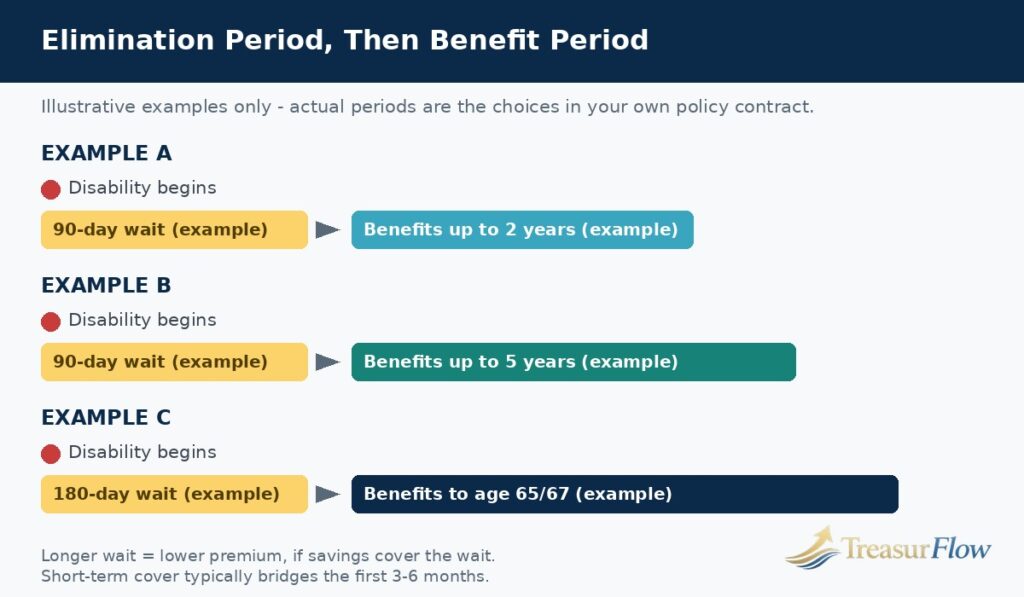
The elimination period is the wait between the start of a disability and the first benefit payment. Think of it as a deductible measured in time. The NAIC notes that a 30-day waiting period is common, and that policies with longer waiting periods generally have lower premiums. Individual long-term policies commonly offer 30, 60, 90, or 180 days, with 90 days a frequent choice because it balances a meaningfully lower premium against a wait most households with an emergency fund can survive.
The honest test is your savings. If you hold three months of expenses in an accessible account, a 90-day elimination period is reasonable. If you hold two weeks of expenses, it is not — you would run out of money before the first cheque arrived. Extending the elimination period is the first lever to pull if a quote is too expensive, but only as far as your savings genuinely allow.
Lever 2: The Benefit Period
The benefit period is how long benefits last for a single disability. The NAIC frames the choice plainly: you will generally have options ranging from one year to retirement age, and choosing a shorter period will likely make the premium lower — but benefits could run out while you are still disabled.
A two-year benefit period is much cheaper than cover to age 65 or 67, and it is also much less protective. Many serious disabilities last longer than two years, and the financial damage concentrates in exactly those long cases. Shortening the benefit period is a legitimate way to cut cost if the alternative is buying nothing, but understand the trade: you are insuring the common, shorter claims and self-insuring the rare, ruinous one. For most primary earners, a benefit period to age 65 or 67 is the benchmark worth pricing first.
Lever 3: The Definition of Disability — Own-Occupation vs Any-Occupation
This lever is the most important sentence in the contract, and the one buyers read least. The NAIC summarises the split: some policies pay benefits if you are unable to perform the duties of your occupation, while others require that your disability keep you from any gainful employment for which you are qualified.
An own-occupation policy pays if you cannot perform the material and substantial duties of your regular occupation, even if you could work in another job. A true own-occupation definition, offered by a small group of specialist carriers, can pay full benefits even while you earn income in a different occupation. An any-occupation policy pays only if you cannot work in any occupation suited to your education, training, and experience — a standard close to the SSDI test.
The classic example is a surgeon, dentist, or trial lawyer who suffers a hand injury. Under an own-occupation definition, the claim can pay because they cannot do their own job. Under an any-occupation definition, the insurer can argue they can still do desk-based work, and the claim may fail. Many group plans use own-occupation for the first 24 months and then switch to any-occupation, so ask not only which definition a quote uses, but for how long. The longer and purer the own-occupation wording, the higher the premium — and for highly trained specialists, it is usually the premium most worth paying.
Lever 4: Riders
Riders are optional extras that reshape a basic policy. Used well, they fix the policy’s known weaknesses. Used badly, they inflate the premium with features you will never claim on. The riders most worth understanding are:
- Residual or partial disability benefit — pays a proportion of the benefit if you return to work part-time or with reduced duties and lose income as a result. The NAIC describes this as coverage that fills the gap in income if you are partially disabled. For many claimants, this is the most-used feature in the contract.
- Cost-of-living adjustment (COLA) — increases benefits during a claim to offset inflation, for an additional premium. It matters most on long benefit periods: a fixed benefit paid for 20 years loses substantial buying power.
- Future increase option — lets you buy more cover later as your income rises, without new medical underwriting. Valuable if you are early in your career and your earnings are likely to grow, because your benefit is otherwise fixed to your income at purchase.
- Waiver of premium — exempts you from paying premiums while you are disabled, until the disability ends. The NAIC notes this is typically included in a policy rather than sold separately, so check it is present.
Lever 5: The Monthly Benefit Amount
The final lever is the benefit itself. Start from need, not from a round number. Add up the monthly costs that must continue if your income stops: housing, food, utilities, transport, insurance premiums, minimum debt payments, and essential healthcare costs. Then subtract income that would continue anyway, such as a partner’s earnings or an employer’s plan. The remainder is the gap your policy needs to fill.
Remember the tax point when you size the benefit. A benefit from an individual policy you paid for yourself is generally received income tax-free, while a benefit from an employer-paid group policy may be partly taxable. Two policies with the same headline monthly benefit can therefore leave you with noticeably different amounts to spend. Size the benefit on the after-tax figure you would actually receive.
A practical order for adjusting a quote that comes back too expensive is: first, lengthen the elimination period as far as your savings allow; second, reconsider the benefit period; and only as a last resort, reduce the monthly benefit. Cutting the benefit amount undermines the purpose of the policy every single month of a claim, whereas the other levers only bite in narrower circumstances.
Group (Employer) vs Individual Policies
Most Americans who have disability insurance have it through work. That group cover is valuable — but it has structural limits that every employee should understand before deciding it is enough.
Group cover through an employer is usually cheaper or even free to the employee, and it typically involves little or no medical underwriting, which makes it the easiest cover to get if you already have health conditions. Some employers pay the full premium; others offer disability cover as a voluntary benefit you purchase at a group rate through payroll deduction. Against those advantages sit four limits. The benefit is usually capped well below what higher earners need. The definition of disability is often any-occupation after an initial period. The cover is rarely portable: leave the job and the protection usually ends. And if the employer paid the premiums, the benefits may be taxable when you receive them, shrinking their real value.
An individual policy is bought by you, from an insurer or broker, and underwritten on your own health, age, occupation, and income. It costs more and involves medical and financial underwriting. In return, it is portable between jobs, you choose the benefit amount, elimination period, and benefit period, stronger own-occupation definitions are available, and — because you pay the premiums yourself — benefits are generally received income tax-free.
Renewability language is the other individual-policy detail to check. The NAIC explains the main options: a non-cancellable policy continues at the same price and coverage as long as you pay premiums on time; a guaranteed renewable policy renews automatically, but the premium may increase. Non-cancellable wording gives you the strongest price certainty and is a hallmark of the higher-quality individual contracts.
For most workers, the sensible answer is layered: keep the group cover your employer provides, then buy an individual policy to fill the gaps — the benefit cap, the definition, the portability, and the tax treatment. Also check whether your employer allows you to increase cover through the group policy, and whether a professional association in your field offers member cover at group rates, which can sit between the two options on both price and quality. Whatever route you take, verify that the insurer and agent are licensed with your state insurance department before you pay anything, as the NAIC advises.
Our Picks: Best Disability Insurance 2026 by Need
There is no single best disability insurance company for every buyer, because the right choice depends on your occupation, whether you need cover quickly, and whether you already have a group plan. The shortlist below is framed by need. It includes only well-known U.S. carriers and marketplaces that appear consistently across major consumer guides — including NerdWallet’s list of big sellers of individual disability insurance — and it deliberately avoids premium quotes, star ratings, and approval statistics, because individual disability premiums are set by personal underwriting and are not published by these carriers. Get quotes for your own age, occupation, and health before deciding.
Best for True Own-Occupation Cover: Guardian
Guardian is one of the carriers most consistently associated with strong own-occupation contract language, including specialty-specific wording for medical and other highly trained professionals. If your income depends on a specific skill set that took years to build — surgery, dentistry, law, or another licensed speciality — Guardian belongs on your shortlist for the definition of disability alone. Expect full medical and financial underwriting, and pricing that reflects the strength of the wording.
Best for Professionals Who Want a Customisable Individual Policy: MassMutual
MassMutual is a long-established mutual insurer, founded in 1851, and a major seller of individual disability income insurance. Its individual disability offering is built around customisation, with a range of optional riders — including cost-of-living and future-increase style options — that let professionals shape a policy around a rising career. It is a natural comparison quote alongside Guardian for white-collar and professional occupations.
Best for Comparing Several Carriers in One Place: Policygenius
Policygenius is not an insurer; it is a marketplace and broker that lets you compare disability quotes from multiple carriers with broker support. That matters in this market because individual disability insurance is hard to comparison-shop on your own: definitions, riders, and occupational classes differ in ways a single number cannot capture. If you do not already have an independent agent you trust, starting with a marketplace comparison is a practical way to see how the specialist carriers price your specific occupation.
Best for Short-Term Cover Through Work: Aflac
Aflac is best known for supplemental and short-term disability cover, frequently offered through employers. If your gap is the first few months of an absence — and your employer offers Aflac as a voluntary benefit — it can be a straightforward way to add short-term protection at a group rate. Check the benefit period and waiting period carefully, and treat it as a bridge to long-term cover rather than a replacement for it.
Best for a Recognised Name With Broad Individual Options: Principal and The Standard
Principal and The Standard complete the group of carriers most often recognised for individual disability insurance with own-occupation options, alongside Guardian, MassMutual, and Ameritas. Both are established names in employer benefits as well as individual cover, which makes them worth quoting if you want to compare a household-name insurer against the specialist contracts above. As with every pick here, the definition of disability, the residual benefit trigger, and the renewability wording will matter more than small differences in headline price.
Best for Budget-Conscious Buyers Adding a Top-Up: Mutual of Omaha and Assurity
Mutual of Omaha and Assurity appear consistently in consumer shortlists for more accessible individual disability cover, including options with simpler underwriting in some cases. They are worth considering if your priority is adding a modest individual top-up over an employer plan without the cost of a fully featured specialist contract. Compare the definition of disability especially carefully at this end of the market, since narrower wording is a common way to keep the price down.
A final warning on every pick: never choose on brand alone. Two policies from the same carrier can behave very differently depending on the definition, elimination period, and riders selected. The carrier gets you to the right shelf; the contract wording decides whether the policy pays.
Who Needs Disability Insurance Most, by Occupation Type
Everyone who relies on earned income needs a plan for disability. But the urgency and the right policy shape vary sharply by how you earn.
Medical and other licensed specialists have the strongest case for true own-occupation individual cover. Your income depends on precise physical and cognitive skills, your training was long and expensive, and a relatively specific injury can end your speciality while leaving you able to do other work. That is exactly the scenario any-occupation wording handles worst.
Self-employed people, freelancers, and business owners have no employer plan to fall back on at all, and no paid sick leave beyond what they fund themselves. You are both the worker and the business, so a disability threatens personal income and business survival together. Prioritise an individual long-term policy, prove your income carefully during underwriting with tax records, and ask about business overhead cover if you have premises or staff costs that continue while you cannot work.
Tradespeople and manual workers face higher physical risk, and their bodies are their tools. A back, shoulder, or knee injury that an office worker could work around may end a trade career. Occupation class will affect your price, and some contracts limit benefit periods for higher-risk classes, so compare carefully — and value residual cover, because graded returns to lighter duties are common in physical work.
Office and white-collar workers often assume they are low risk. In fact, the most common causes of long-term disability — heart disease, cancer, back problems, anxiety, and depression, per the NAIC — do not spare desk workers. Your main task is usually checking the limits of an employer group plan and topping it up individually, rather than starting from zero.
Early-career workers and residents or trainees benefit most from buying young. Premiums are lower when you are younger and healthier, underwriting is easier before conditions develop, and a future increase option lets the benefit grow with your income without fresh medical checks. Waiting until your income peaks usually means paying more for cover you could have locked in earlier.
Single-income households and primary earners in any occupation should treat disability cover as essential rather than optional. When one salary carries the mortgage and the family, that salary is a single point of failure. If that describes you, protect to age 65 or 67 first and trim elsewhere in the policy before trimming the benefit period.
How to Buy Disability Insurance: Step by Step
- Audit what you already have. Check your employer’s benefits for short-term and long-term group cover: the benefit percentage, cap, definition, and whether the employer pays the premium (which affects tax). Check also whether your state runs a short-term disability program. Many people discover they have some cover — and that it replaces far less than they assumed.
- Calculate the monthly gap. List the expenses that must continue, subtract income that would continue anyway, and arrive at the monthly benefit you actually need. Do this before requesting quotes, so quotes are built around your need rather than a salesperson’s default.
- Choose your levers. Decide the elimination period your savings can support, a benefit period — ideally to age 65 or 67 for a primary earner — and whether own-occupation wording is worth the premium for your occupation.
- Get comparable quotes. Quote the same benefit amount, elimination period, and benefit period across at least two or three carriers or through a marketplace or independent broker. Unlike-for-like quotes are the only quotes that tell you anything about price.
- Read the definition page before the price page. Confirm the definition of disability and how long it lasts, the residual benefit trigger, exclusions (especially for mental health conditions and pre-existing conditions), renewability wording, and how benefits coordinate with SSDI or a group plan.
- Complete underwriting honestly. Expect medical questions and, for larger benefits, financial documentation of your income. Answer fully and accurately: material misstatements are a leading reason claims are later disputed. Self-employed applicants should have tax returns ready.
- Verify licensing and keep the paperwork. Confirm the agent and insurer are licensed with your state insurance department, keep the full policy document — not just the summary — and diarise a review whenever your income, job, or health changes materially.
Common Claim-Denial Mistakes to Avoid
A good policy can still fail you if the claim is handled badly. The U.S. Department of Labor has strengthened the procedural protections for workers requesting disability benefits under employer plans — including fuller explanations when a claim is denied and the right to see the claim file — which tells you how often disputes turn on process rather than on the underlying condition. These are the mistakes that cause avoidable problems:
- Waiting too long to file. Policies set deadlines for notifying the insurer and filing a claim. Missing them gives the insurer a procedural reason to resist a claim that should have been straightforward. Notify early, even if your paperwork is incomplete.
- Thin medical evidence. Insurers decide on records, not on how ill you feel. Gaps in treatment, missed appointments, and notes that do not describe your functional limits — what you cannot actually do — are the most common evidential weaknesses. Keep attending treatment and make sure your restrictions are documented.
- Working above the policy’s limits without telling the insurer. Earning income during a claim is not automatically a problem — residual benefits exist precisely for partial work — but undisclosed work that contradicts your stated limitations undermines credibility fast.
- Inconsistent statements. What you tell the insurer, your doctor, and your employer needs to match. Social media posts showing activity that appears to contradict your claimed limitations are routinely used to challenge claims.
- Ignoring the definition switch. On group plans that move from own-occupation to any-occupation after 24 months, benefits can stop at the switch even though nothing about your health changed. Diarise that date from day one and gather evidence against the tougher test in advance.
- Giving up after a first denial. An initial denial is a decision, not the end of the road. Employer-plan claimants have appeal rights and are entitled to a fuller explanation of the reasons and the standards used. Read the denial letter carefully, request the claim file, and respond to the specific reasons given.
- Letting premiums lapse before or during a claim. A policy that has lapsed for non-payment pays nothing. If money is tight, contact the insurer about options before the policy lapses rather than after.
Disability Cover Questions, Answered Plainly
What does disability insurance actually pay for?
Disability insurance pays a monthly benefit to replace part of your income if an illness or injury stops you from working. It does not pay your medical bills — that is the job of health insurance. A typical policy replaces about 60% of your pre-disability earned income, according to the NAIC, and the money can be used for rent or mortgage payments, food, utilities, transport, and other everyday costs while you recover.
What is the difference between short-term and long-term disability insurance?
Short-term disability insurance replaces part of your salary for a brief period, typically three to six months, and is often provided through an employer. Long-term disability insurance generally begins after that early period — often around six months after the disability starts — and can pay for years or even until retirement age. Most people who buy an individual policy buy long-term cover, because a disability that lasts for years is the one that can do lasting financial damage.
What does own-occupation mean, and why does it matter?
Own-occupation means the policy pays if you cannot perform the material duties of your own regular occupation, even if you could earn money doing a different job. Any-occupation is stricter and pays only if you cannot work in any occupation suited to your education, training, and experience. The difference decides real claims: a surgeon who injures a hand may still be able to teach, but an own-occupation policy can still pay, while an any-occupation policy may not.
How long do I wait before disability benefits start?
That wait is called the elimination period, and it works like a deductible measured in time instead of money. A 30-day waiting period is common, and individual long-term policies commonly offer choices such as 30, 60, 90, or 180 days. Longer waiting periods generally have lower premiums, because you are covering the first weeks yourself from savings. Only choose a longer wait if you genuinely have the savings to fund it.
Can I rely on Social Security disability benefits instead of buying a policy?
Social Security Disability Insurance (SSDI) is a valuable safety net, but it is hard to qualify for and slow to arrive. The Social Security Administration requires a condition that prevents you from doing your past work and from adjusting to other work, and that has lasted or is expected to last at least one year or result in death. SSDI pays nothing for partial or short-term disability, and applications can take several months to process, so most workers still need their own cover for the gap.
Are disability insurance benefits taxable?
It depends on who paid the premium. In general, if you have an individual disability policy that you paid for yourself, payments received from the policy are income tax-free. If the payments come from a group policy for which an employer pays some or all of the premiums, a portion of the benefit may be taxable. That tax difference is one reason a group benefit that looks similar on paper can be worth less in practice than an individual benefit.
Conclusion: Protect the Income Everything Else Depends On
Disability insurance is not the most exciting purchase in personal finance, but it may be the most foundational. Life insurance protects your family if you die. Disability insurance protects everyone — including you — if you live but cannot earn. With more than one in four of today’s 20-year-olds expected to become disabled before retirement age, according to the SSA figures cited by the NAIC, this is not cover for other people.
The buying logic is straightforward once you see it clearly. Do not rely on SSDI alone: its test is strict, its wait is long, and it pays nothing for partial or short-term disability. Let savings or short-term cover handle the first months, and buy long-term cover for the years that would otherwise undo your financial life. Spend your premium where it counts — on a strong definition of disability, a benefit period to retirement age, and residual cover — and adjust the elimination period, rather than the benefit itself, when you need to bring the price down.
Start this week with the audit in step one above. Find out exactly what your employer already provides, work out your monthly gap, and get like-for-like quotes while you are young and healthy enough for underwriting to be easy. The best disability insurance 2026 shoppers will find is not a brand name. It is a contract whose definition, timing, and benefit match the way you actually earn a living.

Muhammad Zakir is the founder of Treasurflow and the author of its personal finance guides. He researches consumer banking, credit, and personal loans, and every guide cites primary sources such as the CFPB, FDIC, FTC, and IRS. His content is educational and is not personalized financial advice.