
Refinancing a student loan is not a shopping decision first. It is a decision decision first — and only then a shopping decision.
That order matters because the best student loan refinance 2026 offer on a lender’s homepage can still be the wrong move for you. A lower rate looks simple on paper. What it costs you is less visible: if the loan you are refinancing is federal, a private refinance permanently removes the safety net that came with it. No rate quote, however attractive, puts that safety net back.
So this guide works in the order a careful borrower should. First, who should refinance and who should not. Second, whether you are actually eligible for the rates being advertised. Third, the lenders worth checking, organised by borrower type rather than by who shouts the lowest number. Fourth, the real maths on a worked example, so you can see what a rate cut is worth in dollars — and what it is not worth. Finally, the situations where waiting beats refinancing, even when a lender says you qualify today.
Every rate range in this guide was checked against lender information and major comparison sources in October 2026, and every range is date-stamped accordingly. Rates change, the lowest advertised rate is reserved for the strongest borrowers, and no article can tell you your rate. Only a lender’s own eligibility check can do that. Treat the ranges below as a shortlist, not a promise.
Related Guides
- Best Personal Loans 2026 — if you are comparing other borrowing options alongside refinancing.
- Best Debt Consolidation Loans 2026 — how consolidation differs from refinancing, and when each one fits.
- Best Budgeting Apps 2026 — tools to free up cash for extra loan payments once you have refinanced.
Start With the Decision: Who Should Refinance, and Who Should Not
Refinancing means a private lender pays off one or more of your existing student loans and replaces them with one new private loan, with a new rate, a new term, and a new set of rules. That is all it is. The new loan is not a federal loan, even if the loan it replaced was. It does not inherit any of the old loan’s protections, and it cannot be converted back.
Borrowers who are usually good candidates
You are more likely to benefit if most of the following are true:
- Your loans are already private. Refinancing private loans into a new private loan costs you no federal protections, because you never had them. The decision is then mostly about rate, term, and fees.
- Your credit and income have improved since you borrowed. The borrowers who took out loans at 18 with a thin file are often, years later, employed graduates with a real credit history. That improvement is exactly what a lower refinance rate rewards.
- You have a stable income you expect to keep. A private loan expects the same payment in a bad month as in a good one. Stability is what makes giving up flexible federal payments a reasonable trade.
- You are not pursuing forgiveness. If you do not work for a government or qualifying non-profit employer, have no realistic path to Public Service Loan Forgiveness, and would pay your balance off in full on an income-driven plan anyway, the protections you would give up may be worth less to you than the interest you would save.
- Your current rate is clearly higher than the quotes you are actually receiving. Not the advertised floor rate — your personalised quote, after a soft credit check, on the term you actually want.
Borrowers who should usually not refinance federal loans
Pause — in most cases, stop — if any of the following apply:
- You work, or might work, in public service. Teachers, nurses in public hospitals, government staff, military members, and non-profit employees can have their remaining federal balance forgiven after 120 qualifying payments under Public Service Loan Forgiveness. Refinancing ends that eligibility immediately, and payments you have already counted toward the 120 stop counting for anything.
- Your income is low, variable, or uncertain. Income-driven repayment caps federal payments based on your income and family size, and can reduce them sharply when earnings fall. A private loan does none of that.
- You rely on federal deferment or forbearance. Federal loans come with defined options to pause or reduce payments during hardship, unemployment, or further study. Private lenders may offer something similar, but it is their choice, on their terms, and it is not guaranteed by law.
- You might need a federal discharge. Federal loans can be discharged in specific circumstances, including total and permanent disability and certain school closures. Private lenders are not required to offer the same.
- You are close to forgiveness already. If you are years into income-driven repayment or well into your PSLF payment count, the remaining benefit of staying federal will often outweigh a modest rate cut on a shrinking balance.
⚠️ Federal Loan Warning — Read This Before Anything Else
Refinancing federal student loans into a private loan is permanent and irreversible. StudentAid.gov and the Consumer Financial Protection Bureau both warn that borrowers who refinance federal loans with a private lender lose their rights under the federal student loan program. That includes income-driven repayment (IDR), Public Service Loan Forgiveness (PSLF), federal deferment and forbearance, and federal discharge options. A private lender is not required to offer you any of these. If there is a realistic chance you will need one of them, do not refinance that federal loan — no interest saving in this article is worth more than a forgiveness programme or an income-based payment you later need and no longer have.
Helpful Official Resources
- StudentAid.gov — Federal Student Aid — check which of your loans are federal, your servicer, your balances, and your current repayment plan before you compare any private offer.
- Consumer Financial Protection Bureau — Student Loans — the CFPB’s guidance on student borrowing, repayment, and refinancing risks, plus its complaint tool if a lender or servicer treats you unfairly.
- Federal Trade Commission — Student Loan Debt Relief Scams — the FTC warns that legitimate federal help is free at StudentAid.gov; never pay an upfront fee to a company promising quick forgiveness or special access.
The Eligibility Checklist: Can You Actually Get a Better Rate?
Advertised refinance rates are real, but they are not typical. They are the best a lender offers its strongest applicants — usually on a short term, with autopay, with excellent credit and a low debt-to-income ratio. Before you spend hope on a floor rate, walk through the checklist lenders actually use.
Credit history
Every lender in this guide checks credit, and the published minimums already tell a story. On NerdWallet’s comparison checked in October 2026, Earnest listed a minimum credit score of 650 and LendKey listed 680. Money’s October 2026 review listed ELFI at a minimum credit score of 680 as well. Those are floors for consideration, not thresholds for the best rate. Borrowers who receive floor rates typically present much stronger profiles than the minimum. If your score sits near a lender’s minimum, expect a quote well above the advertised low end — or a decline.
Check your reports for errors before you apply, make every payment on time in the months leading up to an application, and avoid opening other new credit at the same time. Small improvements can matter, because refinance pricing is tiered: crossing into a better tier can move your quote more than haggling ever will.
Income and debt-to-income ratio
Lenders want to see income that comfortably covers the new payment alongside your other debts. ELFI, for example, listed a minimum income of $35,000 in Money’s October 2026 review. Others do not publish a hard minimum but still weigh income and your debt-to-income ratio heavily. A high income with high existing debts can price worse than a moderate income with almost no other obligations. If your ratio is the weak point, paying down a credit card balance before applying may do more for your quote than waiting for your credit score to drift up.
Degree and school
Many lenders historically required a completed degree from an eligible school, and some still do. ELFI’s parent refinance product requires a bachelor’s degree or higher, according to Money’s review. But the market has widened: Earnest says refinancing may be available to borrowers with a bachelor’s or associate degree and, in some cases, to borrowers without a completed degree. Dedicated no-degree options also exist, covered in the lender picks below. If you left school without graduating, do not assume you are excluded — but do expect stricter conditions and check them carefully.
Loan type, balance, and status
Lenders set minimum and maximum amounts. ELFI requires a minimum of $10,000 to refinance, per Money’s review, while Earnest advertises refinancing up to $550,000 in eligible debt. Your loans generally need to be in good standing — refinancing is a tool for borrowers who are current on their payments, not an escape hatch from default. Federal loans in default need a federal solution first, through StudentAid.gov, not a private lender.
Citizenship and residency
Refinance lenders generally require U.S. citizenship or permanent residency, and availability can vary by state for some products and some rate types. If a lender’s page says a loan or a variable rate is not available in your state, that is a hard stop, not a technicality.
How the Lender Picks Below Were Chosen
The four lenders below were not chosen because they advertise the lowest numbers. They were chosen because each one is the clearest answer to a different borrower question: who is best overall, who serves parents, who takes borrowers without a degree, and who routes you to credit unions and community lenders instead of one big bank.
Rate ranges and eligibility details were checked against lender sites and published comparison sources in October 2026, and are stated as of that check. Within days they can move. Always recheck on the lender’s own site before applying, and treat any “as low as” figure as the start of a conversation about your profile, not a quote.
At a glance: rates checked in October 2026
| Lender | Fixed APR range | Variable APR range | Minimum credit score | Source checked |
|---|---|---|---|---|
| Earnest | 4.00%–9.79% | 5.68%–9.79% | 650 | NerdWallet |
| SoFi | 3.99%–10.49% | 5.24%–10.49% | Does not disclose | NerdWallet |
| Splash Financial | 3.99%–10.24% | 4.74%–10.24% | 650 | NerdWallet |
| LendKey | 4.39%–9.24% | See lender site | 680 | NerdWallet |
| ELFI | 4.29%–9.19% | See lender site | 680 | Money |
Two cautions about this table. First, SoFi and Splash Financial appear as market context only — they are legitimate refinance lenders worth quoting, but the picks below go deeper on the lenders that best fit specific borrower types. Second, these ranges come from third-party comparison pages checked in October 2026.
They are ranges, not quotes, and both the desk research and your own final rate check should happen on the lender’s website before you apply.
Understanding the table matters more than the table itself. Notice how close the lenders’ ranges sit to one another. A tenth of a point rarely changes a borrower’s life. What changes outcomes is the approval itself, the term you choose, whether you get a cosigner released, and whether you should be refinancing at all. That is why the picks below are organised by borrower type.
Best Overall for Rate and Flexibility: Earnest
Best for: Borrowers with decent credit who want flexible terms and the option to adjust payments as income changes.
Earnest is the most complete all-round refinance lender in this roundup. On NerdWallet’s checked comparison, Earnest advertised fixed APRs from 4.00% to 9.79% and variable APRs from 5.68% to 9.79%, with a minimum credit score of 650. The fixed range’s low end is among the most competitive of the lenders that publish their ranges openly, and the 650 minimum makes Earnest more reachable than rivals who quietly require scores in the 680s.
What separates Earnest is flexibility. On its own refinance page, Earnest says borrowers can choose a repayment term from five to 20 years, and — unusually — set a custom repayment term rather than picking from a fixed menu. It also says you can change your monthly payment amount or due date through its app, skip a payment once a year after six months of on-time payments, and refinance loans even before you have finished school, without having to wait six months after graduation. For a borrower whose income will rise over the next few years, the ability to start with a payment that fits today’s budget and reshape it later is worth more than squeezing the last few basis points out of a rate.
Earnest also advertises refinancing up to $550,000 in eligible debt, which covers most undergraduate and many graduate and professional borrowers. On eligibility, its site says refinancing may be available to borrowers with a bachelor’s or associate degree and, in some cases, to borrowers who did not complete a degree — one of the more open degree policies among national lenders.
Watch out for: None of this flexibility changes the federal warning above. Earnest will happily refinance your federal loans, and the moment it does, those loans are private. Use the flexibility if you borrow; do not let it rush the decision about whether to borrow.
Best for Parents: ELFI (Education Loan Finance)
Best for: Parents who borrowed for a child’s education and want a lender built around parent loans.
Parent borrowers are often an afterthought in refinance guides, which is strange, because parents carry real balances — most visibly Parent PLUS loans at federal rates that have climbed in recent years. ELFI, short for Education Loan Finance, treats parents as its core audience. It refinances parent loans and offers a dedicated Parent PLUS refinance path, in the parent’s own name or, where eligible, into the name of the student who benefited from the loan.
On Money’s October 2026 review, ELFI advertised fixed APRs from 4.29% to 9.19%, a minimum credit score of 680, and a minimum income of $35,000, with a $10,000 minimum loan amount. That is a competitive fixed range with transparent eligibility gates. A parent with a solid credit history, a long employment record, and a PLUS loan priced well above 9.19% has a genuinely strong case to check a quote.
Two ELFI specifics deserve emphasis. First, its parent refinance requires the parent borrower to hold a bachelor’s degree or higher, per Money’s review — a requirement many parents will meet but some will not, so check it before you invest time in the application. Second, ELFI’s option to move a PLUS loan into the student’s name is unusual and valuable: done carefully, with the student’s informed consent and a real personal rate quote, it can transfer the obligation to the person the family always intended to carry it, at a private rate instead of the parent’s federal one. Done carelessly, it loads a young borrower with debt they did not shop for. Talk it through as a family, in numbers, before anyone signs.
ELFI also promotes rate quotes with a soft credit check and application-fee-free refinancing, which lowers the cost of finding out where you stand.
Watch out for: Refinancing a PLUS loan gives up the federal options attached to it exactly as refinancing a student’s own Direct Loan does. A parent nearing retirement, or one whose income might fall, should weigh that trade with particular care — the forgiveness and income-based options for federal parent loans are narrower than for student loans, but they are not nothing.
Best With No Degree: EDvestinU
Best for: Borrowers who never finished a degree and are shut out by most other lenders.
EDvestinU, the student loan programme of the New Hampshire Charitable Foundation, exists for exactly the borrower most refinance lenders turn away. Its loan refinance page says Craig’s story — that of a student who did not graduate — is typical, and it frames eligibility around at least half-time enrollment historically, rather than around a completed credential. In plain terms: if you attended at least half-time, you may be able to refinance with EDvestinU even though you never graduated.
That positioning makes EDvestinU the natural pick for non-graduates. Its conditions are stricter than a mainstream lender’s — on its refinance page it says applicants must be current on any existing federal student loans or satisfy the foundation’s credit requirements, and cosigner release is listed among its features, with conditions stated there. Borrowers who have defaulted should not expect a private refinance of any kind until the default is resolved through federal channels.
Watch out for: Availability and terms are narrower than the big national lenders, and EDvestinU’s exact rates are published on its own loan pages rather than in the comparison tables used for the table above, so this guide deliberately does not quote a range for it. Check your eligibility on EDvestinU’s own site — and if a mainstream lender will take you, compare both quotes before choosing.
Best Credit Union Option: LendKey
Best for: Borrowers who prefer borrowing from a credit union or community bank but want one application.
LendKey is not a lender. It is the platform behind other institutions’ loans — its site says roughly 13,000 community financial institutions have used its technology. When you refinance through LendKey, the loan itself comes from a credit union or community bank in its network, which gives smaller, relationship-based lenders a way to offer nationally competitive refinancing.
On NerdWallet’s October 2026 checked figures, LendKey listed fixed APRs from 4.39% to 9.24% and a minimum credit score of 680 — a fixed ceiling lower than several rivals, which matters if your credit profile lands you mid-range rather than at the floor. If you like the idea of your loan being held and serviced within a community institution — and, often, of credit union member service — LendKey is the route in.
Watch out for: Because the actual lender sits behind the platform, your servicing experience, cosigner-release policy, and hardship options depend on the specific institution you are matched with. Read your matched lender’s terms as carefully as you would any standalone lender’s, and confirm the details in writing before you sign.
The Worked Example: What a Rate Cut Is Actually Worth
Rate comparisons are abstract until they are attached to a balance. Here is the guide’s single worked example, with the arithmetic shown so you can rerun it with your own numbers.
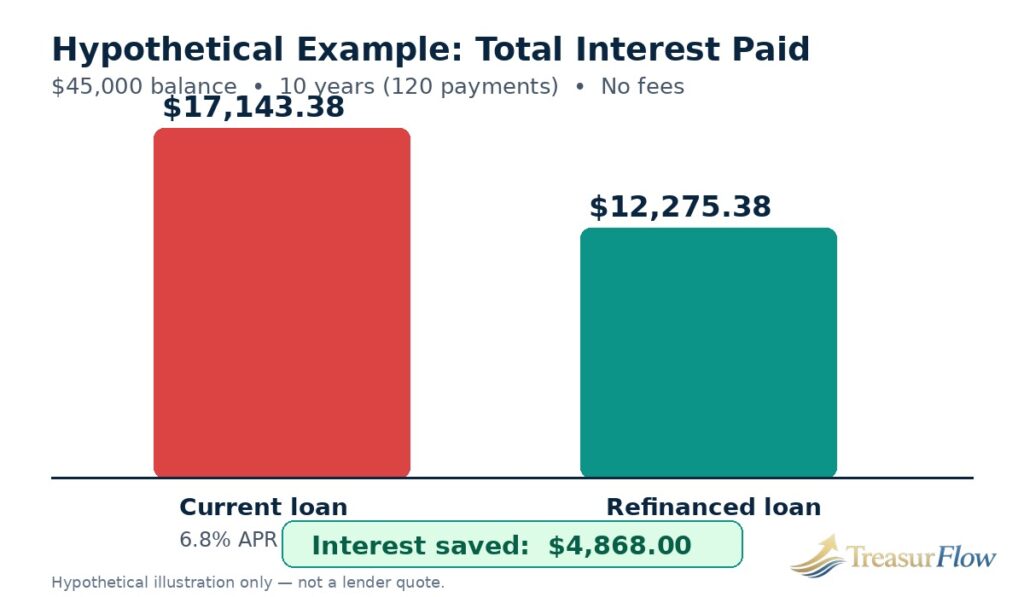
Hypothetical example: a $45,000 balance, repaid over 10 years (120 monthly payments), with no fees.
| Scenario | Rate | Monthly payment | Total paid | Total interest |
|---|---|---|---|---|
| Keep current loan | 6.8% | $517.86 | $62,143.38 | $17,143.38 |
| Refinance | 5.0% | $477.29 | $57,275.38 | $12,275.38 |
| Difference | 1.8 points | $40.57 less per month | — | $4,868.00 less interest |
Three lessons. First, the monthly difference — about $41 — looks small, and on its own it would not justify giving up federal protections for most borrowers. Second, the real prize is the total interest: nearly $4,900 less over the life of the loan, which is real money by any measure. Third, notice what produces the saving. It is not the lender’s brand or a clever trick; it is 1.8 percentage points, sustained over 120 payments, on a five-figure balance. The smaller your balance and the shorter your remaining term, the smaller any rate cut is worth — and the less sense it makes to trade federal protections for it.
Also notice what the example assumes: that you qualify for 5.0%, that you keep the same 10-year term rather than stretching it, and that there are no fees. Change any of those and the result changes. A borrower who refinances $45,000 at 5.0% but restarts the clock on a 15- or 20-year term can pay more total interest than the 6.8% loan they replaced, despite the lower rate — longer terms are the most common way a ‘saving’ quietly evaporates. Your own servicer statement, your own quote, and your own remaining term matter more than any example, including this one.
Fixed vs Variable: The Choice That Decides Your Risk
Every lender above will offer you some version of this choice, and it matters more than most borrowers realise. A fixed rate never changes: the payment you sign for is the payment you keep, for the whole term. A variable rate starts lower — look at the table above and you will see variable floors below fixed floors at several lenders — but it moves with a market index, and your payment moves with it.
Fixed is the default sensible choice for most refinancers, because refinancing is usually a decision you make once and then want to forget about. You lock in the improvement and get on with your life. It is also the only choice that makes a long term safe: over 15 or 20 years, a variable rate has many chances to rise.
Variable can make sense in narrower circumstances: a small balance you will clear in two or three years, a borrower whose income is rising fast, or someone who will sell the risk quickly by paying the loan off long before adjustments compound. If you choose variable, read the caps. Know the maximum the rate can reach, the worst-case payment at that rate, and confirm variable availability in your state — some lenders restrict variable loans by state.
What you should not do is choose variable purely because its starting number photographs better next to a fixed quote on a longer term. The worked example above used a fixed 5.0% for a reason: certainty is what you are buying when you refinance well.
Cosigner Release: Help That Should Not Last Forever
Many borrowers got their original loans — and some will get their refinance — with a parent or relative cosigning. A cosigner improves approval odds and pricing, but it also ties that person’s credit to your loan: the debt can appear on their credit report, count against their own borrowing, and put them on the hook if you miss payments.
Cosigner release is the exit. After a defined run of on-time payments, the lender removes the cosigner from the loan entirely. Earnest, for example, says cosigners can be released after 24 consecutive on-time payments. EDvestinU lists cosigner release among its refinance features as well, with its own conditions. Those conditions matter: the clock usually restarts if you miss a payment, and some lenders require the borrower to re-qualify on income and credit at the point of release.
If you refinance with a cosigner, write the release terms into your comparison. A slightly higher rate with a clean, near release date can be the kinder deal for your family than the cheapest quote with a long or vague release path. And when you reach the release point, apply for it — lenders rarely remove cosigners automatically.
The Refinance Timeline: Step by Step
Step 1 — Inventory your loans. List every loan: servicer, balance, rate, federal or private, and your current payment. StudentAid.gov shows your federal loans in one place; your credit report catches the private ones.
Step 2 — Decide which loans are even candidates. Apply the decision test from the top of this guide. Federal loans you might need protections on stay off the list, full stop.
Step 3 — Run the eligibility checklist on yourself. Credit score, income, debt-to-income ratio, degree status, balances. Fix what is fixable in a month or two — a corrected credit-report error, a paid-down card — before you shop.
Step 4 — Get quotes with soft checks only. Shortlist two or three lenders from the picks above and run their eligibility checks. Soft credit checks do not affect your score, so this stage is free information.
Step 5 — Compare like with like. Same balance, same term, fixed versus fixed. Compare APR, monthly payment, total interest, and the extras that matter to you: cosigner release, payment flexibility, hardship terms.
Step 6 — Apply to one lender. This triggers the hard credit inquiry. Submit documents promptly; rate locks and document windows expire.
Step 7 — Keep paying your old loans. Your old servicer still expects payment until the payoff lands. A missed payment in the gap is the most avoidable own-goal in the whole process — and it can jeopardise the new loan.
Step 8 — Confirm the payoff and your new start date. Check that each old loan shows a zero balance and a closed status, note your new servicer, set up autopay if it discounts your rate, and calendar your cosigner-release date if you have one.
From first inventory to funded loan, most refinances take a few weeks. The borrowers who glide through are not the ones who rushed step 4; they are the ones who did steps 1 to 3 properly.
When to Wait Instead of Refinancing
Refinancing later is frequently worth more than refinancing now. These are the situations where a thoughtful borrower deliberately waits:
- A forgiveness decision or policy change is pending. If your employer certification is in review, or a policy change touching your loans is working through the system, refinancing before it resolves can forfeit a benefit that is about to land.
- You are early in PSLF or IDR. The earlier you are in a forgiveness count, the more valuable each remaining federal year is. Refinancing resets nothing for the better; it simply removes the path.
- Your income is about to change. A new job, a return from parental leave, a finished residency — if your income will look different in six months, your quote will too. Wait for the payslips that prove it.
- Your credit is about to improve. Paying off a card, correcting a report error, or simply ageing past a late payment can move you into a better pricing tier. A quote taken three months later can be genuinely different.
- Your remaining balance is small. On a small balance over a short remaining term, even a full point of rate cut may save less than the value of the flexibility you would surrender. Run the worked-example maths on your own numbers before deciding.
- A rate cycle is moving in your favour — maybe. If market rates are falling, patience can pay. But rate-watching has its own cost: while you wait, you keep paying the higher rate you already have. Set a deadline — if rates have not moved by a fixed date, refinance at the best quote available then.
Mistakes That Quietly Cost Borrowers Money
The single most expensive mistake in this entire topic is refinancing out of federal loans you were on track to have forgiven. It happens when borrowers compare payments instead of paths: the refinance quote shows a lower monthly payment than the IDR payment, the borrower signs, and the PSLF clock — along with every qualifying payment already banked — is gone. No subsequent decision fixes it. The CFPB’s refinancing warnings exist precisely because this trade is one-directional.
The quieter mistakes are arithmetic ones. Extending the term to manufacture a lower payment, as the worked example showed, can raise total interest even at a lower rate. Comparing a variable starting rate against a fixed rate as if they were the same product does the same kind of damage, more slowly. And applying to several lenders outside the rate-shopping window spreads hard inquiries across months. Do the soft-check shopping first, group your real applications together, and let the timeline above keep you honest.
Conclusion: A Lower Rate Is a Tool, Not a Trophy
Refinancing is neither the trap some warnings make it sound, nor the obvious win lender advertising suggests. It is a trade: federal flexibility and forgiveness potential, exchanged for a lower private rate on terms you choose. For borrowers with private loans, strong credit, stable income, and no forgiveness path, that trade is often well worth making — sometimes worth thousands of dollars, as the worked example showed. For federal borrowers counting toward forgiveness or depending on income-driven payments, the same signature can be the most expensive one of their financial lives.
Decide first. Check your eligibility honestly. Compare your own quotes, on the same term, from lenders matched to your situation. Then, and only then, look at the rates. Borrowers who work in that order rarely regret the answer they reach — whichever answer it turns out to be.
Refinancing Questions Borrowers Ask Before Signing
1. Can I refinance federal student loans and keep income-driven repayment or PSLF?
No. Refinancing federal loans with a private lender replaces them with a private loan and permanently ends access to federal income-driven repayment, Public Service Loan Forgiveness, federal deferment and forbearance, and federal discharge options. StudentAid.gov and the CFPB both warn borrowers about this before they refinance.
2. What credit score do I need to refinance student loans in 2026?
Published minimums among the lenders checked in October 2026 start at 650 with Earnest and Splash Financial, and 680 with ELFI and LendKey. Those are floors for consideration, not for the best rates. Borrowers who receive the lowest advertised rates typically have much stronger credit, stable income, and a low debt-to-income ratio.
3. Does checking my refinance rate hurt my credit score?
Rate checks based on a soft credit inquiry do not affect your score, and the main lenders in this guide offer eligibility checks that way. Submitting a full application triggers a hard inquiry, which can cause a small, temporary dip. Do your comparison shopping with soft checks and reserve the hard inquiry for the lender you actually choose.
4. Can I refinance student loans without a degree?
Yes, in some cases. Most lenders historically required a completed degree, but options have widened. Earnest says refinancing may be available to some borrowers without a completed degree, and EDvestinU is built for borrowers who attended at least half-time but never graduated. Expect stricter credit and loan-status requirements from no-degree lenders.
5. Can a parent refinance a Parent PLUS loan into the student’s name?
With some lenders, yes. ELFI offers parent refinance options that include moving a Parent PLUS loan into the student’s name, where the student qualifies. The student becomes fully responsible for a private loan, so the family should compare the student’s own rate quote first and treat the transfer as a serious financial decision, not an administrative one.
6. Is a fixed or variable rate better for refinancing in 2026?
For most borrowers, fixed. A fixed rate locks in the saving and removes rate risk for the whole term, which suits a decision you make once and leave alone. Variable rates start lower but can rise, so they suit smaller balances on short terms that will be repaid quickly. Whichever you choose, check the rate caps and state availability before you sign.

Muhammad Zakir is the founder of Treasurflow and the author of its personal finance guides. He researches consumer banking, credit, and personal loans, and every guide cites primary sources such as the CFPB, FDIC, FTC, and IRS. His content is educational and is not personalized financial advice.