
If your cash is sitting in a regular savings account earning almost nothing, you are paying for convenience you probably are not even using. The national average money market rate was just 0.63% APY in October 2026, according to FDIC data — yet the best money market accounts 2026 shoppers can open today pay more than six times that, with top rates around 4.00% to 4.05% APY, federal insurance, and something most savings accounts cannot offer: the ability to write a check or swipe a debit card straight from the account where your savings live.
That combination — yield plus direct access — is the entire reason money market accounts exist. This guide explains what a money market account actually is, how it differs from a high-yield savings account and from a money market fund (a completely different product with a confusingly similar name), and then ranks the strongest accounts available to U.S. savers in October 2026. Every rate below was checked against published bank and comparison sources in October 2026, is variable, and can change at any time — always confirm the current APY, minimums, and fees on the bank’s own website before you apply.
Quick answer: For most savers in 2026, a money market account makes sense when you want a competitive APY and occasional direct spending access from the same account — for example, an emergency fund you might need to tap by check, or a home-repair or tax-payment fund. If you will never write a check or use a debit card against your savings, compare the top high-yield savings accounts too, because a few of them pay slightly more. If safety of principal is non-negotiable, make sure you are opening a money market account at an FDIC- or NCUA-insured institution — not a money market fund at a brokerage, which is an investment and is not FDIC-insured.
Related Guides
- Best High-Yield Savings Accounts 2026 — if pure yield matters more than check access
- Best CD Rates 2026 — if you can lock money away for a fixed term and a fixed rate
- Best Budgeting Apps 2026 — to track the savings goals your money market account is funding
What Is a Money Market Account?
A money market account — often shortened to MMA, and formally called a money market deposit account — is a type of deposit account offered by banks and credit unions. The Consumer Financial Protection Bureau (CFPB) defines it simply: like other deposit accounts, money market accounts are insured by the FDIC or NCUA up to $250,000 per owner, they tend to pay higher interest than basic savings accounts, they may require a minimum deposit, and they usually limit the number of transactions you can make by check, debit card, or electronic transfer.
Think of an MMA as a hybrid that sits between checking and savings:
- From savings, it takes the yield. The best MMAs pay APYs in the same range as the best high-yield savings accounts — roughly 3.10% to 4.05% APY in October 2026 — and far above the 0.63% national average for money market accounts.
- From checking, it takes the access. Many MMAs come with a checkbook, a debit card, or both, so you can pay a contractor, a landlord, or the IRS directly from your savings balance instead of first transferring money to checking and waiting one to three business days.
- From both, it takes the safety. Because an MMA is a bank or credit union deposit, your principal does not fluctuate with the stock or bond markets, and federal deposit insurance protects you if the institution fails.
Banks can offer that yield because they lend out and invest deposit balances in short-term, high-quality instruments, and they share part of that return with you as interest. Your APY is variable, not fixed: when the Federal Reserve raises or lowers its benchmark rate, MMA rates usually follow within weeks. The Federal Reserve cut rates three times in late 2025, and money market yields drifted down with it — which is exactly why checking the current rate, rather than a rate you saw quoted months ago, matters so much with this product.
Interest on most MMAs is compounded daily and paid monthly, and many accounts use tiered rates, paying a higher APY once your balance crosses a threshold such as $10,000 or $25,000, or — less commonly — a lower APY on very large balances. When you compare accounts, look at the APY that applies to your likely balance, not just the headline maximum.
Money Market Account vs. High-Yield Savings vs. Money Market Fund
This is the comparison that confuses more savers than any other in personal finance, because two of these three products share almost the same name while working in fundamentally different ways.
| Feature | Money Market Account | High-Yield Savings Account | Money Market Fund |
|---|---|---|---|
| What it is | Bank or credit union deposit account | Bank or credit union deposit account | Mutual fund (investment) sold by brokerages and fund companies |
| Federal insurance | Yes — FDIC (banks) or NCUA (credit unions), up to $250,000 per depositor, per institution, per ownership category | Yes — FDIC or NCUA, same $250,000 limits | No — not FDIC- or NCUA-insured |
| Typical top APY / yield, Oct. 2026 | About 3.10%–4.05% APY (variable) | About 4.00%–4.27% APY at the very top (variable) | Varies with short-term rates; no guaranteed yield |
| Checks / debit card | Often yes — this is the defining perk | Rarely | Sometimes check-writing, but it is still an investment account |
| Can the balance fall? | No — principal is a deposit the bank owes you | No | Yes, in rare stress events the share price can fall below $1 (“breaking the buck”) |
| Regulator | FDIC / NCUA and state or federal banking regulators | FDIC / NCUA and banking regulators | Securities and Exchange Commission (SEC) |
| Best for | Savings you may need to spend directly | Savings you move by transfer | Cash held inside an investment account |
The account vs. fund distinction, in plain English
A money market account is a deposit. You lend your money to a bank, the bank owes it back to you with interest, and the FDIC (or NCUA at a credit union) guarantees insured deposits up to the legal limits if the bank fails. The U.S. Securities and Exchange Commission’s investor education site, Investor.gov, makes the same point from the other side: money in a money market deposit account is protected up to the FDIC limits, while money invested in a money market fund — like money in any mutual fund — is not guaranteed by the FDIC, and you can lose money.
A money market fund pools investors’ cash and buys very short-term debt such as Treasury bills and commercial paper. Funds aim to hold a stable $1.00 share price, and they are considered low-risk investments — but low-risk is not no-risk. In September 2008, a major fund “broke the buck” after Lehman Brothers failed, and investors lost money. If your brokerage firm itself fails, SIPC protection may help recover missing securities or cash (up to $500,000, including a $250,000 cash sublimit), but SIPC does not protect you against a decline in the value of the fund itself.
Practical rule: if the money is your emergency fund, a house down payment, or anything you cannot afford to see fluctuate, the FDIC-insured account is the product you want. If the cash already lives inside a brokerage account as a sweep or settlement position, a government money market fund may be perfectly reasonable — just open it knowing it is an investment, not an insured deposit.
MMA vs. HYSA: which one should you actually pick?
Against a high-yield savings account, the trade-off is narrower. Both are insured deposits with variable rates. In October 2026 the very best HYSAs paid a touch more than the very best MMAs, and HYSAs more often have $0 minimums and no balance tiers to decode. The MMA wins in one specific situation: when you genuinely value paying directly out of savings — writing a check to a plumber from the same account that holds your home-repair fund, or using a debit card on a travel reserve without a transfer delay. If that access has no value to you, let the APY, fees, and minimums decide, product label aside.
Best Money Market Accounts 2026: Our Ranked Picks at a Glance
All APYs below are as of October 2026 and are variable — they can change at any time without notice. Minimums and fees are as published by the institutions and major rate trackers (Bankrate, Finder, Motley Fool Money, Forbes Advisor) in October 2026. Confirm current terms with the bank before opening.
| Rank | Account | Best for | APY (Oct. 2026, variable) | Minimum to open | Monthly fee | Access |
|---|---|---|---|---|---|---|
| 1 | Zynlo Bank Money Market | Highest APY with $0 minimum | 4.05% | $0 | $0 | Transfers; checks via third-party vendor |
| 2 | American First Credit Union MMA via Raisin | Top credit union rate, $1 to start | 4.05% | $1 | $0 | Transfers only (via Raisin) |
| 3 | Bank5 Connect Money Market | High yield plus full checking features | 4.00% | $100 | $0 | Checks and Visa debit card |
| 4 | Quontic Bank Money Market | Best all-round access and rate balance | 3.90% | $100 | $0 | Debit card and checks |
| 5 | EverBank Performance Money Market | No minimum with checks and debit | 3.80% | $0 | $0 | Checks and debit card |
| 6 | Sallie Mae Money Market | Simple, no-minimum check-writing account | 3.60% | $0 | $0 | Check-writing |
| 7 | Vio Bank Cornerstone Money Market | Straightforward flat rate on all balances | 3.40% | $100 | $0 with e-statements | Transfers; no debit card |
| 8 | Ally Bank Money Market | Best app, buckets, and customer experience | 3.10% | $0 | $0 | Debit card and checks |
1. Zynlo Bank Money Market — 4.05% APY
Best for: the highest widely available APY with no minimum balance and no monthly fee.
Zynlo Bank’s money market account topped Bankrate’s October 2026 rankings at 4.05% APY, earned on all balances with a $0 minimum to open and no monthly maintenance fee. Bankrate also notes unlimited free withdrawals from this account. The compromise is access: Zynlo does not issue its own checkbooks for this account — you can order checks from a third-party vendor if you want them — and there is no Zynlo debit card for the account. Treat it as a high-yield parking spot with easy electronic transfers rather than a spend-from-savings account. Zynlo Bank is a division of Webster Bank, N.A., Member FDIC — verify current insurance and rate details on Zynlo’s site before depositing.
2. American First Credit Union Money Market via Raisin — 4.05% APY
Best for: savers who want a top rate from a credit union and are comfortable with a marketplace platform.
Through the Raisin savings marketplace, American First Credit Union offered a money market deposit account at 4.05% APY in October 2026 (listed at 3.90% APY in some earlier September roundups — a reminder of how quickly these variable rates move), with a $1 minimum and no monthly fees. Deposits are federally insured by the NCUA. Understand the mechanics before you choose it: Raisin is a marketplace, not a bank or credit union. Your money is held at the insured partner institution, but deposits and withdrawals run by ACH transfer through your Raisin account, typically taking one to two business days, and you get no checks or debit card. That is a fair trade for a top-tier rate if the money is a true reserve you rarely touch.
3. Bank5 Connect Money Market — 4.00% APY
Best for: the strongest combination of yield and genuine checking-style access.
Bank5 Connect paired a 4.00% APY with both check-writing and a Visa debit card in October 2026 — a combination that is surprisingly rare at the top of the rate charts, where many leaders offer transfers only. You need $100 to open and $100 to earn the APY, there is no monthly maintenance fee, and the bank reimburses up to $15 per month in ATM fees charged by other institutions, which offsets its lack of a large branded ATM network. As a Massachusetts-chartered bank, Bank5 Connect also participates in the Depositors Insurance Fund, which insures balances above the FDIC’s $250,000 limit at participating Massachusetts banks — worth confirming directly with the bank if you plan to hold a very large balance.
4. Quontic Bank Money Market — 3.90% APY
Best for: the best balance of rate, debit access, and a $0-fee structure from an online bank.
Quontic’s money market account is a fixture at or near the top of 2026 rankings — Finder rated it best overall at 3.90% APY — with a $100 minimum to open, no monthly fee, and both a debit card and check-writing. Quontic is a fully online, FDIC-insured bank, so there are no branches and cash deposits are awkward, but for savers who fund accounts electronically it delivers the classic MMA promise better than most: savings-level yield with checking-level flexibility. Note that Quontic applies balance tiers on some products, so confirm the APY tier your balance will actually earn.
5. EverBank Performance Money Market — 3.80% APY
Best for: no-minimum opening with both checks and a debit card from an established online bank.
EverBank’s Performance Money Market was listed at 3.80% APY in October 2026 comparisons (some trackers showed introductory or tiered figures up to 3.90% earlier in the fall — again, verify the live rate and whether any introductory period applies). There is no minimum to open and no monthly maintenance fee, and the account includes check-writing and debit card access. EverBank, Member FDIC, is a long-running online bank, which may matter if you prefer an established name over a newer digital brand at a similar rate.
6. Sallie Mae Money Market — 3.60% APY
Best for: a simple, well-known, no-minimum account with check-writing.
Sallie Mae Bank’s money market account paid 3.60% APY in October 2026 with $0 to open, $0 to earn the APY, and no monthly maintenance fee, plus check-writing privileges. You do not get a debit card, and the APY trails the leaders by roughly half a percentage point — on a $20,000 balance that is about $90 a year before compounding — so weigh brand familiarity and simplicity against the yield gap honestly. Sallie Mae Bank is Member FDIC.
7. Vio Bank Cornerstone Money Market — 3.40% APY
Best for: savers who want one flat rate on every dollar, with no tiers to game.
Vio Bank’s Cornerstone Money Market Savings paid 3.40% APY on all balances in October 2026, requires $100 to open, and charges no monthly fee when you use electronic statements (a $5 paper-statement fee applies if you opt for mailed statements). There is no debit card and check access is limited, so this is a set-and-save account rather than a spending account. Vio Bank is a division of MidFirst Bank, Member FDIC, and has a long track record in online high-yield deposits.
8. Ally Bank Money Market — 3.10% APY
Best for: the best overall banking experience — app, service, and spending buckets — at a mid-pack rate.
Ally’s money market account paid 3.10% APY in October 2026 with no minimum and no monthly maintenance fee, a debit card, checks, and access to a large fee-free ATM network through Ally’s partner network. Its standout feature is organizational: savings buckets let you divide one account into labeled goals (emergency fund, vacation, car repair) while earning one rate. The honest trade-off is yield — leaders pay roughly 0.95 percentage points more, worth about $95 a year per $10,000. If you already bank with Ally and value consolidation and a polished app over squeezing out the last fraction of a percent, that can be a rational choice. Ally Bank is Member FDIC.
Check-Writing, Debit Cards, and Transaction Limits: How Access Really Works
The access story is where money market accounts earn their keep — and where the fine print lives. Read this section before you assume an MMA works like a checking account.
Check-writing. Many MMAs include a checkbook or let you order checks. A check drawn on your MMA pays the recipient directly from your savings balance, usually clearing in one to two business days once deposited by the payee. This is ideal for occasional, larger, planned payments: rent to a landlord who prefers checks, a contractor deposit, a tax payment. It is not designed for daily check use — some banks limit the number of checks per statement cycle or charge for check orders beyond an initial free supply.
Debit card and ATM access. Accounts such as Bank5 Connect, Quontic, EverBank, and Ally issue a debit card linked to the MMA. Purchases and ATM withdrawals draw straight from the account. That immediacy is the perk — and the risk. A card linked to a $30,000 emergency fund is a card that can drain your emergency fund on an impulse or if the card number is compromised. Many savers deliberately choose a transfers-only MMA (like the Raisin or Vio options above) for exactly this reason: a one- or two-day transfer delay is a feature for money you are trying not to spend.
The famous “six withdrawals” rule — and what happened to it. For decades, Federal Reserve Regulation D required banks to limit “convenient” withdrawals from savings-type accounts, including MMAs, to six per month. In April 2020 the Federal Reserve suspended that enforcement requirement, and it has not reinstated it. The practical result in 2026 is a patchwork: the federal six-per-month cap is gone, but each bank writes its own account agreement. Some MMAs now allow unlimited withdrawals (Zynlo promotes unlimited free withdrawals; Ally has allowed up to 10 withdrawals per statement cycle on its money market account in recent terms), while others still enforce six, or charge an excess-transaction fee — commonly $5 to $10 per transaction over the limit — or reserve the right to convert frequently used accounts to checking. Always read the deposit account agreement for the specific account you open, because the bank’s own rules, not the old Regulation D headline, are what will apply to you.
Transfers and timing. Electronic (ACH) transfers between your MMA and an external checking account typically take one to three business days and are usually free. Internal transfers between accounts at the same bank are often instant — one more argument for holding your checking and MMA at the same institution if fast access matters. Wire transfers are faster but usually cost $20 to $30 outgoing at online banks.
Deposits. Funding is easiest electronically: ACH transfer, direct deposit, mobile check deposit, or wire. The weakness of online MMAs is cash — most have no branches and limited deposit-taking ATM access, so if you regularly handle cash, a local bank or credit union MMA may serve you better even at a slightly lower APY.
FDIC and NCUA Coverage Explained
Federal deposit insurance is the foundation of the MMA’s safety claim, so it is worth understanding precisely rather than treating “$250,000 insured” as a slogan.
What is covered. The FDIC insures deposit accounts — checking, savings, money market deposit accounts, and CDs — at insured banks. The NCUA insures share accounts, including money market share accounts, at insured credit unions through the National Credit Union Share Insurance Fund. Both programs are backed by the full faith and credit of the United States government, and in both systems the standard coverage is $250,000 per depositor (or member), per insured institution, per ownership category, including principal plus accrued interest up to the limit. Coverage is automatic — you do not apply for it or pay a premium as a depositor. The FDIC notes that no depositor has lost a cent of insured funds since the agency was created in 1933.
What “per ownership category” means for real balances. The limit is not per account — it aggregates. If you hold a $150,000 MMA, a $70,000 savings account, and a $50,000 CD at the same bank, all in your name alone, they share one $250,000 single-ownership limit, and $20,000 of your money is uninsured. But different ownership categories are insured separately: your individual accounts ($250,000), a joint account with a spouse (each co-owner insured to $250,000, so $500,000 for the joint account), and certain retirement accounts such as IRAs ($250,000) can stack to well over $750,000 of coverage at a single bank. Opening accounts at different insured banks also restarts the limit at each institution — which is exactly how marketplace platforms and brokered networks extend coverage for very large cash balances.
What is not covered. FDIC and NCUA insurance does not cover investments, even if you bought them at an insured bank: stocks, bonds, mutual funds — including money market funds — annuities, and crypto assets are outside deposit insurance. It also does not cover amounts above the limits, or losses from fraud on an account you authorized (though separate consumer protection laws, such as Regulation E for electronic transfers, may help — contact your bank immediately if you spot unauthorized activity).
How to verify your institution. Before depositing, confirm insurance yourself: use the FDIC’s BankFind Suite at fdic.gov for banks, and the NCUA’s Credit Union Locator at ncua.gov for credit unions. If an app or website offering a “money market” yield cannot be found in either database, you are almost certainly looking at an investment product or an uninsured fintech arrangement, not an insured MMA.
Who Should — and Shouldn’t — Open a Money Market Account
An MMA is a strong fit if you:
- Keep a meaningful cash reserve — an emergency fund, a tax-payment fund, a home-maintenance fund — that you may occasionally need to pay out of directly by check or debit card.
- Are saving for a near-term goal (one to three years) such as a home down payment or a car, where stock market risk is inappropriate but a regular savings rate of 0.63% or less is needlessly costly.
- Hold cash between larger financial moves — for example, after selling a home or receiving an inheritance — and want it insured and liquid while you decide.
- Want one account instead of two: a single high-yield home for savings that still lets you pay an unexpected bill without a transfer delay.
An MMA is probably the wrong tool if you:
- Will never use checks or a debit card against savings and can earn more in a top high-yield savings account — take the higher APY and skip the features you won’t use.
- Can lock the money away for six months or more and prefer a guaranteed rate — a CD locks its APY for the term, while every MMA rate in this guide is variable and will fall if the Fed keeps cutting.
- Carry high-interest debt. No insured account paying about 4% competes with paying off a credit card charging over 20% APR — clear the expensive debt first, keeping only a starter emergency buffer in cash.
- Are investing for goals five or more years away. Over long horizons, cash yields — even good ones — usually trail inflation-adjusted investment returns, and insured deposits are designed for capital preservation, not growth.
- Cannot meet a balance tier or minimum without stress. A 4.00% account that charges you fees or drops you to a low tier rate because your balance dipped is worse than a simple $0-minimum account at a slightly lower headline APY.
Fees to Watch Before You Open
The accounts ranked above mostly charge no monthly maintenance fee — that is now the competitive standard online — but the wider market still hides costs that can erase a rate advantage. On a $5,000 balance, a $15 monthly fee costs you $180 a year, more than the entire interest a 3.60% APY would pay. Check for:
- Monthly maintenance fees and their waiver rules. Traditional banks commonly charge $10 to $30 per month on money market accounts unless you maintain a minimum daily balance (often $2,500 to $25,000) or hold a combined relationship balance. Know the exact waiver threshold before you open.
- Minimum-balance and tier traps. Some accounts advertise a top APY that applies only above a high balance, or only as an introductory rate for a set number of months. Confirm the APY at your balance and whether the rate is promotional.
- Excess transaction fees. Where a bank still limits withdrawals, exceeding the limit can cost $5 to $10 per transaction — and repeated excess use can trigger account conversion or closure.
- Paper statement fees. Several online banks charge around $5 per month for mailed statements. Enroll in e-statements at opening.
- Wire, check, and miscellaneous fees. Outgoing domestic wires typically run $20 to $30; replacement debit cards, stop payments, and returned items carry their own charges. Dormant or inactivity fees appear on a few accounts after long periods without activity.
- Early closure fees. A small number of banks charge a fee (often $25) if you close the account within 90 to 180 days of opening. If you are rate-testing, note the date.
Fees may reduce earnings on any deposit account — that standard disclosure is worth taking literally. A fee-free 3.60% APY beats a 4.00% APY with $120 a year in fees on balances under roughly $30,000.
How to Open a Money Market Account: Step by Step
Opening an MMA online typically takes 10 to 15 minutes. The process is nearly identical at banks and credit unions:
- Compare on the full package, not just the APY. Shortlist two or three accounts using the rate at your expected balance, the minimum to open, monthly fees and waiver rules, and the access features you will actually use. Use the table in this guide as a starting point, then verify live terms on each bank’s site.
- Verify federal insurance. Look up the bank in the FDIC’s BankFind tool or the credit union in the NCUA’s locator before you send any money. Confirm the legal institution name matches the site you are on.
- Gather your documents. You will need your Social Security number, a government-issued photo ID (driver’s license or passport), your date of birth, home address, phone, and email. For a joint account, have the co-owner’s details ready too. Credit unions will also check membership eligibility — many let anyone join by joining an affiliated association for a small fee or donation.
- Complete the application. Choose individual or joint ownership carefully — ownership category determines your insurance coverage, as explained above. Set up online and mobile access, and enroll in e-statements immediately to avoid paper statement fees.
- Fund the account. Link an external checking account for an ACH transfer (the bank may use micro-deposits or instant verification), or fund by mobile check deposit, wire, or direct deposit. Note that initial ACH funding commonly takes one to three business days, and new accounts may have temporary hold periods on large deposits.
- Order your access tools. If the account includes checks or a debit card, request them during or right after opening — they often arrive seven to ten business days later and may need separate activation. Decide honestly whether you want the debit card active or stored away.
- Automate and label the account. Set a recurring transfer that lands the day after payday, and nickname the account for its purpose (“Emergency Fund — Do Not Touch” works surprisingly well). If the account offers savings buckets or sub-accounts, assign the money to goals now.
- Calendar a rate check. Because MMA APYs are variable and this market reprices quickly, set a reminder to compare your rate against the best money market accounts again in six months. Moving is cheap: there is no penalty for closing or draining most MMAs (mind any early-closure window), and your deposits stay insured at each institution along the way.
One tax note: interest earned in a money market account is taxable as ordinary income in the year it is paid, and your bank will send Form 1099-INT if you earn more than $10 in interest. Budget for that at tax time — it does not change which account you should pick, but it surprises first-time high-yield savers every spring.
Alternatives Worth Comparing
A money market account is one tool among several for cash. A high-yield savings account often pays a slightly higher top APY if you do not need checks or a debit card. A certificate of deposit (CD) trades access for a fixed, guaranteed rate over a set term — useful when the spending date is known. Treasury bills bought directly or through a brokerage can beat deposit APYs and are exempt from state and local income tax, though they are investments, not insured deposits. A money market fund suits cash already sitting in a brokerage account. Many savers combine tools: an MMA for the emergency fund that might need a check tomorrow, an HYSA or CD ladder for goals with dates, and investments for everything beyond three years.
Helpful Official Resources
- FDIC — BankFind Suite and deposit insurance — verify a bank’s FDIC insurance and estimate coverage with the FDIC’s EDIE tool
- NCUA — Credit Union Locator and Share Insurance Estimator — confirm a credit union’s federal share insurance and calculate coverage
- CFPB — What is a money market account? — the Consumer Financial Protection Bureau’s plain-English explainer on money market accounts
- Investor.gov — Money Market Funds — the SEC’s investor site explains money market funds, yields, and why funds are not FDIC-insured
Money Market Questions Savers Actually Ask
What is the difference between a money market account and a money market fund?
A money market account is a bank or credit union deposit account that is FDIC- or NCUA-insured up to $250,000 per depositor, per institution, per ownership category, and it often includes check-writing or a debit card. A money market fund is a mutual fund — an investment — that buys short-term debt securities. It is not FDIC-insured, and although funds aim to keep a stable $1 share price, the value can fall in rare cases.
Are money market accounts FDIC insured?
Yes, when the account is held at an FDIC-insured bank. Credit union money market accounts are insured by the NCUA on equivalent terms. Coverage is up to $250,000 per depositor, per insured institution, per ownership category, including principal and accrued interest. Always verify an institution’s insurance status with the FDIC’s BankFind tool or the NCUA’s credit union locator before depositing.
How much interest will I earn in a money market account in 2026?
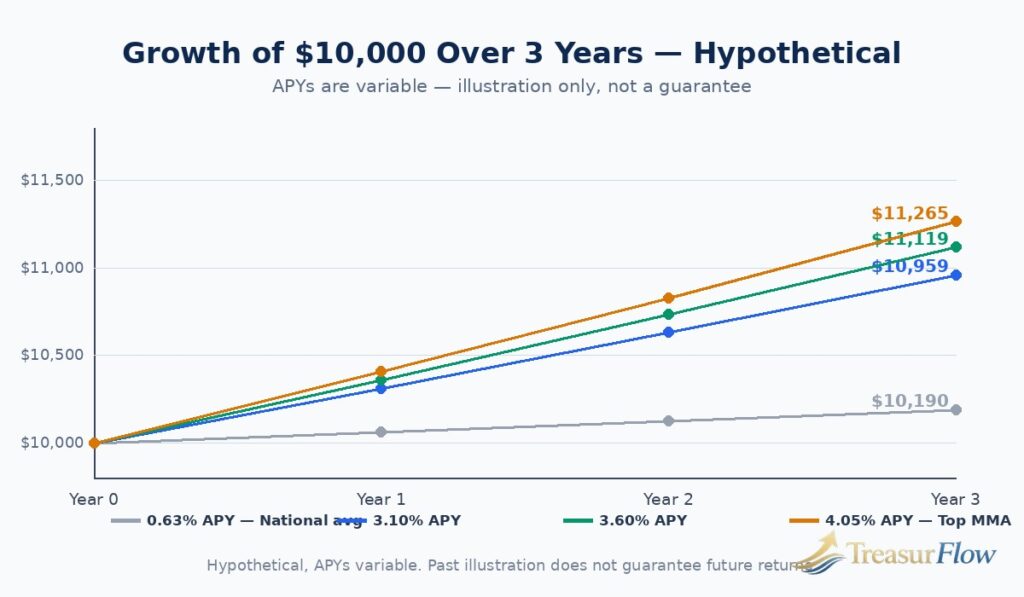
It depends on your balance and the account’s APY, which is variable. As an illustration, $10,000 held for one year earns about $63 at the 0.63% national average savings rate, about $310 at 3.10% APY, and about $405 at 4.05% APY — the top money market rate in our October 2026 rankings. Actual earnings vary as rates change and depend on compounding and how long the money stays in the account.
Can I write checks and use a debit card with a money market account?
Often, yes — that is the feature that separates a money market account from a high-yield savings account. Many MMAs, including several ranked in this guide, offer check-writing, a debit card, or both. Not all do: some high-yield MMAs are transfer-only, and checks on some accounts must be ordered from a third-party vendor. Confirm the exact access features before opening.
How many withdrawals can I make from a money market account each month?
There is no longer a federal six-per-month limit: the Federal Reserve suspended the Regulation D withdrawal cap in April 2020. However, each bank or credit union sets its own rules in the account agreement — some allow unlimited transactions, while others keep a monthly limit and may charge $5 to $10 per excess transaction or restrict the account after repeated excess use. Check your account’s terms.
Is a money market account better than a high-yield savings account?
Neither is universally better. Choose a money market account if you want competitive yield plus direct spending access — checks or a debit card — from the same account. Choose a high-yield savings account if you never need that access, because the top HYSA APYs are sometimes slightly higher. Both are insured deposits with variable rates, so the practical difference is access features, fees, and minimums rather than safety.
Conclusion
The best money market accounts 2026 offers are not exotic products: they are ordinary deposit accounts paying competitive, variable APYs — up to 4.05% in October 2026 — with the check and debit access that savings accounts usually lack. Pick Zynlo or the Raisin-offered American First Credit Union account for pure yield, Bank5 Connect, Quontic, or EverBank for yield plus real spending access, and Ally if the everyday banking experience matters most. Verify the insurance, read the fee schedule, and re-shop the rate twice a year — that small amount of attention is the entire difference between cash that quietly works for you and cash that quietly subsidizes your bank.
Rates and account terms in this article were checked in October 2026 and are variable; they can change without notice. Figures are illustrative examples, not guarantees of future earnings. This article is educational information, not financial advice; consider your own circumstances or speak with a qualified professional before opening an account.

Muhammad Zakir is the founder of Treasurflow and the author of its personal finance guides. He researches consumer banking, credit, and personal loans, and every guide cites primary sources such as the CFPB, FDIC, FTC, and IRS. His content is educational and is not personalized financial advice.