

Best Umbrella Insurance 2026: Top Companies, $1M Policy Costs and How Much Coverage You Need
Picture a rainy evening, a moment’s distraction, and a multi-car accident with serious injuries. The claim settles for $1.2 million. Your auto policy’s liability limit — a fairly typical $300,000 — pays the first $300,000. The remaining $900,000 comes from you: your savings, your home equity, and potentially a claim against your future earnings. That gap is exactly the hole an umbrella policy exists to fill, and filling it costs most households roughly the price of a streaming subscription each month.
Umbrella insurance is the least understood and arguably best-value product in personal insurance. This guide compares the best umbrella insurance companies of 2026 on coverage limits, financial strength and typical cost, shows what a $1 million policy actually costs in October 2026, walks through the coverage math so you can size your own policy, and flags what umbrella insurance does not cover before you buy.
Prices below are published comparison ranges for a typical low-risk household as of October 2026, not quotes. Your premium will depend on your state, vehicles, properties, drivers and claims history.
Related Guides
- Best Homeowners Insurance 2026 — the policy your umbrella sits on top of at home
- Liability-Only Car Insurance — how the underlying auto liability limits underneath an umbrella work
- Best Renters Insurance 2026 — yes, renters can and often should carry umbrella coverage too
Helpful Official Resources
- Insurance Information Institute — What Is Umbrella Insurance?
- National Association of Insurance Commissioners (NAIC) — naic.org
- Insurance Information Institute — iii.org
What an Umbrella Policy Actually Does
An umbrella policy is extra liability insurance that sits on top of your auto and homeowners (or renters) policies. It works in two ways.
It raises your ceiling. When a covered claim exhausts the liability limit of the underlying policy, the umbrella pays the rest, up to its own limit. Policies are sold in $1 million increments, typically from $1 million to $5 million at mainstream carriers, and up to $10 million at some.
It widens the net. Umbrella policies also cover some claims the underlying policies never touch — most importantly personal injury claims such as libel, slander, defamation and false arrest, plus liability arising from rental properties you own.
Run the opening scenario through an umbrella: the same $1.2 million settlement is met by $300,000 from the auto policy and $900,000 from a $1 million umbrella. Assets untouched. That is the entire product in one paragraph — and the Insurance Information Institute notes that $1 million of this protection typically costs only $150 to $300 a year for a typical household, with each additional $1 million costing less than the first. Few financial products trade so little money for so much catastrophic protection.
Umbrella also generally pays legal defense costs for covered claims, in many policy forms on top of the coverage limit rather than eroding it. When a lawsuit is the emergency, the defense bill alone can be life-changing; this feature is a major part of the value.
The Picks: Best Umbrella Insurance Companies of 2026
We weighted AM Best financial-strength ratings (a carrier’s ability to pay very large claims is the whole point of the product), maximum limits, how easily the policy can be bought alongside or apart from your underlying policies, and published 2026 price comparisons.
State Farm — best overall for most households
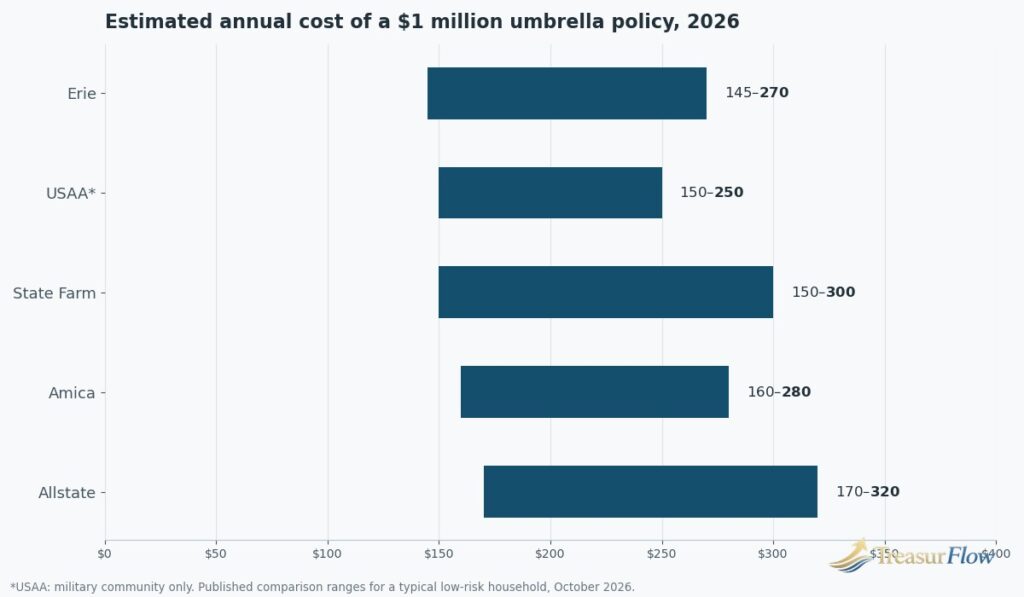
State Farm is the largest personal-lines insurer in the country, which matters for umbrella: it writes umbrella in every state, pairs it naturally with its own auto and home policies, and carries an A+ (Superior) AM Best rating. Published comparisons put a typical $1 million State Farm umbrella in the region of $150–$300 a year, with limits available from $1 million to $5 million. If your car and home already live at State Farm, this is the path of least resistance and usually the benchmark quote to beat.
Amica Mutual — best for customer experience
Amica, a mutual insurer owned by its policyholders, consistently tops customer-satisfaction rankings across personal lines, and its umbrella (limits $1 million to $5 million) is priced competitively at an estimated $160–$280 a year for $1 million in 2026 comparisons. Amica holds an A+ AM Best rating. Households that value claims handling over the absolute lowest premium tend to land here.
USAA — best for the military community, if you qualify
USAA posts the strongest numbers in this roundup — an A++ (Superior) AM Best rating and estimated $1 million premiums of $150–$250 a year — but eligibility is restricted to military members, veterans and their families. If you qualify, get this quote first; almost nobody beats USAA on the combination of price and service for the people it serves. Limits run $1 million to $5 million.
GEICO — best for high limits bought online
GEICO offers umbrella limits from $1 million up to $10 million under an A++ AM Best rating, and its digital-first model suits buyers who want to quote and manage everything online. GEICO’s umbrella typically requires your underlying auto policy (and usually home coverage through its partner network) to meet its minimum limits, so it suits existing GEICO households best.
Travelers — best high limits, and for business owners
Travelers also reaches $10 million limits with an A++ AM Best rating, and WalletHub’s 2026 review singled Travelers out as the best umbrella option for business owners with personal policies, thanks to broad coverage options. Travelers is a strong pick for higher-net-worth households whose exposure — multiple properties, boats, a public profile — exceeds the $5 million mainstream ceiling.
Allstate — best for straightforward bundling
Allstate’s umbrella spans $1 million to $5 million with an A+ AM Best rating and published $1 million estimates around $170–$320 a year — the top of the typical range in our comparisons, but Allstate’s huge agent network makes it easy to buy and service locally. Allstate publicly lists the underlying coverage its umbrella requires (see the requirements section below), which makes planning simpler.
Erie Insurance — best regional value
Erie’s estimated $1 million premium, $145–$270 a year, is the lowest starting point among our picks, and it carries strong regional customer-satisfaction scores. The catch is geography: Erie sells in only about a dozen states, mostly in the East and Midwest. If you live in its footprint, it deserves a quote.
RLI — best standalone policy (no bundling required)
Most carriers insist on holding your auto or home policy before they will sell you their umbrella. RLI is the leading exception: it writes standalone personal umbrella up to $5 million through agents and online channels, backed by an A++ AM Best rating. If your car is insured with one company, your home with another, and neither offers an umbrella you like, RLI is the standard workaround — a genuinely useful option for households with hard-to-place risks too.
What Umbrella Insurance Costs in 2026
Across published 2026 comparisons, a $1 million personal umbrella for a typical low-risk household — homeowner, two cars, clean records, no high-risk features — clusters between $150 and $300 a year. The chart below shows the estimated annual ranges for $1 million of coverage from the carriers profiled above, drawn from October 2026 comparison data.
Premiums climb when your risk profile does. The main levers:
- State. Liability costs and litigation climates differ sharply. Recent quote data shows Florida and New York households often paying well above national ranges, while many Midwestern states price below them.
- Drivers. A teenage driver, a DUI, or multiple at-fault accidents can raise umbrella pricing substantially — or make some carriers decline.
- Properties and toys. Rental properties, pools, trampolines, boats, RVs and certain dog breeds each add exposure, and usually premium.
- Limits chosen. Going from $1 million to $2 million typically adds far less than the first million cost — often cited in the region of $75–$150 — because catastrophic claims are rare. (Exact amounts depend on the carrier and risk profile.)
The practical takeaway: get the quote on the limit you actually need rather than assuming higher limits are unaffordable. They usually are not.
How Much Coverage Do You Need? The Net-Worth Method
The standard sizing rule is: carry at least enough umbrella coverage to protect your net worth — everything a judgment could reach. A simple three-step version:
- Add up exposed assets. Home equity, savings and investments outside protected retirement accounts, business interests, and other property. In many states, qualified retirement accounts (401(k)s, IRAs) enjoy strong protection from creditors under federal or state law, but the rules are state-specific and this article is not legal advice — when in doubt, count more, not less.
- Consider future income. Judgments can in many states attach to future wages. High earners with modest current assets — a young surgeon, a partner-track lawyer — often need more coverage than their balance sheet suggests.
- Round up to the next million. Given how cheaply additional millions price, households with $600,000 of exposed assets are usually better served by a $1 million policy (the minimum increment anyway), and households near $2 million of exposure by $2–$3 million.
You probably need an umbrella if: you own your home; you have a teenage driver; you have a pool, trampoline or dog; you own rental property; you drive a lot; you coach youth sports, volunteer or serve on a board; you have savings and investments you’d rather keep. That list describes a large share of American households — which is the point. Umbrella insurance is not a rich-people product; it is a middle-class asset-protection product priced like a utility bill.
What’s Covered — and What Isn’t
Typically covered:
- Bodily injury and property damage claims above your auto or home liability limits
- Personal injury claims: libel, slander, defamation, false arrest, malicious prosecution
- Liability from rental properties you own (confirm the property is listed)
- Incidents worldwide, in most policy forms
- Legal defense for covered claims
Typically not covered:
- Damage to your own property, or injuries to you and household members (that’s what your underlying policies and health insurance are for)
- Intentional or criminal acts
- Business activities and professional liability — side businesses need commercial coverage or a specific endorsement
- Liability from activities or properties you failed to disclose (an unlisted rental home or a new teen driver can void the protection you thought you had)
- Workers’ compensation for domestic employees in many forms, and punitive damages in some states
Read the exclusions page of any quote. With umbrella insurance, the exclusions matter more than the brochures.
Before You Buy: The Underlying-Limits Requirement
Umbrella policies do not attach to thin underlying coverage. Most carriers require you to carry specified minimum liability limits on the policies underneath — most commonly:
- Auto: $250,000 bodily injury per person / $500,000 per accident / $100,000 property damage (written as 250/500/100), or a $500,000 combined single limit
- Homeowners: $300,000 personal liability per occurrence
- Rental properties and watercraft: typically $300,000, varying by size and type
If your auto policy still sits at state-minimum limits, expect to raise it first — the increase in the underlying premium is real but modest relative to the protection stack it unlocks, and you should count both pieces when comparing the true price of going umbrella.
How to Buy (and How to Buy Standalone)
- Quote with your current auto or home carrier first. Bundled umbrella is usually cheapest and claim coordination is simplest.
- If your policies are split across carriers, or your carrier’s umbrella is weak, quote a standalone carrier such as RLI, which does not require your underlying business.
- Disclose everything — every property, vehicle, boat, young driver and risky feature. Undisclosed exposures are the number-one reason umbrella claims go wrong.
- Set the limit by net worth, not by the cheapest quote (see the sizing method above).
- Re-check at life changes — a new home, a teen getting licensed, a rental purchase, a big income jump. Umbrella policies are cheap to adjust and expensive to outgrow.
Umbrella vs Excess Liability: A Distinction That Matters
These two products are confused constantly — sometimes deliberately, in marketing. Excess liability insurance does one narrow job: it raises the limit of a specific underlying policy while following that policy’s own terms. If the underlying auto policy does not cover a claim type, excess liability does not either. A true umbrella policy does that and more: it covers a broader list of claim types (the personal-injury family — libel, slander, false arrest — that underlying policies typically exclude entirely) and can respond, subject to a self-insured retention, even where no underlying policy applies.
The practical problem: some carriers sell products labelled “umbrella” that behave more like excess liability, and some bundle pages blur the two. Before buying, ask one question — “Does this policy add personal injury coverage my auto and home policies don’t have?” If the answer is no, you are looking at excess liability wearing an umbrella’s name, and a true umbrella from another carrier (or a standalone from RLI) is the better buy.
Where Umbrella Claims Actually Come From
Catastrophic liability claims are rarely exotic. The recurring patterns insurers describe are ordinary life, scaled up:
- One crash, several claimants. Liability limits are per-person and per-accident. A single at-fault collision seriously injuring three people can exhaust a 250/500 auto limit before the property damage is even counted.
- A guest’s fall. A delivery driver or a child’s friend injured on your property — a broken hip, a head injury — can produce medical costs and settlement demands far beyond a $300,000 homeowners liability limit, plus defence costs on top.
- Your dog, someone else’s child. Dog-related injury claims are among the most common large home liability claims, and they regularly exceed standard policy limits when surgery is involved.
- Your teenager’s passengers. Teen drivers have the highest crash rates of any age group, and an at-fault crash with injured passengers is the single most common route by which ordinary families meet a seven-figure claim.
- A post you regret. Defamation claims arising from reviews, posts and neighbourhood disputes are a growth area — and, as noted above, they are precisely what standard auto and home policies do not cover at all and umbrella policies typically do.
None of these require wealth, recklessness or bad luck beyond the everyday kind. They require only that a bad day coincide with being underinsured — which is the entire case for the product.
Umbrella Questions Homeowners Actually Ask
How much does a $1 million umbrella policy cost?
For a typical low-risk household, about $150 to $300 per year, based on Insurance Information Institute guidance and published 2026 carrier comparisons. Erie starts lowest in our comparison (around $145), USAA is estimated at $150–$250 for eligible military households, and State Farm and Allstate cluster between $150 and $320. Teenage drivers, rental properties, pools, prior claims and high-litigation states can push premiums well above these ranges.
How much umbrella insurance do I need?
At least enough to cover your net worth, and often more if your future earnings are substantial, because judgments can reach future income in many states. Policies start at $1 million, and extra millions cost much less than the first — a household with about $1.5 million of exposed assets and income to protect commonly carries $2 million. When in doubt, round up: the price difference between $1 million and $2 million is usually small next to the exposure.
Does umbrella insurance cover libel and slander?
Yes — this is one of its most valuable features. Umbrella policies typically include personal injury coverage for claims such as libel, slander, defamation, false arrest and malicious prosecution, which your auto and homeowners policies generally do not cover at all. In an era when a social media post can generate a defamation suit, that coverage alone justifies the premium for many households.
Do I need umbrella insurance if I rent my home?
Often, yes. Renters carry the same lawsuit exposure from driving, dogs and everyday accidents as homeowners, and an umbrella policy can sit on top of a renters policy just as it does over homeowners insurance. If you have meaningful savings, investments or income to protect — or a dog, or a teenage driver — renting your home does not remove the risk. What matters is what you have to lose, not whether you hold a deed.
What does umbrella insurance not cover?
It does not cover your own injuries or damage to your own property, intentional or criminal acts, or liability from business and professional activities, which need commercial policies or endorsements. It also will not respond to exposures you never disclosed, such as an unlisted rental property. Punitive damages are excluded in some states and policy forms. Always read the exclusions in your specific policy rather than relying on general descriptions.
Can I buy umbrella insurance without bundling my home and auto?
Yes. While most major carriers prefer — or require — that they hold your underlying auto or home policy, standalone specialists such as RLI (and certain policies from Markel) sell personal umbrella coverage on its own, with limits up to $5 million. Standalone pricing is modestly higher than bundled pricing, but it solves the common problem of having your car insured with one company and your home with another.
The Bottom Line
Umbrella insurance converts the one financial accident that can erase decades of saving into a manageable, budgeted cost. Start with State Farm or Amica for a mainstream bundled quote, USAA if you’re military-eligible, and RLI if you need a standalone policy — then size the limit to your net worth and future income, not to the cheapest premium on the page. At roughly $150–$300 a year for the first million, it is the closest thing personal finance has to a free lunch. It is not quite free — but it is close.
Disclaimer: This article is educational information, not insurance or legal advice. Coverage, exclusions, limits and prices vary by carrier, state and policy form; cost figures are published comparison ranges as of October 2026, not quotes. Read your policy and consult a licensed insurance professional about your situation.

Muhammad Zakir is the founder of Treasurflow and the author of its personal finance guides. He researches consumer banking, credit, and personal loans, and every guide cites primary sources such as the CFPB, FDIC, FTC, and IRS. His content is educational and is not personalized financial advice.