

If you’ve ever stared at your renewal bill and wondered why you’re paying hundreds of dollars a year to protect a car that’s barely worth more than a used couch, you’re not alone. That question is exactly what leads most people to liability-only car insurance.
Liability-only car insurance covers the cost of injuries and property damage you cause to other people in an at-fault accident — it does not pay to repair or replace your own vehicle. It’s usually 40–60% cheaper than full coverage, which is why it’s the go-to option for drivers with older, paid-off, or low-value cars. But it’s not the right call for everyone, and getting it wrong in either direction — paying for coverage you don’t need, or dropping coverage you actually do — can cost you real money.
This guide breaks down exactly what liability-only insurance covers, what it costs in 2026, and how to know whether it’s the smart move for your situation or a risk you’ll regret.
What Does Liability-Only Car Insurance Actually Mean?
“Liability-only” simply means your policy carries just the two coverages your state legally requires — nothing extra. There’s no collision coverage, no comprehensive coverage, no protection for your own car at all. If you cause an accident, your insurer pays for the other driver’s damage and injuries. Your own vehicle is on you.
Think of it as insurance that protects your bank account from other people’s claims against you — not insurance that protects your car.
Every state (aside from New Hampshire, which has its own financial responsibility rules) sets a minimum amount of liability coverage that drivers must carry. Go with the state minimum, and you’re technically “liability-only.” You can also buy higher liability limits than your state requires while still skipping collision and comprehensive — you’re still liability-only, just with a bigger safety net for the other driver.
Exact minimums vary by state, so it’s worth double-checking your own — the Insurance Information Institute keeps an updated breakdown of state minimum liability insurance requirements if you want the specific numbers for where you live.
What Liability-Only Insurance Covers — and What It Doesn’t
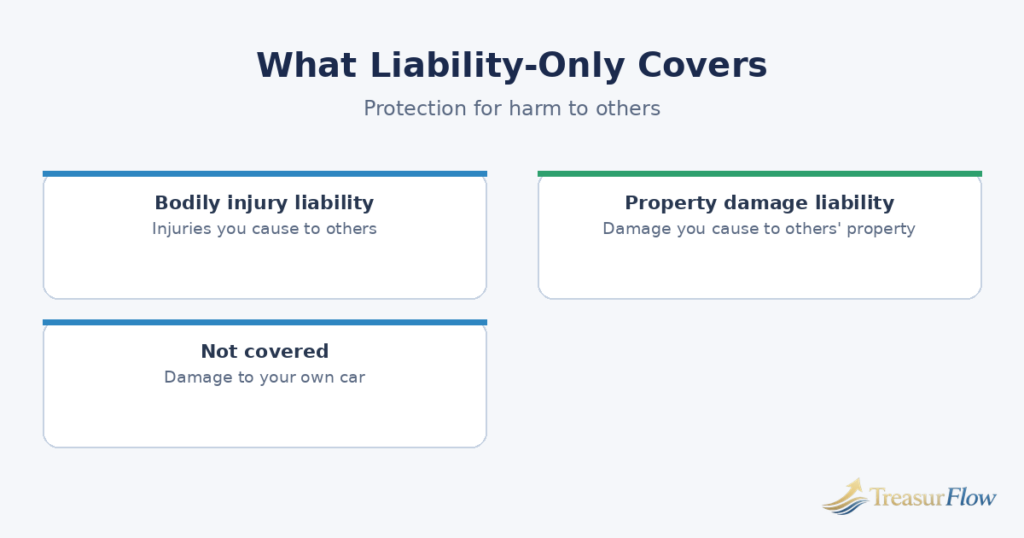
Liability coverage is really two coverages bundled together:
Bodily injury liability pays for medical bills, lost wages, and legal costs if you injure someone else in an accident you caused. This is usually written as two numbers, like 25/50 — meaning $25,000 per injured person, up to $50,000 total per accident.
Property damage liability pays to repair or replace the other driver’s car (or their fence, mailbox, or anything else you hit). This typically has its own separate limit, often shown as a third number — 25/50/25, for example.
What’s Not Covered
This is the part that catches people off guard, so it’s worth spelling out plainly. With liability-only coverage, you are not covered for:
- Damage to your own car from a crash you caused
- Damage to your own car from a crash someone else caused, if they’re uninsured or underinsured (unless you’ve separately added uninsured motorist coverage)
- Theft of your vehicle
- Vandalism
- Weather damage — hail, flooding, falling trees
- Hitting an animal
- Your own medical bills (unless you add medical payments or personal injury protection)
If any of those situations happen and you only carry liability, you’re paying out of pocket, full stop.
Liability-Only vs. Full Coverage: Key Differences at a Glance
| Liability-Only | Full Coverage | |
|---|---|---|
| Covers other driver’s damage/injuries | Yes | Yes |
| Covers your own car after an at-fault crash | No | Yes (collision) |
| Covers theft, vandalism, weather | No | Yes (comprehensive) |
| Required by lienholder (car loan/lease) | Rarely accepted | Usually required |
| Typical monthly cost | Roughly $40–$100 | Roughly $100–$220 |
| Best for | Older, paid-off, low-value cars | Financed, leased, or newer/high-value cars |
The honest way to think about it: full coverage insures the car. Liability-only insures everyone else. If your car isn’t worth much, paying extra to insure it stops making financial sense — which is exactly what the next section walks through.
How Much Does Liability-Only Car Insurance Cost in 2026?
Nationally, liability-only coverage averages somewhere in the $40–$100 per month range, though the exact number swings widely based on who’s doing the quoting, since insurers weigh risk factors differently. A few consistent patterns show up across the data:
- Age matters a lot. Drivers in their 50s and 60s typically pay the least; teens and drivers over 70 tend to pay more.
- Location matters more than most people expect. The gap between the cheapest and most expensive states can run over $1,000 a year, driven by accident rates, lawsuit frequency, and state minimum requirements.
- Your driving history is one of the most important factors you can influence when it comes to your insurance costs. A single at-fault accident or DUI can push liability-only premiums close to what a clean-record driver pays for full coverage.
- Insurers disagree with each other — a lot. It’s genuinely normal to get quotes from different companies that vary by $30–$40 a month for the exact same coverage. That’s not a scam; it’s because each insurer weighs your specific risk factors (age, ZIP code, credit-based insurance score, driving history) using its own formula.
If a quote you’re getting feels way outside these ranges in either direction — suspiciously cheap or unexpectedly expensive — it’s worth getting two or three more quotes before deciding anything.
Your credit history plays a bigger role in your rate than most drivers realize, too — insurers in most states factor in a credit-based insurance score alongside your driving record, so it’s worth understanding how your credit score affects insurance rates before you assume a low quote is simply out of reach.
When Does Liability-Only Insurance Actually Make Sense?
This is the question underneath almost every other question about liability-only coverage, so here’s a straightforward way to think it through.
The Car-Value-vs-Premium-Savings Rule
Compare what you’d save annually by dropping to liability-only against what your car is actually worth (check a site like Kelley Blue Book for a real number, not a guess). A commonly used rule of thumb: if your annual full-coverage premium (just the collision and comprehensive portion) equals 10% or more of your car’s value, liability-only is worth serious consideration.
For example, if collision and comprehensive are costing you $600 a year and your car is worth $4,000, you’re paying 15% of the car’s value annually just to insure it — and after a handful of years, you’ll have paid more in premiums than the car is worth.
Signs You’re a Good Candidate for Liability-Only
- Your car is fully paid off (no loan or lease requiring full coverage)
- Your car’s resale value is under roughly $4,000–$5,000
- You have enough savings to repair or replace the car out of pocket if something happened
- You’re comfortable accepting that risk in exchange for lower monthly costs
Signs You Should Keep Full Coverage
- You’re still making loan or lease payments (your lender almost certainly requires it)
- Your car is newer or holds significant value
- You don’t have savings set aside to cover a totaled car
- You drive frequently in high-traffic areas or bad weather conditions
There’s no universally “right” answer here — it’s a personal math problem, not a moral one. Run your own numbers rather than going with a blanket rule.
Not everyone fits neatly into “own a car outright” either. If you’re driving a vehicle that isn’t registered in your name, it’s worth looking into non-owner auto insurance instead, since a standard liability-only policy assumes you’re insuring a car you actually own. And if you’re weighing coverage options because you don’t currently hold a license, there are still legitimate paths to getting insured — see our guide to car insurance if you don’t have a license for how that works.
What Happens If You’re at Fault With Only Liability Insurance
If you cause an accident and only carry liability, two things happen simultaneously:
- Your insurer pays the other driver’s medical bills and repair costs — up to your policy’s limits.
- Your own car gets no payout. Repairs, a rental, or a replacement vehicle come entirely out of your pocket.
If Damage Exceeds Your Coverage Limits, You’re Personally on the Hook
Liability limits are a ceiling, not a guarantee. If the accident causes $60,000 in damage and injuries but your policy only covers $50,000, the other driver (or their insurer) can pursue you personally for the remaining $10,000 — potentially through a lawsuit, wage garnishment, or a lien against assets you own. This is the single biggest financial risk of carrying only the state-minimum limits, and it’s a strong argument for buying liability limits higher than the legal minimum even if you skip collision and comprehensive entirely.
What Happens If Someone Hits You and You Only Have Liability
This is where a lot of confusion (and frustration) tends to show up, so it’s worth being precise.
If the other driver is at fault, their liability insurance pays for your car’s damage and your injuries — your own liability-only policy isn’t involved at all, because it only covers damage you cause to others.
If the at-fault driver is uninsured or doesn’t have enough coverage, you’re in a tougher spot. Without separately purchased uninsured/underinsured motorist coverage, your liability-only policy pays nothing toward your car or your medical bills in that scenario — even though the crash wasn’t your fault. This is one of the most common gaps people don’t realize exists until it happens to them.
Can you sue your own insurer if you only have liability? Generally, no — not for your own car’s damage, because your policy was never written to cover that in the first place. What you can do is pursue the at-fault driver directly, either through their insurance or, if they’re uninsured, through a personal injury claim or small claims court.
Just Been in an Accident With Liability-Only Coverage? Do This Now
If you’re reading this because it just happened, here’s the short version:
- Get medical attention and document everything — photos of the scene, both vehicles, and any visible injuries.
- Exchange insurance information with the other driver and get a police report if possible.
- Contact the at-fault driver’s insurance company to file a claim for your vehicle’s damage, since your own liability policy won’t cover it.
- If the other driver is uninsured, contact your own insurer to ask about any uninsured motorist protection you may have, and consider speaking with a personal injury attorney if injuries are involved.
- Don’t assume you’re out of options just because you carry liability-only — the at-fault driver’s coverage, not yours, is usually where your claim needs to go.
How to Find the Cheapest Liability-Only Insurance Without Getting Burned
Chasing the lowest number is tempting, but the cheapest quote isn’t always the smartest choice. A few things worth doing before you commit:
- Get at least three quotes. Prices for identical coverage can vary by $30 or more a month between insurers, so shopping around isn’t optional if you want the best rate.
- Ask about every discount you might qualify for — bundling with home or renters insurance, paying in full, low mileage, good student, or safe-driver programs can meaningfully lower your rate.
- Check the insurer’s complaint ratio before you buy. Every state’s Department of Insurance publishes complaint data, and the National Association of Insurance Commissioners (NAIC) tracks how often each company gets complaints relative to its size. A dramatically cheap quote from a company with a poor complaint record is often a bad trade.
- Check the insurer’s financial strength rating (AM Best is the standard reference). This tells you whether the company can actually pay out claims, not just whether it can quote low premiums.
The cheapest policy on paper isn’t cheap at all if the company drags its feet or lowballs claims when you actually need to use it.
If your credit history isn’t in great shape, don’t assume liability-only coverage is off the table — there are insurers that specialize in cheap car insurance if you have bad credit, and some also offer car insurance with no deposit if paying a large sum upfront isn’t realistic right now. It’s also worth checking the insurer’s complaint history before you commit — your state’s Department of Insurance and the NAIC’s complaint data both publish this information for free, and a quick look at AM Best’s financial strength ratings will tell you whether the company can actually afford to pay out claims when you need them to.
Common Mistakes and Misconceptions About Liability-Only Coverage
“Liability-only means I’m basically uninsured.” Not true — you’re fully insured for the damage and injuries you cause to others, which is what the law requires. You’re just not insuring your own vehicle.
“My policy says ‘liability’ even though I have full coverage — did something change?” No — this is normal. Full coverage policies still include liability as one line item on your declarations page, alongside separate lines for collision and comprehensive. Seeing “liability” on your documents doesn’t mean your other coverages disappeared.
“A $500 deductible is always better than $1,000.” Not necessarily. A lower deductible means a higher premium; a $1,000 deductible usually lowers your monthly cost but means you’ll pay more out of pocket if you file a claim. The right choice depends on how much cash you’d have available after an accident, not which number sounds safer.
“Liability-only is only for irresponsible drivers.” It’s a financial decision, not a character judgment — plenty of financially savvy drivers with older, paid-off cars choose it deliberately because paying to insure a car’s value that’s already low doesn’t make mathematical sense.
Liability-Only Car Insurance FAQs
What does it mean if I only have liability car insurance?
It means your policy pays for damage and injuries you cause to other people, but nothing for your own vehicle if it’s damaged, stolen, or totaled.
Is it better to get full coverage or only liability?
It depends on your car’s value and your finances. If your car is worth less than what you’d pay in collision/comprehensive premiums over a few years, and you could cover repairs yourself, liability-only is often the more cost-effective choice.
How much does liability-only car insurance cost per month?
Nationally, it typically runs about $40–$100 per month, though your exact rate depends on your age, location, driving record, and insurer.
What happens if I total my car and only have liability?
Your insurer pays nothing toward your own vehicle. You’d need to cover repair or replacement costs yourself, unless the accident was someone else’s fault and their insurance covers it.
What happens if someone hits my car and I only have liability?
If they’re at fault, their insurance pays for your damage — your liability-only policy isn’t involved. If they’re uninsured, you’d need separate uninsured motorist coverage to be protected, or you can pursue the driver directly.
Can I sue my own insurance company if I only have liability?
Generally no, since a liability-only policy was never designed to cover your own vehicle. Claims for your car’s damage typically go through the at-fault driver’s insurer instead.
What is not covered under liability-only car insurance?
Damage to your own car from any cause — accidents you’re at fault for, theft, vandalism, weather, or hitting an animal — is not covered.
When should you switch to liability-only car insurance?
Generally, once your car is paid off, worth less than roughly $4,000–$5,000, and you have enough savings to handle repair or replacement costs on your own.
Why does my policy say “liability” even though I have full coverage?
Full coverage policies still list liability as a separate line item alongside collision and comprehensive — it’s normal paperwork, not a sign your other coverage was removed.
Is $50–$300 a month normal for car insurance?
Both are plausible depending on your coverage level, state, age, and driving record — liability-only tends to sit at the lower end of that range, while full coverage (especially for younger drivers or higher-value cars) can reach the higher end.
The Bottom Line
Liability-only car insurance isn’t inherently risky or inherently smart — it’s a trade-off between monthly savings and how much financial exposure you’re willing to carry on your own vehicle. If your car is older, paid off, and low in value, the math tends to favor liability-only. If it’s financed, leased, or worth more than a few thousand dollars, full coverage is almost always the safer call.
Run your own numbers using the car-value-vs-premium-savings rule above, get a few quotes to compare, and check any insurer’s complaint history before you switch. That’s the difference between a decision you’re confident in and one you’re second-guessing after the fact.
Ready to see what liability-only coverage would actually cost for your car?
Compare quotes from top-rated insurers and find out in a few minutes.

Muhammad Zakir is the founder of Treasurflow and the author of its personal finance guides. He researches consumer banking, credit, and personal loans, and every guide cites primary sources such as the CFPB, FDIC, FTC, and IRS. His content is educational and is not personalized financial advice.
2 thoughts on “Liability Only Car Insurance: What It Covers, What It Costs, and When It’s Actually Worth It”