
The best airline credit cards 2026 are not really a single ranked list. They are a matching problem. A card that is excellent for a flyer based in Atlanta can be almost useless for a flyer based in Seattle, even if the welcome bonus on the second card looks bigger in an advertisement. That is because nearly everything that makes an airline credit card valuable — a free first checked bag, priority boarding, companion certificates, lounge passes for that airline, and miles you can actually spend — only works when you fly the airline printed on the card.
So this guide works in a different order from most roundups. It starts with your home airport and your dominant airline. Then it walks through the strongest card for each major U.S. airline, one by one: Delta, United, American, Southwest, Alaska and Hawaiian under the Atmos Rewards program, and JetBlue, plus a flexible-points option and a no-annual-fee option for people who should not pay for an airline card at all. After the picks, there is an honest checked-bag math section — computed, not guessed — that shows exactly how many trips it takes for a free checked bag to pay an annual fee, and where that math breaks down. Then comes a direct comparison of co-branded airline cards versus flexible-points cards, the mistakes that cost flyers the most money, and answers to the questions frequent flyers actually ask.
One warning before any numbers: welcome bonuses, annual fees and earning rates on airline cards change often, and sometimes two official-looking pages show different offers for the same card on the same day. Every fee, bonus, earn rate and bag benefit in this guide was checked against card reviews, issuer-page summaries and airline-card offer reporting as of October 2026, and the article is date-stamped that way throughout. Where sources conflicted, this guide says so instead of picking a number silently. Always confirm the live offer on the issuer’s application page before you apply — that page, not any roundup including this one, is the offer you are actually accepting.
Related guides
Helpful Official Resources
- U.S. Department of Transportation — Lost, Delayed, or Damaged Baggage
- U.S. Department of Transportation — Air Travel Consumer Reports
- Consumer Financial Protection Bureau — CFPB Warns Credit Card Companies Against Deceptively Marketing Promotional Offers
- Federal Trade Commission — A Deceptive Credit Card Interest Rate Reduction Offer
Step One: Let Your Home Airport Decide
Most people shop for an airline card backwards. They see a large welcome bonus, imagine a free flight, apply, and only later notice that the airline barely serves their city, that the nonstop routes they actually fly belong to a competitor, or that they almost never check a bag — which removes the main recurring benefit that justifies the annual fee.
Start instead with three honest questions about the last twelve months of your travel, and the next twelve months you can realistically predict.
First, which airline did you actually fly most? Not which airline you like in theory, and not which one ran the best sale last spring. Count segments, or count trips. If six of your last eight flights were on one carrier, that carrier is your dominant airline whether you planned it that way or not. Schedules, fares and where your friends, family, clients and conferences are located have already made the decision for you.
Second, which airline dominates your home airport? Hub economics matter. A hub airline usually offers the most nonstops, the most flight times per day, and the easiest rebooking when weather or a mechanical problem cancels a flight. Delta’s largest operations include Atlanta, Detroit, Minneapolis–St. Paul, Salt Lake City, New York, Boston and Seattle. United’s include Chicago O’Hare, Houston, Newark, Denver, San Francisco, Los Angeles and Washington Dulles. American’s include Dallas/Fort Worth, Charlotte, Phoenix, Miami, Chicago O’Hare, Philadelphia, Washington and New York. Southwest is not a classic hub-and-spoke airline, but it is especially strong in places such as Denver, Chicago Midway, Baltimore, Dallas Love Field, Houston Hobby, Las Vegas and Phoenix. Alaska is centred on Seattle, Portland and Anchorage, with Hawaiian covering Honolulu and inter-island and West Coast–Hawaii routes under their combined Atmos Rewards program. JetBlue is concentrated in New York JFK, Boston, Fort Lauderdale and Orlando. If your airport is dominated by one of these carriers, its card starts with a huge head start — and a rival card has to overcome the fact that you would rarely be able to use its perks.
Third, do you check a bag? This question is worth more money than any earning rate in this article. As the math section below shows, a first checked bag on the big U.S. airlines generally costs $35 each way when prepaid, and $40 at the airport for American and United, while Delta charges a flat $35. That is $70 per solo round trip. Two or three round trips a year is enough for the bag benefit alone to cover most mid-tier annual fees. But if you are a committed carry-on traveller, the bag benefit is worth exactly zero to you, no matter how prominently it is advertised, and you should judge cards only on miles, credits and flexibility — a test most co-branded cards fail against flexible-points cards.
If your answers point clearly to one airline, read that airline’s section closely and skim the rest. If your answers are mixed — you fly whoever is cheapest, you split between two airlines, or you rarely check bags — skip ahead mentally to the co-branded versus flexible-points comparison, because a flexible card is probably your real answer, possibly paired later with one airline card for the carrier you fly most.
The Picks at a Glance
For readers who want the short version before the detail, here is the frame used by major competitors such as NerdWallet in October 2026, checked and organised here by airline rather than by marketing category. As of October 2026: for Delta flyers, the Delta SkyMiles® Gold American Express Card, at $0 introductory annual fee for the first year, then $150. For United flyers, the United℠ Explorer Card, also $0 introductory for the first year, then $150. For American flyers who want the lowest fee that still includes a free checked bag, the Citi® / AAdvantage® Platinum Select® World Elite Mastercard®, at $99, waived for the first year, with the newer, more expensive Citi® / AAdvantage® Globe™ Mastercard® at $350 as the step-up option. For Southwest flyers, the Southwest Rapid Rewards® Priority Credit Card at $229. For Alaska and Hawaiian flyers, the Atmos™ Rewards Ascent Visa Signature® credit card at $95. For JetBlue flyers, the JetBlue Plus Card at $99. For Air Canada and Star Alliance flyers who want a flexible-adjacent airline currency, the Chase Aeroplan® Card at $195. And for American flyers who refuse to pay any annual fee, the American Airlines AAdvantage® MileUp® Card at $0 — with the major caveat that it includes no free checked bag.
Notice what is not on that list: a single “best overall” airline card. Any roundup that crowns one is answering a question real flyers do not have. Your airport answers it for you.
Best for Delta Flyers: Delta SkyMiles® Gold American Express Card
Delta flyers are well served by the middle of Delta’s card lineup. The Delta SkyMiles® Gold American Express Card carries a $0 introductory annual fee for the first year, then $150, as of October 2026. That fee increase — Delta Gold was the first card in its class to move above $100, a point NerdWallet noted when it happened — means the card now has to earn its place every year, and for a regular Delta flyer who checks bags, it generally does.
The headline benefit is a free first checked bag on Delta flights for the cardholder and companions on the same reservation. Current card summaries also describe a free second checked bag on domestic Delta flights, a benefit added in 2026 — verify that detail on the American Express page before you rely on it for a specific trip, because bag terms are exactly the kind of benefit that changes by fare and route. Cardholders also receive Zone 5 priority boarding, which matters less for status than for overhead bin space: boarding earlier is often the difference between keeping a carry-on in the cabin and having it gate-checked. The card also gives a 15% discount when using miles to book award travel on Delta-operated flights through Delta’s site and app, which quietly increases the value of every SkyMile you hold.
Earning is straightforward. As of October 2026, the card earns 2 miles per $1 spent on Delta purchases, 2 miles per $1 at restaurants worldwide, 2 miles per $1 at U.S. supermarkets, and 1 mile per $1 on all other eligible purchases. After you spend $10,000 in purchases on the card in a calendar year, you can receive a $200 Delta Flight Credit for future travel — a meaningful keeper benefit for a flyer who will hit that spending level with normal use, and an irrelevant one for a flyer who will not. Do not manufacture spending to chase it.
The welcome offer needs careful reading. As of October 2026, NerdWallet, Experian, WalletHub and American Express summaries describe an offer described as “as high as” 80,000 bonus miles plus a $250 statement credit after you spend $3,000 in purchases within the first 6 months of card membership, with the offer ending November 4, 2026, and with the explicit warning that you may not be eligible for the maximum welcome offer amount. That “as high as” language is not fine-print trivia. It means the offer you are approved for may be smaller, and you should only accept the card if the specific offer presented to you is worth it. Offers vary, and they change often.
Who should skip it? Delta flyers who never check a bag and fly Delta only once a year will struggle to recover $150 from year two onward. Flyers chasing Medallion status help, lounge access or a companion certificate need Delta’s higher Platinum or Reserve tiers instead — and should price those cards’ much higher fees against how often they would actually use those specific perks, not against how attractive they sound.
Best for United Flyers: United℠ Explorer Card
If United is your hub airline, the United℠ Explorer Card is the default starting point, and it is one of the most complete mid-tier airline cards in this guide. As of October 2026, it carries a $0 introductory annual fee for the first year, then $150. NerdWallet named it among its best cards for airline benefits in 2026, and the reason is the breadth of useful, ordinary perks rather than any single luxury benefit.
The free first checked bag covers the primary cardmember and one companion on the same reservation, on United and United Express flights, when the ticket is purchased with the card and the MileagePlus number is on the reservation. Chase describes the combined saving as up to $200 per round trip for two people. Note that United’s own bag pricing makes that plausible: at $35 prepaid or $40 at the airport each way, two travellers checking one bag each save $140 to $160 on bag fees alone on a typical round trip, before anything else. The card also includes Group 2 priority boarding, two one-time United Club passes each anniversary year, 25% back as a statement credit on eligible inflight purchases, and a statement credit of up to $120 every four years for a Global Entry, TSA PreCheck or NEXUS application fee charged to the card.
Earning was refreshed upward on United purchases. As of October 2026, current summaries describe 9 total miles per $1 on eligible United flights, 3 miles per $1 on all other eligible United purchases, 2 miles per $1 on dining and on hotel stays booked directly with the hotel, and 1 mile per $1 on all other purchases. The 9x figure is a total that includes miles you earn as a MileagePlus member for the flight itself, so do not compare it directly with a simple “2x on airline purchases” line from another card without reading what is included. After $10,000 of spending in a calendar year, summaries also describe a $100 United travel credit, with an additional award-flight discount at a higher spending level — again, treat spending thresholds as a bonus for spending you already do, never as a target to chase with new spending.
The welcome offer, as of October 2026, is widely reported as up to 80,000 bonus miles: 70,000 bonus miles after spending $3,000 on purchases in the first three months from account opening, plus 10,000 bonus miles after adding an authorised user in the first three months. Some October reporting described even higher targeted or promotional-code totals. Because those higher figures depend on extra steps and codes, this guide uses the widely corroborated up-to-80,000 figure and flags the rest as offers vary. If the application page shows you a different number, that number is the real one for you.
The Explorer’s weakness is the mirror of its strength: everything is United. If your travel shifts away from United — a job change, a move, a route cut — the Club passes, bag benefit and miles lose value together. That concentration risk is the core trade-off of every card in this guide, and United flyers should accept it knowingly, ideally because their home airport makes United hard to avoid anyway.
Best for American Flyers: Citi® / AAdvantage® Platinum Select® World Elite Mastercard®
American Airlines flyers have the widest Citi lineup to choose from, and for most of them the right answer is still the middle-low card: the Citi® / AAdvantage® Platinum Select® World Elite Mastercard®. As of October 2026, its annual fee is $99, waived for the first year. That $99 price point now undercuts the $150 Delta and United mid-tier cards by a third, which makes its break-even math the easiest in this guide, as the bag-math section shows.
The core benefits are the ones that matter for ordinary American flyers: a free first checked bag on domestic American Airlines itineraries for the cardholder and up to four companions on the same reservation, preferred boarding, 25% savings on inflight food and beverage purchases when you pay with the card, and no foreign transaction fees. A family or group travelling together is where this card quietly becomes very valuable: five people on one reservation, each checking a first bag that would otherwise cost $35 prepaid each way, represents $350 of avoided bag fees on a single round trip. You do not need to travel like that every trip for the card to pay off — once or twice a year is enough — but you do need at least some trips on American, in domestic itineraries, with checked bags.
Earning, as of October 2026, is 2 miles per $1 on eligible American Airlines purchases, 2 miles per $1 at restaurants, 2 miles per $1 at gas stations, and 1 mile per $1 on all other purchases. Eligible miles earned from purchases also count as Loyalty Points toward AAdvantage status, at one Loyalty Point per eligible mile. There is also a $125 American Airlines flight discount after you spend $20,000 in a cardmember year — a real benefit for high spenders who were going to spend that amount anyway, and a poor reason to increase spending for everyone else.
The welcome offer reported consistently in October 2026 by The Points Guy and WalletHub is 80,000 bonus miles after spending $3,500 on purchases in the first four months from account opening, with the $0 introductory annual fee for the first year. That is a strong offer for a $99 card. It has cycled lower in the past, so if you are reading this after October 2026, expect the live figure to differ and judge it on its own terms.
The Step-Up Option: Citi® / AAdvantage® Globe™ Mastercard®
American flyers who want lounge access without paying for the top-tier Executive card now have a middle option that did not exist before late 2025: the Citi® / AAdvantage® Globe™ Mastercard®, at a $350 annual fee as of October 2026. It earns 6 miles per $1 on AAdvantage Hotels bookings, 3 miles per $1 on American Airlines purchases, 2 miles per $1 at restaurants, 2 miles per $1 on Rides and Rails purchases such as taxis, rideshares and public transit, and 1 mile per $1 on everything else. It includes a free first checked bag — summaries describe coverage for the cardholder and up to eight companions in some materials — preferred or Group 5 boarding, four Admirals Club Globe lounge passes per calendar year, a companion certificate beginning in the second cardmember year upon renewal that is redeemable for $99 plus taxes and fees, up to $100 back on inflight purchases each calendar year, up to $100 in an annual Splurge Credit at chosen merchants, up to $240 back on Turo trips, a Global Entry or TSA PreCheck credit of up to $120 every four years, and a Flight Streak bonus of 5,000 Loyalty Points after every four qualifying American flights, up to 15,000 per status year.
This card is also this guide’s clearest example of why you must check the live offer. As of October 2026, sources conflict on its welcome bonus: Citi’s offer page was reported showing 90,000 miles after $5,000 in purchases in the first four months, while American’s card page and some roundups showed 60,000 miles after $4,000 in the first three months. Both figures are reported here deliberately, and neither is presented as settled. Offers vary by channel. If you apply for the Globe, screenshot the exact offer you accepted.
Is $350 worth it? Only for the semifrequent American flyer who will actually use the lounge passes, the companion certificate and several of the credits naturally. A flyer who uses none of the credits is paying $251 more than the Platinum Select for benefits they could have had for $99. The Globe is a good card for a specific traveller and an expensive souvenir for everyone else.
Best for Southwest Flyers: Southwest Rapid Rewards® Priority Credit Card
Southwest changed more than any other airline in this guide during 2025 and 2026. The carrier that built its brand on bags flying free moved to charging for checked bags on many fares, which completely changed the value of its credit cards. A free first checked bag went from a nice extra on top of a free-bag policy to a benefit Southwest flyers may now genuinely need. That shift is the main reason the top Southwest card earns a place here despite a much higher fee than it used to carry.
As of October 2026, the Southwest Rapid Rewards® Priority Credit Card carries a $229 annual fee — a sharp increase from its earlier pricing, reflecting the new assigned-seating, extra-legroom and bag-fee era at Southwest. The welcome offer reported consistently in October 2026 is 60,000 bonus points after spending $2,000 on purchases in the first three months from account opening.
The card earns 4 points per $1 spent on Southwest purchases, 2 points per $1 at gas stations and restaurants, and 1 point per $1 on all other purchases. It includes a free first checked bag for the cardholder and up to eight additional passengers on the same reservation, Group 5 boarding for the cardholder and up to eight passengers on the same reservation, the ability to select a Preferred seat at booking at no additional charge when available, and upgrades to extra-legroom seats within 48 hours of departure at no charge when available. Cardholders receive 7,500 anniversary points each year and a 10,000 Companion Pass qualifying points boost annually, plus 25% back on inflight purchases and no foreign transaction fees.
Two Southwest-specific points deserve emphasis. First, the sheer width of the bag benefit — up to nine travellers on one reservation — means a single family round trip can produce unusually large avoided bag fees compared with the Delta, United or JetBlue cards, whose companion coverage is narrower. Second, the Companion Pass remains the most valuable repeatable perk in U.S. domestic travel for the right household: a designated companion flies with the pass holder for only taxes and fees. The card’s anniversary boost of 10,000 qualifying points helps toward the Companion Pass threshold, but it does not get you there by itself, and travellers chasing the pass usually time welcome bonuses carefully across cards. Do not open this card assuming the pass is automatic.
Who should choose a cheaper Southwest card instead? Occasional Southwest flyers should look at the lower-fee Plus and Premier tiers, which as of October 2026 were reported at $99 and $149 respectively, also with a free first checked bag and Group 5 boarding. If you fly Southwest once a year, paying $229 for seat and boarding extras you barely use is hard to defend. If you fly Southwest four or more times a year, travel with family, and value seat selection in the new system, the Priority card’s higher fee becomes much easier to justify.
Best for Alaska and Hawaiian Flyers: Atmos™ Rewards Ascent Visa Signature® Credit Card
Alaska Airlines and Hawaiian Airlines combined their loyalty programs under the Atmos Rewards name, and their mid-tier card is now the Atmos™ Rewards Ascent Visa Signature® credit card, issued by Bank of America. As of October 2026, its annual fee is $95 — the joint-lowest fee in this guide among cards that include a free checked bag, alongside the $99 cards from American and JetBlue.
The welcome offer is another case where this guide reports a range honestly instead of pretending precision. The current public offer reported by The Points Guy and AwardWallet as of October 2026 is 50,000 bonus points and a $99 Companion Fare (plus taxes and fees from $23) after spending $1,500 or more on purchases within the first 90 days of opening the account. Earlier in 2026, limited-time offers were higher — NerdWallet reported an 80,000-point offer after $4,000 within 120 days beginning April 1, 2026, and noted that offer period had expired, and 70,000-point offers after $3,000 were also reported. If the live Bank of America page shows you more than 50,000 points, that is a better offer than the baseline described here. If it shows less, judge it accordingly. Offers vary, and this card’s offers have varied a lot in 2026.
Earning, as of October 2026, is 3 points per $1 on eligible Alaska Airlines and Hawaiian Airlines purchases, 2 points per $1 on gas, electric vehicle charging, cable, streaming services and local transit including rideshare, and 1 point per $1 on all other purchases. Cardholders with an eligible Bank of America account receive a 10% rewards bonus on points earned from purchases. Benefits include a free checked bag on Alaska and Hawaiian flights for the cardholder and up to six guests on the same reservation when you pay with the card, priority boarding for the same group, no foreign transaction fees, a $100 discount on an Alaska Lounge+ membership, and the ability to earn an annual $99 Companion Fare (plus taxes and fees from $23) after spending $6,000 on purchases within the prior card anniversary year.
The Companion Fare is the reason many Alaska flyers keep this card for years. Alaska and Hawaii routes can be expensive in cash, especially from the West Coast to Hawaii or within Alaska, and a companion travelling for $99 plus taxes and fees on a cash booking can save several hundred dollars in a single use. But it only works on a paid booking, it requires a companion travelling on the same itinerary, and it requires the $6,000 of prior-year spending to earn it each year after the initial offer. Solo travellers who never use a companion fare are relying only on bags and points to justify the $95 — which, as the math section shows, still works after roughly two solo round trips with checked bags, but with less margin for error.
Best for JetBlue Flyers: JetBlue Plus Card
JetBlue’s footprint is concentrated — New York, Boston, Florida, the Caribbean and selected transatlantic routes — which makes its card the most geographically polarising pick in this guide. If JetBlue is convenient for you, the JetBlue Plus Card is strong. If it is not, no bonus makes it sensible.
As of October 2026, the JetBlue Plus Card, issued by Barclays, carries a $99 annual fee. AwardWallet and other current summaries report a welcome bonus of 70,000 bonus points after spending $1,000 on purchases and paying the annual fee in full, both within the first 90 days. Other channels have shown lower figures in the 50,000 to 70,000 range, so treat 70,000 as the reported public offer as of October 2026 and verify the exact figure on the application page.
The earning rate on JetBlue spending is the highest headline rate in this guide: 6 points per $1 on JetBlue purchases, 2 points per $1 at restaurants and grocery stores, and 1 point per $1 on all other purchases. Benefits include a free first checked bag for the cardholder and up to three companions on the same reservation when the reservation is paid for with the card, a 5,000-point bonus each card anniversary, a 10% rebate of points when you redeem for JetBlue-operated award flights, 50% savings on eligible inflight purchases, and a $100 statement credit toward a qualifying JetBlue Vacations package.
Context helps here. NerdWallet’s JetBlue Plus review notes that without the card, a first checked bag on JetBlue costs $39 — higher than the $35 standard used in this guide’s main math section. At $39 each way, a solo round trip saves $78, and a family of four on one reservation saves $312 on a single round trip. That is why JetBlue flyers who travel as a family can justify the $99 fee faster than almost anyone else in this guide, provided they actually fly JetBlue at least once or twice a year as a group.
The limitation is the currency. TrueBlue points are essentially revenue-linked and stay inside the JetBlue world and its limited partner set. They are predictable and easy to use, which many travellers prefer, but they do not offer the outsized international premium-cabin redemptions that transferable points or alliance currencies sometimes produce. If simple, predictable domestic and Caribbean value is what you want, that is a feature. If you are saving for a long-haul business-class award, it is a reason to choose a different system.
Best Flexible-Airline Option With an Airline Currency: Chase Aeroplan® Card
Some flyers do not have a single dominant U.S. airline but do fly Air Canada or its Star Alliance partners regularly — including United in the United States. For them, the Chase Aeroplan® Card is the interesting middle path: it is technically a co-branded airline card, but Aeroplan points can be redeemed across a partner network of more than 45 airlines, which makes the currency behave more flexibly than a single-airline mileage balance.
As of October 2026, recent reporting from The Points Guy, AwardWallet and Prince of Travel puts the card’s annual fee at $195. Be aware that older listings still show a $95 annual fee for this card; the $195 figure is the one supported by multiple current sources in October 2026, and it is the figure to verify on the Chase application page. The welcome offer reported by those same sources is up to 115,000 bonus points: 75,000 bonus points after spending $4,000 on purchases in the first three months from account opening, plus an additional 40,000 bonus points after spending $20,000 in total purchases in the first 12 months. Read that second tier honestly — most applicants should value this offer on the first 75,000 points and treat the additional 40,000 as relevant only if $20,000 of first-year spending was already going to happen.
Current summaries describe earning of up to 5 total points per $1 on Air Canada purchases (3 points from the card plus additional points earned as an Aeroplan 25K member on eligible flights), 3 points per $1 on travel purchases, 2 points per $1 on dining, groceries and gas, and 1 point per $1 on all other purchases, with an additional monthly spending bonus described in card materials. Benefits include automatic Aeroplan 25K status each year with no spending requirement, a free first checked bag on Air Canada flights for the cardholder and up to eight companions on the same reservation, up to $100 per year in Air Canada statement credits delivered in two $50 instalments, a 15% discount on eligible Air Canada award redemptions, and a credit of up to $120 every four years for Global Entry, TSA PreCheck or NEXUS.
The trade-off is the fee. At $195, the Aeroplan card costs more than the Delta, United, American, Atmos and JetBlue mid-tier cards, and its automatic status and bag benefits only matter on Air Canada. It earns its place for cross-border travellers, Star Alliance flyers, and people who specifically value Aeroplan’s partner award chart — not as a general substitute for a domestic airline card.
Best No-Annual-Fee Airline Option: American Airlines AAdvantage® MileUp® Card
Not everyone should pay an annual fee for an airline card, and the honest no-fee option in this guide is the American Airlines AAdvantage® MileUp® Card. As of October 2026, it has a $0 annual fee. The welcome offer reported by The Points Guy, AwardWallet and WalletHub in October 2026 is 15,000 bonus miles and a $100 statement credit after making $500 in purchases within the first three months of account opening. One source, Experian’s card listing, described the same bonus with a $1,000 spending requirement instead — a small conflict worth flagging, because it changes how easy the bonus is to earn. Check the spending requirement on the offer you are actually shown.
The card earns 2 miles per $1 on eligible American Airlines purchases, 2 miles per $1 at grocery stores including grocery delivery services, and 1 mile per $1 on all other purchases, plus 25% savings on inflight food and beverage purchases on American flights. Eligible miles also earn Loyalty Points toward AAdvantage status.
Now the limits, stated plainly, because no-fee airline cards are often marketed as if they were simply cheaper versions of the paid cards. The MileUp Card does not include a free checked bag. It does not include preferred boarding. It does not include lounge access. It charges a foreign transaction fee — Citi’s terms are described in current reviews as 3% — which makes it a poor card to use abroad despite being an airline card. What it does well is narrower and still useful: it keeps an AAdvantage balance growing from grocery and American spending, it gives occasional American flyers a way to earn that airline’s miles without a yearly fee, and it is a sensible downgrade destination for a Platinum Select holder whose travel has dropped, so they can keep the account relationship without paying $99 for a bag benefit they no longer use.
If you check a bag on American even twice a year, run the comparison before choosing the free card: two solo round trips with a checked bag cost $140 in bag fees, which is $41 more than the Platinum Select’s $99 annual fee that would have made those bags free. “No annual fee” is not the same as “no cost.”
The Checked-Bag Math: Bag Fee Times Trips Versus Annual Fee
This is the section to read twice, because it decides most real-world cases. The method is deliberately simple and conservative, and every figure below was computed from the same inputs so the cards can be compared fairly.
The inputs, as of October 2026: a first checked bag on the major U.S. airlines generally costs $35 each way when prepaid. American charges $35 prepaid and $40 at the airport. United charges $35 prepaid, or $40 at the airport when paid inside 24 hours of departure. Delta charges a flat $35. JetBlue is higher, at $39 according to NerdWallet’s review, and is handled separately below. Using $35 each way: one solo round trip with one checked bag each way costs $35 + $35 = $70. That $70 is the unit of this entire section.
Now divide each annual fee by $70. The Atmos Ascent at $95 breaks even on bags alone after 1.36 solo round trips — in practice, two trips, saving $140 against a $95 fee for a net of +$45. The AAdvantage Platinum Select and the JetBlue Plus, both at $99, break even after 1.41 trips — in practice, two trips, saving $140 against $99 for a net of +$41. The United Explorer and Delta Gold, both at $150 after their introductory first year, break even after 2.14 trips — in practice, three trips: two trips save only $140, which is $10 short of the fee, while three trips save $210 for a net of +$60. The Aeroplan Card at $195 breaks even after 2.79 trips — in practice, three trips, for a net of +$15, which is a thin margin that really needs its status and credits to justify the card. The Southwest Priority at $229 breaks even after 3.27 trips — in practice, four solo trips, saving $280 for a net of +$51. And the AAdvantage Globe at $350 breaks even after exactly 5.00 solo round trips — four trips still leave it $70 underwater on bags alone, which is why the Globe must be justified by its lounge passes, companion certificate and credits, not by bags.
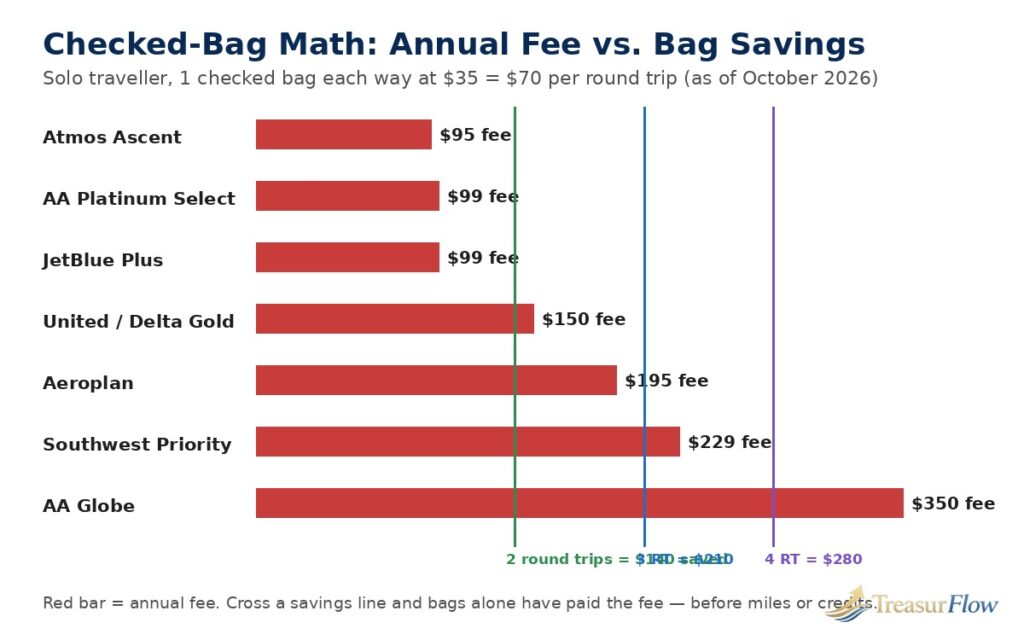
Those are solo numbers, and they understate the case for anyone who travels with other people on the same reservation. A couple travelling together, each checking one bag each way, saves $140 on a single round trip. At that rate, one couple round trip nearly covers a $150 card (net -$10) and fully covers the $95 and $99 cards (net +$45 and +$41 respectively), and two couple round trips put every mid-tier card in this guide comfortably ahead. Wider companion coverage multiplies faster still: the Platinum Select covers the cardholder plus up to four companions, so one round trip for five people represents up to $350 of avoided first-bag fees; the Southwest Priority and the Globe cover up to nine travellers in the summaries cited above. You will not max out that coverage on every trip, and you should not pretend you will. But one family trip a year can be the entire economic case for holding a card, with the miles then genuinely free on top.
Three honest caveats. First, in the first year, several of these cards charge $0 introductory annual fee — United Explorer, Delta Gold and the Platinum Select — so in year one the bag savings are not offsetting a fee at all; they are simply savings. The break-even test matters most from the renewal year onward, which is exactly when you should re-run it. Second, this math counts only bag savings. It ignores miles earned, flight credits, companion fares, anniversary points and lounge passes, all of which can add real value — and it also ignores the interest you would pay if you carried a balance, which can erase all of it quickly. A rewards card used with a revolving balance is a losing trade in almost every scenario in this guide. Third, the math collapses completely if you do not check bags. Zero trips with a checked bag times $70 is zero, at any annual fee. Carry-on-only travellers should skip to the next section and take it seriously.
Co-Branded Airline Cards Versus Flexible-Points Cards
A co-branded airline card gives you that airline’s miles and that airline’s day-of-travel perks. A flexible-points card gives you points you can transfer to several airlines — and usually hotels — or spend through a travel portal. Neither is universally better. They solve different problems.
The co-branded card wins on perks that flexible points cannot buy. No transferable-points card gives you a free first checked bag on Delta, Group 2 boarding on United, a Southwest Companion Pass qualifying boost, an Alaska Companion Fare, or Admirals Club passes. If those perks match your actual travel, they are worth cash money every year, and the miles are the secondary benefit. Co-branded cards also win on simplicity for a loyal flyer: you earn the currency you will spend, on the airline you will fly, with no transfer decisions.
The flexible card wins on optionality. Consider the Chase Sapphire Preferred® Card as the standard example: as of October 2026 it carries a $95 annual fee, and Chase Ultimate Rewards points transfer to airline partners including United MileagePlus, Southwest Rapid Rewards, JetBlue TrueBlue and Air Canada Aeroplan, among others. Current summaries report a welcome offer of 75,000 bonus points after spending $5,000 in the first three months, plus strong travel and dining earning and an annual Chase Travel hotel credit — verify the live offer, as with every card here. The strategic point is not the exact bonus. It is that a flexible balance survives a change in your life. Move cities, change jobs, watch your airline cut your favourite route — transferable points can follow you to a different carrier, while 80,000 miles stranded in a program you no longer fly can sit unused for years. Flexible points also protect you, partially, against a single program devaluing its award prices, because you have not yet committed the points to that program.
The flexible card’s weakness is just as real: it gives you no free checked bag, no priority boarding, no companion certificate and no airline status help. A frequent Delta flyer who replaces a Delta Gold card with a flexible card to chase transfer bonuses will pay $70 per round trip in bag fees for the privilege. That is the co-branded card’s fee, paid to the airline instead of to the card issuer, with nothing to show for it.
The practical answer for many serious travellers is one of each, used for different jobs: the airline card for buying that airline’s tickets, checking bags and holding for its perks — some travellers barely spend on it otherwise — and a flexible card for everyday spending whose points can top up whichever airline needs them. That two-card setup only makes sense if the airline card clears the bag-math test on its own. If it does not, carry the flexible card alone and pay for the occasional checked bag in cash. That is cheaper than paying an annual fee for a benefit you use once.
Mistakes That Cost Airline Card Holders the Most
The first mistake is applying for the airline you wish you flew. Aspirational loyalty is expensive: a card for an airline you take twice a year to a city a competitor serves better will deliver a welcome bonus once and disappointment every year after. Apply for the airline your calendar already chose.
The second mistake is counting the welcome bonus as annual value. A bonus is a one-time event. The renewal decision in year two, three and four depends on bags, credits, companion benefits and anniversary points — the recurring column. Re-run the bag math every year before the fee posts, and downgrade or cancel if your travel pattern changed. Several lineups in this guide have a no-fee or lower-fee landing spot for exactly that purpose.
The third mistake is missing the conditions attached to the bag benefit. Depending on the card, the free bag may require you to pay with the card, to include your frequent flyer number on the reservation, to travel on the operating airline rather than a codeshare, or to be on a domestic itinerary only. Companions generally must be on the same reservation. Travellers discover these rules at the check-in counter, which is the most expensive place to learn them.
The fourth mistake is carrying a balance to earn miles. Airline cards carry variable APRs that current listings commonly show in the roughly 20% to 30% range. One month of interest on a large balance can cost more than the miles earned on that spending are worth. If you cannot pay in full, a lower-interest or cash-back strategy will beat any card in this guide, and the Consumer Financial Protection Bureau’s warnings about promotional offers and grace periods are worth reading before you sign up for any offer.
The fifth mistake is letting miles strand or expire through inattention. Programs change expiration rules, merge — as Alaska and Hawaiian did into Atmos Rewards — and devalue award pricing. Earn toward a specific, near-term redemption rather than an abstract balance, and prefer flexible points when your plans are genuinely uncertain.
The sixth mistake is ignoring application rules and timing. Issuers limit how often you can earn a bonus on the same card — 48 months in several Citi AAdvantage terms described in current reporting, 24 months in several Chase terms — and Chase approvals are widely reported to be affected by how many cards you have opened recently. Applying in the wrong order can lock you out of a bonus you wanted more. Read the eligibility terms on the offer page before you apply, not after you are declined for the bonus.
The seventh mistake is the subtlest: buying a premium airline card for lounge access you will use twice. Lounge passes and memberships feel valuable in the abstract. Count your actual connecting itineraries through that airline’s lounges in the last year. If the honest number is two visits, price the card against paying for two day passes, not against the romance of a quiet lounge.
Airline Card Questions Frequent Flyers Actually Ask
What is the best airline credit card in 2026?
There is no single best airline credit card in 2026 for everyone. The best card is the one tied to the airline that dominates your home airport, because free checked bags, priority boarding and miles are only valuable when you actually fly that airline. If you fly several airlines, a flexible-points card is usually the safer pick.
How many trips does it take for a free checked bag to pay an annual fee?
At $35 for a first checked bag each way, one solo round trip saves $70. A $99 card breaks even on bags alone after two solo round trips, a $150 card after three, and a $95 card after two. Travelling with a companion on the same reservation who also checks a bag cuts those break-even points roughly in half.
Do airline credit card miles expire?
It depends on the program. Policies differ by airline and can change, and some programs keep miles from expiring while your account stays active or while you hold a co-branded card. Check your airline’s current expiration rules before you stockpile miles for a trip years away.
Can I get a free checked bag if I book with points or pay with a different card?
Often, no — or not automatically. Several cards require you to pay for the ticket, or at least the taxes and fees on an award ticket, with the card, and to have your frequent flyer number on the reservation. Read the bag benefit terms for your specific card before you book.
Is a no-annual-fee airline card worth it?
A no-annual-fee airline card such as the AAdvantage MileUp Card can be worth it if you want to earn that airline’s miles on everyday spending and keep a mileage balance alive without paying a yearly fee. It will not give you a free checked bag or priority boarding, so it does not replace a mid-tier card for regular flyers who check luggage.
Should I choose a co-branded airline card or a flexible-points card?
Choose a co-branded card when you fly one airline often enough to use its bag, boarding and companion benefits every year. Choose a flexible-points card when you fly whoever is cheapest, want to transfer points to several airlines, or do not check bags. Many frequent flyers carry one of each and use the airline card only for that airline’s flights and perks.
Conclusion: Match the Card to the Airport, Then Re-Check Every Year
The best airline credit cards 2026 share a pattern once you look past the bonuses. The winners are boring in the best way: a Delta card in the hands of a Delta hub flyer who checks a bag three times a year, a $99 American card in the wallet of a family that takes two trips together, an Atmos card whose Companion Fare gets used every year on a Hawaii or Alaska route someone actually flies. The losers are just as consistent: a premium card bought for lounges that were visited twice, a mileage balance stranded in a program its owner stopped flying, and an annual fee renewing quietly for a travel pattern that ended two years ago.
So make the decision in the order this guide used. Name your dominant airline from your real calendar and your home airport. Run the bag math with your real number of checked-bag trips, solo and with companions. Only then compare welcome bonuses, and treat every bonus as a one-time discount on a multi-year relationship, not as the reason for it. If no single airline clears the test, take the flexible-points card and pay for your occasional bags in cash — that is a rational outcome, not a failed search.
Finally, put a reminder on the calendar eleven months from now. Travel patterns change, fees rise — this guide alone covers cards whose fees moved from $95 to $150, from $99-era Southwest pricing to $229, and from $95 to $195 on the Aeroplan card — and the card that was right this October may be the wrong card next October. The flyers who get the most from airline credit cards are not the ones who found a perfect card once. They are the ones who re-run a seventy-dollar calculation once a year and act on what it tells them.
Rates, fees, bonuses and benefits in this article were checked as of October 2026 and change frequently. Offers vary by channel and by applicant. Confirm all current terms on the issuer’s official application page before applying. This article is educational information, not financial advice.

Muhammad Zakir is the founder of Treasurflow and the author of its personal finance guides. He researches consumer banking, credit, and personal loans, and every guide cites primary sources such as the CFPB, FDIC, FTC, and IRS. His content is educational and is not personalized financial advice.