
The best business checking account in 2026 is not the one with the biggest bonus or the flashiest app. It is the one whose fee rules match how your money actually moves: how much cash you deposit, how many paper transactions you still make, what balance you really keep on a slow month, and whether you will meet an activity target every single month — not just in your best month.
That is why this guide is organized by business profile instead of by bank logo. A freelancer who invoices five clients a month, an LLC that keeps $18,000 sitting in operating cash, a café that deposits cash every night, and an e-commerce seller who sends wires and lives inside QuickBooks do not need the same account. In 2026 they also do not pay the same price for the wrong one. Our worked examples below — computed from published October 2026 terms and labeled illustrative — show a $234-a-year interest gap at an $18,000 balance, and a $180-to-$192-a-year fee bill at a $1,500 balance, between accounts that all advertise themselves as suitable for small businesses.
Every fee, APY, limit and bonus in this guide is date-stamped as of October 2026 and was checked against issuer pages or dated October 2026 roundups from sources such as NerdWallet. Business checking terms change often, and bonuses change fastest of all. Where two current sources disagreed on a number, we say so in the text instead of picking the more convenient figure. Before you apply, confirm the live fee schedule on the bank’s own site — that last check takes five minutes and is the difference between a free account and a $16-a-month surprise.
Related Guides
- Best Checking Account Bonuses 2026 — the personal-account bonus landscape, if you are comparing offers for yourself as well as your business.
- Best High-Yield Savings Accounts 2026 — where to park business reserves that do not need to sit in checking.
- No Credit Check Bank Accounts 2026 — useful background if a past banking problem is blocking your applications.
- Best Budgeting Apps 2026 — for owners who want envelope-style control on top of a plain checking account.
- Best Personal Loans 2026 and Best Cash Back Credit Cards 2026 — the funding and spending tools most owners pair with a new business account.
Helpful Official Resources
- U.S. Small Business Administration — Open a business bank account — the SBA’s own checklist of what to bring and why a separate account matters.
- IRS — Apply for an Employer Identification Number (EIN) online — free, direct from the IRS; never pay a third party for an EIN.
- FDIC — verify any bank’s insurance status and understand the standard $250,000 coverage limit and how sweep programs extend it.
- Consumer Financial Protection Bureau — plain-language consumer guidance and the place to file a complaint if a bank will not resolve a problem.
How we judged the best business checking accounts 2026
We scored every account on the five costs and constraints that actually hit a small business over a full year, in this order:
- The monthly fee and how honestly it can be waived. A $0 fee with no conditions beats a $15 fee with a waiver you will miss in February. We note the exact waiver test — minimum daily balance, average monthly balance, debit-card spend, or payment-processing volume — because each test fails differently.
- What counts as a transaction, and what happens past the limit. “Unlimited transactions” usually means unlimited electronic transactions. Paper checks, teller deposits and deposited items are often capped, with a per-item fee after that. The cap matters more than the headline.
- Cash handling. Can you deposit cash at all, where, how much is included each month, and what does the overflow cost? This single question eliminates most online-only accounts for retail, food and service businesses.
- Interest on money that has to sit in checking anyway. A 1.30% APY on an $18,000 average balance is $234 a year. That is real money — but only if the activity rules attached to the APY are rules you already meet.
- Bonuses, treated last and with suspicion. A welcome bonus is a one-time payment with deposit, balance-hold and transaction conditions. We list only bonuses verified on an issuer page or a dated October 2026 roundup, and we label every one as limited-time. A bonus should break a tie between two accounts that already fit. It should never be the reason you choose an account whose fees will cost you more than the bonus paid.
A note on who is a “bank” here: Chase, Bank of America, U.S. Bank, Axos Bank, nbkc bank and American Express National Bank are banks. Bluevine, Novo, Mercury, Relay and Found are financial technology companies that provide accounts through partner banks. That distinction is not a reason to avoid them — deposits are FDIC-insured through the partner bank, in some cases up to $3 million or $5 million through sweep programs — but it does affect how insurance works, who you call when something breaks, and why you should keep your own records of balances. The FDIC explains pass-through and sweep coverage on its site, linked above.
The short list: best business checking accounts 2026 by profile
| If you are… | Start with | Monthly fee (Oct 2026) | Headline trade-off |
|---|---|---|---|
| A freelancer or solopreneur | Novo or Found | $0 | No interest (Novo) or activity-gated interest (Found) |
| An LLC keeping a real operating balance | Bluevine Standard or Amex Business Checking | $0 | Bluevine’s 1.30% APY needs monthly activity; Amex’s does not, per its issuer page |
| A cash-heavy retail or food business | Chase Business Complete or U.S. Bank Business Essentials | $15 waivable / $0 | Branch cash access costs either a waiver test or a paper-transaction cap |
| An e-commerce seller | Mercury or Axos Basic | $0 | No cash deposits (Mercury); ATM-only cash (Axos) |
| A high-transaction or multi-account business | Relay or Bluevine Plus/Premier | $0–$95, waivable at higher tiers | Paid tiers only pay off at balances most micro-businesses do not hold |
The rest of this guide walks through each profile, then takes apart the fee anatomy — waivers, excess-transaction charges and cash fees — that decides what you really pay.
Best for freelancers and solopreneurs: Novo and Found
Novo Business Checking — the genuinely simple $0 account
Novo is the account we point to when an owner asks for “free checking with nothing to track.” As of October 2026, Novo charges no monthly fee, requires no minimum opening deposit and no minimum balance, and — unusually — charges no excess-transaction or overdraft fees, according to NerdWallet’s 2026 review. There is no waiver to earn and no condition to miss, which is exactly the point: for a one-person business, the most valuable feature is the absence of homework.
What you get instead of interest is tooling. Novo builds invoicing into the account, generates an automatic profit-and-loss view, integrates directly with marketplaces and platforms including Etsy, eBay, Amazon and WooCommerce, and refunds up to $7 a month in third-party ATM fees. Banking services are provided by Middlesex Federal Savings, F.A., Member FDIC, with deposits insured up to the standard $250,000 — there is no sweep program extending that limit, so very successful freelancers holding large balances should note the cap.
The limits are equally clear. Novo does not accept cash deposits. Not all customers can send domestic wire transfers, and NerdWallet flags customer support as the weak spot: help is mainly in-app and by email, and phone support is not available to everyone. If your business is you, a laptop and invoices, none of that may matter. If clients pay you in cash, Novo is disqualified on day one — skip to the cash-heavy section.
Found — built for the self-employed tax problem
Found aims at a narrower target: the freelancer whose real pain is not banking but self-employment tax. Its base plan is $0 a month and bundles automated expense tracking, receipt capture, invoicing, contractor payments and automatic set-asides for taxes, with banking through Lead Bank, Member FDIC.
Read the interest terms carefully, because Found’s APY depends on which plan you hold and when you signed up. Per NerdWallet’s 2026 review, new customers signing up after November 1, 2025 can earn 2.00% APY on balances up to $20,000 on the free plan when they spend $5,000 on qualifying transactions in a month — a high bar for a part-time freelancer. The paid tiers change the math entirely: Found Plus is listed at $35 a month (or $315 a year) paying 1.50% APY on balances up to $20,000, and Found Pro at $80 a month (or $720 a year) paying 2.50% APY on all balances. Do the arithmetic before upgrading: 1.50% on a full $20,000 is $300 a year, which does not cover a $315 annual Plus price on interest alone. The paid plans have to earn their keep through the software features, not the APY. NerdWallet’s October 2026 roundup also lists a $125 bonus for Found, with terms applying — treat it as limited-time and confirm it on Found’s site before counting it.
Freelancer verdict: Choose Novo for zero-maintenance free checking. Choose Found only if you will actually use the tax set-asides and contractor tools — and stay on the free plan until the paid features, not the APY, justify the upgrade. Either way, pair the account with a separate reserve for taxes; our guide to the best high-yield savings accounts 2026 covers where that reserve earns more than it does in checking.
Best for LLCs and corporations that keep a balance: Bluevine and American Express
Once your business consistently holds $10,000 or more in operating cash, a 0% checking account starts charging you an invisible fee: the interest you did not earn. Two $0-monthly-fee accounts fix that in October 2026, with opposite catches.
Bluevine Business Checking — 1.30% APY, if you stay active
Bluevine’s Standard plan charges no monthly fee and no minimum balance, allows unlimited transactions, and pays 1.30% APY on balances up to $250,000 — but only in months when you meet an activity goal: spend at least $500 on the Bluevine debit card, or receive at least $2,500 in customer payments into the account. Miss the goal in a month and that month earns nothing. Deposits are held through Coastal Community Bank, Member FDIC, with FDIC coverage up to $3 million per depositor through a sweep program across program banks — well above the standard $250,000.
Bluevine also sells two paid tiers, and this is where owners most often misread the offer. Plus costs $30 a month, waived with a $20,000 average daily balance plus $2,000 in monthly card spend, and pays 1.75% APY on balances up to $250,000. Premier costs $95 a month, waived with a $100,000 average balance plus $5,000 in monthly card spend, and pays 3.00% APY on all balances. Premier’s rate is genuinely strong, but run the unwaived math: at a $100,000 balance, 3.00% is $3,000 a year; the fee, if you somehow held that balance yet missed the waiver’s spend test, would take back $1,140 of it. In practice, a business holding $100,000 that also spends $5,000 a month on its card pays no fee and keeps the full yield — the tier is built for established firms, not for growing into.
Cash is Bluevine’s compromise. There are no branches. Cash goes in through Green Dot retail locations at $4.95 per deposit, capped at $7,500 per 30 days. Eight cash deposits a month — a light month for a small shop — costs $39.60 a month, or $475.20 a year, before you deposit a single dollar over the cap. That arithmetic is why Bluevine is a balance-earner’s account, not a cash business’s account. NerdWallet’s October 2026 roundup lists a $500 bonus for Bluevine, with requirements to qualify; bonuses at this level change frequently, so treat that figure as a limited-time listing to verify at application, not a promise.
One forward-looking note: in September 2026, Valley National Bancorp announced an agreement to acquire Bluevine, with the deal expected to close in early 2027 and deposits expected to move from Coastal Community Bank to Valley Bank afterward. That is not a reason to avoid the account today — your terms today are the Coastal terms above — but existing and new customers should watch for account-term notices during 2027.
American Express Business Checking — 1.30% APY with no activity test
American Express takes the opposite approach to the same headline rate. Per American Express’s own business checking page, the account pays 1.30% APY on balances up to $500,000, charges no monthly maintenance fee, and requires no minimum balance. Crucially, Amex does not attach a monthly spend-or-receive activity goal to earning that APY — the rate applies to the balance, up to the $500,000 cap, and it is variable and can change. Balances above the cap do not earn interest at that rate. For an LLC whose receipts are lumpy — strong quarter, quiet quarter — removing the activity test removes the main way Bluevine customers accidentally earn 0%.
The account also earns 1 Membership Rewards point for every $2 spent on eligible business debit card purchases, with no cap — a rarity on a debit card — and offers 24/7 customer support, which NerdWallet rates highly. The welcome offer is where you must slow down: NerdWallet’s October 2026 roundup lists 35,000 Membership Rewards points, while September 2026 listings from other sources described a 30,000-point offer requiring $5,000 in eligible deposits within 30 days, an average balance of at least $5,000 held for 60 days, and five qualifying transactions within 60 days. Points offers rotate, and the two figures in circulation this fall are a good example of why we label every bonus limited-time: confirm the exact points amount and its deposit and transaction conditions on americanexpress.com on the day you apply.
Amex’s disqualifiers are hard ones. You cannot deposit cash — at all. The account does not support outgoing international wires. And certain industries are ineligible, including money service businesses, cryptocurrency and internet gambling businesses, and marijuana-related businesses, per Amex’s own disclosures. If none of those apply and your money arrives electronically, Amex is arguably the lowest-effort interest-bearing business checking account of 2026: no fee, no waiver, no activity calendar.
LLC verdict: If you reliably spend $500 a month on a business debit card or receive $2,500 a month in payments, Bluevine Standard matches Amex’s rate and adds sub-accounts, invoicing and a higher $3 million sweep-insurance ceiling. If your activity is irregular, Amex’s no-test APY is the safer earner. Both beat leaving $18,000 in a 0% account by $234 a year, as the worked comparison below shows. When the balance grows well beyond operating needs, move the excess out — checking APYs, even good ones, trail the dedicated accounts in our best high-yield savings accounts 2026 guide.
Best for cash-heavy businesses: Chase and U.S. Bank
If customers hand you physical money, the online-only shortlist mostly evaporates. Mercury, Novo and Amex do not accept cash deposits. Bluevine accepts a capped amount through a retail network, for a per-deposit fee. What remains are the banks with branches and cash-capable ATMs — and their pricing is built around allowances: a slice of cash and paper activity is included each month, and you pay past the slice.
Chase Business Complete Banking — the branch benchmark
Chase Business Complete Banking is NerdWallet’s 2026 pick for best brick-and-mortar business checking, and its terms as of October 2026 are the reference point for this category:
- Monthly fee: $15, waived in any statement period in which you meet one test — keep a $2,000 minimum daily balance, receive at least $2,000 from Chase QuickAccept or other eligible Chase Payment Solutions transactions, spend $2,000 on an eligible Chase business credit card, or link a qualifying Chase Private Client account. Military banking customers have an additional route.
- Transactions: unlimited electronic transactions at no fee. Teller and paper transactions — checks paid, teller deposits and withdrawals — are included up to 20 per statement cycle, then $0.40 each. A business that writes and deposits on paper 35 times a month pays for 15 excess items: $6.00 a month, $72 a year. Annoying, not fatal — but a paper-heavy operation at 120 items a month would pay $40 a month, which argues for a higher Chase tier instead.
- Cash deposits: up to $5,000 per statement cycle in-branch at no additional charge, and no fee for cash deposits at Chase ATMs. Here we flag a genuine conflict in current sources: NerdWallet’s review lists the overage charge as $3 per $1,000 deposited beyond the included amount, while other current fee summaries list $2.50 per $1,000. The included $5,000 and the existence of a per-$1,000 overage fee are consistent; the exact overage rate is not. If your cash regularly exceeds $5,000 a month, get Chase’s current fee schedule in writing before you rely on either figure.
- Other fees worth knowing: $15 for an incoming wire; outgoing domestic wires at $25 sent digitally or $35 in-branch; $3 per withdrawal at an out-of-network ATM, with no ATM-fee refunds; and a $34 overdraft fee per item (capped per day) when the account is overdrawn by more than $50, with a grace structure NerdWallet summarizes as 24 hours and up to $50.
- Bonus: up to $500 for new customers, per NerdWallet’s October 2026 listing, with qualifying activities and terms. Limited-time by nature — verify the current amount, deposit requirement and deadline on Chase’s site.
- Access: more than 5,000 branches and over 14,000 Chase ATMs, plus built-in card acceptance through QuickAccept and Zelle for Business.
What you are buying with the waiver test is the network. A café depositing $4,500 in cash a month, keeping a $2,500 floor balance and taking card payments through Chase can run this account at $0 in monthly fees with room to spare. The same café keeping a $900 balance and depositing $9,000 in cash pays the $15 fee most months plus cash overage — at which point the honest comparison is against Chase’s higher tiers, not against a fintech that cannot take its cash at all.
U.S. Bank Business Essentials — $0 a month, with a paper cap
U.S. Bank Business Essentials is the branch-bank exception to the branch-bank fee: as of October 2026 it charges no monthly maintenance fee at all, with a $25 minimum opening deposit and no interest. Electronic transactions are unlimited and free. The constraint sits on physical activity: 25 in-person transactions and/or paper checks per statement cycle are included, then $0.50 each, per NerdWallet’s review. Cash deposits are included up to 25 free cash deposit units per statement cycle, with one unit equal to roughly $100 — about $2,500 of cash a month inside the allowance, a tighter cap than Chase’s $5,000.
The bonus is the best-documented in this guide: earn $400 by opening a new Business Essentials account online during the offer window (listed as September 28, 2026 through January 13, 2027, with a promo code such as Q4DIG26 or Q4AFL26 depending on the channel), depositing at least $5,000 in new money within 30 days, maintaining at least a $5,000 daily balance through day 60, and completing six qualifying transactions within 60 days. Businesses that held a U.S. Bank business checking account in the past 12 months are excluded, and it is one bonus per business. Even a well-documented bonus is still limited-time — codes rotate quarterly — so confirm the code and window at opening.
Cash-heavy verdict: Under roughly $2,500 a month in cash and light paper use, Business Essentials is hard to beat at $0. Between $2,500 and $5,000 in monthly cash with a balance you can hold at $2,000, Chase Complete’s included allowance fits better. Beyond $5,000 in monthly cash, neither entry account is the tool — budget for a mid-tier branch account and compare its included cash allowance against your actual deposit slips, not against the entry tier’s marketing.
A note on Bank of America — and on conflicting numbers
Bank of America Business Advantage Fundamentals Banking belongs in any branch-bank conversation: a $16 monthly fee that is $0 for the first 12 statement cycles, then waivable with a $5,000 combined average monthly balance, at least $500 in qualified debit-card purchases, or Preferred Rewards for Business membership, with a $100 opening deposit and bonuses listed by NerdWallet in October 2026 at $400 or $750 depending on the offer and tier. We are deliberately not building worked math on two of its numbers, because current sources conflict. Its included cash amount is listed as the first $5,000 per statement cycle in Bank of America’s own offer summaries, but as $7,500 in several current reviews; the overage rate of $0.30 per $100 beyond the included amount is consistent across sources. Its transaction allowance is likewise described as 200 included transactions in some reviews and as 20 included non-electronic items in others — a gap that most likely reflects different counting methods for electronic versus paper items, but which we could not reconcile to a single fee-schedule figure. The account may well suit you; the lesson is broader than one bank. When two reputable sources print different allowances, the fee schedule PDF — not the roundup — is the document to trust, and the CFPB’s guidance on reading account disclosures, linked at the top of this guide, is the right backstop.
Axos Basic Business Checking — the online bank that still takes cash
Axos Bank deserves a place in this section despite having no branches, because it solves the cash problem differently: cash deposits are free at compatible MoneyPass and Allpoint ATMs, with no cash-deposit fee and no monthly limit stated in its terms as reviewed in October 2026. The account itself charges no monthly fee, requires no opening deposit, processes unlimited transactions with no excess-transaction fees, refunds third-party domestic ATM fees automatically and without a stated cap, charges nothing for incoming wires, and lists outgoing domestic wires at $15 — with the first two per month reimbursed. Its overdraft fee is $25 per item, capped at $75 per day. Basic Checking pays no interest; Axos steers yield-seekers to its separate business savings products instead. NerdWallet quotes an Axos welcome offer of up to $200 with promo code START200 for accounts opened by January 31, 2027 — again, limited-time and to be confirmed at application.
The trade-offs are access and support: no branches, phone support on extended weekday hours rather than around the clock, and cash deposits that depend on finding a compatible ATM and on that ATM’s own per-deposit limits. For a business whose cash arrives in moderate amounts near a MoneyPass or Allpoint machine, Axos can deliver branch-bank cash function at a fintech price of $0. For a business that needs a teller, a vault and a banker who knows its name, it cannot — and pretending otherwise is how owners end up with the wrong account.
Best for e-commerce and high-transaction businesses: Mercury and Relay
Mercury — free wires and startup-grade tooling
Mercury, a fintech providing accounts through Choice Financial Group and Column N.A., both Member FDIC, is built for businesses that move money electronically at volume. As of October 2026 it charges no monthly fee, no minimum opening deposit, no excess-transaction fee on U.S. dollar transactions and no overdraft fees, and — its signature feature — no fees on domestic and international wire transfers in U.S. dollars. For a seller paying overseas suppliers, that single line can be worth more than any APY in this guide: a business sending four wires a month that would cost $25 each elsewhere saves roughly $1,200 a year. Deposits are covered up to $5 million through its partner banks’ insured sweep networks. Checking itself pays no interest; yield lives in the separate Mercury Treasury product, which published comparisons place behind a $250,000 entry point — irrelevant to most small sellers, and we do not count it as checking yield. NerdWallet lists a $300 Mercury bonus with requirements to qualify; verify it as limited-time at application.
Mercury’s exclusions mirror Novo’s: no cash deposits, ever, and support that is primarily digital. NerdWallet also notes that Choice Financial Group, one of Mercury’s banking partners, is operating under a federal consent order — disclosed here because E-E-A-T means printing the uncomfortable line too. A consent order against a partner bank is not the same as your deposits being uninsured, but it is a fact a diligent owner should know and weigh, particularly at higher balances.
Relay — many accounts, one login, envelope budgeting built in
Relay, providing accounts through Thread Bank, Member FDIC, takes the opposite organizational approach: instead of one account with software on top, it lets you open up to 20 individual checking accounts per business — operating, tax, payroll, profit, per-location, per-product-line — with granular card and user permissions, automated bill pay and QuickBooks Online and Xero sync. The Starter plan carries no monthly maintenance fees, no minimum balance and no overdraft fees; incoming wires are free and outgoing domestic wires are listed at $5 on published comparisons (Relay’s own comparison material lists $8 on Starter and $5 on its paid Grow and Scale plans — a small conflict worth a glance at the live pricing page before you budget wire costs to the dollar). Relay’s paid plans were listed at $30 a month for Grow and $120 a month for Scale in October 2026 comparisons, adding higher savings yields and cash-back tiers; the free plan is where most small businesses should start.
Relay also illustrates why the cash question must be asked precisely. Some October 2026 comparisons describe Relay cash deposits as supported at Allpoint+ ATMs and through the Green Dot network, while others describe Relay as not supporting cash deposits in the traditional branch sense. Both can be true — ATM and retail-network deposits are not branch deposits — but if cash matters to you, confirm the current deposit methods and limits with Relay directly rather than relying on either summary, ours included.
E-commerce verdict: If wires and integrations dominate your banking life, Mercury’s free USD wires are the strongest single feature in this guide. If your problem is organization — money for ads, inventory, tax and profit all landing in one pot — Relay’s multi-account structure solves it structurally instead of by spreadsheet. Owners who want that envelope discipline in a simpler form may also like the tools in our best budgeting apps 2026 roundup, though a true multi-account setup beats an app overlay once a second team member touches the money.
Two more names you will see everywhere: nbkc and Lili
nbkc bank runs a quiet, low-fee online business account: no monthly fee, unlimited transactions, free cash deposits and withdrawals at eligible MoneyPass and Allpoint ATMs, and refunds of up to $12 a month in third-party ATM fees, per NerdWallet’s reporting. Its checking pays no interest; its separate business money market account was listed at 2.75% APY in October 2026 — a sensible pairing if you want one bank for both jobs. Lili, aimed at freelancers, offers a $0 Core plan in published comparisons, with savings yields on idle cash that rise by balance tier and paid plans above Core whose fees are not itemized on its homepage — check the fee schedule directly before choosing Lili for anything beyond the free tier. We include both for completeness; neither displaced the profile picks above on the October 2026 terms we could verify.
The fee anatomy: what business checking really costs
Monthly fees and the four waiver tests
Across the October 2026 market, monthly fees cluster tightly: $0 at the online banks and fintechs, $15 at Chase and Capital One’s basic business tier, $16 at Bank of America after its first year. The fee itself is the least interesting number. What matters is the test attached to it:
- Minimum daily balance (Chase: $2,000 every day of the cycle). Fails if your balance dips once — one large inventory payment on the wrong day can cost you the month’s waiver.
- Average monthly balance (Bank of America: $5,000 combined average). More forgiving of dips, harder for a thin-balance business to reach at all.
- Debit-card spend (Bank of America: $500 in qualified purchases). Easy if you already spend on the card; a trap if it tempts you to route personal-style spending through the business just to save $16.
- Payment-processing volume (Chase: $2,000 via QuickAccept or eligible Chase Payment Solutions). Free money if Chase already processes your cards; worthless if you are committed to another processor.
A $0-fee account has no test. That is worth more than it looks: the true cost of a waivable fee includes the attention you spend monitoring it, twelve months a year.
Excess-transaction fees: the paper penalty
Electronic transactions are effectively unlimited almost everywhere in 2026. Paper is where allowances bite: 20 included teller/paper items at Chase ($0.40 each after), 25 at U.S. Bank Business Essentials ($0.50 each after), and — depending on which counting method a source uses — the Bank of America figures discussed above. The per-item fees look trivial until a business model multiplies them. A property manager collecting 200 paper rent checks a month, or a wholesaler whose customers still pay by mailed check, can turn a “$0 account” into a $50-to-$90 monthly bill. Count last month’s paper items before you choose. If the count is over 50, you are shopping for a mid-tier account or a lockbox service, not an entry account, whatever the ads say. Businesses in the opposite position — still paying suppliers by paper check out of habit — should also read the other side of this: moving those payments to free ACH is often the cheapest “account upgrade” available, and it costs nothing.
Cash-handling fees: allowances, overages and per-deposit charges
Cash pricing comes in three shapes. Included allowance plus overage: Chase includes $5,000 per cycle in-branch (overage rate conflicting between $2.50 and $3 per $1,000 in current sources); Bank of America includes $5,000 per its own summaries or $7,500 per several reviews, then $0.30 per $100; U.S. Bank includes about $2,500 via its 25-unit system. Per-deposit network fees: Bluevine charges $4.95 per Green Dot deposit, capped at $7,500 per 30 days — predictable, but it scales with deposit frequency, not amount, so daily small deposits are the worst pattern. ATM-based free deposits: Axos and nbkc charge nothing at compatible network ATMs, shifting the cost from money to logistics — you must be near the right machine, within its deposit limits. Model your own pattern: total monthly cash, number of separate deposits, and average deposit size. Those three numbers, honestly written down, pick your cash account more reliably than any review — including this one.
The fees nobody advertises in the headline
Wire fees range from $0 (Mercury, in USD; Axos incoming) to $15–$25 for a typical outgoing domestic wire, and $30–$40 at U.S. Bank for Business Essentials. Overdraft fees range from $0 (Novo, Mercury and Relay charge none on their entry plans) to $34 per item at Chase and $25 per item at Axos. Out-of-network ATM fees, foreign-transaction percentages on debit cards (Amex lists 2.7% on its business debit card) and paper-statement fees ($5 a month at Axos) each look minor; stacked across a year of careless use, they routinely exceed the monthly maintenance fee owners agonized over. The account with no monthly fee and a $34 overdraft fee can cost a sloppy operator more than the account with a $15 fee and a $50 overdraft cushion. Choose for the operator you actually are.
Worked comparison: the true annual cost for two sample businesses (illustrative)
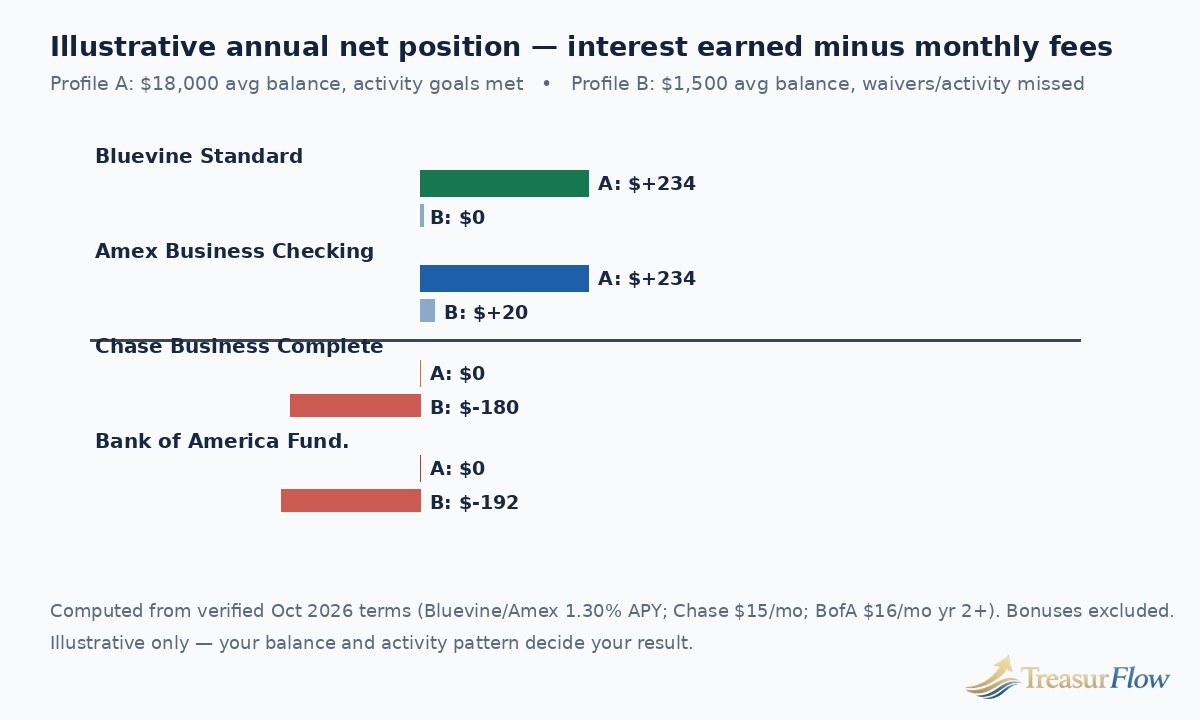
The examples below use only the verified October 2026 figures cited above, apply simple annual interest (balance × APY) with no compounding tricks, exclude one-time bonuses — because a bonus you earn once should not disguise a cost you pay forever — and are labeled illustrative: your balance pattern, not ours, determines your result.
Profile A — an established online services LLC. Average balance $18,000 held all year; all transactions electronic; $600 a month in debit-card spend; $4,000 a month received from clients; no cash; no wires.
- Bluevine Standard: $0 fees. Activity goal met ($600 spend exceeds $500; $4,000 received exceeds $2,500), so interest is $18,000 × 1.30% = $234 earned. Net position: +$234.
- American Express Business Checking: $0 fees. No activity test, so interest is $18,000 × 1.30% = $234 earned. Net position: +$234.
- Chase Business Complete: fee waived (balance well above $2,000), no interest. Net position: $0.
- Bank of America Fundamentals: fee waived (balance above $5,000 and spend above $500), no interest. Net position: $0.
At this profile the two interest-bearing accounts beat the two branch accounts by $234 a year — roughly the cost of a year of bookkeeping software — purely for holding money the business was going to hold anyway.
Profile B — a brand-new micro-business. Average balance $1,500; debit-card spend $300 a month; $2,000 a month received; all electronic; no cash.
- Bluevine Standard: $0 fees, but the activity goal is missed ($300 is below $500; $2,000 is below $2,500), so interest is $0. Net position: $0.
- American Express Business Checking: $0 fees, no activity test, so interest is $1,500 × 1.30% = $19.50 earned. Net position: +$19.50.
- Chase Business Complete: the $2,000 balance test is missed and no other waiver applies, so the fee runs all year: $15 × 12 = $180 paid. Net position: −$180.
- Bank of America Fundamentals: the fee is $0 for the first 12 statement cycles, so year one nets $0 — but from year two, with both waiver tests missed, $16 × 12 = $192 paid. Net position in year two: −$192.
Profile B is the more important lesson. The gap between the best and worst fit is $199.50 in year one against Chase, and $211.50 against Bank of America’s steady-state fee — for a business with only $1,500 in the bank. Small businesses do not lose money to business checking through exotic fees. They lose it through a waiver test they were never going to pass, attached to an account chosen for its bonus or its branch on their street. If a bonus is part of your decision anyway, do that math separately and honestly — our best checking account bonuses 2026 guide walks through how bonus conditions usually work — and if your banking history makes opening any account difficult, start with our no credit check bank accounts 2026 explainer before you apply anywhere.
What you need to open a business checking account in 2026
Requirements are consistent enough across banks and fintechs that you can assemble the packet once. Expect to provide: a government-issued photo ID for every owner; the business’s EIN from the IRS — sole proprietors can often use a Social Security number instead, though an EIN is free from the IRS page linked at the top of this guide and keeps your SSN off paperwork — formation documents (articles of organization for an LLC, articles of incorporation for a corporation), an operating agreement or bylaws, and any DBA or trade-name filing if you operate under a name different from the legal entity. Beneficial owners holding 25% or more should expect identity verification, a standard federal requirement rather than a bank’s whim. The SBA’s account-opening checklist, also linked above, is the authoritative version of this list. Opening deposits in this guide range from $0 (Bluevine, Novo, Mercury, Axos, Amex) to $25 (U.S. Bank Business Essentials) to $100 (Bank of America). If an application is declined, ask whether a ChexSystems record was the reason before you apply elsewhere — repeated applications without fixing the underlying record help no one.
Separation is the point of all of it. The SBA advises opening a business account as soon as the business starts spending or receiving money, and commingling personal and business funds is the fastest way to complicate taxes, weaken an LLC’s liability separation and make a lender or the IRS ask harder questions. A dedicated account, a dedicated card, and clean records are the cheapest legal and tax hygiene a small business can buy — and in 2026, as this guide shows, they can cost $0 a month when the account fits.
Business Checking Questions Owners Ask Before Opening
Do I need an EIN to open a business checking account?
Sole proprietors can usually open a business checking account with a Social Security number, but LLCs, partnerships and corporations are generally required to provide an Employer Identification Number. An EIN is free from the IRS, takes minutes to obtain online, and keeps your Social Security number off bank paperwork, so most owners get one even when it is optional.
How much cash can I deposit into a business checking account each month?
It depends entirely on the account. As of October 2026, Chase Business Complete includes $5,000 per statement cycle in-branch at no additional charge, U.S. Bank Business Essentials includes about $2,500 through its 25-unit system, Bluevine caps Green Dot retail cash deposits at $7,500 per 30 days with a $4.95 fee per deposit, and Mercury, Novo and American Express Business Checking do not accept cash deposits at all.
Are welcome bonuses on business checking accounts worth it?
A bonus is worth it only when the account already fits your business without the bonus. Current verified examples as of October 2026 include up to $500 at Chase, $400 at U.S. Bank Business Essentials and $400 or $750 at Bank of America, each with deposit, balance-hold and transaction conditions, and each limited-time. If meeting the conditions forces you to park cash you need elsewhere, or the account’s fees will exceed the bonus within two years, the bonus is not a gain.
Is my money insured if my business checking account is with a fintech like Bluevine, Novo or Mercury?
Yes, within FDIC limits, because fintech business accounts are provided through partner banks that are FDIC members. Bluevine accounts are held through Coastal Community Bank with coverage up to $3 million per depositor through a sweep program, Mercury accounts run through Choice Financial Group and Column N.A. with coverage up to $5 million through sweep networks, and Novo accounts are held at Middlesex Federal Savings with the standard $250,000 of coverage. Confirm the partner bank and coverage on the provider’s site before depositing.
Can I open a business checking account with no monthly fee and no minimum balance?
Yes. As of October 2026, Bluevine Standard, Novo, Mercury, Relay Starter, Axos Basic Business Checking, American Express Business Checking and U.S. Bank Business Essentials all charge no monthly fee and require no minimum balance to keep the account open. They differ in cash access, interest and transaction rules, so no monthly fee should be the start of your comparison, not the end of it.
What happens if I exceed my business checking account’s transaction limit?
At branch banks, you usually pay a per-item fee on the excess rather than losing the account: $0.40 per item beyond 20 included teller and paper transactions at Chase Business Complete, and $0.50 per item beyond 25 included in-person transactions and paper checks at U.S. Bank Business Essentials, as of October 2026. Most online business accounts in this guide, including Bluevine, Novo, Mercury and Axos Basic, allow unlimited transactions with no excess-transaction fee.
Conclusion: match the account to the money, not the marketing
The best business checking accounts 2026 share one trait: their free tier, waiver test or APY condition describes a business exactly like yours on an ordinary month — not your best month, and not the business you hope to be in three years. Freelancers should start free and tool-rich with Novo or Found. Balance-holding LLCs should collect the $234-a-year difference that Bluevine or American Express pays over a 0% branch account, choosing between them on one question: will you hit an activity goal every month, or not? Cash businesses should count their cash and their paper, then choose between U.S. Bank’s $0 Essentials, Chase’s larger included allowance, or Axos’s free ATM cash deposits with clear eyes about each cap. E-commerce sellers should price Mercury’s free wires and Relay’s multi-account structure against their actual payment patterns.
Do the three-number exercise before you apply: your typical lowest monthly balance, your monthly cash deposited, and your monthly paper-item count. Hold those numbers against the fee anatomy in this guide, verify the finalist’s live fee schedule on its own site, and the choice usually makes itself. And when the business outgrows the account — it will — switching is a normal event, not a failure. The expensive mistake is never the account you open. It is the account you keep paying for, month after month, long after it stopped fitting.

Muhammad Zakir is the founder of Treasurflow and the author of its personal finance guides. He researches consumer banking, credit, and personal loans, and every guide cites primary sources such as the CFPB, FDIC, FTC, and IRS. His content is educational and is not personalized financial advice.