
Most people shop for tax help backwards. They start with a famous name, sit down in an office or open a chat window, hand over a folder of documents, and only learn the price — and the preparer’s actual qualifications — at the very end. By then the return is done, the fee is deducted, and asking hard questions feels awkward.
best tax preparation services 2026: This guide flips that order. It starts with the routes that cost nothing, because a surprising number of filers who pay $200, $300, or more each spring were eligible for free, human help all along. It then decodes the alphabet soup of preparer credentials, so you can tell the difference between a federally licensed enrolled agent, a state-licensed CPA, and a seasonal preparer whose only federal requirement is a registration number. Only after that does it compare the paid options — the national chains, independent CPAs and enrolled agents, and the newer online services where a live preparer does the work for you — by the type of return each one actually fits.
A note on scope before we begin: this article is about tax preparation services — help from a human being, in person or online. A companion topic, do-it-yourself tax software, works well for many confident filers, and we include a dedicated section below on choosing between a service and software. But if you have already decided you want a person to prepare, review, or sign your return — or you are trying to decide whether you need one — this is the guide for you.
It is also a guide written for the 2026 filing season, meaning the season in which you file your tax year 2025 return. The headline dates are these: the IRS began accepting and processing 2025 returns on January 26, 2026, the federal filing deadline was April 15, 2026, and taxpayers who filed an extension generally had until October 15, 2026. If you are reading this in October 2026 to plan ahead, use it to line up your documents, check whether you qualify for a free program next season, and interview preparers before the January rush — the best local professionals often fill their calendars early.
One change matters more than any other this season, and we will state it plainly here so there is no confusion later: IRS Direct File will not be available for filing season 2026. The IRS confirmed to participating states in November 2025 that the Direct File pilot — which let taxpayers file directly with the IRS at no cost in 2024 and 2025 — would not run this season, and no future launch date was set. If you used Direct File last year, you need a different route this year. The good news is that IRS Free File, VITA, TCE, and MilTax all remain available, and this guide walks through each one.
No honest guide can promise you a bigger refund, and this one will not try. Your refund is determined by your income, withholding, deductions, and credits under the law — not by a preparer’s sales pitch. What a good preparer can do is make sure nothing you are entitled to is missed, that forms are filed correctly and on time, and that you have someone to call if the IRS asks questions later. What a bad preparer can do ranges from expensive to genuinely dangerous, which is why the scam-guard section near the end of this guide may be the most important part of it.
Related Guides
- Best Budgeting Apps 2026 — set aside money monthly for tax season instead of scrambling in April.
- Best High-Yield Savings Accounts 2026 — park your refund, or your tax-payment fund, somewhere it earns more.
- How to Save Money Fast on a Low Income 2026 — practical steps if a tax bill, not a refund, is what you are facing.
- Best Identity Theft Protection Services 2026 — relevant because tax season is peak season for refund fraud and stolen-identity returns.
Helpful Official Resources
- IRS Directory of Federal Tax Return Preparers with Credentials and Select Qualifications — search credentialed preparers by ZIP code before you hire anyone.
- IRS Free File — always start Free File from IRS.gov, never from a search ad, so you land on the genuine free offer.
- IRS Free Tax Return Preparation for Qualifying Taxpayers (VITA/TCE) — eligibility and the VITA/TCE site locator.
- Taxpayer Bill of Rights — the ten rights every taxpayer has in dealings with the IRS, including the right to retain representation.
- FTC Consumer Advice on Tax Scams — how to spot tax-related identity theft and imposter scams.
Start With $0: The Free Routes Most Filers Miss
Before any paid comparison makes sense, check the free routes in this order. They are not consolation prizes. Two of them put a trained human on your return at no cost, and one of them is the closest surviving equivalent to the Direct File program that ended.
IRS Free File: Guided Help if Your AGI Is $89,000 or Less
For the 2026 filing season, IRS Free File offers free guided tax preparation to taxpayers whose adjusted gross income (AGI) for tax year 2025 is $89,000 or less. That threshold, confirmed by the IRS and its Free File partners for this season, is up from $84,000 the prior season, and it applies to the return — on a joint return, it is the couple’s combined AGI that must fall at or below the line. Roughly 70 percent of taxpayers fall under it, which means the majority of people reading this guide probably qualify and do not realize it.
Free File is a partnership between the IRS and a group of commercial tax software companies — eight partners participated for the 2026 season, including FreeTaxUSA (offered by TaxHawk), TaxAct, TaxSlayer, 1040.com, 1040Now, ezTaxReturn, FileYourTaxes.com, and On-Line Taxes. Each partner sets some additional conditions of its own, such as age ranges, state residency, or which forms it will handle for free, so the IRS lookup tool matters: start at IRS.gov’s Free File page, answer a few questions, and let it match you to a partner whose free offer actually covers your situation.
Two warnings protect the “free” in Free File. First, always enter through IRS.gov. If you go directly to a partner’s commercial website, or click a search ad, you may land on a paid product that looks nearly identical. The free offer lives behind the IRS doorway. Second, a free federal return does not always mean a free state return. Some partners include state filing free for some filers; others charge for it. Check before you invest an hour entering data.
VITA: Free In-Person Help if You Generally Earn $69,000 or Less
The Volunteer Income Tax Assistance program — VITA — is the free route that most closely matches what many people imagine a paid chain office does, except the price is zero. IRS-certified volunteers prepare and e-file basic returns in person at thousands of sites: libraries, community centers, nonprofit offices, schools, and college campuses.
VITA generally serves people who make $69,000 or less, people with disabilities, and taxpayers with limited English proficiency who need help preparing their returns. Note the word “generally” in the IRS description — it is guidance for the program rather than a cliff edge policed to the dollar at every site, and individual sites can vary in what they offer. If you are modestly above the line, it is still worth checking with your local site rather than assuming you are excluded, while understanding the site may need to turn you away.
What VITA handles well includes wage income, Social Security benefits, pensions, unemployment income, interest and dividends within program limits, and the credits that matter most to lower- and moderate-income households, above all the Earned Income Tax Credit and the Child Tax Credit. What it generally does not handle is just as important: complex business returns, complicated rental activity, and certain complicated capital-gain situations are typically out of scope, and each site follows published scope limits. Ask about your specific situation when you book, so you do not gather documents and wait in line only to learn your return is out of scope.
Every VITA return goes through a quality review process before filing — a second set of trained eyes checks the work, a safeguard worth appreciating. Use the IRS VITA/TCE locator online or call 800-906-9887 to find a site, and book early: appointments at popular sites fill weeks ahead as the deadline approaches.
TCE and AARP Tax-Aide: Free Help Built for Taxpayers 60 and Older
Tax Counseling for the Elderly — TCE — is VITA’s sibling program, focused on taxpayers age 60 and older. Its volunteers receive training weighted toward the questions that dominate later-life returns: Social Security benefits and when they become taxable, pension and annuity income, required minimum distributions from retirement accounts, and the tax treatment of part-time work in retirement.
The largest TCE provider is AARP Foundation Tax-Aide, which operates sites in libraries, senior centers, and community buildings across the country. You do not need to be an AARP member to use Tax-Aide — a point many seniors miss, assuming the program is members-only. It is not. And unlike VITA, TCE does not carry a single headline income figure in the same way; the programs describe their audience as older taxpayers, with priority service for seniors. If you are 60 or older and your return is within scope — most wage, pension, Social Security, and investment-income returns are — TCE should be your first phone call, not a paid office.
MilTax: The Most Generous Free Route, if You Are Military
If you are in the military community, check MilTax before anything else in this guide. Offered by the Department of Defense through Military OneSource, MilTax combines tax software designed for military life with free access to tax consultants — and it has no income limit.
Eligibility covers active-duty service members, members of the National Guard and reserves, immediate family members, eligible survivors, and veterans and retirees for up to 365 days after their separation or retirement date. Eligible filers can prepare and e-file one federal return and up to five state returns at no charge — a detail that matters enormously for military families who moved mid-year and would otherwise pay per-state fees elsewhere. The consultants understand the issues civilian preparers sometimes fumble: combat pay exclusions, permanent-change-of-station moves, multi-state residency, and the Military Spouses Residency Relief Act.
Who the Free Routes Do Not Cover
Honesty about limits makes the rest of this guide more useful. Free programs have scope rules, seasonal hours, and appointment scarcity. If you own a business with employees and inventory, trade extensively, own multiple rentals, lived in several states with complicated sourcing, received a K-1 from an investment you do not fully understand, or have unfiled prior-year returns stacked up, you will likely be referred to a paid professional — and that referral is a favor, not a failure. The next sections explain how to choose that professional without overpaying for credentials you do not need or under-buying expertise you do.
The Credential Decoder: Who Is Actually Qualified to Prepare Your Return?
Here is the uncomfortable fact at the center of the American tax preparation market: at the federal level, almost anyone can get paid to prepare your return. The IRS requires paid preparers to obtain a Preparer Tax Identification Number (PTIN) and to sign the returns they prepare — but a PTIN is a registration, not a qualification. It does not require passing an exam, holding a license, or completing a single hour of tax education. That is why decoding credentials is not academic. It is the difference between hiring someone whose competence has been tested and regulated, and hiring someone whose competence you are taking entirely on trust.
The PTIN: A Registration Number, Not a Credential
Every person who prepares or assists in preparing federal tax returns for compensation must have a valid PTIN, must include it on returns they prepare, and must sign those returns. Keep those three duties in mind, because the scam section of this guide turns on them: a preparer who will not sign your return or will not put their PTIN on it is breaking the rules in a way you can see with your own eyes before filing.
Unenrolled Preparers: The Seasonal Majority
The largest group in the market has no credential beyond the PTIN. Many work seasonally for chains and independent storefronts; some are careful, experienced, and excellent within the scope of straightforward returns. Others are not. The federal system largely leaves it to you to tell the difference, although a handful of states — California, Oregon, Maryland, and New York among them — impose their own registration, education, or testing requirements on paid preparers beyond the federal PTIN.
AFSP Participants: A Voluntary Step Up
The IRS Annual Filing Season Program (AFSP) is a voluntary program for unenrolled preparers. Participants complete a set amount of continuing education each year — including a refresher course covering federal tax law — and receive an AFSP Record of Completion. They agree to follow certain practice obligations, and in return they appear in the IRS Directory of Federal Tax Return Preparers and gain limited representation rights for returns they prepared and signed.
Enrolled Agents: Federally Licensed Tax Specialists
Enrolled agents (EAs) are licensed by the IRS itself. To earn the credential, a preparer must pass a comprehensive three-part examination covering individuals, businesses, and representation and practice before the IRS — or qualify through certain IRS employment experience — pass a background and tax-compliance check, and complete 72 hours of continuing education every three years.
Taxes are the EA’s entire profession. Unlike a CPA, whose license covers accounting broadly, an enrolled agent’s credential is specifically and exclusively about federal taxation. EAs hold unlimited representation rights: they can represent any taxpayer, on any tax matter, before any IRS office — examinations, collections, and appeals alike. For an individual or small-business owner whose main need is tax preparation, tax planning, and someone who can stand in front of the IRS for them, an EA is often the best-matched credential, and frequently at a lower price than a CPA for comparable tax work.
CPAs: State-Licensed Accountants With the Broadest Practice
Certified public accountants are licensed by state boards of accountancy. The path — a bachelor’s degree with substantial accounting coursework, the rigorous Uniform CPA Examination, experience requirements, and ongoing continuing education — is the most demanding in this guide, and CPA firms anchor the high end of the market.
CPAs also hold unlimited representation rights before the IRS. Where a CPA earns their premium over an EA is breadth: business accounting, financial statements, audits and reviews, bookkeeping systems, and business advisory work beyond the return itself. If your tax return is one piece of a larger financial picture — a growing business, an entity choice to revisit, books that need professional attention year-round — a CPA firm is a natural home. If your need is a single individual return, however well prepared, you may be paying for capacity you never use.
Tax Attorneys: For Disputes, Risk, and High Stakes
Tax attorneys are licensed by state bars, hold law degrees, and often advanced training in tax law. They too hold unlimited representation rights, and they add something no other credential offers: attorney-client privilege. You do not hire a tax attorney to prepare a routine return — their hourly rates make that poor economics. You hire one when the matter is a dispute, a large liability, a disclosure decision, an estate or business transaction with serious tax consequences, or anything where you need legal advice and privilege, not just accurate forms.
How to Verify Any of This in Five Minutes
Do not take a wall certificate or a website claim at face value. The IRS maintains the Directory of Federal Tax Return Preparers with Credentials and Select Qualifications, a free searchable database at IRS.gov. You can search by ZIP code and filter by credential — enrolled agent, CPA, attorney, or AFSP participant. If a preparer claims a credential but does not appear, ask why; CPA and attorney listings involve some self-reporting, so for those two credentials you can also confirm standing directly with the state board of accountancy or the state bar. A preparer who welcomes verification is telling you something. So is one who resents it.
Service vs. Software: Which Route Fits You?
Because a separate Treasurflow guide covers do-it-yourself tax software in depth, this section stays focused on the decision itself: when does a human service beat software, and when is software the smarter buy?
Choose a service — a human preparer — when any of these describe you. You had a major life or income change this year: started or closed a business, bought or sold a home or rental, exercised stock options, received an inheritance, moved between states, or began taking retirement distributions. You received a notice from the IRS or a state and want a credentialed professional who can respond and represent you. You have prior-year returns unfiled. You keep records in a shoebox and know your bookkeeping would not survive your own scrutiny, let alone software’s questions. Or you simply know, honestly, that you will not finish a self-guided return accurately — an unfinished or sloppy return costs more than a preparer’s fee.
Software is usually the better buy when your return is genuinely simple — wage income, the standard deduction, common credits — you are comfortable answering interview questions carefully, and your documents are organized. Even then, note the hybrid middle ground covered later in this guide: several brands let you start in software and hand the return to a live preparer to finish, or have a preparer do everything from documents you upload. That hybrid is technically a service, and for many filers it is the sweet spot — human judgment without an office visit.
The tiebreaker question is not “which is cheaper?” but “what happens if something goes wrong?” With software, the follow-up is on you, possibly with paid add-on support. With a credentialed preparer, you have a named professional — and, for EAs, CPAs, and attorneys, someone who can represent you. Price that difference honestly against the complexity of your return, and set the money aside through the year using the kind of system described in our guide to the best budgeting apps for 2026, so the right choice is affordable when January comes.
The Best Tax Preparation Services by Filer Situation
There is no single “best” service in this market — there is a best match for a given return. What follows is organized the way you should actually shop: by situation first, brand second. Pricing notes are dated samples as of October 2026, attributed where they appear, because tax-preparation pricing is seasonal, varies by location and by the forms your return needs, and is often not published as a fixed menu at all. Treat any number here as a starting point for your own written quote, never as a promise.
For Simple Returns In Person: The National Chains
H&R Block is the largest name in in-person preparation, with thousands of offices and a model built on walking in — or dropping off documents, or starting online and finishing with a preparer. Its offices staff a range of preparer experience levels, from seasonal preparers to enrolled agents and its Block Advisors arm for small-business clients. The strength of the model is availability: year-round offices in many locations, a second-look review culture, and the ability to escalate from its online products to a human in the same brand. The weakness to manage is variability — your experience depends heavily on the individual preparer assigned to you, so ask who will prepare your return and what their credential and experience are, rather than buying the logo alone. As of October 2026, H&R Block’s in-person pricing was not a single published national fee; it varies by office and by the complexity of the return, with simpler returns at the low end and each additional form or schedule adding cost. Get the estimate in writing before work begins.
Jackson Hewitt competes on accessibility and speed, including locations inside many Walmart stores — a genuinely convenient option for filers who want to combine errands with an appointment during the season. Its online product has been notable for a flat $25 federal-and-state offer in recent seasons, as widely reported in consumer coverage as of October 2026; its in-person pricing, by contrast, varies by location — many offices are franchises — and promotional offers such as discounted simple-return deals for new clients come with eligibility limits that exclude, for example, many self-employed filers and some state returns. Read the promotion’s conditions before assuming it prices your return.
Liberty Tax operates more than 2,000 locations (a figure the company has cited in recent seasons) and offers three modes: in-office preparation, a remote service where you send photos or scans of documents to a preparer who completes the return for you, and its own online filing tiers. That remote, done-for-you mode is the distinctive one — it suits filers who want a human preparer without a trip across town. Like its chain competitors, Liberty’s in-office fees are set around the forms your return requires and vary by location, so the same written-quote advice applies.
How to choose among the chains. For a truly simple return, first re-check the free routes above — you may be choosing among chains for a return VITA would do free. If you do pay, compare the actual office, not the brand: years in the neighborhood, the named preparer’s credential and AFSP status, whether the office is open year-round, and a written, itemized estimate. A mediocre preparer at a famous chain is a worse buy than a strong preparer at a lesser-known one.
For Business Owners and Complex Returns: Independent CPAs and EAs
If your return includes a Schedule C business with real expenses, rental properties, K-1 partnership income, multi-state income, stock compensation, cryptocurrency disposals, or a first year after a major transaction, skip the seasonal storefront and interview independent professionals — CPAs and enrolled agents in local practice, and the small-business arms of the chains such as Block Advisors.
The buying process here is an interview, and it should happen in the fall, not February. Ask what share of their practice looks like yours; a CPA who prepares returns for fifty restaurants will spot things in a restaurant owner’s books that a generalist will not. Ask who, exactly, prepares the return and who reviews it. Ask how they charge — flat fee by form, hourly, or an annual retainer that bundles planning — and what is included if the IRS asks questions. And ask what they need from you, and by when; the best firms publish an organizer and a cutoff date, and charge rush or cleanup fees for disorganized records delivered in April. That discipline is a feature: it is how your return gets real attention instead of a deadline-week scramble.
For Filers Who Want a Human Without an Office Visit: Online Live-Preparer Services
The fastest-growing model is the hybrid: you upload documents from your phone or computer, and a live preparer — an employee tax professional, and at the higher tiers a CPA or EA — prepares and files the return for you, communicating by chat, phone, or video. H&R Block’s virtual and drop-off options, Liberty Tax’s remote preparer service, TurboTax Live’s full-service tier (in which a preparer does the entire return), and TaxAct’s and TaxSlayer’s expert-help add-ons all live somewhere on this spectrum, from “software with a human on call” to “a human does everything.”
For Prior-Year, Amended, and Problem Returns
Unfiled years, amended returns, and IRS notices change the shopping rules. Free File covers only the current-year return, and VITA sites handle prior years only within limited scope and capacity. This is credentialed-professional territory: an EA or CPA for preparation and examination issues, an attorney if legal exposure is in play. Do not let a seasonal office talk you into bundling old problems into a quick current-year filing. A professional who starts by pulling your IRS account transcripts and triaging the years is showing you the right instincts; a service that wants to file first and ask questions never is not. If identity theft is part of the problem — a return already filed in your name, for instance — pair professional help with the protective steps in our guide to the best identity theft protection services for 2026.
The True Cost of a Prepared Return: Forms, Upsells, and Refund Fees
How Per-Form Pricing Works
Most preparers — chains and independents alike — build the fee from the return itself. A base Form 1040 with the standard deduction anchors the price; itemizing on Schedule A raises it; a Schedule C business, Schedule E rental, or Schedule D investment sales each add their own increments; a state return adds more, and a second state adds again. Hourly and retainer models exist, especially at CPA firms, but even there the underlying driver is the same: complexity takes time, and time is the bill.
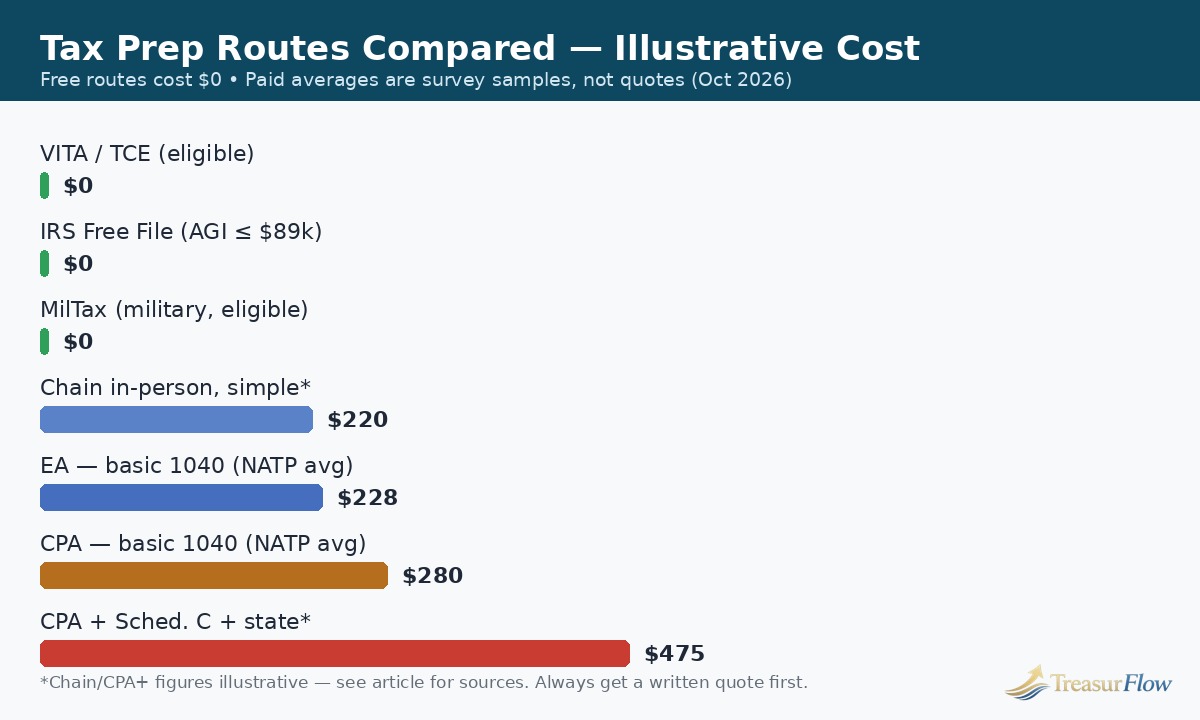
Survey data gives you the shape of the market. The National Association of Tax Professionals’ 2025 fee study, as reported by Accounting Today, put the average fee for a basic Form 1040 at $280 when prepared by a CPA, $228 by an enrolled agent, and about $185 by a non-credentialed preparer — a clean illustration of the credential premium, and of the fact that even “basic” professional preparation now averages in the hundreds, not the dozens. Each schedule adds materially on top; the same reporting put a Schedule C increment in roughly the $123–$135 range. Older benchmarks tell a consistent story over time: the National Society of Accountants’ last detailed form-by-form survey (2020–2021) put a non-itemized Form 1040 with a state return at an average of $220 and an itemized one at $323, figures that later surveys and inflation have only pushed upward. Business entity returns live in a different bracket entirely — partnership and S-corporation returns have averaged several hundred dollars and up in every published survey, and a current quote above those older averages should surprise no one.
An Illustrative Example, With the Math Shown
To make the build-up concrete, here is an illustrative example computed from the sourced averages above — not a quote from any firm. Imagine a freelancer with W-2 income from a part-time job plus a Schedule C side business, filing one state return, prepared by a CPA:
- Basic Form 1040 (CPA average, NATP 2025 fee study): $280
- Add Schedule C (midpoint of the reported $123–$135 increment): $130
- Add one state return (illustrative increment): $65
- Total if paid upfront: $475
- Add a refund-transfer processing fee, if the fee is instead deducted from the refund (illustrative): $39
- Total if paid out of the refund: $514
The lesson is not the total — your return will price differently. The lesson is the structure: $475 of preparation, priced form by form, and then a separate $39 charge that bought no tax work at all. It bought only the method of paying for the tax work. That distinction is where the next two cost traps live.
Upsells: Audit Help, Guarantees, and Products You Did Not Ask For
Around the core fee, the industry sells a ring of extras. Some have genuine value for the right filer: an accuracy guarantee that covers penalties and interest if the preparer errs is a reasonable thing to want, and its terms — what it covers, for how long, and who pays if the tax itself was understated — are worth reading before you buy, because guarantees typically cover penalties and interest from preparer error, not the underlying tax you legally owed.
Refund-Transfer and Refund-Advance Fees: Paying to Be Paid
A refund transfer (sometimes called a refund anticipation check) lets you pay your preparation fee out of your refund instead of upfront. A bank opens a temporary account, receives your refund, deducts the preparer’s fee and its own processing fee, and passes you the remainder. The convenience is real for a filer with no money available in February. So is the cost: the processing fee — commonly in the $30–$40-plus range in recent seasons, varying by provider and bank — pays for nothing but the deduction mechanics, and it stacks on top of the preparation fee, exactly as the example above shows. If you can pay upfront by card or cash, you keep that money. This is a place where a small emergency fund changes the math entirely — the reason we pair this guide with practical resources like our walkthrough of how to save money fast on a low income.
A refund advance is a different animal: a loan against your expected refund, offered through the preparer’s partner bank. Some advance products in recent seasons were marketed at 0% APR with no loan fee for amounts within a set range, while early-season or larger advance products from some providers carried interest — consumer comparisons of the 2026 season, as of October 2026, showed offers ranging from 0% APR products to advances with APRs approaching 36%. An advance does not make your refund arrive from the IRS any faster; it lends you money against it, on the lender’s terms, and approval is not guaranteed. Read the APR, the fee, the repayment trigger if your actual refund comes in smaller than expected, and where the funds must land — some products require the money to go onto the provider’s own card or account. Free direct deposit of an e-filed refund into your own bank account remains the cheapest fast option for most filers, and parking that refund in one of the best high-yield savings accounts for 2026 beats spending it on fees to reach it a few days sooner.
Five Ways to Lower a Legitimate Bill
None of these involve cutting corners on accuracy. First, check the free routes every year — income changes, and last year’s ineligibility may be this year’s VITA or Free File qualification. Second, arrive organized: a complete document packet, with last year’s return, prevents cleanup and rush fees, which are real line items at many firms. Third, file early in the season, when hybrid online services tend to price lower and local offices still have capacity to quote competitively. Fourth, get two written quotes for anything beyond a simple return, using your prior-year return so both quotes price the same complexity. Fifth, pay upfront where you can, and decline checkout add-ons item by item. Together, these five habits routinely matter more than which logo is on the office door.
Scam Guard: Ghost Preparers, Illegal Fees, and Your Legal Responsibility
Everything in this section comes from warnings the IRS repeats every filing season, because every filing season proves they are needed. Tax preparation fraud is not an edge case; the IRS includes abusive preparers in its annual warnings about prevalent tax scams, and the FTC likewise warns consumers about tax-related identity theft and imposter schemes each season.
The Ghost Preparer: The One Who Will Not Sign
Federal law requires a paid preparer to sign the returns they prepare and include their PTIN. A “ghost preparer” — the IRS’s own term — is a paid preparer who refuses to do so. The ghost prepares your return, collects a fee, and has you file it as if you prepared it yourself, or e-files it without their identifying information. Their name appears nowhere. If the return is wrong — and ghost-prepared returns are where inflated deductions, invented credits, and altered income concentrate — the IRS comes to you, and your preparer has vanished. That is the business model: the ghost’s fee is often based on engineering a large refund, and their invisibility is what lets them do it.
Never accept an unsigned prepared return. Never sign a blank or incomplete return, no matter how rushed the appointment feels. Review the complete return before it is filed, confirm your own bank account — not the preparer’s — is the account listed for direct deposit of any refund, and keep a complete copy of everything that was filed in your name.
Fees Based on Your Refund: A Fee Structure the Rules Forbid
Be equally direct about pricing structure: avoid any preparer whose fee is based on a percentage of your refund. The IRS instructs taxpayers to avoid such preparers, and federal practice rules (Treasury Circular 230) generally prohibit practitioners from charging contingent fees for preparing an original tax return, subject to narrow exceptions. The reason is structural, not technical: a preparer paid a slice of the refund is paid to make the refund bigger, by whatever entries achieve that. Legitimate preparers charge by the form, by the hour, or by a flat fee quoted in advance — structures that pay them the same whether your refund is large, small, or a balance due.
Related red flags, all drawn from IRS guidance on choosing a preparer: a preparer who promises a larger refund than competitors before seeing your documents; a preparer who wants to deposit all or part of your refund into their own account; a cash-only operation that provides no receipt; a preparer who bases your income on a pay stub instead of your actual Form W-2; and a preparer who is unreachable after filing season ends. Any one of these should end the engagement. Several together describe a fraud operation, and suspected preparer misconduct can be reported to the IRS on Form 14157, Complaint: Tax Return Preparer.
The Rule That Overrides Everything: You Are Responsible for Your Return
State this without softening, because the IRS states it without softening: you are legally responsible for everything on your tax return, even when someone else prepares it. Signing the return — including e-filing with your PIN — is your declaration that it is true and correct to the best of your knowledge. If a preparer invents deductions, the resulting tax, interest, and penalties are assessed against you; “my preparer did it” is not a defense that erases the balance, even though an honest taxpayer who relied in good faith on a professional may have arguments about certain penalties, and even though the IRS can and does also pursue the preparer.
Identity Safety During Tax Season
What to Bring: The Tax Preparation Checklist
Whether your appointment is at a VITA site, a chain office, a CPA’s conference room, or a video call with a live online preparer, the document packet is the same. Arriving complete is the single easiest way to lower your fee, shorten the appointment, and improve accuracy.
Identity and family: Government-issued photo ID for you (and your spouse, if filing jointly); Social Security cards or ITIN letters for everyone on the return; birth dates for all family members; last year’s tax return; your bank routing and account numbers for direct deposit; and, if the IRS issued you an Identity Protection PIN for this year, that letter — your return cannot be e-filed without it.
Income documents: Form W-2 from every employer; Forms 1099-NEC and 1099-MISC for contract and miscellaneous income; 1099-INT and 1099-DIV for interest and dividends; 1099-B or consolidated brokerage statements for investment sales; Schedule K-1s from partnerships, S-corporations, or estates; SSA-1099 for Social Security benefits; 1099-R for retirement distributions; 1099-G for unemployment or state refunds; W-2G for gambling winnings; and records of any other income — rental receipts, alimony received under older agreements, or digital-asset sales — even where no form arrived. No form does not mean not taxable.
Deductions, credits, and adjustments: Form 1098 for mortgage interest and 1098-T for tuition; receipts and records for charitable contributions; childcare provider details including their tax ID number, for the dependent care credit; Form 1095-A if you bought Marketplace health coverage — this one is mandatory for reconciling premium tax credits and missing it delays returns every season; records of student loan interest (1098-E); HSA and IRA contribution records; estimated tax payments you made, with dates and amounts; and, if you plan to itemize or run a business, organized expense records — organized being the operative word, since a categorized summary costs you an evening and a box of raw receipts can cost you a professional cleanup fee.
For business owners and landlords: a profit-and-loss statement or bookkeeping export, business bank statements, mileage logs, asset purchase records for depreciation, payroll summaries if you have employees, and prior-year depreciation schedules from your last return.
Before you leave the appointment: a complete copy of the filed return, an itemized invoice, the preparer’s name, PTIN, and contact information for after the season, and a note of when and how any balance due will be paid. File the packet somewhere safe — you will want it next year, and so will next year’s preparer, whoever they are.
Tax Prep Questions Filers Ask Before They Hand Over Their Documents
How much does a professional tax preparer cost in 2026?
It depends on complexity and credential. The National Association of Tax Professionals’ 2025 fee study put the average for a basic Form 1040 at $280 with a CPA, $228 with an enrolled agent, and about $185 with a non-credentialed preparer, with each additional schedule adding more. Eligible filers pay $0 through IRS Free File, VITA, TCE, or MilTax, so check the free routes before paying anyone.
What is the difference between an enrolled agent and a CPA for tax preparation?
An enrolled agent is licensed by the IRS after passing a three-part exam focused entirely on taxation, while a CPA is licensed by a state board of accountancy with broader accounting training. Both can prepare any return and represent you before the IRS without limits. Choose an EA for tax-focused work, and a CPA when you also need broader accounting or business services.
Can I get my taxes done for free in person in 2026?
Yes, if you qualify. VITA sites offer free in-person preparation to people who generally make $69,000 or less, people with disabilities, and taxpayers with limited English proficiency. TCE, including AARP Foundation Tax-Aide, offers free help focused on taxpayers age 60 and older. Use the IRS VITA/TCE locator to find a site and book early.
Is IRS Direct File available for the 2026 filing season?
No. The IRS confirmed that Direct File will not be available for filing season 2026, and no future launch date has been set. Taxpayers who used Direct File previously should use IRS Free File if their AGI is $89,000 or less, a free program such as VITA or MilTax if eligible, or a paid service instead.
What should I bring to a tax preparation appointment?
Bring photo ID, Social Security cards for everyone on the return, last year’s return, and bank details for direct deposit, plus all income forms such as W-2s and 1099s. Also bring Form 1095-A if you had Marketplace health coverage, childcare provider details if you claim the dependent care credit, and records for deductions, credits, and estimated tax payments you made.
Am I still responsible if my tax preparer makes a mistake?
Yes. The IRS holds you legally responsible for everything on your return even when a preparer completes it, including any tax, interest, and penalties from errors. Review the full return before it is filed, ask about anything you do not recognize, confirm the refund goes to your own bank account, and keep a complete copy for your records.
Conclusion: Route First, Brand Second, Signature Last
The best tax preparation services in 2026 are not a ranked list of logos. They are a sequence of correct decisions. Start with the free routes and check them honestly every year — Free File at an AGI of $89,000 or less, VITA if you generally earn $69,000 or less, TCE if you are 60 or older, and MilTax with no income limit if you are part of the military community — and remember that Direct File, whatever you may have used or heard about last year, is not available this season. If the free routes do not fit, match the credential to the complexity: a reputable chain office or AFSP participant for simple returns, an enrolled agent or CPA for business and multi-state complexity, a live online preparer when you want a human without the office visit, and an attorney when legal stakes enter the picture.
Then protect yourself at the finish line, because that is where the money and the risk concentrate. Get a written, itemized quote before work begins. Pay upfront instead of out of your refund when you can. Read the finished return line by line, confirm it carries your preparer’s signature and PTIN, confirm the refund — if there is one — flows to your own account, and walk out with a complete copy. No preparer, however credentialed, can promise you a particular refund, and anyone who does has already told you to leave.
Do those things and tax season becomes what it should have been all along: a bounded, budgeted annual task with a qualified human accountable for the work — ideally booked early, paid for from a fund you built across the year, and finished with your documents back in your hands and your name on a return you actually read.

Muhammad Zakir is the founder of Treasurflow and the author of its personal finance guides. He researches consumer banking, credit, and personal loans, and every guide cites primary sources such as the CFPB, FDIC, FTC, and IRS. His content is educational and is not personalized financial advice.