
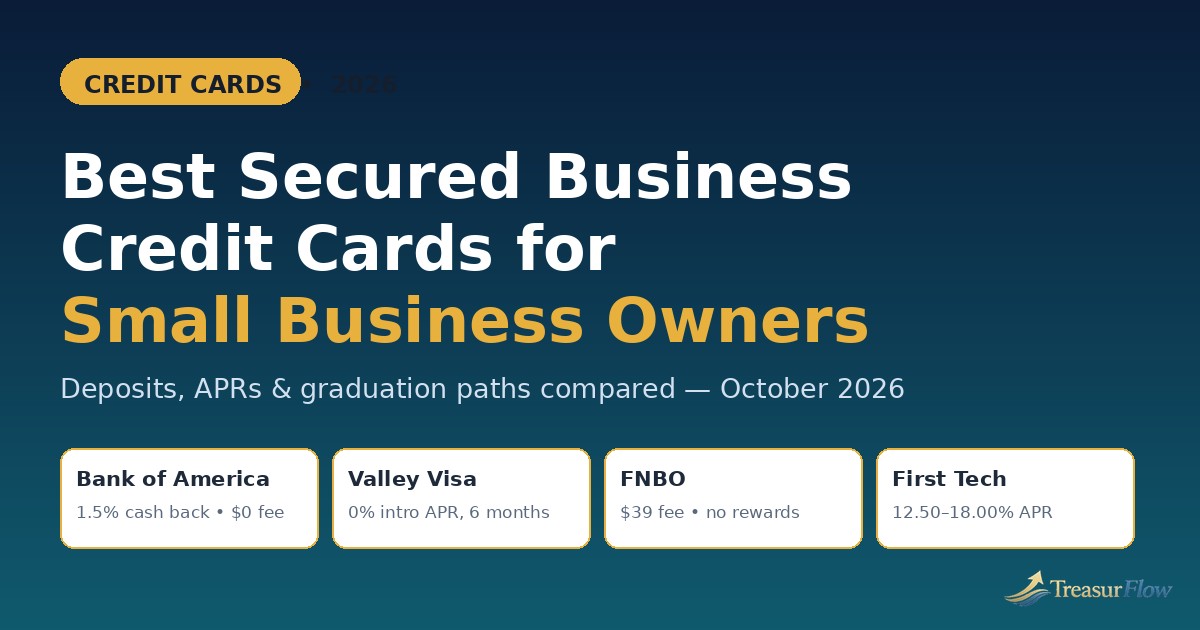
Most guides to the best secured credit cards for small business owners 2026 start with the cards. This one starts with the filing cabinets — a secured business card is only worth its deposit if the right people hear about how you used it.
Best secured credit cards for small business owners 2026: Here is the problem a secured business card is actually solving. Your business is new, or your personal credit history is thin or damaged, so mainstream unsecured business cards are out of reach. A secured card changes the risk math: you hand the issuer a refundable cash deposit, the issuer gives you a credit line backed by that deposit, and your payments get reported so the business builds a track record of its own. Done well, twelve to twenty-four months of boring, on-time payments can turn into an unsecured business card, better vendor terms, and a business credit file that no longer begins and ends with you.
But “done well” is doing real work in that sentence. Business credit is not personal credit with a company logo on it: different bureaus record it, different identifiers open the file, and different rules decide who is liable when it goes wrong. Owners who skip that part make three expensive mistakes — they pay a deposit to a card that reports to the wrong bureaus for their goal, they assume an EIN application means their personal credit is untouched (on true secured business cards, it usually is not), or they treat the deposit like a prepaid balance and are surprised by interest on money they thought they had already paid.
This guide works through the system first — what business credit is, who records it, and how the deposit-for-credit-line machine works — then ranks the best secured credit cards for small business owners 2026 shoppers can realistically get, matched to owner profiles rather than a single generic winner. It finishes with a graduation roadmap and an honest decision framework for owners better served by a personal secured card or a no-deposit corporate charge card instead.
Every rate, fee, and deposit figure below is date-stamped October 2026 and checked against issuer disclosures and major comparison sources. Where sources disagreed — on two cards, they did — the disagreement is flagged in the text instead of smoothed over. Card terms change; confirm current terms on the issuer’s own page before applying.
Related Guides
– Best Secured Credit Cards 2026 (Personal Cards) — the companion guide to this one. If your goal is rebuilding your personal credit file, start there; this article covers the business side of the same strategy.
– Best Cash Back Credit Cards 2026 — what your rewards can look like once you graduate to unsecured cards.
– How Long Does It Take to Build Credit From Scratch? — realistic timelines for a new credit file, personal or business.
– Best Personal Loans 2026 — if what you actually need is a lump sum rather than a revolving line, compare the cost before you tie up cash in a deposit.
Helpful Official Resources
– U.S. Small Business Administration — How to Build Business Credit — the SBA’s step-by-step foundation: form an entity, get an EIN, open a business bank account, then build credit in the company’s name.
– Consumer Financial Protection Bureau — Credit Card Answers — the CFPB’s plain-language answers on APRs, grace periods, and how card interest is calculated.
– Experian — What Is the SBFE and How Is It Relevant to Small Business Owners? — how the Small Business Financial Exchange collects lender payment data and feeds it to business credit bureaus.
– Nav — What Is the Small Business Financial Exchange? — a second, owner-focused explainer on how SBFE data reaches Dun & Bradstreet, Equifax, and Experian.
First, the Part Most Owners Skip: What Business Credit Actually Is
Personal credit has a tidy structure most adults roughly understand: three consumer bureaus (Experian, Equifax, TransUnion), one dominant scoring family, federal rules about who can pull your report and how you dispute errors. Business credit has none of that tidiness. It is a patchwork of commercial bureaus, trade-data exchanges, and scoring models, and your secured card only builds the parts of it that the card’s issuer actually reports to.
The four record-keepers that matter
Dun & Bradstreet (D&B) is the oldest and most vendor-focused business bureau. Its file on your company is anchored by a D-U-N-S Number — a free, unique nine-digit identifier for each business location. D&B tracks payment experiences reported by vendors and lenders and produces scores such as PAYDEX, which grades how promptly a business pays relative to terms. If your goal involves net-30 vendor accounts, supplier credit, or contracts where buyers vet suppliers, a D&B file is usually the first one counterparties check — and a business can have one before any borrowing history, because vendors report trade payments too.
Experian Business and Equifax Business run the closest analogues to consumer bureaus. They compile lender-reported payment data, public records, and firmographic information into business reports and scores — Experian’s Intelliscore Plus and Equifax’s business scores are the ones lenders most commonly cite. When a bank says it will check your “business credit” before approving a line of credit, it is usually pulling one or both of these, often blended with your personal report.
The Small Business Financial Exchange (SBFE) is not a bureau, and confusing it with one causes real misunderstandings. It is a member-owned data exchange, founded in 2001, through which lenders — including most of the largest U.S. small-business card issuers — contribute customers’ payment-performance data. The SBFE issues no reports or scores itself; certified vendors, including Experian and Equifax, license its data and build it into the business credit products they sell to lenders. So when an issuer says a card “reports through the SBFE,” your payment history can influence the business files lenders see even if the issuer never sends a file directly to a bureau. It also means you cannot check “your SBFE report” or dispute data with it directly — corrections go through the bureau that produced the report a lender used.
One more structural fact: business credit data is not covered by the Fair Credit Reporting Act the way consumer data is. Anyone can purchase a report on your business without your permission — mostly a reason to keep the file clean, not a reason to panic. Routine activity on most small-business cards stays off your personal consumer reports, but delinquencies and defaults on personally guaranteed accounts very often do not.
EIN versus SSN: what the application is really asking
Every business card application involves two identifiers, and owners constantly conflate them.
Your EIN (Employer Identification Number) is the business’s federal tax ID. It identifies the business on the account, anchors the business credit file, and is what allows payment history to accumulate under the company’s name. The SBA’s standard sequence for building business credit — form the entity, obtain an EIN, open a separate business bank account, then apply for credit in the business’s name — exists precisely so that a credit file forms around the EIN rather than only around you.
Your SSN, on a traditional small-business card application, does two jobs the EIN cannot do: it lets the issuer pull your personal credit report, and it underpins your personal guarantee. This is the single most misunderstood point in this entire category, so it deserves its own section.
The personal-guarantee reality
With rare corporate-card exceptions, small-business credit cards — secured cards very much included — require the owner to personally guarantee the debt. If the business does not pay, you owe the money personally, and the issuer can pursue your personal assets and report the default to consumer bureaus. The deposit reduces the issuer’s risk; it does not remove the guarantee. Valley’s secured-card disclosure, for example, has the applicant agree to be personally responsible, individually and jointly with the company, for all balances. That language is standard across this category, not a Valley quirk.
Three consequences follow:
- Your personal credit is checked at application. Expect a hard inquiry on your personal report for the mainstream secured business cards in this guide, even though the account itself is a business account.
- A secured business card is not an anonymity tool. Good behaviour usually builds the business file; bad behaviour can damage both files. Late payments and defaults on guaranteed accounts are commonly reported to consumer bureaus even when on-time activity is not.
- “EIN-only” marketing almost never describes secured bank cards. True EIN-only, no-personal-guarantee products exist — Ramp, Brex, and similar corporate charge cards, covered honestly later in this guide — but they underwrite your business’s cash and revenue instead of your deposit, which is a completely different bargain with completely different eligibility bars.
None of this makes secured business cards a bad deal. It makes them a legible deal: you are putting up cash and your personal promise in exchange for a business tradeline that reports, a path to unsecured business credit, and separation of business spending from personal accounts for bookkeeping. For a young business, that is often exactly the right trade. It is just not the trade the brochures describe.
So which bureaus does a card need to report to?
Match the card to the file you are trying to build. Toward bank lending (lines of credit, term loans), prioritise issuers that report to the business bureaus and/or through the SBFE, since bank underwriters lean on Experian Business, Equifax Business, and SBFE-fed data. Toward vendor and supplier terms, a D&B file matters most — and it is built as much by suppliers reporting your trade payments as by any card. Toward rebuilding personal credit at the same time, a business card is the wrong tool unless it also reports to consumer bureaus; one card in this guide (First Tech) does exactly that, a feature for some owners and a dealbreaker for others, labelled clearly wherever it appears.
Issuers are inconsistent about publishing exactly which bureaus each card reports to, and secondary sources disagree — for the Bank of America secured card, some emphasise Equifax Business reporting while others describe SBFE reporting feeding multiple bureaus. So before funding a deposit, ask the issuer directly: “Which business credit bureaus do you report payment history to for this specific card?” One phone call determines whether the next year of payments builds the file you actually need.
How the Deposit Machine Works: Deposit-Sets-Limit Mechanics
A secured card feels simple — deposit money, get card — but the mechanics have more variation, and more traps, than the personal-card versions most people know.
The basic exchange
You apply. If approved, you fund a security deposit held in a locked deposit account with the issuer. You cannot spend from it, withdraw it, or (on most cards) earn meaningful interest on it. The issuer then sets your credit limit by formula:
- Deposit equals limit (1:1): the most common structure. Deposit $5,000, receive a $5,000 credit line. Bank of America, FNBO, and First Tech all work this way on the cards in this guide.
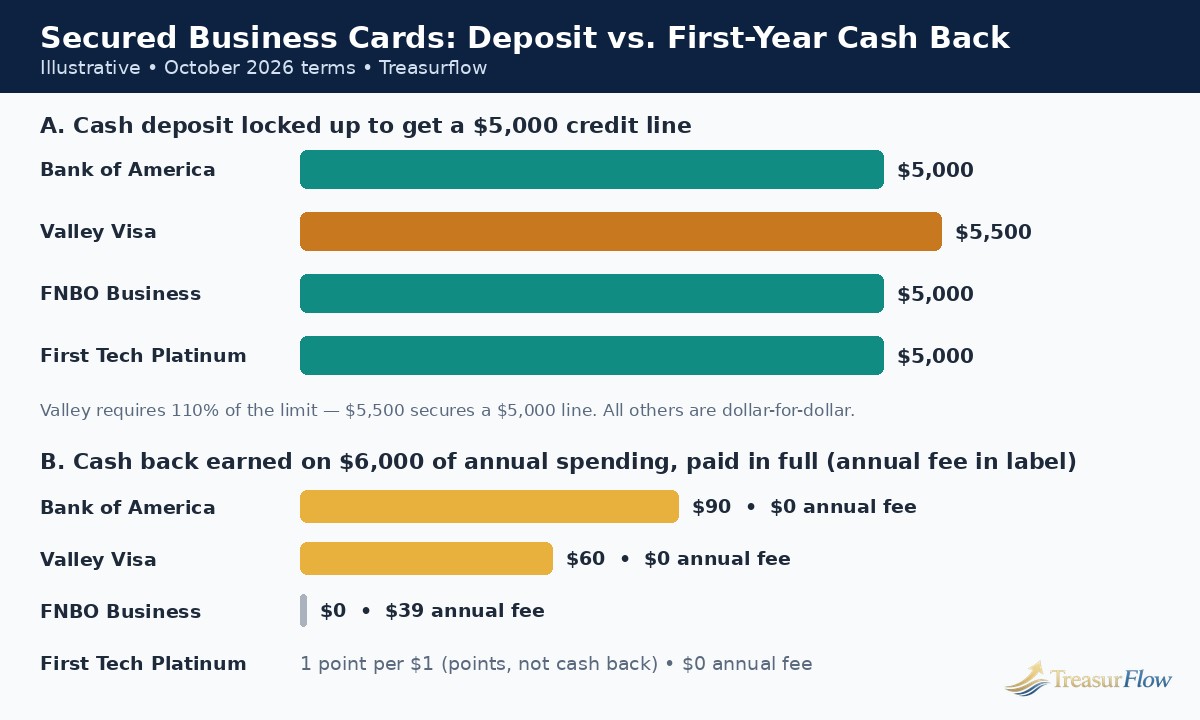
- Deposit exceeds limit (over-collateralised): Valley requires a deposit of 110% of your desired credit limit — a $5,000 line requires $5,500 locked away. The extra 10% is the price of Valley’s unusual secured-card perks, discussed below.
- Deposit partially secures the limit: common on personal secured cards (a $200 deposit sometimes unlocking a higher line), but rare in the business secured market. Do not assume it; on business cards, plan on dollar-for-dollar or worse.
The deposit is not a prepayment. This is the misconception that costs owners real money. When you charge $800 of inventory, you owe $800, due on your statement date, accruing interest at the card’s APR if you carry it. The deposit sits untouched unless you default. Owners who mentally spend the deposit twice — once as the deposit, once as the purchases it “covers” — end up paying 25%+ APR interest on purchases they believed were already paid for. The Consumer Financial Protection Bureau’s secured-card guidance makes the same point for personal cards, and it applies with full force here: the deposit secures the account; your monthly payment repays what you borrowed.
Worked example: what a $5,000 credit line actually costs in locked cash (illustrative)
The following is an illustrative comparison using the deposit formulas verified for October 2026. It assumes you want the same $5,000 credit line from each issuer:
| Card | Deposit formula | Cash you must lock up for a $5,000 line | Annual fee |
|---|---|---|---|
| Bank of America Business Advantage Unlimited Cash Rewards Mastercard Secured | 100% of limit | $5,000 | $0 |
| Valley Visa Secured Business Credit Card | 110% of limit | $5,500 | $0 |
| FNBO Business Edition Secured Mastercard | 100% of limit | $5,000 | $39 |
| First Tech Platinum Secured Mastercard | 100% of limit | $5,000 | $0 |
The $500 Valley difference is not a fee — you get it back — but it is $500 your business cannot use for inventory, payroll float, or its own bank balance for as long as the account stays secured. For a cash-tight business, the honest comparison is not “$0 annual fee versus $0 annual fee.” It is “how much of my scarcest resource — cash — does each card freeze, and what do I get for freezing it?”
Minimums and maximums shape who each card is for
Deposit ranges quietly segment this market: entry points run from $500 (First Tech) to $2,000 (FNBO), with Bank of America at $1,000, while maximum lines run from $10,000 (Bank of America, FNBO) to $25,000 (Valley, at a 110% deposit; First Tech). A solo operator who can spare $500 and a growing firm that wants a $20,000 secured line are not shopping for the same card — which is why the picks below are organised by owner profile rather than ranked 1-to-4.
What happens to the deposit
Your deposit is returned when one of three things happens: the issuer graduates you to an unsecured card and releases the hold, you close the account in good standing after paying it off, or the issuer applies it against your balance after a default — the outcome the deposit exists for. Two practical notes: on closure, issuers typically take several weeks to return funds after the final statement settles, so do not close a secured card the week you need the cash elsewhere; and most deposits here earn no interest while held (FNBO is a partial exception — multiple sources note its deposit may earn interest, a small differentiator worth confirming at application).
The Picks at a Glance (October 2026)
| Card | Best for | Annual fee | Deposit | Credit line | Rewards | Purchase APR (variable) |
|---|---|---|---|---|---|---|
| Bank of America Business Advantage Unlimited Cash Rewards Mastercard Secured | Most owners; rewards + graduation path | $0 | $1,000 min | Equal to deposit, up to $10,000 | 1.5% cash back on all purchases | ~26.74%–26.99%* |
| Valley Visa Secured Business Credit Card | Owners who will use a 0% intro window | $0 | 110% of limit | Up to $25,000 | 1% cash back on all purchases | 0% intro APR for 6 months, then ~15%–27%* |
| FNBO Business Edition Secured Mastercard | Owners who want a plain, nationally available tradeline | $39 | $2,000–$10,000 | Equal to deposit | None | 24.24% |
| First Tech Platinum Secured Mastercard | Owners rebuilding personal credit on a low APR | $0 | $500–$25,000 | Equal to deposit | 1 point per $1 | 12.50%–18.00% |
* Rate-conflict note (October 2026): published APR figures for these two cards vary slightly by source — Bank of America’s secured card appears at 26.99% in several reviews and at 26.74% in others, and Valley’s post-intro range appears variously as roughly 15.20%–26.50%, 15.70%–27.25%, and 14.95%–26.25% depending on the source and date. The ranges in this table reflect that spread honestly rather than picking one figure. Your assigned APR is set at approval from the issuer’s current disclosure; check it before funding your deposit. First Tech’s card, importantly, is a personal secured card usable for business spending by sole proprietors — it reports to consumer bureaus, not business bureaus — and it is included deliberately, with that caveat attached everywhere it appears.
The Picks by Owner Profile
Profile 1: “I want the default choice — rewards now, an unsecured card later” → Bank of America Business Advantage Unlimited Cash Rewards Mastercard Secured
If one card in this guide fits the largest number of owners, it is this one. The Bank of America Business Advantage Unlimited Cash Rewards Mastercard Secured (October 2026 terms) charges no annual fee, requires a minimum $1,000 security deposit, sets your credit line equal to your deposit up to $10,000, and pays 1.5% cash back on every purchase — a genuinely unusual rewards rate for a secured card, business or personal, where “no rewards” is the norm (as the FNBO card below demonstrates). The purchase APR is high, at roughly 26.74%–26.99% variable depending on the source (see the conflict note above), which is typical for the category and a clear instruction: this card is for paying in full.
Three structural advantages put it first for most profiles. National availability with an online application — unlike Valley’s relationship-and-branch model, you need not live near a specific bank’s footprint. A real graduation path — Bank of America periodically reviews secured accounts and may return your deposit and move you to the unsecured version of the card after consistent on-time payments, and the unsecured counterpart is a mainstream card, so the relationship scales instead of dead-ending. Business-bureau reporting — the entire point of choosing a business secured card over a personal one. (Sources differ on whether the emphasis is Equifax Business directly or SBFE-channelled reporting; either route feeds the business files lenders use.)
The honest costs: the $1,000 minimum is real money for a brand-new business, the credit line caps at $10,000 while secured (Valley and First Tech both go to $25,000), there is a 3% foreign transaction fee, and the personal guarantee plus personal credit check apply in full. Cash back redemption is flexible — statement credit, deposit into a Bank of America account, or check.
Illustrative rewards math: on $12,000 of annual business spending ($1,000 a month) paid in full, 1.5% cash back returns $180 per year against a $0 annual fee. That does not make the card “profitable” in any meaningful sense — it makes the credit-building year cost less than it otherwise would, which is the right way to value rewards on a secured card.
Choose it if: you can fund at least $1,000, you will pay in full monthly, and your plan is explicitly “secured now, unsecured Bank of America card later.”
Profile 2: “I have a planned purchase and six months would change everything” → Valley Visa Secured Business Credit Card
The Valley Visa Secured Business Credit Card (October 2026 terms) is the odd one out in this category, in ways that help one specific owner enormously and inconvenience everyone else.
The standout: a 0% introductory APR for the first 6 months after account opening — on purchases and, per Valley’s disclosure, balance transfers. Introductory 0% APR offers are vanishingly rare on secured cards, because the whole premise of a secured card is that the issuer need not compete for you. After the intro window, the APR moves to a variable range of roughly 15%–27% (sources publish 15.20%–26.50%, 15.70%–27.25%, and 14.95%–26.25%; treat ~15%–27% as the honest spread and read your own disclosure). The card also pays 1% cash back on all purchases and charges no annual fee, with limits up to $25,000.
The frictions are equally distinctive. The deposit is 110% of your desired limit — $5,500 locked for a $5,000 line, $11,000 for a $10,000 line. Application is relationship-based and in-branch: you need to have, or establish, a Valley banking relationship, and you cannot click your way through this one from your couch. If you do not live or bank within Valley’s footprint, this card is effectively not available to you, and no amount of wanting the intro APR changes that.
Illustrative intro-APR math: suppose you charge a $3,000 equipment purchase in month one and repay it evenly over the six-month intro window. At 0% APR, your interest cost is $0. Carrying the same balance for six months at 26.99% APR would cost, on a simple-interest illustration, roughly $3,000 × 26.99% × 0.5 = $404.85 (actual card interest uses average daily balance and would differ in detail, but the order of magnitude is the point). That ~$400 of avoided interest is the real product Valley is selling, and it dwarfs the $500 extra deposit’s opportunity cost for an owner with a genuine six-month financing need. For an owner who pays in full anyway, the intro APR is worth $0 — which is why this is a profile pick, not the default pick.
Choose it if: you bank with (or can bank with) Valley, you have a specific purchase to spread over six months, and the 110% deposit does not strain your cash position.
Profile 3: “No games — just a reporting tradeline and a line up to $10,000” → FNBO Business Edition Secured Mastercard
The FNBO Business Edition Secured Mastercard (October 2026 terms) is the category’s plain workhorse. It charges a $39 annual fee, requires a deposit of $2,000 to $10,000 that sets an equal credit line, carries a 24.24% variable APR, and pays no rewards at all. On a spreadsheet of perks, it loses to Bank of America on every row. Owners still choose it, and sometimes should.
What FNBO offers is simplicity and availability. It is nationally available online, has no intro offers expiring or rewards programmes to optimise, and the deposit may earn interest while held — a small offset that neither Bank of America nor Valley matches, and one more reason the card suits a “set it up, use it lightly, pay it off, graduate or close it” plan. Standard small-business account tools and Mastercard benefits such as auto rental coverage and the Easy Savings programme are included, per issuer and comparison sources.
The $39 annual fee deserves a clear-eyed look rather than reflexive rejection. Illustrative first-year math: hold the card one year, spend $6,000 across it and pay in full. Your net cost is exactly the $39 fee (no interest, no rewards). The same year on the Bank of America card nets you +$90 in cash back (1.5% of $6,000) with no fee — a $129 swing. So FNBO is not the value pick; it is the fit pick for owners who cannot or will not use Bank of America (existing-relationship conflicts, a declined application, or a preference for FNBO’s straightforward terms), and for whom a reporting business tradeline this year is worth $39. What it is not is a financing card: at 24.24% APR with a line capped by your own deposit, carrying balances here is paying premium rates to borrow your own collateral back.
Choose it if: you want a nationally available, no-frills business tradeline, the Bank of America card is not an option for you, and you accept $39 a year as the price of simplicity.
Profile 4: “My personal credit is the emergency — the business can borrow my card” → First Tech Platinum Secured Mastercard (with a large caveat)
The First Tech Platinum Secured Mastercard (October 2026 terms) has the most attractive numbers in this guide: a deposit of $500 to $25,000, a purchase APR of just 12.50%–18.00% variable — roughly half the Bank of America card’s rate at the top end — no annual fee, no foreign transaction fee, and 1 rewards point per $1 spent. Membership in First Tech Federal Credit Union is required, as with any credit-union card.
Now the caveat, stated as plainly as possible because burying it would make this guide dishonest: this is a personal secured card, not a business card. It reports to the consumer credit bureaus, not to Dun & Bradstreet, Experian Business, or Equifax Business. A year of perfect payments on it builds your credit file, not your company’s. Competitor roundups that include it — Slash’s 2026 list, for example — describe it accurately as the pick for “solo proprietors who aren’t trying to build a business credit score,” and that framing is exactly right.
Why include it at all? Because a large share of owners searching for secured business cards are sole proprietors whose real bottleneck is personal credit: their personal score is what every future business application will check under the personal guarantee anyway. For that owner, the fastest route to an unsecured business card may run through repairing the personal file first, at a 12.50%–18.00% APR instead of ~27%, with a deposit as low as $500. Used for business spending (sole proprietors may generally use a personal card for business expenses, keeping records carefully for taxes), it keeps costs low while the personal score recovers — after which the Bank of America secured card, or even an unsecured business card, becomes reachable.
Illustrative interest math: carry an average $2,000 balance for a year (labelled illustrative; simple-interest basis). At First Tech’s 18.00% ceiling, the cost is about $2,000 × 18.00% = $360; at its 12.50% floor, about $250. The same balance at 26.99% costs about $539.80. If you know you will carry balances while rebuilding — not ideal, but real — the APR gap is worth more than any rewards programme in this guide.
Choose it if: you are a sole proprietor, your personal credit score is the thing blocking every application, and you understand you are buying personal credit repair at a fair price — not business credit.
The no-deposit alternatives, honestly: Ramp, Brex, and Slash-style corporate charge cards
Any honest 2026 guide has to address the products that dominate the search results for this topic: corporate charge cards from Ramp, Brex, and Slash. They are marketed hard to exactly the owners reading this article, with a seductive pitch — no security deposit, no personal guarantee, no personal credit check, EIN-based application, real spend controls, and cash back up to around 1.5%–2%. Much of that pitch is true. It is also incomplete in ways that matter.
What they genuinely are. These are charge cards, not credit cards: the balance is due in full each cycle. There is no APR because there is no revolving — you cannot carry a balance, finance a purchase over six months, or build a record of managing revolving credit. Underwriting is based on your business’s financials — linked bank balances, revenue, funding — rather than your personal credit history.
The eligibility bar the ads underplay. Removing the deposit does not remove the gate; it moves it. Ramp has historically required a substantial minimum cash balance in a U.S. business bank account (commonly reported at $25,000) and a registered corporation, LLC, or limited partnership — sole proprietors have not been eligible. Brex has targeted venture-backed or higher-revenue businesses, with reported thresholds well above most micro-businesses. If your business keeps $25,000+ in the bank, these products can be excellent — but then you probably would not be reading a guide about a $1,000 secured deposit. The two product families largely serve different businesses at different stages.
The credit-building difference — the decisive point. Slash states openly in its own comparison content that it does not report to the major credit bureaus the way the secured lenders do, and offers no graduation-to-unsecured path. Ramp and Brex reporting practices have varied by programme and over time — verify directly with each provider, because it changes and because it is the whole question. If a charge card does not report your payments to Dun & Bradstreet, Experian Business, or Equifax Business (directly or via the SBFE), a flawless year on it leaves your business credit file exactly as blank as it started. You will have had a good spend-management tool; you will not have built the asset this guide is about.
The fair summary. Choose a corporate charge card if you qualify, you want spend controls and no personal guarantee, and credit-file building is secondary. Choose a secured business card if building a reported business tradeline is the goal, you can fund the deposit, and you accept the personal guarantee as the price of admission. The products are not really rivals; owners who pretend they are interchangeable end up with the wrong one for the job they actually needed done.
The Graduation Roadmap: From Deposit to Unsecured Business Card
A secured business card is a means, not a destination. Owners who treat it as a destination pay deposits and high APRs forever; owners who run a deliberate graduation plan typically convert the same card into unsecured credit, a returned deposit, and a business file that starts opening doors on its own. Here is the roadmap, in the order lenders actually evaluate it.
Months 0–1: Set up the file before you swipe
Graduation begins before the first purchase. Make sure the foundations the SBA recommends are in place: a formed entity (LLC or corporation if you want a genuinely separate file), an EIN, a business bank account in the company’s name, a consistent business address and phone number, and — if you plan to build a vendor-facing file — a free D-U-N-S Number from Dun & Bradstreet. Inconsistency is the silent killer of business credit files: if your card application says “Suite 200,” your bank account says “Ste 200,” and your D&B profile says something else, your history builds in fragments nobody assembles. Use the legal name and address identically everywhere.
Months 1–6: Build the payment record, protect the utilisation
Two behaviours drive nearly all of the value in this phase.
Pay early, not just on time. Business scoring models like D&B’s PAYDEX literally grade payment promptness against terms — paying before the due date scores better than paying on it, which scores far better than paying after it. Set autopay for the full statement balance several days ahead of the due date. Full balance matters: paying only the minimum on a secured card means paying ~25% APR interest on your own collateral while simultaneously signalling strain.
Keep utilisation low — lower than you think. On a small secured line, ordinary spending can spike utilisation without any irresponsibility: a $4,000 inventory order on a $5,000 line is 80% utilisation. Where possible, choose a deposit (and therefore a line) with headroom for your normal monthly spend, and make mid-cycle payments before large purchases so the statement closes at a modest balance. As a working rule for this phase, aim to let statements close below roughly 30% of the line.
Months 6–12: Prove the pattern, add a second tradeline
Six months of clean history is where the file starts to look real. This is the window to add one complementary tradeline rather than three applications: a vendor account that reports to D&B if supplier credit matters to you, or simply continued perfect use of the card if bank lending is the goal. Avoid application sprees — each new guaranteed account is another personal inquiry diluting your average history. If you chose Valley for the intro APR, this is also your discipline window: the 0% period ends at month six, and any remaining balance starts accruing at the regular variable APR (roughly 15%–27% as of October 2026). Have the intro purchase fully repaid before the window closes.
Months 12–24: Ask for the upgrade — do not just wait for it
Bank of America reviews secured accounts periodically and may proactively return the deposit and graduate you to the unsecured card. “May” and “periodically” are doing work in that sentence. If you have twelve-plus months of on-time, in-full payments and healthy utilisation, call and ask for a graduation review rather than waiting indefinitely. The possible outcomes, best to worst: deposit returned and account converted to unsecured (the goal); a higher unsecured line offered alongside the secured account; or a “not yet” with a timeframe — useful information either way.
If an issuer will not graduate the account at all (confirm this before applying anywhere — it is a legitimate pre-application question), the fallback path is: apply for an unsecured business card once your file supports it, then close the secured card and recover the deposit. Weigh the order carefully — closing your oldest business tradeline shortens your business history, which is why issuers with genuine in-house graduation paths (Bank of America being the clearest case in this guide) hold an advantage that does not show up in APR tables.
What graduation actually unlocks
Graduation changes your economics in four concrete ways. Your deposit comes back as working capital. Your line can grow beyond what you could ever deposit. You become eligible for the mainstream unsecured business market — the cards in our Best Cash Back Credit Cards 2026 guide, with sign-up bonuses secured cards never offer. And your business file starts supporting the applications that were the point all along: equipment financing, a bank line of credit, better supplier terms. Owners who need a lump sum sooner should also price the alternative honestly — compare the total cost against the options in our Best Personal Loans 2026 guide before assuming revolving credit is cheapest.
Personal Secured or Business Secured? The Decision Most Owners Get Backwards
Because the same owner usually qualifies (or fails to) for both, this is the real fork in the road. The two cards build different files, and choosing by APR or rewards instead of by file is the classic mistake.
Choose a business secured card when your business is an LLC, corporation, or an organised sole proprietorship with an EIN and a business bank account; your goal is a business credit file that future lenders, landlords, or suppliers can pull; you want business spending separated for bookkeeping and taxes; and your personal credit is at least intact enough to pass the issuer’s application check under the guarantee. The Bank of America and Valley cards live here.
Choose a personal secured card when the file that is actually broken is your personal one. Remember the mechanics: nearly every future business application will check your personal credit anyway because of the personal guarantee, and timelines for personal rebuilding are well documented — our guide on how long it takes to build credit from scratch walks through them. If your personal score is the blocker, fixing it first, cheaply (the First Tech card’s 12.50%–18.00% APR and $500 entry deposit are built for exactly this), then applying for business credit from strength beats building a business file on top of a personal file that vetoes every application. Our companion guide to the best secured credit cards 2026 (personal cards) covers the full personal-card field in detail.
Choose neither — yet — when you cannot fund a deposit without raiding operating cash your business needs this month, or when you know you will carry large balances indefinitely. A secured card used as expensive long-term financing is worse than no card: you pay premium interest to borrow against your own money while your scarce cash sits locked. Stabilise cash first; these cards will still be there next quarter.
A final honesty note on liability: a business card does not move business debt off your shoulders — the personal guarantee sees to that — and for sole proprietors there is no legal separation between business and personal finances at all, as the SBA itself emphasises. What a business secured card genuinely buys is a credit file, cleaner accounting, and a graduation path. Buy it for those reasons and it is fairly priced; buy it for imagined legal protection and it is not.
Mistakes That Quietly Waste a Year of Payments
- Never asking where the card reports. A year of payments reported to a bureau your next lender does not use is a year spent building a file nobody reads. One question, asked before you apply, prevents it.
- Treating the deposit as prepaid spending. It is collateral, not a balance. Every purchase is borrowed money with a due date and APR.
- Paying the minimum on a secured card. Interest at 24%–27% on money secured by your own deposit is the worst financing in most owners’ lives, and minimum payments also read as distress in your payment data.
- Closing the card the moment a better offer arrives. If graduation is available, take it instead; if you must close, do it after the replacement tradeline is reporting, and expect the deposit back over weeks, not days.
- Fragmenting the business identity. Different name spellings, addresses, or phone numbers across the bank, the card, D&B, and the state registry splinter one history into several thin ones.
- Applying for charge cards and secured cards as if they were substitutes. They solve different problems (spend control with no reported tradeline versus a reported tradeline with a deposit and guarantee). Decide which problem you have.
Secured Business Card Questions Owners Ask Before They Hand Over a Deposit
Do secured business credit cards really build business credit?
Yes, but only if the issuer reports your payment history to the business credit system. Cards such as the Bank of America Business Advantage Unlimited Cash Rewards Mastercard Secured report business card activity to business credit bureaus, and many large issuers also feed payment data through the Small Business Financial Exchange (SBFE), which bureaus including Experian and Equifax use to build business reports. Before you fund a deposit, ask the issuer which business bureaus the specific card reports to. A secured card that reports nowhere useful is just an expensive debit card with extra steps.
Can I apply for a secured business credit card with only an EIN and no SSN?
For the traditional secured business cards in this guide, generally no. Bank-issued secured business cards normally require your Social Security number as well as your EIN, because the issuer checks your personal credit and requires a personal guarantee. Genuine EIN-only applications exist mainly on corporate charge cards from providers such as Ramp and Brex, which underwrite your business bank balance and revenue instead, require no deposit, and must be paid in full each cycle. Those are different products solving a different problem.
How much deposit do I need for a secured business credit card?
It depends on the card and the credit line you want. As of October 2026, Bank of America requires a minimum $1,000 deposit and sets your line equal to your deposit up to $10,000. FNBO requires a deposit of $2,000 to $10,000. Valley requires a deposit of 110% of your desired limit, up to a $25,000 limit. First Tech, a personal secured card included in this guide for sole proprietors rebuilding personal credit, allows deposits from $500 to $25,000. On most business secured cards, your deposit and your credit limit are the same number.
Will a secured business credit card hurt my personal credit?
It can, in two specific ways. Applying normally triggers a hard inquiry on your personal credit report, because the issuer checks your personal credit as part of the personal guarantee. After that, routine on-time activity on most small-business cards is reported to business bureaus rather than your personal reports, but serious delinquency or default on a personally guaranteed account is commonly reported to consumer bureaus as well. Paying on time and in full keeps the card building your business file without damaging your personal one.
How long until my secured business card graduates to unsecured?
There is no guaranteed timeline, and any issuer promising you one should be read carefully. In practice, owners with twelve or more months of on-time payments made in full, and statements that close at low utilisation, are in the strongest position to request a graduation review. Bank of America periodically reviews its secured business accounts and may return the deposit and upgrade you to the unsecured card. If your issuer offers no graduation path, the usual route is to open an unsecured business card once your file supports it, then close the secured card and reclaim the deposit.
Is a secured business card better than a personal secured card for a sole proprietor?
It depends which credit file you need to build. A secured business card builds your business credit file with the business bureaus, keeps spending separate for bookkeeping, and can graduate into unsecured business credit. A personal secured card builds your personal credit file instead, and because nearly every business application checks your personal credit under the personal guarantee, a damaged personal score can block you even with a clean business file. Many sole proprietors do both in sequence: repair the personal file first if it is the blocker, then add the business card.
Conclusion: Buy the File, Not the Plastic
Strip away the rewards tables and APR ranges, and every card in this guide sells the same underlying asset: a reported, well-handled business tradeline. Bank of America sells it with 1.5% cash back, a $0 annual fee, and the clearest graduation path — the default recommendation for most owners who can fund its $1,000 minimum deposit. Valley sells it with a rare 0% intro APR worth real money to owners with a planned purchase, at the cost of a 110% deposit and an in-branch relationship. FNBO sells it plainly, for $39 a year. First Tech — a personal card, labelled as such throughout — sells the neighbouring asset, personal credit repair, at the lowest APR in this guide.
The owners who get full value from any of them share three habits. They confirmed where the card reports before they applied. They treated the deposit as locked collateral and paid every statement in full, early, at low utilisation. And they worked a graduation plan from month one instead of discovering at month eighteen that their card had no upgrade path. Do those three things, and the best secured credit cards for small business owners 2026 has to offer stop being a compromise product and become what they are supposed to be: the first, deliberate entry in a business credit file that eventually borrows on the business’s own name.
Rates, fees, and deposit terms in this article were verified against issuer disclosures and major comparison sources as of October 2026 and are subject to change. This article is educational and is not financial advice; confirm current terms with the issuer before applying.

Muhammad Zakir is the founder of Treasurflow and the author of its personal finance guides. He researches consumer banking, credit, and personal loans, and every guide cites primary sources such as the CFPB, FDIC, FTC, and IRS. His content is educational and is not personalized financial advice.