

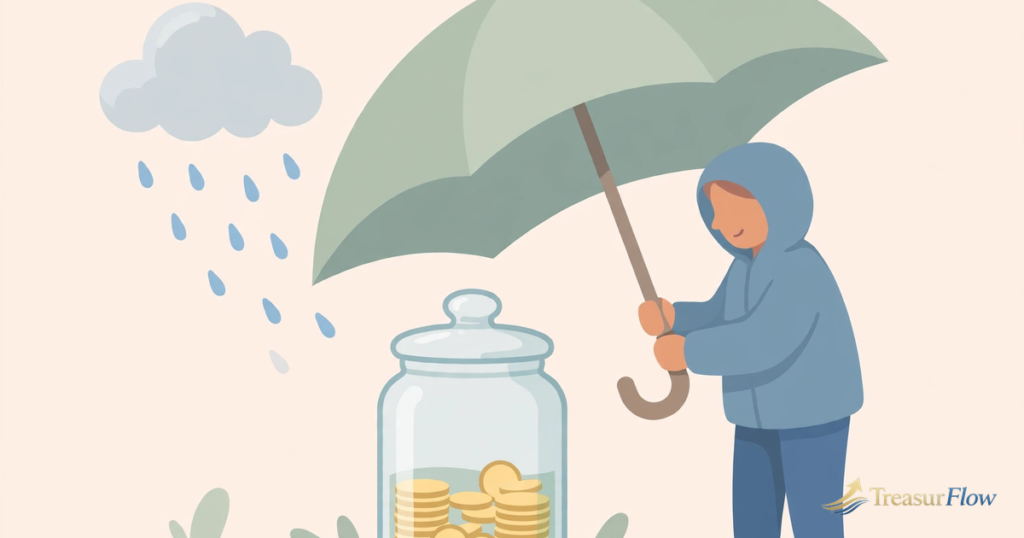
You finally manage to save a little money, and then your car needs an expensive repair. The following month, a medical bill arrives. Soon after that, an appliance stops working. It may feel as though saving money somehow attracts financial problems, but that is not what is happening.
So, how does Murphy’s Law apply to saving money? It reminds us that unexpected expenses can occur even when we cannot predict their timing. Building an emergency fund, maintaining appropriate insurance, and saving separately for predictable costs can prevent those expenses from turning into debt or disrupting long-term financial goals.
In personal finance, Murphy’s Law is not a reason to expect disaster. It is a reason to prepare for uncertainty.
Direct answer: Murphy’s Law applies to saving money because things can go wrong without warning. An emergency fund gives you accessible money for expenses such as urgent car repairs, medical bills, home problems, or temporary income loss. It helps you solve the immediate problem without automatically relying on a credit card or loan.
What Is Murphy’s Law?
Murphy’s Law is commonly expressed as the idea that anything capable of going wrong may eventually go wrong.
It does not mean that every possible problem will happen. It also does not mean that people should constantly worry about the future. In financial planning, it simply recognizes that life includes uncertainty.
You may not know when your car will break down, whether your employer will reduce your hours, or when an urgent medical expense will appear. However, you can reasonably assume that you will face some unplanned costs during your lifetime.
That assumption makes financial preparation necessary.
What Murphy’s Law Does Not Mean
Murphy’s Law does not mean that:
- Saving money causes bad events.
- Every month will bring a new emergency.
- You need to prepare for every imaginable disaster.
- You should keep all your money in cash.
- Investing is always too risky.
- Financial planning can prevent every problem.
Planning cannot stop your furnace from breaking or guarantee permanent job security. It can, however, reduce the financial damage caused by those events.
A Simple Murphy’s Law Money Example
Suppose you have no emergency savings and your car suddenly needs an $850 repair. Because you need the car to get to work, delaying the repair is not practical.
Without savings, you might have to charge the cost to a credit card. Interest and fees could make the original $850 expense more expensive over time.
With an emergency fund, you could pay for the repair, continue working, and gradually rebuild the amount you withdrew. The repair would still be inconvenient, but it would not automatically become long-term debt.
How Does Murphy’s Law Apply to Personal Finance?
Murphy’s Law applies to personal finance by highlighting the difference between an inconvenience and a financial crisis.
An unexpected expense is inconvenient when you have money available to handle it. The same expense may become a crisis when you have no savings, limited credit, or insufficient income.
The Federal Reserve’s 2025 household survey found that 59% of U.S. adults had experienced at least one major unexpected expense during the previous 12 months. Major vehicle repairs or replacements were the most common, followed by major home or appliance repairs and unexpected medical expenses.
These findings show that unexpected costs are not rare exceptions. They are a normal part of financial life.
Emergency Savings Can Reduce the Need for Debt
When you do not have savings, even a temporary problem can create a longer financial burden.
You may need to use:
- A high-interest credit card
- A personal loan
- A payday loan
- A retirement-account withdrawal
- Money borrowed from family
- A missed payment on another bill
The Consumer Financial Protection Bureau explains that using credit or loans for an emergency can make the original expense considerably larger because of interest and fees.
Emergency savings provide another option: using money you already own.
Financial Preparation Protects Long-Term Goals
Emergency savings do more than pay unexpected bills. They can protect the rest of your financial plan.
Without an emergency fund, you might have to:
- Pause retirement contributions
- Sell investments during a market decline
- Delay a home purchase
- Miss essential payments
- Accumulate high-interest debt
- Withdraw money set aside for education
- Abandon another important savings goal
A financial cushion helps isolate an immediate problem so that it does not spread into every area of your finances.
Why an Emergency Fund Is the Best Response to Murphy’s Law
An emergency fund is money reserved specifically for urgent, necessary, and unplanned expenses.
The CFPB describes an emergency fund as a cash reserve intended for financial shocks and unplanned expenses, such as medical bills, home repairs, car repairs, or income loss.
The purpose of this fund is not to earn the highest possible return. Its primary jobs are to remain safe, accessible, and available when needed.
What Should an Emergency Fund Cover?
An emergency fund may be appropriate for:
- An urgent vehicle repair needed for work
- An unexpected medical or dental bill
- A necessary home repair
- A temporary job loss
- A sudden reduction in work hours
- An insurance deductible
- Emergency travel following a family crisis
- Replacement of an essential appliance
- An urgent pet medical bill
- Essential living expenses during an income interruption
The exact definition of an emergency depends on your circumstances. For example, replacing a refrigerator may be essential for a family but less urgent than replacing a decorative household item.
What Should an Emergency Fund Not Cover?
Emergency savings generally should not be used for:
- Planned vacations
- Holiday gifts
- Entertainment
- Routine shopping
- Optional home upgrades
- A new phone when the current one still works
- Predictable annual bills
- Regular vehicle maintenance
- Nonessential subscription costs
- Impulse purchases
These expenses may still deserve a place in your budget, but they should not normally be treated as emergencies.
What Are Three Questions to Ask Before Using Your Emergency Fund?
Before withdrawing money from your emergency fund, ask:
- Is the expense unexpected?
- Is the expense necessary?
- Is the expense urgent?
An expense does not always need to meet all three conditions perfectly, but this test can improve your decision-making.
Is It Unexpected?
An unexpected expense occurs without being part of your normal plan.
A sudden transmission failure may be unexpected. Annual vehicle registration is not. Property taxes, holiday spending, routine maintenance, and annual insurance premiums may feel expensive, but their timing can usually be anticipated.
Is It Necessary?
Ask whether the expense protects your health, income, safety, housing, transportation, or basic living conditions.
An urgent plumbing repair may be necessary. Replacing a working television with a larger model is optional.
Is It Urgent?
Consider whether delaying the expense would create a more serious problem.
A leaking roof may become more expensive if ignored. A cosmetic home improvement can usually wait.
Creating rules before an emergency occurs helps you make calmer decisions when you are under pressure.
How Much Emergency Savings Do You Need?
There is no single emergency-fund amount that is correct for everyone.
Your target should reflect:
- Essential monthly expenses
- Employment stability
- Number of income earners
- Number of dependents
- Health needs
- Insurance coverage
- Housing condition
- Access to family support
- Income predictability
- Personal comfort with risk
A freelancer with irregular income may require a larger reserve than someone in a stable dual-income household.
Start With a Manageable Goal
If saving several months of expenses seems impossible, start smaller.
Useful early milestones may include:
- Your first $100
- $500
- One common insurance deductible
- $1,000
- One month of essential expenses
- Three months of essential expenses
- A personalized long-term target
The first goal should be large enough to help but small enough to feel achievable.
A modest emergency fund is usually more useful than an ideal target that feels so overwhelming you never begin.
Build Toward Several Months of Essential Expenses
A commonly discussed target is enough money to cover several months of living expenses. FDIC and Investor.gov consumer guidance discusses emergency reserves of up to or around six months, although the right target depends on personal circumstances.
In 2025, 55% of U.S. adults reported having enough rainy-day savings to cover three months of expenses.
This does not mean three or six months is automatically right for you. Think of it as a planning range rather than a rigid rule.
Emergency-Fund Formula
Use this simple calculation:
Essential monthly expenses × desired months of coverage = emergency-fund target
For example:
- Essential monthly expenses: $2,500
- Desired coverage: four months
- Emergency-fund target: $10,000
Only include essential expenses in the calculation, such as:
- Rent or mortgage
- Utilities
- Basic groceries
- Transportation
- Insurance
- Minimum debt payments
- Essential healthcare
- Necessary childcare
You may be able to reduce entertainment, travel, dining, and optional shopping during an income emergency.
Where Should You Keep Emergency Savings?
Emergency savings should generally be stored somewhere safe, accessible, and separate from everyday spending.
For many people, a dedicated savings account at an insured bank or credit union offers a practical balance between protection and accessibility. The CFPB notes that banks and credit unions are generally considered among the safest places to keep emergency funds.
A Separate Savings Account
Keeping emergency money separate from checking can reduce the temptation to spend it on daily purchases.
A suitable account may offer:
- No unnecessary monthly fee
- Easy transfers
- A competitive interest rate
- No excessive minimum balance
- Federal deposit insurance
- Reliable online and mobile access
At an FDIC-insured bank, deposits are generally insured to at least $250,000 per depositor, per insured bank, subject to account ownership categories and coverage rules. Covered products include checking accounts, savings accounts, money market deposit accounts, and certificates of deposit.
High-Yield Savings Account
A high-yield savings account may pay more interest than a basic savings account while keeping funds relatively accessible.
However, compare more than the advertised rate. Review:
- Monthly fees
- Transfer times
- Withdrawal access
- Minimum deposits
- Rate changes
- Deposit-insurance status
- Customer service
The best emergency account is not necessarily the one with the highest rate. It is the account you can trust and access when you genuinely need the money.
Money Market Deposit Account
A money market deposit account may also offer interest and access to funds. Do not confuse it with a money market mutual fund, which is an investment product rather than an FDIC-insured bank deposit.
Always verify what type of product you are opening and how your money is protected.
Should You Use a CD?
Certificates of deposit can provide predictable interest, but they may charge a penalty if you withdraw money before maturity. That restriction can make a CD unsuitable for money you may need immediately.
The FDIC specifically advises checking early-withdrawal penalties when considering CDs for emergency savings.
Some people keep only part of a larger emergency reserve in CDs while maintaining an immediately accessible amount in savings. Whether that approach makes sense depends on your liquidity needs.
Should You Keep Cash at Home?
Keeping a small amount of physical cash can be useful during a temporary power outage, banking disruption, or natural disaster.
However, large amounts of cash at home can be stolen, lost, damaged, or destroyed. The CFPB identifies those risks when discussing physical cash as an emergency-fund option.
Physical cash is better treated as a limited backup, not necessarily the main emergency fund.
Emergency Fund vs. Sinking Fund
An emergency fund pays for genuinely unexpected financial shocks. A sinking fund pays for a future expense that is irregular but reasonably predictable.
| Emergency Fund | Sinking Fund |
|---|---|
| Covers unexpected events | Covers expected future expenses |
| Exact timing is unknown | Timing can often be estimated |
| Used only when necessary | Used when the planned expense arrives |
| Example: sudden job loss | Example: annual insurance premium |
| Rebuilt after use | Funded continuously toward a goal |
Common Sinking-Fund Expenses
Create separate sinking funds for:
- Car maintenance
- Home repairs
- Property taxes
- Annual insurance premiums
- Holidays
- School expenses
- Appliance replacement
- Professional fees
- Planned travel
- Technology replacement
If the same “emergency” happens every year, it may not be an emergency. It may be a predictable expense missing from your budget.
Sinking funds prevent routine but irregular costs from repeatedly draining your emergency savings.
Saving vs. Investing
Saving and investing serve different purposes.
| Saving | Investing |
|---|---|
| Supports short-term security | Supports long-term growth |
| Usually involves lower risk | Can rise or fall in value |
| Offers easier access | May require selling assets |
| Appropriate for emergencies | Appropriate for longer-term goals |
| Prioritizes principal protection | Accepts risk for growth potential |
Emergency money is generally kept in savings because you may need it at an unpredictable time. Investing it could expose the balance to market losses just before an emergency occurs.
Investor.gov notes that savings usually offer greater safety and accessibility but lower potential returns, while investments may offer more growth over longer periods.
Once you have an appropriate emergency reserve, investing can help pursue long-term goals such as retirement or future wealth.
This is not an either-or decision. A healthy financial plan often uses saving for stability and investing for growth.
How Planning and Saving for Your Future Help Build Wealth
Emergency savings may not directly produce the highest investment return, but they help protect the wealth-building process.
Saving Can Prevent High-Interest Debt
If an emergency fund prevents you from placing a $1,000 expense on a high-interest credit card, it saves more than the original $1,000. It may also save months of interest payments.
Savings Can Protect Your Investments
Without accessible savings, you may have to sell investments during a market decline or withdraw from a retirement account.
An emergency fund gives long-term investments more time to remain invested.
Planning Creates Consistency
Wealth is often built through repeated, sustainable actions rather than one dramatic decision.
Useful habits include:
- Automatic transfers on payday
- Gradually increasing contributions
- Saving part of bonuses or refunds
- Reviewing expenses regularly
- Rebuilding savings after withdrawals
- Separating short-term and long-term goals
The FDIC recommends scheduled automatic transfers as a way to build emergency savings and notes that even modest recurring contributions can accumulate over time.
How to Build an Emergency Fund Step by Step
1. Review Your Essential Expenses
Look at several months of bank statements and bills.
Separate essential expenses from flexible spending. This will help you calculate a realistic emergency-fund target.
2. Choose Your First Milestone
Do not begin by staring at an intimidating five-figure goal.
Your first milestone might be $500, $1,000, or one insurance deductible. After reaching it, move to the next level.
3. Open a Separate Account
Keep emergency savings away from the account you use for groceries, entertainment, and routine purchases.
Separation creates a useful psychological barrier.
4. Automate Every Payday
Choose an amount you can sustain and schedule it to transfer shortly after you are paid.
The amount can be small. Consistency is more valuable than setting an aggressive target you abandon after two months.
5. Use Windfalls Carefully
Consider directing part of the following toward savings:
- Tax refunds
- Work bonuses
- Cash gifts
- Overtime pay
- Side-income payments
- Rebates
- Money from selling unused items
You do not necessarily need to save every dollar. A percentage-based approach may feel more sustainable.
6. Track Visible Progress
Use a spreadsheet, budgeting application, savings tracker, or account goal.
Visible progress can turn a distant objective into a series of achievable steps.
7. Review the Target Annually
Your emergency-fund target should change when your life changes.
Recalculate after:
- Moving
- Buying a home
- Having a child
- Changing jobs
- Becoming self-employed
- Taking on new debt
- Facing higher healthcare costs
- Experiencing a major income change
What Should You Do After Using Your Emergency Fund?
Using emergency savings for a genuine emergency does not mean your plan failed.
It means the fund did its job.
The CFPB advises people not to be afraid to use emergency money when needed and recommends rebuilding it after the withdrawal.
After using the fund:
- Review what happened.
- Decide whether the cost was truly unexpected.
- Identify whether insurance should cover similar future risks.
- Restart automatic savings.
- Temporarily reduce optional spending when practical.
- Create a sinking fund if the expense may happen again.
For example, a completely unexpected car failure may require emergency savings. Afterward, you could create a separate vehicle-maintenance fund to reduce the impact of future repairs.
Common Murphy’s Law Savings Mistakes
Treating Credit as an Emergency Fund
A credit limit is permission to borrow, not money you own.
Credit may help in some situations, but it can also transform a temporary cost into long-term debt.
Investing the Entire Emergency Fund
Market investments may decline just when you need the money. Emergency savings should prioritize availability over maximum return.
Keeping Everything in Checking
Money mixed with everyday spending is easier to use accidentally.
Calling Every Expense an Emergency
A sale, vacation, optional upgrade, or predictable annual bill is not normally an emergency.
Setting an Impossible First Goal
An unrealistic target can prevent you from starting. Build the fund in stages.
Ignoring Insurance
Emergency savings and insurance perform different functions. Insurance may cover major losses, while savings may cover deductibles, exclusions, immediate expenses, or costs that are not fully reimbursed.
Failing to Replenish the Fund
After using emergency savings, create a specific rebuilding plan instead of waiting for “extra money” to appear.
Real-Life Examples of Murphy’s Law in Personal Finance
Sudden Car Repair
A worker needs a car to commute but faces a $1,200 transmission repair.
Without savings, the worker may borrow at a high interest rate. With an emergency fund, the repair can be paid immediately, protecting both transportation and income.
Temporary Job Loss
A household unexpectedly loses one income.
Several months of essential expenses can provide time to search for work while continuing to pay for housing, utilities, food, insurance, and transportation.
Medical Expense
An insured person receives an unexpected bill that falls within a deductible or is not fully covered.
Emergency savings can pay the bill without delaying care or accumulating credit-card interest.
Broken Appliance
A refrigerator suddenly stops working.
If the failure was genuinely unexpected, emergency savings may be appropriate. After replacing it, the household can create an appliance sinking fund for future replacements.
Irregular Freelance Income
A freelancer has a profitable month followed by several slow months.
Because income is unpredictable, a larger cash reserve may provide stability while invoices are delayed or client work decreases.
Frequently Asked Questions
How does Murphy’s Law apply to saving money?
Murphy’s Law applies to saving money by reminding us that unexpected expenses can occur without warning. Keeping emergency savings allows you to pay urgent bills without automatically relying on debt or disrupting long-term financial goals.
What is an example of Murphy’s Law in personal finance?
A common example is saving $1,000 and then suddenly needing an $800 car repair. The repair does not mean saving was pointless. The savings prevent the repair from becoming a larger debt problem.
Is $1,000 enough for an emergency fund?
A $1,000 fund can be a useful starting point, but it may not cover a major emergency or an extended income loss. After reaching $1,000, consider building toward one month and eventually several months of essential expenses.
Where should emergency savings be kept?
Emergency savings should generally be kept somewhere safe, accessible, and separate from everyday spending. An insured savings account or money market deposit account may be suitable for many people.
Should I invest my emergency fund?
Emergency money is usually better kept in a low-risk, accessible account because investments can decline in value. Investing is generally more suitable for money intended for long-term goals.
What is the difference between an emergency fund and a sinking fund?
An emergency fund covers urgent, unexpected expenses. A sinking fund covers known or predictable future costs, such as annual insurance, car maintenance, holiday spending, or appliance replacement.
How much should I save each month?
The right amount depends on your income, expenses, and timeline. Subtract essential spending from your take-home income, choose a sustainable contribution, and automate it. Even a modest regular amount is more effective than an ambitious plan you cannot maintain.
What should I do after using my emergency fund?
Review the expense, restart automatic contributions, and create a rebuilding target. When the cost is likely to happen again, establish a separate sinking fund for it.
Research and Financial Resources Used
This article is based on widely recognized consumer-finance guidance and financial education resources. Recommendations about emergency funds, unexpected expenses, savings habits, and financial preparedness were informed by resources from organizations such as the Consumer Financial Protection Bureau, which provides guidance on building emergency savings, the Federal Deposit Insurance Corporation for information about safe savings options and deposit protection, and Investor.gov for general education about saving, investing, and long-term financial planning. These resources help ensure that the information presented reflects practical, evidence-based personal finance principles rather than short-term money advice or unsupported claims.
Final Takeaway
Murphy’s Law applies to saving money by teaching one practical lesson: uncertainty is normal, but financial chaos does not have to be.
You cannot predict every repair, medical bill, job change, or household problem. You can build a system that makes those events easier to manage.
Start with a small emergency cushion. Build it gradually toward a target based on your essential expenses and personal risks. Keep the money safe and accessible, use sinking funds for predictable costs, maintain appropriate insurance, and invest separately for long-term growth.
When something eventually goes wrong, your savings will not have failed. They will have done exactly what they were created to do.
Next step: Calculate one month of essential expenses and choose the first savings milestone you can begin funding from your next paycheck.
This article provides general financial education and is not individualized financial, investment, tax, or legal advice.

Muhammad Zakir is the founder of Treasurflow and the author of its personal finance guides. He researches consumer banking, credit, and personal loans, and every guide cites primary sources such as the CFPB, FDIC, FTC, and IRS. His content is educational and is not personalized financial advice.
2 thoughts on “How Does Murphy’s Law Apply to Saving Money?”