

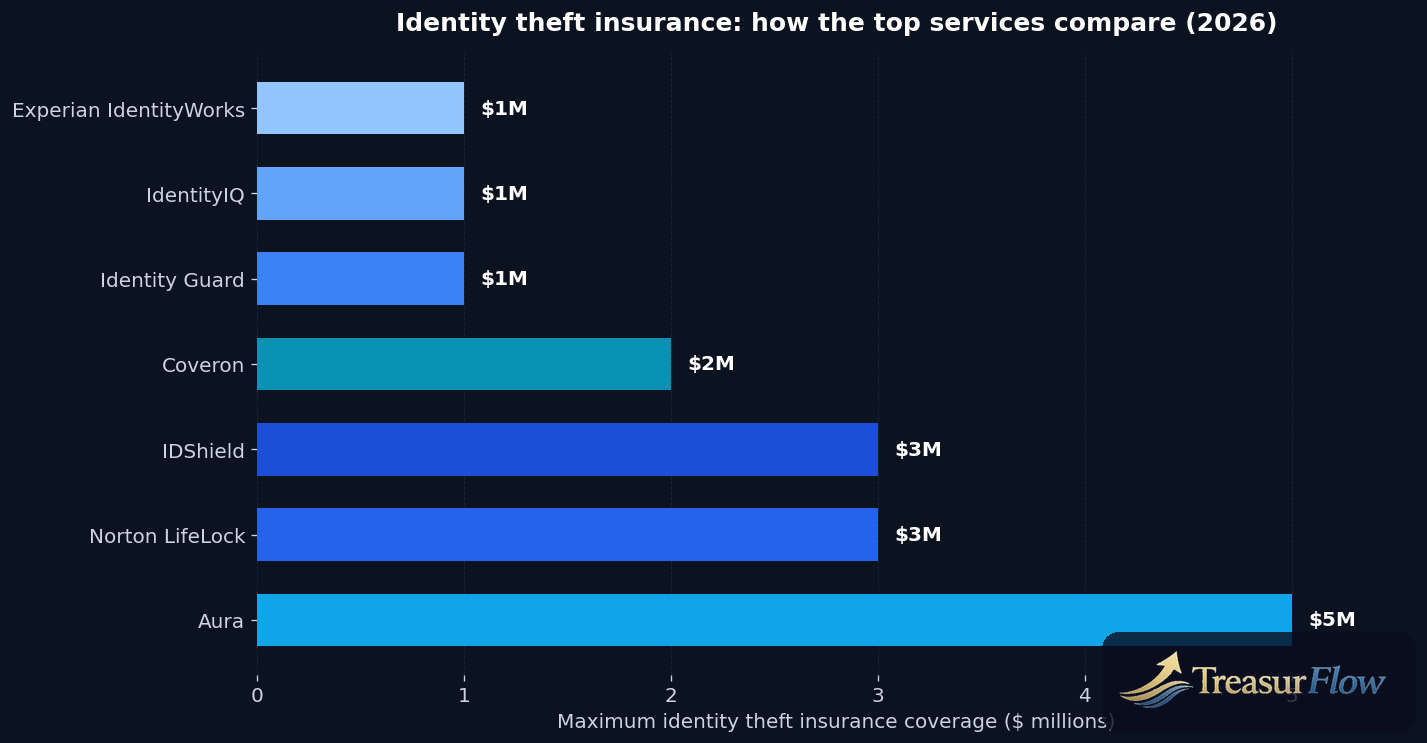
Bottom line up front: If you want one service that covers the most ground for the money in 2026, Aura is the strongest all-around pick — triple-bureau credit monitoring on every plan, dark web and public-records scanning, antivirus and VPN bundled in, and up to $5 million in identity theft insurance on the family plan. Budget shoppers should look at Coveron (from around $5/month), and anyone who wants the biggest possible reimbursement payout should check Norton LifeLock (up to $3 million). Here’s the honest truth, though: no service can prevent your identity from being stolen. What the good ones do is catch misuse fast, alert you immediately, and pay experts to clean up the mess. I compared seven of the best identity theft protection services 2026 has to offer so you can pick with confidence.
The Best Identity Theft Protection Services in 2026: Quick Comparison
Prices below are “starting from” figures reported by reviewers in 2026 — providers run frequent promotions, and renewal prices can jump, so treat these as ballparks and check the provider’s site before you buy.
| Service | Best For | ID Theft Insurance | Credit Bureaus Monitored | Starting Price |
|---|---|---|---|---|
| Aura | Best overall / families | Up to $1M per adult ($5M family) | All 3 (Experian, Equifax, TransUnion) | ~$12/mo |
| Coveron | Best budget pick | Up to $2M | 1 or 3 by tier | ~$4.99/mo |
| Norton LifeLock | Biggest insurance payouts | Up to $3M | 2 or 3 by tier | ~$10.42/mo |
| Identity Guard | AI-driven threat alerts | $1M | 1 or 3 by tier | ~$8/mo |
| IdentityIQ | Credit monitoring depth | Up to $1M | All 3 | ~$7.44/mo |
| IDShield | Legal help + restoration | Up to $3M | 1 or 3 by tier | ~$15/mo |
| Experian IdentityWorks | Free basic option | $1M (paid plans) | 1 or 3 | Free–~$35/mo |
The 7 Best Identity Theft Protection Services in 2026
1. Aura — Best Overall
Verdict: The most complete package for individuals and families — the rare service that doesn’t gate its best monitoring behind its priciest tier.
Aura is the service most independent reviewers ranked at or near the top of their 2026 lists (including Money.com and CyberInsider), and the reason is simple: every plan includes triple-bureau credit monitoring from Experian, Equifax, and TransUnion. Most competitors only give you all three bureaus if you pay for the top tier. That means you get alerted about new accounts, hard inquiries, and address changes no matter which bureau the thief’s application lands on.
The monitoring goes well beyond credit. Aura scans the dark web for your SSN, emails, phone numbers, and passwords; watches home title records (a real but underappreciated risk — deed fraud is genuinely hard to detect on your own); and monitors criminal records, court records, and USPS change-of-address filings. The device suite — antivirus, VPN, password manager — covers up to 10 devices on most plans.
Pricing starts around $12/month for an individual on annual billing, with family plans covering up to five adults and unlimited children. Insurance runs $1 million per adult, up to $5 million combined on family plans. Downsides: no rock-bottom tier, and the antivirus doesn’t work on iOS. Still, for most people, this is where I’d start.
2. Coveron — Best Budget Pick
Verdict: Serious protection at the
5. IdentityIQ — Best for Credit Monitoring Depth
Verdict: The pick for people who want identity protection and serious credit tools in one subscription.
IdentityIQ stands out by treating your credit health as a first-class feature: three-bureau credit reports and scores, a credit score simulator, and even rent and utility payment reporting that can help build credit from everyday bills. Add in synthetic identity fraud detection (thieves combining real and fake details — one of the fastest-growing fraud types) and up to $1 million in insurance, all starting around $7.44/month, and it’s a strong value.
The monitoring breadth isn’t quite as deep as Aura’s on non-credit data (no home title tracking, for example), so think of IdentityIQ as the credit-first choice rather than the everything choice.
6. IDShield — Best for Legal Help and Restoration
Verdict: If your nightmare scenario is the legal paperwork after fraud, IDShield’s licensed investigators and attorneys are the standout feature.
IDShield’s differentiator is human: licensed private investigators handle your case, and the plans include genuine legal assistance — not just a hotline, but help dealing with creditors, agencies, and courts. Insurance coverage reaches up to $3 million, matching LifeLock’s top end.
Plans start around $15/month, which puts it above the budget picks, and credit monitoring tiers vary (one or three bureaus depending on plan). Choose IDShield if the recovery side of identity theft worries you more than the detection side — especially if you’ve been through fraud before and know how brutal the paperwork is.
7. Experian IdentityWorks — Best Free Option
Verdict: The only reputable free tier worth mentioning — limited, but genuinely useful as a starting point.
Is Identity Theft Protection Worth It?
For most people who live a significant part of their financial life online — which is nearly everyone — yes, with one big caveat: it’s worth it if you pick a service that actually monitors broadly and you understand what you’re buying.
Here’s the math that matters. A paid service costs roughly $5–$35/month for an individual. The alternative — discovering fraud months late — can cost you hundreds or thousands of dollars plus dozens of hours on the phone with banks, bureaus, and agencies. Victims routinely describe the recovery process as one of the most stressful experiences of their financial lives. A service doesn’t eliminate that, but early alerts and professional restoration help compress a months-long nightmare into a manageable project.
When is it not worth paying? If you’ve never been in a breach, keep a close eye on your accounts yourself, use strong unique passwords with two-factor authentication, and keep free credit freezes in place, you can reasonably skip the subscription. Tom’s Guide put it well: you might be okay without it if your data has never been compromised and you’re vigilant. Just be honest with yourself about whether “vigilant” describes you on a random Tuesday six months from now.
Does Identity Theft Protection Really Work?
Here’s the answer the industry’s marketing sometimes dances around: no service can stop your identity from being stolen. Anyone who claims otherwise is lying. What reputable services genuinely do well is three things:
- Detect faster. Continuous monitoring of your credit files, SSN, and the dark web means you learn about misuse in days or hours instead of months. Time is everything — the earlier you catch fraud, the less damage spreads.
- Alert clearly. Instead of you manually checking three credit reports every month, the service pings you the moment something changes, and tells you what to do next.
- Restore professionally. This is the underrated part. Identity theft insurance (typically $1–$5 million depending on the plan) reimburses stolen funds and covers lawyers, experts, and lost wages. Just as valuable: restoration specialists who’ve handled thousands of cases do the bureaucratic heavy lifting with you.
So “does it work” depends on your definition. If you mean “will it keep my SSN out of criminals’ hands” — no, nothing can promise that. If you mean “will it meaningfully reduce the damage and hassle if I’m targeted” — yes, the good ones do, and that’s what you’re paying for.
What You Can Do for Free (Before You Pay Anything)
Paid services are convenient, but the U.S. government gives you powerful tools for free. Honestly, everyone should do these regardless of whether they buy a subscription:
- Freeze your credit — free. Contact Equifax, Experian, and TransUnion and place a security freeze on each file. A freeze blocks new accounts from being opened in your name, including by you, until you lift it. It’s the single strongest free protection that exists. (Per the CFPB, reviewed July 2026.)
- Set fraud alerts — free. A one-year fraud alert (renewable) tells creditors to verify your identity before issuing new credit. You only need to co
What to Do If Your Identity Is Stolen
If you’re reading this section in a panic, take a breath — this is fixable, and there’s a clear order of operations from the FTC and CFPB:
- Call the fraud department of the bank, lender, or company where the fraud happened. Ask them to close or freeze the affected accounts and change your logins, passwords, and PINs.
- Report it at IdentityTheft.gov. The FTC will generate an official Identity Theft Report and a personalized recovery plan — this report proves to businesses that the theft happened and unlocks specific legal rights. (FTC recovery steps)
- Place a fraud alert or freeze with the three credit bureaus if you haven’t already.
- File a police report. Bring your FTC Identity Theft Report, a photo ID, and proof of address. Some creditors require the police report before they’ll remove fraudulent charges.
- Dispute fraudulent items with each bureau in writing, attaching your FTC report. They’re legally required to block fraudulent information from your report.
- Report internet-related crime to the FBI’s Internet Crime Complaint Center (IC3) — especially useful for online scams and account takeovers.
- Keep a log of every call: dates, names, reference numbers. Recovery is a paperwork marathon, and your notes are your evidence trail.
The CFPB’s victim guidance (reviewed July 30, 2026) covers these same steps: What do I do if I am a victim of identity theft? And if a thief drained your checking account, our guide on no-credit-check bank accounts can help you find a safe landing spot while you rebuild.
How to Choose the Right Service for You
Don’t just grab the cheapest plan or the biggest brand name. Run through this checklist:
Frequently Asked Questions Is identity theft protection worth it in 2026?
For most people, yes — with the FTC logging about 1.36 million identity theft reports in 2025 (up ~20% from 2024), early detection and professional restoration are worth $5–$35/month. It’s not worth it if you diligently self-monitor with free credit freezes and regular report checks.
Does identity theft protection really work?
It works at what it’s designed to do: detect misuse early, alert you fast, and help restore your identity with insurance-backed support. It cannot prevent your data from being stolen in a breach — no service can.
What is the best identity theft protection service in 2026?
Aura is the strongest all-around pick for most people, with triple-bureau monitoring on every plan and up to $5 million in family insurance. Coveron is the best budget option (from ~$5/month), and Norton LifeLock offers the largest insurance payouts (up to $3 million) for those who want maximum coverage.
How much does identity theft protection cost per month?
Individual plans generally run $5–$35/month depending on the service and tier, with family plans higher. Entry prices reported in 2026: Coveron ~$4.99, IdentityIQ ~$7.44, Identity Guard ~$8, LifeLock ~$10.42, Aura ~$12, IDShield ~$15. Prices change frequently — always verify current rates and renewal pricing on the provider’s site.
Can I protect my identity for free?
Largely, yes. Free credit freezes at all three bureaus, free fraud alerts, free weekly credit reports at AnnualCreditReport.com, and the FTC’s free recovery plan at IdentityTheft.gov cover the essentials. Paid services add convenience, broader monitoring (dark web, public records), insurance, and professional restoration.
What should I do first if my identity is stolen?
Call the fraud department of the affected company, then file a report at IdentityTheft.gov to get your official Identity Theft Report and recovery plan. Next: place fraud alerts or freezes with the credit bureaus, file a police report, and dispute fraudulent items in writing.
Is a credit freeze better than identity theft protection?
They do different jobs. A freeze prevents new accounts from being opened in your name — it’s stronger prevention and it’s free. Identity protection monitors for misuse across more data sources and helps you recover. The smartest setup is both: freeze your credit for free, then decide whether paid monitoring is worth the convenience.
Does identity theft protection cover my spouse and kids?
Only on family plans. Individual plans cover one adult. If you want coverage for a partner or children, look specifically at family tiers — Aura and Identity Guard both offer family plans covering multiple adults and unlimited children.
The Bottom Line
The best identity theft protection services 2026 offers won’t make you breach-proof — nothing will. What they buy you is speed: faster detection, faster alerts, and a professional team plus insurance backing when the worst happens. For most households, Aura hits the sweet spot of broad monitoring and fair pricing; Coveron proves you don’t need to spend much to get real coverage; and LifeLock remains the heavyweight for maximum payouts.
But here’s the part I’d underline twice: do the free stuff today, whether or not you buy anything. Freeze your credit at all three bureaus, pull your free reports, and bookmark IdentityTheft.gov. Those three moves cost nothing and close the biggest holes. A paid service is the reinforcement — not the foundation.
ong>Triple-bureau monitoring: All three bureaus (Experian, Equifax, TransUnion) is meaningfully better than one. Thieves don’t check which bureau your service watches.- Dark web + SSN monitoring: Table stakes in 2026. Every service here offers it.
- Insurance amount: $1 million is the baseline; families and high-net-worth folks should look at $2–$5 million plans.
- Restoration support: Dedicated specialists and legal help matter more than most people realize — until they need them.
- Family coverage: If you have kids, child identity theft is a real category (a child’s clean SSN is valuable precisely because nobody checks it). Family plans covering unlimited children are worth the premium.
- Renewal pricing: Intro rates are marketing. Check what year two costs — LifeLock in particular has drawn criticism for steep renewal jumps.
- Free trial / money-back guarantee: Aura offers a 14-day trial and 60-day money-back guarantee on annual plans. Use it.
- Pull your free credit reports. You’re entitled to free reports from all three bureaus at AnnualCreditReport.com. Scan them for accounts you didn’t open and inquiries you didn’t authorize.
- File a free recovery plan at IdentityTheft.gov. If theft happens, the FTC’s site builds you a personalized recovery plan with pre-filled dispute letters.
- Use a password manager and turn on two-factor authentication everywhere it matters — email first, then banking.
Our guide to understanding your Choice credit score walks through how monitoring your credit reports fits into this picture — it’s the free habit that paid services are essentially automating for you.
Because it comes straight from one of the three credit bureaus, IdentityWorks gives you direct access to your Experian credit report and FICO score, plus basic dark web and SSN monitoring, for free. Paid tiers (up to around $35/month) add the other two bureaus, $1 million in insurance, and broader monitoring.
The free plan is a legitimate way to get some protection for zero dollars — pair it with a free credit freeze (more on that below) and you’re better defended than most Americans. Just know its limits: no family coverage to speak of, no device security bundle, and obviously a bureau selling you monitoring of its own data is a little circular. Still, free is free, and this one isn’t a gimmick.
lowest entry price in this roundup — the service that made cheap identity theft protection credible.Built by the team behind NordVPN, Coveron fused identity protection with genuinely good cybersecurity tools. Plans start from around $4.99/month, and you still get up to $2 million in identity theft insurance — more than some services costing three times as much. Dark web monitoring, real-time alerts, and a VPN are baked in.
Gizmodo’s 2026 hands-on testing named Coveron its overall winner on value, praising the alert speed and household-plan pricing. The trade-offs at this price: home title protection is limited compared with Aura’s, and the very cheapest tier monitors fewer credit bureaus. But if your budget is tight and you want real coverage rather than a token free tool, Coveron is hard to beat.
3. Norton LifeLock — Best for Large Insurance Payouts
Verdict: The biggest name in the industry, with the deepest monitoring footprint and the largest reimbursement limits — but watch the renewal price.
LifeLock pairs identity monitoring with Norton’s security ecosystem, and it covers more data points than almost anyone: SSN, dark web, court records, investment accounts, and (on higher tiers) home title. Insurance goes up to $3 million, and you get access to U.S.-based restoration specialists — real humans who help you dispute fraudulent accounts and rebuild your records.
The catch is pricing complexity. There are multiple tiers (Core, Advanced, Total), entry plans start around $10.42/month at last check, and renewal rates can jump sharply — one 2026 comparison noted LifeLock’s top individual plan renewing at $339.99/year after a $239.88 first year. That doesn’t make it a bad service; it just means you should read the renewal terms before the first bill, not after. LifeLock makes the most sense if you want maximum payout coverage and don’t mind paying for it.
4. Identity Guard — Best for AI Threat Detection
Verdict: A solid mid-priced option whose AI-driven scanning catches emerging threats early, with generous family coverage.
Identity Guard leans on artificial intelligence to scan billions of data points for early signs of fraud, and it pairs the monitoring with practical extras: a password manager, safe-browsing tools, and family plans that cover unlimited children. Insurance is $1 million, and plans start around $8/month.
Where it lands in the middle: it doesn’t bundle as much device security as Aura or Coveron, and triple-bureau monitoring costs more than the entry tier. It’s a good fit if the AI-monitoring angle appeals to you and you want straightforward pricing without a cybersecurity-suite upsell.

🏛️ Helpful official resources (free):
- FTC IdentityTheft.gov — recovery steps — the federal government’s free recovery plan if your identity is stolen.
- CFPB: What to do if you are a victim of identity theft — reviewed July 2026.
- Experian’s identity theft statistics page — FTC Consumer Sentinel data summarized for 2025.
What Is Identity Theft Protection?
Identity theft protection is a paid service that monitors your Social Security number, credit reports, bank accounts, and the dark web, alerting you to signs of misuse. Most plans include insurance for stolen funds and recovery costs, plus specialists who help restore your identity. It detects and limits damage — it can’t prevent a breach.
That last sentence matters more than anything else on this page. Every year, billions of personal records leak from companies you did nothing wrong trusting. The FTC logged about 1.36 million identity theft reports in 2025, up nearly 20% from 2024, with credit card fraud the single biggest category at roughly 598,000 complaints (FTC Consumer Sentinel data, via Experian, July 2026). You can’t prevent breaches. You can shrink the gap between the moment your data leaks and the moment you find out — and that gap is usually what decides how expensive the cleanup gets.
📌 Related guides on Treasurflow:
- Choice Credit Score: What It Is and How It Affects You — identity theft often shows up first as strange activity on your credit reports, so understanding your credit score is part of protecting yourself.
- No Credit Check Bank Accounts 2026 — if a thief drains your bank account, having a safe place to park your money while you recover matters.

Muhammad Zakir is the founder of Treasurflow and the author of its personal finance guides. He researches consumer banking, credit, and personal loans, and every guide cites primary sources such as the CFPB, FDIC, FTC, and IRS. His content is educational and is not personalized financial advice.
1 thought on “Best Identity Theft Protection Services 2026”