If you are trying to pick investments for the first time, the hardest part is rarely the math. It is the noise. Every week brings a new hot stock, a new prediction, and a new reason to feel behind. Index funds cut through that noise with a simple idea: instead of trying to pick the winners, you own a small piece of hundreds or thousands of companies at once, for a fee so small it barely registers. This guide compares the best index funds 2026 offers across S&P 500, total market, international, dividend and bond categories.
That simplicity is why index funds have become the default building block for millions of American investors, from workplace 401(k) plans to individual retirement accounts opened on a phone. This guide is not a list of funds to buy blindly. It is a build-a-portfolio guide. You will learn what an index fund actually owns, how the main index categories differ, which low-cost funds are worth comparing in each category in 2026, and how to combine two or three funds into a portfolio you can understand, maintain, and leave alone.
Every fund and fee in this guide comes from published fund data. Where we show growth numbers, they are clearly labelled hypothetical illustrations, not predictions and not promises. Investing always involves risk, including the possible loss of the money you invest, and past performance does not guarantee future results. Read the disclaimer at the end of this guide before acting on anything here.
Related Guides
- Best Roth IRA Accounts 2026 — where many investors hold their index funds for tax-free growth in retirement
- Best Online Broker 2026 — compare the platforms where you can actually buy these funds
Helpful Official Resources
- Investor.gov — Compound Growth Calculator (U.S. Securities and Exchange Commission)
- Investor.gov — Introduction to Asset Allocation and Diversification
- U.S. Securities and Exchange Commission — SEC.gov
- FINRA — finra.org
First, What an Index Fund Actually Owns
An index is a list. It is a rules-based basket of investments chosen to represent a part of the market. The S&P 500, for example, is a list of about 500 large U.S. companies. A total stock market index is a much longer list, covering large, mid-sized, and small U.S. companies. An index fund is simply a fund that buys and holds the investments on one of those lists, in roughly the same proportions, instead of paying a manager to hand-pick a shortlist.
Because there is no team of analysts trying to outguess the market, index funds cost very little to run. That cost shows up as the expense ratio, the percentage of your money taken out each year to pay the fund’s expenses. On a $10,000 investment, a 0.03% expense ratio costs about $3 a year. A 1.00% fee costs about $100 a year on the same balance, and the gap compounds over time, as the fee-drag section below shows with a hypothetical illustration.
There is a second reason index funds are hard to beat. According to S&P Dow Jones Indices SPIVA scorecards, the large majority of actively managed U.S. large-cap funds, roughly 9 in 10, underperform the S&P 500 over 15-year periods. In other words, most professional stock-pickers charging higher fees have historically failed to beat a simple list. That does not mean an index fund will make money in any given year. It means the low-cost, own-everything approach starts each year with a structural advantage: lower fees and no dependence on one manager being right.
Here are the five index families you will meet in this guide, and what each one actually holds.
The S&P 500 index holds about 500 of the largest publicly traded companies in the United States. It is weighted by market value, so the biggest companies make up the biggest share. It covers roughly four-fifths of the value of the U.S. stock market, which is why so many investors treat it as shorthand for “the market” itself.
A total U.S. stock market index goes further. Alongside the giants, it adds mid-cap and small-cap companies, several thousand stocks in all. You give up nothing from the S&P 500, since those same large companies still dominate the fund, but you also own younger and smaller firms that the S&P 500 leaves out.
The Nasdaq-100 index holds 100 of the largest non-financial companies listed on the Nasdaq exchange. In practice that means a heavy tilt toward large technology and growth companies. It is more concentrated and more volatile than a broad market index, so most investors who use it treat it as a tilt on top of a core holding, not as the core itself.
International stock indexes hold companies outside the United States, across developed markets such as Europe and Japan and, in broad funds, emerging markets as well. U.S. stocks have led global returns for a long stretch, but that leadership has rotated across decades. International funds are how investors avoid betting their entire future on one country.
Bond indexes hold baskets of bonds, typically U.S. government and high-quality corporate bonds in a broad fund. Bonds generally move less than stocks and often (not always) cushion a portfolio when stocks fall. Older investors and anyone who cannot stomach deep drops usually hold more of them.
One honest warning before the picks: an index fund removes stock-picking risk, not market risk. When the whole market falls, your index fund falls with it. Diversification across stock and bond indexes softens the ride. It does not remove it.
The Best Index Funds 2026, Organized by Index Category
Rather than ranking funds against each other across different jobs, this guide organizes picks by the job each fund does. A good portfolio usually needs one fund from the U.S. stock category, optionally one from international stocks, and, depending on your age and nerves, one from bonds. Within each category the funds track the same or very similar indexes, so the deciding factors are the expense ratio, the minimum investment, and where you already keep your accounts.
Best S&P 500 Index Funds
Vanguard S&P 500 ETF (VOO) — 0.03% expense ratio. VOO tracks the S&P 500 and is one of the largest and most heavily traded index ETFs in the world. It suits investors who want the classic large-cap U.S. core in ETF form and already invest through any major brokerage, since ETFs trade anywhere.
iShares Core S&P 500 ETF (IVV) — 0.03% expense ratio. IVV tracks the same S&P 500 index for the same 0.03% fee. Functionally, VOO and IVV are near-identical exposures; investors usually pick based on which fund family or platform they prefer, or which one their workplace plan offers.
SPDR S&P 500 ETF (SPY) — 0.095% expense ratio. SPY is the oldest U.S. ETF and still one of the most traded securities on earth, which makes it a favorite of active traders who care about razor-thin trading spreads. For a buy-and-hold investor, its 0.095% fee is more than triple the cost of VOO or IVV for the same index, so long-term holders usually choose a cheaper twin.
Fidelity 500 Index (FXAIX) — 0.015% expense ratio, no minimum. FXAIX is a mutual fund version of S&P 500 exposure at half the already tiny cost of the big ETFs, and Fidelity lets you start with any amount. It suits investors who prefer automatic monthly investing in round dollar amounts inside a Fidelity account.
Fidelity ZERO Large Cap Index (FNILX) — 0.00% expense ratio. FNILX charges nothing at all. The catch is in the name of the index it follows: it tracks a Fidelity-built index of large U.S. companies rather than the licensed S&P 500, so holdings are similar but not identical, and the fund is designed to be held at Fidelity. For a fee-sensitive investor at Fidelity, it is difficult to argue with free.
Schwab S&P 500 Index (SWPPX) — 0.02% expense ratio, no minimum. Schwab’s mutual fund matches the pattern above: S&P 500 exposure, a fee below the big ETFs, and no minimum to start. It is the natural pick for investors whose accounts already live at Schwab.
Vanguard 500 Index Admiral (VFIAX) — 0.04% expense ratio, $3,000 minimum. VFIAX is Vanguard’s mutual fund share class of its S&P 500 fund. The $3,000 minimum and slightly higher fee than FXAIX or SWPPX make it less beginner-friendly on paper, but long-time Vanguard investors value the ability to automate purchases and hold everything under one roof.
The honest summary of this category: the index matters far more than the sponsor. Pick the version that matches your platform and account type, keep the fee at or under roughly 0.04%, and move on. Arguing over 0.03% versus 0.015% matters much less than starting and contributing regularly.
Best Total U.S. Stock Market Index Funds
Vanguard Total Stock Market ETF (VTI) — 0.03% expense ratio. VTI holds several thousand U.S. stocks, large through small, in one fund. Many investors prefer it to an S&P 500 fund because the portfolio is complete in a single ticker: nothing in the U.S. market is left out. It suits one-fund U.S. investors who want maximum breadth at a minimal fee.
Schwab U.S. Broad Market ETF (SCHB) — 0.03% expense ratio. SCHB tracks a broad U.S. index of large and mid-sized companies (with small-cap exposure through the index’s broad construction) for the same 0.03%. Its per-share price has historically been lower than VTI’s, which can help investors buying whole shares at smaller balances. It is Schwab’s natural answer to VTI.
If you already own an S&P 500 fund, you do not need to switch to a total market fund; the two overlap heavily and the big companies drive both. Choose total market if you are starting fresh and want the whole market in one holding.
Best International and World Index Funds
Vanguard Total International Stock ETF (VXUS) — 0.07% expense ratio. VXUS holds thousands of stocks outside the United States, across developed and emerging markets. Pair it with a U.S. fund and you control the split yourself; many sample allocations put roughly 20% to 40% of the stock side overseas. It suits investors building a deliberate U.S.-plus-international portfolio.
Vanguard Total World Stock ETF (VT) — 0.07% expense ratio. VT goes one step further and holds the whole world, U.S. stocks included, weighted by global market size. It is arguably the simplest stock portfolio possible: one fund, every major market, automatically rebalanced by the market’s own weights. It suits investors who never want to think about the U.S.-versus-international split again.
International funds charge a little more than U.S.-only funds, 0.07% here versus 0.03%, because trading across dozens of countries costs more to run. That is still a very low fee in absolute terms.
Best Dividend Index Fund
Schwab U.S. Dividend Equity ETF (SCHD) — 0.06% expense ratio. SCHD tracks an index of U.S. companies with a record of paying dividends and the financial strength to keep paying them, screened for quality measures such as cash flow and return on equity. It tilts toward established, profitable firms and pays a higher dividend yield than a broad market fund. It suits income-minded investors, with one caution: dividends paid in a taxable account are generally taxed in the year you receive them, and a dividend tilt is still a tilt, narrower than the whole market. Many investors who want dividend exposure hold SCHD inside a retirement account such as a Roth IRA, where qualified withdrawals in retirement are tax-free under current rules; see our guide to the best Roth IRA accounts for 2026 for how those accounts work.
Best Bond Index Fund
Vanguard Total Bond Market ETF (BND) — 0.03% expense ratio. BND tracks a broad index of U.S. investment-grade bonds, government and corporate. Its job in a portfolio is not growth; it is ballast. Bonds have fallen in some years, including when interest rates rose sharply, so BND is not a savings account. But across most stock downturns, a high-quality bond fund has dropped far less than stocks, and its interest payments add steady income. It suits investors adding stability as they get closer to needing the money.
Three Sample Lazy Portfolios
A “lazy portfolio” is a small set of index funds, rebalanced once in a while, that covers the market without ongoing decisions. The three examples below are educational illustrations, not recommendations. Your right mix depends on your age, income stability, debts, and how you actually behave when markets drop, because the best portfolio is the one you will still hold in a bad year.
Portfolio 1: The Two-Fund Starter (long horizon, higher risk tolerance). 80% total U.S. stock market (VTI) and 20% total international stock (VXUS). No bonds. This fits a younger investor saving for a goal decades away who has watched markets fall before without panicking and selling. The simplicity is the point: two funds, automatic contributions, and a rebalance back to 80/20 once a year. An investor who prefers a single fund could hold VT instead and skip the split entirely.
Portfolio 2: The Classic Three-Fund Portfolio (balanced, middle path). 60% total U.S. stock market (VTI), 20% total international stock (VXUS), and 20% total bond market (BND). This is the famous three-fund structure popularized by long-term investing communities: the whole world of stocks plus a meaningful bond cushion. It fits an investor in their middle earning years who wants growth but also wants downturns to hurt less. As retirement approaches, many investors gradually raise the bond share.
Portfolio 3: The Steady Four-Fund Portfolio (lower volatility, income tilt). 45% S&P 500 (VOO), 15% total international stock (VXUS), 10% dividend equity (SCHD), and 30% total bond market (BND). The larger bond allocation and the dividend tilt produce more regular income and typically smaller swings, in exchange for lower expected long-run growth. It fits an investor closer to their goal, or anyone who knows from experience that big drops push them toward selling at the worst moment.
For readers who want growth exposure beyond the broad market, a small Nasdaq-100 position via Invesco QQQ (QQQ, 0.20% expense ratio) is sometimes added as a satellite of 5% to 10% alongside a core fund. Be clear-eyed about what that does: QQQ concentrates you in large technology and growth stocks that your core fund already holds heavily, so it raises both expected volatility and overlap. Its 0.20% fee is also roughly seven times the cost of a broad U.S. fund. Treat it as an optional tilt, never the foundation.
Whatever mix you choose, write it down, including your rebalance rule, before you invest. A written plan is what stands between a normal market drop and an expensive emotional decision.
ETF or Mutual Fund? The Real Differences
Many funds in this guide exist in both wrappers. VOO and VFIAX, for example, are two doors into S&P 500 exposure. Here is what actually differs.
How you buy. ETFs trade on an exchange throughout the day at a changing market price, like a stock. Mutual funds are priced once a day after the market closes, and everyone who buys that day gets the same price. For a long-term investor, intraday pricing is mostly irrelevant; you are not supposed to be watching it.
Minimums and dollar amounts. ETFs historically required buying whole shares, although many brokers now allow fractional shares. Mutual funds are built around dollar amounts: you can invest exactly $50 or $200, and several index mutual funds in this guide, including FXAIX and SWPPX, have no minimum at all, while VFIAX requires $3,000. If you are setting up an automatic monthly investment from each paycheck, a no-minimum mutual fund is often the path of least resistance.
Fees. ETF versions are sometimes a basis point or two cheaper; mutual fund versions at Fidelity and Schwab undercut the big ETFs. At the fee levels in this guide, the difference on a $10,000 balance between 0.015% and 0.03% is about $1.50 a year. It is real money over decades, but it should not drive the decision by itself.
Taxes. In taxable brokerage accounts, ETFs are generally more tax-efficient than mutual funds because of how their creation and redemption process works, so they tend to distribute fewer surprise capital gains. Inside a Roth IRA or traditional retirement account, that advantage mostly disappears, since the account itself shelters the tax. If you are choosing funds for a retirement account, pick on simplicity and automation; for a taxable account, the ETF edge is worth a thought. Choosing the right account and broker matters as much as the wrapper, which is why we compare account options in our best online broker 2026 guide.
Behavior. This is the difference nobody prints on the fact sheet. An ETF’s live price ticker invites checking and tinkering. A mutual fund’s once-a-day price and automatic purchase plan invite ignoring your account, which, for most people, is the healthier habit. Choose the wrapper that makes your good behavior easier.
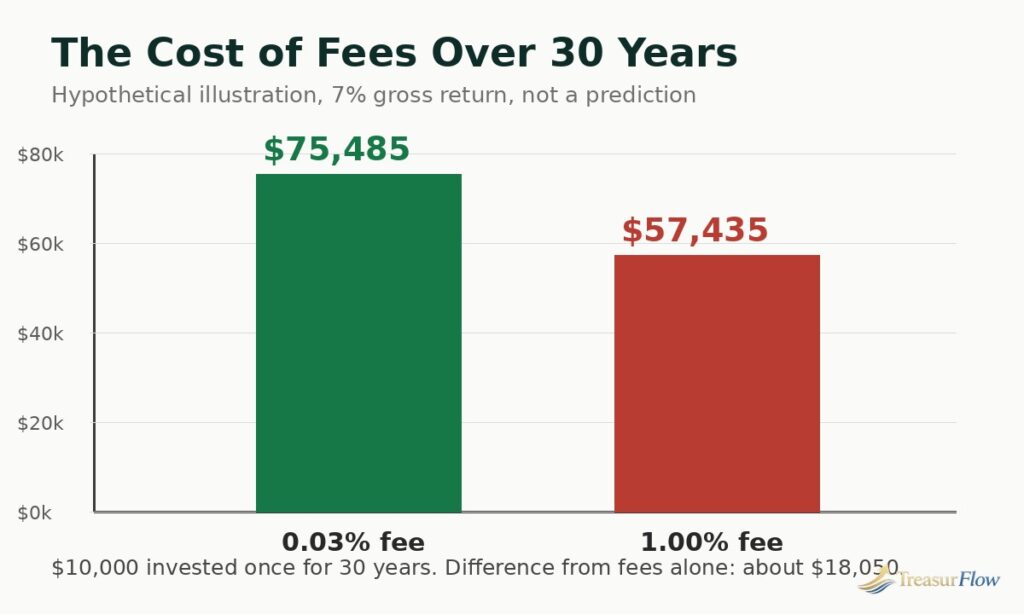
The Fee Drag: What 0.03% Versus 1.00% Really Costs Over 30 Years
Fees look harmless because they are quoted in percentages of percentages. They are not harmless, because they are charged every year on your whole balance, including on all your past growth, and every dollar paid in fees is a dollar that stops compounding for you.
Here is the arithmetic, computed for this guide and labelled exactly for what it is: a hypothetical illustration, not a prediction. Assume you invest $10,000 once, it earns a hypothetical 7% gross annual return for 30 years, and fees are subtracted each year.
- With a 0.03% annual fee (the cost of VOO, IVV, VTI, SCHB, or BND), your net return is 6.97% and $10,000 grows to about $75,485.
- With a 1.00% annual fee (a level still charged by many actively managed funds and some advisors’ fund lineups), your net return is 6.00% and $10,000 grows to about $57,435.
- The difference is about $18,050 — on a $10,000 starting investment, the high-fee investor ends with roughly 24% less, purely because of fees. For reference, with no fee at all the same hypothetical growth would reach about $76,123, so the 0.03% fund gives up only about $638 to fees while the 1.00% fund gives up about $18,688.
Real markets do not return a smooth 7% a year, and your actual result will differ, possibly by a lot. The point of the illustration survives any return assumption: a fee gap of about one percentage point, compounded for 30 years, quietly consumes a quarter of your ending wealth. That is the entire economic case for index funds in one paragraph. You cannot control what the market returns. The fee is one of the few numbers in investing you can control completely, on day one, by choosing funds like the ones in this guide.
How to Buy Your First Index Fund in 5 Steps
Step 1: Pick the account first, the fund second. For retirement saving, an IRA or a workplace 401(k) usually comes before a taxable brokerage account because of the tax treatment. Many investors open a Roth IRA for its tax-free qualified withdrawals in retirement; our breakdown of the best Roth IRA accounts in 2026 walks through the rules and providers. If your employer offers a match in a 401(k), contributing enough to capture the full match is usually the first move, before any account you open yourself.
Step 2: Choose one core fund. Resist the urge to buy six funds on day one. A total U.S. market fund (VTI) or an S&P 500 fund (VOO, FXAIX, or SWPPX) is a complete U.S. stock portfolio by itself. You can add international (VXUS) and bonds (BND) later with new contributions.
Step 3: Decide ETF or mutual fund using the section above. If your broker offers fractional shares and you are investing manually, an ETF is fine. If you want a fixed dollar amount invested automatically every payday with no minimum, a no-minimum mutual fund such as FXAIX or SWPPX is built for exactly that. If you have not settled on a broker yet, compare minimums, fractional shares, and automatic investing features in our best online broker 2026 comparison before you open the account.
Step 4: Place the order and set up automatic contributions. For an ETF, enter the ticker, choose a market or limit order during market hours, and confirm. For a mutual fund, enter the dollar amount; the trade executes at that day’s closing price. Then turn on the automatic investment, even if it is small. Contributions on autopilot are what turn a fund choice into a portfolio over time.
Step 5: Write down your plan and rebalance once a year. Note your target allocation (for example, 80% stocks, 20% bonds, split as in the sample portfolios above) and one calendar date a year when you will nudge it back in line using new contributions first. Then leave it alone. Checking prices daily is not managing your portfolio; it is just volunteering for stress.
A final practical note: before investing money you will need soon, most financial educators suggest keeping short-term savings and an emergency fund in insured bank accounts, separate from investments. Index funds are long-horizon tools. Money needed within the next few years generally does not belong in the stock market, because a downturn may not have time to recover before you need it.
Index Fund Questions New Investors Ask Most
What is the best index fund for beginners in 2026? For many beginners, a single broad fund such as a total U.S. stock market ETF or an S&P 500 index fund is a common starting point because it is diversified and low cost. The best choice depends on your goals, timeline, and the account you are investing in, so compare fees, minimums, and what the fund tracks before you buy.
How much money do I need to start investing in index funds? It depends on the fund and the broker. Many ETFs can be bought for the price of one share, and some brokers offer fractional shares. Several index mutual funds, including Fidelity 500 Index (FXAIX) and Schwab S&P 500 Index (SWPPX), have no minimum investment, while Vanguard 500 Index Admiral (VFIAX) requires a $3,000 minimum.
What is a good expense ratio for an index fund? Broad U.S. stock index funds commonly charge 0.03% or less per year, and some charge nothing. In general, the lower the expense ratio, the less of your return is lost to fees each year, but you should also check what index the fund tracks and whether it fits your plan.
Are index funds safer than individual stocks? An index fund spreads your money across hundreds of companies, so a single company’s problems hurt less than they would if you owned only that stock. Index funds can still fall in value when the overall market falls, and you can lose money, so they are not risk-free.
Should I choose an ETF or a mutual fund index fund? Both can track the same index. ETFs trade during the day like stocks and often have low minimums, while index mutual funds let you invest a set dollar amount and are often easier to automate with recurring purchases. Either structure can work; pick the one your account and habits make easiest to stick with.
Do index funds pay dividends? Yes, many index funds pass along the dividends paid by the companies they hold, usually quarterly. You can take those dividends as cash or reinvest them automatically, which many long-term investors do to keep their money compounding.
Conclusion
The best index funds in 2026 are not a secret and they are not exciting, and that is precisely their strength. A total market or S&P 500 fund at 0.03% or less, an international fund if you want global diversification, and a bond fund sized to your nerves and timeline will cover the needs of most investors. The SPIVA record, showing roughly 9 in 10 active large-cap funds trailing the S&P 500 over 15-year periods, and the fee math in this guide point the same direction: keep costs near zero, diversify broadly, contribute automatically, and give compounding time to work. Choose your account, pick your core fund, write your plan down, and start with whatever amount you can sustain. The most important decision is not which of these nearly identical low-cost funds you pick. It is starting, and then not stopping.
Disclaimer: This article is for general educational and informational purposes only and is not financial, investment, tax, or legal advice, and it is not a recommendation to buy or sell any fund or security. Investing involves risk, including the possible loss of principal. Past performance does not guarantee future results. All growth figures shown are hypothetical illustrations based on stated assumptions, not predictions of any fund’s performance. Fund fees, minimums, and holdings can change; verify current details in the fund’s prospectus before investing, and consider speaking with a qualified financial professional about your personal situation.

Muhammad Zakir is the founder of Treasurflow and the author of its personal finance guides. He researches consumer banking, credit, and personal loans, and every guide cites primary sources such as the CFPB, FDIC, FTC, and IRS. His content is educational and is not personalized financial advice.