
A gold IRA is easy to buy and surprisingly hard to price. Almost every company in this market will happily tell you its account minimum and its Better Business Bureau rating within the first minute of a call. Almost none of them will lead with the number that matters most: how much more than the market price of gold you are about to pay for every coin and bar that goes into your account.
That gap is why this guide is organised differently. Instead of starting with company logos and star ratings, it starts with the fee anatomy — the three layers of cost stacked on top of every gold IRA — and works a real storage example from a published depository fee schedule, dollar by dollar. Only after you can see what a gold IRA actually costs do the company comparisons make sense, because a low annual fee cannot rescue an account that was overcharged on day one.
Everything that follows is dated. Minimums, ratings and fee figures are reported as of October 2026, attributed to the sources that published them, and flagged where sources disagree. Gold IRA pricing is not standardised, dealers change promotions constantly, and affiliate review sites — which dominate search results for this topic — are often paid by the companies they rank. Treat every figure here as a starting point for your own written quote, not as a price list.
One more thing before the numbers: this article is educational, not personal financial advice. Gold pays no interest and no dividends, its price can fall sharply as well as rise, and rolling retirement savings into physical metal is a long-term, hard-to-reverse decision. The balanced view — including a full section on who should not open a gold IRA — is part of the point.
Related guides:
Helpful Official Resources:
- IRS — Rollovers of Retirement Plan and IRA Distributions
- IRS Publication 590-A (Contributions to Individual Retirement Arrangements)
- Investor.gov / SEC — Self-Directed IRAs and the Risk of Fraud (Investor Alert)
- CFTC & FINRA — 10 Things to Ask Before Buying Gold (brochure PDF)
- CFTC — Precious Metals Frauds (Fraud Center)
- FTC — Report Fraud
Start With the Cost Stack: The Three Layers You Actually Pay
Every gold IRA carries the same three cost layers. Two of them are small, visible and quoted on websites. The third is large, invisible and usually revealed only after you have signed. Understand the layers in order of size, not in the order a salesperson presents them.
Layer 1: The dealer spread or markup over spot — the biggest hidden cost
When you buy metal for your IRA, you do not pay the spot price of gold — the wholesale market price quoted on financial news. You pay the dealer’s retail price, and the difference between the two is the spread, or markup. That difference is the dealer’s margin, and unlike custodian and storage fees, it is almost never published as a clean number. It is buried inside the per-coin or per-bar price you are quoted on the phone.
The regulatory and consumer-protection sources that have examined this market describe markups that vary enormously by product and by dealer. Common bullion coins and bars sold by competitive dealers may carry modest single-digit percentage premiums over spot. At the other end of the market, the CFTC and state regulators have repeatedly documented — in enforcement actions and consumer advisories — markups of 30% or more on so-called proof, graded or collectible-style coins sold into retirement accounts, in some litigated cases far higher. The practical consequence is brutal arithmetic: if you pay 30% over spot, the gold price must rise 30% before your account breaks even, even if every other fee were zero. At a 5% markup, you need a 5% rise. Same metal, same account, completely different investment — decided entirely by a number most buyers never ask for.
Why is this layer so hard to see? Because there is no standardised disclosure. A dealer can truthfully advertise “no commissions” and “fee-free first year” while embedding its entire profit in the coin price. Quotes are typically given per coin, over the phone, without the spot price at that moment stated alongside. The defence is simple and is repeated throughout this guide: before any purchase, get the quote in writing, note the spot price at that moment, and compute the percentage yourself. Any dealer that will not quote a price you can compare against spot is telling you something important.
To make the scale concrete, the ranges below reflect how this market is commonly described by regulators, consumer advocates and dealer pricing pages as of October 2026. They are illustrative ranges, not quotes:
- Standard bullion bars and common bullion coins (for example American Gold Eagles and Buffaloes from major mints): often low single digits to around 10% over spot from competitive sellers, higher from full-service IRA dealers.
- “Exclusive,” proof or limited-edition coins marketed for IRAs: frequently far higher — the segment where regulators have documented the most extreme markups.
- Silver and other metals generally carry higher percentage premiums than gold because refining and shipping costs are spread over a lower metal value.
- Buy-back spreads apply on exit too: when you sell, you receive a wholesale-side price, so the round trip — buy at retail, sell at wholesale — is the true transaction cost.
Compare those figures with the other two layers: a typical custodian charges a flat annual fee that is often around $100 to $300, and storage on a $100,000 account, as the worked example below shows, can run to a few hundred dollars a year. In other words, a single percentage point of spread on a $100,000 purchase — $1,000 — can exceed several years of all the other fees combined. Shopping for a gold IRA company on annual fees alone is like choosing a house by the price of its doormat.
Product choice drives the spread as much as dealer choice. Plain bullion — standard coins and bars whose value tracks the metal — is priced competitively because any buyer can compare it in seconds. Numismatic, graded and proof products are priced opaquely because comparison is hard: the price depends on claimed scarcity and condition grades that a retirement saver cannot verify on a call. Regulators’ fraud advisories return to this point again and again, because the high-pressure end of the industry steers IRA buyers toward exactly those products. A useful rule of thumb: if a coin’s price cannot be explained almost entirely by its metal content, it does not belong in a retirement account.
Layer 2: Custodian fees
An IRA must, by law, be held by an IRS-approved custodian — a bank, trust company or other approved entity. For a self-directed IRA holding physical metal, the custodian holds title paperwork, receives your rollover, pays the dealer on your instruction, arranges delivery to the depository and reports to the IRS. In exchange it charges a setup fee (often $0 to $75, frequently waived in promotions), an annual administration or maintenance fee, and sometimes a per-transaction fee. The annual fee at custodians commonly used for gold IRAs is typically a flat amount — often in the $100 to $300 range as of October 2026 — rather than a percentage of assets, which is one of the few genuinely consumer-friendly features of this market: a flat $125 fee is 1.25% of a $10,000 account but only 0.125% of a $100,000 account.
Some custodians instead charge a sliding scale or percentage-based fee, which quietly reverses that advantage as your account grows or the gold price rises. The structure matters more than the headline number, and it is a specific question to ask: is the fee flat for the life of the account, or does it step up with account value? Get the custodian’s full published fee schedule — custodians, unlike dealers, generally do publish one — before you open the account.
Which custodian will you get? Usually, the dealer chooses for you: each gold IRA company works with one or a small number of preferred custodians — Equity Trust, Gold Star Trust, Kingdom Trust, Strata Trust and others recur across the industry — and the pairing is part of what you are buying. You are not obliged to accept it; a self-directed custodian account can be opened independently and the dealer instructed to sell into it. But the default pairing is what almost all customers end up with, so the custodian’s fee schedule belongs in your comparison alongside the dealer’s prices.
Layer 3: Storage fees — with the maths done properly
IRA rules require your metal to be held by the custodian or stored in an approved depository — you cannot keep it at home, a point covered in full below. Storage is therefore a mandatory, recurring cost, charged in one of two ways: a flat fee for pooled (“commingled”) storage, where your metal is held in a shared allocated bulk holding, or a higher fee for segregated storage, where specific bars or coins are held separately in your account’s name. Many gold IRA companies advertise a flat storage figure; depositories, however, often price storage as a percentage of the account’s value, which means the fee rises automatically when the gold price rises.
This is the layer where this guide can be unusually precise, because at least one major depository publishes its full fee schedule, and the maths can be done openly rather than estimated. The worked example below uses the Delaware Depository’s published annual storage rates, captured on 21 September 2026. Delaware Depository is named here because it is one of the depositories most frequently used by the companies compared later, and — crucially — because it publishes numbers the public can check. Nothing in this section is a recommendation of that depository; it is simply the one whose arithmetic can be verified.
Delaware Depository — one of the depositories most frequently named by gold IRA companies — publishes its annual storage fee schedule for IRA accounts on its website, under Custodial Services / Storage Fees (delawaredepository.com), current at the date of capture, 21 September 2026:
- Commingled (allocated-in-bulk) storage: 0.12% of account value per year, with a minimum fee of $100 per year.
- Segregated storage: 0.19% of account value per year, with a minimum fee of $200 per year.
Commingled storage pools your metal with other customers’ metal of the same type: you own a defined quantity, held in bulk, and on withdrawal you receive equivalent metal rather than the identical bars deposited. Segregated storage keeps specific, identified bars or coins in a separate location under your account — you get back the very items deposited — and the published rate reflects that extra handling and space. Both are legitimate, IRS-compatible arrangements; the choice is about cost versus the comfort of identified holdings.
Now the worked example. Applying those published rates, and nothing else, gives:
| Account value | Commingled: rate maths | Commingled: you pay | Segregated: rate maths | Segregated: you pay |
|---|---|---|---|---|
| $10,000 | 0.12% × $10,000 = $12 → below the $100 minimum | $100 | 0.19% × $10,000 = $19 → below the $200 minimum | $200 |
| $50,000 | 0.12% × $50,000 = $60 → below the $100 minimum | $100 | 0.19% × $50,000 = $95 → below the $200 minimum | $200 |
| $100,000 | 0.12% × $100,000 = $120 → above the minimum | $120 | 0.19% × $100,000 = $190 → below the $200 minimum | $200 |
| $200,000 | 0.12% × $200,000 = $240 → above the minimum | $240 | 0.19% × $200,000 = $380 → above the minimum | $380 |
| $250,000 | 0.12% × $250,000 = $300 → above the minimum | $300 | 0.19% × $250,000 = $475 → above the minimum | $475 |
Read the $100,000 row carefully, because it exposes a widespread misreading. It is sometimes claimed — including in summaries of this very fee schedule — that at $100,000 a year, segregated storage at Delaware Depository costs $315. That figure does not survive contact with the published schedule. The segregated rate is 0.19%, and 0.19% of $100,000 is $190. Because $190 is below the $200 annual minimum for segregated storage, the minimum applies and the fee is $200 — not $315. A figure of $315 could only arise from different rates or a different account value: for example, pairing a custodian fee of about $125 with $190 of storage gives roughly $315 of total annual cost, which is a different claim from a $315 storage fee. Conflating the two is exactly the kind of quiet error that compounds through review sites copying one another. The maths above uses only the published rates — 0.12% with a $100 minimum, 0.19% with a $200 minimum — and every row can be checked with a calculator.
Two warnings attach to this table. First, it is one depository’s schedule: other depositories price differently, several gold IRA companies negotiate or bundle storage into a single flat “all-in” fee, and a flat fee can be better or worse than 0.12% depending on your account size — run your own row before deciding. Second, percentage storage means your fee rises with the gold price even though the service does not change: on a $250,000 account, commingled storage at Delaware Depository is $300 a year. Neither warning undermines the example; they define what it is — a transparent, checkable illustration of how layer 3 behaves, in a market where most illustrations cannot be checked at all.
Putting the stack together on $100,000
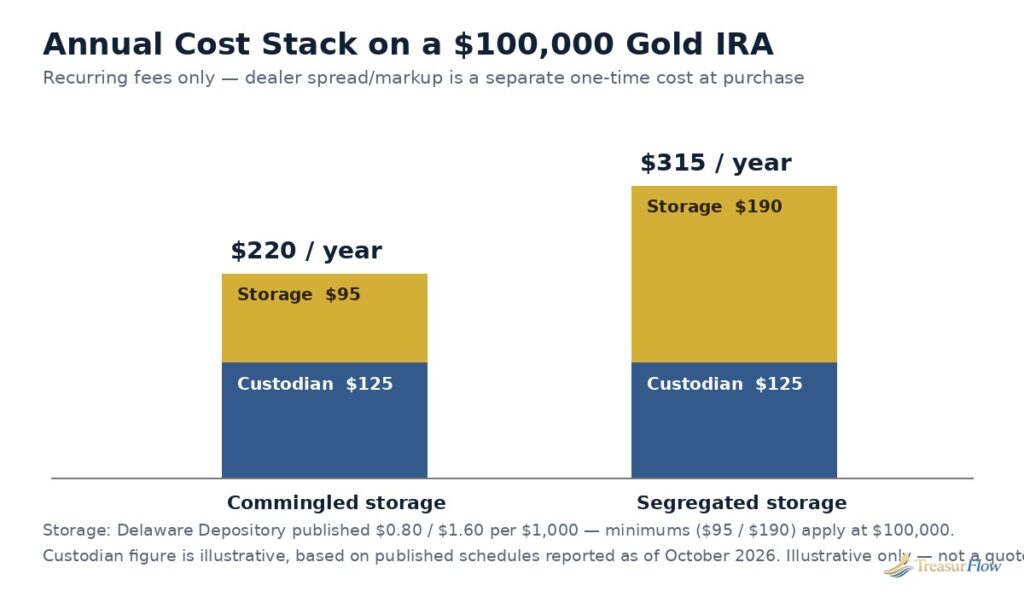
Now combine the layers for a single year on a $100,000 gold IRA, using the figures established above. The custodian fee is illustrative — a mid-range flat fee of the kind described in Layer 2 — while storage uses the verified Delaware Depository rates:
- One-time dealer spread at purchase — not annual, but real: at an illustrative 5% over spot, $5,000 of day-one cost; at 15%, $15,000; at 30%, $30,000.
- Annual custodian fee — illustrative $100 (flat-fee custodians commonly fall in the $100–$300 band; use your custodian’s schedule).
- Annual storage — $120 (commingled: 0.12% × $100,000 = $120, above the $100 minimum) or $200 (segregated: 0.19% × $100,000 = $190, so the $200 minimum applies).
- Total recurring cost — $220 to $315 a year, before any transaction or wire fees, against a one-time spread that can equal $5,000, which is more than two decades of the commingled recurring fees above.
That is the fee anatomy. Everything else in this guide — minimums, ratings, company profiles — sits on top of it, and a company that looks cheap on layers 2 and 3 can still be the most expensive choice in the room if its layer 1 is fat. Keep the stack in mind as you read the company section.
How a Gold IRA Actually Works
A gold IRA is not a special type of IRA in the tax code. It is an ordinary IRA — usually a self-directed IRA — whose assets happen to include physical precious metals. The IRS permits an IRA to own certain coins and bullion, provided the assets are held by the IRA’s custodian or stored in an approved depository. That single condition shapes the entire structure, because a regular brokerage IRA cannot hold physical metal and a regular bank IRA will not. Three parties are involved in every account:
- The dealer (the gold IRA company) sells you the metal. This is the company whose advertisements you see — Augusta, Goldco and the rest. Despite the branding, the dealer is not the custodian and does not hold your account; it is a retailer.
- The custodian is the IRS-approved entity that administers the IRA itself: holding the account, executing your instructions, keeping records and filing IRS reports. Custodians in this market are typically specialised self-directed IRA companies or trust companies.
- The depository is the high-security vault where the metal physically sits, insured and audited, in the custodian’s name for your benefit.
You never take possession of the metal. Your money moves from your old retirement account to the custodian; the custodian pays the dealer; the dealer ships metal to the depository; the depository confirms receipt; your statement shows holdings. If any step in that chain involves metal coming to your house, something has gone wrong — see the home-storage warning below.
Funding it: contributions are small, rollovers are the real route
In theory you can fund a gold IRA with annual contributions, but the IRA contribution limit — $7,000 for 2025, plus a $1,000 catch-up at age 50 and over, per IRS figures — makes that a slow way to build a meaningful position, and many dealers’ minimums exceed it anyway. In practice, almost every gold IRA is funded by moving existing retirement money: a rollover or transfer from a previous employer’s 401(k), a traditional IRA, or, where the plan allows, a current employer’s plan. The mechanics matter because a mistake can turn a tax-free move into a taxable distribution.
Rollover steps, in order
- Choose the company and custodian, and open the self-directed IRA with the custodian. The dealer usually coordinates the paperwork, but the account is yours, with the custodian.
- Complete the funding paperwork — a rollover (from an employer plan) or an IRA-to-IRA transfer form, specifying the amount.
- Money moves custodian-to-custodian. In a direct rollover or transfer, funds pass between institutions without touching your bank account. This is the route to insist on (see the next section).
- Confirm receipt with the new custodian, and confirm the exact cash balance available to trade.
- Place the metal order with the dealer: agree the products, the per-unit prices and the total — in writing — and check the spread against spot before authorising.
- The custodian pays the dealer; the dealer ships to the depository. Verify the depository receipt and that your statement reflects the exact coins or bars purchased.
Timelines vary: dealers commonly describe the full sequence taking one to three weeks, most of it consumed by the releasing institution’s processing. Nothing about the process requires speed, and any pressure to complete “today” comes from the seller, not the system.
Direct vs. 60-day indirect rollover — and the tax trap
The IRS describes two ways money can move between retirement accounts, and the difference is not a technicality:
- Direct rollover / trustee-to-trustee transfer. The money goes straight from one institution to the other. You never hold it, no tax is withheld, and there is no deadline pressure beyond normal processing. For IRA-to-IRA transfers there is no limit on how often you can do this.
- Indirect (60-day) rollover. The old account pays you, and you have 60 days to deposit the full amount into the new IRA. Two traps attach. First, when money leaves an employer plan this way, 20% is typically withheld for federal tax — yet you must still deposit 100% of the original amount within 60 days, funding the missing 20% from elsewhere, or the withheld portion becomes a taxable distribution (and, if you are under 59½, potentially subject to the 10% early-distribution penalty as well). Second, for IRA-to-IRA indirect rollovers, the IRS one-rollover-per-year rule limits you to one such rollover in any 12-month period across all your IRAs.
- Miss the 60 days and the entire amount is treated as distributed: income tax, possible penalty, and the money is out of the retirement system permanently.
The IRS’s own rollover guidance (see the official resources at the top of this article) sets out these rules in full. The practical advice is unambiguous: use a direct, trustee-to-trustee movement every time. There is no benefit to the indirect route for a gold IRA purchase, only deadline and withholding risk.
The IRS Rules That Are Not Negotiable
Precious metals inside an IRA sit under specific Internal Revenue Code rules, principally IRC §408(m), which treats most collectibles as prohibited IRA investments and then carves out exceptions for specified coins and bullion meeting fineness standards, held by the trustee or custodian. IRS Publication 590-A, which governs IRA contributions and the treatment of investments in collectibles, states the same framework in plain terms. The rules below are the ones that matter in practice; they are also the rules that promotional marketing most often blurs.
Eligible metals and fineness
- Gold: minimum fineness of 0.995 (99.5% pure). Qualifying products commonly include American Gold Eagle coins (which are specifically excepted by statute despite their 91.67% purity), American Gold Buffaloes, Canadian Maple Leafs and bars from accredited refiners.
- Silver: minimum fineness of 0.999.
- Platinum: minimum fineness of 0.9995.
- Palladium: minimum fineness of 0.9995.
- Not eligible: collectibles and rare or graded coins held for numismatic value, and any metal that fails the fineness tests. South African Krugerrands (0.9167 fine) are the classic example of a famous coin that does not qualify.
Custody and storage: home storage is prohibited
The exception only applies while the metal is in the physical possession of a qualified trustee. In practice, that means:
- The IRA’s custodian must hold the account, and the metal must be stored at an IRS-approved depository.
- You cannot store IRA gold at home, in a personal safe, or in a safe deposit box you rent yourself. Personal possession is treated as a distribution of the metal’s value.
- “Home storage IRA” and checkbook-LLC pitches should be treated as disqualifying. Promoters periodically market structures in which an IRA-owned LLC supposedly lets you keep coins at home. Tax Court litigation — most prominently McNulty v. Commissioner (2021), where the taxpayers stored IRA-owned coins at home through an LLC and were hit with tax and penalties — confirmed that personal possession breaks the rule regardless of the paperwork wrapped around it. The SEC and FINRA investor alerts warn against exactly these arrangements.
- You also cannot use IRA metal personally in any way: no displaying it, no pledging it as collateral for a personal loan, no “borrowing” a coin and putting it back. Prohibited-transaction rules under Section 4975 sit on top of the collectibles rules, and a prohibited transaction can disqualify the entire IRA, not just the metal involved.
Taxes, distributions and RMDs
Inside the account, a traditional gold IRA behaves like a traditional IRA: no tax on the rollover if it is done correctly, tax-deferred growth, and ordinary income tax on distributions. A Roth gold IRA uses after-tax money and follows Roth distribution rules. Physical metal creates two practical wrinkles. First, liquidity: to spend your gold in retirement you must sell it back through a dealer — at the dealer’s buyback price — or take an in-kind distribution of the metal itself and owe tax on its fair market value. Second, RMDs: traditional IRA holders face required minimum distributions in their seventies under current law, and a vault full of coins cannot mail the IRS a percentage of itself. Custodians handle this by valuing the account (typically at year-end spot-based value) and requiring you to liquidate enough metal for cash, take metal in kind and pay the tax, or satisfy the RMD from another traditional IRA you own. Plan for this before you are in your seventies, not during.
The Best Gold IRA Companies 2026, Compared on Verifiable Facts
Here is the honest limitation of every comparison in this market, including this one: dealers do not publish their spreads, and spreads are the largest cost. What can be compared publicly is the account minimum, the third-party record (BBB rating and accreditation), which custodians and depositories a company works with, and how long it has traded. The table below sticks to those verifiable or clearly attributed facts, as of October 2026. Where review sources conflict on a figure, the conflict is shown rather than quietly resolved — because if five affiliate sites cannot agree on a company’s minimum, the only reliable source is the company’s own written quote.
| Company | Reported IRA minimum (as of Oct 2026) | BBB rating | Custodian / storage partners commonly reported | Notes |
|---|---|---|---|---|
| Augusta Precious Metals | $50,000 | A+ | Equity Trust Company; Delaware Depository | Founded 2012. Highest minimum in this group; education-led sales model. |
| Goldco | $25,000 | A+ | Independent custodians; Delaware Depository | Founded 2006. Flat-fee schedule published by several reviewers (see below). |
| American Hartford Gold | $10,000 | A+ | Equity Trust Company; Delaware Depository / Brinks | Founded 2015. Low minimum; fee-waiver promotions vary by account size. |
| Birch Gold Group | $10,000 per most sources; $5,000 per one source — conflict flagged | A+ | Multiple custodians; Delaware Depository, IDS | Long operating history (about two decades). Confirm the current minimum in writing. |
| Noble Gold Investments | $20,000 per most sources; lower figures appear in some tables — conflict flagged | A+ | Texas-based storage via IDS of Texas commonly reported | Offers gold, silver, platinum and palladium. Confirm the current minimum in writing. |
Minimums are dealer-set, change with promotions, and were compiled from multiple published reviews in October 2026 — they are reported figures, not guarantees. BBB ratings are as reported by those reviews and the companies’ BBB profiles in October 2026; check the live BBB profile before you commit, because ratings and complaint counts move.
Augusta Precious Metals — the high-minimum, education-first option
Augusta is the name that recurs at the top of independent rankings, and its constraint is equally consistent across sources: a $50,000 minimum, the highest in this comparison, reported by every source consulted with no conflict. Reviews consistently describe an A+ BBB rating, accreditation since 2015, and an unusually clean complaint record, alongside an education-led process built around a one-on-one web conference before any purchase. Custody is most commonly reported through Equity Trust Company, with storage at Delaware Depository.
The fee picture reviewers report is a small one-time setup fee (around $50) plus custodian and storage charges broadly in the $200 to $300 a year zone depending on storage type, with promotions that waive fees for a period on qualifying accounts. Treat the waiver as a promotion with unpublished terms — get its duration and conditions in writing. Augusta sells gold and silver only, not platinum or palladium, in IRAs. The real Augusta question is the same as everywhere else: the per-ounce premium on the specific coins quoted to you. A clean BBB file tells you a company handles complaints well; it does not tell you its spread. If your rollover is under $50,000, Augusta is simply not available to you, and no review ranking changes that.
Goldco — the mid-minimum rollover specialist
Goldco’s reported minimum is $25,000, consistent across the sources consulted, with an A+ BBB rating (accredited since 2011, per its BBB profile as reported by reviewers) and a founding date of 2006. It is the most “published” of the group on fees: multiple reviewers report the same flat structure — roughly a $50 setup fee, around $125 a year in administration, and storage around $100 a year non-segregated or $150 segregated, for an all-in recurring cost in the region of $225 to $275 a year. On a $25,000 account, note what flat fees do: $225 a year is 0.9 percent of the account annually, every year, before any price movement. The same fee on $100,000 is 0.23 percent. Goldco’s minimum exists precisely because the arithmetic below it is unkind.
Goldco markets buyback support and periodic bonus-silver promotions on larger purchases. Apply the rule from the cost-stack section: a bonus funded by margin is a pricing structure, not a gift. Compare Goldco’s all-in price per ounce on plain bullion against at least one competitor’s, on the same day, before valuing any promotion. Goldco focuses on gold and silver; reviewers note platinum and palladium are not its primary offering.
American Hartford Gold — the low-minimum, promotion-heavy option
American Hartford Gold is consistently reported with a $10,000 minimum and an A+ BBB rating, founded in 2015, working with Equity Trust Company as custodian and Delaware Depository / Brinks storage. Reviewers report tiered fee waivers — commonly described as first-year fees waived at $50,000-plus and up to three years waived at $100,000-plus — plus a price-match guarantee and a no-fee buyback commitment. Those reported terms are promotions, and promotions are the fastest-moving numbers in this industry; the version that counts is the one in your written agreement.
The caution with a $10,000 entry point is arithmetic, not trustworthiness. At $10,000, even the leanest recurring stack — say roughly $180 to $225 a year in custodian and storage charges, in line with figures reviewers report for this segment — is about 2 percent of the account every year, and segregated storage minimums alone can approach that. Gold would need to rise steadily just for the account to stand still. If your allocation is genuinely $10,000, the honest comparison is not between gold dealers; it is between a gold IRA at that size and cheaper ways to hold a small gold allocation outside a retirement account, or waiting until a rollover makes the account large enough for flat fees to shrink into the background.
Birch Gold Group — broad metals range, and a minimum you must confirm
Birch Gold Group is a long-running dealer (about two decades, per most reviews) with an A+ BBB rating as reported across sources, a wide metals range including platinum and palladium, and storage commonly reported through Delaware Depository and IDS. It is also this comparison’s clearest example of why affiliate fee tables cannot be trusted blindly: most sources report a $10,000 IRA minimum, but at least one widely syndicated comparison table lists $5,000. Both figures were live in October 2026. This guide reports the range — $5,000 to $10,000, with $10,000 the majority figure — and flags the conflict rather than picking the more convenient number. If Birch is on your shortlist, the first thing to obtain is its current minimum and full fee schedule in writing; a dealer whose entry price is misreported across the internet is a dealer whose spread you should check with extra care.
Reviewers commonly report Birch fees in the region of a $50 setup fee and roughly $180 a year in combined administration and storage, plus wire fees. As with Goldco, endorsements and education content feature heavily in its marketing; neither is a pricing fact.
Noble Gold Investments — mid-range minimum, Texas storage angle
Noble Gold is reported by most sources with a $20,000 minimum and an A+ BBB rating, offering all four IRA-eligible metals, with storage commonly associated with IDS of Texas — a differentiator for savers who specifically prefer Texas-based storage. Some comparison tables have listed lower minimums for Noble (figures as low as $2,000 to $5,000 appear in syndicated tables), which conflict with the $20,000 figure in the majority of reviews and in Noble-focused fee breakdowns. This guide therefore reports $20,000 as the majority-reported figure, with lower figures appearing in some tables, and flags the conflict rather than resolving it silently. Reviewers report a flat annual fee structure in the region of $230 a year covering administration and storage in some breakdowns — a structure that, like all flat fees, becomes proportionally cheaper as balances grow, and proportionally expensive at the minimum.
How to use this comparison (and how not to)
Do not pick a winner from the table. Use it to build a shortlist of two or three companies whose minimums fit your actual rollover, then run the only comparison that decides real outcomes: same day, same product, written quotes. Ask each dealer for the all-in price per ounce on a plain bullion coin (for example, a standard American Gold Eagle or Canadian Maple Leaf), their same-day buyback price per ounce for the identical coin, the custodian’s complete fee schedule, the depository and storage type, and every promotion’s terms in writing. The dealer with the best BBB rating and the worst spread is the expensive dealer. The dealer who answers all five questions in writing, quickly, without a countdown timer, has told you something real about how it does business.
A note on ratings generally: an A+ BBB rating is a threshold check, not a ranking. Every company in this table holds one, which tells you the rating alone cannot separate them. Complaint patterns on the live BBB profile — especially complaints mentioning premiums, buyback prices or pressure — are more informative than the letter grade.
Red Flags and High-Pressure Sales Warnings
Regulators have spent a decade documenting how gold IRA fraud and abuse actually work, and the pattern is stable enough to list. The CFTC states that precious metals frauds promising “safe” investments have pressured thousands of investors into losing millions through false claims, overpriced coins and excessive or hidden fees, and that over the past decade it has charged companies over an alleged total of more than $500 million in fraudulent sales (CFTC and FINRA joint investor bulletin). The victims are disproportionately older workers and retirees — people with large rollover-eligible balances and the least time to recover from a loss. Walk away, or at minimum pause for a week, if you meet any of the following:
- Urgency theatre. “Prices are about to explode,” “this allocation is nearly gone,” “the promotion ends Friday.” Gold has traded for thousands of years; it will be available next week. Manufactured deadlines exist to stop you comparison-shopping — the one activity that actually protects you.
- Fear as the entire pitch. Collapse-of-the-dollar scripts, confiscation stories and crisis countdowns are marketing, not analysis. The CFTC warns that fraudsters deliberately prey on fears about the durability of the financial system.
- “Safe,” “risk-free” or “guaranteed.” The SEC, NASAA and FINRA alert is explicit: claims such as “risk-free,” “zero risk,” “absolutely safe” and “guaranteed profit” are hallmarks of fraud. Gold’s price is volatile; a dealer who denies that is lying about the one thing you can check in ten seconds.
- Steering to premium, proof or “semi-numismatic” coins. This is the spread machine. If the recommended product costs dramatically more per ounce than plain bullion, the difference is margin, and resale buyers will not pay it back to you.
- Home storage offers. Any arrangement that ends with IRA metal in your house contradicts IRS custody rules and the McNulty Tax Court outcome. A dealer who offers it is offering you a tax problem.
- Verbal-only pricing. No written all-in price per ounce, no written buyback price, no written fee schedule — no deal. The CFTC/FINRA bulletin is direct: if fees are not available in writing before purchase, that is a red flag.
- A salesperson acting as your adviser. The joint bulletin notes that most precious metals salespeople are not registered or licensed to give investment, trading or tax advice, are not fiduciaries, and are paid on commission. Treat their recommendations as sales, because legally that is what they are. Verify any genuinely registered professional through FINRA or Investor.gov.
- Leverage and financing pitches. Offers to control more metal with borrowed money multiply every risk in this article and feature heavily in CFTC enforcement actions.
- Fake authority. Stolen celebrity images, invented endorsements and affinity targeting through political or religious communities are documented CFTC warnings, not hypotheticals.
- Free offers that require a fast, large rollover. Ask how the company profits if it appears to be giving metal away. If the answer is not clear, the answer is the spread.
The protective habits are boring and effective: never respond to cold calls or unsolicited offers; check the company and salesperson for complaints with your state attorney general, state securities regulator, the BBB and the CFTC; compare at least two written quotes; and take a second opinion from a licensed adviser who sells no metal at all.
Who Should NOT Open a Gold IRA
Balanced coverage requires saying plainly that for many savers the correct answer to this entire article is “don’t.” You should probably not open a gold IRA if:
- Your rollover is small. Below roughly $25,000, flat custodian and storage fees — and especially storage minimums — consume a percentage of the account every year that gold must outrun before you gain anything. At $10,000 with segregated storage, the published Delaware Depository minimum alone is 1.9 percent a year.
- You may need the money soon. Physical metal in an IRA is illiquid by retirement-account standards: selling means a dealer buyback at the dealer’s price, shipping and paperwork, and distributions carry tax consequences. Money needed within a few years does not belong in a vault.
- You are close to, or in, RMD territory and hold little other IRA money. Required minimum distributions force annual valuations and sales or in-kind distributions with tax attached. A gold-only traditional IRA makes RMDs an annual project.
- You want income. Gold pays no interest, dividends or rent. If your retirement plan depends on portfolio income, a non-yielding asset with annual storage costs works against the plan.
- You already hold plenty of gold exposure. Gold funds or mining shares inside an existing brokerage IRA give price exposure without custodian minimums, storage fees or dealer spreads on coins. Physical metal in an IRA is for savers who specifically want allocated bullion and accept its costs — not for adding generic “gold exposure” at maximum expense.
- You cannot verify the deal. If you cannot get written pricing, cannot name your custodian and depository, or feel rushed at any point, the correct action is to stop. A legitimate dealer survives a two-week delay; a pressure pitch does not.
- Your emergency savings or debt situation is unfinished. High-interest debt and an absent emergency fund are higher-certainty financial problems than the absence of gold in a portfolio. Solve those first.
For savers who clear those hurdles — a large rollover, a long horizon, a deliberate decision to hold a minority allocation in physical metal, and a written quote with a thin spread on plain bullion — a gold IRA is a legitimate, IRS-recognised structure. The difference between a sensible allocation and an expensive mistake is almost entirely in the execution details covered above.
Gold IRA Questions Savers Ask Before Rolling Over
What is a gold IRA and how is it different from a regular IRA?
A gold IRA is a self-directed individual retirement account that holds physical precious metals instead of only stocks, bonds and funds. The tax rules are the same as a regular IRA, but a specialised custodian holds the account, the metals must meet IRS fineness standards, and the metal itself must be stored in an IRS-approved depository. You direct the purchases, and the custodian does not give investment advice or verify that a metal is a good buy.
Can I store gold IRA metals at home?
No. IRS rules require gold held in an IRA to be in the physical possession of a qualified trustee or custodian, which in practice means an IRS-approved depository. Taking the metal home, keeping it in a personal safe or using a home-storage LLC arrangement is treated as a distribution. That can trigger income tax on the value of the metal and, if you are under age 59 and a half, an additional 10 percent early distribution tax.
What purity does gold need to be for an IRA?
Gold bullion must meet a minimum fineness of 0.995, which is 99.5 percent pure, under Internal Revenue Code Section 408(m)(3). Bars and coins must also come from a national government mint or an accredited refiner. The American Gold Eagle is a specific statutory exception: it is 0.9167 fine and still qualifies because Congress named it in the law. Collectible and numismatic coins do not qualify, even if their gold content is high.
How much does a gold IRA really cost each year?
Recurring costs usually have three parts: a custodian administration fee, a depository storage fee and any transaction fees. As an example computed from published rates as of October 2026, Delaware Depository charges $0.80 per $1,000 of value for commingled storage and $1.60 per $1,000 for segregated storage, with $95 and $190 annual minimums, so storage on a $100,000 account is $95 or $190 a year. The largest cost is usually not annual at all: it is the dealer spread or markup over the spot price that you pay when you buy.
What is the difference between a direct rollover and a 60-day rollover?
In a direct rollover, your old plan or IRA custodian sends the money straight to the new IRA and no tax is withheld. In a 60-day rollover, the money is paid to you and you must deposit the full amount into the new IRA within 60 days. A distribution from an employer plan paid to you is subject to mandatory 20 percent withholding, so you would need other cash to make up the shortfall, and missing the deadline can make the whole amount taxable. For most people, the direct route is simpler and safer.
How much of my retirement savings should go into a gold IRA?
There is no IRS rule that sets an allocation, and this article does not give personal financial advice. Gold pays no interest or dividends, its price can fall as well as rise, and a gold IRA carries higher ongoing costs than a standard brokerage IRA. Many savers who use one keep metals as a minority part of a diversified portfolio rather than moving an entire retirement account. Talk to a licensed, independent financial adviser who is not selling you metal before deciding on any amount.
Conclusion: Price the Spread First, Then Pick the Company
The best gold IRA companies 2026 comparison comes down to a discipline, not a brand. The IRS rules are fixed and knowable: 0.995-fine gold, an approved custodian, an approved depository, no home storage, and a direct rollover if you want to avoid the withholding trap. The ongoing fees, once you do the storage maths properly from a published schedule like Delaware Depository’s, are a few hundred dollars a year on a large account — real money, but not the main event. The main event is the spread on the metal itself, the one number no dealer publishes and every dealer negotiates.
So the order of operations for any saver still considering this after the “who should not” section is: confirm the account size makes flat fees trivial; shortlist dealers whose minimums fit — Augusta Precious Metals at a reported $50,000, Goldco at $25,000, Noble Gold at a majority-reported $20,000, and American Hartford Gold and Birch Gold Group at the lower end, with Birch’s $5,000-to-$10,000 conflict and Noble’s conflicting lower table figures resolved in writing before you rely on them; then collect same-day written quotes on identical plain bullion and compare all-in price and buyback price per ounce. Walk away from urgency, premium coins and verbal-only pricing, whatever the BBB rating says.
Done that way, a gold IRA is a transparent, rules-bound way to hold physical metal inside a retirement account. Done in the order the sales scripts prefer — company first, product second, price never — it is one of the most expensive ways to buy gold ever devised. The metal does not care which order you choose. Your retirement balance will.
This article is for education only and is not financial, tax or legal advice. Figures are reported as of October 2026 from the sources described in the text and can change; obtain current written quotes and fee schedules, and consult a licensed financial adviser and tax professional before rolling over retirement funds.

Muhammad Zakir is the founder of Treasurflow and the author of its personal finance guides. He researches consumer banking, credit, and personal loans, and every guide cites primary sources such as the CFPB, FDIC, FTC, and IRS. His content is educational and is not personalized financial advice.