
If you are searching for the best debt relief companies 2026 has to offer, start with the part most advertisements leave out: debt relief can help some people, hurt others, and it is never free, fast, or guaranteed. A legitimate company cannot legally charge you an upfront fee for telemarketed debt relief, cannot promise to make your debt disappear, and cannot stop every collection call or lawsuit. Any company that tells you otherwise is giving you a reason to hang up, not a reason to enroll.
This guide is deliberately ordered differently from most rankings. It puts the law and the scam warnings first, compares debt settlement with a nonprofit debt management plan, debt consolidation, and bankruptcy second, and only then looks at well-known companies such as National Debt Relief, Freedom Debt Relief, Accredited Debt Relief, and Pacific Debt Relief. That order matters. The best company for you depends on which type of relief fits your situation — and for many readers, the safest first call is not to a for-profit settlement company at all, but to a nonprofit credit counselor.
All fees, rules, and company details below are stated as of October 2026. Debt relief programs, state availability, and company terms change, so confirm every figure in writing before you sign anything.
Related guides
Helpful Official Resources
Start With the Law: What the FTC Bans and What It Requires
The Federal Trade Commission (FTC) amended the Telemarketing Sales Rule to add specific protections for debt relief services. The rule covers for-profit companies that sell debt relief by phone, including calls you place to them in response to an advertisement — not only calls they place to you.
The single most important protection is the advance-fee ban. Under the rule, a covered debt relief company cannot collect any fee from you until three things have happened:
- It has renegotiated, settled, reduced, or otherwise changed the terms of at least one of your enrolled debts.
- There is a written settlement agreement, debt management plan, or other agreement between you and the creditor, and you have agreed to it.
- You have made at least one payment to the creditor under that agreement.
If you enroll several debts and the company settles them one by one, it may collect a proportionate fee for each debt it has actually settled. It may not front-load its fees. It may ask you to set aside money in a dedicated account for fees and creditor payments, but that account is subject to restrictions designed to protect you, including that the account be held at an insured financial institution and that you retain the ability to withdraw your funds.
The rule also requires honest disclosure before you enroll. Before you sign up, a covered company must tell you how long it will take to get results, how much the service will cost, the negative consequences that could result from using debt relief, and key facts about any dedicated account, if one is used. It must also avoid misrepresentations — including falsely claiming nonprofit status, inventing success rates, or promising a specific reduction it cannot guarantee.
Bona fide nonprofit credit counseling organizations are treated differently under the rule, which is one reason the nonprofit route described later in this guide deserves a serious look before any for-profit program.
Why does this matter to your search? Because the advance-fee ban gives you a simple, legal test you can apply in the first minute of any sales call. If a company asks for an enrollment fee, a setup fee, a retainer, or a monthly fee that starts before any debt is settled, it is describing a charge the FTC rule was written to prohibit for telemarketed debt relief. Do not debate it. End the call.
The Red Flags the CFPB Tells You to Walk Away From
The Consumer Financial Protection Bureau (CFPB) makes the same point from the consumer side. It warns that dealing with debt settlement companies can be risky and that you may end up in more debt than when you started. That is not bureaucratic caution. It reflects how the settlement model works: many companies tell you to stop paying your creditors while you build up funds, and while you are not paying, late fees and interest can grow, your credit scores can fall, and creditors or debt collectors can sue you.
The CFPB advises you to avoid doing business with any debt settlement company that:
- Charges any fees before it settles your debts
- Tells you to stop communicating with your creditors
- Guarantees it can make your debt go away
- Tells you it can stop all debt collection calls and lawsuits
- Promises it can settle all of your debt for a specific percentage reduction
- Promotes a “new government program” to bail out personal credit card debt
Read that list twice, then use it as your filter for every advertisement, post, and sales script you see in 2026. A guarantee is not a sign of confidence in this industry. It is a warning sign named by a federal regulator.
There are other practical red flags worth adding. Be wary of a company that pressures you to sign the same day, will not give you its fee and timeline in writing, will not name the third party that would hold your dedicated account, cannot explain what happens if a creditor sues you, or discourages you from speaking to a nonprofit counselor or a bankruptcy attorney. A legitimate company working under the FTC rule should be able to answer each of those questions in a sentence or two, because the rule requires much of that disclosure anyway.
What “Debt Relief” Actually Means — Four Different Products
“Debt relief” is an umbrella term, and companies benefit when you confuse its parts. There are at least four distinct routes, with different costs, credit consequences, and legal risks.
Debt settlement
Debt settlement is the service most for-profit companies in this guide sell. You stop — or are already behind on — payments to enrolled unsecured creditors, deposit money into a dedicated account, and the company tries to negotiate lump-sum settlements for less than the full balance. Typical fees reported by regulators, credit bureaus, and reputable reviewers run from 15% to 25% of the enrolled debt. Programs commonly run 24 to 48 months according to multiple October 2026 reviews, although no timeline can be guaranteed for your debts. Creditors are not obliged to settle, and some will not work with settlement companies at all.
Debt management plan (DMP)
A debt management plan is usually offered through a nonprofit credit counseling agency, including members of the National Foundation for Credit Counseling (NFCC). You make one monthly payment to the counseling agency, which distributes it to your creditors. Counselors may be able to get interest rates lowered and fees waived, but you generally repay the full principal you owe. According to the NFCC, DMP payments typically run from 36 to 60 months. Because you keep paying, a DMP is generally less damaging to credit than settlement, although closing enrolled cards and the initial effect of entering a plan can still affect your scores.
Debt consolidation
Debt consolidation replaces several debts with one new loan or balance-transfer product, ideally at a much lower interest rate. You repay the full amount, but more of each payment goes to principal. Consolidation only helps if the new rate is genuinely lower, the term does not stretch so long that you pay more overall, and you stop adding charges to the cards you paid off. If you are comparing this route, read our guide to the best debt consolidation loans 2026 and the wider best personal loans 2026 before you apply.
Bankruptcy
Bankruptcy is a legal process, not a commercial product. Chapter 7 can discharge qualifying unsecured debts, while Chapter 13 involves a court-supervised repayment plan. The NFCC notes that Chapter 7 remains on credit reports for 10 years and Chapter 13 for 7 years, and that filing involves court costs and attorney fees and may put non-exempt assets at risk. Those are serious consequences. But for someone whose debts genuinely cannot be repaid, bankruptcy can be faster and cheaper than years of failed settlement deposits — and the automatic stay in bankruptcy offers court protection from collections that no settlement company can promise. Only a bankruptcy attorney who has reviewed your full situation can advise you on this route.
Debt Settlement vs. DMP vs. Consolidation vs. Bankruptcy
| Feature | Debt settlement | Nonprofit DMP | Consolidation loan | Bankruptcy |
|---|---|---|---|---|
| What you repay | Part of each settled balance, plus fees | Full principal, ideally at reduced interest | Full principal plus interest on the new loan | Chapter 7 may discharge qualifying debts; Chapter 13 repays part or all under a court plan |
| Typical cost | Commonly reported at 15%–25% of enrolled debt | Setup and monthly fees may apply; amounts vary and hardship waivers may be available | Interest on the new loan; origination fees may apply | Court costs and attorney fees |
| Upfront fee rule | No fee until at least one debt is settled, you agree in writing, and you make a payment | Ask what is charged, when, and whether waivers apply | Compare the annual percentage rate and total cost, not just the monthly payment | Attorney may require payment terms set by the engagement and the court process |
| Credit impact | Usually severe: missed payments and settled-for-less notations | Generally milder if payments stay on track, but accounts may be closed | Can help or hurt depending on utilization, new credit, and payment record | Severe: 10 years for Chapter 7 and 7 years for Chapter 13 on credit reports, per the NFCC |
| Tax on forgiven debt | Possible: canceled debt of $600 or more may trigger Form 1099-C | Generally no forgiven principal if you repay in full | No, if you repay the new loan in full | Debts discharged in bankruptcy are a recognized IRS exception — confirm your case with a professional |
| Lawsuit risk while enrolled | Yes. Creditors can still sue | Lower if creditors accept the plan and payments continue | Payments continue under the new loan if you stay current | The automatic stay generally stops collections, subject to legal exceptions |
| Best fit | Already behind, cannot repay in full, understands the credit and tax costs | Can repay in full if interest and fees are reduced | Qualifies for a materially lower rate and can avoid reusing cards | Debts cannot realistically be repaid, or legal protection is needed |
The table shows why “best” cannot mean one company. If you can repay your principal with lower interest, settlement charges you a large fee to damage your credit for a discount you did not need. If you cannot repay in full and are already delinquent, a DMP that assumes full repayment may be unaffordable. Match the product to the math first. Only then compare companies that offer that product.
How We Vetted Companies for This Guide
We did not rank companies by who pays the highest commission, and this draft carries no affiliate links to the companies named. As of October 2026, we assessed well-known settlement providers against a public checklist drawn from the FTC and CFPB guidance above:
- No upfront fees. Does the company state that fees are collected only after a debt is settled, agreed in writing, and paid on at least once?
- Fee transparency. Is the fee expressed as a percentage of enrolled debt, and is the commonly reported 15% to 25% range disclosed before enrollment rather than discovered afterward?
- No guarantees. Does the marketing avoid promising a specific percentage reduction, a specific timeline, or protection from lawsuits?
- Dedicated-account clarity. Who holds your money, is that institution independent and insured, what account fees apply, and how quickly can you withdraw?
- State availability and minimums. Settlement is not available in every state, and reported minimum enrolled-debt amounts differ between reviewers — verify both for your state and balance before relying on any figure in a comparison table, including ours.
- Complaint and enforcement history. Check the CFPB consumer complaint database, your state attorney general, and the Better Business Bureau profile for any company you are considering. Past enforcement does not automatically disqualify a large, long-running company, but it is information you should read before enrolling, not after.
- An exit you understand. What happens if you withdraw, miss deposits, or are sued? What money comes back, and how fast?
Use this same checklist on any company not named here. A company that fails the first three items should not reach the interview stage.
The Companies, With the Caveats Attached
The four providers below are among the most frequently listed by reputable reviewers in October 2026, including Money’s list of the best debt relief companies of October 2026, which named Accredited Debt Relief, Freedom Debt Relief, and National Debt Relief among its top picks and also considered Pacific Debt Relief. Inclusion here is not a guarantee of your outcome, your state’s availability, or your fee. Verify every detail directly with the company, in writing, before enrolling.
National Debt Relief — the most frequently top-listed settlement name
National Debt Relief, founded in 2009, is one of the largest and most frequently top-listed debt settlement companies in 2026 roundups. Multiple reviewers report a minimum enrolled debt of $7,500 and fees in the 15% to 25% of enrolled debt range, with typical programs described as 24 to 48 months. At least one October 2026 reviewer reported a $10,000 minimum instead, which is exactly why you should treat every published minimum as a figure to confirm on your own free consultation, not as a promise. The company works with unsecured debts such as credit cards, personal loans, and medical bills. It does not make settlement free of consequences: you should expect the standard settlement risks of credit damage, possible lawsuits while you are saving toward settlements, and possible tax on forgiven amounts.
Consider it if: you have already decided settlement — not a DMP or consolidation — fits your math, you are already behind or about to fall behind, and you want a large, established provider to compare first.
Ask first: your exact fee percentage, whether any third-party account fees apply on top of it, which of your creditors it will not work with, and what support, if any, it provides if you are sued.
Freedom Debt Relief — a long-running provider, with a regulatory history to read
Freedom Debt Relief, founded in 2002, is another large settlement provider frequently listed in 2026. Reviewers commonly report a $7,500 minimum enrolled debt and fees of 15% to 25% of enrolled debt, with typical programs of 24 to 48 months. One October 2026 comparison noted that Freedom Debt Relief settled with the CFPB in 2019 and referred to a pending 2026 Georgia investigation. We are reporting that reviewer’s note, not making a finding of our own — read the underlying records and the company’s response for yourself before you decide what weight to give it. A long operating history and a regulatory history can both be true at once, and a careful consumer should look at both.
Consider it if: you are comparing established settlement firms side by side and you are willing to read its disclosures and complaint record as carefully as its marketing.
Ask first: the same fee, account, creditor, and lawsuit questions as above — plus what has changed in its practices since the matters described in its regulatory record.
Accredited Debt Relief — frequently praised for customer reviews, with conflicting minimums
Accredited Debt Relief, founded in 2011 according to multiple reviewer profiles, appears in Money’s October 2026 top picks, where it was listed for best customer reviews. Reviewers report fees in the same broad 15% to 25% of enrolled debt range. However, published minimum enrolled-debt figures conflict materially — different reputable reviewers in 2026 reported figures ranging from $5,000 to $10,000. Because we could not reconcile those figures to a single verified number as of October 2026, we are not stating a minimum for this company in this guide. Ask the company directly, get the answer in writing for your state, and do not rely on any comparison table — ours included — for that figure.
Consider it if: customer-review reputation matters to you and you are comparing settlement providers — after you have confirmed its current minimum, fee, and state availability yourself.
Ask first: the minimum, in writing; whether it is enrolling you itself or referring you to a partner provider; and who will actually negotiate your debts and hold your account.
Pacific Debt Relief — an established name where the details need extra checking
Pacific Debt Relief was founded in 2002 according to its own site, and it was “also considered” by Money in its October 2026 roundup without making that publication’s top-pick list. One October 2026 reviewer profile described a minimum enrolled debt of $7,500 and fees of 15% to 25% of enrolled debt, while another reviewer reported a minimum as high as $20,000 — a spread too wide to act on without asking. The same profile that listed $7,500 described the company’s program operating on a monthly subscription-style fee model, a description that sits oddly next to how settlement fees are normally structured under the Telemarketing Sales Rule. We are not stating its fee model or its minimum as fact here, because we could not confirm them consistently as of October 2026. Treat this entry as a prompt for extra diligence, not a summary.
Consider it if: it appears in your research and you are prepared to do more verification than usual before trusting any figure attached to its name.
Ask first: whether the company ever charges subscription-style or monthly fees before debts are settled, and how that fits the advance-fee ban; the true current minimum; and written references for every number it quotes you.
The nonprofit alternative — start here if you can repay in full
If you can repay your principal but not your interest, none of the four companies above may be your best first call. A nonprofit credit counseling agency can review your budget free and, where appropriate, set up a debt management plan that repays your creditors in full at reduced interest. Find a member agency through the NFCC’s guide to debt relief and debt management programs and take that free benchmark before you pay anyone for settlement.
The Real Math: What a “50% Settlement” Actually Costs
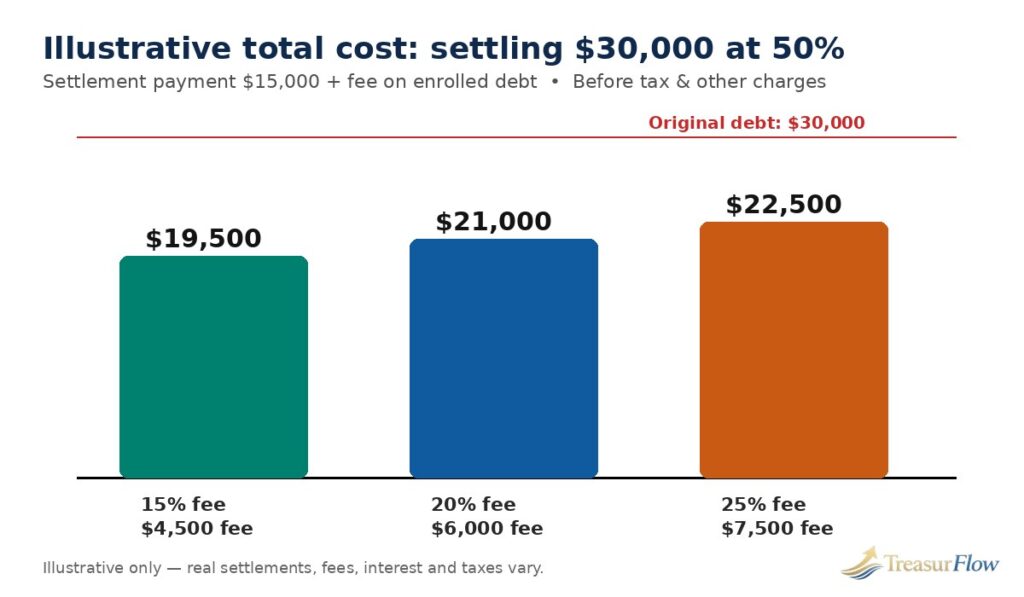
Settlement advertising loves a simple headline: settle $30,000 of debt for $15,000. The arithmetic below, computed for this guide and labelled illustrative, shows what that headline omits. It is not a prediction for any reader — real settlements vary by creditor, balance, delinquency, and state, and many enrolled debts never settle at all.
Illustrative example — $30,000 of enrolled unsecured debt, settled at 50%:
- Amount paid to creditors: $15,000
- Forgiven amount: $15,000
- Settlement fee at 15% of enrolled debt: $4,500 — total cost $19,500
- Settlement fee at 20% of enrolled debt: $6,000 — total cost $21,000
- Settlement fee at 25% of enrolled debt: $7,500 — total cost $22,500
So the “half your debt gone” outcome actually costs between $19,500 and $22,500 before tax, late fees, interest accrued while you were not paying, and any dedicated-account fees. Your saving against the original $30,000 balance is $7,500 to $10,500 before those extra costs — meaningful if the alternative was not repaying at all, and much less dramatic than the advertisement suggests.
Then add tax. If the full $15,000 forgiven in this example were taxed at an illustrative 22% federal rate and no exclusion applied, that would be a further $3,300, bringing the 20%-fee scenario to $24,300 in total. That tax figure is purely illustrative — your rate, your state, and any exclusion will change it — but the direction is not optional to consider. Budget for the tax question before you settle, not when a form arrives the following January. A budgeting reset helps here too: our best budgeting apps 2026 guide and our walkthrough on how to use ChatGPT to make a budget can help you build the monthly surplus any of these plans depends on.
Taxes on Forgiven Debt: The 1099-C Surprise
The Internal Revenue Service (IRS) is clear on the general rule: if your debt is canceled, forgiven, or discharged for less than the amount owed, the canceled amount is generally taxable income, reportable in the year the cancellation occurred. Read the IRS guidance directly in Topic No. 431, Canceled Debt.
In practice, if a creditor cancels $600 or more of a debt, you should expect a Form 1099-C, Cancellation of Debt, showing the amount canceled; the creditor sends a copy to the IRS as well. Two points surprise people. First, the $600 figure is the creditor’s reporting threshold — your responsibility to report taxable canceled debt correctly does not depend on whether a form arrives in the mail. Second, there are important exceptions and exclusions, notably for debts discharged in bankruptcy and for insolvency — broadly, when your total debts exceed the fair market value of your total assets at the time of cancellation — which are generally claimed using Form 982. Insolvency helps many settlement clients, but it is a calculation with paperwork, not an automatic exemption. If you expect meaningful forgiven debt, price a conversation with a tax professional into the cost of settlement before you enroll.
Keeping an eye on the credit side matters just as much. Settlement notations and missed payments affect what lenders see for years, so it is worth understanding how credit scores are presented and checked before you accept a plan that trades short-term cash relief for long-term borrowing costs.
Who Settlement May Fit — and Who It Usually Harms
Debt settlement may be worth investigating if you are already seriously behind on unsecured debts, you cannot afford a DMP that repays your principal in full, you understand that your credit will likely get worse before it gets better, you can sustain monthly deposits for two to four years, and you have taken advice on the tax and lawsuit risks. Even then, negotiate directly with your creditors first if you can — creditors sometimes offer hardship programs or lump-sum settlements without a 15% to 25% intermediary fee.
Settlement is usually the wrong tool if you are current on your payments and could stay current under a DMP or a genuinely cheaper consolidation loan, if most of your problem debt is secured or is federal student loan debt, if you cannot sustain the monthly deposit, if you need your credit intact soon for housing or employment, or if a single creditor is likely to sue quickly. It is also the wrong tool if the only reason you are choosing it is that a salesperson told you bankruptcy is always worse. That comparison deserves an attorney’s analysis of your debts, assets, income, and state exemptions — not a sales script.
Five Steps to Take Before You Enroll Anywhere
- Get the free benchmark first. Book a session with a nonprofit NFCC-member counselor and ask whether a DMP works on your actual income. This is your control price for every other offer.
- Call your creditors yourself. Ask about hardship programs, temporary rate reductions, and lump-sum settlement offers. Keep notes of names, dates, and terms.
- Run the full-cost math. For any settlement quote, add the fee at the stated percentage of enrolled debt, account fees, accrued interest and late fees, and a provision for tax on forgiven amounts. Compare that total — not the headline settlement percentage — with the DMP and consolidation totals.
- Vet the company like a regulator. Check the CFPB complaint database, your state attorney general and licensing records, and the company’s BBB profile. Confirm no upfront fee, get the fee and timeline in writing, and confirm who holds your dedicated account.
- Take the attorney question seriously. If your debts are large, you face lawsuits, or you own assets you need to protect, get a bankruptcy consultation before enrolling. Many bankruptcy attorneys offer an initial consultation at low or no cost, and knowing that option clearly makes you a better negotiator in every other conversation.
Debt Relief Questions People Ask Before They Sign Anything
Is it legal for a debt relief company to charge me upfront?
No, not for telemarketed debt relief covered by the FTC’s Telemarketing Sales Rule. A covered company cannot collect a fee until it has settled or otherwise resolved at least one of your debts, you have agreed to a written settlement or plan with the creditor, and you have made at least one payment under that agreement. If a company asks for an enrollment, setup, or retainer fee before that point, walk away.
How much do the best debt relief companies charge in 2026?
As of October 2026, reputable reviewers and regulators commonly report debt settlement fees of 15% to 25% of the debt you enroll, charged only after a debt is settled. Some companies and reviews report narrower or slightly different ranges, and third-party dedicated-account fees may apply on top, so always require a complete, itemized fee schedule in writing before you enroll.
Will debt settlement hurt my credit score?
Yes, debt settlement will usually hurt your credit score. Programs typically involve not paying enrolled creditors while you save toward settlements, so late payments, charge-offs, and settled-for-less-than-the-full-balance notations can appear on your reports and damage your scores. A nonprofit debt management plan generally has a milder credit impact if you keep up its payments, because you repay your principal in full.
Is forgiven debt taxable?
Generally, yes. The IRS treats canceled or forgiven debt as taxable income, and if a creditor cancels $600 or more, you should expect a Form 1099-C, Cancellation of Debt. Exceptions and exclusions exist, including for debts discharged in bankruptcy and to the extent you were insolvent when the debt was canceled, generally claimed on Form 982, so check your own position with a tax professional.
What is the difference between debt settlement and a debt management plan?
Debt settlement tries to reduce the principal you owe by negotiating lump-sum payoffs for less than the full balance, usually charges 15% to 25% of enrolled debt, and usually damages your credit. A debt management plan, usually run by a nonprofit credit counseling agency, repays your principal in full over 36 to 60 months at interest rates the agency negotiates down, which generally costs less and is gentler on your credit.
How long does a debt settlement program usually take?
Reviewers commonly describe debt settlement programs as taking 24 to 48 months as of October 2026, but no company can guarantee your timeline. How long yours takes depends on how much you can deposit each month, how many debts you enroll, and whether and when each creditor agrees to settle, and some enrolled debts may never settle at all.
Conclusion: The Best Company Is the One That Survives Your Checklist
The best debt relief companies 2026 offers are not the ones with the boldest promises. They are the ones that charge nothing upfront, put a 15% to 25% fee and a realistic timeline in writing, explain the credit, lawsuit, and tax costs without flinching, and still make sense after you have compared them with a nonprofit debt management plan, a consolidation loan you actually qualify for, and a bankruptcy attorney’s view of your situation.
Start with the free and low-cost benchmarks, run the full-cost math on your own balances, and treat every guarantee as a disqualifier. If settlement is genuinely your best remaining route, choose between established providers such as National Debt Relief, Freedom Debt Relief, Accredited Debt Relief, and Pacific Debt Relief using the vetting checklist in this guide — and verify their current minimums, fees, account charges, and state availability yourself, in writing, as of the day you enroll. No outcome in debt relief is guaranteed, and any company worth your money will be the first to tell you so.
This article is educational information only, as of October 2026, and is not financial, legal, or tax advice. Consult a nonprofit credit counselor, a licensed attorney, or a tax professional about your specific situation.

Muhammad Zakir is the founder of Treasurflow and the author of its personal finance guides. He researches consumer banking, credit, and personal loans, and every guide cites primary sources such as the CFPB, FDIC, FTC, and IRS. His content is educational and is not personalized financial advice.