
A store credit card is not a general-purpose rewards card with a logo on it. It is a narrow tool built for one job: giving you a bigger return at one retailer than a regular cash-back card would, in exchange for limits on where you can use it, where you can redeem what you earn, and — in most cases — a much higher interest rate if you ever carry a balance.
That trade can be worth it. It can also be a quiet way to pay more for the same shopping basket. The difference is rarely the headline percentage on the checkout sign. The difference is how you pay.
This guide to the best store credit cards 2026 is organized differently from most roundups, and deliberately so. Instead of ranking every retail card against every other retail card, we organize the picks by store. That is how these cards actually work in a wallet. An Amazon card does not compete with a Target card for most households. It competes with the general-purpose card you would otherwise tap at Amazon. A Lowe’s card does not compete with a Kohl’s card. It competes with paying for a water heater some other way.
So start with a simple question before you read any pick below: where do you already spend, month after month, without trying to spend more? If a store is not already on that list, its card does not belong on yours — no matter how large the first-purchase discount looks at the register.
A second warning belongs up front, because it shapes every recommendation in this article. Store cards are a niche tool, not a core wallet strategy. As of October 2026, the average store credit card APR reported in WalletHub’s Credit Card Landscape Report was 33.14%, compared with 22.25% for credit card offers overall in the same report. The Federal Reserve’s G.19 consumer credit data put the average APR on interest-bearing credit card accounts at 22.15% in the second quarter of 2026. In other words, the typical store card charges roughly half again as much interest as the typical card that is already sitting in most wallets. Every pick below only makes sense on one condition, stated plainly and repeated throughout this guide: you pay the statement balance in full, every month. If you know you will carry a balance, skip to the section on who should skip store cards entirely. That section is not filler. For many shoppers, it is the most valuable part of this article.
All rates, rewards, and fees in this article are stated as of October 2026 and were checked against issuer pages and major roundup sources available at that time. Card terms change, sometimes without much notice, and your own APR, credit limit, and eligibility will depend on your credit profile. Always read the issuer’s current rates-and-fees table before you apply. Where sources disagreed about a figure — and that happened more than once while researching this guide — we say so in the text instead of printing a single guessed number.
Related Guides
- Best Cash Back Credit Cards 2026 — the general-purpose alternatives a store card has to beat at its own store.
- Best Secured Credit Cards 2026 — a safer starting point if you are building or rebuilding credit.
- Best Balance Transfer Credit Cards 2026 — what to look at instead if you already carry a balance.
- No Credit Check Credit Cards 2026 — options and trade-offs when a standard application is not realistic.
Helpful Official Resources
- Consumer Financial Protection Bureau — What is a grace period for a credit card? — how paying in full protects you from interest, and how losing the grace period works.
- Consumer Financial Protection Bureau — CFPB Warns Credit Card Companies Against Deceptively Marketing Promotional Offers — the regulator’s warning on promotional and deferred-interest offers, with consumer tips.
- Federal Trade Commission — Using Credit Cards and Disputing Charges — your rights on billing errors, dispute deadlines, and what an issuer must do.
- Federal Reserve — Consumer Credit, G.19 — the official source for average credit card APRs and consumer credit balances used in this article.
Closed-Loop vs. Open-Loop: The Distinction Most Roundups Skip
Before any store-by-store pick makes sense, you need one piece of vocabulary that checkout offers almost never explain: closed-loop versus open-loop.
A closed-loop card works only at one retailer, or at one retailer’s family of brands. The classic Amazon Store Card, the standard Target Circle Card credit version, the Kohl’s Card, and the MyLowe’s Rewards Credit Card are examples. You cannot tap a closed-loop card at a gas station, a grocery store across town, or an airline website. It has no Visa, Mastercard, or American Express network logo that makes it usable everywhere, because it is not meant to be used everywhere. Its whole value is concentrated in one place.
An open-loop co-branded card carries a network logo — Visa, Mastercard, or American Express — and can be used anywhere that network is accepted. The Prime Visa, the Costco Anywhere Visa Card by Citi, and the My Best Buy Visa are examples. These cards usually pay their highest rewards rate at the partner store and much lower rates everywhere else. They are real general-use cards, but their rewards design still tries to pull your spending back to one retailer.
Why does this matter so much? Four practical reasons.
First, usefulness. A closed-loop card that you forget at home, or that does not work where an unexpected expense happens, earns nothing on that expense. An open-loop card at least earns its base rate.
Second, redemption lock-in. Closed-loop rewards are often paid in the store’s own currency: store rewards, store cash, or certificates that expire and can only be spent with that retailer. That is not cash back, even when an advertisement uses similar language. If the retailer raises prices, changes its rewards program, or you simply stop shopping there, the value you thought you earned can shrink or vanish.
Third, credit limits and utilization. Store cards are widely reported to come with lower starting credit limits than many general-purpose cards. A low limit is not a problem if you charge a small amount and pay it off. It becomes a problem when a single appliance or furniture purchase uses most of the limit, because the share of your available credit that you are using — your utilization — is a factor in credit scoring. A card that saves you 5% while pushing utilization high for several months can cost you in a less visible way.
Fourth, approval structure. With several retailers, you do not actually choose which version you get. You submit one application and the issuer decides whether you qualify for the open-loop network version, the closed-loop store-only version, or neither. Target and Best Buy both work this way in different forms, and Walmart’s current program does as well. Read each pick below with that in mind: the card in the advertisement may not be the card you are approved for.
There is also a fifth, quieter point. Easier approval is part of the store-card pitch, and Credit Karma’s retail card guide notes that some retail cards can be easier to qualify for than other kinds of credit cards. Easier approval is not the same as a good deal. A card approved quickly at a very high APR, with a low limit and deferred-interest promotions attached, can be more expensive over a year than a secured general-purpose card that required a deposit. Approval is the start of the cost calculation, not the end of it.
How We Judged These Cards
We used the same test for every store in this guide, and you can reuse it for any retailer we did not cover.
One: does the card beat a solid no-annual-fee general-purpose cash-back card at this specific store, after any required membership cost? If a store card pays 5% but requires a paid membership you would not otherwise keep, the membership is part of the card’s real price.
Two: how flexible is what you earn? Cash back you can take as a statement credit or deposit is worth more, dollar for dollar, than rewards locked into store currency with an expiry date.
Three: what happens if something goes wrong — if you pay late, need to finance a large purchase, or cannot clear a promotional balance in time? That is where APR and deferred-interest terms matter, and where store cards are weakest.
Four: is the value automatic, or does it depend on offers, coupons, and timing games? A simple 5% discount taken at the register is easier to value honestly than a stack of rotating coupons whose real-world redemption rate is much lower than their printed rate.
With that framework, here are the picks, store by store.
Amazon: Prime Visa, Amazon Store Card, and Amazon Secured Card
Amazon is the unusual case where one retailer offers three meaningfully different cards, for three different shoppers. Treating them as one “Amazon card” is the most common mistake in coverage of this category.
Prime Visa — the open-loop pick for committed Prime members
The Prime Visa, issued by Chase, is an open-loop Visa card with no annual fee for the card itself, as of October 2026. According to Chase’s card page, it earns unlimited 5% back at Amazon.com, Amazon Fresh, Whole Foods Market, and on Chase Travel purchases with an eligible Prime membership; unlimited 2% back at gas stations, restaurants, and on local transit and commuting, including rideshare; and unlimited 1% back on all other purchases. Chase also lists a $150 Amazon Gift Card loaded on approval for Prime members, and a Prime Card Bonus feature offering 10% back or more on a rotating selection of items and categories. The purchase APR listed by Chase was 18.74% to 27.49% variable, as of October 2026.
Notice two things about those numbers. First, the low end of that APR range is well below the store-card average — because this is not really a traditional closed-loop store card. It is a mainstream rewards Visa whose best category happens to be one retailer. Second, the 5% rate is conditional. It requires an eligible Prime membership, and Prime is not free. Reviewers covering this card in 2026 listed Prime at $139 per year, or $69 per year for the student version. If you already pay for Prime for shipping and video and would keep it without the card, treat the card as a genuine no-annual-fee 5% card at Amazon. If you would only join Prime to get the card, do the subtraction honestly: on $2,780 of Amazon spending a year, 5% is $139 — exactly the membership cost, before you count any other Prime benefit. Below that level of Amazon spending, a no-membership card paying a lower rate can leave you ahead.
Money’s retail card coverage named the Prime Visa its best retail card, on essentially this logic: 5% at Amazon and Whole Foods, plus usable rewards elsewhere, is hard to match for a household whose spending is already concentrated there. We agree, with the membership caveat above.
Amazon Store Card — the closed-loop version
The Amazon Store Card, issued by Synchrony Bank, is the closed-loop sibling. It can be used only at Amazon. Prime members earn 5% back on Amazon purchases, and the card also offers special financing and equal-monthly-payment options on qualifying orders instead of rewards on a given purchase — you choose one or the other, not both. There is no annual fee for the card itself, as of October 2026.
Reviewer data in 2026 reported the Store Card’s APR at 29.49% variable — materially higher than the Prime Visa’s range, and a clear illustration of the closed-loop trade: a similar headline rewards rate, a narrower card, and a harsher rate if you revolve a balance. Because Synchrony’s published terms can change and reviewer figures are a snapshot, confirm the current APR in the issuer’s terms before applying. The structural point does not depend on the exact decimal: this card is for people who pay in full and who either do not qualify for, or do not want, the Chase Visa.
Amazon Secured Card — the credit-building version
The Amazon Secured Card, also issued by Synchrony, is the entry point for shoppers building or rebuilding credit. It requires a security deposit — NerdWallet’s 2026 coverage reported a $100 minimum, with the deposit setting the credit limit — and Prime members earn 2% back on eligible Amazon purchases. Several sources reported a notably low 10% APR for this secured card, which is unusual in this category; even so, treat that as a figure to verify in current issuer terms, not a reason to carry a balance on purpose.
Used responsibly for about a year — on-time payments, low utilization — the Secured Card may offer a path to upgrade to the unsecured Amazon Store Card and get the deposit back, according to NerdWallet’s coverage. That upgrade path is the real product here. The 2% rewards are a modest bonus on top of credit building, not a reason on their own to choose a secured card over other secured options. Compare it against the secured cards in our related guide above before deciding, especially on deposit minimums, reporting, and upgrade terms.
Amazon verdict: Prime members with good credit who already spend heavily at Amazon and Whole Foods: the Prime Visa is the strongest all-around store-linked card in this guide. Prime members with fair credit who pay in full: the Store Card can deliver the same 5% at Amazon, at a higher APR risk. Builders and rebuilders: the Secured Card is a reasonable Amazon-specific path, but only if Amazon is genuinely where your spending already happens.
Target: Target Circle Card
Target’s card — long known as the RedCard and now sold as the Target Circle Card — has one of the simplest value propositions in this entire category: a 5% discount on eligible Target purchases, taken at checkout, in store and online, with no annual fee, as of October 2026. Credit Karma’s retail guide highlights the same headline: 5% off at Target and Target.com, plus free shipping on certain online orders. WalletHub’s October 2026 review listed a $50 initial bonus in Target Circle Rewards when you spend $50 or more on qualifying purchases within the first 60 days of approval, a regular APR of 28.2% variable, and no membership fee.
A discount at the register is worth more than the same percentage paid later in rewards points, for two reasons. You cannot forget to redeem it, and it cannot expire unused in an account you stop checking. Target also advertises extended returns for cardholders — WalletHub noted 30 extra days on top of the standard return window — which is a genuinely practical benefit for a store where households buy everything from groceries to electronics.
The structure to understand is that Target offers credit, debit, Mastercard, and reloadable versions built around the same 5% idea, and they are not interchangeable. The store credit version is closed-loop: Target only. The Target Mastercard version is open-loop and can be used elsewhere, with lower rewards outside Target. The debit version links to an existing checking account and delivers the discount without opening a new credit line. You do not always get to pick the credit version you receive; the issuer, TD Bank, decides based on your application.
That debit option deserves special emphasis, because it changes the risk calculation completely. If what you want is simply 5% off at Target and you are not trying to build credit with this account, a debit version that pulls from money you already have gives you the discount without a 28.2% APR attached to it. Many shoppers apply for the credit version by default without ever considering that alternative.
Exclusions matter, too. The 5% discount does not apply to every item in the store — Credit Karma and other reviewers note excluded categories, and pharmacy, gift cards, and certain other purchases are commonly among them. Read the current exclusion list before you estimate your savings on a specific basket, especially a pharmacy-heavy one.
Target verdict: One of the cleanest store-card offers available, if Target is a primary grocery and household store for you and you pay in full — or if you take the debit route and remove the interest risk entirely. A poor choice for anyone who would revolve a balance at a rate WalletHub listed at 28.2% variable as of October 2026.
Costco: Costco Anywhere Visa Card by Citi
The Costco Anywhere Visa Card by Citi breaks the usual store-card pattern in an important way: its best rewards are not actually on Costco warehouse purchases.
As of October 2026, Citi and reviewer coverage listed the card’s rewards as 5% cash back on gas at Costco, 4% cash back on other eligible gas and EV charging purchases — with the 5% and 4% gas categories sharing a combined cap of the first $7,000 per year, then 1% — 3% cash back on restaurants and eligible travel, including Costco Travel, 2% cash back on all other purchases from Costco and Costco.com, and 1% cash back on all other purchases. The Points Guy listed an ongoing purchase APR range of 18.99% to 26.99% variable and no annual fee for the card. There is no annual fee for the card, but you must maintain a paid Costco membership to apply and keep it. A 2026 review listed membership at $65 per year for Gold Star and $130 per year for Executive, as of October 2026 — verify current membership pricing with Costco, because it is the card’s effective annual cost if you would not otherwise be a member.
That structure leads to a counterintuitive conclusion many shoppers miss. At the warehouse itself, this card pays 2%. A household that joins Costco mainly for groceries and household bulk buys, and fills up elsewhere, may earn less with this card than the advertising suggests. The card shines for a different household: one that buys Costco gas, eats out, and travels, and treats the warehouse 2% as a baseline rather than the headline.
Two more frictions are specific to this card. First, rewards are not paid monthly. They arrive as an annual rewards certificate after the February billing cycle, redeemable at U.S. Costco warehouses for merchandise or cash. That is a long wait, and it means a year of rewards is tied up until the certificate arrives. Second, Costco warehouses in the U.S. accept Visa cards, which is why this card is a Visa — a detail that matters if your other cards are Mastercard and you assumed any card would work at the register.
Executive members should also keep the two separate 2% programs straight. The Executive membership’s own 2% annual reward on qualifying Costco purchases is a membership benefit, separate from the credit card’s 2% cash back. They can stack on the same purchase, which is where the often-quoted combined figure comes from — but they have different caps, different terms, and different payout mechanics. Do not budget for a combined rate until you have read both sets of terms.
Costco verdict: A strong open-loop card for existing Costco members who spend meaningfully on gas, dining, and travel, and who are patient about annual redemption. A weak reason, by itself, to become a Costco member — the 2% warehouse rate alone rarely justifies a membership you would not otherwise use.
Walmart: From Capital One to the OnePay CashRewards Card
Walmart is the section of this guide where older information will actively mislead you, so we will be direct about what changed.
The Capital One Walmart Rewards Mastercard is gone for new applicants. Walmart and Capital One ended their partnership, new applications stopped in 2024, and existing cardholders were transitioned to other Capital One products, according to NerdWallet and The Points Guy coverage of the change. If a website still recommends applying for the Capital One Walmart card, or quotes its old rewards — 5% back at Walmart.com and 2% back in Walmart stores — that page is out of date. Do not base a decision on it.
The current program is the OnePay CashRewards Card, issued by Synchrony Bank and running on the Mastercard network, which began rolling out in late 2025. NerdWallet’s August 2026 review listed its rewards as 5% cash back on purchases at Walmart and Walmart.com for Walmart+ members, 3% back at Walmart and Walmart.com for non-members, and 1.5% back on all other purchases. There is no annual fee for the card itself, as of October 2026. Walmart+ membership, which unlocks the 5% rate instead of 3%, was listed by NerdWallet at $98 per year, or $12.95 per month.
Do that membership math the same way as the Amazon calculation. The difference between the member and non-member Walmart rate is 2 percentage points. On $4,900 of Walmart spending a year, 2% is $98 — the full cost of a year of Walmart+. Below that spending level, the extra rewards alone do not pay for the membership, though Walmart+ includes other benefits, such as fuel discounts and delivery benefits, that may justify it on their own terms. Judge the membership as a membership first, and the extra 2% as a bonus, not the other way around.
The application structure also matters. Walmart’s current program considers applicants first for the general-use CashRewards Card and, if they do not qualify, may consider them for a Walmart-only spend card with a more limited feature set. As with Target and Best Buy, you are not guaranteed the version in the headline.
We are deliberately not printing a specific APR for the OnePay CashRewards Card in this guide. The sources we reviewed in October 2026 did not publish a consistent, issuer-confirmed APR figure for the new program that we could verify to the standard we use for the other cards here, and printing a plausible-looking number we could not confirm would be worse than printing none. Check the APR and full terms in the application disclosures before you apply — and given the store-card averages cited in this article, assume the rate will be high enough that carrying a balance is a bad plan until the issuer’s own table proves otherwise.
Walmart verdict: Potentially valuable for genuine Walmart loyalists, especially existing Walmart+ members whose grocery and household spending already runs through Walmart every week. The honest comparison for non-members is 3% at Walmart and 1.5% elsewhere against a flat-rate general-purpose card — a much closer contest than the 5% headline suggests.
Lowe’s: MyLowe’s Rewards Credit Card
The MyLowe’s Rewards Credit Card, issued by Synchrony Bank, is a closed-loop card for Lowe’s stores and Lowes.com. Its everyday offer is simple and, for a home-improvement retailer, genuinely useful: 5% off eligible Lowe’s purchases, with no annual fee, as of October 2026. Credit Karma’s retail guide lists the same headline, and Lowe’s and Synchrony materials describe the card as the automatic way to get that discount.
The important detail is that the 5% discount is a choice, not a stack. On a given purchase, cardholders generally choose between the 5% discount and a special financing offer. Reviewer coverage in 2026 described the structure as 5% off qualifying purchases, or six months of special financing on purchases of $299 or more, or longer fixed-payment financing at a reduced APR on larger eligible purchases. Synchrony pricing information in search results listed a regular APR of 26.99% for the Lowe’s card account — verify the current rate in your own offer terms, because Synchrony rates for this program have changed over time and your offer controls.
That choose-one structure is where Lowe’s shoppers most often misjudge value. On a $400 tool purchase, 5% off is $20, paid immediately and with certainty. Six months to pay the same $400, interest-free if you clear it in time, is worth much less than $20 to anyone who could have paid cash — and it carries a risk the discount never does, which the deferred-interest section below explains in full. Financing only beats the discount when the purchase is genuinely large, the cash genuinely is not available today, and you have a concrete, automated plan to clear the promotional balance before its deadline, with room to spare.
The card also interacts with the MyLowe’s Rewards loyalty program. Reviewer coverage noted that cardholders receive Silver-tier status in that program regardless of annual spend, with its own points earning on eligible purchases. Keep the two benefits separate in your head: the 5% is a card discount at the register; the loyalty points are a program currency with their own earning and redemption rules. Adding them together into a single invented percentage overstates the card.
A first-purchase offer has also been part of this card’s marketing. Upgraded Points’ 2026 review described 20% off a first purchase, up to $100 in value, with the everyday 5% applying instead if it would be worth more. Offers like this change frequently, so treat any specific first-purchase figure as a promotion to confirm at application, not a permanent feature of the card.
Lowe’s verdict: The clearest case in this guide for a project-based store card. If you are renovating, replacing appliances, or maintaining a property with regular Lowe’s spending, an automatic 5% off with no annual fee is real money — provided you take the discount on everyday purchases, reserve financing for large purchases you have a payoff plan for, and pay in full.
Kohl’s: Kohl’s Card
The Kohl’s Card, issued by Capital One, is a closed-loop card usable only at Kohl’s and Kohls.com, with no annual fee, as of October 2026. On paper, it has the highest ongoing rewards rate in this guide: 7.5% back in Kohl’s Rewards on every qualifying purchase when you are a Kohl’s Rewards member paying with the Kohl’s Card, compared with 5% in rewards for members paying another way. Kohl’s announced that 7.5% structure in its own program materials, and WalletHub’s 2026 coverage lists the same 7.5% rewards rate.
Now the two honesty notes this pick requires, because Kohl’s is where source-checking mattered most in researching this article.
First, the first-purchase discount. Kohl’s own program announcement and several 2026 guides describe 35% off a first purchase. WalletHub’s updated 2026 card pages, however, list a 40% discount on a first purchase made within 30 days of approval. Those figures conflict, and both come from sources a shopper would reasonably trust. The likely explanation is a promotional change over time, but we cannot confirm from the sources reviewed which figure would apply to a new applicant today. So do not plan a large first purchase around either number. Confirm the exact discount in the offer you are actually presented before you apply, and treat anything above the ongoing rewards as a bonus.
Second, the APR. WalletHub’s 2026 Kohl’s Card pages listed a regular APR of 29.49% variable. Another 2026 source calculated the card’s variable APR at 30.24%, based on Capital One’s stated margin over the prime rate. Again, the sources do not agree to the decimal, and variable rates move with the prime rate. What does not change across any source is the category: this is a card priced around 30%, and carrying a balance on it is expensive by any version of the number.
The rewards themselves also need translation. Kohl’s Rewards balances are converted into Kohl’s Cash coupons in $5 increments, issued after the earning period, and WalletHub noted those rewards expire 30 days from issuance. Kohl’s Cash is not cash. It is a timed coupon that requires another Kohl’s trip, within a short window, to have any value at all. A household that shops at Kohl’s constantly will use nearly all of it. A household that shops there twice a year will watch a meaningful share expire — which means its effective rewards rate is not 7.5%. It is 7.5% multiplied by the share of coupons it actually redeems in time.
Kohl’s pricing culture is the final context. This is a retailer built on layered sales, coupons, and Kohl’s Cash earn events. A percentage earned inside a system designed around frequent promotional pricing is not directly comparable to the same percentage off a low everyday price somewhere else. That does not make the card bad. It makes honest comparison harder, and it means the card rewards shoppers who already understand and enjoy that system far more than shoppers who do not.
Kohl’s verdict: The highest headline rate in this guide, and one of the most conditional. Worth it for frequent Kohl’s shoppers who reliably redeem Kohl’s Cash before it expires and pay in full. Easy to overvalue for everyone else.
Best Buy: My Best Buy Credit Card and My Best Buy Visa
Best Buy offers two related cards issued by Citi: a closed-loop My Best Buy Credit Card usable only at Best Buy, and an open-loop My Best Buy Visa usable anywhere Visa is accepted. As with several other retailers here, applicants are considered through one process and the version you receive depends on your credit profile.
The core offer, as listed on Citi’s Best Buy card pages as of October 2026, is a choice on Best Buy purchases: 5% back in rewards, or flexible financing. You do not get both on the same purchase. Rewards are paid in My Best Buy points and redeemed as reward certificates toward Best Buy purchases — another store-currency system, not cash back — with Citi and WalletHub describing a $5 reward certificate for every 250 points. WalletHub’s 2026 coverage also listed 10% back in rewards as an initial offer on first-day purchases made shortly after account opening, plus, for the Visa version, 3% back in rewards on gas purchases, 2% back on grocery, dining, and takeout purchases, and 1% back on other purchases. The standard store card carries no annual fee; be aware that some Visa variants in this program have historically carried different fee structures, so confirm the fee for the specific version you are offered before accepting it.
Best Buy is the clearest place in this guide to see why the rewards-versus-financing choice matters. Electronics and appliances are exactly the kind of large, infrequent purchases where financing gets offered at the register, and exactly where a wrong choice is most expensive. On a $1,000 television, 5% back in rewards is $50 in certificates toward a future Best Buy purchase. Financing that same television over a promotional period is worth something only if you needed the time to pay — and, as the next sections explain, Best Buy’s promotional financing has historically been structured as deferred interest, not as a true 0% APR.
WalletHub’s Best Buy card listings spelled that structure out in unusual detail in 2026: no interest if paid in full within 18 months on appliance purchases of at least $599, and within 24 months on certain higher-priced categories such as home theater purchases above stated thresholds. Read that sentence the way the CFPB teaches consumers to read it. “No interest if paid in full” is the signature wording of deferred interest. It does not mean no interest is building. It means interest is building from the purchase date and is waived only if every dollar is cleared before the deadline.
Best Buy verdict: Reasonable for committed Best Buy shoppers making planned electronics purchases who will take the 5% in rewards and pay in full. The financing path demands a separate, careful decision — read the next two sections before choosing it on any purchase you cannot clear early.
The APR Reality: What Carrying a Store-Card Balance Actually Costs
Everything above assumes you pay in full. This section is about what happens when that assumption fails, because for a large share of cardholders, at some point, it does.
Start with the benchmarks, all as of October 2026 unless a different date is stated. The Federal Reserve’s G.19 data put the average APR on credit card accounts assessed interest at 22.15% in the second quarter of 2026. WalletHub’s Credit Card Landscape Report put the average APR among credit card offers overall at 22.25%, and the average store credit card APR at 33.14%. Money and other roundups reported individual store-card APRs clustering in the high twenties, and the specific cards in this guide fit that picture: WalletHub listed Target at 28.2% variable, reviewer data reported the Amazon Store Card at 29.49% variable, and Synchrony pricing information listed Lowe’s at 26.99%. Even the more mainstream open-loop cards here — the Prime Visa at 18.74% to 27.49% variable from Chase, and the Costco Anywhere Visa at 18.99% to 26.99% variable as listed by The Points Guy — reach well above the national average at the top of their ranges.
Translate that into dollars, because percentages hide the damage. These are simple illustrative calculations, using an average balance held for a full year and ignoring compounding and payments, so treat them as a floor for understanding rather than a statement prediction. A $1,000 average balance held for a year at the 33.14% average store-card APR generates about $331 in interest. The same $1,000 at the Federal Reserve’s 22.15% average generates about $222. The store card costs roughly $110 more per $1,000 carried, per year — for the privilege of rewards that, at a 5% rate, required $2,200 of spending to earn $110 in the first place.
Now scale it to a realistic store-card scenario. Suppose you earn a genuine $180 in a year from a 5% card, using the rewards math in the next section, and then carry an average balance of just $600 for that same year at 33.14%. The interest is about $199. You are now behind. You did everything the advertisements asked — you concentrated your spending, you earned the top rate — and you still lost money, because the interest side of this product is priced so much more aggressively than the rewards side.
This asymmetry is not an accident, and it is not unique to one retailer. It is the business model of the category. Rewards of 5% are funded in part by cardholders who revolve balances at rates near or above 30%. When you pay in full, you are on the winning side of that transfer. When you do not, you fund it.
Two practical rules follow. First, a store card should never be your emergency card. If a card is the one you would reach for in a month when money is short, it should be the lowest-APR general-purpose card you can qualify for, not a store card. Second, a first-purchase discount is never a reason to buy something you cannot pay off this month. A 35% or 40% discount on a purchase that then revolves at around 30% for a year is not a saving. It is a loan with a coupon attached.
If you are already carrying a store-card balance, the most useful next step is usually not a new store card at all. It is a payoff plan, and possibly a balance transfer to a lower-rate card if you qualify and can clear the transferred balance inside its promotional window. Our related guide to balance transfer cards covers that comparison in detail.
Deferred Interest: The Warning Section This Category Requires
Deferred interest is the single most misunderstood feature in retail credit, and it appears throughout this category — in home improvement, electronics, furniture, and appliance financing especially. The Consumer Financial Protection Bureau has warned about these promotions for years, cautioning that consumers may be surprised by high, retroactive interest charges after a promotional period ends, and encouraging issuers to consider more straightforward promotions that are less risky for consumers.
Here is the mechanic, in plain language. When a promotion says “no interest if paid in full within 12 months,” interest is not paused. It is calculated from the purchase date, at the card’s regular APR, the entire time — it is simply not charged to you if, and only if, you pay the entire promotional balance to zero before the deadline. Leave any balance at all when the period ends, even a small one, and the issuer charges you all of the interest that built up from the original purchase date, based on the balances you carried each month along the way.
The CFPB’s own consumer example shows how unintuitive this is. In the Bureau’s illustration, summarized in consumer guidance, a $400 purchase at a 25% interest rate on a 12-month promotion, paid down to a remaining $100, leaves the shopper owing $165 under a deferred-interest promotion — the $100 balance plus $65 in interest that had been accruing all year. Under a true 0% APR promotion with the same numbers, the shopper would owe only the remaining $100, because no interest was being calculated during the promotion at all. Same purchase, same payments, same remaining balance. A $65 difference created entirely by one word: “if.”
Other analyses of CFPB work on this product have modeled the larger version of the same trap, in which a big-ticket furniture purchase left with a small unpaid remainder at the deadline triggered retroactive interest many times larger than the amount still owed. The exact figure depends on the purchase size, the APR, and the payment path, so we are not printing a single modeled total here as if it were your outcome. The direction, however, is consistent across every source we reviewed: the larger and longer the promotion, the larger the retroactive charge when the deadline is missed by any amount.
Deferred interest is not a true 0% APR offer, and the wording is how you tell them apart. A true 0% introductory APR offer says so directly, and interest begins only on whatever balance remains after the promotion ends, from that point forward. A deferred-interest offer is conditional, and its signature phrases are “no interest if paid in full,” “special financing,” and “deferred interest” itself in the terms. Best Buy’s published financing descriptions and Lowe’s special financing offers, covered above, use this family of language. That does not make those offers scams — a disciplined buyer who clears the balance early genuinely pays no interest. It makes them unforgiving.
If you take a deferred-interest promotion anyway, the CFPB’s consumer guidance points to a workable discipline. Do not rely on the minimum payment, which is generally not set to clear a promotional balance by its deadline. Instead, divide the purchase amount by the number of months in the promotion, subtract a month of safety margin, and automate that payment from the first month. Check every statement for the promotional balance and its expiration date, which issuers are required to show. And do not add new purchases to the same card casually during the promotion, because payment allocation between promotional and non-promotional balances follows the issuer’s terms and can leave a promotional balance lingering past its deadline.
If you are not confident you can run that system without a miss, the safer choice is to take the everyday discount instead of financing where a retailer offers that choice, or to use a card with a true 0% introductory APR whose terms you have read. Boring is a feature here, not a failure.
The Rewards Math: What These Percentages Are Actually Worth
Percentages feel large at the register and small at the end of the year. So let us compute the annual value of the main offers in this guide on one consistent, clearly labeled assumption, so the cards can be compared honestly.
Illustrative assumption: you spend $300 per month at one store, charged to that store’s card — $3,600 per year — and you pay in full every month, so interest is $0. This is an illustration we computed for this article, not a promise, a survey result, or an issuer figure. Your spending will differ, and that is the point of showing the method rather than only the answer.
- At 5% — the Amazon Prime Visa and Amazon Store Card rate at Amazon with Prime, the Target Circle Card discount at Target, and the MyLowe’s Rewards Card discount at Lowe’s: $3,600 × 5% = $180 per year.
- At 7.5% in Kohl’s Rewards — the Kohl’s Card rate on qualifying purchases: $3,600 × 7.5% = $270 per year, in Kohl’s Rewards converted to Kohl’s Cash, subject to the redemption and expiry limits described above. This is the largest number in the list and the least cash-like.
- At 5% for Walmart+ members on the OnePay CashRewards Card, versus 3% for non-members, on the same Walmart spending: $180 per year versus $108 per year. The $72 gap is what the 5% headline is worth over the non-member rate at this spending level — less than the $98 annual cost of Walmart+ listed in 2026 coverage.
- At 2% — the Costco Anywhere Visa rate on Costco warehouse purchases: $3,600 × 2% = $72 per year, paid as an annual certificate, not monthly.
- For comparison, at a flat 2% from a general-purpose cash-back card on that same $3,600, wherever you spent it: $72 per year, in flexible cash back, with no store restriction and no membership requirement.
- At 1.5% — the OnePay CashRewards Card’s rate on non-Walmart purchases: $3,600 × 1.5% = $54 per year.
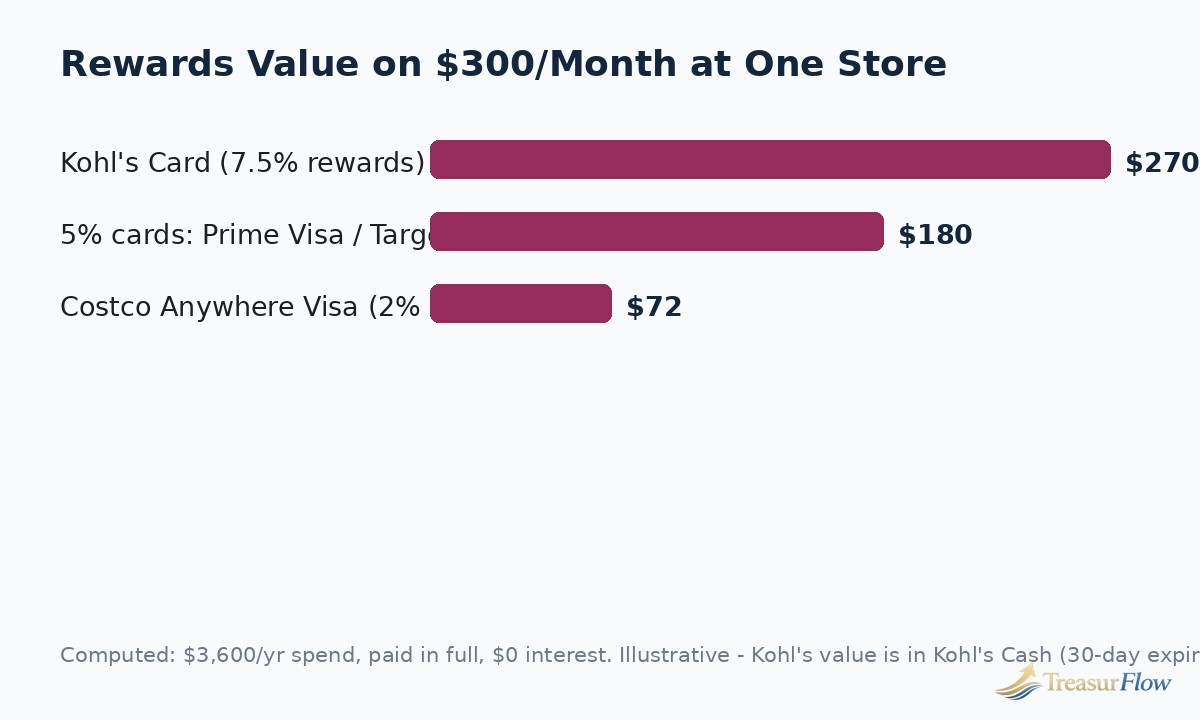
Three conclusions fall out of this simple table, and they matter more than any ranking.
First, the advantage of a top store card over a good flat-rate card, at moderate spending, is real but modest: about $108 a year in the 5% example above. That is worth having if it costs you nothing in interest, fees, or extra spending. It is not worth opening a card, taking a hard inquiry, and managing another due date for a store where the same math produces only a few dollars.
Second, spending level changes the answer more than the percentage does. At $100 a month at one store — $1,200 a year — a 5% card earns $60 and beats a 2% card by only $36 a year. At $800 a month, the same comparison is worth $288 a year. This is why our verdicts keep returning to the same question: not “which rate is highest?” but “how much do you already spend there?”
Third, membership-gated cards must clear a higher bar. If a membership costs $98 or $139 a year and you would not keep it for its own benefits, subtract that cost from the first column before comparing anything. Several popular “5% cards” become 2% or 3% cards in real household terms once that subtraction is done honestly, and some become net negatives at low spending levels.
One more piece of math, in the other direction. None of the figures above survives carrying a balance, as the APR section showed. A year’s worth of well-earned 5% rewards on $3,600 of spending is $180. A single month of interest on a $3,600 balance at 33.14% is roughly $99 on a simple monthly calculation. Two bad months can erase a good year. That is the whole economics of this category in one sentence.
Who Should Skip Store Cards Entirely
A fair guide to this category has to be willing to talk a large share of its readers out of the product. Store cards are the wrong tool in each of the following situations, and no first-purchase discount or rewards rate in this article changes that.
You carry a balance, or you honestly might. This is the most important item on the list. At an average store-card APR of 33.14% as reported by WalletHub as of October 2026, interest outruns rewards quickly and quietly. If your balances rise and fall with the month, put your spending on the lowest-rate general-purpose card you can get and work on the balance itself. A store card added to that picture makes the underlying problem more expensive.
You are opening the card for one purchase. A single large discount can be rational if the purchase was already planned, the discount is confirmed in writing in your offer, and you pay the balance in full on the first statement. It is not rational when the purchase itself only exists because a cashier offered 35% or 40% off it. Retailers offer first-purchase discounts at the register precisely because that is the moment when shoppers are least likely to do arithmetic.
You would need to join or keep a paid membership mainly for the card. As the rewards math above shows, a membership fee can consume the entire advantage of a higher rewards rate at ordinary spending levels. Buy memberships for shipping, fuel, delivery, or warehouse access if those benefits pay for themselves. Let card rewards be a secondary benefit.
Your credit limit and utilization cannot absorb the purchase. A low-limit store card used for a large appliance or furniture purchase can sit near its limit for months. Even with on-time payments, high utilization on an individual card is an unhelpful signal in credit scoring, and it leaves no room for a genuine emergency on that account. If a purchase would use most of a new card’s likely limit, that is a reason to finance it differently or delay it.
You do not want another account to manage. Every card in this guide adds a separate statement, due date, login, and issuer. Missing a payment on a $90 store-card balance triggers late fees and credit reporting just as surely as missing one on a large general-purpose account. Several small, forgettable accounts are a common way organized people end up with an uncharacteristic missed payment. If your system is already stretched, consolidating spending onto fewer cards is worth more than an extra percentage at one store.
You are chasing a deferred-interest promotion without a payoff system. If you cannot automate a payment large enough to clear the promotional balance at least a month early, you are not getting a free financing offer. You are accepting a retroactive interest charge whose size you will only learn after the deadline. Skip the promotion, take an everyday discount if one is offered instead, and keep the purchase simple.
You are in the middle of a major credit application. If you are preparing to apply for a mortgage or another significant loan in the near future, this is generally not the season to open retail accounts for modest savings. New inquiries, new accounts, and changed utilization can all complicate a profile at exactly the wrong moment. The $108 annual advantage in our worked example is not worth friction on a far larger transaction.
None of this makes store cards a bad product in themselves. It makes them a specialized one. The households that benefit from them tend to share a profile: high, stable spending at one retailer, no revolving balances, a membership they already value, and a payment system that runs on autopay without attention. If that description fits, the picks above can pay you a modest, real amount every year. If it does not fit yet, the most profitable move available is usually to fix the balance or the system first, and revisit store cards afterward.
How to Choose Your One Store Card
Most households that benefit from this category need exactly one store card, not four. A wallet full of single-store cards multiplies due dates and divides spending so thinly that no single card earns much. Use this sequence to pick the one that earns its place.
First, look at your last three months of actual spending, not your intentions. Identify the single retailer, outside of general groceries and gas, where your household spending is most concentrated and most stable. That retailer is your only serious candidate.
Second, run the rewards math from this article on your real monthly figure for that store, and compare it against what a flat-rate cash-back card you already have, or could easily get, would earn on the same spending. If the store card’s advantage is less than about $75 a year, the extra account is usually not worth managing.
Third, subtract any membership cost you would not otherwise pay, and translate any store-currency rewards into the share you will realistically redeem before they expire. Use the smaller, honest number.
Fourth, read the issuer’s current rates-and-fees table in full: regular APR, late fee, how the grace period works, whether financing offers are deferred interest, and whether the version you want is the version you can actually apply for. This step takes ten minutes and is worth more than any roundup, including this one.
Fifth, set up autopay for the full statement balance before the card arrives. That single action is what keeps a household on the winning side of the store-card model described in this article. If you are not willing to autopay in full, revisit the skip list above.
Finally, recheck the decision once a year. Retail card programs change issuers, as Walmart’s move from Capital One to OnePay showed. Rewards rates, membership requirements, and APRs all move. A card that was the best choice for your store in 2026 is a starting assumption for 2027, not a permanent answer.
Store Card Questions Shoppers Ask Before They Swipe
Are store credit cards worth it if I pay in full every month?
They can be, but only at a store where you already spend regularly. On $300 a month at one store, a 5% card returns $180 a year, compared with $72 from a flat 2% cash-back card. That $108 difference is worth having if there is no annual fee, no required membership you would not otherwise keep, and no interest. It is not a reason to spend more, or to open a card for a store you rarely visit.
What is the difference between a closed-loop and an open-loop store card?
A closed-loop card works only at one retailer or its family of brands, such as the Amazon Store Card or the Kohl’s Card. An open-loop co-branded card carries a Visa, Mastercard, or American Express logo and works anywhere that network is accepted, such as the Prime Visa or the Costco Anywhere Visa. Open-loop cards usually pay their highest rate at the partner store and lower rates everywhere else.
Why are store credit card APRs so much higher than regular credit card APRs?
As of October 2026, WalletHub reported an average store credit card APR of 33.14%, compared with 22.25% for credit card offers overall, and the Federal Reserve reported an average of 22.15% on interest-bearing card accounts in the second quarter of 2026. Retail cards are often approved for a wider range of credit profiles and are priced for higher risk and promotional costs. Whatever the reason, carrying a balance on them is expensive.
Is deferred interest the same as a 0% APR offer?
No. With a true 0% APR offer, no interest is calculated during the promotion, and interest starts only on any balance left after it ends. With deferred interest, interest builds from the purchase date at the regular APR and is waived only if you pay the full promotional balance before the deadline. Leave any balance, even a small one, and the issuer can charge all of the interest that built up from the purchase date.
Do I need a paid membership to get the best rate on Amazon, Costco, and Walmart cards?
In most cases, yes. The Prime Visa and Amazon Store Card pay 5% at Amazon only with an eligible Prime membership. The OnePay CashRewards Card pays 5% at Walmart for Walmart+ members and 3% for non-members. The Costco Anywhere Visa requires an active Costco membership, although its 5% rate applies to Costco gas, while warehouse purchases earn 2%. Always subtract a membership cost you would not otherwise pay from the rewards.
Will a store credit card help me build credit?
It can, because most major store cards report account activity to the credit bureaus, and paying on time and keeping your balance low relative to your limit can support a healthier credit profile. But store cards often start with low limits, so a single large purchase can use most of your available credit. If building credit is your main goal, compare a store card with a secured general-purpose card before applying.
Conclusion: A Store Card Should Earn Its Wallet Slot
The best store credit cards 2026 are not the ones with the largest percentages on the checkout sign. They are the ones attached to stores where your spending already lives, whose rewards you will actually redeem, and whose interest you will never pay.
By store, that usually means the Prime Visa for committed Prime members with heavy Amazon and Whole Foods spending; the Target Circle Card for Target households who value a simple 5% discount taken at the register, including its debit alternative; the Costco Anywhere Visa for existing members whose gas, dining, and travel spending makes its unusual rewards structure pay; the OnePay CashRewards Card for Walmart loyalists, judged honestly at its member and non-member rates; the MyLowe’s Rewards Card for project-driven Lowe’s shoppers who take the discount and pay in full; the Kohl’s Card for frequent Kohl’s shoppers who redeem Kohl’s Cash before it expires; and the Best Buy cards for planned electronics purchases where the rewards path, not deferred-interest financing, is the right choice.
Every one of those recommendations carries the same condition. Pay in full, on autopay, every month. Store cards transfer money from shoppers who revolve balances at rates around 30% to shoppers who do not. Deciding which side of that transfer you are on is worth more than any single pick in this guide — and if you are not sure, the safest answer is to skip the application, keep your spending on a simple cash-back card, and revisit the question when your answer is certain.
This article is educational information about credit card products, not individualized financial advice. Rates, rewards, bonuses, and fees are stated as of October 2026 from issuer and major roundup sources and can change; where sources conflicted, this article says so rather than presenting an unverified figure as fact. Confirm all terms with the issuer before applying.

Muhammad Zakir is the founder of Treasurflow and the author of its personal finance guides. He researches consumer banking, credit, and personal loans, and every guide cites primary sources such as the CFPB, FDIC, FTC, and IRS. His content is educational and is not personalized financial advice.