
Most bond guides start in the wrong place. They start with a yield — the biggest number on the page — and work backwards to a product you are supposed to buy. This guide does the opposite. It starts with the job you need done, because in 2026 the best bonds 2026 are not one single bond, fund, or ticker. They are different tools for different jobs: U.S. Treasuries when safety is the job, investment-grade corporate bonds when steady income is the job, municipal bonds when tax-free income is the job, and Series I savings bonds and Treasury Inflation-Protected Securities (TIPS) when keeping up with inflation is the job. Pick the job first, and the short list almost writes itself. Pick the yield first, and you can easily end up owning a risky product that happens to be labelled a bond.
That purpose-first approach also keeps you honest about what bonds can and cannot do. A bond is a loan. You lend money to a government, a city, or a company, and in return it promises to pay interest and return your principal on a set date. That promise is only as strong as the borrower behind it, which is why a U.S. Treasury bond and a high-yield corporate bond — both sold under the word “bond” — behave like completely different investments in a crisis. This guide, updated as of October 2026, walks through each job in turn, explains the total-bond funds most investors use as a simple core, shows you how to build a basic 1-to-5-year Treasury ladder step by step, works through the tax math that can completely change which bond pays you more after tax, and ends with the mistakes that turn supposedly safe money into risky money.
You do not need a finance degree, a large account, or a broker calling you with ideas to use any of this. You can buy Treasury bills, notes, bonds and TIPS directly from the U.S. Treasury through TreasuryDirect with a $100 minimum for marketable securities, buy a diversified bond fund for as little as the price of one share, or hold I bonds in $25 electronic increments. What you do need is a clear reason for owning bonds at all — a house deposit in three years, income in retirement, a calmer portfolio, or a store of value that inflation cannot quietly erode — and the discipline to match the bond to that reason and then leave it alone. Everything that follows is organized to help you do exactly that, in order, without chasing the highest headline yield.
Disclaimer: This article is for general educational and informational purposes only and is not personalized financial advice, and it is not tax, legal, or investment advice for your specific situation. It is not a recommendation to buy or sell any bond, fund, or security. Bond prices fall when interest rates rise, you can lose money in bond funds, and past performance does not guarantee future results. Yields, expense ratios, ratings and purchase limits cited here are as of October 2026 and can change; verify current figures in the fund prospectus or at TreasuryDirect before you buy, and consider speaking with a qualified financial or tax professional about your own circumstances.
Related Guides
Best Online Broker 2026
compare the platforms where you can buy bond funds and individual TreasuriesBest Robo Advisors 2026
if you want an app to build and rebalance a stock-and-bond portfolio for youBest Roth IRA Accounts 2026
a tax-advantaged account where many investors hold bond fundsHow to Build Wealth Slowly
the long-term habits that make any bond allocation actually work
Helpful Official Resources
TreasuryDirect
buy U.S. Treasury bills, notes, bonds and TIPS directly from the U.S. TreasuryTreasuryDirect — Series I Savings Bonds
official I bond rates, limits and redemption rulesInvestor.gov — Bonds
the SEC’s plain-English explainer on how bonds workFINRA — Bonds
investor guidance on bond risks, pricing and corporate and municipal bonds
Start With the Job, Not the Yield
Before you look at a single ticker, answer one question in plain words: what is this money for, and when will you need it? Your answer sorts almost every bond decision you will ever make. Money you need in one to five years for a house deposit, a car, tuition, or an emergency reserve has a safety job. It must be there, in full, on a date you can roughly name. Money that supplements a paycheck or a pension has an income job. It needs to pay reliably, month after month or quarter after quarter, without drama. Money sitting in a taxable brokerage account in a high tax bracket has a tax job as well as an income job, because what matters is not the interest printed on the statement but the interest you keep after tax. And money you are setting aside for a goal a decade away has an inflation job, because cash that earns nothing while prices rise is losing value in slow motion, even if the balance on the screen never goes down.
Bonds map neatly onto those four jobs, which is why this guide is organized as a ladder of purposes rather than a ranked list. For safety, you climb no higher than you need to: short-term Treasuries sit on the lowest, steadiest rung. For income, you step one rung out to high-quality corporate bonds and diversified total-bond funds, accepting modest credit risk in exchange for higher interest payments. For tax-free income, you step sideways into municipal bonds, where a lower stated yield can beat a higher taxable yield once tax is counted. For inflation protection, you use instruments built specifically for that job — I bonds, whose rate adjusts with inflation, and TIPS, whose principal adjusts with inflation — rather than hoping a conventional bond’s fixed payments will keep up.
Two terms will carry you through the whole guide. The first is duration, a measure of how much a bond or bond fund’s price moves when interest rates change. As a rough rule, a fund with a duration of six years will fall by about 6% if rates rise by one percentage point, and rise by about 6% if rates fall by one point. Duration is not a defect; it is the price of earning term interest, and short-term bonds with low duration are far steadier than long-term bonds with high duration. The second term is credit quality. Ratings agencies grade borrowers from AAA at the top down through investment grade (BBB and above) to high-yield or “junk” grades below that. Higher quality means a stronger promise and a lower yield. Lower quality means a thinner promise and a higher yield to compensate you for the extra chance the promise breaks. Every mistake in the final section of this guide is, at bottom, someone forgetting one of those two terms and reaching for yield anyway.
A final framing point before the picks themselves. Bonds are not a replacement for a savings account, and a bond fund is not insured the way a bank deposit is. A total-bond fund can and does have losing years, most painfully when interest rates rise quickly. What high-quality bonds offer is a different, usually calmer pattern of returns than stocks, contractual interest payments, and — for Treasuries held to maturity — a return of principal backed by the full faith and credit of the United States government. Hold them for the job they do, in the right account, for the right length of time, and they do that job well. Ask them to deliver stock-like returns without stock-like risk, and they will disappoint you every time.
Job 1: Safety First — Treasury Bills, Notes and Bonds
If safety is the job, U.S. Treasury securities are the benchmark everything else is measured against. When you buy a Treasury, you are lending directly to the United States government, and investors around the world treat that promise as the closest thing in finance to risk-free — not because the price never moves, but because the government’s ability to pay interest and repay principal in its own currency is not in practical doubt. That status is why Treasury yields are usually the lowest on offer for a given maturity. You are not being underpaid. You are paying, in forgone yield, for the strongest promise available, and for money with a deadline that trade is often exactly right.
Treasuries come in three main shapes, and the difference is simply time. Treasury bills (T-bills) mature in one year or less — common terms run from a few weeks to 52 weeks — and are sold at a discount to their face value rather than paying regular interest coupons; you earn the difference when the bill matures at full value. Treasury notes mature in two, three, five, seven, or ten years and pay interest every six months. Treasury bonds mature in 20 or 30 years and also pay interest every six months. Shorter maturities swing far less in price when rates move, which is why safety money belongs at the short end: a bill maturing in three months does not need to be sold at a fluctuating market price at all if you simply wait for it to mature.
There are three practical ways to own Treasuries, and each suits a different kind of saver. First, you can buy them directly at TreasuryDirect, the Treasury’s own website, which sells bills, notes, bonds and TIPS directly with a $100 minimum for marketable securities. You can buy at regularly scheduled auctions, set purchases in advance, and hold the securities in your TreasuryDirect account until maturity, which removes any worry about market prices in between. Second, you can buy them through a brokerage account, usually commission-free at major brokers, which makes them easier to hold alongside your funds and easier to sell before maturity if your plans change. Third — and simplest for most people — you can own them inside a diversified bond fund, including the total-bond funds covered below, or in a short-term Treasury fund if you want the safety job done with no maturity dates to manage at all.
Interest on Treasuries has one tax feature worth memorizing: it is subject to federal income tax but exempt from state and local income taxes. For a saver in a high-tax state holding cash-like reserves in a taxable account, that exemption can close much of the gap between a Treasury bill and a nominally higher-yielding alternative that is taxed at every level. It is the first of several places in this guide where the after-tax number, not the headline number, is the one that should drive your choice. The second practical feature is liquidity. Treasuries trade in one of the deepest markets in the world, so if you hold them at a broker and need to sell before maturity, you generally can, quickly and at a fair price — although the price you get will reflect current interest rates, which is why a note bought when rates were lower can sell for less than you paid if rates have since risen.
Who should make Treasuries the center of their bond holdings? Anyone funding a known expense in the next one to five years, anyone building an emergency reserve beyond what they keep in a bank account, retirees funding the next few years of spending so they never have to sell stocks in a downturn, and any investor who discovered in the last stock market fall that their real risk tolerance is lower than they thought. For all of them, the correct question is not “what is the highest yield I can get?” but “what is the shortest, simplest Treasury that matures when I need the money?” Answer that, buy it, and the safety job is done.
Job 2: Steady Income — Investment-Grade Corporate Bonds
If income is the job, investment-grade corporate bonds are the natural next step up the ladder. When you buy one, you are lending to a company — a large bank, a manufacturer, a utility, a technology firm — rather than to the government. Companies, even strong ones, are a weaker promise than the United States Treasury, so they must pay you more interest to borrow your money. That extra yield over a comparable Treasury is called the credit spread, and it is your compensation for accepting the possibility, however small for highly rated companies, that the borrower runs into trouble and pays late, restructures, or defaults.
The words “investment-grade” do a lot of work in that paragraph, and they should do a lot of work in your portfolio too. Investment-grade means the bond is rated BBB or higher by the major rating agencies — a judgment that the borrower has a solid capacity to pay. Below that line sit high-yield bonds, covered in the mistakes section, which pay much more precisely because the chance of non-payment is materially higher and because their prices tend to fall alongside stocks in a crisis, exactly when you wanted your bonds to be calm. Investment-grade corporates are not immune to price swings — their prices move with interest rates just as Treasuries do, and they dip when investors worry about the economy — but historically their role in a portfolio has been what most people want from bonds: regular income with materially smaller falls than the stock market.
Most individual investors should own corporate bonds through a fund rather than one by one, and the reason is diversification arithmetic. A single corporate bond is a single company’s promise; a corporate bond fund, or a total-bond fund that includes corporates alongside Treasuries and mortgage-backed securities, holds hundreds or thousands of those promises at once, so trouble at any one borrower barely registers. Buying individual corporates sensibly also requires larger sums to spread across issuers, attention to each bond’s maturity and call features — many corporate bonds can be repaid early by the issuer when rates fall, cutting off your higher interest — and pricing that is less transparent than stock pricing for small orders. A low-cost fund solves all three problems at once for a few hundredths of a percent a year, which is why the funds in the next-but-one section are the default income vehicle in this guide.
How much extra income are we actually talking about? It changes with markets, so treat any single figure as a snapshot, not a fixture. As of October 2026, a 2026 roundup cited the Vanguard Total Bond Market ETF (BND) — which blends Treasuries, investment-grade corporates, and government mortgage-backed securities — as yielding about 4.4% on a 30-day SEC yield basis. We quote that figure exactly as what it is: a roundup figure describing a recent distribution rate at a moment in time, not a promise, not a forecast, and not a guaranteed return. Yields move as rates move and as the fund’s holdings change, and the fund’s price moves in the opposite direction to rates, so your total return in any year will be the yield plus or minus that price change. The honest takeaway is the shape, not the decimal: a diversified investment-grade bond portfolio in 2026 pays meaningful income again — several percent a year rather than the near-zero of the ultra-low-rate era — without asking you to lend to fragile borrowers to get it.
If you do buy individual corporate bonds, hold yourself to three rules. Buy only issuers you would be comfortable lending to unsecured for the full term, because that is literally what you are doing. Ladder your maturities instead of concentrating everything in one year, so a portion of your money comes back regularly to reinvest or spend. And check whether the bond is callable before you buy, because a bond that can be called away just when its high coupon becomes most valuable is worth less to you than its yield suggests. Investors who find those rules a chore are not failing some test; they are simply describing why bond funds exist.
Job 3: Tax-Free Income — Municipal Bonds
Municipal bonds — “munis” — are loans to state and local governments and the agencies and authorities they sponsor: cities, counties, school districts, water systems, toll roads, airports, and hospitals. They exist to finance public projects, and they carry a feature no Treasury or corporate bond can match: for most investors, the interest is exempt from federal income tax, and if you buy bonds issued in your own state, it is often exempt from state and local tax as well. That exemption is the entire reason munis exist as a separate category in this guide. A muni almost always offers a lower stated yield than a comparable taxable bond. The question is never whether the muni’s yield is lower. It is whether it is lower by less than the tax you would have paid on the taxable bond — and for investors in higher brackets, it frequently is.
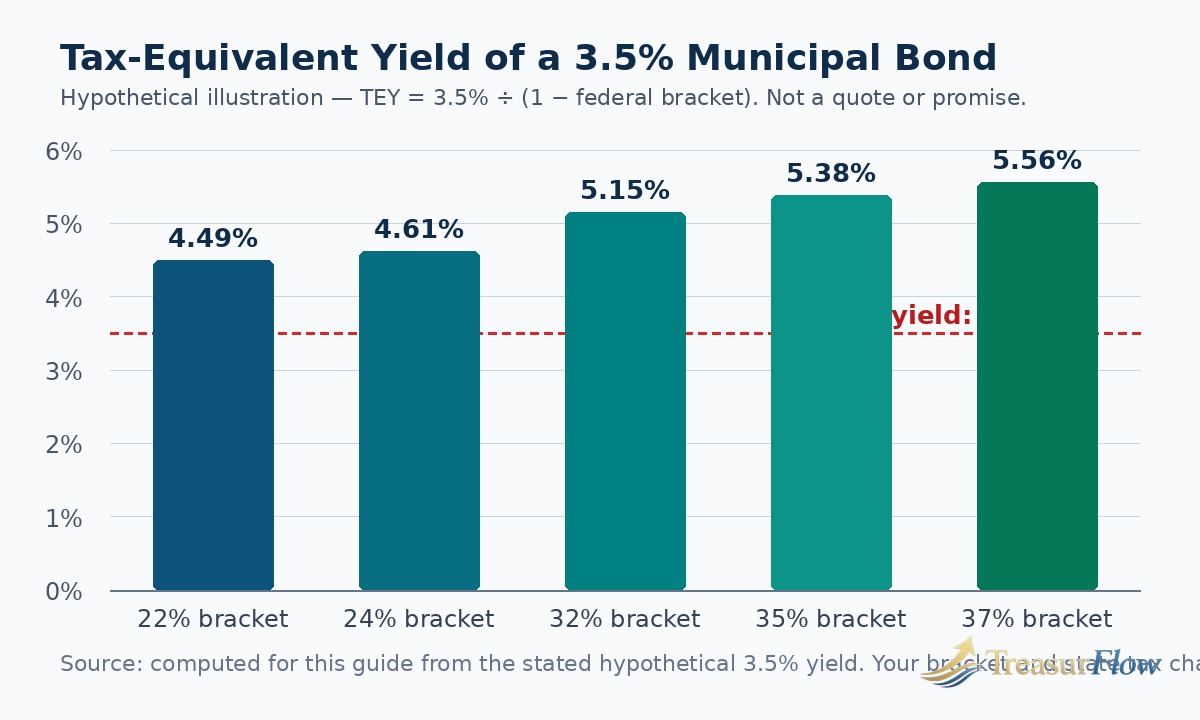
That comparison has a name, the tax-equivalent yield, and this guide works it in full in the taxes section below, with a chart. The short version is simple: you divide the muni’s yield by one minus your tax bracket to find the taxable yield you would need to match it after tax. A 3.5% muni is worth 4.49% taxable to someone in the 22% federal bracket, and 5.56% taxable to someone in the 37% bracket. Notice what that arithmetic implies. The same bond is a mediocre deal for a low-bracket saver and an excellent deal for a high-bracket saver, which is why blanket statements about munis being “good” or “bad” are meaningless without a bracket attached. It is also why munis belong, as a rule, in taxable accounts. Inside an IRA or 401(k), your interest is already sheltered from annual tax, so accepting a muni’s lower yield buys you an exemption you cannot use.
Investors have two routes into munis: individual bonds from their own state, or a diversified municipal bond fund. Individual state bonds maximize the tax exemption and let you control maturity precisely, but they require research into an issuer’s finances, larger purchase sizes to diversify, and dealer markups that can be significant on small trades. For most people, a well-run national muni fund — or a state-specific fund where one exists for their state — is the more practical choice, trading a small amount of state-tax advantage for diversification across hundreds of issuers and professional credit research. As an example of what to look for in this category, the Fidelity Intermediate Municipal Income Fund (FLTMX) carried a Morningstar Medalist Gold rating in fund data cited in a September 2026 roundup, with a 0.37% expense ratio and a 3.4% SEC yield per that Morningstar data. Read those three numbers the way this guide reads every number: the rating is one research firm’s assessment, not a guarantee; the 0.37% fee is notably higher than the 0.03% charged by the big total-bond index funds, which is common in actively managed muni funds and must be justified by the manager’s credit work; and the yield is a dated snapshot as of that roundup, not a promised payment.
Credit quality matters in munis just as it does in corporates. Most munis are backed either by a government’s taxing power (general obligation bonds) or by the revenue of a specific project (revenue bonds). Both have historically defaulted far less often than corporate bonds of similar ratings, but “far less often” is not “never” — fiscally stressed cities and single-project revenue bonds have defaulted in the past, which is another argument for the diversification of a fund unless you have the time and stake to research individual issuers properly. Keep your muni holdings investment-grade for any money whose job is income you depend on, match the fund’s duration roughly to when you will spend the money, and let the tax math — not habit, and not a sales pitch — decide how much of your bond allocation belongs here.
Job 4: Inflation Protection — I Bonds and TIPS
Every bond discussed so far pays you a fixed stream of dollars. That is a strength when prices are stable and a quiet weakness when they are not, because inflation shrinks what each future dollar buys. Two U.S. government instruments were built specifically to close that gap, and they do it in different ways. Series I savings bonds adjust the interest rate you earn with inflation. Treasury Inflation-Protected Securities (TIPS) adjust the principal value of the bond itself with inflation. Both are backed by the United States government, both are routinely misunderstood, and each is the best tool for a slightly different version of the inflation job.
Series I savings bonds (I bonds) are the simpler and, for small savers, often the more attractive of the two. An I bond’s rate is a composite of a fixed rate that stays with the bond for life and an inflation rate that resets twice a year with changes in the Consumer Price Index, so your return automatically rises when inflation rises and falls when inflation cools. I bonds are bought only via TreasuryDirect — you cannot buy them at a bank or through a broker — and the purchase rules, per TreasuryDirect, are specific enough to plan around. The electronic purchase limit is $10,000 per person per calendar year, with a $25 electronic minimum, so you can start very small and add in any amount to the cent. In addition, you can buy up to $5,000 in paper I bonds using your federal tax refund, which is the one route above the electronic limit. A married couple can therefore shelter a meaningful amount each year between two individual limits, and families sometimes buy for children as well, though you should read TreasuryDirect’s own rules on gift purchases and delivery before relying on any multi-person strategy.
The trade-off for that inflation-linked rate is lock-up. You cannot cash in an I bond for the first 12 months after purchase, with no exceptions for ordinary hardship, so I bonds are never emergency-fund money for year one — they become part of your emergency reserve only after that first year has passed. And if you cash in before five years, you forfeit the last three months of interest, a modest penalty that shrinks in importance the longer you hold. Two further features round out the picture. I bond interest is exempt from state and local tax, like other Treasury interest, and federal tax on it can be deferred until you redeem the bond or it matures after 30 years, which makes I bonds unusually tax-friendly for a taxable account. And because an I bond’s value never falls — the composite rate can drop to zero in a deflationary period, but the bond does not lose principal value the way a marketable security can — it behaves more like an inflation-indexed savings account than like a traded bond. For money earmarked for a goal three to ten years away, where keeping pace with inflation matters more than squeezing out the last fraction of return, that combination is hard to beat within its $10,000-a-year limit.
TIPS solve the same problem for larger amounts and for money held at brokers and in retirement accounts. A TIPS bond’s principal rises and falls with the Consumer Price Index; its fixed interest rate is then applied to that adjusted principal, so both your interest payments and your final repayment move with inflation. If inflation runs high, you are compensated. If deflation occurs, the Treasury guarantees that a TIPS held to maturity repays at least its original face value, even if its adjusted principal has fallen. TIPS are marketable securities: TreasuryDirect sells them directly with the same $100 minimum for marketable securities that applies to bills, notes and bonds, in five-, ten- and thirty-year maturities, and you can also buy TIPS funds and ETFs at any broker for diversified exposure in an IRA.
The caveat with TIPS is price volatility. A TIPS bond held to maturity delivers its inflation-adjusted promise, but a TIPS sold early, or held through a fund, can lose market value when real interest rates rise — long-maturity TIPS fell sharply in past rate shocks even though inflation was high at the time, because their prices reflect rates as well as inflation adjustments. In a taxable account, TIPS also create “phantom income”: the inflation adjustment to principal is taxed as income in the year it occurs, even though you do not receive that cash until maturity, which is why many investors prefer to hold TIPS inside tax-advantaged accounts and hold I bonds, with their deferred tax, in taxable ones. Used with those rules in mind — I bonds first for smaller taxable savings within the annual limit, TIPS or a TIPS fund for larger inflation protection inside retirement accounts, short maturities when the spending date is near — inflation protection stops being a worry and becomes a line item you have already handled.
The Simple Core: Total-Bond Funds — BND, AGG and FXNAX
Everything above describes building a bond portfolio job by job. Most investors, most of the time, do not need to. A single total-bond fund buys the safety and income jobs in one diversified package — thousands of U.S. investment-grade bonds spanning Treasuries, government-backed mortgage securities, and corporate bonds, weighted toward the highest-quality borrowers — and holds them for a fee close to zero. If the rest of this guide is about understanding what you own, this section is about the sensible default for readers who would rather own it all in one fund and spend their attention on savings rate and asset allocation instead, which is where most of the long-run difference is made anyway.
The two standard-bearers are the Vanguard Total Bond Market ETF (BND) and the iShares Core U.S. Aggregate Bond ETF (AGG). Both are regarded as the standard total-bond core funds, both track broad indexes of the U.S. investment-grade bond market (the Bloomberg U.S. Aggregate Bond Index family), and as of October 2026 both charge a 0.03% expense ratio — three dollars a year on a $10,000 holding. Their portfolios are not identical in every detail, but they are close enough that choosing between them on holdings alone is rarely productive. Investors typically pick based on which platform they use, which fund their workplace plan or robo advisor uses, or simple familiarity. A 2026 roundup cited BND as yielding about 4.4% on a 30-day SEC yield basis; as noted in the corporate bond section, treat that as a dated snapshot of a distribution rate, useful for understanding the current income level of the asset class, and never as a promised return.
Mutual fund investors have an equally cheap twin available. The Fidelity U.S. Bond Index Fund (FXNAX) tracks the same broad U.S. aggregate bond universe in mutual fund form and charges a 0.025% expense ratio as of October 2026 — marginally less than the two ETFs, a difference of fifty cents a year on $10,000 that should not drive the decision by itself, but which underlines how completely fees have collapsed in this category. The mutual fund form suits investors who want to invest a fixed dollar amount automatically each payday without thinking about share prices or trading hours; the ETF form suits investors who prefer exchange-traded flexibility or who invest at a broker where the ETF is the cheaper or more available option. Either wrapper, from either provider, does the core job. What matters is that the core exists, that it is investment-grade and diversified, and that its size in your portfolio is set by your timeline and temperament rather than by this month’s headlines.
Three honest limitations of the total-bond core deserve space, because understanding them is what stops investors abandoning the fund at the worst moment. First, a total-bond fund has meaningful duration — its price will fall when rates rise, sometimes by enough to produce a negative year, and there is no maturity date on which you are handed your principal back; the fund is a rolling portfolio, not a loan with an end date. Second, the index is weighted by how much debt issuers have outstanding, so it holds large amounts of government and mortgage debt and relatively little of some categories, such as munis and TIPS, that many investors want deliberately — which is why the job-by-job sections above exist as additions to, not replacements for, the core. Third, a total-bond fund pays taxable interest, so in a high-bracket taxable account a muni fund may serve you better for the bond allocation you hold outside retirement accounts. None of those limitations is a reason to avoid the core. Together they are simply the instructions for using it well: hold it mainly in tax-advantaged accounts where possible, size it to your horizon, and add I bonds, TIPS, or munis on top when a specific job calls for them.
Individual Bonds vs Bond Funds: The Decision That Actually Matters
Sooner or later every bond investor faces the same fork: buy individual bonds you hold to maturity, or buy funds that hold bonds for you? There is no universally right answer, but there is a right answer for a particular sum of money doing a particular job, and the trade-offs are clear enough to decide in minutes once you see them side by side.
Individual bonds give you certainty of schedule. Barring a default — vanishingly rare for Treasuries, rare for high-quality issuers — you know the interest dates, the interest amounts, and the exact date your principal returns. If you have a known expense on a known date, a Treasury maturing the month before is a precision instrument no fund can match. You also pay no ongoing expense ratio on bonds bought directly, and holding to maturity means interim price swings are irrelevant to you in a way they never quite are in a fund statement you check monthly. The costs of that precision are concentration and effort. Diversifying individual corporate or municipal bonds takes substantial sums, pricing on small trades can include dealer markups you cannot easily see, and you — or someone you pay — must research each issuer, manage maturities as they approach, and reinvest proceeds as bonds mature. For Treasuries bought at TreasuryDirect or a major broker, those costs shrink dramatically, which is why individual bonds make the most sense, for most households, in their Treasury form.
Bond funds give you diversification and delegation. One purchase spreads your money across hundreds or thousands of bonds, a professional team handles credit research, maturities roll automatically, and you can buy or sell any amount on any business day at a transparent price. The costs are the mirror image of the individual route: a fund has no maturity date, so there is no date on which you are promised your purchase price back; its price moves with rates indefinitely; and you pay an expense ratio every year — trivial at 0.03% for BND or AGG, material at the higher fees some actively managed and municipal funds charge. Funds also distribute interest as dividends on their own schedule rather than on dates matched to your bills, unless you deliberately align withdrawals yourself.
A practical way to decide, used by many financial planners, is to split by job rather than by preference. Match individual bonds — overwhelmingly Treasuries and I bonds — to liabilities: money with a date attached. The house deposit, the tuition bill, the first three years of retirement spending. Use funds for the portfolio allocation: the long-term bond share of a retirement portfolio whose job is ballast and income over decades, where no single maturity date exists and diversification matters more than schedule. And be honest about scale. Below roughly $25,000 to $50,000 of bond holdings outside Treasuries, it is very difficult to diversify individual corporate or municipal bonds responsibly, so funds win by default; above that level, individual ladders become a genuine option rather than a hobby. Whichever side of the fork you choose, choose it deliberately and write down why, because the investor who drifts into individual bonds by chasing one high coupon, or into an expensive fund by default, usually gets the costs of both routes and the benefits of neither.
How to Build a Simple 1-to-5-Year Treasury Ladder
A bond ladder is the individual-bond idea made systematic. Instead of investing all your safety money at one maturity — and then worrying whether you picked the right year — you split it into equal rungs maturing in successive years. Each year, one rung matures and returns your principal in cash. You can then spend it, if the expense it was funding has arrived, or reinvest it at the long end of the ladder, buying a new five-year rung at whatever rates then prevail. The ladder gives you regular liquidity without selling anything, averages your reinvestment across many rate environments instead of betting everything on one day’s rates, and keeps your average maturity — and therefore your price risk — moderate and roughly constant over time. It is, in short, the safety job and part of the income job, automated.
Here is a concrete build using Treasury notes, in round numbers. Suppose you have $25,000 earmarked for goals over the next five years — a car replacement, a home repair fund, and a cushion beyond your bank emergency savings — and you want it in Treasuries. A simple ladder buys $5,000 maturing in one year, $5,000 in two years, $5,000 in three years, $5,000 in four years, and $5,000 in five years. In practice, Treasury notes are issued in two-, three-, five- and seven-year terms, with one-year exposure usually provided by a 52-week bill, so a real-world ladder mixes bills and notes to hit each annual rung. You can buy every rung at TreasuryDirect — marketable securities there carry a $100 minimum, and purchases are made in $100 increments — or at a broker, where newly issued Treasuries are typically available commission-free and existing issues can be bought on the secondary market. Either way, keep a simple record for each rung: amount, maturity date, and the expense it is matched to. That one page is your entire management system.
Then the ladder runs itself on an annual rhythm. When the one-year rung matures, $5,000 plus its final interest lands in your account. If the goal it funded is due, spend it without a backward glance — that was its purpose. If not, roll it to the back of the line: buy a new five-year note (or the longest rung you use), restoring the ladder to five rungs stretching one to five years from today. Two disciplines keep a ladder a ladder rather than a pile of bonds. First, do not raid a longer rung early for a tempting purchase; selling before maturity exposes you to whatever price the market offers that day, which is precisely the risk the ladder was built to avoid. Second, do not let matured cash sit idle for months earning nothing while you wait for a “better” rate; the ladder’s return comes from always being invested across the curve, not from timing it. Investors who want the same structure with zero ongoing decisions can approximate it with funds — a combination of short-term and intermediate-term Treasury funds, or simply a total-bond fund for longer horizons — accepting fund price movement in exchange for never managing a maturity date again. Neither approach is a failure of the other. They are the same idea at different levels of involvement, and the better one is the one you will actually maintain for years.
Taxes and Bonds: The Section That Changes the Answer
Taxes are where bond comparisons are won and lost, because bond returns arrive mostly as interest, and interest is usually taxed as ordinary income — at your highest marginal rate — in the year you receive it. The same yield can therefore be excellent in one account and mediocre in another, and two bonds with different stated yields can swap places entirely once tax is counted. Three rules organize almost everything. Treasuries: interest is taxed federally but exempt from state and local tax. Municipals: interest is generally exempt from federal tax, and often from state tax for in-state issuers. Corporates and bond fund dividends: generally taxed at federal, state and local level, with total-bond fund dividends following the character of the underlying interest. And account placement multiplies those rules: interest inside a traditional IRA or 401(k) is not taxed annually (it is taxed on withdrawal), interest inside a Roth IRA is not taxed annually and qualified withdrawals are tax-free, and interest in a taxable account is taxed as it arrives. The standard placement logic follows directly — put fully taxable bonds and total-bond funds in tax-advantaged accounts first where you can, and use munis and Treasuries for the bond holdings that must live in a taxable account.
The comparison tool for the taxable account is the tax-equivalent yield (TEY): TEY = tax-free yield ÷ (1 − your marginal tax rate). Below is a fully worked, hypothetical illustration using a 3.5% municipal yield — chosen as a round teaching example, not quoted from any fund — across the five federal brackets specified for this guide. The chart image in this article plots exactly these computed values.
| Federal bracket | Math: 3.5 ÷ (1 − bracket) | Tax-equivalent yield |
|---|---|---|
| 22% | 3.5 ÷ 0.78 | 4.49% |
| 24% | 3.5 ÷ 0.76 | 4.61% |
| 32% | 3.5 ÷ 0.68 | 5.15% |
| 35% | 3.5 ÷ 0.65 | 5.38% |
| 37% | 3.5 ÷ 0.63 | 5.56% |
Read the table as a decision rule, not as trivia. If you are in the 22% bracket and a taxable bond or fund of similar quality and duration yields more than 4.49%, the taxable option pays you more after federal tax, and the muni’s exemption is worth little to you. If you are in the 37% bracket, a taxable alternative must yield more than 5.56% to beat that same 3.5% muni — a much higher bar, which is why high-bracket investors are the natural buyers of munis and why muni yields can stay comparatively low and still sell. If your state also taxes the taxable bond but not an in-state muni, the muni’s advantage grows further; repeat the calculation with your combined federal-plus-state rate for the full picture. Remember, too, that these are federally focused, hypothetical illustrations: your actual bracket depends on your full return, some investors face additional taxes on investment income, and capital gains treatment differs from interest treatment. The method travels; the inputs must be yours.
One more tax placement nuance completes the section, and it involves the inflation instruments. I bonds defer federal tax on their interest until redemption, which lets the full amount keep compounding and lets you choose, within limits, the year — perhaps a lower-income year — in which the income lands; their interest is also state-tax-exempt. TIPS in a taxable account do the opposite, taxing each year’s inflation adjustment as it accrues, before you receive the cash. Same government, same inflation protection in spirit, opposite tax timing. It is a perfect summary of this whole section: in bonds, the product is only half the decision. The account you hold it in, and the bracket you hold it at, are the other half.
What Fees Really Cost: 0.03% vs 1.00%, Worked in Full
Bond returns are modest by design, and that modesty makes fees proportionally more dangerous than they are in a stock fund. A one-percentage-point fee does not trim a bond portfolio’s return — in a low-yield environment it can consume a quarter or more of it. The good news is that in 2026 the core of a bond portfolio is available at fees that are, to two decimal places, effectively free: 0.03% for BND and AGG, 0.025% for FXNAX. The point of this section is to show, with complete arithmetic, what you give up if you instead hold a bond portfolio charging around 1.00% a year — a level still found in some actively managed funds, insurance-wrapped products, and advisor-sold share classes — so you can recognize the trade wherever it appears.
Here is the illustration, computed for this guide and labelled for exactly what it is: a hypothetical illustration, not a prediction and not a promise. Assume you invest $10,000 every year for 30 years — think of a steady retirement saver — and earn a hypothetical 5% gross annual return before fees. A low-cost fund charging 0.03% nets you 4.97% a year. A high-cost fund charging 1.00% nets you 4.00% a year. Compounding those annual contributions for 30 years gives an ending value of about $660,976 in the 0.03% fund and about $560,849 in the 1.00% fund. The difference is about $100,127 — roughly ten full years of your $10,000 contributions, transferred from you to fees, on identical gross performance. The high-cost investor did not pick worse bonds in this illustration. They picked the same bonds in a more expensive wrapper, and kept about 15% less for it.
Three lessons travel from that arithmetic to every bond decision in this guide. First, in a category where a diversified core costs 0.03%, any fund charging many times more must justify itself with something specific — genuine municipal credit expertise, for example, of the kind investors seek in a fund like FLTMX at 0.37% — and even then the justification should be examined, not assumed. Second, fee drag does not announce itself. Your statement will show growth in both funds in most years; only the side-by-side math reveals how much growth went missing. Third, fees are the one input you control completely on the day you invest. You cannot control next year’s interest rates, inflation, or credit spreads. You can control whether your core costs 0.03% or 1.00%. In an asset class bought for steadiness, controlling the controllable is not a minor optimization. It is a substantial part of the return.
Where Bonds Fit by Age and Horizon
How much of a portfolio belongs in bonds has no single correct answer, but it is not a mystery either. It turns mainly on two variables you can actually assess: how long until the money is spent, and how you behave — honestly, from experience — when investments fall. The old rule of thumb that your bond percentage should roughly equal your age survives because it captures something true about horizons: as the spending date approaches, you have fewer years for a stock portfolio to recover from a bad fall, so more of the portfolio migrates toward the asset that pays contractual interest and returns principal on schedule. Treat that rule as a starting conversation, not a prescription. A healthy 60-year-old funding a 30-year retirement often holds far more in stocks than the rule suggests, while an anxious 30-year-old saving for a house in three years should hold that deposit almost entirely in short-term Treasuries and I bonds regardless of what any age rule says about retirement money.
A clearer way to frame it is by horizon bands. Money needed within two years does not belong in a bond fund at all, in most cases: keep it in insured bank savings or the shortest Treasury bills and ladders, where price movement is negligible and access is certain. Money needed in two to five years is ladder territory — individual Treasuries and maturing I bonds matched to dates, or, if simplicity wins, a short-term bond fund whose duration roughly matches the horizon, accepting small price movement as the cost of convenience. Money needed in five to ten years can carry an intermediate total-bond allocation, whose duration risk has time to be offset by reinvested interest. Money not needed for ten years or more — retirement savings for younger and mid-career investors, principally — is where the allocation question becomes a temperament question: a total-bond core of 10% to 40% alongside stocks is a common range in diversified portfolios, with the lower end for investors who have held through falls without selling and the higher end for those who know, or suspect, that they have not yet been tested.
Retirement itself deserves its own paragraph, because the bond job changes there. In the years just before and just after retiring, many investors build a spending bridge: two to five years of planned withdrawals held in a Treasury ladder, I bonds past their first year, and cash, so that a stock market fall in the fragile early years of retirement cannot force them to sell equities at depressed prices to pay the rent. Behind that bridge, a total-bond fund continues to provide income and ballast, and total return — interest plus price change, spent thoughtfully — matters more than yield alone. Retirees reaching for higher yield outside that structure, in junk bonds or complex products, to “make the money last” are usually adding the most risk at the exact moment they can least afford a permanent loss. The safer levers are unglamorous: spending flexibility, the ladder doing its quiet job year after year, and fees kept at the 0.03% end of the scale described above.
Whatever your age, write the allocation down — the percentage in stocks, the percentage in bonds, and within bonds, how much is core fund, ladder, muni, or inflation-protected — together with the date each year when you will rebalance back to it. A bond allocation only calms a portfolio if it is actually there when stocks fall, at the size you planned, and rebalancing with new contributions first is what keeps it there without drama or tax surprises. If you use a robo advisor or target-date arrangement to maintain that allocation automatically, that is a legitimate choice too; our guide to the best robo advisors for 2026 covers how those services handle the bond side. The plan matters more than the platform.
Mistakes That Turn Safe Money Risky
Mistake 1: Reaching for yield. This is the master mistake from which most others descend. It begins innocently — a saver sees a total-bond fund yielding around the mid-single digits and a product on the next screen yielding two, three, or four points more — and ends with the saver owning credit risk, duration risk, leverage, or illiquidity they never named. Yield is not a gift; it is a price tag on risk, and in bonds it is an unusually honest one. Whenever a yield looks decisively better than BND’s or AGG’s for the same job, ask which of the four risks above you are being paid to carry, and do not buy until you can answer in a full sentence. If the answer is “I don’t know,” you have your answer.
Mistake 2: Using high-yield junk bonds as a core holding. High-yield bonds are issued by companies with below-investment-grade ratings, and while their yields are seductive, their behavior betrays the job description. In crises, high-yield bonds behave like equities — falling alongside stocks as investors flee weaker borrowers — which means a portfolio whose “safe” half is junk discovers, in the worst month, that it owns two stock portfolios. That does not make high-yield bonds forbidden. It defines their place: if you hold them at all, keep them as a small satellite — around 5% maximum of the portfolio is a common guideline — funded from the stock side of your allocation, sized so that a bad year in them is an annoyance rather than a derailment, and never as the ballast your plan depends on. Your core should be Treasuries, investment-grade bonds, and the funds that hold them.
Mistake 3: Ignoring duration. Two bond funds can hold equally creditworthy bonds and move completely differently, because one holds bonds maturing in two years and the other in twenty. Investors who bought long-duration funds for their slightly higher yields in past rate cycles learned, in a single year, that “government bonds” can fall by double digits when rates rise quickly — not through any default, but through arithmetic. Match duration to horizon with the same care you match credit to quality: short money, short duration; no exceptions for a prettier yield. If you do not know the duration of a bond fund you own, look it up in the fund’s fact sheet before you buy more of it; it is printed there in plain figures, and it tells you more about your likely experience than the fund’s name does.
Mistake 4: Holding the right bond in the wrong account. Taxable bond interest in a high-bracket taxable account, munis wasting their exemption inside an IRA, TIPS generating phantom income in a brokerage account while I bond space sits unused — placement errors like these cost real money every year while producing no visible mistake to learn from. Run the tax-equivalent yield calculation before you buy in a taxable account, default your total-bond core into tax-advantaged space first, and review placement whenever your bracket changes materially.
Mistake 5: Treating a bond fund like a savings account — or a savings account like an investment. Bond funds fluctuate; that is normal, and selling a quality fund after a rate-driven dip locks in a loss that holding, or a ladder’s maturity, would have repaired. The equal and opposite error is leaving long-horizon money in zero-yield cash for decades out of an excess of caution, guaranteeing a slow inflation loss to avoid a visible market one. Bonds exist precisely between those two errors: steadier than stocks, more productive than idle cash, and honest about both halves of that description. Respect the middle ground for what it is, and most of the other mistakes in this section never happen.
How to Buy: A Short, Practical Checklist
Theory aside, buying the bonds in this guide reduces to a handful of concrete routes. For Treasuries and TIPS, open a TreasuryDirect account or use your existing brokerage: at TreasuryDirect you buy marketable securities with a $100 minimum at scheduled auctions or on a schedule you set; at a broker you can buy at auction or from existing inventory, which suits investors consolidating accounts. For I bonds, TreasuryDirect is the only route — remember the $10,000 per person annual electronic limit, the $25 minimum, the 12-month lock-up, and the option to add up to $5,000 in paper bonds through a tax refund. For bond funds, including BND, AGG and FXNAX, any of the major brokers compared in our best online broker guide will do; enter the ticker, check you have selected the share class with the low expense ratio cited here, and set dividends to reinvest unless you are deliberately drawing income. For municipal exposure, most investors start with a diversified muni fund rather than individual bonds, for the diversification and credit-research reasons covered earlier.
Whichever route you take, finish with the same four checks. Confirm the expense ratio on the fund’s current fact sheet, not from any article — including this one, whose figures are as of October 2026. Confirm the account type matches the tax plan: core taxable-interest funds in retirement accounts where possible, munis only in taxable accounts, TIPS preferably sheltered, I bonds in taxable TreasuryDirect accounts by design. Confirm the maturity or duration matches the date you need the money. And confirm the allocation matches the plan you wrote down — the percentage, not just the product. Four confirmations, five minutes, and the great majority of expensive bond errors are screened out before any money moves.
Conclusion: Buy the Job, Keep the Fee Low, Let the Ladder Run
The best bonds 2026 are the ones matched to a job you can name. Treasuries for safety, bought directly with a $100 minimum or laddered one to five years so principal returns on your schedule. Investment-grade corporates and the total-bond core — BND and AGG at 0.03%, FXNAX at 0.025% — for diversified income and ballast. Municipals, judged by tax-equivalent yield rather than headline yield, for investors whose bracket makes tax-free income the higher after-tax income. I bonds, within their $10,000 annual limit and 12-month lock-up, and TIPS for larger or retirement-account holdings, for inflation protection that is built in rather than hoped for. High-yield bonds, if anywhere, as a satellite of around 5% at most — never the core. None of that requires predicting interest rates, and all of it survives rates rising or falling, because each holding was chosen for what it does rather than for what it yielded on the day it was bought. Start with the job, keep the fee near zero, write the plan down, and let the ladder run.
Bond Questions Savers Ask Before They Buy
What are the best bonds to buy in 2026 for safety?
For safety, U.S. Treasury bills, notes and bonds are the standard choice because they are backed by the full faith and credit of the U.S. government. Match the maturity to when you need the money, buy through TreasuryDirect with a $100 minimum for marketable securities or through a broker, and consider a 1-to-5-year ladder so principal returns each year. Shorter maturities fluctuate least in price.
Are I bonds still worth it in 2026?
I bonds can be worth it for money you will not need for at least a year, because their rate adjusts with inflation and federal tax is deferred until redemption. You buy them only via TreasuryDirect, up to $10,000 per person per calendar year electronically, plus up to $5,000 in paper bonds using a tax refund. You cannot cash in during the first 12 months, and cashing in before 5 years forfeits the last 3 months of interest.
Should I buy individual bonds or a bond fund like BND or AGG?
It depends on the job. Individual Treasuries suit money with a fixed date, because you know exactly when principal returns if you hold to maturity. Bond funds like BND and AGG, both charging 0.03% as of October 2026, suit long-term portfolio allocations, because one fund holds thousands of investment-grade bonds with no single maturity date. Many investors use individual bonds for dated goals and funds for their long-term core.
How much of my portfolio should be in bonds?
There is no single right percentage. It depends mainly on when you will spend the money and how you react when stocks fall. Money needed within two years generally belongs in savings or very short-term Treasuries, while longer-horizon investors commonly hold a total-bond core alongside stocks and raise the bond share as the spending date approaches. Write your target down and rebalance to it once a year.
Are municipal bonds worth it if I am not in a high tax bracket?
Often not. A municipal bond’s tax-free yield is worth most to investors in higher brackets. Use tax-equivalent yield: divide the muni yield by one minus your bracket. A hypothetical 3.5% muni equals 4.49% taxable at the 22% bracket but 5.56% at the 37% bracket. If a similar taxable bond yields more than your tax-equivalent figure, the taxable bond usually pays you more after tax.
Are high-yield or junk bonds safe for income?
No, not as a core income holding. High-yield bonds are issued by below-investment-grade borrowers and tend to behave like equities in crises, falling alongside stocks when you most want stability. If you hold them at all, keep them as a small satellite, around 5% of your portfolio at most as a common guideline, and fund that position from your stock allocation, never from your safe money.

Muhammad Zakir is the founder of Treasurflow and the author of its personal finance guides. He researches consumer banking, credit, and personal loans, and every guide cites primary sources such as the CFPB, FDIC, FTC, and IRS. His content is educational and is not personalized financial advice.