
If you rent out a house, a condo, or a small apartment building, the best landlord insurance 2026 shoppers can buy is not a homeowners policy with a different name on the declarations page. It is a different kind of contract, built for a different kind of risk: a building you own but do not live in, occupied by people you do not control, producing income you will lose the moment a fire, a burst pipe, or a serious storm makes the place unlivable. Get that distinction right at the start, and almost every other decision in this guide — the policy form, the five coverage blocks, the deductible, and the carrier — falls into place in the right order.
That order is the opposite of how most landlords shop. Most owners start with a price, then a company name, then whatever coverage happened to be in the default quote. This guide works backwards from the loss instead. First, why a homeowners policy fails landlords, in practical claim terms. Next, the three dwelling policy forms — DP-1, DP-2, and DP-3 — and what each one actually promises. Then the anatomy of a landlord policy, block by block: dwelling, other structures, the appliances and property you own inside the unit, loss of rental income, and liability, plus the endorsements that sit on top of them. Only after the anatomy is clear do we name carriers, organized by landlord profile rather than by a single fake winner: a first-time owner with one property, a portfolio or multiunit owner, a condo landlord, and a hands-off buyer who wants to do the whole thing online.
Finally, we deal with the two subjects that quietly ruin otherwise good policies: short-term rentals, which standard landlord policies usually exclude, and cost — what drives it, what a single verified Florida sample can and cannot tell you, and how a percentage deductible can turn a cheap-looking quote into an $8,000 surprise. The article closes with a claims checklist you can keep with your lease. Every carrier pick and price point in this guide is date-stamped as of October 2026, and every worked example is labeled illustrative, because a rental property is too large an asset to insure on the strength of a number nobody sourced.
Disclaimer: This article is educational information about landlord insurance, not insurance, legal, or tax advice, and not a quote or a guarantee of coverage. Policy forms, endorsements, exclusions, and availability vary by carrier and by state, and the policy you sign — not any article, including this one — controls what is paid on a claim. Carrier descriptions below summarize 2026 roundups from ValuePenguin, Awning, CNBC Select, and Investopedia as of October 2026; check each carrier’s current terms before you buy. For tax questions, use the IRS resource linked below and talk to a qualified tax professional about your own situation.
Related Guides
Best Homeowners Insurance 2026
the owner-occupied policy a landlord policy replaces, and how its coverage differs.Best Renters Insurance 2026
what your tenant’s own policy covers, and why it does not protect your building or your liability the way your landlord policy does.How to Invest in Real Estate Without Buying Property
the lower-maintenance alternatives to weigh before you take on a physical rental at all.Best Mortgage Refinance 2026
if a loan sits on the rental, review the financing alongside the insurance, because lenders set their own coverage requirements.
Helpful Official Resources
IRS Topic No. 414: Rental Income and Expenses
the IRS’s own explanation of rental income, including advance rent and loss-of-rent proceeds, and the expenses that go with it.HUD Fair Housing
U.S. Department of Housing and Urban Development fair housing information for housing providers and tenants.FEMA Flood Insurance
official information on flood insurance, which is separate from a standard landlord policy, through the National Flood Insurance Program.
Why a Homeowners Policy Fails Landlords
The Owner-Occupied Assumption Built Into Every Homeowners Policy
A homeowners policy is underwritten for an owner-occupied home. The pricing assumes you live there, notice the slow leak under the sink before it rots the floor, hear the alarm, lock the doors, maintain the yard, and care about the building because it is also your home. A tenant-occupied property behaves differently in almost every one of those respects, which is exactly why ValuePenguin notes that landlord policies typically cost more than a homeowners policy on the same home: tenant-occupied risk is higher. That higher price is not a penalty for being a landlord. It is the insurer honestly pricing a risk it was never asked to price in the homeowners version.
Once a home becomes a long-term rental, the homeowners form is simply the wrong tool. Its personal property coverage is designed for the owner’s furniture and belongings, most of which are no longer in the house. Its loss-of-use coverage is designed to put the owner in a hotel after a covered loss, not to replace rent the owner stops collecting. And its liability and medical-payments structure is designed around guests in your home, not around a paying tenant, a tenant’s guest, a delivery driver on the tenant’s steps, or a repair contractor working in a unit you own but rarely enter.
What Can Happen at Claim Time
The real cost of the mismatch appears after a loss, not before it. If a carrier learns — during a claim investigation — that a property insured as owner-occupied was in fact tenant-occupied, the claim can be reduced, disputed, or denied on the basis that the occupancy on the application did not match the occupancy at the time of loss, depending on the policy language and state law. You do not need to predict exactly how a particular dispute would end to see the problem: you would be arguing for payment under a contract written for a different use of the property, at the exact moment you can least afford an argument.
There is a second, quieter failure even when no one disputes occupancy. A homeowners policy simply does not contain the coverage blocks a landlord most needs. It has no fair rental value block designed to replace months of lost rent while a unit is repaired. It is not built to cover the landlord’s appliances left in the unit for the tenant’s use, the detached garage rented with the house, or a landlord’s liability exposure arising out of owning and maintaining a rental. A policy cannot pay under a coverage it does not contain, no matter how faithfully you paid the premium.
Start With the Form: DP-1 vs DP-2 vs DP-3 Explained
Landlord policies in the United States are most commonly written on dwelling policy forms, shortened to DP-1, DP-2, and DP-3. Think of the number as a ladder of protection. As you climb, the list of covered causes of loss gets longer, and the way the building is valued after a loss generally gets more favorable. The labels are widely used, but they are not perfectly uniform across every carrier and state, so treat this section as the map and your own policy form as the territory: always confirm which perils your specific form names, and how it settles the dwelling.
DP-1: The Basic Form
DP-1 is the basic form. It generally covers a short, named list of perils — classically fire and lightning and internal explosion, with extended coverage for a defined set of additional perils sometimes added by endorsement. Named-peril means the burden runs in one direction: if the cause of loss is not on the list, it is not covered. A peril nobody listed, however real and however expensive, falls on you.
DP-1 policies also commonly settle the dwelling on an actual cash value basis, meaning depreciation is deducted from the cost to repair or replace. An older roof, older flooring, or older systems are worth less on paper than they cost to restore, and that gap is yours. DP-1 can have a legitimate place — for a low-value property owned free and clear, where the owner consciously self-insures much of the risk and wants mainly fire and liability protection — but it should be chosen on purpose, after reading the settlement basis, not accepted because it produced the lowest number on a quote screen.
DP-2: The Broad Form
DP-2 is the broad form. It names a materially wider set of perils than DP-1, typically adding causes of loss that DP-1 leaves out, and it is more commonly written with replacement cost settlement for the dwelling than the basic form. For many single-family landlords, DP-2 is where a policy starts to feel like genuine protection rather than a lender checkbox: the perils list covers much of what actually damages rental houses, and the settlement basis is less likely to punish you for the age of the building’s components.
Broader is not the same as complete, though. DP-2 is still a named-peril form. Water damage is the classic area to read line by line on any form: sudden and accidental discharge from plumbing is a different question from a slow leak, a backup through a sewer or drain, surface water, or flood, and each of those can be treated differently, excluded, or available only by endorsement. Do not ask an agent, in general terms, whether a policy covers water damage. Ask which water, from where, over how long, and under which paragraph.
DP-3: The Special Form
DP-3 is the special form, and it is the form most often recommended for landlords who want the strongest standard protection for the building itself. Its defining feature is how it treats causes of loss for the dwelling: instead of a named list, the dwelling is generally covered on an open-perils basis, meaning a loss is covered unless the policy excludes it. That reversal matters. Under a named-peril form you search the policy hoping to find your loss on the list; under DP-3 you search the exclusions hoping not to find it there.
DP-3 policies are also commonly written with replacement cost settlement for the dwelling, which is one reason Allstate’s replacement cost coverage was highlighted in Awning’s 2026 roundup of landlord insurers. Read the exclusions with the same care you would give a perils list on DP-1, because on DP-3 the exclusions are the substance: wear and tear, deterioration, earth movement, flood, neglect, and intentional acts are among the kinds of exclusions and limitations you should expect to find in some form, and endorsements exist for some of them and not for others. Open perils does not mean all losses. It means all losses the contract does not take back.
| Feature | DP-1 (Basic) | DP-2 (Broad) | DP-3 (Special) |
|---|---|---|---|
| How perils are covered | Short named list only | Wider named list | Open perils for the dwelling, unless excluded |
| Typical dwelling settlement | Often actual cash value | More often replacement cost | Commonly replacement cost |
| Best understood as | Minimum fire-and-liability shelter | Middle-ground protection | Strongest standard landlord form |
| Main risk to the buyer | Unlisted perils and depreciation gaps | Assuming named perils means every loss | Skipping the exclusions list |
| A sensible fit when | Low-value property, owner knowingly keeps risk | Owner wants broad named-peril cover | Owner wants the strongest standard form |
Whichever form you are quoted, get four answers in writing before you bind: which form it is, which perils or exclusions define it, whether the dwelling settles at replacement cost or actual cash value, and what deductible applies — including whether a separate, higher percentage deductible applies to wind or hurricane losses. Those four answers describe your policy more honestly than the premium does.
The Five Coverage Blocks Inside a Landlord Policy
A landlord policy is not one promise. It is five separate promises, each with its own limit, its own deductible treatment, and its own exclusions — plus a layer of optional endorsements that can matter as much as the blocks themselves. Shopping well means inspecting each block on its own, because a generous limit in one block does nothing to repair a missing or tiny limit in another. A quote that advertises a large dwelling limit while quietly capping your loss of rental income at a token figure is not a bargain. It is a building policy with an income problem.
Block 1: Dwelling Coverage
Dwelling coverage pays to repair or rebuild the rental structure itself after a covered loss: the framing, roof, walls, built-in systems, and permanently installed fixtures. The limit should reflect what it would cost to rebuild the property as it stands, not what you paid for it, not its market value, and not the balance on your mortgage. Those four numbers are rarely the same, and confusing them is how owners end up underinsured with a declarations page that looked reassuring.
Two questions decide whether this block performs. The first is settlement: replacement cost pays the cost to repair or replace with materials of like kind and quality, subject to the policy terms, while actual cash value deducts depreciation first. The second is the limit itself after any major work. If you renovated a kitchen, replaced a roof, or added a bathroom since the limit was set, tell the carrier and re-price the rebuild cost. A limit frozen at purchase, on a property you have since improved, understates the very asset the policy exists to restore.
Block 2: Other Structures Coverage
Other structures coverage extends physical-damage protection to structures on the property that are not the main dwelling: a detached garage, a shed, a fence, or a similar structure. On a rental, this block deserves more attention than it gets on an owner-occupied home, because tenants use those structures hard, store things in them you never see, and may treat a detached garage as part of the rented premises whether your lease spells that out or not.
Check two things. First, whether the limit — which is often set as a proportion of the dwelling limit rather than chosen on its own — would actually rebuild the structures you have. A large detached garage or a substantial fence line can cost more than a default proportion provides. Second, whether business or storage use by a tenant changes how a structure is treated. If a tenant runs anything out of the garage beyond parking a car and storing household goods, describe it to the carrier rather than discovering at claim time that the use was never contemplated.
Block 3: Personal Property and Appliances You Own
A landlord’s personal property coverage is narrower and more specific than a homeowner’s, and that is by design. It is not there for the tenant’s sofa, television, or clothes — those belong on the tenant’s own renters policy, which is why requiring or strongly encouraging renters insurance in your lease is sensible risk management for both of you. The landlord version covers property you own and leave at the rental for the tenant’s use or for maintaining the property: the refrigerator, stove, washer and dryer you supplied, and equipment you keep on site to service the unit.
Make an actual list. Walk the unit before a tenancy starts, photograph the appliances you supplied, note their age and approximate replacement cost, and keep that record with the lease. Then compare the total against the limit on your quote. Appliance-heavy rentals — furnished units in particular — can outgrow a default personal property limit quickly. The same list does double duty later: it is your condition record at move-in and your evidence of ownership if you ever file a claim.
Block 4: Loss of Rental Income — Fair Rental Value
For most working landlords, this is the block that turns a disaster into an inconvenience instead of a cash-flow crisis, and it is a block landlord policies typically bundle in a way homeowners policies do not, as ValuePenguin notes in its 2026 landlord coverage summaries. Loss of rental income coverage, often framed as fair rental value, is designed to replace rent you lose when a covered loss makes the property unlivable or unrentable while it is being repaired. The mortgage, the taxes, the insurance premium, and the utility obligations you still carry do not pause because the building is empty and torn open. This block is what keeps the income side of the ledger from going to zero while those bills continue.
Read its limits as carefully as the dwelling limit. Fair rental value is commonly subject to a dollar limit, a time limit, or both, and it generally responds only while repairs for a covered loss are actually in progress and the unit cannot be occupied — not for a vacancy between tenants, not for a tenant who stops paying, and not for a soft rental market. Eviction, non-payment, and ordinary vacancy are business risks you manage with screening, reserves, and your lease. This block is for the fire, not for the empty month.
Worked Example: Six Months Without Rent (Illustrative)
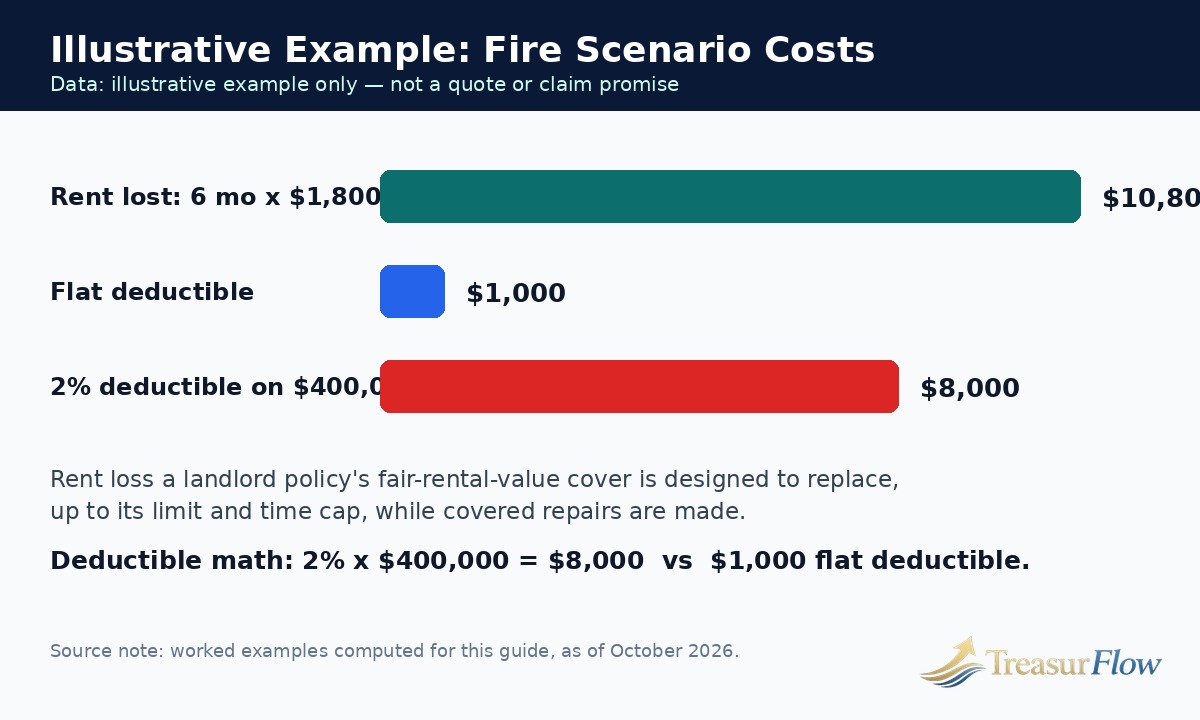
Take a single-family rental at $1,800 a month. A fire makes the unit unlivable, and repairs take six months — a realistic span once permits, contractors, and inspections are counted. The rent that does not arrive is $1,800 multiplied by 6 months, which equals $10,800. That $10,800 is exactly the kind of loss a landlord policy’s fair-rental-value cover is designed to replace, up to its limit and time cap, while the covered repairs proceed. It is an illustrative example, not a promise about any claim — but run the same arithmetic on your own rent and your own plausible repair window before you decide this block is a minor add-on. For many small landlords, six months of missing rent is a larger and more certain financial hit than the deductible they spent so long negotiating.
There is also a tax point to flag and not to fudge. The IRS treats rental income broadly: according to IRS Topic No. 414, rental income includes advance rent, and generally loss-of-rent insurance proceeds are treated as rental income as well. That is a reason to read the IRS topic linked in the resources box and to keep clean records of any proceeds you receive — not a reason to take tax advice from an insurance article. We are pointing you to the source rather than interpreting it for your return.
Block 5: Liability Coverage
Liability coverage is the block that protects everything else you own. If a tenant, a tenant’s guest, or a visitor is injured on the property and you are found legally responsible — a failed handrail, an unrepaired step, a condition you knew about and did not address — liability coverage is designed to pay the damages you owe, up to the limit, and to provide a legal defense under the policy terms. It also responds, within its terms, when you are responsible for damage to someone else’s property.
Choose this limit by looking at your total exposure, not at the rent. A serious injury claim does not scale with whether the unit rents for $900 or $2,400 a month. It scales with the injury, the medical costs, and the assets and future income a judgment could reach. Documented maintenance is the partner coverage nobody sells: a dated record that you inspected, repaired, and responded to hazards promptly is evidence about negligence, and negligence is what liability claims are actually about. Keep repair requests and your responses in writing, and treat every safety-related request as urgent on paper as well as in fact.
The Endorsement Layer: Umbrella, Ordinance and Law, and the Rest
On top of the five blocks sits an endorsement layer. Three additions deserve a deliberate yes or no, not a default.
A personal or commercial umbrella policy, coordinated with the landlord policy’s underlying liability limit, adds an extra layer of liability protection above it. It is worth pricing when your net worth, your other assets, or the size of your portfolio means a single serious claim could exceed a standard landlord liability limit. Confirm that the umbrella actually sits over the rental exposure — that the property is listed or otherwise covered as required — rather than assuming a household umbrella automatically follows you into landlord activity.
Ordinance and law coverage addresses a gap owners rarely see coming: when a damaged building must be repaired or rebuilt to current building code, the extra cost of bringing undamaged parts up to code, or of demolishing what remains, may not be inside a standard dwelling settlement. Older rentals are the most exposed to this gap, because the distance between how they were built and what code now requires is the widest. If your property is older, ask about this endorsement by name.
Beyond those two, ask specifically about water or sewer backup if it is available as an endorsement, about vandalism and theft wording as it applies to a tenant-occupied or vacant property under your chosen form, and about how any vacancy between tenancies is treated. None of these questions has a universal answer across carriers — which is precisely why they belong on your quote checklist, answered in writing, rather than assumed from a brochure.
Best Landlord Insurance 2026 by Landlord Profile
There is no single best landlord insurer for every owner, because landlords are not one kind of buyer. A retired couple renting the house next door, an investor with three fourplexes, a professional renting out a condo she once lived in, and a remote owner who wants to bind a policy from a phone have different properties, different service needs, and different tolerances for doing paperwork themselves. So instead of a ranked list, here is how the carriers named in verified 2026 roundups map to those profiles, as of October 2026. ValuePenguin’s 2026 picks name Allstate as best landlord insurance overall, Travelers as best for condos, Farmers as best for multiunit properties, and State Farm as best for full-time landlords. Awning’s 2026 roundup names Obie as best overall, citing an online-first landlord specialist, and also highlights State Farm for personalized service, Allstate for replacement cost coverage, GEICO for customer service, Nationwide for bundling, and Liberty Mutual for its claims process. Steadily, a landlord-focused insurer founded in 2020, appears on CNBC Select’s and Investopedia’s best landlord insurance lists for 2026.
For the First-Time Landlord With One Property
Start your quote set with Allstate and State Farm, and add one landlord specialist — Obie or Steadily — for comparison. Allstate earns its overall billing in ValuePenguin’s 2026 picks and a specific nod from Awning for replacement cost coverage, which matters for a first-timer because settlement basis is the detail a new landlord is least likely to interrogate and most likely to regret. State Farm’s appeal, in Awning’s framing, is personalized service: for an owner who has never filed a property claim and does not yet know which questions to ask, an agent relationship is a real feature, not a nostalgic one.
The specialist quote is your discipline check. Obie, as an online-first landlord specialist, and Steadily, as a landlord-focused insurer founded in 2020 that appears on both CNBC Select’s and Investopedia’s 2026 lists, exist only for this product. If a specialist and a generalist quote you similar money on the same form and the same limits, you have learned the market price of your risk. If they differ sharply, the difference is a question to ask — about form, settlement, deductible, or loss-of-rent limits — before it is a reason to celebrate or walk away.
For the Portfolio and Multiunit Landlord
Farmers is the name ValuePenguin’s 2026 picks attach to multiunit properties, so a portfolio owner should have a Farmers quote in the set. State Farm, named by ValuePenguin as best for full-time landlords, belongs there too, because at portfolio scale the relationship, the ability to review multiple properties coherently, and consistency of forms across properties start to rival price as decision factors.
Multiunit ownership changes the coverage conversation in two ways. First, loss of rental income multiplies: a fire in one building can take several units of rent offline at once, so the fair rental value limit that felt generous for a single house may be thin for a four-unit building. Model your own version of the worked example above using the building’s total monthly rent and a repair window you would actually face. Second, liability exposure multiplies with doors, tenants, guests, and common areas. Price the umbrella conversation seriously at this scale, and keep forms and deductibles consistent enough across the portfolio that you, or anyone managing for you, can say without guessing what a given property is covered for.
For the Condo Landlord
Travelers is ValuePenguin’s 2026 pick for condos, and the condo landlord’s central task is different from a house landlord’s: drawing the line between your unit-owner landlord policy, the condo association’s master policy, and your tenant’s renters policy. Condo buildings divide responsibility — the association’s policy typically addresses the building and common elements in some form, while your policy needs to address the interior, your landlord property, your rental income, and your liability, with the exact boundary set by the association documents and your policy wording.
Before you bind anything, get the association’s certificate of insurance and read what the master policy covers, then show it to the agent quoting your unit policy and ask, in writing, where your coverage begins. The expensive condo claims live in the seam between two policies, each of which was assumed to be the one that covered the interior, the betterments, or the water damage from one unit into the next. A carrier experienced with condos helps, but only your own documents settle the boundary.
For the Hands-Off Online Buyer
Obie is the natural first stop: Awning’s 2026 roundup names it best overall and describes it as an online-first landlord specialist, which is exactly the hands-off buyer’s brief — a landlord-only product, quoted and bought through an online flow rather than an office visit. Steadily belongs in the same quote set for the same reason: a landlord-focused insurer, founded in 2020, that appears on CNBC Select’s and Investopedia’s 2026 best landlord insurance lists, built for owners who think of landlording as the product category, not as a sideline of a homeowners company.
Hands-off buying still requires hands-on checking. An online flow makes it easy to accept defaults, and the defaults are where this guide has told you the risk lives: DP-1 instead of DP-3, actual cash value instead of replacement cost, a fair rental value limit too small for your rent, a percentage deductible you did not notice. Slow down on those four screens. The convenience is real and worth having; just spend the minutes it saves you on the screens that decide a claim.
If Service, Bundling, or Claims Handling Decides It for You
Some owners choose on how a company behaves rather than on product architecture, and the 2026 roundups give you sourced language for those preferences too. Awning highlights GEICO for customer service, Nationwide for bundling — relevant if your auto, homeowners, and landlord policies can be coordinated with one carrier for simplicity or bundle pricing — and Liberty Mutual for its claims process. Use those descriptors as a starting hypothesis, not a verdict: claims handling is experienced one claim at a time, service quality varies by channel, and bundling only saves money if each bundled policy is itself the right form at the right limit. Never trade a DP-3 replacement cost policy for a weaker form just to complete a bundle.
Landlord Insurance vs Homeowners Insurance: Side by Side
If you still hold both kinds of policy in your head as near-equivalents, this table is the correction. They insure related buildings and unrelated lives.
| Question | Homeowners Policy | Landlord Policy |
|---|---|---|
| Who is assumed to live there? | The owner | A tenant; the owner lives elsewhere or in another unit |
| What personal property is covered? | Mainly the owner’s belongings in the home | Mainly the landlord’s appliances and property left for tenant use or maintenance |
| What happens to income after a covered loss? | Loss of use helps the owner live elsewhere | Fair rental value is designed to replace lost rent during covered repairs |
| Whose liability is the focus? | The owner’s, around home and guests | The landlord’s, around tenants, their guests, and visitors to the rental |
| Why does it cost what it costs? | Priced for owner-occupied risk | Typically costs more than homeowners on the same home because tenant-occupied risk is higher (ValuePenguin) |
| Typical form family | Homeowners forms | Dwelling forms: DP-1, DP-2, or DP-3 |
Two practical consequences follow. First, keeping a renters policy requirement in your lease does not shrink your need for a landlord policy: the tenant’s policy protects the tenant’s belongings and the tenant’s liability, not your building, your rental income, or your liability as owner. The two policies are complements, not substitutes. Second, if you are converting a former home into a rental, budget for the premium to change along with the form. ValuePenguin’s point that landlord coverage typically costs more than homeowners coverage on the same home is not a quote and not a percentage — it is direction. Tenant-occupied risk is priced higher because, in the insurer’s experience, it is higher.
The Short-Term Rental Warning: Read This Before Your First Guest
Everything in this guide so far assumes a long-term rental: a tenant, a lease, a month-to-month or annual term. Short-term rental — nightly or weekly guests through a platform or direct booking — is a different use, and standard landlord policies usually exclude it. That single sentence deserves its own section, because a growing number of owners drift into short-term rental gradually — a few weekends a year, then a season, then a de facto hospitality business — without ever telling their insurer the use changed. Gradual drift does not soften an exclusion. The use at the time of the loss is what the policy will be read against.
Why Insurers Treat Short Stays Differently
From an underwriter’s chair, a short-term rental concentrates risk. Guests rotate constantly, none of them has a tenant’s stake in the property, parties and extra occupants are a standing temptation, appliances and systems cycle far harder, and the property may sit empty and unmonitored between stays. Whether or not that describes your careful, well-managed listing, it describes the category, and categories are what standard forms are written for. A policy written for a twelve-month tenant was not priced for forty groups of strangers a year.
AirCover and Host Programs Are Not a Substitute Policy
Platform host programs — Airbnb’s AirCover is the best-known name — are often treated by new hosts as if they were an insurance policy they already own. They are not a substitute for your own policy. Host protection and damage programs have their own terms, their own claims processes, their own definitions, and their own limits, and they sit inside a commercial relationship between you and a platform — they were not underwritten for your building, your lender’s requirements, your rental income pattern, or your liability exposure to a neighbor, a passerby, or anyone outside the platform transaction. They also do not turn an excluded use into a covered one under your landlord or homeowners policy. Relying on a host program while your own carrier believes the property is a long-term rental — or a primary home — stacks two misunderstandings on top of each other: a program that was never your policy, and a policy that was never told the truth.
What to Do If You Rent Short-Term, or Mix Both Models
Tell your carrier or agent, before the first booking, that short-term rental is part of the use, and get the answer in writing. Depending on the carrier and the property, the honest options are a landlord policy with a short-term rental endorsement, a policy written specifically for short-term rental use, or a commercial-style policy — the right shape depends on how often you host, whether you also live there, and how your local rules treat the activity. Also check the layers outside insurance: your lease or condo or homeowners association rules, your lender’s terms, and your city or county’s short-term rental rules can each restrict the activity independently of what an insurer will sell you, and fair housing and local housing-provider obligations — HUD’s fair housing resources, linked above, are the federal starting point — apply to how you operate as a housing provider regardless of booking length. If a carrier will not cover the use you actually intend, that is useful information delivered cheaply. The expensive way to learn it is from a claims letter.
What Landlord Insurance Costs in 2026 — and What Actually Drives the Price
Here is the part of the guide where honesty requires us to give you less than you may want. There is no responsible national average premium we can hand you from the verified 2026 sources used for this article, and we are not going to invent one, borrow one from an unsourced listicle, or dress a single state’s figure up as a countrywide fact. Premiums for landlord insurance are intensely local and property-specific. What we can give you is one clearly labeled sample, a qualitative direction, and — more useful than any average — the list of levers that will move your own quotes, so you can read them like an underwriter instead of like a lottery ticket.
The one sample: as of October 2026, Insuranceopedia’s 2026 reporting puts a standard DP-3 landlord policy in Florida at an average of about $2,208 a year. Present that number exactly as what it is — a Florida sample for a DP-3 policy, in a state whose wind and hurricane exposure shapes property premiums in ways most states do not share. It tells a landlord in Ohio, Colorado, or Oregon almost nothing about their own quote, and it should never be quoted, by us or by you, as a national price. Its real value is narrower: it shows that a serious DP-3 landlord policy is a four-figure annual line item in a high-risk state, not a trivial add-on, and that form choice belongs in any cost conversation.
The direction, from ValuePenguin, is the one already stated: landlord policies typically cost more than a homeowners policy on the same home, because tenant-occupied risk is higher. Beyond direction and the Florida sample, your price is your property, your form, and your choices. Here is where the money actually moves.
The Cost Drivers That Move Your Quote
The form and the settlement basis. DP-3 with replacement cost costs more than DP-1 at actual cash value, for the obvious reason that it promises more. Compare premiums only between quotes offering the same form and settlement, or you are comparing promises, not prices.
The dwelling limit. A higher, honest rebuild cost costs more to insure than a flattering low one. Saving premium by understating the rebuild cost is not a saving; it is a pre-agreed shortfall on a total loss, and it can interact badly with policy conditions about insuring to value.
Location and its perils. Wind and hurricane exposure on the coasts, hail in the plains, wildfire in parts of the West, freeze risk, local fire protection, and distance to a hydrant and a fire station all feed the price. Two otherwise identical houses in different ZIP codes are different risks, and no article’s average survives that fact.
The deductible — and its shape. A higher deductible lowers premium, but shape matters as much as size, which the worked example below makes concrete. A percentage deductible grows with your dwelling limit, so a limit increase you barely noticed at renewal can quietly raise your out-of-pocket exposure by hundreds of dollars.
The property itself. Age, roof age and material, updated or original electrical, plumbing, and heating, number of units, and whether the property is a single-family home, a condo unit, or a multiunit building all matter. Older systems and roofs are where quotes rise and where some carriers hesitate altogether.
Your rental income at risk. A policy replacing a larger rent, over a longer potential repair window, under a higher fair rental value limit, prices that exposure. Multiunit owners should expect this block to be a visible part of the premium, not a rounding error.
Liability limits and endorsements. Higher liability limits, an umbrella layer, ordinance and law coverage, and backup endorsements each add cost, generally modestly compared with the dwelling premium — which is why cutting them to save premium is usually poor arithmetic. They protect against the low-frequency losses that are large enough to reach your other assets.
Your history and your management. Prior claims, including claims on the property under a previous owner where a carrier can see them, your own insurance history, and in some cases how the property is managed can affect pricing and eligibility. A clean, documented, promptly maintained property is not just safer — it is easier to underwrite.
Worked Example: The Deductible You Did Not Read (Illustrative)
Suppose your dwelling limit is $400,000. A flat deductible of $1,000 means a covered loss costs you the first $1,000. A wind or hurricane deductible set at 2 percent of the dwelling limit — a structure used in wind-exposed areas — means 2 percent of $400,000, which equals $8,000, comes out of your pocket before the policy pays on a wind claim. That is a $7,000 difference between two quotes that may have looked similar on premium, hidden in one line about deductible type. Neither deductible is automatically wrong: the percentage deductible usually buys a lower premium, and an owner with deep reserves may choose it deliberately. The failure is not choosing it. The failure is discovering it after the storm, from an adjuster, while the roof is open to the sky. On every quote, ask: what is my deductible in dollars, for wind, on the day I bind — and write the answer on the quote itself.
The Claims Checklist: Before, During, and After a Loss
Before Any Loss Happens
Keep, in one place you can reach when the property is damaged and you are not thinking clearly: the policy and declarations page, the carrier’s claims number, your agent’s contact details, the appliance and condition inventory with photos, dated photos of the property’s condition including the roof and major systems, the current lease, and a maintenance log showing inspections, repair requests, and completed work with dates. Update the photos at every tenant turnover. This file is unglamorous and decisive: it establishes what you owned, what condition it was in, and that you maintained it.
In the First 48 Hours After a Loss
Protect people first, then protect the property from further damage — most policies expect you to take reasonable steps to prevent a covered loss from getting worse, such as shutting off water after a burst pipe or covering a damaged roof, and to keep receipts for that emergency work. Notify the carrier promptly and note the claim number, the adjuster’s name, and every instruction you are given. Photograph and video everything before cleanup where it is safe to do so, and do not discard damaged materials or appliances until the carrier has had its chance to inspect them or tells you otherwise. Notify your tenant in writing about access, habitability, and next steps, and keep that correspondence. If rent will be interrupted, open a simple ledger on day one: rent normally due, rent actually received, and the dates the unit is uninhabitable, because that ledger is the backbone of a fair rental value claim.
While Repairs and the Claim Proceed
Keep every invoice, contract, permit, and inspection record, and log repair milestones with dates — the fair rental value block is tied to the repair period for a covered loss, so a clean timeline is money. Communicate with the adjuster in writing where you can, and read any settlement document before you sign it, paying attention to whether it is a full and final settlement or a partial payment. If a liability claim is involved — someone injured on the property — notify the carrier immediately, preserve any incident details and witness names, and do not speculate about fault in writing to anyone other than your carrier and your own legal counsel. Finally, remember the tax record point from IRS Topic No. 414: rental income, including advance rent and generally loss-of-rent insurance proceeds, is treated as rental income, so keep the proceeds paperwork with your tax records and take questions to the IRS resource or your tax professional, not to the adjuster.
Conclusion: Buy the Anatomy First, the Carrier Second, the Price Last
The best landlord insurance 2026 decision is not a brand. It is a sequence. Start by retiring the homeowners policy from a job it cannot do, because tenant-occupied risk is a different contract. Choose the form with your eyes open — DP-3 for the strongest standard protection, DP-2 as a considered middle, DP-1 only when you knowingly intend to keep most of the risk yourself — and confirm settlement basis and deductible in dollars, in writing. Build all five coverage blocks deliberately, sizing fair rental value against your real rent — $10,800 in our six-month, $1,800-a-month illustrative example — and liability against your real assets, then add the umbrella and ordinance-and-law answers as conscious decisions. Only then shop carriers by profile: Allstate and the specialists for a first property, Farmers and State Farm at portfolio and multiunit scale, Travelers for a condo, Obie and Steadily for the online buyer, and GEICO, Nationwide, and Liberty Mutual where service, bundling, or claims handling is your deciding factor, each as named in the 2026 ValuePenguin, Awning, CNBC Select, and Investopedia roundups as of October 2026.
Above all, do not let a short-term rental, a vacancy, or a conversion from your own home quietly change the use of the property while the policy still describes the old one. Insurance pays, when it pays, on the contract you actually bought for the use you actually disclosed. Tell the truth on the application, keep the documents that prove condition and maintenance, and review the policy whenever the property, the rent, or the use changes. That discipline — not a headline premium, and not a Florida sample mistaken for a national price — is what makes a landlord policy worth the paper it is printed on when the fire, the pipe, or the storm finally tests it.
Landlord Insurance Questions Property Owners Ask Us Most
Do I need landlord insurance if I already have homeowners insurance?
Yes, if the property is rented to a tenant. A homeowners policy is written for an owner-occupied home, so it does not contain the landlord blocks you need, such as fair rental value for lost rent and coverage for appliances you leave for a tenant’s use, and a claim can be disputed if the occupancy on the policy does not match the tenant-occupied use. Tell your carrier the true occupancy and switch to a landlord policy written on a DP-1, DP-2, or DP-3 form.
What is the difference between DP-1, DP-2, and DP-3 landlord policies?
DP-1 is the basic form, covering a short named list of perils and often settling the dwelling at actual cash value after depreciation. DP-2 is the broad form, covering a wider named list of perils and more often offering replacement cost settlement. DP-3 is the special form, generally covering the dwelling on an open-perils basis unless a loss is excluded, and commonly offering replacement cost settlement, which makes it the strongest standard landlord form for most owners.
Does landlord insurance cover loss of rental income?
Yes, landlord policies typically bundle loss of rental income, often called fair rental value, which is designed to replace rent you lose when a covered loss makes the unit unlivable while repairs are made, up to the policy limit and time cap. In an illustrative example, $1,800 a month in rent lost for 6 months after a fire equals $10,800. It does not cover ordinary vacancy, a tenant who stops paying rent, or a weak rental market.
How much does landlord insurance cost in 2026?
There is no single national price we can responsibly quote from the verified sources used in this guide, and landlord policies typically cost more than a homeowners policy on the same home because tenant-occupied risk is higher, according to ValuePenguin. As a Florida-only sample as of October 2026, Insuranceopedia puts a standard DP-3 landlord policy in Florida at an average of about $2,208 a year. Your own price depends on the form, dwelling limit, location, deductible, property age and condition, rental income, and liability limits you choose.
Does a standard landlord policy cover short-term rentals like Airbnb?
Usually no. Standard landlord policies are written for long-term tenancies and usually exclude short-term rental use, so tell your carrier before the first guest and get the answer in writing; you may need a short-term rental endorsement or a policy written for that use. Host programs such as Airbnb AirCover are not a substitute for your own policy, because they were not underwritten for your building, your lender’s requirements, or your full liability exposure.
Is rental income taxable, and where should I check the rules?
According to IRS Topic No. 414, rental income includes advance rent, and generally loss-of-rent insurance proceeds are treated as rental income as well. Read the IRS topic linked in the resources box in this guide, keep records of any rent and any insurance proceeds you receive with your tax documents, and ask a qualified tax professional about your own return rather than relying on an insurance article for tax advice.

Muhammad Zakir is the founder of Treasurflow and the author of its personal finance guides. He researches consumer banking, credit, and personal loans, and every guide cites primary sources such as the CFPB, FDIC, FTC, and IRS. His content is educational and is not personalized financial advice.