
Most people shopping for the best rv loans 2026 start in exactly the wrong place: at a dealership, looking at a monthly payment on a whiteboard. The salesperson lowers the payment by stretching the term, the number suddenly looks affordable, and the total cost quietly grows by tens of thousands of dollars. An RV is not a car, and an RV loan is not an auto loan with a bigger price tag. It is a secured, mortgage-like loan on a depreciating recreational asset that most lenders restrict by age, mileage, use, and loan size — and that difference changes everything about how you should qualify, compare offers, and choose a term. This guide flips the usual order. You will qualify first, understand the underwriting second, and only then look at lenders and monthly payments.
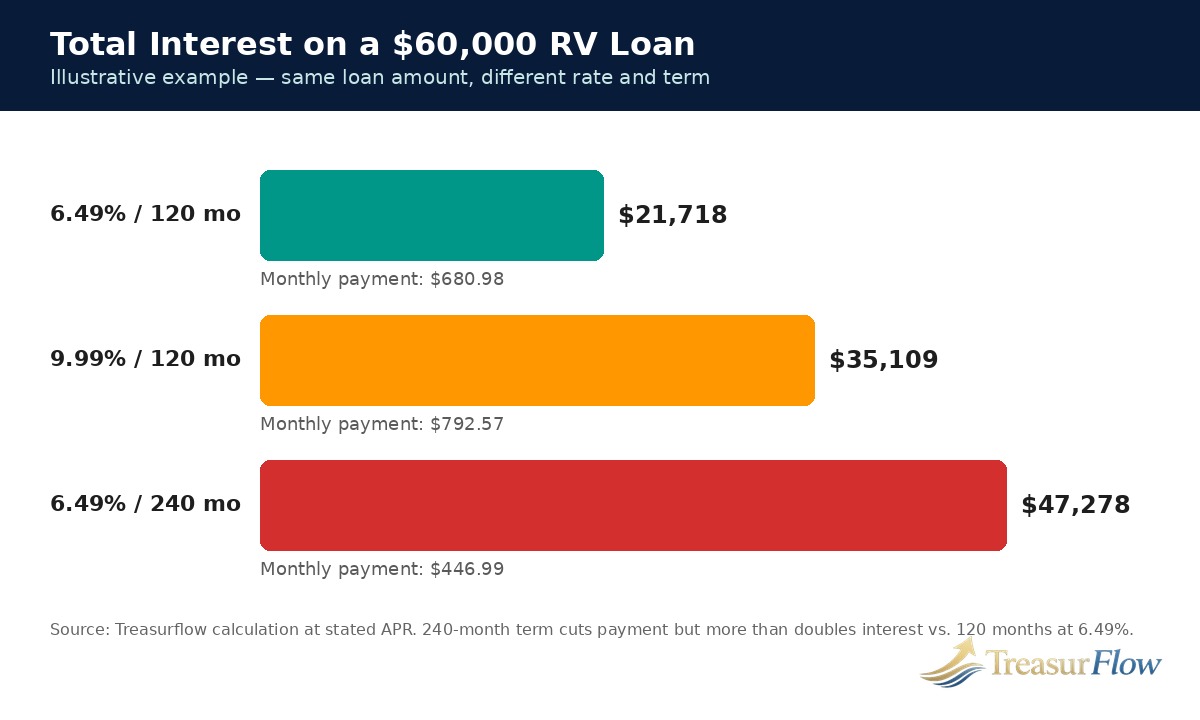
That qualification-first roadmap matters more in 2026 than it did a few years ago because the spread between the best and worst RV loan offers is unusually wide. As of October 2026, starting APRs from top lenders in Bankrate’s October 2026 RV loan roundup begin at 6.24% for well-qualified borrowers, while borrowers with weaker credit who finance through more flexible channels can face rates in the mid-to-high teens. On a $60,000 loan, that gap is not a rounding error. At 6.49% over 120 months you would pay about $680.98 per month and $21,717.91 in total interest in an illustrative calculation. At 9.99% over the same 120 months you would pay about $792.57 per month and $35,108.66 in total interest — $13,390.75 more interest for the exact same RV. The lender you choose, the term you accept, and the credit profile you bring to the application will matter more than almost any negotiation you do on the sticker price.
This article is built for buyers who want a decision they can defend a year from now, not just a payment they can squeeze into this month’s budget. We will walk through how RV lending actually works, which lender types fit which borrowers, our picks organized by borrower profile and loan size, the long-term trap hidden inside 180- and 240-month loans with the full interest math shown, how to finance a used or private-party RV without getting stranded, a total-cost-of-ownership checklist most buyers skip, and the exact pre-approval steps to complete before you ever set foot on a lot. All rates in this guide are starting or “from” APRs as of October 2026, attributed to Bankrate’s October 2026 roundup and lender-published figures, and your actual rate will depend on credit, income, loan amount, RV age and type, down payment, and term.
Disclaimer: This article is for general educational information only and is not financial, legal, or tax advice. RV loan rates, terms, credit requirements, and lender policies change frequently and vary by state, RV type, and borrower profile. All APRs shown are starting (“from”) APRs as of October 2026, based on Bankrate’s October 2026 RV loan roundup and lender-published figures, and are not a guarantee of the rate you will receive. Loan examples are illustrative calculations only. Always verify current rates, fees, and eligibility directly with the lender before applying, and consider speaking with a qualified financial professional about your own situation.
Related Guides
- Best Auto Loan Refinance 2026 — How secured vehicle refinancing works, and when a lower rate is actually worth the fees.
- Best Personal Loans 2026 — Unsecured borrowing compared, for smaller RVs, older rigs, and buyers who cannot use the RV as collateral.
- Best Debt Consolidation Loans 2026 — If existing debts are pushing your debt-to-income ratio too high to qualify for an RV loan, start here.
Helpful Official Resources
- CFPB — Auto Loans — The Consumer Financial Protection Bureau’s plain-English guide to vehicle financing, total cost, and dealer add-ons; the core concepts apply directly to RV loans.
- AnnualCreditReport.com — The federally authorized site to check your credit reports for free before you apply anywhere.
- NHTSA — Vehicle Recalls — Check any used RV by VIN for open safety recalls before you buy.
Start Here: The Qualification-First Buyer’s Roadmap
Step 1 — Know Your Numbers Before a Lender Sees Them
Before you compare a single lender, pull your own credit reports, note your credit score from at least one major bureau, add up your gross monthly income, and list every monthly debt payment that will appear on your credit report plus housing. Many RV lenders, as a matter of common practice, want your total debt-to-income ratio — including the new RV payment — at or below about 40%. That is not a universal rule and some lenders are more flexible, especially for larger loans with strong assets, but it is a useful planning ceiling. If your housing, car payment, credit card minimums, student loans, and the estimated RV payment already push you past that range, you have three honest levers: buy a less expensive RV, put more money down, or pay down existing debt first. Pretending the math will work at the dealership is how buyers end up with a denial, a much higher rate, or a term so long the loan outlives the RV’s best years.
Credit score tells a similar story. The most competitive starting APRs in this guide — 6.24% from Alliant Credit Union and Southeast Financial as of October 2026 — are aimed at borrowers around a 680 minimum credit score and, in practice, the very best pricing usually goes to borrowers well above that floor with clean payment history and stable income. LightStream and Good Sam Finance Center start at 6.49% as of October 2026, again for strong profiles. At the other end, My Financing USA works with credit scores from about 550, according to lender and roundup figures, but roundups cite roughly 14.74% to 19.95% for lower credit tiers. That does not make a lender “bad.” It makes timing important. If you are at 580 today and could reasonably reach 660 to 680 in six to nine months by paying down revolving balances and fixing report errors, waiting can save you more than any dealer discount.
Step 2 — Decide What the RV Is Really For
Lenders care whether the RV is for recreation, occasional travel, seasonal living, or full-time living, and many secured RV loans restrict or price full-time use differently. Be accurate on the application. Also decide honestly how long you will keep this RV. First-time buyers frequently trade up or trade out within three to five years as they learn what layout, length, and towing or driving setup actually fits their life. If your realistic ownership window is five years, signing a 20-year loan and assuming you will “just sell it later” is risky, because early payments are mostly interest and the RV depreciates fastest in its early years. Match the loan term to a conservative ownership plan, not to the lowest possible payment.
Class and price matter too. A $28,000 travel trailer, a $95,000 Class C, and a $350,000 Class A diesel pusher live in different lending universes. Smaller loans are often capped at shorter terms and sometimes are better handled as unsecured personal loans. Mid-size loans are the sweet spot for specialist RV lenders and credit unions. Very large loans — Southeast Financial goes up to $4 million and Trident Funding up to $2 million in published figures as of October 2026 — involve mortgage-like documentation: tax returns, asset statements, appraisals or valuations, and a much closer look at liquidity after closing. Knowing your lane before you apply prevents wasted hard inquiries and mismatched expectations.
Step 3 — Set a Down Payment and Term Ceiling in Advance
Common lender practice is to expect 10% to 20% down on larger RV loans, and putting that money down does more than lower your payment. It reduces the chance you are underwater in year two, it can improve your approval odds and pricing tier, and it gives you a cushion if you need to sell in a soft used market. Write down two numbers before you shop and do not move them on the lot: your maximum out-the-door price including tax, title, delivery, and dealer fees, and your maximum term. For most buyers, a term ceiling of 120 to 144 months is a prudent default even when 180 or 240 months is offered. Later in this guide we show exactly why, with the interest math on the same $60,000 loan.
How RV Lending Differs From Auto Loans
Secured, Collateral-Based, and Picky About the Collateral
An RV loan is almost always secured by the RV itself. If you default, the lender can repossess and sell the unit, so the lender cares deeply about what that unit will be worth — and whether it can be sold — for years to come. That is why RV underwriting feels closer to a mortgage than to a quick auto approval. Expect verification of income and employment, documentation of assets, questions about other real estate or large debts, and, on larger loans, full tax returns. Expect the lender to check the RV’s book value, require insurance with the lender listed as lienholder, and in many cases require a professional inspection or appraisal on used units.
That collateral focus also explains RV age rules, one of the most common surprises for used buyers. Many lenders restrict financed RV age, commonly to units about 10 to 15 years old at origination, and some calculate age at loan payoff rather than at purchase, which can shorten your maximum term on an older rig. Trident Funding, notably, finances RVs from model year 2005 and newer in its published figures as of October 2026, which is more permissive than many competitors, but even permissive lenders will weigh condition, mileage on motorized units, and value carefully. If the RV you want is 16 years old, a secured loan may simply not be available at any reasonable rate, and an unsecured personal loan or cash purchase becomes the realistic path.
Longer Terms, Larger Balances, Slower Equity
Auto loans today commonly run 36 to 84 months. RV loans routinely run 120, 144, or 180 months, and on large loans Southeast Financial publishes terms up to 180 to 240 months as of October 2026. Longer terms exist because the balances are larger and because lenders treat well-maintained motorhomes somewhat like vacation property. But an RV is not property that typically appreciates. It is a vehicle exposed to weather, mileage, water damage, and fast-changing floorplan tastes. Stretching the term slows your equity build to a crawl. In the first several years of a 240-month loan, most of each payment is interest, the balance falls slowly, and depreciation usually falls faster. That gap is the central risk in RV financing, and managing it — with down payment, term discipline, and buying used at the right price — is more important than chasing the last quarter-point of APR.
Essential-Use vs. Luxury Treatment and Why Rates Differ
Some lenders historically treated RV loans more favorably when the RV qualified as a second home with cooking, sleeping, and bathroom facilities, and borrowers sometimes ask about mortgage interest deductibility. Tax treatment depends on your individual facts, current law, and whether the loan and RV meet specific requirements, and this article does not provide tax advice. What matters for shopping is simpler: do not let a possible tax point talk you into a larger loan. Price the loan on APR, total interest, fees, prepayment terms, and your ability to carry the full cost of ownership. If a tax benefit applies to you, treat it as a bonus you confirm with a tax professional, never as the reason the payment “works.”
The Four Lender Types, Compared Honestly
Specialist RV Lenders and Brokers
Specialists do nothing but recreational lending, and that focus shows up in higher loan limits, longer terms on large units, comfort with full-time or unusual situations, and staff who understand the difference between a fifth wheel and a Class B. Good Sam Finance Center, from 6.49% APR as of October 2026, Southeast Financial, from 6.24% APR with loans from $10,000 up to $4 million and terms up to 180 to 240 months on large loans, Trident Funding, with loans up to $2 million and financing for model year 2005 and newer units, and My Financing USA, which works with scores from about 550, all sit in or around this specialist and broker world. Brokers are especially useful for credit-challenged buyers and unusual collateral because they can submit your file to multiple wholesale lenders. The trade-off is to ask, in writing, about origination, documentation, and broker fees, and to confirm whether there is any prepayment penalty in the underlying loan.
Choose a specialist when your loan is large, your RV is older but still financeable, you are buying from a private party, or your credit story needs a human underwriter rather than an algorithm. Specialists are often the only realistic secured option above $250,000 and for borrowers who need a 180-month structure on a high-value coach — though, as the math section shows, needing that structure should also prompt a hard look at price.
Credit Unions
Credit unions frequently post the lowest starting APRs in the entire market, and this roundup is no exception. Alliant Credit Union offers secured RV loans from 6.24% APR as of October 2026, for $10,000 to $400,000, with a minimum credit score around 680. Navy Federal Credit Union starts from 7.45% APR as of October 2026, but eligibility is limited to members — military members, veterans, and their families who meet membership rules. Credit unions tend to offer clean fee structures, no-pressure service, and relationship pricing if you already bank there. Their limits are real, though: membership eligibility, lower maximum loan amounts than the big specialists, sometimes shorter maximum terms, and sometimes stricter RV age caps. If you qualify for membership and your loan fits inside the cap, always get a credit union quote. It is the benchmark every dealer offer should have to beat.
Unsecured Online Lenders
LightStream is the headline name here: from 6.49% APR with AutoPay as of October 2026, unsecured loans up to $100,000, and no origination fee in its published terms. Unsecured means the RV is not collateral. There is no lien, no RV age rule, no inspection of the unit, and funding can be fast, sometimes in days. That makes unsecured borrowing genuinely attractive for older RVs that secured lenders will not touch, for private-party purchases where title transfer is messy, for buyers who strongly prefer no lien, and for smaller purchases under $100,000 where the paperwork of a secured loan feels disproportionate.
The cautions are just as real. Unsecured approval depends heavily on credit and income because the lender has no collateral, maximum terms are typically far shorter than secured RV terms, which raises the monthly payment, and the average personal loan rate was 12.28% as of June 2026, according to Federal Reserve data via Bankrate — a reminder that LightStream’s 6.49% starting rate is for excellent credit, not a typical outcome. Compare an unsecured offer on total interest over its actual, shorter term, not just on APR. A higher APR over 72 months can sometimes cost less in total dollars than a lower APR stretched over 180 months, and you will own the RV free and clear far sooner.
Banks and Dealer Financing
U.S. Bank, from 7.99% APR as of October 2026, represents the large-bank lane: convenient if you already bank there, credible and regulated, but rarely the cheapest starting rate in this category and sometimes less flexible on older or unusual RVs. Dealer financing is not a lender type so much as a distribution channel — the dealer submits your application to a panel of banks, credit unions, and specialists and presents you with an offer at the point of sale. Its advantage is speed and convenience, especially on weekends. Its risk is opacity. The dealer may be compensated based on the rate you accept, add-on products like warranties, GAP coverage, tire protection, and paint packages can be rolled into the loan, and the conversation is framed around monthly payment rather than APR and total cost.
The rule that protects you is simple: never walk into dealer financing without an outside pre-approval in hand. With a written pre-approval at, say, 6.49% for a defined amount and term, the dealer’s finance office has to beat a real number, in writing, on APR, term, and fees — not just shave $18 off a monthly payment by adding three years to the loan. If the dealer beats your pre-approval on identical term and total cost, take the win. If not, use your own lender and let the dealer sell you an RV, not a loan.
Best RV Loans 2026: Picks by Borrower Profile and Loan Size
The picks below use only the verified figures in our fact sheet as of October 2026. They are organized by who you are and what you are buying, because the “best” lender for a $30,000 used trailer with a 760 score has almost nothing in common with the best lender for a $600,000 coach with a 640 score.
Best Overall Starting Rate and Best Credit Union Pick: Alliant Credit Union
Alliant posts secured RV loans from 6.24% APR as of October 2026, tied for the lowest starting rate in this guide, with loan amounts from $10,000 to $400,000 and a minimum credit score around 680. That combination covers the great majority of new and late-model used purchases, from well-equipped travel trailers through most Class C and many Class A units. If your score clears the threshold and your loan fits under $400,000, Alliant belongs on every shortlist and is the quote to use as your negotiating benchmark. Confirm current membership eligibility, maximum term for your loan size, RV age limits, and whether the lowest rate requires a shorter term or a specific loan-to-value, because starting rates almost always attach to the strongest tier and the most favorable structure.
Best for Very Large Loans and Longest Available Terms: Southeast Financial
Southeast Financial also starts from 6.24% APR as of October 2026, but its range is what sets it apart: $10,000 up to $4 million, with terms up to 180 to 240 months on large loans. For buyers financing a high-end Class A, a luxury fifth wheel with a tow vehicle strategy, or any purchase that exceeds credit union caps, Southeast is built for that scale and understands large-loan documentation. Use its longest terms with extreme care. The availability of a 240-month term is a reason to model the interest cost in full — which we do below — not a reason to default to it. On a seven-figure loan, even a small rate or term decision compounds into life-changing dollars, so large-loan borrowers should also budget for insurance, storage, maintenance reserves, and professional advice as part of the purchase decision.
Best Specialist for Mainstream Buyers: Good Sam Finance Center
Good Sam Finance Center starts from 6.49% APR as of October 2026 and brings the credibility of a brand built entirely around RV ownership. For mainstream buyers — solid credit, a dealer or private-party purchase in the $40,000 to $250,000 range, and a desire for an lender whose staff speak RV fluently — Good Sam is a natural first application alongside a credit union quote. Specialist fluency matters when questions arise about delivery timelines, out-of-state purchases, inspections, or titling, because those are routine files for a specialist and edge cases for a generalist bank. As with every pick, confirm fees, prepayment language, and age and mileage rules for your specific unit before you rely on the starting APR.
Best Unsecured Option and Best for Older or Private-Party RVs: LightStream
LightStream starts from 6.49% APR with AutoPay as of October 2026, offers unsecured loans up to $100,000, and charges no origination fee in its published terms. That structure makes it our top pick when the RV itself is the problem for secured lenders: too old, sold by a private party with a complicated title, or priced in a range where you value speed and a clean, lien-free title over the lowest possible payment. Strong-credit borrowers should model a LightStream offer over 60 to 84 months against a secured offer over 120 months and compare total interest paid and the date you own the RV outright. Many buyers are surprised to find the unsecured path is competitive in total dollars precisely because the term is disciplined. Borrowers with average credit should set expectations using that 12.28% average personal loan rate as of June 2026 as context — unsecured pricing falls quickly as credit scores decline.
Best for Military Members and Families: Navy Federal Credit Union
Navy Federal starts from 7.45% APR as of October 2026 and serves members only — military service members, veterans, and eligible family members. Its starting rate is higher than Alliant’s headline, so why recommend it? Because starting rates are not the whole loan. Credit union service, transparent fees, member support during deployments or moves, and competitive actual offers for members with strong but not perfect profiles can make Navy Federal the best real-world choice for its eligible community. If you are eligible, get its quote early. Military buyers should also ask specifically about payment options during PCS moves, insurance requirements in storage, and any restrictions if the RV will be your residence during a transition.
Best Big-Bank Option: U.S. Bank
U.S. Bank starts from 7.99% APR as of October 2026. On rate alone it will rarely win this comparison, and this guide will not pretend otherwise. Its place is as a convenience and relationship option for existing customers who value having the loan inside a bank they already use, and as an additional quote to keep pressure on other lenders. If U.S. Bank is your most convenient path, negotiate with your outside pre-approvals visible and pay close attention to maximum term, RV age rules, and fees, which matter more than the familiarity of the logo.
Best for Lower Credit Scores: My Financing USA
My Financing USA works with credit scores from about 550, according to published figures, which makes it one of the few realistic doors for borrowers rebuilding credit who still want a secured RV purchase. Roundups cite roughly 14.74% to 19.95% for lower credit tiers, and you should enter with eyes fully open: at those rates, total interest can approach or exceed the depreciation-adjusted value of the RV itself if the term is long. If you buy through a higher-rate channel, protect yourself with the largest down payment you can manage, the shortest term you can afford, a purchase price well below book value, and a written plan to refinance after 12 to 24 months of on-time payments and credit improvement — without counting on that refinance as guaranteed. Also model the alternative honestly: waiting a year, buying a less expensive RV for cash or with a smaller loan, and entering ownership without a payment that strains every month.
Best for Older RVs That Still Deserve Financing: Trident Funding
Trident Funding finances RVs from model year 2005 and newer and offers loans up to $2 million in published figures as of October 2026. In a market where many lenders cut off around 10 to 15 years of age, a 2005-and-newer policy opens the door to well-kept coaches and trailers that have already taken their steepest depreciation — often the smartest value purchases in the entire RV market. Older-unit financing still requires discipline: budget for inspection, tires, roof and seal work, appliances, and a maintenance reserve, because a low purchase price with immediate repair bills is not a bargain. Ask Trident, or any lender on an older unit, exactly how maximum term is calculated against RV age, and get the valuation method in writing before you commit to a seller.
Picks by Loan Size, at a Glance
For loans under $35,000, start with a credit union secured quote and a LightStream unsecured quote and compare total interest, not payment. For $35,000 to $150,000 — the heart of the market — get Alliant, Good Sam, and one specialist quote, all on the same term, ideally 120 months, and let them compete. For $150,000 to $400,000, add Southeast Financial and expect fuller documentation and a 10% to 20% down payment conversation. Above $400,000, Southeast and Trident are your primary lanes, Alliant drops out above its cap, and the process becomes mortgage-like in paperwork and timeline, so start pre-approval weeks, not days, before you expect to buy. At every size, borrowers below about 640 should include My Financing USA for a realistic floor, then work the credit-improvement math before deciding whether to proceed now or wait.
The Long-Term Trap: What 180 and 240 Months Really Cost
The $60,000 Example, Fully Worked
Take a single, clean example and refuse to look away from the totals. You borrow $60,000. The RV is identical in every scenario. Only the rate and the term change. These are illustrative calculations using standard amortization, not lender quotes.
At 6.49% APR over 120 months, your payment is $680.98 per month. You make 120 payments totaling $81,717.91, of which $21,717.91 is interest. That is a substantial cost, but after ten years you own the RV outright and the loan is gone.
At 9.99% APR over the same 120 months, your payment rises to $792.57 per month — $111.59 more each month — and total interest climbs to $35,108.66, for $95,108.66 paid in total. The rate difference alone, with no change in term, costs you $13,390.75 in extra interest. This is why credit preparation before you apply is worth real money, and why a buyer at 9.99% should ask whether six months of credit work could move them into a lower tier before they sign for a decade.
Now hold the rate at that attractive 6.49% and stretch only the term to 240 months. The payment falls to $446.99 per month, a drop of $233.99 that feels like relief at the dealership. But you now make payments for twenty years, pay $107,277.77 in total, and hand the lender $47,277.77 in interest — $25,559.86 more interest than the 120-month loan at the same rate, and more than double the interest, for the privilege of a lower monthly number. Total interest at 240 months is roughly 2.18 times the interest at 120 months at the identical APR. The RV did not get better. The loan just got longer, and you will likely still be paying for it long after you have sold it, traded it, or stopped using it as often as you do today.
Why the Trap Is Worse on an RV Than on Almost Anything Else
Three forces compound the long-term problem. First, depreciation: most RVs lose value fastest in the early years, exactly when a long loan’s balance falls slowest, so negative equity is the default outcome without a large down payment. If you owe $54,000 in year three on a unit the market values at $42,000, selling requires bringing cash to the closing, and an unexpected job change, health issue, or family need becomes a financial crisis rather than a simple sale. Second, aging costs: a 240-month loan runs alongside roof reseals, tire replacements every five to seven years regardless of mileage, appliance failures, slide and seal maintenance, and, on motorized units, drivetrain work — all while the payment continues. Third, life change: a loan signed at 45 runs to age 65. A loan signed at 58 runs to 78. Storage, insurance, and campground costs do not pause when your travel does. None of this means a long term is never justified. On a very large, high-quality coach bought well below replacement cost, with 20% or more down, strong liquidity, and a genuine long-term use plan, a 180-month structure can be a rational cash-flow choice for a borrower who invests or retains the difference and could pay the loan off early without penalty. What it should never be is the default setting used to make an unaffordable RV look affordable.
Use two guardrails. First, if the payment only works at 240 months and does not work at 144 or 180, the RV is too expensive for your current budget — the term is telling you the truth. Second, if you do take a longer term for flexibility, confirm in writing that there is no prepayment penalty, set your actual budget payment at the 120- or 144-month level, and pay that amount anyway. Flexibility you use as discipline is valuable. Flexibility you use as permission is expensive.
Add-Ons Rolled Into Long Loans
Dealer add-ons deserve special scrutiny on long terms because their cost multiplies quietly. A $3,500 service contract, $1,200 in tire and appearance packages, and documentation and delivery fees rolled into a 240-month loan do not cost $4,700 and change. Financed at 6.49% over twenty years, every $1,000 added to the amount financed costs about $1,788 in total payments. Buy only the coverage you have read, understand, and would pay cash for at the same price. Decline anything you cannot get explained in plain language on one page, and remember that most add-ons can be purchased later, separately, or not at all — while the loan, once signed, is yours for its full term unless you refinance or pay it off.
Buying Used and From Private Parties: The Section That Saves Deals
Why Used Is Often the Smartest Purchase — and the Hardest to Finance
A three- to seven-year-old RV bought from a careful owner can deliver most of the experience of a new unit at 55% to 75% of the original price, with the steepest depreciation already absorbed by someone else. Lenders know this value exists, but they also know older units carry condition, title, and valuation risk, which is why age caps commonly in the 10- to 15-year range, inspections, and book-value limits appear in secured underwriting. Your job as a used buyer is to make your file easy to approve: choose a unit inside lender age rules when you need secured financing, get the VIN early, confirm the title is clean and in the seller’s name, and never agree to a price far above book value expecting the lender to fund the gap — the gap becomes your additional cash down, or the deal dies at funding.
Check the VIN through the NHTSA recalls resource listed in our official resources box, ask for maintenance records, service receipts, and tire date codes, and pay for an independent certified RV inspection on any used purchase above a modest price. An inspector checks water intrusion — the single most destructive and expensive hidden problem in RVs — along with roof condition, seals, slide operation, appliances, plumbing, electrical, and, on motorhomes, the chassis and drivetrain. Budget the inspection as part of the loan decision, not as an optional extra. If an inspection reveals delamination, soft floors, or frame rust, walk away regardless of how good the rate is. There is no APR low enough to fix a rotting RV.
Private-Party Purchases, Step by Step
Private-party deals remove the dealer’s finance office, which is both the opportunity and the work. First, get pre-approved for a private-party purchase specifically, because some lenders and dealer-oriented channels will not fund them, while specialists, Trident Funding, Southeast Financial, credit unions, and unsecured lenders like LightStream are generally better lanes to ask. Second, agree the price contingent on inspection and on the lender’s valuation. Third, let the lender guide title and lien paperwork — funds often go through an escrow-like process or are paid jointly, and the title must transfer with the lender’s lien recorded correctly, which varies by state. Fourth, arrange insurance effective the day of transfer, with the lienholder listed. Fifth, never hand a private seller full payment in cash against a promise to mail a title that has an existing lien on it. If the seller still owes money on the RV, the seller’s lender must be paid off and the lien released as part of the transaction paperwork, coordinated between the two lenders. This is routine for specialist lenders and exactly the situation where their experience earns its keep.
For older private-party units that fall outside secured age rules entirely, model the LightStream unsecured path or a credit union personal loan, keep the amount modest, and shorten the term aggressively. An affordable older rig owned outright in five years is a triumph. The same rig on a long, high-rate loan that costs more in interest than the RV is worth is a trap with a nice kitchen.
Total Cost of Ownership: The Checklist Dealerships Skip
The loan payment is only the first line of RV ownership. Buyers who budget only for the payment are the ones listing nearly new RVs for sale in year two. Before you sign, price every line below for your actual rig and region, and add them to the monthly payment to get your true carrying cost.
Insurance is mandatory with a lien and should be quoted on the specific VIN before purchase, not estimated. Full-timers and high-value coaches pay substantially more, and agreed-value versus actual-cash-value coverage matters on older, well-kept units. Storage ranges from free, if you can legally park at home, to several hundred dollars a month for covered storage in expensive markets — confirm local ordinances and HOA rules before you buy a 38-foot commitment with nowhere to live. Registration, taxes, and inspection fees vary sharply by state and by whether the RV is motorized. Maintenance deserves a real reserve: plan for annual seal and roof inspection, caulking and reseal work, tire aging even when tread looks fine, batteries, brakes, bearings and suspension on trailers, generator service, winterization where relevant, and at least one significant appliance or system repair across any five-year window. Fuel and campground costs are usage costs rather than ownership costs, but they decide whether the RV actually gets used — a financed RV sitting in storage is the worst financial outcome of all, because you pay every ownership cost and collect none of the experience.
A practical rule: if the loan payment plus insurance, storage, registration, and a monthly maintenance reserve exceeds what you can carry comfortably in a bad month, not just a good one, reduce the purchase price. The right RV is the one whose full cost leaves your emergency fund and retirement contributions intact. Lenders approve you against their loss risk, not against your life goals. Only you can underwrite those.
Pre-Approval Steps: Do These, in This Order
First, pull your credit reports at AnnualCreditReport.com and dispute any errors, because a corrected utilization or a removed mistaken late payment can change your tier. Second, calculate your debt-to-income ratio with the estimated new payment included and decide your price, down payment, and maximum term using the guardrails above. Third, gather documentation before a lender asks: recent pay stubs or income proof, the last one to two years of tax returns especially for larger loans or self-employment, bank and asset statements, driver’s license, and information on the RV if you have a specific unit, including VIN, year, make, model, mileage, and seller type. Fourth, apply to two or three well-matched lenders within a short window — a credit union such as Alliant if you are eligible and near its score threshold, a specialist such as Good Sam or Southeast Financial matched to your loan size, and LightStream if an unsecured comparison makes sense — and compare every offer on the same amount and the same term, looking at APR, fees, prepayment language, RV age rules, and funding conditions for private-party purchases. Rate inquiries for similar loans grouped closely together are generally treated more favorably by scoring models than inquiries scattered over months, so do your shopping in one focused period once you are genuinely ready to buy.
Fifth, get the pre-approval in writing with its amount, term, rate conditions, and expiration date, and take it to the dealership or seller as your ceiling, not your target. Negotiate the out-the-door price of the RV first, as if you were paying cash, and only then discuss financing, comparing any dealer offer against your written pre-approval on identical terms. Sixth, before signing the final loan, re-read four things in the actual contract: the APR and total of payments, the presence or absence of a prepayment penalty, every fee and add-on included in the amount financed, and the insurance and storage requirements the lender imposes. If any number differs from the offer you accepted, stop and have it corrected before you sign, not after. Seventh, after funding, set payments on autopay if it earns a rate benefit or simply protects your payment history, calendar your insurance and registration renewals, and start your maintenance reserve in the same month the loan starts.
Refinancing Later: A Tool, Not a Plan
If your credit improves substantially, rates fall, or you bought through a lower-credit channel like My Financing USA at a mid-to-high-teen rate, refinancing into a lower secured rate after a period of on-time payments can save significant money — especially if you also shorten the term rather than restarting a long clock. When you model a refinance, compare the new total interest over the remaining ownership period against the old, include any refinance fees, and never refinance into a longer term just to lower the payment without seeing the full interest cost in writing. Our related guide on auto loan refinancing covers the break-even math in detail, and the same discipline applies here with larger stakes.
How We Chose These Lenders
We built this guide from Bankrate’s October 2026 RV loan roundup and lender-published figures, using only verified starting APRs, loan ranges, and program features, and we dated every figure to October 2026 rather than presenting any rate as permanent. We organized picks by borrower profile and loan size instead of declaring a single winner, because eligibility — membership at Navy Federal, a roughly 680 floor at Alliant, scores from about 550 at My Financing USA — changes the right answer more than a quarter-point of APR does. We deliberately flagged where starting rates apply only to the strongest borrowers, used Federal Reserve data via Bankrate showing a 12.28% average personal loan rate as of June 2026 to keep unsecured expectations honest, and showed the long-term interest cost with standard amortization on a $60,000 example so readers can test our claims with their own calculators. We did not invent fees, approval timelines, or customer satisfaction scores we could not verify, and we recommend confirming every figure directly with the lender before applying, because RV programs change terms, age limits, and pricing tiers without notice.
RV Loan Questions Buyers Ask Before the Dealership
What credit score do I need for the best RV loan rates in 2026?
The lowest starting APRs in this guide, 6.24% from Alliant Credit Union and Southeast Financial as of October 2026, are aimed at well-qualified borrowers, and Alliant lists a minimum credit score around 680. In practice, the best pricing tiers generally require scores well above the minimum, clean payment history, and a debt-to-income ratio many lenders want at or below about 40% including the new payment. Borrowers with lower scores can still be approved through lenders like My Financing USA, which works with scores from about 550, but roundups cite roughly 14.74% to 19.95% for lower credit tiers, so improving your score before applying can save thousands in interest.
How long can I finance an RV, and should I take the longest term?
Some lenders offer very long RV terms, including up to 180 to 240 months on large loans at Southeast Financial as of October 2026, but the longest term is rarely the wisest choice. On an illustrative $60,000 loan at 6.49%, stretching from 120 months to 240 months drops the payment from $680.98 to $446.99 but raises total interest from $21,717.91 to $47,277.77 — more than double. Take the shortest term whose payment fits comfortably alongside insurance, storage, and maintenance, confirm there is no prepayment penalty, and treat a longer available term as flexibility, not as permission to buy a more expensive RV.
Can I finance a used or older RV, or one from a private seller?
Yes, but secured lenders commonly restrict financed RV age to about 10 to 15 years, require a valuation and often an inspection, and need clean title transfer with their lien recorded, which makes private-party deals more paperwork-intensive than dealer purchases. Trident Funding finances RVs from model year 2005 and newer as of October 2026, which is more permissive than many lenders. For RVs too old for secured financing, an unsecured option like LightStream, up to $100,000 from 6.49% APR with AutoPay as of October 2026, avoids age and lien rules entirely, though approval depends heavily on credit and income.
How much do I need for a down payment on an RV loan?
Common lender practice is to expect about 10% to 20% down on larger RV loans, though requirements vary by lender, loan size, credit profile, and the RV’s value relative to its book price. A larger down payment lowers your monthly payment and total interest, improves approval odds, and protects you against owing more than the RV is worth in its early, fastest-depreciating years. If you are buying used above book value, expect to cover the difference in cash as well, because most secured lenders will only finance up to their valuation of the unit.
What is the difference between a secured RV loan and using a personal loan?
A secured RV loan uses the RV as collateral, which typically allows larger amounts, longer terms, and lower starting APRs — from 6.24% to 6.49% at the top lenders in this guide as of October 2026 — but imposes RV age, valuation, inspection, and insurance rules, and the lender can repossess the RV if you default. An unsecured personal loan, such as LightStream from 6.49% APR with AutoPay up to $100,000 with no origination fee as of October 2026, has no lien and no RV age rules and funds quickly, but terms are shorter, approval leans heavily on credit, and the average personal loan rate was 12.28% as of June 2026, so most borrowers pay more than the starting rate.
Should I get pre-approved before visiting an RV dealership?
Yes, pre-approval is the single most protective step a buyer can take. A written pre-approval from a credit union or specialist lender gives you a real APR, amount, and term to compare against any dealer offer on identical terms, prevents the conversation from being steered by monthly payment alone, and reveals underwriting problems — debt-to-income, documentation, or RV age issues — while you can still fix them. Apply to two or three matched lenders in one short window, negotiate the RV’s out-the-door price first, and only then let the dealer try to beat your pre-approved financing in writing.

Muhammad Zakir is the founder of Treasurflow and the author of its personal finance guides. He researches consumer banking, credit, and personal loans, and every guide cites primary sources such as the CFPB, FDIC, FTC, and IRS. His content is educational and is not personalized financial advice.