
If you are comparing the best grocery credit cards 2026 has to offer, start with a question most roundups never ask: where does your grocery money actually go? A card that pays 6% back at U.S. supermarkets is a genuinely excellent card — for the household that shops at supermarkets. For the household that fills a cart at Walmart, Target, or Costco every week, that same 6% headline can quietly become 1%, not because the card is dishonest, but because those stores generally do not code as supermarkets at all. The store comes first. The card comes second. Get that order backwards, and you can do everything else right — apply for the highest rate, pay in full every month, track the cap — and still earn a fraction of what you expected.
That is not a small miss, because groceries are not a small line in a household budget. USDA food plan estimates put a family of four’s grocery bill roughly in the $1,000 to $1,500 a month range, as of October 2026. Even a smaller household spending $400 or $500 a month is moving $4,800 to $6,000 a year through grocery checkouts. On $6,000 of spending, the difference between earning 1% and earning 6% is $300 a year. The difference between a well-matched card and a poorly matched one is not points trivia — it is a week or two of groceries, paid for by a decision you make once and then benefit from every single week, on spending you were going to do anyway. Few financial decisions pay you that reliably for that little ongoing effort, provided the card actually matches the store.
This guide is therefore built as a store-first decision guide, not a simple ranked list. We start with the merchant category code system that decides what counts as a supermarket, then we organize the picks by store type: traditional U.S. supermarkets, wholesale clubs, Walmart and Target, and online grocery and Whole Foods. Inside each store type, we give you the honest best option — which is sometimes a famous grocery card, sometimes a warehouse card, and sometimes, counterintuitively, a plain flat-rate card or an uncapped 3% card that never pretends your superstore is a supermarket. Then we do the cap math in full, at $500 and at $1,000 a month, show you how to stack two cards without making your wallet unmanageable, walk through how to choose step by step, and finish with the mistakes that cost shoppers their grocery rewards. Every rate, cap, and fee in this guide is stated as of October 2026, and you should confirm current terms on the issuer’s own page before you apply, because card terms do change.
Disclaimer: This article is educational information only, not financial advice tailored to your situation. All rates, caps, fees, and product details are as of October 2026 and can change without notice. Confirm current terms with the issuer before applying. Rewards are only worth earning if you pay your statement balance in full each month — interest charged on a carried balance will erase grocery cash back quickly.
Related Guides
Helpful Official Resources
Start With the Store, Not the Card
Most grocery card advice starts with a rate. Ours starts with a receipt. Before you look at a single percentage, pull up the last two or three months of your bank or card statements and sort your food spending by store. Most households discover that their grocery money is not one kind of spending at all — it is three or four different kinds of spending wearing the same label in the household budget. There is the weekly supermarket run. There is the monthly warehouse stock-up. There is the Walmart or Target trip that mixes food with household goods. And increasingly, there is the online order — delivered, picked up, or bought through a store’s own app. Each of those trips is treated differently by card networks, and each one has a different best card.
The four store types that decide everything
Everything that follows is organized around four store types. First, U.S. supermarkets: traditional grocery chains and independent grocery stores that sell food as their main business. This is the home turf of the strongest grocery rates in this guide, including 6% back from the Blue Cash Preferred Card from American Express on up to $6,000 a year. Second, wholesale clubs: Costco, Sam’s Club, and similar membership warehouses. Their prices are excellent and their card coding is its own world — supermarket bonuses generally do not apply there, and the best returns come from club-specific or club-friendly cards. Third, Walmart and Target: the superstores where a huge share of American grocery spending actually happens, and where — this is the single most important fact in this article — purchases generally do not code as supermarket purchases, no matter how much food is in the cart. Fourth, online grocery and Whole Foods: delivery and pickup orders, plus the Amazon-owned grocery chain, where Prime-linked and online-grocery-specific rates can beat every in-store rate in this guide.
Keep those four buckets in mind as you read the picks. When a card section says “best for supermarket shoppers,” it means it, literally: if your dollars are not in that bucket, skip to the bucket where they are. There is no shame in the flat-rate answer for your bucket, either. An honest 2% on every dollar you actually spend beats a theoretical 6% on dollars you do not.
The MCC Explainer: Why Walmart and Target Usually Do Not Count as Supermarkets
Behind every bonus category is a piece of plumbing called a merchant category code, or MCC. When a store sets up to accept cards, it is assigned a code that describes its type of business. When you pay, that code travels with the transaction, and your card issuer uses it to decide which earning rate applies. A traditional grocery store is coded as a supermarket or grocery store. A warehouse club is coded as a wholesale club. A Walmart or Target superstore is generally coded as a discount store or superstore — even if the specific location has a full grocery department and even if your individual cart was 100% food. The issuer is not looking at your receipt. It is looking at the store’s code. That is the whole mechanism, and once you understand it, most grocery card disappointment becomes predictable before it happens.
None of this is a trick, and it is not a reason to avoid grocery cards. It is a reason to choose them with your store list in hand. The shopper who knows that Walmart generally does not code as a supermarket will not waste an application on a 6% supermarket card for Walmart spending. They will choose an uncapped or flat-rate option for those dollars, and, if they also shop at a real supermarket, pair it with a true supermarket card for those dollars. That pairing — one card per store type, each used only where its bonus is real — is the core strategy of this entire guide, and we return to it in the stacking section below.
The Picks at a Glance, by Store Type
For readers who want the map before the territory, here is the whole guide in one table. Rates, caps, and fees are as of October 2026.
| Where you mainly shop | Best-fit card | Grocery earning, as of October 2026 | Annual fee |
|---|---|---|---|
| U.S. supermarkets, heavy spend | Blue Cash Preferred from Amex | 6% at U.S. supermarkets on up to $6,000/yr, then 1% | $0 intro, then $95 |
| U.S. supermarkets, moderate spend | Blue Cash Everyday from Amex | 3% at U.S. supermarkets on up to $6,000/yr | $0 |
| U.S. supermarkets, no cap wanted | Capital One Savor | 3% on groceries, uncapped | $0 |
| U.S. supermarkets, points instead of cash | Amex Gold | 4X points at U.S. supermarkets on up to $25,000/yr | $325 |
| Wholesale clubs | Bank of America Customized Cash Rewards | 2% at grocery stores and wholesale clubs | $0 |
| Costco specifically | Costco Anywhere Visa by Citi | 2% at Costco | $0 for the card; membership required |
| Walmart / Target | An uncapped card or your supermarket card’s base strategy — see the superstore section | Superstore purchases generally do not earn supermarket bonuses | Varies |
| Whole Foods and Amazon | Amazon Prime Visa | 5% at Whole Foods Market and Amazon | Prime membership required |
| Online grocery | Chase Sapphire Preferred | 3X points on online grocery purchases | $95 |
Picks for U.S. Supermarkets: Where the Big Rates Actually Work
If your receipt breakdown showed most of your food money going to traditional supermarkets — regional chains, national grocery chains, and independent grocers coded as supermarkets — you are in the luckiest bucket in this guide. This is the spending the famous grocery cards were built for, the caps are sized for real households, and the choice among the top cards comes down to three honest questions: how much you spend, whether you want cash back or points, and whether you are willing to pay an annual fee and watch a cap in exchange for a higher rate.
Blue Cash Preferred from American Express — the 6% headline, with a cap and a fee
Grocery rate: 6% cash back at U.S. supermarkets on up to $6,000 per year in purchases, then 1%, as of October 2026. Annual fee: $0 introductory annual fee for the first year, then $95, as of October 2026. Other rates: 6% cash back on select U.S. streaming subscriptions, and 3% cash back at U.S. gas stations and on transit, as of October 2026.
The Blue Cash Preferred, often shortened to BCP, carries the strongest supermarket rate of any card in this guide, and for a household that spends close to $6,000 a year at supermarkets — $500 a month — its math is genuinely excellent. Six percent on $6,000 is $360 in cash back. Subtract the $95 annual fee that applies after the introductory year and the net is $265 a year from grocery spending alone, before counting anything earned on streaming, gas, or transit. No other card in this guide nets that much on $500 a month of supermarket spending, as the worked math section shows in full. If your household lives in the supermarket bucket and spends at or near that level, this is the card to beat.
The two limits deserve the same emphasis as the rate. The first is the cap: the 6% rate applies only to the first $6,000 of supermarket spending each year. A household spending $1,000 a month at supermarkets passes that cap halfway through the year, after which the card earns 1% on supermarket purchases — a lower rate than a no-fee uncapped card would have paid on the same dollars. The BCP does not stop being a good card at $1,000 a month; it still nets $325 in our worked example. But its advantage shrinks and eventually reverses as spending climbs, which is why the stacking strategy later in this guide pairs it with an uncapped backup for post-cap months. The second limit is the fee itself. At low supermarket spending, the fee eats the advantage: a household spending only $150 a month at supermarkets earns $108 at 6%, which the $95 fee reduces to almost nothing, while a no-fee 3% card would have paid $54 with no fee to recover. The BCP is a high-spend card. Let it be one.
Best for: households spending roughly $400 to $600 a month at true U.S. supermarkets, who pay in full and will notice when the $6,000 cap approaches. Skip it if: your main stores are Walmart, Target, or wholesale clubs; your supermarket spending is under about $250 a month; or you do not want an annual fee after the first year.
Blue Cash Everyday from American Express — the same idea at 3%, with no fee to justify
Grocery rate: 3% cash back at U.S. supermarkets on up to $6,000 per year in purchases, as of October 2026. Annual fee: $0, as of October 2026.
The Blue Cash Everyday is the BCP’s no-fee sibling, and for a large share of households it is the more sensible of the two. Three percent on supermarket spending with no annual fee means every dollar earned is a dollar kept — there is no break-even calculation to redo each year and no fee quietly converting a good year into a mediocre one. At $500 a month of supermarket spending, the Everyday earns $180 a year, clean. That is $85 less than the BCP nets at the same spending level, which is the honest price of simplicity — and at lower spending levels the comparison flips, because the Everyday’s $180-style math scales down gracefully while the BCP’s fee does not. At $250 a month of supermarket spending, the Everyday earns $90; the BCP earns $180 at 6% but gives $95 back as a fee, netting $85. Below roughly that level, the no-fee card wins outright.
Best for: supermarket households spending up to about $500 a month who want a strong rate with no annual fee and no break-even math. Skip it if: you spend enough at supermarkets, month after month, that the BCP’s extra 3% clearly outweighs its $95 fee — run the numbers in the cap math section with your own spending before deciding.
Capital One Savor — the uncapped 3% for shoppers who refuse to watch a calendar
Grocery rate: 3% cash back on groceries, uncapped, as of October 2026. Other rates: 3% cash back on dining, as of October 2026. Annual fee: $0, as of October 2026.
The Savor’s pitch is the removal of every asterisk the Amex cards carry. Same 3% as the Blue Cash Everyday at the supermarket — but with no $6,000 annual cap to cross in October, no category ceiling to track, and a matching 3% on dining that makes it a natural two-category everyday card. At $500 a month of grocery spending, the Savor earns the same $180 a year as the capped Everyday. At $1,000 a month, the difference appears: the Savor pays 3% on the full $12,000, earning $360 — the highest net cash figure of any card in our $1,000-a-month worked example, ahead of even the BCP once its cap and fee are accounted for. Uncapped is a boring word that becomes very valuable at family-of-four spending levels, which USDA food plan estimates put roughly in the $1,000 to $1,500 a month range, as of October 2026.
That makes the Savor the natural second card in a stacked wallet, as we show later: let a capped high-rate card take the first dollars of the year, then let the Savor take everything above the cap at a full 3% instead of 1%. It also makes the Savor the simplest single-card answer for heavy grocery spenders who do not want to manage that hand-off. One card, one rate, no cap, no fee, and a dining bonus that covers the other big food category in most budgets. What it does not offer is a peak: there is no spending level at which the Savor beats the BCP’s 6% on the dollars under the BCP’s cap. It is the tortoise in this guide — never the fastest on any given dollar, and very hard to beat across a full year of heavy spending.
Best for: heavy grocery spenders, households that blow past $6,000 a year at supermarkets, and anyone who wants one no-fee card for groceries and dining with nothing to monitor. Skip it if: your supermarket spending is moderate and steady — under the Amex cap, the BCP or Everyday will match or beat it on the same dollars.
American Express Gold — 4X points for the household that would rather travel than take cash
Grocery rate: 4X points at U.S. supermarkets on up to $25,000 per year in purchases, as of October 2026. Annual fee: $325, as of October 2026.
The Amex Gold is the points entry in the supermarket bucket, and it should be evaluated as a points card, not a cash back card. Four points per dollar at U.S. supermarkets, on up to a generous $25,000 a year, produces serious volume: a household spending $1,000 a month at supermarkets earns 48,000 points on $12,000 of spending in a year, well under the cap, as the worked math section confirms. Whether those 48,000 points are worth more or less than the $325 to $360 a top cash back card would return on the same spending depends entirely on how the points are redeemed — points transferred and used well for travel can be worth more than a cent each, while points taken in low-value ways can be worth less. That variability is the product. If you already travel and already understand points, you can price this card for yourself. If you do not, the honest assumption is to value the points conservatively and compare against the cash figures.
Best for: points-and-travel households with high supermarket spending who will redeem points for travel at strong value. Skip it if: you want cash back, your supermarket spending is moderate, or a $325 annual fee needs the grocery category alone to justify it.
Picks for Wholesale Clubs: Great Prices, Different Coding, Different Cards
Wholesale clubs break supermarket cards, and they break them completely. A household can spend $800 a month at Costco — real food, in real grocery quantities — and a 6% supermarket card will generally pay its base rate on all of it, because a wholesale club is not coded as a supermarket. This is not an edge case; for club households, the club is often the largest single grocery destination in the budget. The good news is that club spending has its own sensible card answers. They pay lower headline rates than the supermarket stars, but they pay them on the dollars you actually spend, which is the only comparison that matters. Our own guide to the best cash back credit cards 2026 makes the same point across all spending: the best rate is the best rate that applies.
Bank of America Customized Cash Rewards — the rare card that names clubs in writing
Grocery and club rate: 2% cash back at grocery stores and wholesale clubs, as of October 2026. Other rate: 3% cash back in a category of your choice, as of October 2026. Cap: the 3% chosen-category rate and the 2% grocery and wholesale club rate apply to the first $2,500 in combined spending in those categories each quarter, as of October 2026. Annual fee: $0, as of October 2026.
Read that first line again, because it is doing something unusual: this card’s 2% category explicitly covers both grocery stores and wholesale clubs in the same breath. For a household split between a supermarket and a club — the most common real-world pattern — that one line means both halves of the grocery budget earn a bonus rate on the same card, with no coding gamble at the club. Two percent is not a thrilling number next to 6%, but 2% on club dollars beats 6%-in-theory and 1%-in-practice every single week. The card then adds flexibility on top: a 3% rate in a category you choose, which a household can point at a category where its non-grocery spending is heavy, making this a plausible single-card answer for mixed shoppers rather than a club-only tool.
The limit is the shared quarterly cap. The 3% chosen category and the 2% grocery and club category draw from the same $2,500 per quarter allowance — about $833 a month across both categories combined. A club household spending $600 a month at the warehouse plus $300 at a supermarket is already at $900 a month of category spending, which means part of the quarter’s spending will spill past the cap and earn the base rate. That does not disqualify the card; it means heavy households should do the same honest arithmetic as with the Amex caps, and consider pairing it with an uncapped card for overflow, exactly as the stacking section describes. For light-to-moderate mixed spenders who stay comfortably under $2,500 a quarter in those categories, this is one of the cleanest club answers available with no annual fee.
Best for: households split between supermarkets and wholesale clubs who want both covered by one no-fee card, at moderate volumes. Skip it if: your combined grocery, club, and chosen-category spending regularly exceeds $2,500 a quarter and you do not want to manage overflow onto a second card.
Costco Anywhere Visa by Citi — 2% where club members actually shop
Costco rate: 2% cash back at Costco, as of October 2026. Requirement: a Costco membership is required, as of October 2026.
If Costco is your grocery store in practice, the Costco Anywhere Visa is the straightforward in-house answer: 2% back on Costco purchases, from the card built for the store, with no coding question to wonder about — a purchase at Costco is a purchase at Costco. For a member household running $500 a month through Costco, that is $120 a year in cash back on spending that a supermarket card would generally have paid only its base rate on. The membership requirement is the key condition, and it should be read the right way: this card makes sense for people who are already members because they value the club itself. If you are already paying for membership for the prices, the card’s 2% is a clean add-on. If you would be joining only to get the card, the membership cost belongs in your math, and at moderate spending it can consume much of the first year’s cash back.
Best for: existing Costco members whose warehouse is their main grocery destination. Skip it if: you are not a member and would join only for the card, or your grocery spending is mainly at supermarkets and superstores rather than the club.
Picks for Walmart and Target: The Superstore Problem, Solved Honestly
Now for the bucket where the most grocery money in America is spent and the least bonus is paid. Walmart and Target sell an enormous share of the nation’s groceries, and their superstore locations generally do not code as supermarkets. That single coding fact invalidates the core pitch of most grocery cards for most superstore shoppers. If your weekly shop is a Walmart Supercenter or a Target with a full grocery section, the Blue Cash Preferred’s 6%, the Blue Cash Everyday’s 3%, and the Amex Gold’s 4X supermarket rates generally do not apply to those trips, no matter how full of food the cart is. Any guide that ranks those cards for you without asking where you shop is setting you up to earn the base rate and blame yourself.
So what should a superstore shopper actually carry? Start with the uncapped, category-light options, because their rates do not depend on the supermarket code. The Capital One Savor pays 3% on groceries and dining, uncapped, with no annual fee, as of October 2026 — but read its grocery definition carefully against your store before assuming a superstore trip earns the bonus, and verify with a small first purchase and your statement, as with every card in this guide. The dependable floor is the flat-rate card: a card paying a flat 2% on all purchases pays that 2% at Walmart and Target with the same certainty as anywhere else, turning $6,000 a year of superstore grocery spending into $120 back, guaranteed by the flat structure rather than by a code. In our worked math, that flat $120 is the baseline every bonus card must beat on your actual stores — and at superstores, several famous bonus cards do not beat it at all.
Picks for Online Grocery and Whole Foods: Where the Newest Rates Live
Amazon Prime Visa — 5% at Whole Foods for Prime households
Rate: 5% back at Whole Foods Market and at Amazon, as of October 2026. Requirement: Prime membership is required, as of October 2026.
For a household that is already a Prime member and already shops at Whole Foods, this is the highest clean grocery rate in this guide after the BCP’s 6%: 5%, at a defined merchant, with no supermarket coding ambiguity — Whole Foods is Whole Foods. A Prime household spending $500 a month at Whole Foods earns $300 a year at that rate, with no annual grocery cap in the verified terms above to plan around. Whole Foods also sits in an interesting middle position in the store-first framework: it is a true grocery chain, but the strongest card for it is not a supermarket card at all — it is the retailer’s own Prime-linked card. That is the store-first principle working exactly as intended: the best card for a store is the one built for that store, not the one with the biggest generic category.
Best for: existing Prime members who genuinely shop at Whole Foods as a main grocery store. Skip it if: you are not a Prime member, or your Whole Foods spending is occasional while your main shop is elsewhere.
Chase Sapphire Preferred — 3X points on online grocery purchases
Rate: 3X points on online grocery purchases, as of October 2026. Annual fee: $95, as of October 2026.
The Sapphire Preferred earns its place in a grocery guide through one specific, well-defined category: online grocery purchases at 3X points. For a household that has shifted its supermarket spending to delivery or pickup ordered online, that wording matters more than any in-store rate — it names the exact way you shop. A household spending $500 a month on online grocery orders earns 18,000 points a year from that category alone at 3X. As with the Amex Gold, this is a points card, and its value depends on redemption: points used well for travel are the case for the card, while a household that wants simple cash back should compare those points, valued conservatively, against the straightforward $180 a no-fee 3% cash card pays on the same $6,000 — and then ask whether the $95 annual fee is covered by the rest of what the card does for them.
Best for: points households that order groceries online as their default and will use points for travel. Skip it if: you shop for groceries in person, want cash back rather than points, or cannot justify a $95 annual fee across the card’s full value to you.
A Closed Door to Know About: Citi Custom Cash
Older grocery guides — and plenty of pages still ranking in search results — recommend the Citi Custom Cash Card as an easy 5% grocery answer: 5% cash back on your top eligible spending category each billing cycle, on up to $500 in spending per month, which for a grocery-heavy household naturally becomes a grocery card. As of October 2026, that card is closed to new applicants. We include it in this guide for exactly one reason: so that you do not build a plan around applying for a card you cannot open. If a comparison page, a video, or a friend’s advice sends you to apply for the Custom Cash as a new cardholder, that advice is out of date. Existing cardholders are a different matter — this note is about new applications, and it is a do-not-apply note, not a pick. Everything recommended in the sections above is presented as a currently openable option as of October 2026; always confirm on the issuer’s page before applying, because application availability, like rates and fees, can change.
The Cap Math: What Each Card Really Nets at $500 and $1,000 a Month
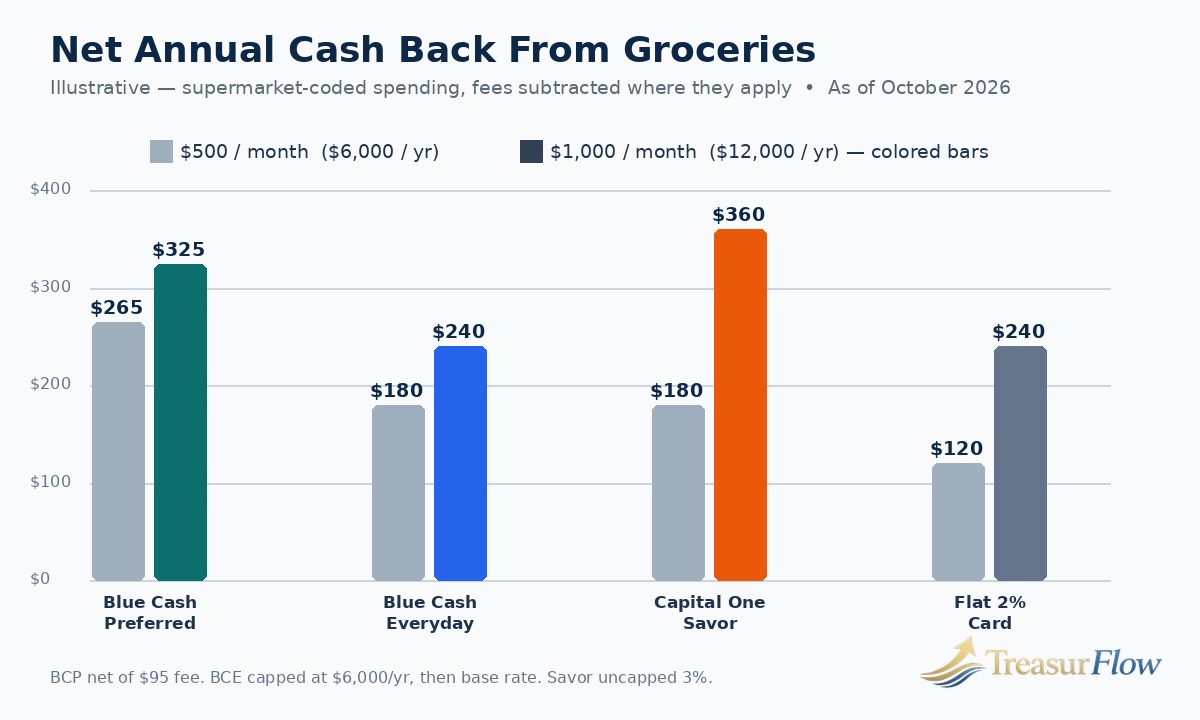
Percentages are advertising. Dollars are information. This section converts the main cash back contenders into annual dollars at two spending levels that bracket most households: $500 a month in groceries — $6,000 a year — and $1,000 a month — $12,000 a year, the low end of the USDA food plan range for a family of four, as of October 2026. Every figure below is illustrative — a teaching calculation built from the rates, caps, and fees stated in this guide as of October 2026, not a promise of what any individual household will earn. The calculations assume the spending earns each card’s grocery rate, which in practice means supermarket-coded spending for the supermarket cards. Spending at clubs and superstores will earn differently, for the coding reasons explained earlier.
At $500 a month: $6,000 a year in groceries
Start with the Blue Cash Preferred. Six percent on $6,000 is $360 in cash back. After the introductory year, subtract the $95 annual fee, and the BCP nets $265 for the year. That is the number to beat at this spending level, and at this spending level, nothing else in the cash back field beats it. The Blue Cash Everyday pays 3% on the same $6,000 — exactly at its cap, so no step-down applies — for $180, with no fee to subtract. The Capital One Savor pays the same 3%, uncapped, for the same $180, with no fee. A flat 2% card pays $120. So at $500 a month, the ranking is clear and the gaps are meaningful: the BCP nets $85 more than the 3% cards and $145 more than the flat card. If your spending sits right here and your store is a supermarket, the BCP’s fee is not a close call — it is covered more than three times over by the extra rate, $180 of additional gross cash back against a $95 charge.
At $1,000 a month: $12,000 a year in groceries
Now double the spending and watch the caps change the story. The Blue Cash Preferred earns 6% on the first $6,000 — $360 — and then 1% on the next $6,000 — $60 — for $420 in gross cash back. Subtract the $95 annual fee and the BCP nets $325. Still strong, still ahead of most of the field — but look at the Savor. Uncapped 3% on the full $12,000 is $360, with no fee, which means the simple no-fee card now beats the 6% headline card by $35 over the year. The cap did that. Half of the BCP household’s spending earned 1%, a rate below the flat card’s, and the fee took its cut on top. The Blue Cash Everyday at this level earns $180 on its first $6,000 at 3%, plus the base rate on the remaining $6,000, for $240 total — the same total as a flat 2% card’s $240 on $12,000, a neat illustration of how a capped 3% and a flat 2% converge once spending doubles past the cap.
The Amex Gold tells the points version of the same story. At $1,000 a month, its 4X rate applies to all $12,000 of supermarket spending, because its cap is $25,000 a year — the household earns 48,000 points before any cap math becomes relevant. Whether 48,000 points beats $360 in cash depends on redemption value: at exactly one cent per point, the points are worth $480 against the Gold’s $325 fee; taken at lower value, the cash cards win; transferred and used at higher value, the Gold pulls ahead. The guide’s position is not that one answer is right — it is that you must run your own redemption value through this arithmetic before the fee makes sense, and households that do not travel should not assume the favorable end of that range.
Stacking Two Cards: The Cap Fix and the Store Fix in One Wallet
The cap stack: a high-rate card first, an uncapped card after the cap
The cleanest stack pairs the Blue Cash Preferred with the Capital One Savor. The BCP takes the first $6,000 of supermarket spending each year at 6%. The moment the household crosses that cap — for a $1,000-a-month household, around the start of July — grocery spending moves to the Savor, which pays its uncapped 3% on everything above the cap instead of the BCP’s post-cap 1%. Run the $12,000-a-year example through this stack: $360 from the BCP’s first $6,000, plus $180 from the Savor’s 3% on the second $6,000, is $540 gross, and minus the BCP’s $95 fee, the household nets $445. Compare that to the single-card results from the cap math section — $325 for the BCP alone, $360 for the Savor alone — and the stack is worth $85 to $120 a year for the effort of switching which card you hand over at roughly mid-year. The no-fee version of the same stack pairs the Blue Cash Everyday with the Savor: the Everyday’s 3% and the Savor’s 3% are identical, so there is no gain while both are under the cap — the value there appears only above the Everyday’s $6,000 cap, where the Savor keeps paying 3% on dollars that would otherwise step down.
The store stack: a different card for a different merchant code
The second stack is organized by store rather than by time. The household’s supermarket card lives for supermarket trips only. Its club or superstore card — the Bank of America Customized Cash Rewards with its explicit grocery-and-wholesale-club category, a Costco card at Costco, or a plain flat-rate card — lives for the warehouse and superstore trips where the supermarket card’s bonus does not exist. Neither card is a backup for the other; each is the primary card for its own territory, and the rule at the checkout is a single question: which store am I standing in? That rule is easy to remember, easy to teach to a partner who shares the grocery shopping, and immune to caps arriving mid-year, because each card’s territory is defined by place rather than by cumulative spending.
How to Choose Your Grocery Card: Six Steps in Order
Step 1: Sort last month’s grocery spending by store. Use your bank statements or a budgeting app and divide the total into the four buckets from this guide: supermarkets, wholesale clubs, Walmart and Target, and online or Whole Foods. The biggest bucket chooses your first card. Do not proceed on a guess — the entire strategy depends on this being your real spending, and most people’s guesses about the split are wrong in the direction of the supermarket bucket.
Step 2: Name your monthly supermarket number specifically. Of the total, how much is at true, supermarket-coded stores? That single number drives the fee decision. Around $500 a month there points to the Blue Cash Preferred’s math — $265 net in our worked example. Well below it points to the no-fee Blue Cash Everyday or the uncapped Savor. Well above it points to the Savor, a stacking plan, or the Amex Gold if you are a points household.
Step 3: Decide cash back or points, honestly. Cash back cards in this guide return a knowable dollar figure. Points cards — the Amex Gold at 4X on up to $25,000 a year in supermarket spending and the Chase Sapphire Preferred at 3X on online grocery — return a figure that depends on your redemption skill and travel habits. If you do not already redeem points for travel, choose cash back and take the certain number. Points are a hobby with a payout, not a default.
Step 4: Subtract every fixed cost before you compare. Annual fees come off the top: $95 for the Blue Cash Preferred after its introductory year and for the Sapphire Preferred, $325 for the Amex Gold, as of October 2026. So do memberships you would buy only for the card — Costco membership for the Costco card, Prime for the Amazon Prime Visa. A no-fee card that earns $180 beats a fee card that earns $200 gross and $105 net, and this exact inversion is the most common arithmetic error in grocery card comparisons.
Step 5: Plan the cap before it plans you. If your chosen card has a cap — $6,000 a year on the Amex cash cards’ supermarket categories, $2,500 a quarter combined on the Bank of America card’s bonus categories, $25,000 a year on the Amex Gold’s supermarket category, all as of October 2026 — decide now what happens the month you cross it. The answer is usually the stacking move: an uncapped card like the Savor takes over. Deciding in advance turns a cap from a silent rate cut into a scheduled hand-off.
Step 6: Verify on your first statement, then automate. Whatever you choose, make your normal shop at your normal store, then check the statement and confirm the bonus rate actually posted on that merchant. If it did not, your store’s coding is not what you assumed, and it is far better to learn that on a $40 trial shop than after a year of $500 shops. Then set up autopay for the full statement balance. That one setting protects more money than any decision in this guide, because a single month of interest on a grocery balance costs more than the annual difference between the best and worst cards here. The Consumer Financial Protection Bureau’s credit card guidance, linked in the resources box at the top of this guide, is worth ten minutes on exactly this point — and before applying anywhere, pull your free credit reports from AnnualCreditReport.com, also linked above, so you know the credit profile a issuer will see.
Mistakes That Cost Shoppers Their Grocery Rewards
The first mistake is the one this whole guide is built against: buying a supermarket card for superstore spending. A household that applies for a 6% supermarket card and then does its weekly shop at Walmart has not bought a 6% card in any sense that matters — it has bought a base-rate card with, after the first year, a $95 fee attached. The fix is never a different supermarket card. It is a card whose rate does not depend on the supermarket code, used at the store that does not carry that code.
The second mistake is ignoring the cap until the statement surprises you. Capped cards do not send a warning letter when the bonus ends; the rate simply steps down, and a household spending $1,000 a month at supermarkets can spend half the year earning 1% on a card it thinks of as its 6% card. The fix is the calendar habit and the uncapped backup from the stacking section — or, for households that know they will never track it, choosing the uncapped card from the start and surrendering the higher peak rate for a rate that never moves.
The fifth mistake is the oldest one in rewards cards, and it outweighs the other four combined: carrying a balance. Grocery spending is recurring, unavoidable, and easy to underestimate, which makes a grocery card a quiet way to build a balance — and interest on that balance will exceed the cash back at any rate in this guide. The Federal Reserve’s G.19 consumer credit release, linked above, tracks what revolving credit costs American households in aggregate; the individual version of that statistic is a grocery card statement with an interest charge larger than its rewards line. If a balance is part of your current picture, the best grocery card is the one you pay off — and rewards shopping resumes, profitably, once every shop can be paid in full.
Conclusion: Match the Card to the Cart
The best grocery credit cards 2026 has to offer are not a single ranking — they are a matching exercise. Supermarket households win with the Blue Cash Preferred’s 6% up to its $6,000 cap if their spending justifies the $95 fee after the first year, with the Blue Cash Everyday’s clean no-fee 3% if it does not, and with the Capital One Savor’s uncapped 3% when spending runs past every cap. Points households with heavy supermarket or online grocery spending have the Amex Gold’s 4X on up to $25,000 a year and the Chase Sapphire Preferred’s 3X on online grocery to price against their own redemption values. Club households should use cards that name their territory — the Bank of America Customized Cash Rewards at 2% for grocery stores and wholesale clubs, or the Costco Anywhere Visa’s 2% at Costco for members. Walmart and Target households should stop chasing supermarket rates that generally do not apply to their stores and take the honest uncapped or flat-rate return instead. Prime members at Whole Foods have a clean 5% waiting for them. And nobody, in October 2026, should plan around applying for the closed Citi Custom Cash.
Do the work in the order this guide presents it. Sort your spending by store. Run the cap math on your real monthly number, not a hopeful one. Subtract every fee and membership before you compare. Verify the rate on your first statement. Pay in full, automatically, forever. Followed in that order, those five habits are worth more than the difference between any two cards in this article — and with the right card underneath them, a household spending $500 to $1,000 a month on groceries can expect roughly $180 to $445 a year back from spending it was going to do anyway, as of October 2026. That is the grocery card game played correctly: not the biggest headline, but the biggest number that actually posts.
Grocery Card Questions Shoppers Ask at the Checkout
Do Walmart and Target purchases count as supermarket spending on grocery credit cards?
Generally no. Walmart and Target superstores are usually assigned merchant category codes for discount stores or superstores rather than supermarkets, and card issuers decide bonus categories from that code, not from the items in your cart. That means a card paying 6% at U.S. supermarkets will generally pay only its base rate at Walmart and Target, even if everything you bought was food. Superstore shoppers are usually better served by an uncapped or flat-rate card whose return does not depend on the supermarket code, and every shopper should confirm how their own store codes by checking the first statement.
Is the Blue Cash Preferred worth the $95 annual fee for groceries?
It depends on how much you spend at U.S. supermarkets. At $500 a month in supermarket spending, the card earns $360 at 6% on $6,000 a year, which nets $265 after the $95 annual fee that applies after the $0 introductory first year, as of October 2026. That is ahead of the $180 a no-fee 3% card earns on the same spending. At much lower supermarket spending, the fee consumes the advantage, and a no-fee card such as the Blue Cash Everyday or the Capital One Savor is the better choice. Multiply your annual supermarket spending by 3% to estimate whether the higher rate covers the fee for you.
What happens when I reach the $6,000 supermarket cap on an Amex Blue Cash card?
The bonus rate steps down for the rest of the year. On the Blue Cash Preferred, supermarket purchases earn 6% on the first $6,000 each year and then 1% on further supermarket spending, as of October 2026. In practice, a household spending $1,000 a month at supermarkets reaches the cap about halfway through the year. Many households handle this by switching grocery spending to an uncapped card, such as the Capital One Savor at 3%, once the cap is reached, instead of accepting the lower rate for the remaining months.
Which grocery credit card is best for Costco shoppers?
Costco purchases generally do not earn supermarket bonus rates, because a wholesale club is not coded as a supermarket. Existing Costco members can earn 2% back at Costco with the Costco Anywhere Visa Card by Citi, and a paid Costco membership is required, as of October 2026. Another option is the Bank of America Customized Cash Rewards card, which pays 2% at grocery stores and wholesale clubs, subject to its $2,500 combined quarterly cap on its bonus categories. If you are not already a member, include the membership cost in your math before deciding the card is worth it.
Is an uncapped 3% card ever better than a 6% capped card?
Yes, at high grocery spending it can be. The Capital One Savor pays 3% on groceries with no cap and no annual fee, so at $1,000 a month it earns $360 over a year. The Blue Cash Preferred at the same spending earns $360 at 6% on the first $6,000 plus $60 at 1% on the next $6,000, for $420, and nets $325 after its $95 annual fee, as of October 2026. The uncapped card wins that comparison by $35, which is why heavy spenders should run the cap math on their own monthly spending instead of choosing by headline rate alone.
Can I still apply for the Citi Custom Cash for 5% back on groceries?
No, not as a new applicant. The Citi Custom Cash, which paid 5% on a cardholder’s top eligible spending category on up to $500 per billing cycle, is closed to new applicants as of October 2026. Older guides and videos may still recommend it, but a new shopper should not build a grocery strategy around applying for it. Choose instead from currently available options such as the Blue Cash Preferred, the Blue Cash Everyday, or the uncapped Capital One Savor, and confirm application availability on the issuer’s own page before you apply.

Muhammad Zakir is the founder of Treasurflow and the author of its personal finance guides. He researches consumer banking, credit, and personal loans, and every guide cites primary sources such as the CFPB, FDIC, FTC, and IRS. His content is educational and is not personalized financial advice.