
Most small businesses do not fail because they picked the wrong logo or the wrong point-of-sale system. They get into serious trouble because one uninsured event — a customer injury, a kitchen fire, an employee accident, a ransomware lockout — arrives before they have built the right protection underneath the business. Business insurance is not a single policy you buy once and forget. It is a stack of coverages, each one handling a different kind of loss, and the best business insurance 2026 buyers can put together is the stack that matches their premises, their people, their vehicles, and their data.
This guide walks through the full stack layer by layer, starting with the business owner’s policy — the bundle most small businesses buy first — and then adding the layers a BOP does not include. It explains what state law actually requires, what landlords and clients require in practice even when the law does not, how much published benchmarks suggest small businesses pay as of October 2026, and how the major buying routes compare: online-first carriers such as NEXT Insurance, Hiscox, biBERK, and Thimble; established small-business insurers such as The Hartford, Travelers, State Farm, and Chubb; and marketplaces and brokers such as CoverWallet that can show you more than one quote at a time.
Related Guides
- Understanding liability limits and how they work in practice: Primary liability insurance explained
- If your business handles customer data, pair cyber cover with personal protection thinking: Best identity theft protection services 2026
Helpful Official Resources
The Coverage Stack, Explained Layer by Layer
Think of business insurance as layers, because each policy was designed for a different balance-sheet problem.
The bottom layer protects you when your business harms someone else or damages their property. That is general liability. The next layer protects your own stuff — your building, equipment, stock, and furnishings. That is commercial property. The next layer protects your income when a covered property loss forces you to close for repairs. That is business interruption, also called business income insurance. Those three layers are so commonly needed together that insurers bundle them into the business owner’s policy, or BOP.
Layer One Inside the BOP: General Liability Insurance
General liability insurance, often shortened to GL and formally written as commercial general liability, responds when a third party claims your business caused bodily injury, property damage, or certain personal and advertising injuries. The classic examples are consistent across the SBA and NAIC guidance: a customer slips on a wet floor and breaks a wrist; your employee damages a client’s property while working at their site; a competitor alleges your advertising copied their slogan or defamed them. A GL policy typically helps pay medical expenses, repair or replacement costs for damaged property, and — critically — legal defence costs and settlements or judgments, subject to your limits and the policy’s terms.
Defence costs are the part new owners underestimate. A claim does not need to succeed to be expensive. Once a lawsuit is filed, attorneys, filings, expert opinions, and time away from running the business start costing money immediately. General liability is therefore the layer landlords, venues, general contractors, marketplaces, and larger clients most often ask to see first, usually as a certificate of insurance showing at least $1 million per occurrence and $2 million in aggregate. Those $1 million / $2 million limits have become the common small-business default, not because every business faces the same risk, but because so many leases and contracts were written around them.
Layer Two Inside the BOP: Commercial Property Insurance
Commercial property insurance protects the physical assets your business owns or is responsible for under its lease: a building you own, tenant improvements you paid for, furniture, computers, machinery, tools that stay at your premises, signage, and inventory or stock. Covered causes of loss commonly include fire, smoke, wind and hail, vandalism, and theft, subject to the policy form. Flood and earthquake are typically excluded from standard commercial property forms and, where you need them, are bought separately or added by specific endorsement. That exclusion surprises owners in flood-prone areas every year, so check it explicitly rather than assuming “property cover means all weather.”
Two valuation words in a property policy change what you actually receive after a loss. Replacement cost coverage aims to pay the cost of repairing or replacing damaged property with property of similar kind and quality, subject to limits and deductible. Actual cash value coverage subtracts depreciation, so an older piece of equipment may be valued well below what it costs to replace it and get back to work. Replacement cost usually costs more in premium, but for equipment you genuinely need to replace, it is often the more honest comparison. Either way, your limit should reflect a current inventory: list equipment, estimate replacement values, photograph serial numbers, and update the list when you buy something major. An out-of-date schedule is a quiet way to be underinsured without realising it.
Layer Three Inside the BOP: Business Interruption Insurance
Business interruption insurance, called business income insurance in many policy forms, helps replace lost income and pay continuing expenses when a covered property event forces you to suspend or slow operations. If a fire damages your shop and you must close for three weeks of repairs, property insurance addresses the physical damage; business income coverage addresses the rent that still comes due, the payroll you want to protect, loan payments, taxes, and the net income you would have earned. Many forms also address extra expense — the reasonable additional cost of operating from a temporary location or expediting repairs so you can reopen sooner.
The NAIC notes that business interruption coverage is typically bundled inside a BOP alongside property and liability, and that companies with 100 or fewer employees and revenues up to about $5 million are the typical BOP-eligible market, though exact eligibility varies by carrier and industry. The NAIC also cites a sobering Federal Emergency Management Agency observation that about 25 percent of businesses fail to reopen after a disaster. No policy can guarantee a business reopens — customers move on, staff find other work, and cash reserves differ — but income coverage is the layer designed to buy time while physical repairs happen.
The BOP Anatomy: Why the Bundle Comes First
A business owner’s policy bundles general liability, commercial property, and business interruption into one policy with one premium, one renewal date, and usually a lower combined price than buying the same three coverages separately. The NAIC describes the BOP as a package product for small businesses, and the SBA similarly presents it as a way to simplify buying and potentially save money compared with separate policies. For a retail store, a small office, a cafe, a salon, a workshop, or a professional firm with premises and equipment, the BOP is therefore the natural starting quote.
A good BOP is also customisable, within limits. Common endorsements and options include equipment breakdown coverage for mechanical or electrical failure, signs coverage, accounts receivable coverage, valuable papers coverage, employee dishonesty coverage, hired and non-owned auto liability in some cases, and small data-related sublimits. Some carriers offer industry-tailored BOPs — for restaurants, retailers, contractors, or professional offices — that pre-select endorsements those buyers commonly need. Industry tailoring can be genuinely useful, but it does not remove the need to check limits: a “restaurant BOP” with a property limit below your equipment value or an income limit below a realistic closure period is still underinsured for your restaurant.
The Layers a BOP Leaves Out — and Why They Matter Just as Much
Workers’ Compensation: The Employee-Injury Layer
Workers’ compensation insurance provides medical care, a portion of lost wages, rehabilitation support, and, in the tragic case of a work-related death, a funeral or death benefit for employees who are injured or become ill because of their work. In exchange, the workers’ compensation system generally becomes the employee’s exclusive remedy against the employer for a covered workplace injury, which is why the system protects both workers and owners when it works as designed.
The NAIC states the legal position clearly: workers’ compensation coverage is mandatory for most employers in every state except Texas. Texas allows private employers to opt in — employers who buy coverage are often called subscribers, and those who do not are non-subscribers. Non-subscriber status in Texas does not mean “no responsibility.” A Texas employer without workers’ compensation can face direct negligence lawsuits from injured employees and loses certain common-law defences that subscribers retain. Government contracts in Texas can also require coverage even when state law does not require it for a purely private job. In short, Texas is the exception to the mandate, not an exception to the risk.
Every other state requires coverage for most employers, but the details differ in ways that matter at hiring time. States set different employee-count thresholds, different rules for sole proprietors, partners, LLC members, and corporate officers, different exemptions for very small or agricultural employers, and different rules for independent contractors — who are generally not employees, though misclassifying a worker as a contractor does not make the underlying obligation disappear. Four states and two territories use monopolistic state funds where you must buy workers’ compensation from the state programme rather than a private carrier: North Dakota, Ohio, Washington, and Wyoming, plus Puerto Rico and the U.S. Virgin Islands, according to NAIC and NerdWallet summaries of state systems. Large, financially strong employers may be allowed to self-insure in many states if they meet strict qualification standards, but that is rarely a realistic route for a small business.
Commercial Auto: The Vehicle Layer
If your business owns, leases, or regularly uses vehicles for work — delivery vans, service trucks, catering vehicles, sales cars titled to the business — you need commercial auto insurance. A personal auto policy typically excludes or limits business use, and a serious crash is the worst possible time to discover that the vehicle doing business work was insured as if it were only doing personal errands. Commercial auto can include liability for bodily injury and property damage you cause to others, collision and comprehensive cover for your own vehicle, medical payments or personal injury protection where applicable, and uninsured or underinsured motorist coverage, depending on state law and the options you select. Most states require liability coverage for vehicles owned by a business, just as they do for personal vehicles, though required minimums and additional mandates vary by state and vehicle type.
Commercial auto also handles a gap many service businesses miss: hired and non-owned auto, often called HNOA. If an employee drives their own car to a client site, rents a van for a weekend event, or runs a delivery in a borrowed vehicle and causes a crash, your business can be sued even though it does not own the vehicle. HNOA liability coverage is designed for that exposure and is often available as an endorsement or as part of a commercial auto policy. It does not replace the driver’s personal policy, and it does not repair your employee’s own car, but it addresses your business liability for a vehicle you hired or do not own.
Food and mobile businesses feel this layer most directly. A food truck is simultaneously a commercial kitchen, a retail premises, and a vehicle, so its owners usually need to think about BOP or package cover for the business, commercial auto for the truck on the road, and equipment and income cover for the kitchen inside it. If that is your business, our guide to food truck finance is a useful companion on the cost side while you price the insurance side here. More broadly, any contractor, caterer, cleaner, real-estate professional, or sales team that drives between client locations should raise the vehicle question explicitly, even if no vehicle is titled to the business today.
Cyber Liability: The Data and Systems Layer
Cyber liability insurance — sold as cyber insurance, data breach insurance, or as part of a broader technology policy — helps a business respond to and recover from data breaches, ransomware and other cyberattacks, and certain technology failures. A modern policy is usually described in two halves. First-party coverage addresses your own costs: forensic investigation to find out what happened, data and system restoration, customer notification and call-centre support, credit monitoring where offered or required, public relations help, legal guidance on breach-notification laws, business income lost during a covered system outage, and, where the policy and the law allow, ransomware response costs. Third-party coverage addresses claims against you: lawsuits from customers or partners whose data was exposed, regulatory proceedings and insurable fines or penalties, payment-card assessments, and liability if your compromised system harms someone else’s network.
No small business should assume it is “too small to be targeted.” Automated attacks do not check revenue before trying a weak password, an unpatched system, or a convincing phishing email. The businesses that feel a breach most acutely are often the ones with the least spare cash and no in-house IT team: an online store that cannot take payments for a week, a clinic or firm that must notify hundreds of people, a retailer whose point-of-sale provider requires evidence of an investigation. At the same time, cyber insurance is not a substitute for basic controls. Insurers increasingly ask at application — and expect honest answers — about multi-factor authentication, regular backups kept separate from the main network, endpoint protection, prompt patching, and staff phishing training. Weak or misrepresented controls can raise price, limit options, or complicate a claim.
Professional Liability (E&O): One Layer of the Stack
Professional liability insurance, also called errors and omissions or E&O, covers claims that your professional service, advice, design, or failure to deliver as promised caused a client financial loss. It is the layer for consultants, agencies, accountants, architects, engineers, IT providers, real-estate professionals, and other service firms whose main product is expertise. A general liability policy responds to bodily injury and property damage; professional liability responds to economic loss from a professional mistake. Many service businesses need both.
Keep this layer in proportion in the stack — essential if you sell advice or services, unnecessary as a headline purchase if you do not — and note two features that return later in this guide. First, most professional liability policies are written on a claims-made basis, so the retroactive date and what happens when you switch carriers matter a great deal. Second, contract requirements drive many E&O purchases: clients often name a limit, require a certificate, and require notice if the policy is cancelled. As of October 2026, Insureon reports a median professional liability cost of $88 per month among its small-business customers. Buyers who need a full E&O buying guide should treat this section as the map, not the territory, and get profession-specific quotes — E&O forms are tailored by profession because the mistakes that cause claims differ by profession.
Other Layers Worth Naming Before You Buy
A complete stack review names the layers you decide not to buy, so the decision is conscious. Commercial umbrella insurance adds extra liability limits above your GL, commercial auto, and employers liability limits, and can be a cost-effective way to reach a $2 million, $5 million, or higher limit a contract requires. Employment practices liability insurance, or EPLI, addresses claims by employees alleging discrimination, wrongful termination, or harassment — claims general liability does not handle. Product liability, sometimes included in GL for retailers and manufacturers and sometimes bought separately, addresses harm from a product you make, distribute, or sell. Inland marine coverage follows tools, equipment, and goods in transit or at temporary locations, where a premises-based property policy may stop. Each of these is a real layer for some businesses and an unnecessary expense for others; the test is always the same — name the loss you fear, then find the policy section that actually responds to it.
State-Requirement Reality: What the Law Requires vs. What Contracts Require
Owners often ask for a single list of “required insurance.” There is no single national list, because business insurance in the United States is regulated primarily at the state level. What exists instead is a pattern you can rely on, plus state-specific details you must verify for your own business.
Workers’ compensation is required for most employers in every state except Texas, as described above, with state-specific thresholds and exemptions. Unemployment insurance tax registration is a separate employer obligation the SBA flags alongside workers’ compensation — it is a tax programme, not a commercial policy you buy from a carrier, but new employers miss it surprisingly often. Disability insurance is required by a small number of states for eligible employees for non-work-related illness or injury; the SBA lists California, Hawaii, New Jersey, New York, and Rhode Island, plus Puerto Rico, as jurisdictions with such requirements. If you have employees in more than one state, you may have obligations in each state, not just the state where the business is headquartered.
Commercial auto liability is required in most states for vehicles you own or use for business, subject to state minimum limits and vehicle rules. Commercial property, general liability, cyber, and professional liability are generally not required by state law for most businesses — and that sentence misleads many owners, because “not required by law” does not mean “not required to trade.” Landlords require GL and often property and income cover as lease conditions. Lenders require hazard and property insurance on collateral, and SBA-backed lenders require evidence that required insurance is in place. Clients, general contractors, franchisors, marketplaces, and government contracts require GL, professional liability, workers’ compensation, commercial auto, and increasingly cyber, at named limits, with certificates and sometimes additional-insured endorsements. A business can be fully legal and still unable to sign its lease or its biggest contract because it lacks a policy no statute forced it to buy.
Best Business Insurance Providers in 2026, by Buyer Type
There is no honest single winner for every business, because carriers specialise. Some are built for speed: quote, pay, and download a certificate in minutes, with no agent conversation. Some are built for breadth: one carrier that can write your BOP, workers’ compensation, commercial auto, umbrella, and specialty lines as you grow, often through an agent who knows your industry. Some are marketplaces: they do not insure you themselves, they show you quotes from several carriers for the same application. The picks below are organised by buyer type for that reason. All provider descriptions are based on what the providers publish about their own products and routes to buy, checked as of October 2026; availability varies by state and industry, and a provider that declines your class is not a bad provider — it is a provider whose appetite lies elsewhere.
Best Online-First for Solo Operators and Micro-Businesses: NEXT Insurance
NEXT Insurance (now also styled ERGO NEXT following its acquisition) built its reputation on a fully online purchase: answer questions, get a quote, buy, and manage certificates digitally, with self-service certificates that suit freelancers, contractors, consultants, cleaners, fitness professionals, and other micro-businesses that need proof of insurance quickly for a client or platform. NEXT publishes general liability starting prices from $19 per month for some low-risk businesses — a floor for the lowest-risk profiles, not a typical price — and sells BOP, professional liability, workers’ compensation, commercial auto, and cyber-related options for eligible classes. Choose NEXT first when speed and digital self-service matter most and your operation is straightforward enough to describe accurately in an online application. If your risk involves subcontractors, unusual operations, or multiple locations, confirm the online class description truly matches your work before you bind.
Best for Professional Services and E&O Depth: Hiscox
Hiscox has specialised in small-business and professional-services insurance for decades, with professional liability forms tailored by profession — consultants, IT professionals, designers, marketers, health and wellness practitioners, and many others — alongside general liability, BOP, and cyber options sold online and through partners. Hiscox publishes professional liability starting prices around $22.50 to $23 per month and general liability from about $30 per month for low-risk profiles, again as starting points rather than typical bills. Choose Hiscox first when the professional liability layer is the centre of your stack and you want the E&O wording built around your actual profession. Note that Hiscox does not sell workers’ compensation directly in the same way full-line carriers do, so employers may place that layer elsewhere.
Best for Buying Direct and Cutting Out Broker Fees: biBERK
biBERK, part of the Berkshire Hathaway group, sells directly to businesses online and by phone with licensed specialists, positioning direct purchase as a way to avoid broker mark-ups — it markets potential savings of up to 20 percent compared with buying through intermediaries, which is the company’s own claim and can only be tested with a like-for-like quote. Its range covers BOP, general liability, professional liability, workers’ compensation, commercial auto, and umbrella for eligible businesses. Choose biBERK first when you want a direct relationship with the carrier, are comfortable buying without an independent broker shopping for you, and want to compare a direct price against an agent or marketplace quote for exactly the same limits. Its Berkshire Hathaway backing is a financial-strength talking point the company itself emphasises; verify the specific underwriting company’s current AM Best rating on the quote documents you receive rather than relying on any summary, including this one.
Best Broad Small-Business Carrier With Agent Support: The Hartford
The Hartford has insured small businesses for more than two centuries and is the default agent-led and hybrid option in many roundups for a reason: a broad Spectrum business owner’s policy that can be customised with data-breach, professional liability, employment practices, and equipment-breakdown options, plus standalone workers’ compensation, commercial auto, and umbrella lines, sold online, by phone, and through independent agents. The Hartford publishes average figures for its own small-business customers — around $68 per month for general liability and around $141 per month for a BOP in figures cited in 2026 cost guides — which sit above Insureon’s medians, reflecting a different, somewhat larger customer mix. Choose The Hartford first when you have employees, want one established carrier that can grow with you across several lines, or want a human agent conversation without giving up online servicing. Its workers’ compensation support services and return-to-work resources are a genuine differentiator for employers, not just a product list.
Best for Mid-Sized and More Complex Risks: Travelers
Travelers is one of the largest U.S. commercial insurers and is typically reached through independent agents rather than a quick online bind. That route suits businesses that have outgrown a simple BOP: multiple locations, higher property values, fleets, manufacturing or contracting operations, or specialty liability needs. Travelers’ small-business and middle-market BOP and package options, workers’ compensation, commercial auto, cyber, and umbrella breadth make it a strong agent-led quote to request when a direct online flow starts declining your class or forcing awkward descriptions of what you do. Choose Travelers when complexity, not checkout speed, is your main problem, and expect the process to involve more underwriting questions — that is a feature for a complex risk, not a flaw.
Best for Agent-Led Local Service: State Farm
State Farm sells business insurance through its large local-agent network, including BOP, commercial auto, workers’ compensation through partner arrangements in some cases, liability, and specialty small-business options depending on state. For owners who value a local agent they can visit — retailers, trades, and Main Street businesses in particular — State Farm is often the familiar name on the quote list. Choose State Farm first when face-to-face agent service matters more than an instant online bind, and compare its BOP quote carefully on property limits and income coverage, because agent-sold packages can differ meaningfully in endorsements included by default.
Best for Higher Limits and Premium Claims Expectations: Chubb
Chubb serves small businesses through agents and partners and is better known for mid-sized, affluent, and higher-value businesses that need higher limits, broader forms, and a premium claims reputation they are willing to pay for. Its small commercial BOP and specialty offerings, cyber strength, and international capability suit businesses with valuable property, professional exposure, or operations beyond a single U.S. location. Choose Chubb when your property values, contracts, or risk profile have pushed you beyond standard small-business forms — and budget accordingly. It is rarely the cheapest quote, and it does not try to be.
Best for Short Jobs, Events, and Seasonal Work: Thimble
Thimble specialises in flexible, short-duration coverage: buy general liability and certain other covers by the job, by the month, or for a specific event, manage it in an app, and pause or cancel when the work stops. Published starting prices include general liability from around $17 per month for qualifying micro-business profiles. Choose Thimble first when your exposure is genuinely temporary — a market stall for a season, a contractor job that requires a certificate, an event, a side business testing demand — rather than paying for an annual policy you will not use. If the work becomes year-round, re-quote on an annual basis; annual policies are often better value for continuous exposure and avoid gaps between short terms.
Best for Comparing Several Carriers in One Application: CoverWallet and Marketplaces
CoverWallet, now part of Aon’s small-business offerings, and marketplaces such as Insureon and Simply Business (owned by Travelers) do not primarily underwrite your policy — they route your application to multiple carriers and show competing quotes, sometimes with adviser support. Choose a marketplace first when you do not know which carrier writes your class competitively, when you have been declined or non-renewed, or when you simply want the discipline of seeing two or three prices for identical limits before you decide. The discipline matters more than the platform: whichever route you use, compare the same limits, the same deductibles, the same endorsements, and the same class description, or you are comparing different products that happen to share a name.
Picks by Industry, in Brief
Retail and e-commerce: start with a BOP from The Hartford, NEXT, State Farm, or biBERK; add cyber as soon as you take card payments or hold a customer list, and product liability thinking if you import or white-label goods. Restaurants and food service: start with a BOP built for food risks, workers’ compensation priced on your real payroll, commercial auto if you deliver, and spoilage and equipment-breakdown endorsements checked by name. Contractors and trades: start with GL or a contractor BOP, commercial auto or HNOA, workers’ compensation with correct class codes, and inland marine for tools that travel; expect contracts to dictate your limits. Consultants and agencies: start with GL plus professional liability from Hiscox, NEXT, or The Hartford, add cyber if you touch client systems or data, and skip heavy property cover if you genuinely have little property to protect. Health, wellness, and personal services: confirm professional liability covers your specific service, check abuse and molestation or allied-health provisions where relevant, and do not assume a general BOP endorsement answers a profession-specific claim. Home-based businesses in any industry: solve the homeowners-policy gap first with a BOP or an in-home business endorsement that actually matches your revenue and visitor exposure.
What Business Insurance Costs in 2026: Factors and a Worked Example
Cost is where most buying guides either invent a single “average” or drown you in tables. The honest middle path is to show the published medians, explain what moves your price away from them, and then add the medians together — transparently — so you can see what a full stack, not a single policy, actually budgets to.
Published Medians, Attributed
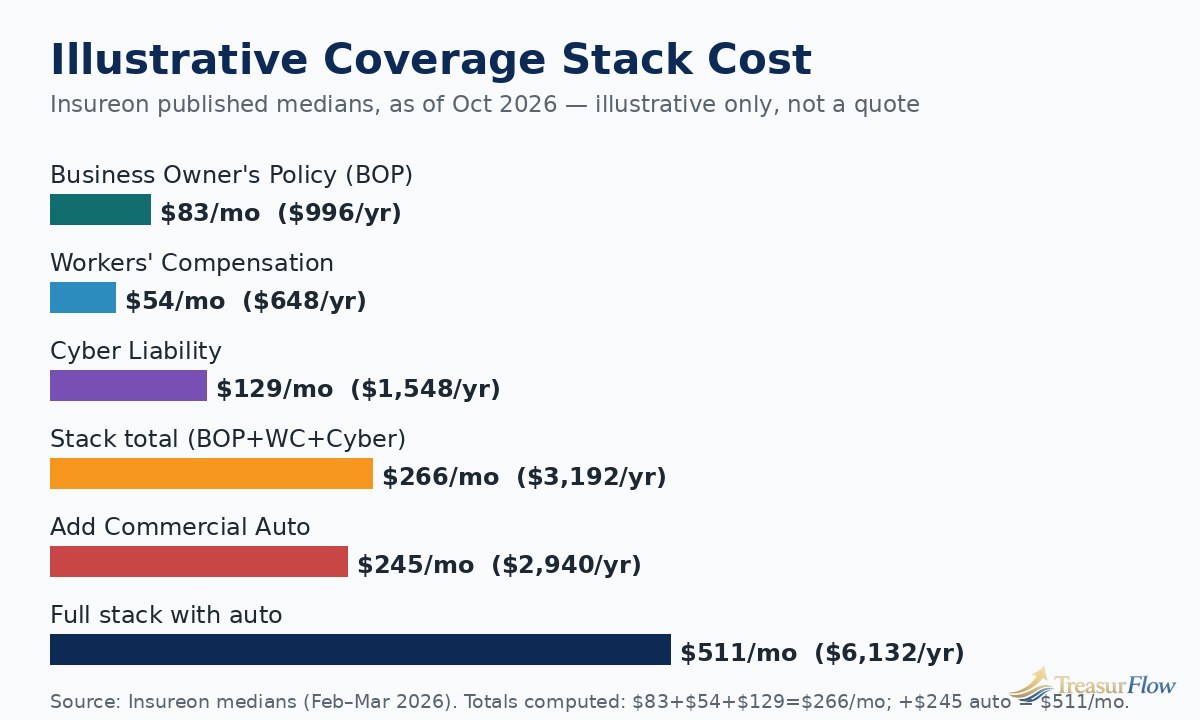
Insureon’s published medians for its small-business customers, updated in February and March 2026 and widely cited across 2026 cost guides, are as follows as of October 2026: general liability, $45 per month; business owner’s policy, $83 per month; workers’ compensation, $54 per month; professional liability, $88 per month; cyber insurance, $129 per month; and commercial auto, $245 per month. Insureon’s customer base skews very small — many are sole proprietors or firms with a handful of employees and modest revenue — so larger or higher-risk businesses should expect to sit above these medians, sometimes far above. MoneyGeek’s separate modelled averages for BOPs across dozens of industries, by contrast, cluster higher, around $115 to $178 per month depending on carrier in its 2026 BOP comparison for businesses with two employees. Both can be true at once: they describe different customer mixes and methods. That is precisely why a median is a budgeting benchmark, not a quote.
The Seven Factors That Move Your Premium
Industry class is usually the largest factor. Insurers price the claim history of businesses like yours, so a roofer, a restaurant, and a copywriter with identical revenue do not pay identical GL prices. Revenue and payroll size the exposure: more sales usually mean more customer interactions and more value at risk; more payroll, classified by job type, directly drives workers’ compensation. Location matters through state regulation, litigation environment, weather and crime exposure for property, and state workers’ compensation rates. Limits and deductibles trade directly against premium: higher limits cost more; a higher property deductible lowers premium but leaves you paying more of the first loss yourself, so only choose a deductible you could actually pay on a bad week without borrowing. Property values and construction — what your building is made of, how old its roof and systems are, how far it is from a fire station, and whether it has sprinklers and alarms — move the property section. Claims history and experience modifiers reward clean records over time and penalise repeated claims, sometimes for years. Finally, controls and risk management — training, safety programmes, cyber controls, driver checks — increasingly influence both price and eligibility, especially for workers’ compensation, commercial auto, and cyber.
A Worked Stack Example, Computed From the Medians Above
The following example is illustrative only. It is not a quote, a prediction, or a price offered by any carrier. It simply adds Insureon’s published medians above, computed with basic arithmetic, so you can see the difference between budgeting for one policy and budgeting for a stack. All figures as of October 2026.
Imagine a small retail shop with a leased storefront, two employees, a point-of-sale system holding customer payment and contact data, and no business-owned vehicle. Its stack is a BOP at the $83 monthly median, workers’ compensation at the $54 monthly median, and cyber insurance at the $129 monthly median. Added together: $83 plus $54 plus $129 equals $266 per month, which is $3,192 per year. An owner who budgeted only for “business insurance” by looking up the $45 general liability median would have underestimated the annual stack by thousands of dollars — not because any figure was hidden, but because the stack has three layers, not one.
Now give the same shop a delivery van it owns. Add commercial auto at the $245 monthly median: $266 plus $245 equals $511 per month, or $6,132 per year. The van more than doubles the stack, which matches how owners experience commercial auto in real life — it is often the single most expensive line for a small business that drives.
Claims-Made vs. Occurrence: One Short Section You Should Not Skip
Most general liability policies for small businesses are written on an occurrence basis: the policy that was in force when the injury or damage occurred is the policy that responds, even if the claim is reported later. That is intuitive, and it is one reason GL switches between carriers are relatively clean.
Most professional liability, cyber, and some other specialty liability policies are written on a claims-made basis: the policy in force when the claim is first made against you — and reported, as the form requires — is the one that responds, and it usually only covers wrongful acts that happened on or after a date printed in the policy called the retroactive date. Two consequences follow. First, never let a claims-made policy lapse casually; a gap can mean a claim made next month about work you did last year has no home. Second, when you switch claims-made carriers, protect your retroactive date — carry it forward to the new policy, or buy an extended reporting period, often called tail coverage, from the old carrier so old work can still be reported. Owners who switch E&O or cyber carriers for a small saving and silently reset their retroactive date to the switch date have, in effect, uninsured their past work. Ask one direct question on every claims-made switch: “What is my retroactive date on the new policy, in writing?” If the answer is today’s date and you have prior work you care about, stop and solve that before you celebrate the saving.
What Business Insurance Does Not Cover
A clear-eyed list of exclusions prevents more disappointment than any sales pitch. Business insurance, including a well-built stack, does not cover intentional or criminal acts by the insured. It does not cover flood or earthquake damage to your property under standard property forms — those need separate policies or endorsements where available. It does not cover wear and tear, mechanical breakdown (unless equipment-breakdown cover was added, and then only as that section provides), or the cost of fixing your own faulty work itself, though GL may respond to resulting damage your faulty work causes to other property, depending on the form. It does not cover employee injuries under GL, professional mistakes under GL, vehicle crashes under GL or a BOP, or data breaches under a standard BOP beyond any small sublimit — each of those needs its own layer, as the stack sections above explain.
Finally, no policy covers a claim you fail to report as the policy requires, work you misdescribed in the application, or operations you added and never told the carrier about. Accuracy at application is not paperwork pedantry; it is the foundation the claim will be tested against. If your business changes — new service, new vehicle, new location, first employee — tell your carrier or agent when it changes, not at renewal.
If you own your home and run any part of the business there, the same exclusion logic applies on the personal side. Owners comparing best homeowners insurance 2026 options should check the home policy’s business exclusions at the same time they price the BOP, so the two policies together leave no gap at the address where the business actually operates.
How to Buy: Direct Online vs. Broker or Agent
There are three honest routes to the same stack, and the best route depends on complexity, not on loyalty to a channel.
Direct online — through carriers such as NEXT, Hiscox, biBERK, or Thimble, or an insurer’s own website — is fastest for straightforward risks. You answer the application, you see a price, you bind and download a certificate, often in minutes. It suits solo operators, micro-businesses, and owners whose lease or client needs a certificate today. Its limits are the mirror of its speed: you choose the limits, you describe your class, and you spot the missing endorsement, with no adviser obligated to catch your error. If you buy direct, slow down on three screens — class description, limits and retroactive dates, and exclusions and endorsements — because those are where self-service mistakes live.
An independent broker or agent shops multiple carriers for you, advises on limits and endorsements, helps place unusual or higher-risk classes, and assists at claim time. That help is most valuable when you have employees, vehicles, multiple locations, prior claims, contract reviews, or an industry where placement is the problem. Brokers are paid by commission from the carrier in most small-commercial placements, which does not make the advice free of incentives — ask which carriers they represent and whether a quote list actually contains competing options — but a good broker who knows your industry routinely earns their place the first time a certificate, endorsement, or audit dispute needs handling. Captive or direct agents, such as local State Farm agents, represent one carrier family deeply rather than many carriers broadly; that can be excellent service within that family’s appetite, with the obvious limit that the answer will always come from that family’s products.
Business Insurance Questions Owners Ask Before They Buy a Policy
What insurance does a small business actually need to start?
Most small businesses start with general liability or a business owner’s policy if they have premises or equipment, then add workers’ compensation when they hire employees, professional liability if they sell advice or services, commercial auto if they drive for work, and cyber liability if they store customer data or take digital payments. Your lease, lender, licences, and client contracts may require specific policies and limits, so check those requirements before you buy.
Is a business owner’s policy better than buying general liability alone?
A business owner’s policy is usually better value if you need property and business income cover as well as liability, because it bundles general liability, commercial property, and business interruption into one policy that typically costs less than buying them separately. General liability alone can be enough if you have no premises, little equipment or stock, and no lease requiring property cover. A BOP does not include workers’ compensation, commercial auto, or professional liability.
Is workers’ compensation insurance required for my business?
Workers’ compensation is required for most employers in every state except Texas, where private employers can choose to opt in, though Texas non-subscribers face direct lawsuits from injured employees and may still need cover for government work. Thresholds, owner exemptions, and contractor rules vary by state, and North Dakota, Ohio, Washington, and Wyoming require buying through a state fund. Confirm your duty with your state workers’ compensation office as soon as you hire.
How much does small business insurance cost per month in 2026?
Published medians for Insureon’s small-business customers as of October 2026 are $45 per month for general liability, $83 for a business owner’s policy, $54 for workers’ compensation, $88 for professional liability, $129 for cyber insurance, and $245 for commercial auto. These are medians for one marketplace’s mostly very small customers, not quotes. Your cost depends on industry, state, revenue, payroll, limits, deductibles, property values, and claims history, so budget layer by layer.
Does general liability insurance cover employee injuries, professional mistakes, or data breaches?
No. General liability covers third-party bodily injury, property damage, and certain personal and advertising injury claims. Employee injuries are covered by workers’ compensation, professional mistakes and bad advice are covered by professional liability or E&O insurance, vehicle accidents need commercial auto insurance, and data breaches and ransomware need cyber liability insurance. Each gap in a general liability policy is handled by a different layer of the coverage stack described in this guide.
Is business insurance tax deductible?
In general, the IRS treats premiums for business insurance as deductible ordinary and necessary business expenses for the business, including liability, property, workers’ compensation, and business interruption premiums, claimed on Schedule C for many sole proprietors or on the relevant business return for other entities. Rules depend on your entity type and the policy, and policies benefiting the owner personally can be treated differently. This is general information only, so confirm your treatment with the IRS guidance and your tax adviser.
Conclusion: Build the Stack, Then Shop the Stack
The best business insurance 2026 decision is rarely a single company name. It is a stack built in the right order — a BOP for liability, property, and income at the base for most premises-based businesses; workers’ compensation the moment you hire; commercial auto the moment a vehicle touches work; cyber the moment data becomes part of how you trade; professional liability wherever clients pay for your judgment — placed with carriers whose appetite, service model, and financial strength fit each layer, at limits your real contracts require.
Shop that stack whole. Get at least two like-for-like quotes, protect your claims-made retroactive dates, read the exclusions before you need them, and review the stack every time the business changes. An owner who can name each layer they bought, each layer they consciously skipped, and the requirement or risk behind each choice is already better insured than an owner with a thicker policy they have never read. Start with the requirements sheet, price the stack layer by layer, and let the carriers compete for the business you actually run.

Muhammad Zakir is the founder of Treasurflow and the author of its personal finance guides. He researches consumer banking, credit, and personal loans, and every guide cites primary sources such as the CFPB, FDIC, FTC, and IRS. His content is educational and is not personalized financial advice.
1 thought on “Best Business Insurance 2026: The Complete Coverage Stack for Small Businesses”