
Buying land feels simpler than buying a house. There is no roof to inspect, no kitchen to remodel, and no tenant to inherit. Financing that same land is where the simplicity ends. The best land loans in 2026 are not a single product with a single rate and a single down payment. They are three very different loans hiding under one name, and which one you qualify for depends less on you at first and more on the dirt itself: whether it has road access, whether utilities reach it, whether a surveyor can mark it, whether a septic system can go in the ground, and whether a lender believes someone else would buy it if you stopped paying.
best land loans 2026: That last point explains almost everything in this guide. A house gives a lender a structure that can be appraised against dozens of nearby sales, insured, and resold to a large pool of buyers. Bare land gives a lender none of that comfort. There is no monthly rent coming in, no building to live in, and often no easy comparison for value. Lenders respond the way lenders always respond to higher risk: they ask for more of your cash up front, they shorten the time you have to repay, they charge more than they charge on a home mortgage, and some lenders simply decline to make land loans at all. Land loans are harder to qualify for than home loans. That is not a warning tucked into the fine print of this article. It is the starting point, and planning around it honestly is what separates buyers who close from buyers who lose a parcel they loved to a financing deadline they could not meet.
Related Guides
- If you already own a home and are weighing whether to refinance it to free up cash, start with our guide to the best mortgage refinance options in 2026.
- Investors comparing property-backed borrowing should also read our explainer on DSCR loan rates in 2026.
- Still saving toward a purchase on a renter’s budget? See our plan to save money for a house while renting in the USA in 2026.
- Once you own land and build on it, you will need cover for the finished home — compare the best homeowners insurance in 2026 before you close on construction.
Helpful Official Resources
- Consumer Financial Protection Bureau (CFPB) — plain-language guides on mortgages, Loan Estimates, closing disclosures, and contracts for deed, including the risks of seller-financed land contracts.
- USDA Rural Development — official information on Section 502 home loans, rural housing site loans, and single-close construction-to-permanent loans for eligible rural home sites.
- Farm Credit Administration — the federal regulator of the Farm Credit System; use it to understand who Farm Credit lenders are and how the cooperative system is supervised. You can also explore the lender network at Farm Credit’s national site.
- Federal Deposit Insurance Corporation (FDIC) supervisory guidance — the source most lender guides cite for the baseline down payment floors by land type discussed below.
What a Land Loan Is — and What It Is Not
A land loan is a loan secured by a parcel of land with no finished home on it, or with no dwelling that the lender counts as the main collateral. People also search for it as a lot loan, a vacant land loan, a raw land loan, and, for larger rural acreage, a farm or ranch loan. The names overlap, but lenders draw one distinction consistently: a lot loan usually means a smaller, residential, mostly ready-to-build parcel in or near a developed area, while a land loan can mean anything from that same lot to hundreds of unimproved acres. When you talk to a lender, describe the parcel, not just the product name. Two buyers who both ask for a land loan can be offered completely different terms because one is buying a serviced lot in a subdivision and the other is buying wooded acreage down a dirt track with no power line in sight.
Start With the Land: The Land-Type-First Framework
Raw Land: No Utilities, No Road, No Shortcuts
Raw land is land in its least developed state. Typically it has no electric service, no public water, no sewer or approved septic site, no legally recorded road access or only rough physical access, and sometimes no recent survey. It may be farmland without improvements, timberland, desert, recreational acreage, or a large rural parcel that has never been prepared for a home. Raw land can be beautiful and, per acre, it can look cheap. It is also, in lending terms, the hardest collateral to finance and the hardest to resell. If a borrower defaults, the lender may wait a long time to find the next buyer for an unserviced parcel, and in the meantime the land produces no income to offset that risk.
Because of that risk, raw land sits at the top of the down payment ladder. LendingTree and Experian, both citing Federal Deposit Insurance Corporation guidance for lenders, report baseline minimum down payments of 35 percent for raw land. Treat 35 percent as a floor described in guidance, not as a promise. Individual lenders set their own, stricter standards, and many lender guides report raw land requirements in a 30 percent to 50 percent range, with 50 percent down quoted often enough that you should never be surprised by it. Credit expectations are also at their strictest here. Lender guides commonly describe a minimum credit score around 700 for land loans generally, with raw land borrowers in the low 700s or above in the strongest position. Terms are the shortest of the three types: many land loan programs cap repayment at 10 to 15 years overall, and raw land terms at the shorter end of that range — sometimes five to seven years at some lenders, sometimes structured with a longer amortisation and a balloon payment due much earlier — are common in lender guides. Rates, where guides describe them, run higher than for improved lots. Experian reported that, as of November 2025, a borrower could expect a land loan rate of 6.5 percent to 8.5 percent or higher depending on creditworthiness, loan terms, and the type of land. That is context from a named source, not a quote for your loan, and raw land would normally sit toward the higher end of any such range.
Unimproved Land: Some Infrastructure, Still Real Work Ahead
Unimproved land sits in the middle. It may have road access — sometimes a gravel or dirt road rather than a paved street — and some utilities may be nearby or partially available. Power might run along the road even if it has not been brought onto the parcel. A well may exist, or water service may be possible, even though no septic approval has been granted. The parcel may have been surveyed or partially cleared. Definitions vary slightly from lender to lender, which is why you should ask any lender you approach exactly how they classify a specific parcel, in writing, before you rely on their headline terms.
The financing sits in the middle too. The FDIC guidance cited by LendingTree and Experian puts the baseline minimum down payment for unimproved land at 25 percent. Lender guides commonly describe actual requirements in a 20 percent to 35 percent range, depending on which utilities and access are genuinely in place. A parcel described as unimproved that turns out to have legal, recorded access and power at the boundary may be priced by one lender closer to an improved lot. A parcel with only informal access and no utility confirmation may be priced closer to raw land, whatever the listing called it. Credit expectations are still firm — a score around 700 is a common benchmark in lender guides, with high-600s sometimes workable at some lenders for better parcels — and debt-to-income expectations for land loans generally are commonly described in a 30 percent to 40 percent range, with 43 percent often cited as an outer limit. Terms are commonly in the 10-to-15-year range, sometimes longer at portfolio lenders that know the local market well.
Improved Land and Residential Lots: The Closest Cousin to a Mortgage
Improved land — the category that includes most residential lot loans — already has the essentials: legal road access, electricity, water, and sewer service or an approved septic arrangement available at or near the property, and usually a recorded plat or survey in a recognised subdivision or developed area. From a lender’s point of view, this parcel is closest to a house without the house. It can be appraised against other lot sales, it can be built on promptly, and it can be resold to builders and home buyers if necessary. That lower risk earns the most favourable land loan terms available, although favourable is a relative word in this market.
The FDIC guidance cited by LendingTree and Experian puts the baseline minimum down payment for improved land at 15 percent. In practice, many lot loan programs ask for 20 percent to 25 percent down, and this guide’s worked example below uses 20 percent for an improved lot as a realistic planning figure rather than the guidance floor. Credit expectations ease slightly compared with raw land — lender guides commonly place lot loan borrowers in the high 600s to 700-plus range — but this is still not a low-credit-score product. Terms can stretch longer than for raw land, with 10-to-20-year structures appearing in lender guides for improved lots and some portfolio lenders offering longer amortisation. Rates for improved lots are generally the lowest among land loans, though still typically above a comparable home mortgage rate for the same borrower, often described in lender guides as roughly one to three percentage points above conventional mortgage pricing depending on the lender and the parcel. As of October 2026, do not treat any range in this article as a live quote: land loan pricing is set lender by lender and parcel by parcel, and the only rate that matters for your budget is the one on your own Loan Estimate.
The Down Payment and Term Ladder at a Glance
| Land type | What is already in place | Baseline down payment floor in FDIC guidance cited by LendingTree and Experian | What lenders commonly ask in guides | Typical term pattern in lender guides | Who usually finances it |
|---|---|---|---|---|---|
| Raw land | No utilities, no developed road access, often no recent survey | 35% | 30%–50% | Shortest; often 5–15 years, sometimes with a balloon | Farm Credit associations, specialist rural lenders, some community banks, sellers |
| Unimproved land | Some access or nearby utilities, not fully serviced | 25% | 20%–35% | Commonly 10–15 years | Community banks, credit unions, Farm Credit, regional banks |
| Improved land / lot | Road access, utilities available, surveyed or platted | 15% | 15%–25%, often 20% | Commonly 10–20 years at some lenders | Community banks, credit unions, lot loan programs, larger banks that offer lot loans |
Worked Example: The Same $80,000 Price, Three Very Different Purchases
Numbers make the ladder real. Take a purchase price of $80,000 and compare the three planning cases used in the chart in this article: an improved lot at 20 percent down, unimproved land at 25 percent down, and raw land at 35 percent down. All three monthly payments below were computed with the standard amortising loan formula at an illustrative rate of 8.00 percent over a 15-year (180-month) term. The 8.00 percent figure is illustrative only — labelled that way so you can compare the effect of the down payment and the term on equal footing. It is not a lender quote, not an average, and not a prediction of what you will be offered as of October 2026 or any other date. Your actual rate, if you are approved, will depend on your lender, your credit, your parcel, and your term, and it could be higher or lower.
At 20 percent down on an improved lot, your cash down payment is $16,000 and you borrow $64,000. At the illustrative 8.00 percent rate over 15 years, the monthly principal and interest payment is $611.62.
At 25 percent down on unimproved land, your cash down payment is $20,000 and you borrow $60,000. At the same illustrative rate and term, the monthly principal and interest payment is $573.39.
At 35 percent down on raw land, your cash down payment is $28,000 and you borrow $52,000. At the same illustrative rate and term, the monthly principal and interest payment is $496.94.
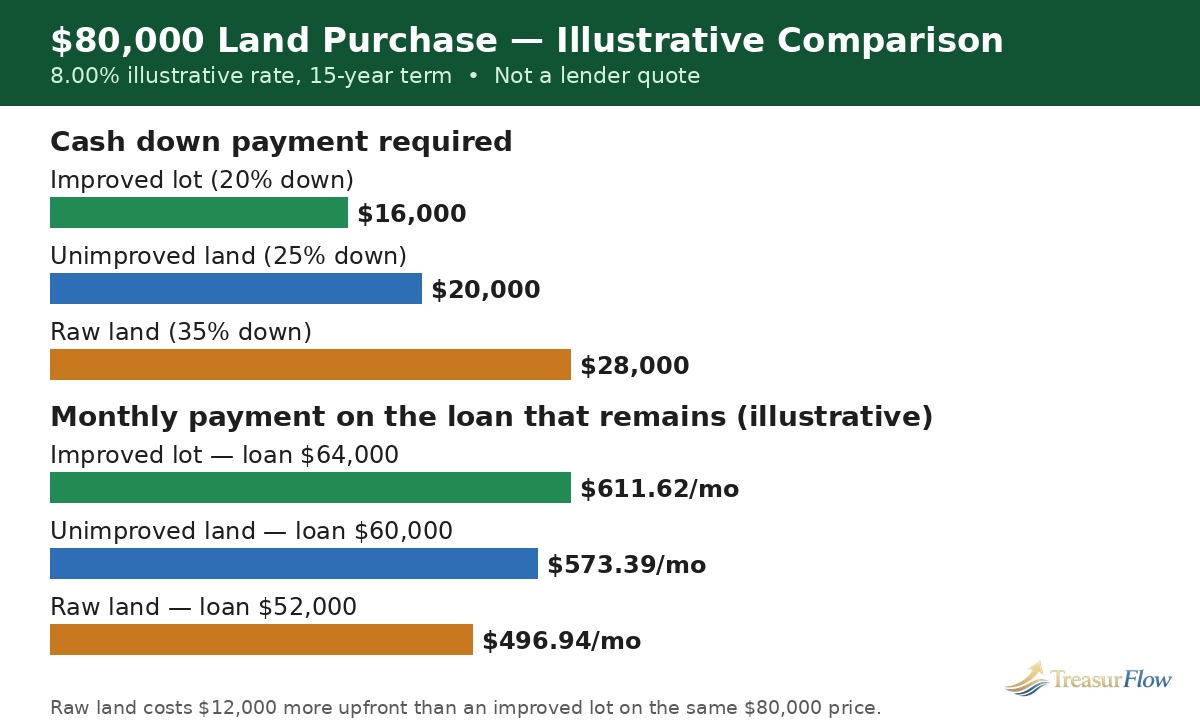
Hold those three results together and notice the trade that confuses many first-time land buyers. The raw land loan has the lowest monthly payment of the three — $496.94, which is $114.68 a month less than the improved lot payment of $611.62 — not because raw land financing is cheaper, but because you borrowed less. To earn that lower payment you had to bring $28,000 in cash instead of $16,000, a difference of $12,000 on the same $80,000 purchase price, before closing costs, before surveys and tests, and before a single dollar of site work. A lower monthly payment bought with a much larger down payment is not a saving. It is a different distribution of the same cost, and for buyers whose cash reserves are limited, it is often the wrong distribution, because land ownership itself will keep asking for cash after closing: taxes, insurance, maintenance, access work, and eventually building costs.
Now change only the term, and the picture flips again. Keep the raw land loan at $52,000 and the illustrative 8.00 percent rate, but shorten the term from 15 years to 10 years, a pattern lender guides describe as common for rawer parcels. The monthly payment rises to $630.90 — higher than the improved lot payment on a larger loan at the longer term. That is why comparing land loan offers by monthly payment alone is meaningless. You must compare down payment, loan amount, rate, term, whether the payment fully amortises the loan or leaves a balloon balance, and total interest over the time you actually expect to hold the loan, side by side. It is also why a longer term is not automatically better: stretch the improved lot loan of $64,000 at the same illustrative rate to 20 years and the payment falls to $535.32 a month, but if you held it for the full term you would pay substantially more total interest than on the 15-year version. Most land buyers do not hold a land loan to maturity — they build, refinance into a construction or permanent loan, sell, or pay the land off — so model the exit you actually plan, not just the longest term on offer.
Who Actually Lends on Land: Lenders Ranked by Land Type
For Improved Lots: Community Banks, Credit Unions and Lot Loan Programs
For a serviced residential lot, your widest realistic choice is usually a community bank or a credit union that offers a lot loan program, supplemented in some markets by regional banks and by builders’ preferred lenders where a build is imminent. Community banks earn their place at the top of this list for a structural reason: many keep land and lot loans as portfolio loans, meaning they hold the loan on their own books instead of selling it into the secondary mortgage market. Portfolio lending lets them judge a local parcel on local knowledge — which subdivision sells well, which road the county is about to pave, which lots have a history of drainage problems — rather than forcing every parcel through a national checklist. Credit unions offer a similar local advantage and sometimes price member loans competitively, although their land programs vary widely and some cap loan amounts or terms more tightly.
Ask a lot lender these questions before you apply: What down payment do you require on this specific lot? Is the rate fixed or adjustable, and if adjustable, what index, margin, and caps apply? Does the loan fully amortise, or is there a balloon payment, and if so, when? Is there a requirement to start construction within a set period, as some lot programs impose a build deadline of a year or two? What happens if you do not build in time — an extension, a rate change, or a requirement to repay? Can this lot loan later be paid off and rolled into a construction loan with the same lender, and will any of your closing costs be credited if it is? A lot loan that looks cheap but forces a build before you are ready can become the most expensive option of all.
For Unimproved Land: Local Portfolio Lenders and Farm Credit
Unimproved land narrows the field. Community banks and credit unions that lend locally remain a strong first call, precisely because classification judgement matters: a local lender is better placed to credit the parcel for the access and utilities it genuinely has. Farm Credit associations also become important here, particularly where the parcel is rural, larger than a house lot, or intended for a rural home, small farm, or recreational use that a suburban lot lender would not understand. Regional banks with agricultural or rural real estate departments may also compete in some states.
For Raw Land and Larger Acreage: Farm Credit Associations First
For raw land, farm and ranch acreage, timberland, and recreational land, Farm Credit associations are frequently the most knowledgeable institutional lenders in the United States. The Farm Credit System is a nationwide network of borrower-owned cooperative lending institutions, regulated by the Farm Credit Administration, created to serve agriculture and rural communities. Local Farm Credit associations finance farmland, rural land, rural homes, and land improvements, and their loan officers typically understand issues that defeat a generalist underwriter: soil productivity, water access, agricultural zoning, conservation programmes, and the resale market for acreage in their territory. Many associations also offer long-term real estate loans and, through rural home programmes, homesite and construction financing for country properties. Start at the national Farm Credit site to find the association that serves your county, and then talk to that local association about the specific parcel. Terms, down payments, and eligible uses are set locally, so a national summary — including this one — can point you to the door but cannot quote you the loan behind it.
A Necessary Correction: What USDA Home Loans Will and Will Not Do
Because USDA loans are famous — rightly — for offering eligible rural home buyers no-down-payment financing, they are the source of the most persistent misunderstanding in land buying. Here is the accurate version. USDA Rural Development’s Section 502 home loan programmes, both the guaranteed programme delivered through approved lenders and the direct programme delivered by USDA itself, exist to finance homes that borrowers will live in as a primary residence in eligible rural areas, subject to income limits that vary by county and household size. They can include buying a site and building a home, including through a single-close construction-to-permanent loan in which the lot, the construction, and the permanent mortgage are combined. USDA’s rural housing site loan provisions have a specific, narrow role, historically centred on eligible organisations and, in defined circumstances, site development for homes. What USDA home loans do not do is finance a purchase of raw land on its own, to hold, to use recreationally, or to build on at some indefinite future date with no home as part of the transaction. Vacant land without an eligible dwelling as part of the deal is not what the programme funds.
How Qualification Really Works: Credit, Income, the Parcel and the Plan
Land loan underwriting examines four things at once: you, your income, the parcel, and your plan. On you, lenders look at credit history and score. Lender guides commonly describe a score of at least 700 as typical for land loans, with high-600s sometimes acceptable for improved lots at some lenders and stronger scores expected for raw land. A higher score does not just affect approval. It affects which tier of pricing and which term a lender is willing to offer, so even a modest score improvement before you apply can be worth money — another reason not to rush an application the week you find a listing.
From Lot Loan to House: The Lot-Loan-to-Construction-Loan Path
Route One: Buy the Lot With a Land Loan Now, Build Later
This is the classic two-step. You finance the lot with a standalone lot or land loan, hold it while you save, design your home, choose a builder, and arrange permits, and then, when you are ready to build, you take a construction loan that typically pays off the lot loan and funds the build, followed by a permanent mortgage that pays off the construction loan. The attraction is time and control. You can secure a lot you love before someone else buys it, without having a builder and a full set of plans ready today. Some buyers also prefer to own the land outright before building, paying the lot loan down aggressively or off entirely, so that the land’s equity can support the construction loan.
Route Two: Single-Close Construction-to-Permanent, Land Included
A single-close construction-to-permanent loan — also called a one-time-close loan — combines the lot purchase, the construction financing, and the permanent mortgage in one loan with one closing. You qualify once, upfront, on the basis of the finished home: plans, specifications, builder contract, and an appraisal of the completed property. During construction, funds are released to the builder in stages called draws as work is inspected and completed, and you typically pay interest only on the amount already disbursed during the build. When construction is complete and final approvals are issued, the loan converts — by modification rather than a brand-new closing in the usual single-close structure — into your permanent mortgage.
For buyers who are genuinely ready to build, this route can be cleaner and cheaper in total transaction costs than stacking separate lot, construction, and mortgage closings, and it removes the risk of failing to qualify for a permanent mortgage after the house is built. It is also the structure through which government-backed options — conventional, Federal Housing Administration, Department of Veterans Affairs, and USDA programmes, each with its own eligibility rules — are commonly delivered, which is why ready-to-build buyers sometimes access lower down payments on the combined project than a land-only buyer would ever see on the lot alone. The trade-off is readiness. You need a buildable lot under contract, a licensed builder in most programmes (owner-builder options are limited and programme-specific), final plans and pricing, and all the due diligence on the site completed before closing, because the lot becomes part of a much larger loan. If you are still a year or more away from choosing a builder, a single-close loan is not a later problem solved early. It is the wrong product for your stage, and a lot loan is the honest fit.
Route Three: Two-Close Construction, Then a Permanent Mortgage
The older structure is two closings: a short-term, stand-alone construction loan first, and then, after the home is complete, a separate permanent mortgage that repays it. Some buyers prefer this route because it lets them shop for the permanent mortgage near completion, when rates and their own finances are clearer, and some local builders and banks work this way by habit. The risk is the mirror image of the single-close advantage: you must qualify a second time, and if you cannot — or if rates have risen sharply — you are left holding a maturing construction loan on a finished house. Whichever route you choose, ask who the permanent lender is expected to be, what happens if construction runs long or over budget, how draws and inspections work, what interest reserve, if any, is built in, and which costs sit outside the loan. Construction budgets overrun often enough that a contingency reserve is not pessimism. It is standard prudence.
The Due Diligence Checklist: Prove the Land Is Buildable Before You Owe Money on It
Zoning, Use and Restrictions
Start at the county or city planning office with the parcel number in hand. Confirm the zoning classification and that your intended use — a single-family home, a farm use, a business use, a subdivision, keeping animals, placing a manufactured home — is actually permitted, not merely rumoured to be permitted. Ask about setbacks, minimum lot sizes, height and coverage limits, and any overlay zones for floodplain, wetlands, historic, or environmental protection that shrink the buildable area. Check deed restrictions, covenants, conditions and restrictions in a subdivision, and homeowners association rules, which can restrict building style, timing, outbuildings, or even whether you may live in a recreational vehicle while you build. If your plan depends on a variance or a rezoning, treat the parcel as unproven until the approval is granted. A hope is not a permit.
Perc Testing, Septic and Soils
Where public sewer does not reach, your home needs a septic system, and a septic system needs soil that percolates at a rate the local health department accepts. A percolation test — a perc test — and the broader soil evaluation that health departments typically require will determine whether a conventional system is possible, whether an engineered or alternative system is needed at much higher cost, or whether the site cannot support a dwelling at all. Ask whether a perc test or soil evaluation has already been done, who did it, when, and whether the approval is still valid and transferable, and make your offer contingent on satisfactory results if it has not. Also ask about well feasibility and separation distances between a well and a septic system, soil bearing capacity for foundations, expansive or rocky soils that raise excavation costs, and any history of the land that suggests contamination, such as old fuel storage, dumping, or intensive chemical use. A failed perc test is one of the classic ways a bargain parcel becomes an unbuildable one.
Utilities: What Reaches the Land, and at What Price
List every service your plan needs — electricity, public water or a well, public sewer or septic, natural gas or propane, and broadband — and confirm each one separately, in writing, with the provider. Utilities at the road is not the same as utilities on your building site. A power line along the frontage may still require poles, easements, trenching, a transformer, and fees to reach a house set back hundreds of feet, and extension charges for distant parcels can be very large. Get written estimates or at least written statements of the process and typical cost range from the electric utility, the water provider, and a local well driller and septic installer who know the area. Ask the seller what services they have used or been quoted, but verify independently. Utility surprises are the most common reason an unimproved parcel’s true cost overtakes an improved lot’s price.
Survey, Boundaries and Title
Commission or obtain a recent boundary survey by a licensed surveyor unless a reliable recent survey already exists and your lender and title company accept it. Do not trust fence lines, old markers, or online parcel maps for boundaries. A survey confirms acreage, marks corners, and reveals encroachments — a neighbour’s driveway, shed, or fence on the land you are about to pay for — that are far easier to resolve before closing than after. At the same time, order a title search and obtain a title commitment through a title company or attorney. Look for liens, unpaid taxes, judgments, ownership gaps, severed mineral, timber, or water rights, and any leases — grazing, hunting, farming, oil and gas — that survive a sale. If someone else holds rights that control how you can use the surface, you need to know before you own it, and your lender will insist on knowing too.
Easements and Legal Road Access
Confirm legal access, not just physical access. A parcel you can drive to across a neighbour’s field may have no recorded legal right to be reached at all, which makes it landlocked in the eyes of a lender, a title insurer, and a future buyer. Check the deed and the title commitment for recorded access easements, shared driveway agreements, private road maintenance obligations, and utility easements that cross the building area. Ask who maintains a private road, whether there is a road maintenance agreement, whether the access meets county standards for a driveway permit and for emergency vehicles, and whether the lender will accept the access as documented. Many raw land deals die on this item alone, and they should: without legal, insurable access, financing, building permits, and resale all become difficult or impossible.
Flood, Wetlands and Environmental Limits
Look the parcel up on the Federal Emergency Management Agency flood maps and ask the county about floodplain on the site. Building in a high-risk flood area can require elevation, engineering, and flood insurance, and can be restricted outright. Check for wetlands and streams, using national wetland mapping as a screen and a professional delineation where the ground looks wet, because filling wetlands can require permits that may not be granted. Ask about drainage across the parcel, neighbouring uses that affect you — industrial sites, intensive agriculture, landfills, major roads — and any planned roads, rezonings, or developments nearby that would change the quiet lot you think you are buying. Finally, review property taxes and assessments: current classification such as agricultural use valuation can change when you buy and change the use, back taxes or special assessments can attach, and the tax bill on the finished home you plan will be far higher than the tax bill on vacant land. None of these items is glamorous. Together, they are the difference between buying a building site and buying a problem with a view.
Alternatives When a Traditional Land Loan Does Not Fit
Seller Financing and Contracts for Deed
Seller financing is common in land sales, especially for raw or hard-to-finance parcels: you pay the seller a down payment and then make instalment payments directly to the seller at an agreed rate over an agreed term, often a shorter term with a balloon payment for the remaining balance. It can be faster and more flexible than bank financing, and for some buyers it is the only available route. It can also be structured as a contract for deed — also called a land contract or land instalment contract — in which the seller keeps legal title until you have completed the payments, while you carry the burdens of ownership such as taxes, insurance, and maintenance during the contract.
The Consumer Financial Protection Bureau has warned consumers about contracts for deed and issued an advisory opinion confirming that these arrangements generally count as credit under the Truth in Lending Act. The practical risks are concrete. Protections that are routine in a mortgage — appraisals, title procedures, and foreclosure processes with notice and time to cure — may be weaker or absent in a poorly drafted contract. If you miss payments, the seller may be able to pursue forfeiture or eviction far more quickly than a mortgage lender could foreclose, and you could lose the property and the money you have already paid, including money spent improving it. A balloon payment adds a refinancing risk at a fixed future date. And if the seller still has their own mortgage or liens on the property, their failure to pay can put your purchase at risk without any failure by you. None of this makes every seller-financed deal a bad deal. It makes legal protection non-negotiable: insist on a title search before signing, have a real estate attorney draft or review the documents, use a properly drafted promissory note and a deed of trust or mortgage recorded with the county where local practice allows instead of an unrecorded handshake contract, record your contract to protect your interest, confirm how and when the deed will transfer, and write down exactly what happens on late payment, default, and early payoff. If a seller resists those protections, that resistance is information about the deal.
Home Equity Loans and HELOCs: Borrowing Against a Home You Already Own
If you already own a home with meaningful equity, a home equity loan or a home equity line of credit (HELOC) borrows against that home, not against the land. That removes the land from the collateral equation, which can make approval simpler and pricing closer to home-secured borrowing than to raw land borrowing, and some buyers use equity funds as the down payment on a land loan or even to buy a modest lot outright. The danger is equally clear and should be stated without softening: your existing home secures the debt. If the land project fails, or your income falls, the home you live in is at risk, not just a vacant parcel you could sell. A HELOC also usually carries a variable rate, so payments can rise. This route fits best when the land cost is small relative to your available equity, your income is stable, you have reserves after the purchase, and you have priced the total plan — not merely when a lender says the line is available.
Personal Loans for Very Small Lots
An unsecured personal loan can occasionally be the right answer for a small, inexpensive lot — a modest in-town parcel, a small adjoining lot from a neighbour, or a inexpensive rural lot whose price falls comfortably within personal loan limits. There is no appraisal of the land, no land underwriting, and funding can be quick. The costs are higher rates than secured borrowing in most cases, shorter repayment terms that make monthly payments heavy relative to the amount borrowed, and loan limits that rule this route out for most substantial acreage. Crucially, a personal loan also removes a useful discipline: no lender will examine zoning, access, or buildability for you, so the full due diligence checklist above becomes entirely your job. Use a personal loan for size and simplicity where it genuinely fits, not as a shortcut around a parcel’s problems.
Red Flags That Should Slow You Down or Stop the Deal
Walk away, or at least pause and investigate, when you meet any of the following. A seller or intermediary who guarantees loan approval, a rate, or a closing date before any lender has underwritten you and the parcel. A request to pay application or reservation fees to an unfamiliar company before you have written loan terms and a verifiable identity for the lender. A contract for deed offered with no title search, no recording, and no attorney involvement, especially with a large balloon payment in a few years. A parcel with no recorded legal access, or access described only as an understanding with a neighbour. A listing that calls land buildable with no perc or soil information, no survey, and no utility confirmation, in an area where those are live questions. A price justified by a future rezoning, a future road, or future development that has not been approved. Pressure to waive your feasibility, appraisal, or financing contingency to win the deal before tests come back. An appraisal gap the seller expects you to cover in cash without discussion. A lot loan with a construction deadline or balloon date that your actual building timeline cannot meet. Taxes, dues, or special assessments that nobody can document. And any suggestion that you misstate the intended use of the land — as agricultural when you mean residential, as a primary home when you mean an investment — on a loan application. Misstating use is not a clever workaround. It is misrepresentation, and it can cost you the loan, the property, and far more.
How to Apply: A Step-by-Step Sequence That Respects the Ladder
First, classify the land. Use the framework in this guide to decide whether your target parcel is raw, unimproved, or improved, and confirm how local lenders classify it. Second, set your cash budget from the ladder, not from hope: down payment at the realistic percentage for that type, plus closing costs, plus survey, perc, appraisal, and professional fees, plus a reserve for site work and for carrying the land. Third, check your own file the way an underwriter will: credit score and history, debt-to-income ratio including the new payment, documented income, and the source of your down payment funds. Fourth, talk to the right lenders in the right order — Farm Credit for raw and rural acreage, community banks and credit unions for lots and unimproved land, and construction-to-permanent lenders if you are ready to build — and ask each for parcel-specific terms in writing. Fifth, complete due diligence during your contingency period and do not let the period expire while tests or utility quotes are outstanding; ask for an extension rather than waving goodbye to your protection. Sixth, compare Loan Estimates and written terms on the same basis: rate type, term, amortisation, balloon, down payment, closing costs, build deadlines, prepayment rules, and the path into construction financing. Seventh, close with title insurance, recorded documents, and a file that keeps your survey, perc results, utility letters, permits, and loan papers together. You will need that file again when you apply to build, and again when you insure and eventually sell.
Conclusion: Buy the Land Type Your Financing Can Honestly Carry
The best land loan in 2026 is not the one with the most attractive headline. It is the one matched, honestly, to the type of land you are buying, the cash you actually have, the timeline on which you will genuinely build or use the land, and a lender who finances that kind of parcel for a living. Start with the land, not the loan: raw land will ask for roughly a third to a half of the price in cash and give you the shortest time to repay; unimproved land will ask for roughly a quarter and reward you only if the missing infrastructure is truly cheap to complete; an improved lot will ask for the least cash, offer the friendliest terms land loans provide, and still demand stronger credit and more cash than a house purchase. If you are ready to build now, price the single-close construction-to-permanent route alongside any lot loan, and check whether a government-backed home programme can include your site — remembering that those programmes finance homes, not bare land held for later. If you are not ready to build, let a lot or land loan do its one job well, protect yourself with due diligence on zoning, soils, utilities, survey, access, and flood risk, and keep the reserves that land ownership will inevitably request.
Land Loan Questions Buyers Ask Before They Make an Offer
How much down payment do I need for a land loan?
It depends mainly on the type of land. FDIC guidance cited by LendingTree and Experian puts baseline minimums at 35 percent for raw land, 25 percent for unimproved land, and 15 percent for improved land. Many lenders ask for more, with raw land often requiring 30 percent to 50 percent down.
Can I use a USDA loan to buy raw land and build later?
No. USDA Rural Development home loans finance a home you will live in as a primary residence in an eligible rural area, and they can include a site when the land is part of buying or building that home. They do not finance raw land on its own to hold for later.
What credit score do I need for a land loan?
Lender guides commonly describe a score of at least 700 as typical for land loans, with scores in the high 600s sometimes workable for improved lots at some lenders and stronger scores expected for raw land. Each lender sets its own standards, and a higher score can improve your terms.
What is the difference between a lot loan and a construction-to-permanent loan?
A lot loan finances only the purchase of the lot and leaves building for a later, separate financing step. A construction-to-permanent loan combines the lot purchase, construction financing, and permanent mortgage, usually with one closing, so you need a builder, plans, and a construction budget ready before you close.
What should I check before buying land to build on?
Confirm zoning allows your intended use, order a perc test if the site needs a septic system, get written utility estimates, obtain a boundary survey, verify recorded legal road access and easements, check flood and wetland limits, and review the title commitment. Complete these checks during your contingency period.
Are land loan rates higher than mortgage rates?
Generally yes, because land is riskier collateral than a finished home. Land loan rates are rarely published, so treat any general range as context only. Experian reported 6.5 percent to 8.5 percent or higher as of November 2025. Compare real written quotes for your specific parcel instead.

Muhammad Zakir is the founder of Treasurflow and the author of its personal finance guides. He researches consumer banking, credit, and personal loans, and every guide cites primary sources such as the CFPB, FDIC, FTC, and IRS. His content is educational and is not personalized financial advice.