
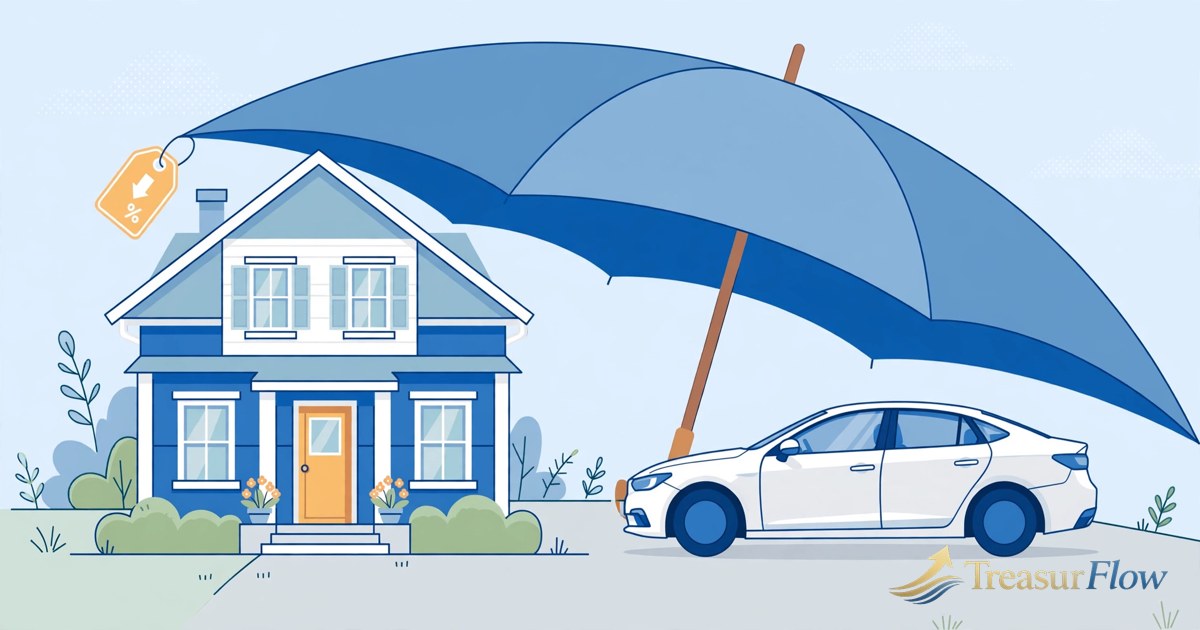
Buying your car insurance and homeowners insurance from two different companies is easy to do — and it may be quietly costing you money. A home and auto insurance bundle puts both policies with a single insurer in exchange for a multi-policy discount, and for many households it is one of the simplest ways to cut two premiums at once. But bundling is not automatically the cheapest route, and the advertised discount percentage can be misleading if the underlying rates are high.
In this guide, we break down how bundling works, how much you can realistically expect to save, which companies tend to offer the strongest bundle deals, and — just as importantly — the situations where buying your home and auto insurance bundle separately from two specialists will leave you better off. By the end, you will know how to compare a bundled quote against separate quotes the right way, so you can make the decision based on total cost and coverage, not marketing.
The short answer: A home and auto insurance bundle typically saves households roughly 10% to 25% across their policies, with many comparison studies putting the average closer to 15%. The discount usually applies to both policies, though rarely at the same rate. Bundling is usually worth it when the same carrier is already competitive on both your home and your car — but if one of the two base rates is expensive, two separate policies from different insurers can cost less overall, even after giving up the bundle discount.
Related Insurance Guides
- Insurance Guides Hub
- Best Homeowners Insurance 2026
- Best Renters Insurance 2026
- Liability-Only Car Insurance Explained
Helpful Official Resources
- National Association of Insurance Commissioners (NAIC) — consumer guides on home and auto insurance, plus each state insurance department’s contact information.
- Consumer Financial Protection Bureau (CFPB) — federal consumer guidance on insurance, mortgages, and protecting your finances as a homeowner.
What Is a Home and Auto Insurance Bundle?
A home and auto insurance bundle is simply two or more policies purchased from the same insurance company. The policies usually remain separate contracts — your homeowners policy still has its own limits, deductible, and renewal date terms — but because the insurer holds more of your business, it rewards you with a multi-policy discount (sometimes called a multi-line discount).
You do not have to bundle only home and auto. Most large insurers extend the same idea to other combinations, such as:
- Auto + renters insurance
- Auto + condo insurance
- Home + auto + umbrella liability
- Auto + motorcycle, boat, or life insurance
That said, home and auto is by far the most common and usually the most valuable pairing, because homeowners premiums are large enough that even a mid-sized percentage discount turns into real dollars. Insurers like bundles for a business reason, too: customers who hold two policies cancel far less often than single-policy customers, so carriers are willing to give up margin to win both policies.
One detail many people miss: the multi-policy discount does not have to be the same on both policies. A carrier might take, for example, a larger percentage off your auto premium and a smaller percentage off your homeowners premium, or the reverse. What matters is the combined total you pay per year — not the headline percentage on either policy.
How Much Can You Save by Bundling Home and Auto Insurance?
Discount ranges vary widely by insurer, state, and your personal profile, but most published figures land in a similar band:
- Typical range: roughly 5% to 25% combined savings across the two policies
- Commonly cited average: around 15% to 16% in national rate analyses
- Where the savings show up: often weighted toward one policy — the auto side frequently gets a bigger percentage cut, though some carriers discount the home side more
To put that in dollar terms, a household paying $2,000 a year for auto insurance and $1,800 a year for homeowners insurance might save somewhere in the neighborhood of $380 to $950 a year at the commonly cited discount levels. Households with higher premiums — young drivers, homes in disaster-prone areas, or multiple vehicles — can see larger dollar savings simply because the percentages apply to bigger numbers.
Two cautions before you get excited about the top of that range:
“Up to” is doing heavy lifting. Insurer advertisements quote maximums. Real-world averages for the same company can be far lower in some states — in a few published examples, a carrier advertising up to 25% averaged only about 2% for customers in one large state.
A discount on an expensive policy can still be expensive. A 20% discount on a $2,600 auto premium leaves you paying $2,080. A competitor with no bundle at all might charge $1,850 for the same coverage. Always compare the final totals, never the discount percentages alone.
Best Companies for a Home and Auto Insurance Bundle
No single carrier is the cheapest bundle for everyone — rates are personal, and the winner depends on your state, home, cars, and record. Still, the companies below consistently show up in national comparisons for bundle value. Discount figures are advertised or study-based ranges and vary by state and profile, so treat them as a starting point for quotes, not a promise.
| Company | Typical bundle discount | Best for | Good to know |
|---|---|---|---|
| State Farm | Often cited around 20–25% | All-around value | Largest US home and auto insurer; strong local agent network; bundle savings frequently ranked among the highest in rate studies |
| Allstate | Up to 25% advertised | Feature-rich bundles | Averages vary a lot by state; strong add-on and endorsement menu |
| Progressive | Averages in the mid-single digits on auto in most states | Competitive auto rates | Home policies are placed through partner insurers; offers a single-deductible perk for some bundled claims |
| USAA | Up to roughly 10% | Military members and families | Eligibility is restricted to military, veterans, and their families; service ratings are consistently excellent |
| Farmers | Commonly 10% or more | Stacking many discounts | Long list of combinable discounts (multi-car, homeowner, affinity, and more) |
| Liberty Mutual | Varies; advertises large average dollar savings | Homeowners adding multiple policies | Bundle can extend to umbrella and other lines; savings claims are company-reported |
| Nationwide | Up to roughly 20% advertised | Flexible multi-policy combinations | Bundles auto with home, renters, motorcycle, boat, life, and more |
State Farm
State Farm is the name that appears at or near the top of most bundle comparisons, largely because it is genuinely competitive on both sides of the bundle — an area where many rivals are strong on one policy and mediocre on the other. Rate studies have credited its multi-policy discount with average savings in the low-20% range, among the best of the national carriers. If you only get one bundle quote, this is a reasonable place to start.
Allstate
Allstate advertises bundle savings of up to 25%, and its home insurance product is one of the more customizable on the market, with optional endorsements that appeal to landlords and homesharers as well as standard homeowners. The caution: Allstate’s base premiums run higher than average for some profiles, and its real-world bundle savings swing widely by state, so the quote itself matters more than the national advertising.
Progressive
Progressive is often the price leader on the auto side, and its multi-policy discount averages in the mid-single digits on auto premiums in most states. Its homeowners policies are written and serviced through affiliated or third-party insurers rather than Progressive itself, which some customers love (best-of-both pricing) and others dislike (two underwriters in a claim). One genuinely useful perk: on certain bundled claims where the same event damages both your home and car, you may owe only a single deductible.
USAA
If you qualify, USAA is hard to beat on service and claims satisfaction, and it offers a bundle discount commonly cited around 10%. The catch is eligibility: membership is limited to current and former military members and their families. If you are not eligible, skip it and focus on the open-market carriers.
Farmers, Liberty Mutual, and Nationwide
These three are worth a quote in most states. Farmers is known for letting customers stack a long list of discounts on top of the multi-policy credit. Liberty Mutual advertises some of the largest average dollar savings for bundlers (figures are company-reported, so verify with your own quote). Nationwide is one of the most flexible bundlers, letting you combine auto with home, condo, renters, motorcycle, boat, or life policies under one multi-policy umbrella.
Pros of Bundling Home and Auto Insurance
- Real savings on both policies. The multi-policy discount typically trims a percentage off each premium, and because it applies to two policies at once, the total dollar savings often exceed what you could squeeze out of either policy alone.
- One company, one bill, one login. Bundled policies usually mean a single app or portal, one agent or support line, and — if you align the dates — one renewal cycle to think about each year. For busy households, that simplicity has genuine value.
- Single deductible for shared events. Some insurers waive or combine deductibles when one event, like a storm or a fallen tree, damages both your home and your vehicle. Instead of paying two deductibles, you pay one. Not every carrier offers this, so confirm it in writing if it matters to you.
- Better treatment as a multi-line customer. Bundled customers tend to be an insurer’s most profitable and loyal segment. That can translate into more flexibility after a small claim, better access to loyalty perks, and less chance of being non-renewed over a single minor incident — though none of that is guaranteed.
- Easier coverage-gap spotting. When one agent or one portal holds both policies, it is easier to see your whole liability picture and add an umbrella policy that sits cleanly on top of both.
Cons of Bundling — and When It Is NOT Cheaper
Bundling is a discount, not a guarantee. Here are the situations where the home and auto insurance bundle loses:
- The carrier is only good at one of the two policies. Many insurers price aggressively on auto but are unremarkable on homeowners, or the reverse. If the weak policy’s base rate is 20% above the market, a 15% bundle discount still leaves you overpaying.
- A specialist beats the generalist. Digital-first and specialty insurers sometimes undercut big carriers sharply on a single line. A common example: a homeowner gets an excellent home premium from a home-focused insurer like Lemonade, and a rock-bottom auto rate from an auto-focused carrier like GEICO (which does not even underwrite its own homeowners policies — it partners with other insurers). Bought separately, those two best-in-class prices can beat any single company’s bundle. Published comparisons have found four-figure annual differences in exactly this kind of split scenario.
- You have a high-risk profile on one side. If your driving record includes a DUI or multiple accidents, a nonstandard auto specialist may price your car insurance far better than a mainstream bundler — while your clean, low-risk home is cheap anywhere. Bundling forces both policies into one company’s pricing model, which can punish the policy that does not fit.
- Your home is in a tough market. In areas with high wildfire, hurricane, or hail exposure, the best homeowners option may be a regional carrier or a state-backed plan that does not sell auto insurance at all. Bundling with a national carrier just to get the discount could mean worse home coverage or a much higher home premium.
- The discount shrinks at renewal. Introductory pricing and first-year discounts sometimes fade. If the bundle’s price creeps up while you stop shopping because everything is “handled,” the savings can quietly disappear over two or three renewals.
How to Compare a Bundle vs. Separate Quotes the Right Way
The only fair test is a side-by-side comparison at identical coverage. Here is a simple process that takes about an hour and settles the question with real numbers:
- Write down your current coverage first. Note your auto liability limits, deductibles, and add-ons, plus your homeowners dwelling limit, personal property coverage, liability limit, and deductible (including any separate wind/hail or hurricane deductible). Every quote you collect must match these numbers.
- Get at least two bundle quotes. Pick two carriers known for competitive bundles (for many households, State Farm plus one of Allstate, Progressive, or Nationwide is a solid pair).
- Get at least two separate quotes. Price your auto with an auto-strong carrier and your home with a home-strong carrier. Include at least one digital or specialist insurer in each category.
- Compare totals, not discounts. Add up the full annual cost of each scenario. Ignore the advertised discount percentage entirely — it is already baked into the totals.
- Check the fine print. Confirm whether the bundle offers a single-deductible perk, whether both policies must share a renewal date, and what happens to your discount if you later move or cancel one policy.
- Re-run the comparison at every renewal. Last year’s winner is not guaranteed to win next year. A 20-minute check each renewal keeps the bundle honest.
A useful rule of thumb: if the bundle and the best separate combination are within about $50 a year of each other, take the bundle for the convenience and the single-deductible possibility. If separate policies win by more than that, take the savings.
Stacking Multi-Policy Discounts to Save Even More
The bundle discount is just the first layer. Households that stack several discounts on top of it keep more money:
- Add an umbrella policy. Umbrella coverage often costs a few hundred dollars a year for $1 million of extra liability protection, and adding it as a third policy can deepen the multi-policy discount while seriously upgrading your protection.
- Bundle a third or fourth line. Renters, condo, motorcycle, boat, and life policies frequently qualify for the same multi-policy credit. Each added line is another percentage off somewhere.
- Insure every vehicle. A multi-car discount stacks with the bundle discount, and households with two or more cars often see the largest combined savings.
- Keep the profile discounts. Safe driver, claims-free, telematics/usage-based programs, home safety devices (alarms, water shutoff sensors), new-roof credits, paperless billing, autopay, and paying in full can all stack on top of the multi-policy discount at many carriers.
- Raise deductibles deliberately. Moving both deductibles to a level your emergency fund can actually cover lowers both premiums — and pairs especially well with a bundle that offers a single-deductible feature.
Just remember the eligibility rule most carriers enforce: both policies generally must stay active for the discount to apply. If you cancel one, the discount on the other usually disappears at the same time — sometimes retroactively to the next bill.
What to Watch at Renewal Time
Bundles create a quiet kind of lock-in, and renewal is where it costs people money. Watch for these traps:
- Rate creep on one policy. Carriers know bundled customers shop less. If either premium jumps more than roughly 10% without a clear reason (a claim, a ticket, a regional rate change), get fresh quotes before you pay.
- Coverage drift. Make sure a renewal quote has not quietly lowered your dwelling coverage, dropped an endorsement like water backup, or changed your deductible structure to manufacture a “savings” headline.
- Life changes that should trigger a re-quote. A paid-off mortgage, a teen driver getting licensed (or leaving home), a new roof, a move, or a big credit-score improvement can all change which scenario — bundle or separate — wins.
- Losing the discount by accident. Letting one policy lapse, even briefly, can remove the multi-policy discount from the other and, in published examples, wipe out a full year of bundle savings in a single billing cycle. Keep both policies’ payment methods current.
Frequently Asked Questions
How much does a home and auto insurance bundle save on average?
Most national analyses put typical savings in the 10% to 25% range across both policies, with averages often landing near 15%. Your actual savings depend on the carrier, your state, and your home and driving profile, so treat any single number as an estimate until you have real quotes.
Is it always cheaper to bundle home and auto insurance?
No. Bundling guarantees a discount, but the discount is applied to that company’s base rates. If a carrier’s home or auto rate is uncompetitive for you, buying each policy from a different specialist insurer can cost less overall — sometimes by several hundred dollars a year or more.
Which company has the best home and auto bundle?
State Farm is the most frequent top pick in national rate studies because it pairs one of the strongest multi-policy discounts with competitive rates on both policies. Allstate, Progressive, Nationwide, Farmers, and Liberty Mutual are all worth quoting, and USAA is an excellent option if you qualify through military service.
Can I bundle if I rent instead of own?
Yes. Most major insurers offer an auto and renters insurance bundle with the same multi-policy discount logic. The dollar savings are smaller because renters premiums are low, but renters-plus-auto is one of the easiest bundles to set up, and some carriers advertise meaningful savings for it.
What happens to my discount if I cancel one policy in the bundle?
In most cases, the multi-policy discount on the remaining policy is removed, usually right away or at the next billing cycle. Before canceling one half of a bundle, ask for a quote on the remaining policy without the discount so you are not surprised.
Does bundling affect my coverage or deductibles?
Bundling does not change your coverage limits by itself — those are set by you. Some carriers add a perk where a single event that damages both your home and car triggers only one deductible. Always compare quotes at identical limits and deductibles so the price comparison is honest.
Conclusion
A home and auto insurance bundle is one of the most reliable discounts in personal insurance, typically worth somewhere around 10% to 25% — but it is a starting point for negotiation with yourself, not the finish line. The households that save the most treat the bundle as one option among two: they price the best bundle they can find, price the best separate home and auto policies they can find, and take whichever total is lower at matched coverage. Do that comparison once, stack the extra discounts you qualify for, and re-check the math at every renewal, and you will capture the bundle’s convenience without ever falling for a discount that costs you money.

Muhammad Zakir is the founder of Treasurflow and the author of its personal finance guides. He researches consumer banking, credit, and personal loans, and every guide cites primary sources such as the CFPB, FDIC, FTC, and IRS. His content is educational and is not personalized financial advice.