

When a client likes your product or service but cannot pay the full price upfront, you may wonder how to give credit on price to a client without putting your business at risk. This is a common situation for consultants, contractors, agencies, service providers, B2B companies, and small businesses across the USA.
The goal is not to randomly lower your price. The smarter goal is to keep your full price and offer structured payment flexibility. That may include payment terms, a deposit, Net 30, installment payments, or third-party customer financing.
Done correctly, offering credit can help you close more deals. Done poorly, it can create late payments, unpaid invoices, cash flow pressure, and uncomfortable collection conversations.
This guide explains how to offer credit to clients safely, professionally, and strategically.
What Does It Mean to Give Credit on Price to a Client?
Giving credit on price means allowing a client to receive your product or service now and pay some or all of the amount later. Instead of reducing the total price, you give the client more time or more flexible payment options.
For example, if your service costs $5,000, you may offer:
| Payment Option | Example |
|---|---|
| Full upfront payment | Client pays $5,000 before work begins |
| Deposit + balance | Client pays $2,500 upfront and $2,500 after delivery |
| Net 30 terms | Client pays the full invoice within 30 days |
| Installment plan | Client pays $1,000 per month for 5 months |
| Third-party financing | Client pays monthly through a financing provider |
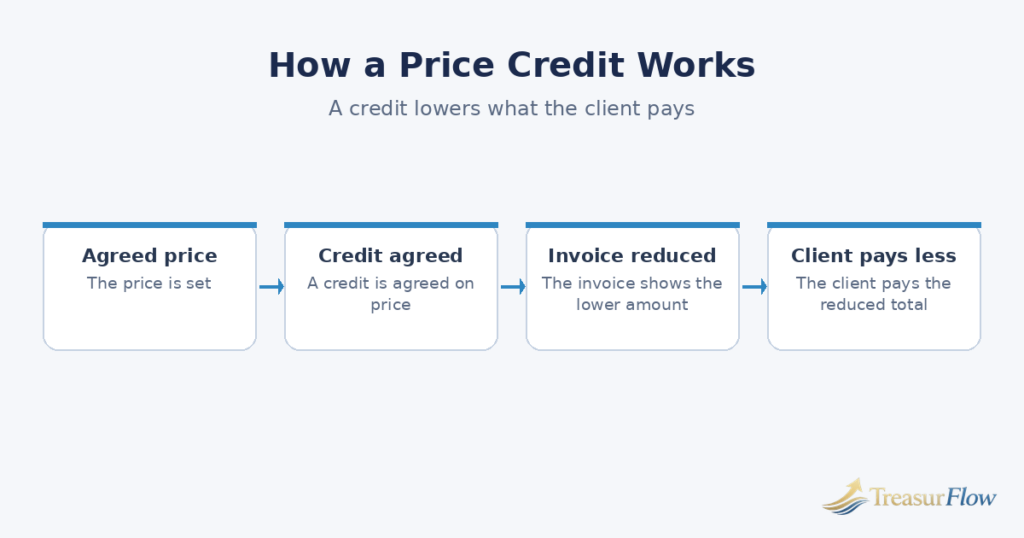
This is important: credit is not the same as a discount.
A discount reduces your price. Credit keeps your price the same but changes when or how the client pays.
Should You Offer Credit to Clients?
Yes, you can offer credit to clients, but you should not offer it to everyone.
Credit works best when the client is trustworthy, the amount is manageable, and the payment terms are clear in writing. It is risky when the client is new, has no payment history with you, avoids written agreements, or asks for a large amount of work with no upfront payment.
A simple rule is:
Offer flexibility to good clients, not unlimited credit to every client.
Before you approve credit, ask yourself:
- Has this client paid on time before?
- Can my business handle delayed payment?
- Is the invoice amount too large to risk?
- Do I have written payment terms?
- What happens if the client pays late?
- Should I ask for a deposit first?
If you cannot answer these questions clearly, you are not ready to offer credit yet.
Common Ways to Give Credit to Customers
There are several ways to give credit to customers or clients. The right option depends on your business model, client relationship, risk level, and cash flow needs.
1. Net 30 Payment Terms
Net 30 means the client has 30 days from the invoice date to pay the full amount. It is common in B2B transactions and professional services. Stripe explains Net 30 as payment being due within 30 days of the invoice date, and similar net terms such as Net 60 or Net 90 extend that due date further.
Example wording:
Payment is due within 30 days of the invoice date. Late payments may be subject to additional fees as stated in the agreement.
Net 30 is usually better for trusted clients, not brand-new clients.
2. Deposit Plus Remaining Balance
This is one of the safest options for service businesses.
Example:
50% deposit due before work begins. Remaining 50% due upon project completion.
This helps protect your cash flow while still giving the client some flexibility.
3. Installment Payment Plan
An installment plan lets the client pay in smaller scheduled payments.
Example:
Total project price: $6,000. Client pays $2,000 upfront, then $2,000 after milestone one, and $2,000 after final delivery.
This works well for high-ticket services, coaching, consulting, home improvement, marketing projects, and long-term work.
4. Milestone-Based Payments
Milestone payments are tied to project progress.
Example:
- 30% before work starts
- 40% after first major milestone
- 30% before final delivery
This is useful when the project has clear phases.
5. Third-Party Customer Financing
With third-party financing, a financing provider helps the client pay over time. Depending on the provider and agreement, your business may receive payment upfront or according to the financing structure.
This can be useful when clients want monthly payments but you do not want to personally manage credit risk.
6. Early Payment Discount
An early payment discount rewards clients for paying quickly.
Example:
2% discount if paid within 10 days; full amount due within 30 days.
This can motivate faster payment without heavily reducing your price.
Credit vs Discount vs Financing: Which One Should You Offer?
Many business owners panic when a client says, “That price is too high.” Their first instinct is to offer a discount. But sometimes the client does not need a lower price. They need a better payment structure.
| Option | What It Means | Best For | Main Risk |
|---|---|---|---|
| Discount | You reduce the total price | Price-sensitive clients | Lower profit |
| Credit | Client pays later | Trusted clients | Late or missed payment |
| Payment Plan | Client pays in installments | High-ticket services | Admin and collection risk |
| Financing | Third party helps client pay | Larger purchases | Fees or approval issues |
| Deposit | Client pays part upfront | New clients or service work | Still requires follow-up |
Best rule:
Do not discount first. Present your full price, then offer payment options if needed.
How to Decide If a Client Qualifies for Credit
Before giving credit, check whether the client is likely to pay on time.
You can use a simplified version of the 5 C’s of credit:
Character
Does the client seem reliable? Have they paid on time before? Do they communicate clearly?
Capacity
Can the client afford the payment? For business clients, do they seem financially stable?
Capital
Does the client or business have enough financial strength to support the purchase?
Conditions
Is the project amount reasonable? Is the payment timeline realistic?
Collateral
For many small business services, collateral may not apply. But for larger deals, contracts, deposits, or guarantees may reduce risk.
You do not need to overcomplicate this. For most small businesses, start with three simple checks:
- Review payment history.
- Require a deposit.
- Set a credit limit.
How to Present Credit Terms to a Client Professionally
The way you explain credit matters. You do not want to sound desperate, uncertain, or careless.
Start with the full price first.
Example:
The total project investment is $5,000.
Then present payment options:
We can offer two payment options: full payment upfront, or approved payment terms with a 50% deposit and the remaining balance due within 30 days.
This keeps your value strong. You are not saying, “I can lower the price.” You are saying, “I can make the payment structure easier.”
Example Script for Offering Credit to a Client
The full price for this project is $5,000. To make payment easier, we can offer approved payment terms. Typically, we require a deposit upfront and the remaining balance by an agreed due date. I can include the payment schedule in the proposal so everything is clear before we begin.
Example Script When a Client Asks to Pay Later
We do offer payment terms for approved clients. Before we confirm that option, we usually review the project amount, payment schedule, and deposit requirement. That helps us make sure the terms work for both sides.
Example Script to Say No Politely
At this time, we are not able to offer delayed payment on this project. However, we can split the work into phases so the payments are easier to manage.
This is a professional way to protect your business without damaging the relationship.
What Should Be Included in Client Payment Terms?
Your payment terms should be written clearly in the proposal, invoice, or service agreement. Xero’s invoice payment guidance recommends using standard terms customers recognize and making sure invoice terms match the original agreement.
Include these details:
- Total price
- Deposit amount
- Payment due date
- Payment schedule
- Accepted payment methods
- Late payment rules
- Credit limit
- Work start date
- Delivery terms
- Cancellation policy
- Collection process
- Signature or written approval
Never rely only on a verbal promise. If the client is allowed to pay later, that agreement should be written.
How to Protect Cash Flow When Offering Credit
Cash flow is the biggest reason credit can become dangerous. If too many clients pay late, your business may struggle to cover payroll, software, inventory, ads, contractors, or daily operations.
Here are practical ways to protect your business:
Require a Deposit
For new clients, avoid starting work with zero upfront payment. A deposit shows commitment and reduces your risk.
Set a Credit Limit
Do not allow a client to delay unlimited payments. Start small.
Example:
New clients may qualify for up to $1,000 in credit after deposit. Larger credit limits require payment history or approval.
Keep Payment Terms Short
Net 30 may be reasonable for trusted B2B clients. Net 60 or Net 90 can create cash flow pressure for small businesses.
Send Invoices Immediately
Do not wait days or weeks to invoice. Late invoicing often leads to late payment.
Follow Up Before the Due Date
A friendly reminder before the due date is better than chasing payment after it is late.
Stop Credit for Late-Paying Clients
If a client repeatedly pays late, move them back to upfront payment or deposit-based work.
Pros and Cons of Offering Credit to Customers
Offering credit can be powerful, but it is not risk-free.
| Pros | Cons |
|---|---|
| Helps close more sales | Can create late payments |
| Makes higher prices easier to accept | May hurt cash flow |
| Builds stronger client relationships | Adds admin work |
| Can increase order size | Creates bad debt risk |
| Helps you compete | May require collection follow-up |
The biggest disadvantage of credit is that you may deliver the work before receiving the money. That means your business takes on payment risk.
Example Client Credit Policy for Small Businesses
Here is a simple sample policy you can adapt:
We offer payment terms to approved clients only. New clients may be required to pay a deposit before work begins. Payment schedules, due dates, and credit limits must be confirmed in writing before the project starts. Late payments may pause current or future work. Continued credit approval depends on payment history.
For an invoice, you might write:
Payment Terms: 50% deposit due before project start. Remaining 50% due within 15 days of final delivery.
For Net 30:
Payment Terms: Net 30. Full payment is due within 30 days of the invoice date.
For installment payments:
Payment Terms: $1,500 due today, followed by three monthly payments of $1,000 due on the 1st of each month.
When Should You Use Third-Party Financing?
Third-party financing may be better when:
- Your product or service is expensive
- Clients want monthly payments
- You do not want to manage collections
- You want to reduce payment risk
- You sell to consumers or high-ticket customers
- You want to avoid acting like a lender yourself
In the USA, customer financing and credit arrangements may involve disclosures, consumer protection rules, state laws, and lender requirements. The FTC provides business guidance to help companies understand responsibilities related to credit and consumer protection, so businesses should be careful when offering financing or credit-like arrangements.
For larger business funding needs, SBA-guaranteed loans can be used for many business purposes, including operating capital, depending on the loan program and lender.
This does not mean every business needs a loan. It simply means you should understand whether you are offering client credit, customer financing, or using business funding to support cash flow.
Common Mistakes When Giving Credit to Clients
Avoid these mistakes:
Offering Credit to Everyone
Not every client deserves credit. New or unproven clients should usually start with deposits or shorter payment terms.
Confusing Credit With a Discount
Credit changes the payment schedule. A discount lowers your price. Keep them separate.
Not Writing Terms Clearly
If the client does not understand when payment is due, problems can happen later.
Giving Too Much Time to Pay
Long payment windows can hurt small business cash flow.
Ignoring Late Payments
Late payment should not become normal. Follow up quickly and professionally.
Starting Work Without a Deposit
This is especially risky for custom work, consulting, design, marketing, construction, and other service-based businesses.
Final Answer: How Do You Give Credit on Price to a Client?
To give credit on price to a client, first present your full price clearly. Then offer structured payment terms such as a deposit, Net 30 invoice, installment plan, milestone payments, or third-party financing. Before approving credit, check the client’s reliability, set a credit limit, write the terms clearly, and protect your cash flow with due dates and follow-up rules.
The safest approach is:
- Keep your full price.
- Offer payment flexibility only when needed.
- Require a deposit for new clients.
- Put all terms in writing.
- Set clear due dates.
- Stop credit if the client pays late.
- Use third-party financing for larger or riskier deals.
Remember, the goal is not to become a bank for your customers. The goal is to make your offer easier to buy while still protecting your business.
FAQs
How do you give credit on price to a client?
You give credit on price by allowing the client to pay later or in scheduled payments while keeping the total price the same. Common options include deposits, Net 30 terms, installment payments, or third-party financing.
Can I offer credit to my customers?
Yes, you can offer credit to customers, but you should use written payment terms, check customer reliability, set credit limits, and protect your cash flow before allowing delayed payment.
Is offering credit the same as giving a discount?
No. A discount lowers the total price. Credit keeps the full price but lets the client pay later or over time.
What is the safest way to let clients pay later?
The safest way is to require a deposit, use written terms, set a clear due date, limit the credit amount, and follow up before the invoice becomes overdue.
What does Net 30 mean?
Net 30 means the client must pay the full invoice amount within 30 days of the invoice date.
Should I offer credit to new clients?
Be careful with new clients. It is usually safer to require a deposit or offer a smaller credit limit until the client builds a reliable payment history.
How can I offer financing to my clients?
You can offer financing through in-house payment plans or by working with a third-party financing provider. Third-party financing may reduce your risk because the provider can handle approval and repayment.
What should I say when a client asks to pay later?
You can say: “We offer payment terms for approved clients. I can include a deposit amount, payment schedule, and due date in the proposal so everything is clear before we begin.”
Conclusion
Learning how to offer credit to clients is really about balance. You want to help clients say yes, but you also need to protect your business.
The best strategy is to keep your full price, offer flexible payment terms when appropriate, and avoid giving open-ended credit without written rules. Use deposits, Net 30 terms, installment payments, or third-party financing based on the client’s trust level and your cash flow needs.
Need help offering flexible payment options without lowering your price? Set up clear client credit terms, payment plans, or financing options that help customers buy while keeping your cash flow protected.
Resources: This guide is based on trusted small business payment and financing references, including Stripe’s guide to Net payment terms, Xero’s invoice payment terms guide, the FTC Business Guidance Center, and the U.S. Small Business Administration loan programs page. These sources explain invoice terms, payment deadlines, credit-related business responsibilities, and funding options that can help businesses manage cash flow when offering client payment flexibility.

Muhammad Zakir is the founder of Treasurflow and the author of its personal finance guides. He researches consumer banking, credit, and personal loans, and every guide cites primary sources such as the CFPB, FDIC, FTC, and IRS. His content is educational and is not personalized financial advice.
2 thoughts on “How to Give Credit on Price to a Client Without Hurting Your Cash Flow”