
Commercial equipment refinancing is a financial strategy that allows capital-intensive businesses to replace existing asset-backed debt structures with customized long-term debt. This process uses existing machinery, commercial fleets, medical technology, or heavy industrial equipment as collateral.
When capital markets fluctuate, interest rate environments shift, or operating cash flows tighten, maintaining rigid capital structures can constrain a company’s growth. Refinancing commercial equipment helps lower debt service overhead, recover capital locked in unencumbered equipment equity, and align equipment asset life with corresponding liabilities.
Quick Answer
Can you refinance commercial equipment to lower monthly debt payments and recover working capital?
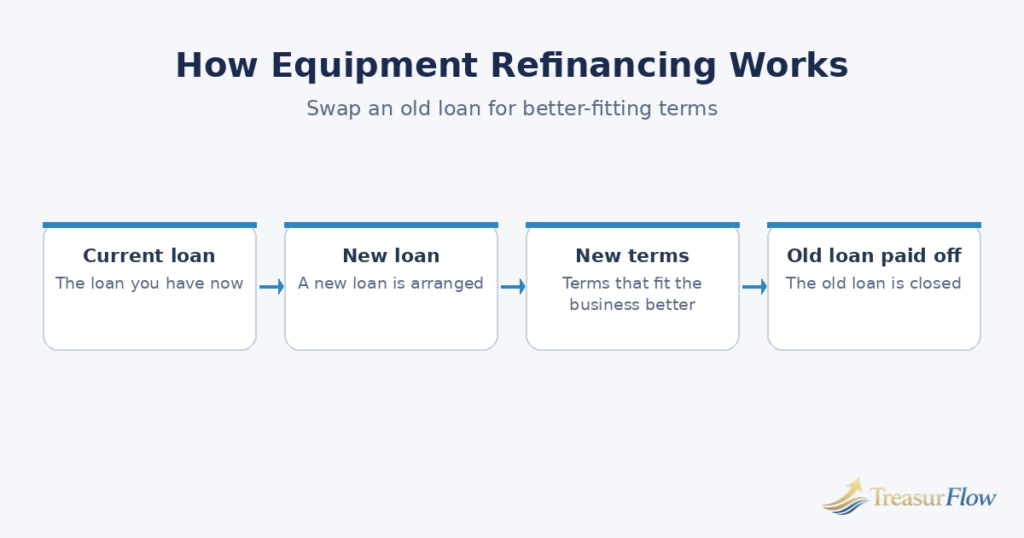
Yes. Commercial equipment refinancing replaces an existing loan or lease agreement with a new term loan backed by the current appraised equity of business equipment . By extending repayment terms, securing lower fixed interest rates, or adjusting amortization structures, companies can reduce monthly cash outflows, consolidate high-cost liabilities, or extract liquidity through cash-out refinancing. Eligibility requires equipment with a clear title or verifiable equity, a minimum Debt-Service Coverage Ratio (DSCR) of 1.20x–1.25x, and a valid appraisal verifying the equipment’s current Fair Market Value (FMV).
[Current Debt / Paid Off Equipment] ──> [Independent FMV Appraisal] ──> [New Term Structure]
                                                                                │
                   ┌────────────────────────────────────────────────────────────┴────────────────────────────────────────────────────────────┐
                   ▼                                                                                                                       ▼
    [Option A: Rate & Term Refinance]                                                                                       [Option B: Cash-Out Refinance]
• Extends loan tenor (e.g., 36 mo ──> 72 mo)                                                                              • LTV up to 80% of Appraised FMV
• Lowers monthly debt service burden                                                                                      • Pays off existing balance
• Improves net operating cash flow & DSCR                                                                                 • Unlocks liquid capital for expansion
Core Concepts & Market Context
To evaluate equipment refinancing options effectively, businesses must understand the technical terminology used by underwriters and equipment appraiser networks.
- Loan-to-Value Ratio (LTV): The ratio of the requested loan balance to the appraised value of the collateral asset. In equipment refinancing, lenders usually cap LTV at 70% to 80% of Orderly Liquidation Value (OLV) or Fair Market Value (FMV).
- Orderly Liquidation Value (OLV) vs. Fair Market Value (FMV): FMV estimates the asset’s value in an open market between a willing buyer and seller. OLV estimates the net dollar amount realized from an asset sale if given a reasonable timeframe to liquidate (typically 6 to 9 months). Lenders base refinance limits on OLV for heavy industrial machinery due to market volatility.
- Uniform Commercial Code Lien (UCC-1 Filing): A legal notice creditors file to announce a security interest in a debtor’s personal property. Refinancing requires navigating UCC-1 filings to ensure the new lender secures a primary (first-position) lien.
- Debt-Service Coverage Ratio (DSCR): A measure of the cash flow available to pay current debt obligations. Calculated as:
$$\text{DSCR} = \frac{\text{Net Operating Income (NOI)}}{\text{Total Debt Service (Principal + Interest)}}$$ - Section 179 & Depreciation Recapture: How Refinancing Can Change Your Tax Position. While loan proceeds from cash-out refinancing are not considered taxable income, changing the financing structure must account for historical Section 179 write-offs and potential depreciation recapture under IRS rules.
                 EQUINOMICS ENGINE: THE DSCR IMPROVEMENT LOOP

  [High Monthly Equipment Debt]   ───>   [Compressed Cash Flow (DSCR < 1.15x)]
                 │                                        │
                 ▼                                        ▼
  [Execute Rate/Term Refinance]   ───>   [Lower Monthly Principal & Interest]
                 │                                        │
                 └───────────────────►   [Expanded Free Cash Flow (DSCR > 1.35x)]
When reviewing liability limits alongside equipment collateral, business owners should also verify their commercial fleet policies, specifically ensuring proper coverage through primary liability insurance to satisfy lender underwriting requirements.
Financial Structures: Rate-and-Term vs. Cash-Out Refinancing
Selecting the right refinancing model depends on whether your primary objective is operational expense reduction or balance-sheet liquidity extraction.
Rate-and-Term Equipment Refinancing
Rate-and-term refinancing modifies the original interest rate, the duration of the loan, or both, without increasing the principal balance beyond transaction fees.
- Primary Purpose: Operating cost reduction and liability stabilization.
- Best Used When: Market interest rates fall below your existing coupon rate, or when short-term balloon equipment loans need conversion into long-term fixed debt.
- Impact on Balance Sheet: Neutral to overall debt liabilities; improves monthly liquidity by extending amortization periods.
Cash-Out Equipment Refinancing (Sale-Leaseback / Asset Equity Extraction)
Cash-out refinancing leverages unencumbered equipment (assets owned debt-free) or equity built in partially paid-off assets. The lender issues a new loan based on the equipment’s appraised market value, pays off any remaining lien, and provides the remaining balance as unencumbered working capital.
- Primary Purpose: Capital generation without diluting equity or taking on high-cost merchant debt.
- Best Used When: Funding capital expansion, acquiring secondary companies, or acquiring inventory without using high-interest short-term lines of credit.
- Impact on Balance Sheet: Increases overall long-term debt liabilities; provides immediate cash on the asset side of the balance sheet.
Comprehensive Comparison Matrix
| Feature | Rate-and-Term Refinance | Cash-Out Equipment Refinance | Working Capital Line of Credit | Merchant Cash Advance (MCA) |
| Primary Objective | Lower debt payments | Extract built-in equity | Short-term cash management | Emergency short-term cash |
| Typical Term | 36 to 84 Months | 24 to 72 Months | Revolving (12-36 Months) | 3 to 18 Months |
| Interest Rate Model | Fixed / Variable (6.5%–9.5%) | Fixed (7.0%–11.0%) | Variable (Prime + Margin) | Factor Rate (1.15x – 1.45x) |
| Collateral Basis | Target Equipment Asset | Target Equipment Asset | Blanket Corporate UCC-1 Lien | Future Credit Card Sales |
| Underwriting Focus | Asset Value + Debt Service | Asset Value (FMV/OLV) + Equity | Cash Flow & Bank Receivables | Daily Bank Revenue |
| Impact on DSCR | Positive (Reduces Debt Service) | Moderate (Adds New Debt) | Neutral to Negative | Negative (Drains Cash Flow) |
| Tax Implications | Interest Expense Deductible | Non-Taxable Proceeds; Deductible Interest | Interest Expense Deductible | Fees Deductible as Expense |
Refinancing vs. Equipment Lease Buyouts (Sale-Leaseback Differences)
Choosing between refinancing an existing term loan and restructuring an active equipment lease requires understanding ownership structures, tax treatment, and payoff options.
- Equipment Refinancing: Replaces an existing loan backed by an asset you already own (or hold title to). The goal is to lower interest rates, extend terms, or extract cash equity. You retain title and ownership throughout the process.
- Lease Buyout (FMV / $1 Option): Purchases the equipment from the leasing company before or at the end of the lease term. If you hold a Fair Market Value (FMV) lease, buying out the equipment requires paying the remaining lease payments plus the asset’s current appraised market value.
- Sale-Leaseback Restructuring: Sells fully owned or funded equipment to a financing company for cash, then immediately leases it back. This removes the asset from your balance sheet as a fixed asset and converts ownership into an operating or capital lease expense.
| Feature | Equipment Refinancing | Equipment Lease Buyout | Sale-Leaseback Restructuring |
|---|---|---|---|
| Asset Ownership | Borrower retains legal title | Transfers from Lessor to Lessee | Transfers from Owner to Lessor |
| Primary Financial Goal | Reduce debt service or extract cash | Acquire full ownership of asset | Maximize immediate off-balance liquidity |
| Accounting Treatment | Balance Sheet Debt (Liability) | Converts Lease to Capital Asset | Operating/Capital Lease Expense |
| Tax Impact | Interest expense deductible | Resets asset depreciation basis | Lease payments fully deductible |
| UCC Lien Status | Primary UCC-1 Lien on Asset | Lease Notice filing removed | Lessor holds primary ownership title |
Current Commercial Equipment Refinancing Rates & Terms (US Market Benchmarks)
Underwriting benchmarks for commercial equipment refinancing depend on federal benchmark rates, equipment type, credit tiers, and asset age.
- Fixed Interest Rates: Typically range from 6.75% to 9.75% for prime corporate borrowers (680+ FICO, 2+ years in business). Non-prime or specialized asset transactions range from 10.0% to 14.5%.
- Variable Interest Rates: Tied to the Prime Rate or SOFR (Secured Overnight Financing Rate), usually structured as SOFR + 2.50% to 5.50%.
- Repayment Terms: Range from 36 to 84 months. Lenders cap the term at the remaining useful life of the asset (e.g., Class 8 trucks cap around 48–60 months; heavy industrial CNC machinery can reach 84 months).
- Maximum Loan-to-Value (LTV): Capped at 70% to 80% of Orderly Liquidation Value (OLV) or Fair Market Value (FMV).
- Standard Fee Structure:
- Origination / Application Fee: 1.0% to 2.0% of total loan amount.
- Third-Party Appraisal Fee: $1,200 to $3,500 (depending on asset location and complexity).
- UCC Filing & Document Fees: $250 to $750.
If you are evaluating property or real estate collateral alongside machinery, keep in mind that benchmark rates vary by asset type—for instance, reviewing current DSCR loan rates in 2026 can provide a helpful baseline for real estate-backed debt strategies.
💡 Related Financial Guides on Treasurflow:
- Real Estate Financing: Learn how to invest in real estate without buying property to build indirect cash-flowing portfolios.
- Consumer & Fleet Rate Reduction: See our breakdown on how to lower your car interest rate for personal or small commercial vehicles.
Strategic Advantages of Equipment Refinancing
Refinancing equipment offers strategic benefits beyond basic interest rate management, helping support long-term corporate health.
                  STRATEGIC ADVANTAGES OF REFINANCING

       ┌───────────────────────────────┼───────────────────────────────┐
       ▼                               ▼                               ▼
[Liquidity Generation]      [Balance Sheet Optimization]    [Tax & Capital Strategy]
 • Unlocks hidden equity     • Replaces high-cost debt       • Preserves credit lines
 • Non-dilutive capital       • Prevents covenant breaches    • Maintains Section 179
 • Fixed repayment terms     • Standardizes debt terms         tax positioning benefits
- Non-Dilutive Capital Access: Cash-out refinancing allows middle-market and small businesses to convert physical assets into liquid capital without selling equity or bringing in board-level debt partners.
- Mitigating Debt Covenant Violations: If a business risks breaching a bank-mandated DSCR threshold (e.g., falling below 1.20x), refinancing equipment over a longer amortization period reduces annual debt service requirements. This helps restore compliance without requiring cash injections.
- Consolidation of Fragmented Asset Liens: Companies that finance machinery piecemeal across multiple lenders often struggle with varying payment schedules and rates. Refinancing consolidates separate equipment liabilities into a single structured term loan, simplifying debt management.
- Inflation and Interest Rate Hedging: Converting variable-rate debt into fixed-rate structures during low-interest periods shields operational margins from interest rate increases driven by central bank actions.
Underwriting Requirements and Qualifying Asset Criteria
Equipment refinancing underwriters evaluate applications based on two main factors: the creditworthiness of the business and the market value of the collateral.
                           UNDERWRITING DUAL-TRACK REVIEW

    [BORROWER CREDIT PROFILE]                            [COLLATERAL ASSET PROFILE]
 ├── 2+ Years Corporate History                       ├── Useful Life Remaining > Loan Term
 ├── 650+ FICO / Corporate Credit                     ├── Clear Ownership & Title Chain
 ├── DSCR ≥ 1.25x (Historical)                        ├── High Resale Liquidity (Yellow Iron/Fleets)
 └── Clean Bankruptcy & Legal History                 └── Certified Physical Appraisal (FMV/OLV)
Eligible Equipment Categories
Not all business assets qualify for equipment refinancing. Lenders look for assets with low rates of obsolescence, clear resale markets, and long useful lives.
- Heavy Construction & Mining Equipment: Financing Excavators, Bulldozers, Cranes, Wheel Loaders, and Other Heavy Machinery.Highly liquid with global secondary resale markets.
- Commercial Transportation & Fleets: Financing Class 8 Trucks, Sleeper Cabs, Specialized Trailers, and Delivery Vehicles.Requires clear titling and mileage verification.
- Manufacturing & Industrial Machinery: CNC machines, stamping presses, bottling lines, packaging plants. Requires specialized appraisals due to installation and removal costs.
- Medical & Diagnostic Equipment: MRI systems, CT scanners, surgical lasers. Subject to regulatory compliance, technology generation cycles, and maintenance record audits.
- Agricultural Equipment: Combines, tractors, specialized harvesting machinery. Highly valued due to structural durability and consistent asset retention.
Required Documentation Checklist
To move through underwriting smoothly, assemble the following document package:
- Equipment Identification Schedule: Complete listing of equipment including make, model, year, serial numbers, engine hours, and physical location.
- Proof of Ownership: Original purchase invoices, bills of sale, paid-in-full receipts, or existing lender payoff statements.
- Financial Statements: Last three years of audited or CPA-reviewed financial statements (Income Statement, Balance Sheet, Cash Flow Statement).
- Tax Returns: Last two to three years of corporate federal tax returns.
- Debt Schedule: Complete itemization of all outstanding loans, leases, lines of credit, and corresponding collateral liens.
- Appraisal Reports: Third-party equipment appraisals conducted by a certified appraiser (e.g., ASA or CMEA certified), if required by loan size.
For transport operators looking to expand without upfront equity, explore specialized debt structures such as semi-truck financing with no money down
or specialized food truck finance solutions tailored to mobile operational assets.
Step-by-Step Implementation Guide
Executing a commercial equipment refinancing strategy without operational friction requires a structured, step-by-step approach.
1. Inventory & Asset Valuation Review: Determine your equipment’s current value before approaching lenders.
Conduct a physical and financial audit of company assets. Group equipment by age, operational status, location, and lien status. Use industry guides (e.g., EquipmentWatch, Rouse Services, IronPlanet historical sales) to estimate current Fair Market Value (FMV) and Orderly Liquidation Value (OLV).
2 . Lien & UCC Search Execution: Identify existing security claims to ensure first-position eligibility.
Run a formal state and county UCC search to view all recorded security interests against the business. Identify which assets are encumbered by blanket liens versus specific purchase-money security interests (PMSI). The refinancing lender will require a primary first-lien position on the target assets.
3. Financial Forecasting & DSCR Analysis: Evaluate whether the proposed loan terms improve your business’s financial stability.
Model the proposed loan terms using a financial calculator. Calculate projected monthly savings, total cost of capital over the loan term, and the impact on the business’s overall DSCR. Ensure the new structure provides clear long-term savings after accounting for origination, appraisal, and legal fees.
4 . Third-Party Equipment Appraisal: Obtain verified asset valuations for loan underwriting.
Hire an accredited third-party appraiser (ASA or CMEA certified) to complete a desktop or physical site-inspection appraisal. The appraiser produces a report detailing FMV and OLV, which forms the basis for the lender’s Loan-to-Value (LTV) limit.
5. Underwriting & Payoff Coordination: Finalize approval terms and issue payoff requests to legacy lenders.
Submit the complete loan application package to the underwriting team. Once conditionally approved, request official payoff letters from existing lienholders. These letters specify the exact balance needed to release the asset’s UCC-1 lien.
6 . Closing, Lien Release, & Fund Distribution: Execute the refinancing agreement and transfer capital.
Sign the formal credit agreement, promissory note, and security agreements. The new lender sends funds directly to legacy lenders to satisfy outstanding debts, files an updated UCC-1 lien on the collateral, and remits any remaining cash-out proceeds directly to your operating account.
Structuring complex refinancing deals involving real property or multi-creditor intercreditor agreements often requires specialized counsel; consulting a commercial real estate attorney can prevent title conflicts and lien priority issues.
Tax Implications: IRS Section 179 and Depreciation Recapture
Refinancing equipment involves tax considerations that require close coordination with a certified public accountant (CPA).
                            SECTION 179 & REFINANCE TAX FLOW

   [Year 1: Equipment Purchased]  ───►  [Elect Section 179 Immediate Expensing]
                                                          │
                                                          ▼
  [Year 3: Cash-Out Refinance]    ───►  [Proceeds Received = Non-Taxable Debt]
                                                          │
                                                          ▼
  [Tax Return Filing Impact]      ───►  [Interest Deductible / Depreciation Continues]
IRS Section 179 Guidelines
Under Section 179 of the Internal Revenue Code, businesses can write off the full purchase price of qualifying equipment during the year it is placed in service, up to annual inflation-adjusted deduction limits.
- Tax Treatment of Refinance Proceeds: Refinancing existing equipment—even through a cash-out structure—does not trigger a taxable event or count as gross income. Loan proceeds are classified as financial liabilities rather than earned revenue.
- Interest Expense Deductibility: The interest paid on commercial equipment refinancing loans remains deductible as a standard business expense, provided loan funds are used for operational or business growth purposes.
- Depreciation Recapture Risks: If a refinancing agreement is improperly structured as a taxable asset sale rather than a secured term loan, it can trigger depreciation recapture. Under IRC Section 1245, the IRS taxes previously deducted depreciation as ordinary income if an asset is sold above its adjusted tax basis. Keep the transaction structured as a loan secured by collateral to avoid triggering a taxable sale.
📈 Capital & Wealth Strategy Reading:
- Compare direct dealer lending structures with our comprehensive breakdown on what is in-house financing.
- Looking to structure long-term asset accumulation? Read our guide on how to build wealth slowly through disciplined capital deployment.
Real-World Case Studies
Case Study 1: Fleet Logistics Operator (Rate and Term Optimization)
- Company Profile: Regional refrigerated transport fleet operating 22 Class 8 tractors.
- Challenge: The company financed its fleet during a period of high interest rates using short 36-month loan terms. Monthly debt service reached $68,000, reducing working capital and compressing the company’s DSCR to 1.08x.
- Solution: The business executed a Rate-and-Term Equipment Refinance, consolidating 22 separate vehicle loans into a single $2.4M term loan at a fixed 7.2% interest rate over an extended 60-month term.
- Financial Result:
- Monthly debt service decreased from $68,000 to $47,780 (a $20,220 monthly cash savings).
- Operational DSCR improved from 1.08x to 1.41x, restoring full banking covenant compliance.
- Preserved operational capacity without liquidating underlying fleet assets.
Case Study 2: Industrial Precision Manufacturer (Cash-Out Equity Extraction)
- Company Profile: Precision CNC machining plant holding $4.5M in fully paid-off, unencumbered manufacturing machinery.
- Challenge: The business secured a major aerospace supplier contract requiring $1.2M in immediate raw material inventory and workforce expansion. Traditional bank lines of credit required long approval timelines, while merchant capital alternatives offered unsustainable factor rates.
- Solution: The manufacturer completed a cash-out equipment refinance on six precision CNC milling centers. An independent appraisal established an Orderly Liquidation Value (OLV) of $2.1M. The lender issued a 65% LTV term loan totaling $1.36M over 48 months at an 8.5% fixed APR.
- Financial Result:
- Extracted $1.36M in liquid capital within 14 business days.
- Avoided high-cost cash advances, saving an estimated $180,000 in interest and financing fees.
- Leveraged contract revenues to comfortably cover the new $33,500 monthly equipment loan payment.
Common Pitfalls and Risk Mitigation Strategies
Avoid these strategic and financial mistakes when structuring an equipment refinancing agreement.
1. Over-Amortizing Obsolete Assets
- The Pitfall: Extending loan terms beyond the remaining operational life of the underlying equipment. This creates negative equity, where the remaining loan balance exceeds the asset’s actual value.
- Mitigation Strategy: Match loan amortization schedules to the equipment’s remaining useful life. If an asset has an estimated operational life of 4 years, do not extend loan terms beyond 36 to 48 months.
2. Ignoring Prepayment Penalties on Legacy Debt
- The Pitfall: Closing a new refinance loan without accounting for yield maintenance clauses or prepayment penalties on existing loans. These fees can eliminate projected interest savings.
- Mitigation Strategy: Request written payoff demand letters from existing lenders early in the process. Calculate the net financial benefit by subtracting prepayment penalties from total interest savings:
$$\text{Net Refinance Benefit} = \text{Total Interest Saved} – (\text{Prepayment Fees} + \text{Closing Costs})$$
3. Blanket Lien Conflicts
- The Pitfall: Secondary lenders filing blanket UCC-1 liens across all corporate assets, which can block future financing options or trigger default notices with primary banking partners.
- Mitigation Strategy: Instruct legal counsel to ensure refinancing UCC filings specify exact collateral descriptions (including serial numbers and equipment schedules) rather than broad, blanket language.
Companies exploring direct dealer-funded debt options rather than traditional bank refinancing should evaluate the full in-house financing guide
to weigh in-house financing pros and cons before committing.
External References & Industry Standards
For official regulatory guidelines, asset valuation frameworks, and corporate tax codes related to commercial refinancing, consult the following official resources:
- Lien Search & Uniform Commercial Code: Review official state-level filing procedures via the National Association of Secretaries of State (NASS) UCC Guidelines.
- Equipment Appraisal Standards: Verify appraiser credentials through the American Society of Appraisers (ASA).
- IRS Section 179 Guidelines: Examine current deduction limits and depreciation schedules on the official IRS Section 179 Property Rules.
- Federal Reserve Economic Data (FRED): Monitor benchmark commercial lending rates via the Federal Reserve Bank of St. Louis (FRED).
Frequently Asked Questions (FAQ)
Can you refinance commercial equipment if you still owe money on the original loan?
Yes. If the equipment’s current Fair Market Value exceeds the outstanding loan balance, a new lender can pay off the existing lien and issue a new loan. If there is sufficient equity, you can also extract cash above the payoff amount through a cash-out refinance.
What is the minimum Debt-Service Coverage Ratio (DSCR) required for refinancing?
Most commercial lenders require a minimum historical or projected DSCR of 1.20x to 1.25x. This ensures the business generates $1.20 to $1.25 in net operating income for every $1.00 of total debt service, providing a comfortable financial buffer.
How do lenders determine the value of equipment during refinancing?
Lenders use certified third-party appraisers who evaluate the equipment based on physical inspection, age, engine hours, maintenance records, and secondary market sales data. Appraisals typically establish values using Fair Market Value (FMV) or Orderly Liquidation Value (OLV).
Will refinancing commercial equipment impact my tax position?
Refinancing proceeds from cash-out loans are non-taxable because debt is not considered income. Additionally, interest payments on the new loan remain deductible as a business expense. However, structured sales or leasebacks can trigger tax consequences, so always review proposed loan agreements with a CPA.
How quickly can a commercial equipment refinance close?
Simple rate-and-term refinancing for standard, easily valued assets (e.g., commercial trucks, common construction machinery) can close within 5 to 10 business days. Complex, multi-asset industrial refinances requiring on-site appraisals and multi-creditor intercreditor agreements typically take 2 to 4 weeks.

Muhammad Zakir is the founder of Treasurflow and the author of its personal finance guides. He researches consumer banking, credit, and personal loans, and every guide cites primary sources such as the CFPB, FDIC, FTC, and IRS. His content is educational and is not personalized financial advice.
1 thought on “Equipment Refinancing Commercial Equipment: Lower Monthly Payments”