

If you are new to investing, the hardest question is not “which stocks should I buy” — it is “how much will this cost me before I have real money?” Most robo-advisor rankings compare features built for people with $100,000. This one is different. We ranked 2026’s best robo-advisors by what a beginner with a small account actually pays in fees, using numbers verified on each provider’s official site.
The short answer: Fidelity Go charges $0 in advisory fees on balances under $25,000, which makes it nearly unbeatable if you are starting small. But the moment your balance crosses $25,000, the math flips — and Betterment, Wealthfront, and SoFi pull ahead at 0.25% per year. Below, we show you exactly what you would pay at $1,000, $5,000, $10,000, and $25,000 so you can pick with real numbers, not marketing.
Related Guides
- Best High-Yield Savings Accounts 2026 — park your emergency cash somewhere it earns while you learn investing
- Best Checking Account Bonuses 2026 — 10 bank bonuses ranked by bonus-hunter strategy
- Best Balance Transfer Credit Cards 2026 — kill high-interest debt before you invest
- No-Credit-Check Bank Accounts 2026 — banking access without a credit pull
Helpful Official Resources
- Fidelity Go — official overview and pricing
- Betterment — official pricing page
- Wealthfront — official pricing page
- SoFi Automated Investing — official FAQ and pricing
- Investor.gov (SEC) — investor education
Quick Comparison: Best Robo-Advisors 2026
| Robo-advisor | Best for | Advisory fee | Minimum to start |
|---|---|---|---|
| Fidelity Go | $0 fees under $25,000 | $0 under $25K; 0.35%/yr at $25K+ | $10 to invest |
| Betterment | Goal planning + advice options | $5/month or 0.25%/yr | $0 |
| Wealthfront | Automated tax-loss harvesting | 0.25%/yr | $500 |
| SoFi Automated Investing | All-in-one banking + investing app | 0.25%/yr | $50 |
| Schwab Intelligent Portfolios | Existing Schwab customers | Check schwab.com* | Check schwab.com* |
*Schwab’s website blocks automated verification, so we could not confirm its current pricing directly. Check the official site before opening an account.
Our Method: Fees First, for Small Accounts
Most “best robo-advisor” lists are written for established investors. They compare tax-loss harvesting engines and direct indexing — features that matter at $250,000, not at $2,500. We flipped the lens.
Our ranking answers one question: if you are a beginner starting with a small balance, which robo-advisor takes the least of your money in fees? Every fee and minimum below was checked on the provider’s own website in October 2026. Fees change, so treat this as a snapshot and always confirm on the official page before you open an account — but as of our check, these are the real numbers.
We scored each platform on four things that matter most to beginners:
- Advisory fee at small balances — the headline rate you pay on $1,000 to $25,000.
- Account minimum — how much you need just to get started.
- Fee traps — flat monthly fees that punish small accounts, and thresholds where pricing suddenly jumps.
- Beginner-friendly extras — coaching, planner access, and simple onboarding that actually help someone investing for the first time.
The 5 Best Robo-Advisors for Beginners in 2026, Ranked by Fees
1. Fidelity Go — Best $0 Fee Under $25,000
Fidelity Go is the clearest winner for beginners starting small, and it is not close. Fidelity charges no advisory fee at all while your balance is under $25,000. There is no minimum to open an account — you only need $10 for Fidelity to actually start investing your money. There are no trading fees, no transaction fees, and no rebalancing fees on top.
That combination — $10 to start, $0 in fees — makes Fidelity Go the cheapest way for a true beginner to get a professionally managed portfolio in 2026. It is also the only pick on this list that Condor Capital named Best Overall Robo-Advisor in its 17th Robo Ranking (summer 2026 edition), which is a meaningful independent signal.
The catch, and you should know it upfront: the moment your balance reaches $25,000, Fidelity starts charging 0.35% per year — which is higher than the 0.25% that Betterment, Wealthfront, and SoFi charge. At that threshold you do unlock unlimited 1-on-1 financial coaching calls and tax-loss harvesting on taxable accounts, but purely on fees, the advantage flips. Our advice: start with Fidelity Go, and when you approach $25,000, run the math on whether switching saves you money.
Fidelity Go supports taxable accounts, Traditional and Roth IRAs, rollover IRAs, SEP IRAs, and even HSAs. One gap to note: tax-loss harvesting and coaching only kick in at $25,000, so smaller accounts get the managed portfolio without those extras.
Verdict: Start here if you have under $25,000. Pay $0 in advisory fees while you learn.
2. Betterment — Best for Goal Planning (Watch the $5/Month)
Betterment pioneered the robo-advisor category, and its platform is still the best at one thing beginners love: organizing money around goals. You can set up separate “goals” for a house down payment, a wedding, and retirement, each with its own portfolio and timeline. If you want occasional human guidance, Betterment’s Premium tier ($100,000 minimum, 0.65% per year) adds unlimited access to financial advisors.
But beginners need to understand Betterment’s 2026 pricing carefully, because it has a trap for small accounts. The base price is $5 per month. You only switch to the cheaper 0.25% annual rate if you set up recurring deposits of $200 or more per month or reach a $24,000 balance across your Betterment accounts.
Do the math on a $1,000 account: $5 a month is $60 a year — a 6% fee drag. That is brutal on a small balance. But if you commit to $200 a month in automatic deposits (which is a great habit anyway), you drop to 0.25% immediately — just $2.50 a year on that same $1,000. The lesson: Betterment is excellent for beginners who automate deposits, and expensive for beginners who deposit once and forget.
Other verified details: no minimum balance to open, tax-saving technology included, and a $75 fee if you ever transfer an account out to another company. Balances over $1 million get discounted rates (0.15% on $1–2M, 0.10% above $2M), which will not matter to you yet but is nice to know.
Verdict: Great pick if you will set up $200/month in automatic deposits. Avoid it for a small one-time deposit you plan to ignore.
3. Wealthfront — Best Automated Tax-Loss Harvesting
Wealthfront keeps pricing dead simple: 0.25% per year, one rate, no tiers, no monthly fees, no thresholds. The minimum to start automated investing is $500. On a $1,000 account you pay about $2.50 a year. On $10,000, about $25. There is nothing to game and nothing to trip over.
Where Wealthfront earns its spot is automation depth. Its tax-loss harvesting runs daily and automatically — the software looks for opportunities to turn market dips into tax savings, which Wealthfront says can cover its fee several times over for taxable accounts. It also rebalances automatically and lets you customize portfolios with hundreds of funds.
The tradeoff versus Betterment: Wealthfront is fully digital. There is no premium tier with unlimited human advisor access. If you want a human to talk through a big decision, you will not find one here. For most beginners who want to set it and forget it, that is fine — but know what you are (not) getting.
Wealthfront also offers a 529 College Savings Plan (confirmed on Wealthfront’s official support site) — a useful edge for parents, since Fidelity Go’s published account lineup does not include 529s.
Verdict: The simplest pricing in the industry. Pick it if you want pure automation with no fee homework.
4. SoFi Automated Investing — Best All-in-One App
SoFi charges 0.25% per year with a $50 minimum to enroll — both verified on SoFi’s official site. That puts it in the same fee tier as Wealthfront and Betterment’s discounted rate, with a lower starting minimum than Wealthfront’s $500.
SoFi’s real edge is not the robo-advisor itself — it is everything around it. SoFi is a full financial ecosystem: checking and savings, personal loans, credit cards, and investing in one app with one login. If you already bank with SoFi (or plan to), keeping your automated investing in the same app is genuinely convenient. Funding the account, moving money, and seeing your full financial picture happen in one place.
On the advice side, SoFi gives every member a 30-minute complimentary session with a financial planner, plus access to its team of licensed financial advisors at no additional cost. Portfolios are built with input from SoFi’s investment committee with support from BlackRock, and you can choose from Classic, Classic with Alternatives, or Sustainable portfolio themes. Supported accounts include individual and joint brokerage accounts plus Traditional, Roth, and SEP IRAs.
One honest note: SoFi’s robo launched as a free service years ago and moved to 0.25% in late 2024, so it no longer has a price advantage over Betterment or Wealthfront. Judge it on the ecosystem and the planner access, not on fees.
Verdict: Pick it if you want banking, borrowing, and investing in one app. The 30-minute planner session is a nice beginner bonus.
5. Schwab Intelligent Portfolios — Check the Official Site First
Schwab Intelligent Portfolios belongs on any 2026 robo-advisor shortlist — it is one of the biggest names in the category and is widely described as charging no advisory fee. However, Schwab’s website blocked our direct verification when we checked in October 2026, and our rule for this site is strict: we do not publish fee or minimum numbers we could not verify on the provider’s official page.
So here is our honest guidance: if you already bank or invest with Schwab, Intelligent Portfolios is worth a serious look — but confirm the current advisory fee, account minimum, and cash allocation terms directly on schwab.com before opening. We will update this section once we can verify the numbers firsthand.
The Real Fee Math: What You Pay at $1K, $5K, $10K, and $25K
Percentages are abstract. Dollars are not. Here is what one year of advisory fees looks like at four beginner-sized balances, using each provider’s verified pricing. (Betterment assumes no $200/month deposits for the $5/month column — with auto-deposits, use the 0.25% column instead.)
| Balance | Fidelity Go | Betterment ($5/mo) | Betterment (0.25%) | Wealthfront | SoFi |
|---|---|---|---|---|---|
| $1,000 | $0 | $60.00 | $2.50 | $2.50 | $2.50 |
| $5,000 | $0 | $60.00 | $12.50 | $12.50 | $12.50 |
| $10,000 | $0 | $60.00 | $25.00 | $25.00 | $25.00 |
| $25,000 | $87.50 | $62.50 | $62.50 | $62.50 | $62.50 |
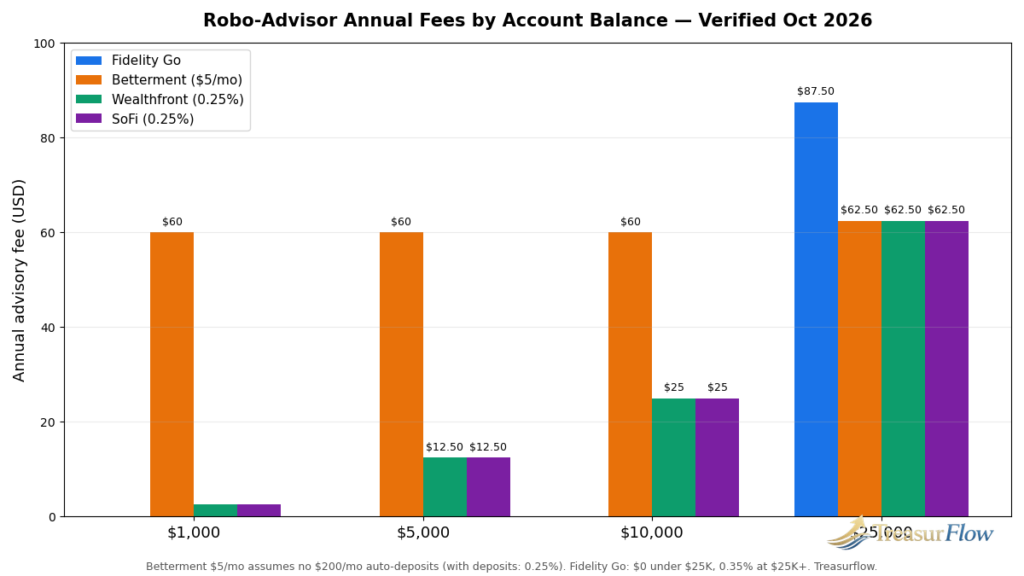
Three takeaways jump out:
- Under $25,000, Fidelity Go wins outright. Zero is zero — nobody beats it.
- Betterment’s $5/month is punishing on small balances — $60 a year on $1,000 is a 6% drag. Set up the $200/month auto-deposit and it becomes one of the cheapest.
- At $25,000, the crown flips. Fidelity’s 0.35% ($87.50) costs more than everyone else’s 0.25% ($62.50). That is the moment to reconsider.
The “Free” Trap Most Beginners Miss: Cash Drag
A quick warning before you chase the lowest headline fee. Some robo-advisors advertise a $0 advisory fee but keep a chunk of your portfolio in cash — sometimes a large chunk. Cash earns less than invested assets, so in a rising market that idle cash can quietly cost you more than a 0.25% fee on a fully invested portfolio. The industry calls this cash drag.
The fix is simple: compare the all-in cost — advisory fee plus underlying fund expenses plus any cash drag — not just the headline rate. Fidelity Go sidesteps this cleanly for small accounts because its $0 fee comes with fully invested Flex-fund portfolios, not a cash-heavy model. Whenever a platform looks suspiciously free, ask where it makes its money.
How to Pick the Right Robo-Advisor in 2026
Starting with under $1,000? Fidelity Go ($10 to invest, $0 fees) or SoFi ($50 minimum, 0.25%). Wealthfront’s $500 minimum rules it out at the very bottom.
Starting with $1,000–$25,000? Fidelity Go is the fee winner. If you prefer Betterment’s goal-planning tools, commit to $200/month in auto-deposits to unlock its 0.25% rate.
Sitting near $25,000? Compare Fidelity Go’s 0.35% against 0.25% elsewhere — that 0.10% gap is $25 a year per $25,000, every year, compounding.
Want human advice? Betterment Premium ($100K+, 0.65%) or Fidelity Go’s free coaching at $25K+. SoFi’s free 30-minute planner session is the best no-minimum option.
Investing for a child’s college? Wealthfront’s 529 support stands out on this list.
Already a Schwab customer? Check Schwab Intelligent Portfolios on schwab.com — consolidation has real value, just verify pricing first.
Whatever you choose, remember the golden rule of beginner investing: the best robo-advisor is the one you actually fund consistently. A 0.25% fee on money you invest every month beats a $0 fee on an account you never feed.
Robo-Advisor Questions
What is a robo-advisor and how does it work?
A robo-advisor is an automated investing service. You answer questions about your goals, timeline, and risk tolerance, and the software builds you a diversified portfolio of low-cost funds, then manages it — rebalancing when markets drift, reinvesting dividends, and sometimes harvesting tax losses. You deposit money; the algorithm handles the day-to-day decisions for a fraction of what a human advisor charges.
How much do robo-advisors charge in 2026?
Most charge 0.25% of your balance per year — that is $25 a year on $10,000. Fidelity Go charges $0 under $25,000, then 0.35%. Betterment charges $5 a month (or 0.25% with $200/month in auto-deposits or a $24,000 balance). Wealthfront and SoFi both charge a flat 0.25%. Always add underlying fund expenses to get your true all-in cost.
What is the cheapest robo-advisor for beginners?
For balances under $25,000, Fidelity Go — it charges $0 in advisory fees with just $10 needed to start investing. Above $25,000, Betterment (with auto-deposits), Wealthfront, and SoFi tie at 0.25% per year, which undercuts Fidelity Go’s 0.35%.
How much money do I need to start with a robo-advisor?
It depends on the platform: Fidelity Go needs $10 to begin investing (no minimum to open), SoFi needs $50, Wealthfront needs $500, and Betterment has no minimum balance. Always confirm the current minimum on the provider’s official site before opening an account.
Is a $0-fee robo-advisor really free?
Not always. Some platforms advertise no advisory fee but hold a large portion of your portfolio in cash, and that idle cash can cost you more in missed returns than a small fee would — a phenomenon called cash drag. Compare the all-in cost (advisory fee plus fund expenses plus cash drag), not just the headline fee.
Betterment vs. Wealthfront: which is better for beginners?
Choose Betterment if you want goal-based planning tools and the option of human advisor access later — but set up $200/month in auto-deposits to avoid the $5/month fee on small balances. Choose Wealthfront if you want the simplest pricing (flat 0.25%, $500 minimum) with strong automated tax-loss harvesting and no fee homework.
Do robo-advisors do tax-loss harvesting?
Some do. Wealthfront includes automated tax-loss harvesting, and Betterment includes tax-saving technology. Fidelity Go offers tax-loss harvesting on taxable accounts once your balance reaches $25,000. SoFi does not advertise automatic tax-loss harvesting. Tax-loss harvesting matters most in taxable accounts — it does nothing inside an IRA.
Can you lose money with a robo-advisor?
Yes. A robo-advisor invests your money in the stock and bond markets, which go up and down. Automation does not remove market risk — as SoFi puts it on its own site, robo investing “includes risk of total loss of principal.” Only invest money you will not need in the next few years, and keep your emergency fund in a high-yield savings account instead.
Are robo-advisors safe?
Robo-advisors from established brokerages are regulated investment advisers, and your securities are typically protected by SIPC (Fidelity confirms SIPC membership on its site) if the brokerage fails — SIPC does not protect against market losses, only brokerage failure. Stick with well-known providers, enable two-factor authentication, and verify each provider’s protections on its official site.
When should I switch from a robo-advisor to a human advisor?
Consider it when your finances get complex — stock options, a business sale, estate planning, or retirement withdrawals. As a rough guide, Betterment’s Premium tier (0.65% at $100,000+) and Fidelity Go’s free coaching (at $25,000+) are the natural on-ramps on this list. Below that, a good robo-advisor plus a one-time planner session (like SoFi’s free 30-minute session) covers most beginners.
The Final Take
If you are starting small in 2026, Fidelity Go is the hardest pick to argue against: $10 to start, $0 in advisory fees under $25,000, from a firm Condor Capital named Best Overall Robo-Advisor. Automate your deposits, and when you approach $25,000, re-run the numbers — at that point Betterment, Wealthfront, and SoFi (all 0.25%) become cheaper than Fidelity’s 0.35%. If you would rather pick your own investments, compare the best online broker 2026.
The fee gap between the best and worst options here is small in dollars but enormous in habit. Pick one, set up automatic monthly deposits, and let compounding do the heavy lifting. Your future self will thank you for starting today instead of waiting until you feel “ready.”
Investing involves risk, including possible loss of principal. Fees and minimums were verified on each provider’s official website in October 2026 and can change — always confirm current terms before opening an account. This article is for educational purposes only and is not financial advice.
Some links on this page go to product or issuer pages. Treasurflow’s rankings are based on the criteria stated in each guide. See the About page for how the site is funded.

Muhammad Zakir is the founder of Treasurflow and the author of its personal finance guides. He researches consumer banking, credit, and personal loans, and every guide cites primary sources such as the CFPB, FDIC, FTC, and IRS. His content is educational and is not personalized financial advice.
1 thought on “Best Robo Advisors 2026: 5 Picks Ranked by Fees for Beginners”