
Travel points are exciting — but let’s be honest: you buy groceries every week and fill your gas tank every few days. You only fly a few times a year. That’s why this best cash back credit cards 2026 ranking is built around the spending you actually do: supermarkets, gas stations, streaming, and everyday purchases.
This guide ranks six standout cards by one clear measure — how much cash they put back in your pocket on grocery and gas spending — with every rewards rate, annual fee, and welcome offer verified directly on the card issuers’ official pages in October 2026. If you’d rather earn travel points than cash, our best travel rewards credit cards guide covers that side of the rewards world.
Related guides: Best Travel Rewards Credit Cards 2026 · Best Balance Transfer Credit Cards 2026 · No-Credit-Check Credit Cards 2026 · Best Checking Account Bonuses 2026 · Best High-Yield Savings Accounts 2026
Helpful official resources: Wells Fargo credit cards · Chase Freedom cards · Amex Blue Cash Preferred · Capital One Quicksilver · CFPB on credit card rewards programs
How We Compared: A Grocery-First Methodology
Most “best of” lists rank cards by headline rewards rates. We did something more practical: we ranked by effective yearly cash back on a realistic household budget — heavy on groceries ($6,000/year) and gas — because that’s where the average American family spends the most unavoidable money.
For each card we used the exact earn rates, caps, annual fees, and welcome bonuses published on the issuer’s official site, then calculated what a household spending $500 a month on groceries would actually earn. The chart below shows the result. Card offers change, so always confirm current terms on the issuer’s official page before applying.
Best Cash Back Credit Cards 2026: The 6 Picks at a Glance
| Card | Grocery earn rate | Gas earn rate | Annual fee | Welcome offer |
|---|---|---|---|---|
| Blue Cash Preferred® (Amex) | 6% at U.S. supermarkets (up to $6,000/yr, then 1%) | 3% at U.S. gas stations | $0 first year, then $95 | As high as $300 after $3,000 in 6 months* |
| Wells Fargo Active Cash® | 2% on all purchases | 2% on all purchases | $0 | $100 after $500 in 3 months |
| Chase Freedom Unlimited® | 1.5% on all purchases | 1.5% on all purchases | $0 | $200 after $500 in 3 months |
| Capital One Quicksilver | 1.5% on all purchases | 1.5% on all purchases | $0 | $200 after $500 in 3 months |
| Chase Freedom Flex® | 5% in quarterly categories (up to $1,500, activation required) | 5% when gas is the quarterly category | $0 | $250 after $500 in 3 months (limited-time) |
| Discover it® Cash Back | 5% in quarterly categories (up to $1,500, activation required) | 5% when gas is the quarterly category | $0 | Cashback Match: year-1 earnings matched |
*Welcome offers vary by applicant; check the official site for your offer.
1. Blue Cash Preferred® Card from American Express — Best for Groceries
If one category dominates your budget — groceries — no other card on this list comes close. The Blue Cash Preferred earns 6% cash back at U.S. supermarkets on up to $6,000 per year (then 1%), plus 6% on select U.S. streaming subscriptions, 3% at U.S. gas stations, 3% on transit, and 1% on everything else, according to American Express’s official card page.
The grocery math: a household spending $500 a month at the supermarket hits exactly $6,000 a year — earning $360 back at 6%. The card’s annual fee is $0 the first year and $95 after that, so even after the fee you’re keeping about $265 a year from groceries alone, before counting gas and streaming. The welcome offer is advertised as high as $300 cash back after spending $3,000 in the first 6 months, though Amex notes offers vary and you may not be eligible.
Watch out for: the 6% supermarket rate excludes warehouse clubs — Costco, Walmart, and Target typically don’t code as supermarkets, so those trips earn just 1%. The card also carries a 0% intro APR for 12 months on purchases and balance transfers, then a variable 19.74%–28.74% APR. Cardholders can also enroll for up to a $120 yearly Disney streaming credit ($10/month). Full details: Amex Blue Cash Preferred.
2. Wells Fargo Active Cash® Card — Best Flat-Rate Simplicity
Don’t want to think about categories, caps, or activation calendars? The Wells Fargo Active Cash pays an unlimited 2% cash rewards on every purchase with a $0 annual fee — the highest flat rate among no-annual-fee cards on this list. New cardholders can earn a $100 cash rewards bonus after spending $500 in the first 3 months.
The grocery math: that same $6,000 a year in groceries earns $120 back — no caps, no activation, no supermarket exclusions to memorize. It also includes a 0% intro APR for 12 months on purchases and qualifying balance transfers (transfers made within 120 days qualify), after which a 18.49%, 24.49%, or 28.49% variable APR applies. If you’re carrying a balance you’d like to pause interest on, our balance-transfer guide compares longer 0% windows. Full details: Wells Fargo credit cards.
3. Chase Freedom Unlimited® — Best All-Around Flexibility
The Freedom Unlimited is the “one card that does a bit of everything” pick: unlimited 1.5% cash back on all purchases, 3% on dining and drugstores, and 5% on travel purchased through Chase Travel, with a $0 annual fee. New cardmembers earn a $200 bonus after spending $500 in the first 3 months, and the card offers 0% intro APR for 15 months on purchases and balance transfers (then 18.49%–27.99% variable).
The grocery math: $6,000 a year in groceries at 1.5% earns $90 — less than the flat 2% cards, but the 3% dining and drugstore categories plus the $200 bonus close the gap for many households in year one. It also plugs into Chase Ultimate Rewards, so if you later add a travel card, your cash back can convert — see how that ecosystem works in our travel rewards guide. Full details: Chase Freedom cards.
4. Capital One Quicksilver Cash Rewards — Best Simple Card With Travel Perks
Quicksilver mirrors the Freedom Unlimited’s simplicity: unlimited 1.5% cash back on every purchase, $0 annual fee, and a $200 one-time cash bonus after spending $500 within 3 months. Two extras set it apart: no foreign transaction fees (rare at this price point) and 5% back on hotels and rental cars booked through Capital One Travel. The intro offer is 0% APR for 15 months on purchases and balance transfers, then 18.74%–28.74% variable.
The grocery math: identical to Freedom Unlimited — $90 on $6,000 of grocery spend. Choose Quicksilver if you want the occasional international trip without foreign transaction fees; choose Freedom Unlimited if dining and drugstores dominate your non-grocery spending. Full details: Capital One Quicksilver.
5. Chase Freedom Flex® — Best Rotating Categories
For households willing to do a tiny bit of homework, the Freedom Flex pays 5% cash back on up to $1,500 in combined purchases each quarter in rotating bonus categories (activation required each quarter), plus 5% on travel through Chase Travel, 3% on dining and drugstores, and 1% on everything else. The current new-cardmember offer is a $250 bonus after spending $500 in the first 3 months (advertised as limited-time), with 0% intro APR for 15 months and then 18.49%–27.99% variable. No annual fee.
The grocery math: grocery stores appear as a 5% quarterly category several times a year. In a quarter when they do, $1,500 of grocery spending earns $75 — but only in that quarter, and only if you remembered to activate. Pair it with a flat-rate card for the other three quarters and you get the best of both worlds. Full details: Chase Freedom cards.
6. Discover it® Cash Back — Best First-Year Value
Discover’s signature card works like the Freedom Flex — 5% in rotating quarterly categories on up to $1,500 (activation required), 1% on everything else, $0 annual fee — but its welcome offer is unlike anything else on this list: Cashback Match. At the end of your first year, Discover automatically matches every dollar of cash back you earned. Earn $300, get $300 more. There is no cap on the match.
The grocery math: maxing a grocery quarter ($1,500 × 5% = $75) across four quarters is $300 a year — and the first-year match doubles it to an effective $600. The card also offers 0% intro APR for 15 months on purchases and balance transfers (then a variable APR; check Discover’s official site for current rates). The catch is the same as the Flex: you must activate categories quarterly, and groceries only earn 5% in quarters when they’re featured. (Rates cross-verified via Bankrate, Motley Fool, and CardRatings; confirm current terms on Discover’s official site.)
Grocery Math: What $6,000 a Year Earns You
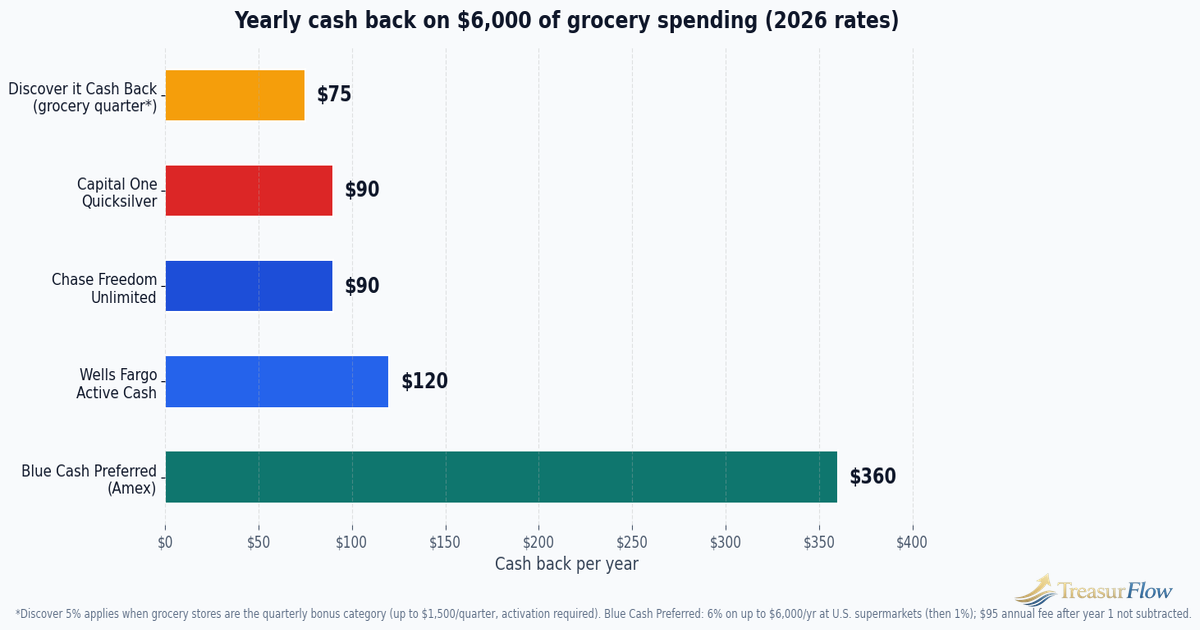
The chart uses each card’s published 2026 earn rate applied to $6,000 of annual grocery spending. Two honest caveats: the Blue Cash Preferred figure doesn’t subtract the $95 annual fee (it still wins by a wide margin), and Discover’s 5% only applies in quarters when grocery stores are the featured category.
5 Cash-Back Mistakes That Cost You
- Carrying a balance. A 25% APR wipes out a 6% reward in about three months. Cash back cards only make sense if you pay in full monthly — envelope budgeting makes that habit easier to keep.
- Ignoring the supermarket fine print. Warehouse clubs and superstores often don’t code as “supermarkets” — your 6% can quietly become 1%.
- Forgetting quarterly activation. Freedom Flex and Discover pay 5% only after you activate each quarter. Set a calendar reminder.
- Chasing a bonus you can’t reach. A $300 bonus requiring $3,000 in 6 months is only free money if that was your normal spending anyway.
- Letting rewards sit unredeemed. The CFPB has flagged that issuers can change rewards programs and that unredeemed rewards can vanish if an account closes — redeem regularly rather than hoarding. (See the CFPB’s circular on credit card rewards programs.)
Flat-Rate vs. Bonus Categories: Which Wins?
It depends on how much effort you’ll actually put in:
- Flat-rate cards (Active Cash 2%, Freedom Unlimited/Quicksilver 1.5%) win for set-it-and-forget-it households. You earn on every swipe with zero calendar-watching.
- Category cards (Blue Cash Preferred 6% groceries, Freedom Flex/Discover 5% rotating) win on raw yield — but only if your spending lines up with the categories and you activate quarterly bonuses.
The highest-earning real-world setup is a two-card combo: Blue Cash Preferred for groceries and gas, plus a flat 2% card for everything else. If you’re still building credit and these cards feel out of reach, our no-credit-check credit cards guide covers starting points that don’t require a hard inquiry.
Cash-Back Questions
What is the best cash back credit card in 2026?
For grocery-heavy households, the Blue Cash Preferred (6% at U.S. supermarkets up to $6,000/year) earns the most. For simplicity, the Wells Fargo Active Cash (unlimited 2% on everything, $0 annual fee) is the best flat-rate pick.
Which cash back card is best for groceries?
The Blue Cash Preferred earns 6% at U.S. supermarkets on up to $6,000 per year (then 1%) — the highest grocery rate among major cash back cards. Just note warehouse clubs like Costco and Walmart typically don’t count as supermarkets.
Is the Blue Cash Preferred worth the $95 annual fee?
If you spend roughly $175+ a month at U.S. supermarkets, the extra 4.5% over a 1.5% flat-rate card covers the $95 fee — and the fee is $0 the first year, so you can test it risk-free.
What is Discover’s Cashback Match?
Discover automatically matches all the cash back you earn during your first year as a new cardholder, with no cap. If you earn $300, you get another $300 at the end of year one.
Flat-rate or rotating categories — which earns more?
Rotating 5% categories earn more per dollar but only in featured quarters and only up to $1,500 per quarter (activation required). Flat-rate cards earn less per dollar but on everything, with zero effort. Most maximizers carry one of each.
Do cash back rewards expire?
It depends on the issuer — many rewards don’t expire as long as your account stays open and in good standing, but the CFPB notes rewards can be lost if an account closes. Check your card’s terms and redeem regularly.
Can I have two cash back credit cards?
Yes. A common strategy is pairing a 6% grocery card (Blue Cash Preferred) with a flat 2% card (Wells Fargo Active Cash) for everything else. Only apply if you can manage both responsibly and pay in full.
What’s the difference between Chase Freedom Unlimited and Freedom Flex?
Freedom Unlimited pays a flat 1.5% on all purchases with no activation needed. Freedom Flex pays 5% in rotating quarterly categories (up to $1,500, activation required) plus 1% elsewhere. Both have no annual fee and a 0% intro APR for 15 months.
What credit score do I need for these cash back cards?
Most of these cards are aimed at applicants with good to excellent credit. If you’re unsure where you stand, use the issuer’s free pre-qualification tool — it won’t affect your credit score.
How do cash back redemptions work?
Most issuers let you redeem as a statement credit, direct deposit to a bank account, or check. Some, like American Express, issue Reward Dollars redeemable as statement credits or at Amazon checkout. Options and minimums vary by issuer.
Start Earning
The best cash back credit card of 2026 isn’t the one with the flashiest headline rate — it’s the one that matches your grocery cart. Big supermarket spenders should grab the Blue Cash Preferred’s 6%; everyone else should keep it simple with the Wells Fargo Active Cash’s flat 2% or the Freedom Unlimited’s flexible 1.5%. Whichever you choose, verify the current offer on the issuer’s official page, pay your balance in full, and put your rewards somewhere they grow — like one of the high-yield savings accounts or bonus-paying checking accounts we’ve ranked.
Content on Treasurflow is for educational purposes only and is not financial advice. Card terms change — always confirm rates, fees, and offers on the issuer’s official site before applying.
Some links on this page go to product or issuer pages. Treasurflow’s rankings are based on the criteria stated in each guide. See the About page for how the site is funded.

Muhammad Zakir is the founder of Treasurflow and the author of its personal finance guides. He researches consumer banking, credit, and personal loans, and every guide cites primary sources such as the CFPB, FDIC, FTC, and IRS. His content is educational and is not personalized financial advice.
1 thought on “Best Cash Back Credit Cards 2026: 6 Picks Ranked for Groceries, Gas & Everyday Spending”